How to Store Your Weed: Stop Killing Your Terpenes
Learn the science-backed way to store cannabis that preserves terpenes, prevents mold, and keeps your flower fresh for up to a year.

Head Cultivator
On this page
The way you store your cannabis matters more than most people realize. Keep it wrong, and you're literally watching your terpenes evaporate into thin air—taking flavor, aroma, and effects with them. Get it right, and your flower stays fresh, potent, and enjoyable for up to a full year.
This guide breaks down the science of cannabis storage in plain terms. Whether you're storing a single eighth or building a personal collection, these principles protect your investment and your experience. No fancy equipment required—just understanding four key factors: temperature, humidity, light, and air.
If you've ever opened a jar and wondered "why doesn't this smell like it used to?"—terpenes were the first casualty of improper storage. The good news: preventing that loss is simple once you know what to avoid. This article covers everything from the $3 Mason jar solution to recognizing when your cannabis has crossed the line from "past prime" to "potentially unsafe."
Why Storage Matters: The Science of Terpene Loss #
Improperly stored cannabis can lose 30–50% of its terpenes within six months, with extreme cases seeing up to 99% terpene loss after just 24 hours of direct light exposure. These aromatic compounds aren't just responsible for smell—they work with cannabinoids to shape your experience through what's called the entourage effect.
How Terpenes Degrade #
Terpenes are volatile organic compounds, meaning they evaporate easily when exposed to heat, air, light, or improper humidity. Research from Terpene Belt Farms shows that monoterpenes like myrcene (the mango-smelling terpene that makes you sleepy), limonene (citrus aroma, mood-lifting), and pinene (pine scent, alertness) are the most fragile. They start evaporating at temperatures as low as 70°F.
Sesquiterpenes such as caryophyllene (peppery, anti-inflammatory) and humulene (earthy, appetite-suppressing) are somewhat more stable, but they still degrade without proper storage conditions.
Why terpenes matter beyond smell: Terpenes don't just make cannabis smell good—they actively shape your experience. Myrcene helps THC cross the blood-brain barrier faster, potentially intensifying effects. Limonene interacts with serotonin receptors, contributing to mood elevation. Caryophyllene is the only terpene known to directly activate CB2 receptors, providing anti-inflammatory benefits. When you lose terpenes, you're not just losing flavor—you're losing part of the therapeutic and experiential profile.
The four enemies of terpenes:
| Factor | How It Hurts Terpenes | What Happens |
|---|---|---|
| Heat | Increases evaporation rate | Terpenes turn to vapor and escape |
| Light/UV | Breaks molecular bonds | Chemical structure degrades |
| Air/Oxygen | Oxidation | Terpenes change into different compounds |
| Low Humidity | Dries trichomes | Terpenes trapped in brittle resin glands break off |
The good news? Proper storage can preserve 70–90% of terpenes for a full year.
The Goldilocks Zone: Ideal Temperature and Humidity #
Store cannabis at 60–70°F (15–21°C) with 59–63% relative humidity for optimal preservation. This range keeps terpenes stable while preventing mold growth.
Temperature Guidelines #
Think of cannabis storage like storing a good bottle of wine—not freezing cold, not hot, but consistently cool. Temperature spikes above 80°F cause noticeable changes in aroma within hours. Here's what happens at different temperatures:
| Temperature Range | Effect on Cannabis | Recommendation |
|---|---|---|
| Below 50°F | Risk of condensation, brittle trichomes | Use only with sealed glass |
| 60–70°F | Optimal preservation, stable terpenes | Ideal for home storage |
| 75–85°F | Accelerated terpene loss (30–50% in 6 months) | Avoid warm rooms, cars, appliances |
| Above 90°F | Rapid degradation, harsh taste | Never store near heat sources |
Finding your home's sweet spot: Walk through your living space with a thermometer. Check closets, cabinets, and drawers at different times of day. You're looking for spots that stay consistently between 60–70°F year-round—interior closets often work best, while exterior walls, attics, garages, and areas near appliances usually run too warm or fluctuate too much.
Humidity: The 59–63% Sweet Spot #
Relative humidity (RH) is the amount of moisture in the air compared to what it could hold at that temperature. For cannabis flower, 59–63% RH is the narrow sweet spot that preserves terpenes without encouraging mold.
According to medical cannabis storage guidelines, the broader acceptable range is 55–65% RH:
- Below 55% RH: Buds dry out, trichomes become brittle, terpenes evaporate faster
- 55–58% RH: Good for long-term storage, slightly drier flower
- 59–63% RH: Optimal preservation of terpenes and cannabinoids
- 65–70% RH: Higher mold risk, especially above 70°F
- Above 70% RH: Significant mold and mildew risk
The relationship between temperature and humidity is critical. Warm, humid air holds more moisture and creates perfect conditions for mold. That's why a closet at 70°F with 65% humidity is riskier than a basement at 65°F with the same humidity level.
Southeast Michigan makes that relationship seasonal. NWS Detroit/Pontiac climate normals show warm, wet summers around Detroit (July average highs near the mid-80s°F with several inches of monthly precipitation), while winters bring cold outdoor air that turns bone-dry once furnace heat runs indoors. Your jar doesn't care about the outdoor average — it cares about the air that actually sits around your stash. In a Detroit-area apartment or house, that often means fighting summer humidity creep (mold risk if you leave lids loose or skip humidity packs) and winter over-drying (brittle trichomes and flat aroma when heated indoor air pulls moisture from flower). Keep the 59–63% RH target year-round; just expect to check packs more often when seasons flip.
Best Containers for Cannabis Storage #
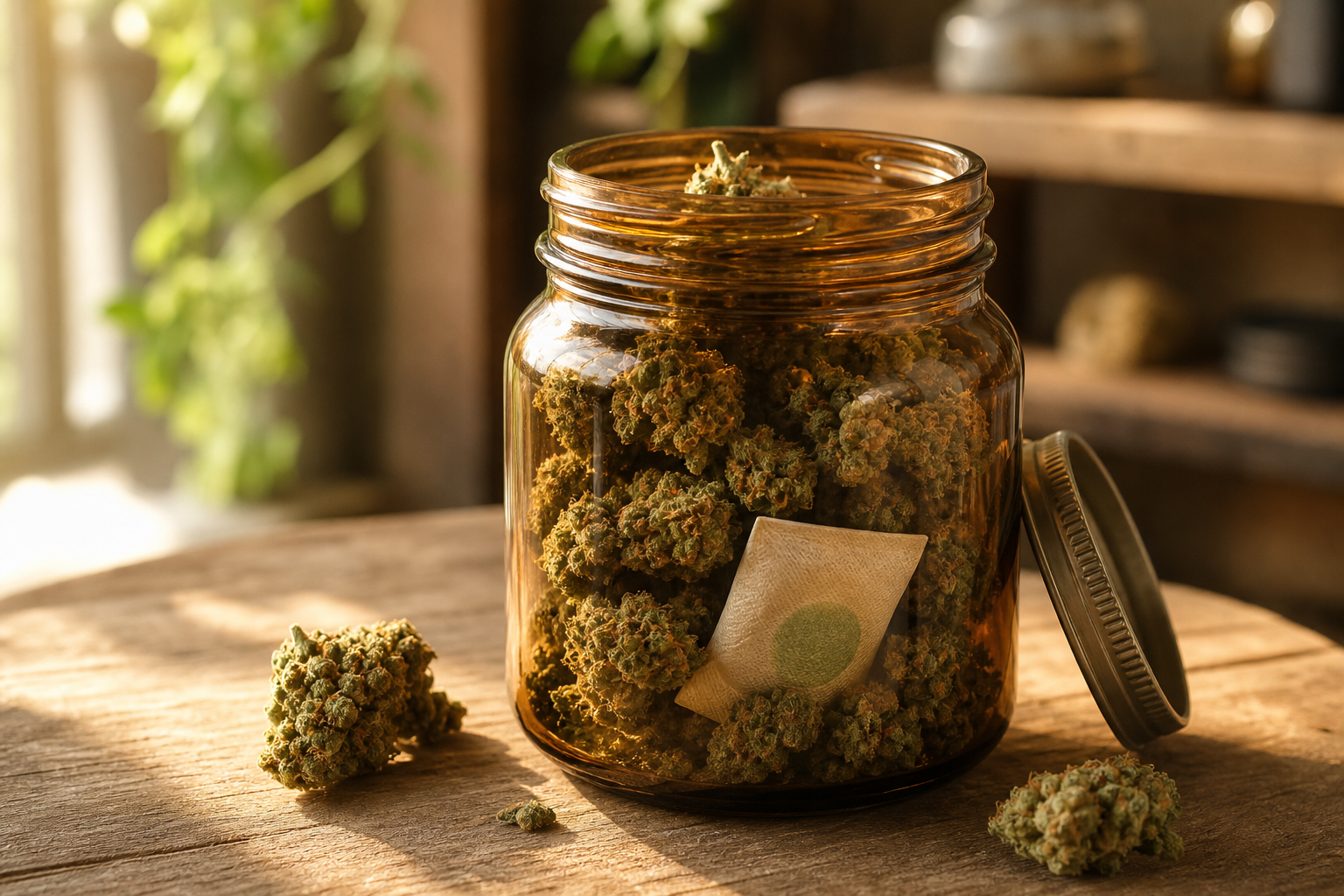
Airtight, opaque or UV-protected glass containers are the gold standard for cannabis storage. Glass is chemically inert—it won't react with terpenes or cannabinoids—and amber or violet glass blocks harmful light.
Material Comparison #
| Material | Best For | Pros | Cons |
|---|---|---|---|
| UV-protected glass | Long-term home storage | Inert, airtight, blocks UV light | Breakable, clear glass offers no protection |
| Stainless steel | Travel, bright environments | Blocks 100% of light, durable, discreet | Can't see contents, seal quality varies |
| Ceramic | Aesthetic storage, medium-term | Inert, opaque, temperature-stable | Heavy, can chip or crack |
| Clear glass | Short-term only | Inert, airtight options common | Zero light protection |
| Plastic | Emergency transport only | Lightweight, unbreakable | Can absorb odors, static pulls trichomes, may interact with terpenes |
Mason jars with amber glass and two-piece lids are widely recommended because they create a true airtight seal. The key features to look for:
- Airtight seal: Prevents oxygen exchange that oxidizes terpenes—look for two-piece metal lids with rubber gaskets or silicone-sealed closures
- Light blocking: Amber, violet, cobalt, or opaque containers—clear glass offers almost no UV protection
- Right size: Match container to amount—less headspace means less oxygen exposure and more stable humidity
- Humidity compatibility: Wide mouth for adding humidity packs and easy access without squeezing buds
- Inert material: Glass, ceramic, or food-grade stainless steel—avoid reactive metals or plastics
Test your seal: Close the container, then try to open it. You should hear a distinct "pop" or suction sound as air rushes in. If it opens silently, the seal isn't airtight enough for long-term storage.
Plastic bags and containers are the worst choice for anything beyond a few days. Plastic can create static electricity that pulls trichomes off your buds, and some plastics absorb terpene aromas or leach chemicals over time. Have you ever noticed how a plastic-bagged strain starts smelling like plastic after a week? That's the material interacting with your terpenes.
Fix: Transfer to glass within 24–48 hours of purchase. If you get flower in a plastic container from a dispensary, treat it like a to-go coffee cup—temporary convenience, not long-term storage. Michigan dispensaries and many Detroit-area head shops stock amber jars and two-way humidity packs — grab them on the same trip if your home setup is still plastic bags and hope.
When you're moving product by car, Michigan law also cares about the container. Under MCL 750.474, usable marihuana in a motor vehicle must be enclosed in a case carried in the trunk, or — if the vehicle has no trunk — in a case that is not readily accessible from the interior. A sealed jar in the trunk beats an open bag on the passenger seat for both freshness and compliance.
Size Matters #
Don't store a gram of flower in a quart jar. The empty space (headspace) contains oxygen that slowly degrades your cannabis. Choose a container that fits your stash with minimal empty space, or use multiple smaller jars instead of one giant one.
Container size guide:
| Stash Amount | Ideal Jar Size | Why |
|---|---|---|
| 1–3.5 grams | 4 oz jar | Minimal headspace, portable |
| 7 grams (¼ oz) | 8 oz jar | Good fit for quarter ounces |
| 14 grams (½ oz) | 16 oz jar | Standard mason jar size |
| 28+ grams (1 oz+) | Multiple 8 oz jars | Divides large amounts, reduces opening frequency |
When you open a large jar less often, you preserve the unopened portions better. Many experienced consumers keep a "daily jar" (small, opened frequently) and a "storage jar" (larger, opened rarely) for the same strain.
Humidity Packs: Boveda vs Integra Explained #
Humidity packs are two-way controllers that add moisture when air is too dry and absorb moisture when air is too humid. They maintain a stable RH automatically, making them a "set and forget" solution for cannabis storage.
How They Work #
Both Boveda and Integra Boost use permeable membranes containing solutions that release or absorb water vapor to maintain target humidity:
- Boveda uses a salt-based saturated solution
- Integra Boost uses a plant-based glycerin formula
Side-by-side testing shows both brands perform nearly identically, stabilizing within 1% of their target RH after 2–3 days.
Choosing Your RH Level #
| RH Level | Best For | Notes |
|---|---|---|
| 55% | Long-term storage (6+ months), drier preference | Lower mold risk, preserves structure |
| 58% | Balanced preservation | Good all-around choice |
| 62% | Curing fresh flower, softer buds | Most common recommendation |
Most consumers do well with 58% or 62% RH packs. If you're storing flower for many months or prefer slightly drier buds, 55% is the safer choice. For freshly cured flower that you want to keep soft, 62% works well. In Michigan winters, when furnace heat can drop indoor RH well below the jar target, a fresh 62% pack is often the difference between sticky flower and dusty crumble. In humid Great Lakes summers, the same pack absorbs excess moisture so your buds don't tip toward mold territory.
Usage Tips #
- One pack per jar is usually sufficient
- Replace when packs harden completely (typically 2–4 months)
- Store unused packs in original packaging—they activate when exposed to air
- Don't use multiple different RH levels in the same container
The Seven Deadly Sins of Cannabis Storage #
These are the most common mistakes that ruin cannabis quality, ranked by how quickly they damage your flower.
1. Storing in Direct Light (Fastest Damage) #
Leaving clear jars on windowsills or under bright lights can cause 99% terpene loss in just 24 hours. UV light breaks terpene molecules apart, permanently destroying aroma and modifying effects.
Fix: Use opaque or amber containers. Store in drawers, cabinets, or closets.
2. Heat Exposure (Hours to Days) #
Cars, windowsills, top of refrigerators, near radiators—any warm spot accelerates terpene evaporation. Temperatures above 80°F cause noticeable changes within hours.
Fix: Choose the coolest, most stable spot in your home. Avoid exterior walls if possible.
3. Air Exposure (Days to Weeks) #
Loose lids, non-airtight containers, or constantly opening your stash lets oxygen in. Oxidation turns terpenes stale and eventually converts THC to CBN (the sleepy cannabinoid), changing the experience.
Fix: Invest in containers with quality seals. Don't leave lids off "just for a minute."
4. Refrigerator or Freezer Storage (Risky) #
While cold temperatures slow chemical reactions, refrigerators create humidity and temperature swings every time you open the door. Freezers make trichomes brittle—they can break off when handled.
If you must use cold storage:
- Use only fully airtight glass containers
- Freeze only fully dried, cured flower
- Let the sealed container thaw completely before opening (prevents condensation)
- Never refreeze after thawing
For most consumers, cool room-temperature storage beats refrigeration.
5. Plastic Bags and Containers (Weeks) #
That plastic baggie from the dispensary? It's actively hurting your cannabis. Static electricity pulls trichomes off buds. Plastic can absorb terpene aromas. Some plastics may interact chemically with cannabinoids over time.
Fix: Transfer to glass within 24–48 hours of purchase.
6. Improper Humidity (Weeks to Months) #
Too dry = harsh smoke, lost terpenes, brittle buds. Too humid = mold risk. Both ruin the experience and can make cannabis unsafe to consume.
Fix: Use a hygrometer (humidity meter) in your storage area. Add humidity packs for long-term storage.
7. Frequent Handling and Reopening #
Every time you open the container, fresh oxygen enters and terpenes escape. Opening twice daily instead of once weekly adds up to hundreds of extra air exchanges per year.
Fix: Use multiple small containers instead of one large one. Take out what you need for the week, store the rest sealed.
How Long Does Cannabis Stay Fresh? #
Properly stored cannabis flower maintains quality for 6 months to 1 year. After that point, you'll notice gradual decline in aroma, flavor, and potency, though it remains safe to consume if no mold is present.
Signs Your Cannabis Is Degrading #
| Sign | What It Means | Still Usable? |
|---|---|---|
| Loss of aroma | Terpenes evaporating | Yes, but less enjoyable |
| Dry, crumbly texture | Over-dried, brittle trichomes | Yes, harsh smoke |
| Brown or dull color | Oxidation, aging | Yes, likely less potent |
| Harsh taste when smoked | Degraded terpenes, possible oxidation | Yes, unpleasant |
| Stale or hay-like smell | Advanced terpene loss | Yes, weak effects |
| White/gray fuzzy spots | Mold contamination | No—discard immediately |
| Black or dark gray spots | Advanced mold or bud rot | No—discard immediately |
| Musty, basement odor | Mold or mildew present | No—discard immediately |
When in doubt, throw it out. Mold on cannabis isn't like mold on cheese—you can't cut away the bad part and safely consume the rest. Mold sends microscopic roots (mycelium) throughout the entire bud, and some molds produce mycotoxins that can cause respiratory issues even after heating. If you see any fuzz, white powder that isn't trichomes, or smell anything musty or ammonia-like, it's not worth risking your health.
According to Healthline's cannabis storage research, the timeline varies significantly based on strain, initial quality, and storage conditions. High-terpene strains tend to show degradation faster because they have more to lose.
Maximizing Shelf Life #
For the longest-lasting cannabis:
- Use airtight, UV-protected glass
- Maintain 58–62% RH with humidity packs
- Store at stable 65–68°F
- Open containers minimally
- Check periodically for mold (especially in humid climates)
Even with perfect storage, plan to consume or replace your flower within a year for the best experience.
Troubleshooting Common Storage Problems #
Problem: My cannabis got too dry and crumbles to dust.
Solution: Add a 62% RH humidity pack and wait 3–7 days. For faster results, place a small piece of fresh citrus peel or lettuce leaf in the container for 12–24 hours (remove immediately to prevent mold). The texture will improve, though some terpene loss is permanent.
Problem: I see condensation inside my jar.
Solution: Remove the cannabis immediately and spread it on a clean surface to air dry for 30–60 minutes. Check your humidity pack—if it feels saturated or swollen, replace it. Ensure your storage location has stable temperature (not near heat sources or exterior walls).
Problem: My cannabis smells like the container (plastic, metal, or wood).
Solution: Transfer to inert glass immediately. The odor transfer means the material is interacting with your terpenes. Some aroma may remain, but halting further exposure prevents additional flavor contamination.
Problem: I forgot about cannabis in my drawer for 2+ years.
Solution: Check thoroughly for mold (any fuzz, white/gray/black spots, or musty smell). If mold-free, it may still produce effects but will have degraded significantly. Use for edibles where precise terpene preservation matters less than in smoking. If harsh when smoked, consider making cannabutter.
Problem: My humidity pack hardened after just 2 weeks.
Solution: This usually indicates extremely dry cannabis that absorbed all available moisture. Replace with a fresh pack. Consider using a larger humidity pack size for very dry flower. Multiple small packs work better than one undersized pack.
Quick-Start Storage Setup #
Get properly set up in one shopping trip with this practical system.
Essential Supplies #
| Item | Purpose | Approximate Cost |
|---|---|---|
| Amber glass Mason jars (4–8 oz) | Primary storage | $2–4 each |
| Humidity packs (58% or 62% RH) | Moisture control | $1–2 each |
| Small hygrometer | Monitor humidity | $5–10 |
| Labels and marker | Track strains and dates | $3 |
Step-by-Step Setup #
- Transfer your cannabis from dispensary containers to amber glass jars within 24–48 hours
- Add one humidity pack per jar (match jar size to pack rating)
- Seal tightly and store in a cool, dark closet or drawer
- Label with strain name and purchase date
- Check monthly—look for mold, smell for freshness
Pro tip: When transferring, handle buds minimally. The trichomes on the surface contain most of the terpenes and cannabinoids. Every touch knocks some off. Use the original container to gently pour into the jar rather than handling individual buds.
Where to store in your home:
- Best: Interior closet on a middle shelf (stable temperature, dark)
- Good: Kitchen cabinet away from appliances (avoid heat from fridge/oven)
- Avoid: Bathroom (humidity fluctuations), garage (temperature swings), near windows (light), top of refrigerator (heat rises)
Quick temperature check: Leave a thermometer in your chosen storage spot for 24 hours, checking morning and evening. If it swings more than 5°F between readings, find a more stable location. Consistency matters more than hitting an exact degree.
Upgrade Options #
- Stainless steel canisters for travel or bright environments—blocks 100% of light, dent-resistant, discreet appearance
- Vacuum-sealed bags for very long-term storage (6+ months)—removes oxygen completely, ideal for large harvests
- Cannabis humidors with built-in hygrometers—wood-lined containers designed specifically for cannabis, often with temperature monitoring
- Refrigerated storage for concentrates (not flower)—live resin, rosin, and other extracts preserve better cold
- Hygrometer jars with built-in digital displays—know your exact humidity at a glance
- UV-blocking storage boxes for multiple jars—protects your entire collection from light exposure
Most consumers never need upgrades beyond basic amber jars and humidity packs. Start simple, add complexity only if you have specific needs (frequent travel, massive collections, or professional storage requirements).
Related Divine Toke Reading #
Want to dive deeper into terpenes and storage? Check out our complete guide to cannabis storage for advanced techniques, or learn more about what terpenes actually are and how they work to understand why preserving them matters so much. If you're curious about why sun-grown organic cannabis tends to have richer terpene profiles in the first place, read our comparison of sun-grown vs indoor cannabis.
FAQ: Common Cannabis Storage Questions #
Q: What is the best humidity level for storing cannabis? #
A: 59–63% relative humidity is the sweet spot for preserving terpenes while preventing mold. The broader acceptable range is 55–65% RH. Use 55–58% for long-term storage and 62% if you prefer slightly softer buds.
Q: Can I store cannabis in the refrigerator or freezer? #
A: It's generally not recommended for flower. Refrigerators create temperature and humidity fluctuations that can encourage mold. Freezers make trichomes brittle and prone to breaking off. If you must use cold storage, use airtight glass only, let sealed containers thaw completely before opening, and never refreeze. Cool, dark room-temperature storage (60–70°F) is safer for most consumers.
Q: How long does cannabis stay fresh when stored properly? #
A: 6 months to 1 year when stored in airtight, UV-protected containers at 60–70°F with 58–62% humidity. After a year, you'll notice gradual decline in aroma and potency, though it remains safe if no mold is present.
Q: Is it okay to store cannabis in plastic bags? #
A: Only for very short-term transport (24–48 hours). Plastic creates static that pulls trichomes off your buds, can absorb terpene aromas, and may interact with cannabinoids over time. Transfer to glass as soon as possible.
Q: What temperature should I keep my cannabis at? #
A: 60–70°F (15–21°C) is ideal. Avoid anything above 75°F—heat accelerates terpene loss and can make smoke harsh. Temperatures below 50°F risk condensation and brittle trichomes unless using carefully sealed glass containers.
Q: How do I know if my cannabis has gone bad? #
A: Look for these signs: Loss of smell (terpenes gone), dry crumbly texture (over-dried), brown or dull color (oxidized), harsh taste (degraded), or white/gray fuzzy spots (mold). Moldy cannabis should be discarded immediately—don't risk your health.
Q: Do I need humidity packs for my cannabis? #
A: For storage longer than 2–3 weeks, yes. Humidity packs maintain stable moisture levels automatically, preventing the over-drying that destroys terpenes. They're inexpensive ($1–2 each) and last 2–4 months. Essential for anyone storing more than a week's supply — especially in Detroit-area homes that swing from humid summer air to dry winter heat.
Q: What's the difference between Boveda and Integra Boost? #
A: Both are two-way humidity controllers that work nearly identically. Boveda uses salt-based solutions; Integra uses plant-based glycerin. Independent testing shows both stabilize within 1% of target RH. Choose based on availability and price—they're functionally equivalent.
Q: Can I rehydrate cannabis that has gotten too dry? #
A: Yes, but it won't fully restore lost terpenes. Place a humidity pack (62% RH) in the container for 3–7 days. You can also use a small piece of citrus peel or lettuce leaf for 12–24 hours (remove immediately to prevent mold). The texture improves, but some aroma is gone forever.
Q: Does storing cannabis in the dark really matter? #
A: Absolutely. Light exposure causes 99% terpene loss in 24 hours at high intensity, and even normal indoor light degrades quality over weeks. UV light breaks terpene molecules apart. Opaque or amber containers in drawers/closets are essential.
Q: Should I store different strains separately? #
A: Yes. Strong-smelling strains can transfer aroma to milder ones when stored together—a phenomenon called "terpene bleeding." Each strain maintains its unique profile better in separate containers. Plus, you can customize humidity levels if needed.
Imagine storing a powerful Garlic Cookies next to a subtle Blue Dream. After two weeks, that Blue Dream might carry hints of garlic that weren't there before. Separate containers preserve each strain's intended experience.
Q: Can I store cannabis with cigars or tobacco? #
A: Don't. Tobacco and cigars require much higher humidity (65–72% RH) that encourages mold in cannabis. They also transfer strong flavors and aromas. Keep cannabis in its own dedicated containers at 58–62% RH.
Tobacco humidors are designed for completely different moisture levels. Using them for cannabis is like storing bread in a fruit crisper—it creates conditions for spoilage.
Q: Is vacuum sealing good for cannabis storage? #
A: Excellent for long-term storage (6+ months). Vacuum sealing removes oxygen that causes oxidation and terpene degradation. However, use a gentle setting—aggressive vacuuming can compress and damage buds. Best paired with humidity packs inside the sealed bag.
Vacuum sealing works particularly well for:
- Large harvests you won't consume within 6 months
- Backup emergency supply
- Travel where space is limited
- Preventing odor escape (though compliance with local laws is always essential)
The key is including a humidity pack inside the vacuum bag so moisture levels stay optimal even when the bag is sealed tight.
Closing Thoughts #
Storing cannabis properly isn't complicated, but it does require attention to four simple factors: cool temperature, stable humidity, darkness, and airtight containers. Get these right, and your flower rewards you with full flavor, aroma, and effects for months.
Think of good storage as completing the circle that started when the seed was planted. The grower put months of care into producing quality flower—living soil, organic nutrients, careful harvesting, patient curing. Improper storage throws away that effort in weeks. Proper storage honors it for months.
You don't need expensive equipment. A $3 amber Mason jar, a $2 humidity pack, and a dark closet beat fancy humidors that get the fundamentals wrong. Consistency matters more than perfection. A stable 70°F environment beats one that swings between 65°F and 75°F daily.
Your nose knows when storage has gone wrong—that stale, hay-like smell means terpenes have already escaped. But your nose also knows when it's right: that burst of aroma when you open a well-sealed jar, the complexity that unfolds as you break apart a fresh bud. That's what proper storage preserves.
The 5-minute storage audit:
- Where is your cannabis right now? (If you can see it from a window, move it.)
- What container is it in? (If plastic, transfer to glass this week.)
- When did you last check for mold or smell changes? (Set a monthly reminder.)
- Do you have humidity packs? (Order some today if not.)
- How many times daily do you open your container? (Consider a daily-use jar separate from storage.)
Small improvements compound. Moving from a plastic bag to glass, adding one humidity pack, and finding a darker spot takes maybe an hour total. That hour preserves months of quality. It's one of the highest-return investments you can make in your cannabis experience.
If you're curious to experience what properly preserved, terpene-rich cannabis actually tastes like, stop by Divine Toke. Our sun-grown organic flower is handled with care from harvest through curing, and we're always happy to share storage tips so you keep that quality at home. You paid for quality—keep it that way.
Good storage isn't about being precious—it's about respecting the plant, the process, and your own investment.
This article is for educational purposes only and is not medical advice. Always consult your healthcare provider before starting any new wellness routine.
Grown in Detroit. Shipped to your door.
Small-batch, sun-grown cannabis cultivated in living soil. Mail-order shipping to all 50 states.