Can an Out-of-State ID Buy Cannabis in Michigan?
A valid out-of-state license can clear a Michigan adult-use counter at 21. Here is the CRA photo-ID rule and the 2.5-ounce cap on the bag you carry out.
Questions this article answers
- Can an out-of-state ID buy cannabis in Michigan?
- Can I use an Ohio driver's license at a dispensary counter?
- Do I have to be a resident to buy recreational weed?
- What photo ID does the adult-use counter accept?
- How much cannabis can I buy in one transaction?
- Does an out-of-state medical card work at the adult-use counter?

Head Cultivator
On this page
You hand over a valid Ohio license at a Michigan adult-use counter. The sale rule asks for a photo and a birthday that reads 21 or older. It doesn't ask which state printed the card.
I'm Jamie. I grow sun-grown flower here in Michigan, and I'm not a lawyer. This page sticks to the counter and the ID in your hand. The border map lives in our cannabis travel guide. What happens to that eighth after you leave the state lives in the Labor Day hosting post. I checked the rule text before this page's date, October 24, 2026.
Can an Adult with an Out-of-State ID Buy at a Michigan Counter? #
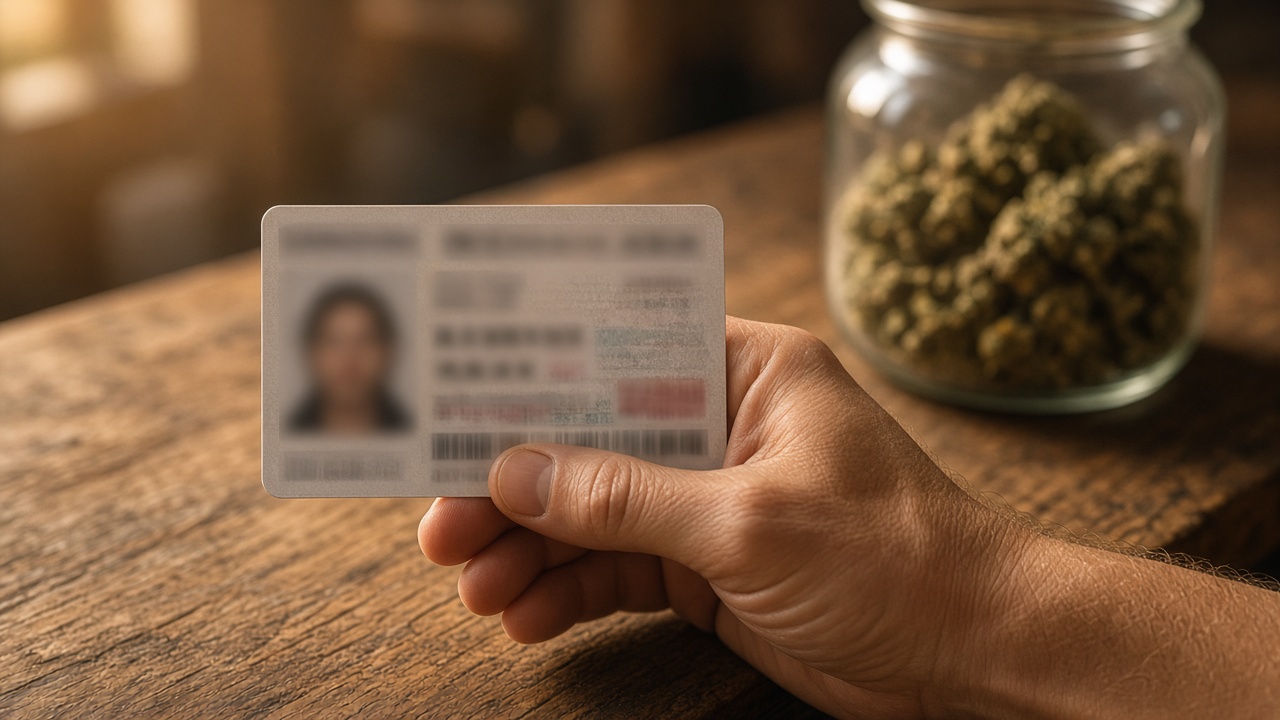
Yes. If you are 21 or older, a valid out-of-state driver's license can be the ID at a Michigan adult-use counter.
The Cannabis Regulatory Agency writes the shop rules. Two of those rules do the ID work. Both still show an effective date of March 7, 2022, in the administrative code for R 420.1 through R 420.1004.
R 420.505 is the sale rule for a marihuana sales location. Subsection (1)(c) says the customer presents a valid driver's license or a government-issued identification card. Under the adult-use act, that card bears a photo and proof the person is 21 or older. The adult-use act is the Michigan Regulation and Taxation of Marihuana Act, often called the MRTMA.
R 420.104 is the retailer license rule. Subsection (3)(c) tells the retailer to verify the person appears 21 or older. The check is government-issued photographic identification containing a date of birth. The same line says the sale stays inside the single-transaction limit.
MCL 333.27955 is the statute on lawful acts by a person 21 or older, and it includes purchasing. The section calls the buyer a person. The line it draws on who may buy is age.
The CRA page on the MRTMA still tells shoppers that personal possession is for people 21 and over. The consumer page says the 2018 vote made marijuana legal under state law for adults 21 or older.
In these rules, a marihuana sales location covers more than one kind of shop. It includes a retailer, a microbusiness, and a class A microbusiness under the adult-use act. It also includes a medical provisioning center. At an adult-use counter, the adult-use half of the ID sentence is the half that applies.
The CRA bulletin index is the change log I used. It shows a June 22, 2020 note on visiting medical patients. Later notes on that index cover recalls and a January 14, 2026 wholesale-tax memo. That index doesn't show a 2025 or 2026 bulletin that rewrites the adult-use ID sentence.
What Age Does the Clerk Have to See? #
The adult-use counter is 21. A license with a younger birthday doesn't clear it.
MCL 333.27961a tells a licensed seller not to sell marihuana to a minor. In that section, minor means a person younger than 21. The same section also blocks a sale to someone who is visibly intoxicated. Visibly intoxicated means obvious, visible signs an ordinary observer would see.
If a shop is later sued over a sale to a minor, the section gives it a specific defense. The licensee demanded a government-issued photographic identification. The ID appeared genuine. The ID showed the person to be 21 or older. That proof is a complete defense in the civil action the section describes. It protects the shop, and it also spells out the check in plain words.
R 420.104(1) says a retailer sells or transfers to an individual 21 or older. R 420.105 says a microbusiness sells to an individual 21 or older only. The age line reads the same way at those counters.
The CRA consumer page covers medical cards separately. It says a resident can apply for a medical card at 18, or younger with a parent as caregiver. That sentence is about the medical program. The adult-use counter in R 420.505 stays at 21.
A card can run vertical or horizontal. The adult-use sentence talks about a photo and proof of age. It doesn't mention the card's shape. The birthday on the card is the age fact the rule names.
Which IDs Does the Rule Actually Name? #
The rule names a valid driver's license, or a government-issued identification card with a photo and proof of age 21. It doesn't print a menu of passport, military ID, and tribal ID.
Here is the same text as a table. If a row says the rule is silent, the sentence I quoted doesn't name that document. I'm not reading a yes into the silence.
| What you are holding | What the written rule does with it |
|---|---|
| Valid driver's license with your photo and proof you are 21 or older | Named in R 420.505(1)(c). The sentence names no home state. |
| Government-issued identification card with a photo and proof you are 21 or older | Named in the same adult-use half of R 420.505(1)(c). |
| Government-issued photographic identification that contains a date of birth | Named in R 420.104(3)(c) as the check before a retailer sale. |
| Passport, passport card, military ID, or tribal ID | Not printed as their own rows in those two sentences. |
| A photo of your license on a phone | Not named. The sentence describes a license or card the customer presents, with a photo on it. |
| An expired card | The adult-use line uses the word valid. It doesn't add a numbered grace period. |
The medical lines in the same sale rule use stricter words for a different card. R 420.505(1)(g) talks about a registered qualifying patient or primary caregiver. That person holds a registry identification card that is valid, current, unexpired, and unrevoked. That list belongs to the medical registry card. The adult-use photo-ID line says valid, with a photo and proof of 21.
Delivery uses the same photo idea. R 420.207 covers delivery in limited cases. For an adult-use delivery, the shop confirms the customer presented a valid driver's license or government-issued identification with a photo. The customer has to be 21 or older at the time of delivery. This page stays at the counter. I mention delivery only so the standard doesn't look like a second law.
Does the License Have to Come from Michigan? #
The adult-use ID sentence names a valid driver's license or a government-issued ID card. It names no issuing state.
An Ohio license, an Indiana license, or a license from another state is still a driver's license. If it is valid, shows your photo, and proves you are 21 or older, it matches R 420.505(1)(c). R 420.104(3)(c) asks for government-issued photographic identification with a date of birth. A state driver's license is government-issued. The rule text doesn't add a residency test on top of that.
MCL 333.27955 lets a person 21 or older purchase. You can read the whole section in the initiated-law PDF. The purchase paragraph ties the buyer to age.
Some towns have no counter at all. MCL 333.27956 lets a city, village, or township prohibit marihuana establishments inside its borders. Your license can't make a dry township open a shop. Detroit has licensed adult-use retailers, and a counter there uses this same rule. A township that opted out has no counter to walk up to. The ID rule applies statewide. Whether a town has a counter depends on the town.
R 420.505(4) is the privacy line for an adult-use retailer, microbusiness, or class A microbusiness. The state rule doesn't require that shop to keep a file of customer details beyond five sale facts. Those facts are payment method, amount of payment, time of sale, product quantity, and other product descriptors. The rule doesn't require the shop to store a copy of an out-of-state address. A shop can still look at your license while you're standing there. Checking a card is one thing and filing it is another. The rule speaks to what the shop has to retain.
How Much Can You Walk Out With? #
One adult-use sale cannot go over 2.5 ounces, and no more than 15 grams of that marihuana may be concentrate. The public possession amount is the same 2.5 ounces.
MCL 333.27955(1)(a) says a person 21 or older may possess, purchase, and transport 2.5 ounces or less. The same clause says not more than 15 grams of marihuana may be in the form of marihuana concentrate. Marihuana is the spelling the statute still uses, and it means cannabis. Concentrate, in the act, means the resin extracted from the plant.
R 420.506(3) puts the same cap on the retailer. A retailer may not sell one adult more than 2.5 ounces in a single sale. The adult in that rule is 21 or older. The next sentence in that subsection says no more than 15 grams may be marihuana concentrate. Both texts state the ounce cap and the concentrate cap, so the statute and the rule are the pair to remember at the door.
R 420.506(4) adds one more counter cap. A marihuana sales location may sell no more than 3 immature plants to a customer per transaction. A plant is still something you walk out holding. The ounce cap covers flower and product. The plant cap stands on its own.
| Moment | Amount the text allows | Where it is written |
|---|---|---|
| One adult-use sale | Not over 2.5 ounces, and not more than 15 grams may be concentrate | R 420.506(3) |
| In public, including the sidewalk outside | 2.5 ounces or less, with the same 15 gram concentrate cap | MCL 333.27955(1)(a) |
| Inside a residence | Not more than 10 ounces, plus cannabis from plants grown there | MCL 333.27955(1)(b) |
| Immature plants in one sale | No more than 3 | R 420.506(4) |
The 10-ounce figure applies inside a residence. On the way to the car, the public amount is 2.5 ounces. Home storage is its own topic, and this page stays with the bag you carry out.
A second counter the same day has its own sale cap. Each adult-use transaction is capped at 2.5 ounces, and the amount you may possess in public is also 2.5 ounces. Two legal sales can leave you holding more than the public amount. The possession line still applies to the person on the sidewalk.
Medical shops run on different math. R 420.506(1) and (2) are the medical daily and monthly checks in the statewide monitoring system. Those subsections name a registered qualifying patient or caregiver. The adult-use subsection is the single transaction. Don't borrow the medical daily total and paste it onto an out-of-state shopper's adult-use sale.
Flower weight and concentrate weight are the walk-out facts. A jar, a 1 gram pre-roll, and a concentrate container all count toward what you're holding. The label weight is the number to add up before you leave the parking lot.
What If You Only Have an Out-of-State Medical Card? #
An out-of-state medical card is a separate path. The adult-use counter still checks a photo ID and age 21.
The medical path runs through a provisioning center licensed under the medical facilities act. R 420.505(3) says that center verifies a visiting qualifying patient before the sale. The patient needs a valid unexpired medical marihuana registry card, or its equivalent. The card is issued in another state, district, territory, commonwealth, or insular possession of the United States. It must allow the medical use of marihuana. The patient also presents a valid driver license or government-issued identification card with a photo.
The CRA FAQ on visiting patient cards repeats that pair. Card from the other state, plus a photo ID. The FAQ points to section 3 of the medical marihuana act for the visitor definition.
MCL 333.26423 defines visiting qualifying patient. It means a patient who is not a resident of this state. It also means a patient who has been a resident for less than 30 days. The full medical act is in the 2008 initiated-law PDF.
MCL 333.26424(k) gives that out-of-state card the same force and effect as a registry card issued by the department. The card in that sentence is the card the other state issued. The CRA FAQ doesn't describe a second card that the department prints and mails to you. Bring the card you already have, and bring the photo ID.
The adult-use counter doesn't swap in that medical path. If you're 21 and hold an Ohio medical card, the adult-use sale still uses the photo ID, and the birthday on it has to read 21 or older. The provisioning-center sale, when the shop is licensed for it, runs on the visitor rule. Some buildings hold more than one license, so ask which counter you're standing at. The sign on the menu should match the license.
Someone under 21 gets stopped at the adult-use counter. The visitor rule is narrow, so read the card's dates and the FAQ before you count on the medical path.
When Can the Counter Refuse the Sale? #
The counter stops the sale when it cannot verify age 21 from a valid government photo ID. It also stops the sale when the person is visibly intoxicated. A good license can't force a sale of a product the shop isn't allowed to hand over.
R 420.505(1) is a checklist the sales location runs before the transfer. The product is not on an administrative hold, recalled, or ordered destroyed. The product is not past its expiration date. The customer presented the ID described above. The sale will not exceed the purchasing limit in R 420.506. The product was tested under R 420.305. The product is labeled and packaged for sale under R 420.504.
Any line on that list can stop the handoff. Your license can be fine, and the jar can still stay on their shelf. That's a product rule, and it applies the same way to a Detroiter and a visitor.
MCL 333.27961a is the intoxicated-person line and the under-21 line. If the signs of intoxication would be obvious to an ordinary observer, the licensee is told not to sell. I can't give you a trick for looking sober, and the statute's word is visible.
A town with no shop is a refusal before you reach a counter. MCL 333.27956 is the local opt-out.
The sale on this page is the one to an adult who presents the ID. Handing cannabis to a person under 21 is outside the adult-use permission in MCL 333.27955, the same purchase section.
What Should You Do with the Bag After You Pay? #
Outside a residence, keep the public amount at 2.5 ounces or less. If you want this state's adult-use permission to cover the bag, keep it inside Michigan.
The purchase permission and the public possession permission sit in the same statute. MCL 333.27955(1)(a) covers possessing, purchasing, and transporting that 2.5 ounces. Transporting, in that sentence, is still inside the act's permission. The act you just used is state law.
Crossing a state line is covered elsewhere. Our cannabis travel guide covers where you can carry product. The Labor Day hosting post covers that eighth once it leaves the state. This page stops at the counter.
Divine Toke is mail order at divinetoke.org. I grow the sun-grown flower. If you already live in Michigan and want that flower shipped, the website is the checkout. The ID rules on this page are for a licensed counter, and I'm not stating an ID policy for the online shop. The wider policy shelf is the industry status guide.
FAQ #
Can I buy cannabis in Michigan with an Ohio driver's license? #
Yes, if you are 21 or older and the Ohio license is a valid photo license. The Ohio license has to prove the age. R 420.505(1)(c) names a valid driver's license and names no issuing state. The retailer check in R 420.104(3)(c) is a government photo ID with a date of birth. The CRA rules compilation is the file those sentences live in.
Can I buy with an Indiana license? #
Yes. An Indiana driver's license is treated under the same sentence as any other valid driver's license. You still need the photo and proof you are 21 or older. The single sale still stops at 2.5 ounces under R 420.506(3). The public possession cap in MCL 333.27955 is the same 2.5 ounces.
Do I have to live in Michigan to buy adult-use cannabis? #
The adult-use purchase line is age 21, plus the photo ID the sale rule names. MCL 333.27955 says a person 21 or older may purchase. Residency shows up in a different place, the visiting-patient definition in MCL 333.26423, which sits on the medical side. That definition doesn't set the adult-use counter's test.
What if I am 20 and my license is from another state? #
The adult-use counter stays at 21. MCL 333.27961a defines minor, for that sales ban, as a person younger than 21. A valid license showing age 20 means the sale stops. The medical application age on the consumer page belongs to a different program.
Does an expired license work? #
The adult-use line requires a valid driver's license or government-issued ID card. It doesn't spell out a grace period of extra days after the expiration date. The word unexpired shows up on the medical registry card in R 420.505(1)(g). It also shows up on a visitor's card in R 420.505(3). Bring a license that still counts as valid.
Can I show a photo of my license on my phone? #
The sale rule describes a license or card the customer presents, with a photographic image on it. It doesn't name a screenshot, a camera roll, or a mobile ID app. R 420.104(3)(c) says government-issued photographic identification containing a date of birth. Have the physical card the sentence describes.
Does the state print a reciprocity card for visitors? #
The pages I used describe the card your other state already issued. MCL 333.26424(k) gives that card the same force and effect as a department registry card, for a visiting qualifying patient. The CRA visitor FAQ tells a provisioning center to check that card plus a photo ID. Those pages don't describe a separate card the department prints for you.
Can my out-of-state medical card replace a photo ID at the adult-use counter? #
The adult-use half of R 420.505(1)(c) still asks for the photo license or government ID card. It also asks for proof you are 21. The medical visitor path in R 420.505(3) also asks for a photo ID. That path adds the unexpired out-of-state registry card on top of the photo ID. A medical card by itself doesn't meet the adult-use check. If you're 21, the license in your wallet is the adult-use document.
How much can I buy in one trip to the counter? #
2.5 ounces in that single transaction, and not more than 15 grams may be concentrate. That's R 420.506(3). The shop may also sell no more than 3 immature plants in the transaction, under R 420.506(4). Add the label weights before you walk out, because public possession under MCL 333.27955 is 2.5 ounces too.
Can I go to two shops on the same day? #
Each adult-use sale has its own 2.5-ounce cap. The amount you may possess in public is also 2.5 ounces, under MCL 333.27955(1)(a), the public possession rule. A second bag can put the total in your hands over that public amount. The medical monitoring limits in R 420.506(1) apply to registered patients and caregivers.
Will the shop keep a copy of my out-of-state license? #
R 420.505(4) doesn't require an adult-use retailer to retain customer information beyond five sale facts. Those facts are payment method, payment amount, time of sale, product quantity, and other product descriptors. The clerk can still look at the license to match the photo and the birthday. That retention list is short.
Can I take the purchase home to Ohio? #
Once the product leaves the state, you're off this page, and that includes the drive back to Ohio. The cannabis travel guide covers carrying product across borders. The Labor Day post covers that eighth after it leaves the state. Read those two before you point the car at the line.
What Is the Short Version? #
A valid driver's license or government-issued photo ID card, proof you are 21, and a single sale that stays at 2.5 ounces with no more than 15 grams as concentrate. The text is in the administrative rules and in MCL 333.27955, the purchase section for a person 21 or older. None of those sentences names a home state.
Divine Toke is mail order at divinetoke.org. If you want sun-grown flower shipped inside this state, the website is the checkout. The site lists flower, 1 gram pre-rolls, and a 20-pack of 20 one-gram joints for $120. The counter rules above belong to a licensed retailer.
This page is educational, and it isn't legal advice. Shops can have a house practice that is stricter than the sentence in the rule. If a clerk won't take the document, ask which line they're using. Then check the CRA text.
Grown in Detroit. Shipped to your door.
Small-batch, sun-grown cannabis cultivated in living soil. Mail-order shipping to all 50 states.