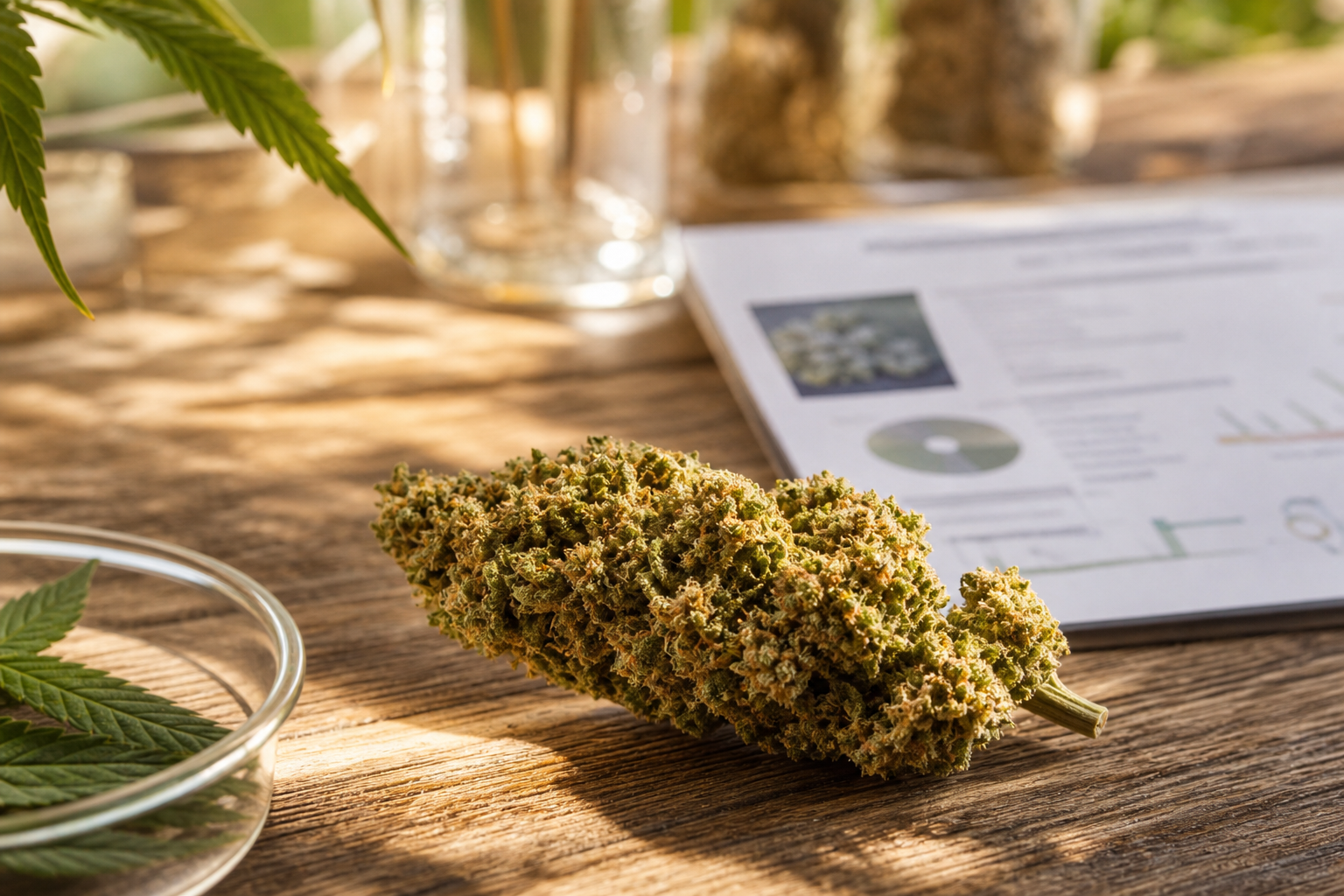
What "Lab Tested" Actually Means — and Why You Should Care
"Lab tested" is on every Michigan cannabis package — but what does it actually mean, who checks the checkers, and can you trust that number on the label?

Head Cultivator
On this page
You see "lab tested" on pretty much every cannabis product sold in Michigan. But what does that actually mean? What got tested? Who ran the tests? And should you trust the number on the label?
The honest answer is: it depends. Michigan has real testing requirements — but the system has gaps, and recent enforcement actions prove that "lab tested" is not the same as "verified safe." Here's what you actually need to know.
What Does "Lab Tested" Mean on a Michigan Cannabis Product? #
"Lab tested" means the batch was sampled and analyzed by a state-licensed safety compliance laboratory before it could be sold. The label is supposed to confirm two things: the product was checked for harmful contaminants, and the cannabinoid levels on the package came from an actual test — not a guess.
In Michigan, no licensed cannabis product can legally hit store shelves without passing through this testing system. Before a cultivator or processor ships anything to a dispensary, a licensed lab sampler pulls physical samples from the batch. Those samples go to an independent testing lab. The results — everything from THC percentage to whether the batch has mold or pesticides — get logged into METRC, the state's seed-to-sale tracking platform.
Here's the part most people don't know: "lab tested" is a process, not a guarantee. It means a test happened. Whether that test was 100% accurate, and whether the number on the label reflects the actual product in your hands, is a more complicated question.
| What "Lab Tested" Means | What It Does NOT Mean |
|---|---|
| A batch sample was tested by a licensed lab | Every individual unit was tested |
| The batch was in the METRC tracking system | The test was definitely accurate |
| The test covered the state-required categories | No contamination was present at all |
| A pass/fail result was recorded | The THC number on the label is exact |
The Michigan Cannabis Regulatory Agency (CRA) licenses and oversees both the cannabis businesses and the labs that test their products. But as we'll cover in a moment, the system has had real problems — including labs that gamed the results.
What Tests Does Michigan Actually Require? #
Michigan requires cannabis products to pass nine categories of testing before they can be sold legally. This covers everything from how strong the product is to whether it has mold or lead in it. The full list is spelled out in the Michigan CRA's Sampling and Testing Technical Guidance.
Here's a plain-English breakdown of everything that's supposed to get tested:
| Test Category | What It Checks | Why It Matters |
|---|---|---|
| Potency | THC, THCA, CBD, CBDA, other cannabinoids | So the label is accurate |
| Pesticides | Synthetic chemicals used to kill bugs | Some are toxic even in small amounts |
| Heavy metals | Lead, arsenic, cadmium, mercury, chromium, nickel | Can build up in your body over time |
| Microbials | Mold, yeast, E. coli, Salmonella, Aspergillus | Can cause serious illness, especially in people with weak immune systems |
| Mycotoxins | Aflatoxins, ochratoxin A | Toxic compounds made by mold |
| Residual solvents | Leftover chemicals from extraction (BHO, CO2, ethanol) | Used in making concentrates; can be harmful if not properly purged |
| Foreign matter | Glass, metal shavings, synthetic fibers, insects | Auto-fail — zero tolerance |
| Water activity/moisture | How dry the product is | High moisture = mold risk |
| Homogeneity | Even distribution of cannabinoids in edibles | So every piece of a gummy has the same dose |
For vape cartridges specifically, the CRA also requires testing for Vitamin E acetate and MCTs — two compounds linked to EVALI, the vaping lung illness that hurt thousands of people a few years back.
Potency: THC, CBD, and the Other Cannabinoids #
Potency testing measures how much THC, CBD, and other active compounds are in the product. For flower, that's usually reported as a percentage of dry weight. For edibles and concentrates, it's reported in milligrams per serving or per package.
The test must cover THC, THCA (the non-psychoactive raw form that converts to THC when heated), CBD, and CBDA. Labs can also report other cannabinoids like CBG, CBN, or THCV if their methods are validated for those compounds.
This is the number most people focus on. And as we'll cover later, it's also the number that has the most room for manipulation.
Pesticides, Heavy Metals, and Microbials — The Safety Tests That Matter Most #
Pesticide, heavy metal, and microbial testing are the safety tests that protect your health. These aren't about potency — they're about making sure the product won't hurt you.
Michigan's heavy metals panel includes six specific metals:
- Lead — can cause neurological damage
- Arsenic — a known carcinogen
- Cadmium — damages kidneys over time
- Mercury — neurological toxin
- Chromium — can be carcinogenic at high levels
- Nickel — an allergen and possible carcinogen
Microbial testing looks for organisms that cause food poisoning and respiratory infections. The PMC review of cannabis contaminant regulations confirms that microbial contamination is among the most commonly cited reasons for cannabis product failures in legal markets.
Residual Solvents and Foreign Matter (for Concentrates and Vapes) #
Residual solvents are chemicals left behind after making concentrates, and Michigan requires testing to make sure they're below safe levels. When you make wax, shatter, oil, or vape carts, you typically use a solvent like butane, propane, ethanol, or CO2 to extract the cannabinoids. The extraction process is supposed to remove all that solvent, but sometimes trace amounts remain.
The benchmark for what's "safe" in cannabis extraction is often compared to the pharmaceutical standard USP <467>, which classifies solvents by how toxic they are and sets limits accordingly. Michigan's state rules set their own action limits, but the concept is the same.
Foreign matter failures are automatic and no-exceptions. If your batch has glass shards, metal shavings, or synthetic fibers in it, it fails. Full stop.
What Is a Certificate of Analysis — and How Do You Read One? #
A Certificate of Analysis (COA) is the lab report for a specific batch. It shows every test result in one place — potency, contaminants, and whether the batch passed or failed. It's your best tool for knowing what's actually in the product you're about to consume.
Every COA should contain:
- Product and batch information — product name, lot number, test date, and the name of the lab
- Cannabinoid potency — THC, CBD, and other cannabinoids with percentage or mg numbers
- Contaminant results — pass/fail for each required safety test
- Lab accreditation status — the lab's licensing and ISO certification
Reading a COA is easier than it sounds. Think of it like a report card. The New Jersey Cannabis Commission's COA reading guide breaks it down in steps that apply to Michigan products too:
- Match the batch number first. The lot number on the COA must match the lot number on the package. If they're different, the report doesn't apply to what you're holding.
- Check the test date. An old COA (6+ months ago) on a freshly packaged product is a red flag.
- Look at safety pass/fail results first. Pesticides, heavy metals, microbials — these should all say PASS. Any FAIL is a problem.
- Then check potency. Compare the THC percentage to what you expected. If it's wildly different from what the budtender told you, ask questions.
- Watch for missing tests. A COA that only shows potency and skips contaminants is not a full safety report.
A full COA from a reputable lab should look something like the examples Leafly describes in their certificate of analysis guide — comprehensive, clearly formatted, with pass/fail status for every tested category.
How to Find the COA for a Product You Already Bought #
Most Michigan dispensaries can pull up a COA for any product on request. You can also find it several other ways:
- Scan the QR code on the package — many Michigan brands print a direct link to their COA
- Ask the budtender by batch number — they can look it up in their system
- Check the brand's website — some post COAs by product line
If a dispensary can't or won't show you a COA, that's worth noting. A legitimate, compliant product always has one.
The THC Number on the Label: Can You Trust It? #
The honest answer is: not always. Research shows that what's printed on the label often doesn't match what's actually in the package — and the gap usually goes in one direction. Labels tend to run higher than reality.
A PLOS One study on cannabis potency label accuracy tested retail flower from dispensaries and compared the results to what the labels claimed. The findings were striking:
- The average observed THC was 14.98%
- Observed values were 23.1% lower than the label's low estimate on average
- Observed values were 35.6% lower than the label's high estimate on average
- Nearly 70% of samples tested more than 15% below their stated label value
Put simply: if a bag says 28% THC, there's a good chance the actual content is closer to 18–22%. That gap matters if you're using cannabis for specific purposes — dosing for pain, sleep, or anxiety — because you're not getting what you think you're getting.
Why does this happen? There are a few reasons. One is just measurement variation — different equipment and methods produce slightly different numbers. But a bigger reason has a name.
What "Lab Shopping" Is and Why It's a Problem #
"Lab shopping" is when a cannabis producer deliberately tests their products with multiple labs and submits to whichever one returns the highest potency numbers. It's not necessarily illegal, but it's a systemic problem that skews the entire market toward inflated THC percentages.
Think of it this way. Two dispensaries are competing for the same customer. One's flower tests at 22% THC. The other's tests at 28%. Even if the 28% number is from a lab known to run high, the customer often buys based on the number. So every producer has a financial incentive to shop for high numbers. The AOCS review of cannabis testing accuracy and Astrix Inc's analysis of THC inflation both identify this as one of the central integrity problems in state cannabis markets.
The result is a race to the top of a meaningless number. And it makes it hard for honest producers — who test with rigorous labs and report accurate results — to compete on price and shelf placement.
One investigation by Outlier Media into Michigan cannabis lab testing found this dynamic playing out in real Michigan dispensaries.
What Happens When Cannabis Fails a Test? #
When a cannabis batch fails a required test in Michigan, it cannot be sold until the problem is addressed — and some failures mean the entire batch gets destroyed. The specific outcome depends on what failed and why.
Here's how Michigan handles test failures:
- Potency failure — usually means mislabeling; product may be relabeled if retested accurately
- Pesticide failure — the batch is quarantined; some pesticide issues can be addressed through remediation, but many result in destruction
- Heavy metal failure — typically results in destruction; no remediation path for heavily contaminated product
- Microbial failure — some microbial issues can be addressed through remediation (like re-drying to reduce moisture), then retesting; others require destruction
- Foreign matter failure — automatic destruction if glass, metal, or synthetic fibers are found
- Residual solvent failure — concentrate may be able to undergo additional processing; if not cleared on retest, destroyed
The CRA can investigate any lab that shows unusual patterns — like batches that fail one test and then mysteriously pass on retest with a different sample. That pattern was at the center of the Viridis Laboratories case, which we'll cover next.
The Viridis Laboratories Case: When the System Failed Michigan Consumers #
The Viridis Laboratories case is the biggest example of Michigan's cannabis testing system breaking down — and it involved more than 64,000 pounds of recalled product. If you were buying cannabis in Michigan around 2021, there's a real chance some of what you bought passed through Viridis labs.
According to CRB Monitor's reporting on the CRA's August 2025 enforcement action, the allegations against Viridis Laboratories included:
- Inflating THC potency numbers — reporting higher percentages than were actually in the samples
- Passing products that had failed microbial tests — products with potential contamination were cleared for sale
- Misreporting mold contamination — in some cases, mold was identified incorrectly or not flagged at all
The 2021 recall covered roughly 64,000 pounds of cannabis product — flower, concentrate, and edibles — that had passed through Viridis's labs. That's a lot of product that consumers bought trusting it was safe.
The CRA had been reviewing lab methods and compliance since 2020. In August 2025, they finally reached a settlement with Viridis, revoking the lab's licenses and banning the owners from future operations in Michigan cannabis.
The lesson isn't that all labs are corrupt. Most aren't. The lesson is that "lab tested" stamps on a package depend entirely on whether the lab running the tests is operating with integrity. It's a system that relies on oversight, enforcement, and consumer awareness. The Michigan CRA acted — but it took years, and a lot of product moved in the meantime.
Michigan's New State Reference Lab: What It Means for You #
Michigan is building a state-run reference laboratory to serve as a quality-control watchdog over the private testing labs — and as of early 2026, it's built, staffed, and waiting for final operational authority. This is a direct response to the Viridis case and the broader problem of private labs having financial relationships with the producers whose products they're testing.
According to ACT Labs' February 2026 reporting on the state reference lab, the CRA's laboratory is already equipped and staffed. Legislative testimony in February 2026 described the lab as awaiting final certification and accreditation authority to begin operations.
What the state reference lab would do:
- Test samples independently — the state can pull samples from any batch and run its own test
- Audit private lab results — compare state results to what the licensed labs reported
- Catch systematic inflation — if a private lab consistently reports higher than the state's own tests, that's a red flag the CRA can investigate
- Serve as a tiebreaker — when a producer disputes a failed test, the state lab can adjudicate
This is a meaningful change. Right now, the entire system relies on private labs — businesses that get paid by the producers whose products they test — to produce accurate, unbiased results. A state reference lab adds an independent layer that makes systematic manipulation much harder to hide.
For consumers, this should mean more reliable numbers and fewer situations like Viridis. It won't be instant, but it's a structural improvement. Watch for the CRA to announce the lab's full operational launch in 2026.
How to Tell If a Lab Is Legitimate #
A legitimate cannabis testing lab in Michigan must be licensed by the CRA as a safety compliance facility AND hold ISO/IEC 17025:2017 accreditation from a recognized accreditation body. Those are the two boxes you're looking for.
ISO/IEC 17025 is the international standard for testing labs. Think of it like a license to practice — it means the lab has demonstrated it can produce technically valid, reproducible results. The accrediting body (an organization like A2LA, the American Association for Laboratory Accreditation) is an independent third party that audits the lab's processes, equipment calibration, staff qualifications, and documentation.
The National Institute of Standards and Technology (NIST) has been working to provide quality assurance tools and reference materials specifically for cannabis labs — because the lack of standardized methods has been a real problem in getting consistent results across different labs.
When checking a lab's legitimacy, look for:
- CRA-licensed status — Michigan's CRA maintains a list of licensed safety compliance facilities
- ISO/IEC 17025:2017 accreditation — should be stated on the COA itself
- Independent ownership — a lab with no financial ties to the brands it tests is more trustworthy
- Consistent pass/fail rates — a lab where nearly everything passes should raise questions
- Scope of testing — a legitimate lab tests all required categories, not just potency
SC Labs, ACT Labs, and the Michigan Cannabis Industry Association's approved testing lab list are good starting points if you want to see what state-licensed cannabis labs in Michigan look like.
Does Organic or Sun-Grown Cannabis Test Cleaner? #
Organic and sun-grown cannabis doesn't automatically test cleaner than conventionally grown cannabis — but avoiding synthetic pesticides from the start does lower the risk of certain failures. The honest answer from the research is nuanced: practice matters more than the label.
A review in PMC covering cannabis contamination regulations confirmed that pesticide residue is one of the most common reasons cannabis products fail testing in legal markets. Organic cultivation sidesteps that specific risk by not using synthetic pesticides in the first place.
But here's the thing: organic cannabis can still pick up heavy metals from contaminated soil, grow mold if moisture isn't controlled, or test high for mycotoxins if harvest or drying conditions go wrong. Conversely, a clean indoor operation that never touches synthetic pesticides can also pass every test even without an organic designation.
What organic and regenerative growing practices reliably do:
- Eliminate pesticide failure risk — if you never use synthetic pesticides, you can't fail for them
- Reduce chemical intervention overall — healthier soil means fewer pest pressures that would tempt a grower to reach for chemicals
- Align with what sun-grown certifications like Sun+Earth already require — certified farms must still submit to independent lab testing, but the certification also addresses farming practices upstream of the lab
At Divine Toke, we grow without synthetic pesticides. That's a starting point for clean lab results — but it doesn't replace testing. Every batch still goes through Michigan's required panel. Clean practices and independent testing work together, not instead of each other.
FAQ: Cannabis Lab Testing in Michigan #
Q: What tests are required for cannabis sold in Michigan? #
Michigan requires nine categories of testing before any cannabis product can be sold legally. According to the Michigan CRA's technical guidance, those categories are: potency (THC, CBD, and related cannabinoids), pesticides, heavy metals, microbial impurities, mycotoxins, residual solvents (for extracts), foreign matter, water activity/moisture, and homogeneity (for edibles). The specific tests required vary by product type — flower gets a different panel than a vape cart.
Q: What is a Certificate of Analysis (COA)? #
A COA is the lab's official report for a specific product batch, showing every test result in one place. It includes potency numbers, contaminant test results, pass/fail status, and the lab's identifying information. It's the document that turns "lab tested" from a sticker into something you can actually verify. Leafly's COA guide is a useful starting point for learning how to read one.
Q: How do I find the COA for a product I bought at a dispensary? #
Ask the budtender by lot or batch number — any licensed Michigan dispensary should be able to pull it up. Many brands also print a QR code directly on the package that links to the COA online. If the dispensary can't or won't provide a COA, that's a red flag worth paying attention to. The New Jersey Cannabis Commission's COA reading guide walks through what to look for once you have it, and the same principles apply to Michigan products.
Q: What does it mean if a cannabis product fails lab testing? #
It means the batch didn't meet one or more of Michigan's required safety or labeling standards and cannot be sold until the issue is resolved. Some failures allow the producer to remediate the batch (like re-drying flower that has high moisture) and retest. Others — like finding glass shards, high levels of heavy metals, or certain pesticides — result in the batch being destroyed. The Michigan CRA Sampling and Testing guidance specifies which failure types allow remediation.
Q: Can I trust the THC percentage on a cannabis label? #
The short answer: treat it as a rough estimate, not a precise measurement. A PLOS One study on cannabis potency labels found that about 70% of retail flower samples tested more than 15% below their label claim, with observed values averaging 23.1% lower than the label's lowest stated number. Lab shopping (producers seeking labs that return higher numbers) and method variation both contribute to this gap. Use the label as a general guide, not a precision dosing tool.
Q: What is "lab shopping" and is it a problem in Michigan? #
Lab shopping is when a producer tests their product at multiple labs and submits to the one that returns the highest potency numbers. It's not necessarily illegal, but it's an integrity problem that inflates THC numbers market-wide. Astrix Inc's industry analysis identifies lab shopping as one of the central drivers of potency inflation in regulated cannabis markets. Michigan's upcoming state reference lab is partly designed to make this harder to get away with.
Q: What heavy metals are tested for in Michigan cannabis? #
Michigan's heavy metals panel covers six specific metals: lead, arsenic, cadmium, mercury, chromium, and nickel. This is a broader panel than some states require. The Michigan CRA technical guidance along with lab industry summaries confirm all six are required. Cannabis can absorb heavy metals from contaminated soil — which is one reason growing in clean, tested soil matters.
Q: How do I know if the testing lab is legitimate? #
A legitimate Michigan cannabis testing lab must be licensed by the CRA as a safety compliance facility and hold ISO/IEC 17025:2017 accreditation. ISO/IEC 17025 is the international quality standard for testing labs, independently audited by bodies like A2LA. Both credentials should be stated on the COA itself. The NIST cannabis laboratory quality assurance program provides reference materials that help accredited labs produce consistent, reliable results.
Q: Does organic or sun-grown cannabis test cleaner than indoor cannabis? #
Not automatically — but organic practices that avoid synthetic pesticides directly eliminate one of the most common sources of lab failures. The PMC review of cannabis contamination regulations found pesticide residue among the most common failure types in legal cannabis markets. Growing without synthetic pesticides removes that specific risk. But testing is still required because organic cannabis can still pick up heavy metals from soil, or develop mold if moisture control isn't tight. Clean practices and independent testing work together.
Q: What happened with Viridis Laboratories in Michigan? #
Viridis Laboratories was a Michigan cannabis testing lab that allegedly inflated THC potency numbers, passed products that had failed microbial tests, and misreported contamination. A CRB Monitor report on the August 2025 enforcement action confirmed the Michigan CRA revoked Viridis's licenses and banned the owners from future operations in Michigan cannabis. The original problems led to a recall of roughly 64,000 pounds of cannabis products in 2021 — one of Michigan's largest cannabis safety recalls.
Q: What is Michigan's new state reference lab and when will it be operational? #
Michigan's CRA has built a state-run reference laboratory to serve as an independent quality-control check on private testing labs. As of February 2026, the lab was built, staffed, and equipped — awaiting final certification and accreditation authority to begin operations, according to ACT Labs' reporting on the February 2026 legislative testimony. Once operational, the state lab will be able to independently test cannabis samples and compare results to what private labs reported, making systematic manipulation much harder to sustain.
The Bottom Line on Lab Testing #
"Lab tested" is a floor, not a ceiling. It means a licensed third party ran the required tests and recorded the results. It means Michigan's state tracking system has a record of the batch. It means the product cleared the basic safety bar — or at least, it was supposed to.
What it doesn't mean: perfect accuracy, zero contamination risk, or a THC number you can take to the bank.
The smarter move is to use "lab tested" as a starting point, not an ending point. Ask for the COA. Match the batch number. Check that safety tests have actual pass results, not just potency numbers. And buy from producers and dispensaries that make that information easy to access.
If you're curious about cannabis that starts with clean farming practices before it even gets to the lab, we'd love to introduce you to what we do at Divine Toke. Our sun-grown flower is grown without synthetic pesticides and goes through Michigan's full testing panel — you can ask for the COA at any dispensary that carries us.
For more on Michigan cannabis policy and how the rules affect what you buy, read our breakdown of Michigan's 24% wholesale cannabis tax and what the illicit market's growth means for legal consumers. For the farming side — what goes into growing clean cannabis before it ever reaches a lab — check out what Sun+Earth Certified actually means.
This article is for educational purposes only and is not medical advice. Always consult your healthcare provider before starting any new wellness routine.
Grown in Detroit. Shipped to your door.
Small-batch, sun-grown cannabis cultivated in living soil. Mail-order shipping to all 50 states.
You Might Also Enjoy
Cannabis Insurance: The Hidden Cost No One Talks About
July 24, 2026 · 22 min read

The 2018 Hemp Farm Bill vs. the 2026 Farm Bill: What Every Consumer Needs to Know
April 26, 2026 · 18 min read
A Closer Look at Cannabis Rescheduling: What Schedule III Means for Everyday Smokers
April 26, 2026 · 10 min read