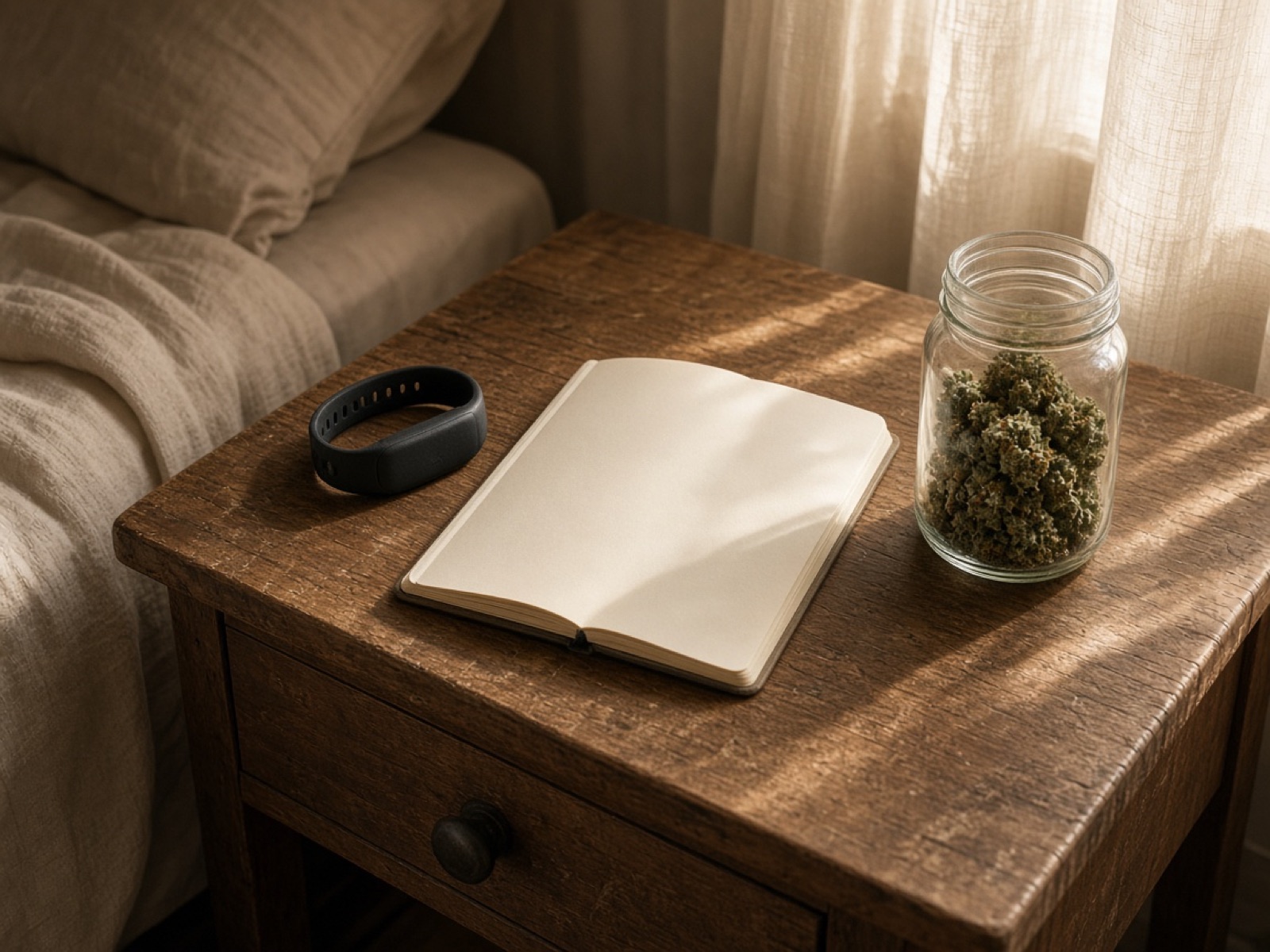
You Felt Rested, the Tracker Said Otherwise: The New Study on Cannabis and Middle-Age Sleep
You woke up fine, but the wrist monitor saw a choppy night. What a new middle-age sleep study found, what it can't prove, and how to check your own sleep.
Questions this article answers
- does regular cannabis use improve sleep in middle age
- why do I feel rested if my sleep tracker says I slept poorly
- what did the middle age cannabis sleep study find
- what happens to sleep when you stop cannabis
- how should a night shift worker check sleep honestly

Head Cultivator
On this page
You woke up feeling fine. Your watch says you were awake a long stretch in the middle of the night.
A study out today found that split in adults around age 61. People who used cannabis for more years had choppier wrist-measured nights. They did not rate their own sleep any worse. It did not prove the plant caused it.
I have used flower at night for years, and my tolerance isn't a typical tolerance. I read this one twice.
What Did the New Sleep Study Actually Find? #
Each extra cannabis-year lined up with higher odds of broken wrist-measured sleep. It did not line up with a worse score on the sleep questionnaire. A cannabis-year is 365 days of use added up over time. This is a cohort study. Researchers followed the same people for years. Nobody was assigned cannabis or a dummy pill.
The paper is Recent and Cumulative Cannabis Use and Sleep in Middle-Aged Adults, published online October 9, 2026, in JAMA Network Open (DOI 10.1001/jamanetworkopen.2026.38303). After adjustment, each additional cannabis-year was tied to:
| Measured outcome | Adjusted odds per extra cannabis-year | 95% confidence interval |
|---|---|---|
| Low sleep percentage (under 85% of the night asleep) | 1.10 | 1.06 to 1.14 |
| High sleep fragmentation (top quarter of this sample) | 1.04 | 1.01 to 1.08 |
| Prolonged wake after sleep onset (30 minutes or more) | 1.21 | 1.10 to 1.34 |
| Poor self-rated sleep (PSQI score over 5) | 1.01 | 0.98 to 1.04 |
An odds ratio of 1.21 means the odds of that long wake time were about 21% higher for each extra cannabis-year. It does not mean 21% of people. The self-rated row sits at about 1.00. Its interval crosses 1, so the questionnaire showed no clear difference.
The same paper found no clear link between years of use and sleeping under 6 hours (odds 1.01, interval 0.98 to 1.05). Sleeping over 8 hours was also flat (odds 1.02, interval 0.97 to 1.06). Both were compared with a 6 to 8 hour night. Mean time asleep stayed about 6.8 hours across the use groups in the raw table. Total sleep did not shrink on average. The nights got chopped up.
Northwestern's release the same day used a harder headline: "Think cannabis helps you sleep better? Think again." Corresponding author Thanh-Huyen T. Vu said cannabis may line up with poorer sleep even when people do not feel those changes. Senior author Mercedes R. Carnethon said the data do not support the belief that cannabis is helpful as a sleep aid. The paper itself is more careful. It reports an association and stops there.
I still use flower when I want the evening to settle. There is not enough research yet on one person's own endocannabinoid system, the body's own cannabis-like signaling. This study does not erase a night that helped someone fall asleep. It says the wrist record and the morning feeling can disagree.
How Did They Measure the Night? #
They scored sleep with a research wrist monitor worn for 7 days, and they scored the feeling with a questionnaire. The monitor was a Philips Actiwatch Spectrum Plus on the non-dominant wrist, the wrist you do not write with. People also kept a simple sleep log. The questionnaire was the Pittsburgh Sleep Quality Index, the PSQI. It is a 1989 form that adds seven parts of a month of sleep into one score from 0 to 21. Higher is worse. A score over 5 is the cutoff this paper used for poor sleep, the same cutoff from the original PSQI paper.
Actigraphy means a watch guesses sleep from movement. It is not a lab night with wires on your scalp. The October 9 paper used four wrist numbers:
| Word in the paper | What it means in a bedroom | What they called "worse" |
|---|---|---|
| Sleep duration | Hours actually asleep in the main rest block | Short is under 6 hours. Long is over 8. Optimal is 6 to 8. |
| Sleep percentage | Share of that rest block spent asleep. Closer to 100 is more time asleep. | Low is under 85%. |
| Sleep fragmentation | A restlessness score. Higher means more chop. | High is the top quarter of this group. |
| Wake after sleep onset (WASO) | Minutes awake after you first fall asleep, until the rest block ends | Prolonged is 30 minutes or more. |
The average night in the whole monitor group was 6.8 hours asleep, with 90% of the rest block spent asleep. The average fragmentation score was 21, and average WASO was 45 minutes. Three out of four people already had 30 minutes or more of WASO (669 of 891, 75.1%). So long wake time was common before anyone sorted by cannabis. The odds climbed further as years of use climbed.
The PSQI is the feeling side. The mean score was 6.3. Half the people who filled it out, 566 of 1,128 (50.2%), already scored over 5. Cannabis use did not separate the scores.
A phone band is not this watch. Consumer apps can miss wake time and call quiet lying-there "sleep." If you test yourself, test the idea, not the brand. The study scored the main rest block. For a Detroit night-shift parent, that block might start at 8 a.m., and an app set to 11 p.m. will grade it wrong.
Who Was in the Study? #
The monitor group was 891 adults, average age 60.7, followed since they were young adults in the mid-1980s. The project is CARDIA, the Coronary Artery Risk Development in Young Adults study. It started in 1985 and 1986 with 5,115 Black and White adults ages 18 to 30 in Birmingham, Chicago, Minneapolis, and Oakland. Detroit was not a site. The CARDIA home page is at the University of Alabama at Birmingham. The sleep add-on happened at the year-35 exam, run in 2020 to 2022.
Of 1,285 people with a usable monitor file or a PSQI form, 19 were dropped for pregnancy, medical cannabis use, or thin cannabis records. That left 1,266. Of those, 891 had the wrist data, 1,128 had the questionnaire, and 753 had both. The paper is about nonmedical use. People using cannabis as medicine were taken out on purpose. If your Michigan card is the reason you buy flower, you are not this sample.
Among the 891:
| Fact | Number |
|---|---|
| Average age (year-35 exam) | 60.7 years (spread 3.6) |
| Women / men | 564 (63.3%) / 327 (36.7%) |
| Black / White | 365 (41.0%) / 526 (59.0%) |
| Used in the past 30 days | 108 (12.1%) |
| Used before, not in the past 30 days | 642 (72.1%) |
| Never used | 141 (15.8%) |
| Zero or under half a cannabis-year | 514 (57.7%) |
| More than 2 cannabis-years, up to 35.8 | 180 people |
Most of this group used little or never. The heavy-use bin was the smaller one. And 92 of the 108 recent users (85.2%) sat in that more-than-2-years bin. Recent use and a long history showed up in the same people. You cannot read this as "a Friday joint in your 40s."
A cannabis-year adds up the days of use people reported at each exam. Daily use for a year is about one. One day a week for a year is about 52 days, roughly a seventh of one. The paper did not record whether that use was a joint, a pipe, or something swallowed. It did not record THC percent or how close to bedtime anyone used.
Before any adjustment, the highest bin looked worse on the wrist. Low sleep percentage (under 85%) was 5.7% in never-users and 27.2% in the more-than-2-years bin. High fragmentation was 14.9% versus 38.3%. Average WASO was 39 minutes versus 57 minutes. Prolonged WASO was 68.1% versus 91.7%. That raw gap is not the final answer. The high-use bin also had more cigarette smoking and more drinking. The adjusted odds in the first section try to account for that.
Why Can You Feel Rested When the Monitor Disagrees? #
In this study, cannabis use was not tied to how people rated their own sleep, even when the wrist record got choppier. Vu flagged that split. The wearable saw more nighttime disruption in people with long cannabis exposure. The people themselves, in general, did not report worse sleep. That is in the Northwestern release. The paper shows the same result in the PSQI row: the adjusted score change per cannabis-year was about zero (−0.003, interval −0.05 to 0.04).
Feeling rested is a real report. You are not lying, and the watch is not broken. They ask different things. The PSQI asks you to grade the past month. The watch counts minutes awake after sleep starts. You can grade the month as fine and still rack up those minutes. Short wakes are easy to forget by breakfast.
The paper's discussion says THC, the part of the plant that gets you high, may cut sleep latency, the wait to fall asleep. It may still chop the night into more wake time, and that effect can fade as you get used to it. That is a maybe from other work. This watch did not prove it. Both can be true: easier falling asleep and a messier middle of the night. There is not enough research yet on one person's own system to say which side you are on.
A few more things blur the picture:
- Longer sleep can feel like better sleep. Recent users in this paper had higher odds of sleeping over 8 hours. The paper put those nights in a "long sleep" bin and did not call them better.
- Quiet wake gets misread. Lie still at 3 a.m. and a movement watch can mark you asleep. So you and the watch can both be a little off.
- Morning mood only grades the morning. I have had easy nights and easy mornings, and I never logged the 2 a.m. ceiling. My memory of 2 a.m. is not a sleep study.
For the wider map of what flower, CBN, and a bedtime routine can and cannot do, read the cannabis and sleep guide. This post stays on the split the October 9 paper measured.
Does This Prove Cannabis Causes Worse Sleep? #
No. The design cannot prove that cannabis caused the worse wrist scores. People were not assigned to use or not use. They reported use across 35 years, and sleep was measured once, for one week, around age 61. A cleaner test would change the use, then watch the sleep change, with a comparison group. This paper does not have that.
The authors list their limits in the paper. In plain words:
| Limit | What it means for a shopper |
|---|---|
| Use was self-reported | People forget, round, and skip. No blood test of use. |
| No product detail | No potency, no flower versus a gummy, no "how close to bed." |
| 35 years of a changing plant | A day of use in 1990 is not a day of use in a Michigan jar now. The paper says today's stronger products may not match. |
| A cannabis-year hides the pattern | Two people can land on the same total from very different habits. |
| Sleep was one week | They cannot see whether bad sleep came before the cannabis or after it. |
| Other life still leaks in | They adjusted for age, sex, race, city, school years, smoking, alcohol, other drugs, activity, body size, sleep medicine, depression scores, and chronic illness. Leftover mix-ups are still possible. |
| COVID years | Fewer people came in person in 2020 to 2022. Who showed up may not match who stayed home. |
| Not every body | Black and White adults near 61 in four cities. No Detroit site, no teenagers, no medical cannabis patients. |
Two results keep the story from turning into "any past use ruins sleep."
First, people who had quit did not differ from never-users on any wrist measure in the recent-use comparison. "Former" is a wide bucket. It mixes a person with a few dozen days and a person with years.
Second, the researchers dropped everyone who had used in the past 30 days. The cannabis-year link to lower sleep percentage and longer WASO was still there. Fragmentation's adjusted estimate in that cut included zero, so they did not claim that one held. Among people who had not used in the past month, more years of use still lined up with a choppier night. That is an association, and it does not say the years caused it. The count of years told more than the yes-or-no "former versus never" label.
The release says the link held after adjusting for age, sex, race, smoking, alcohol, physical activity, depression, chronic conditions, and other substance use. That matches the paper. Adjustment does not prove cause. It means the gap held up with those other factors in the math.
Northwestern's "think again" is a press headline. The narrower line from the study design: more reported days of use lined up with choppier measured sleep. Nobody was assigned cannabis. The study did not show that your jar, this month, is why you woke at 3 a.m.
What Showed Up With Use in the Past Month? #
People who had used in the past 30 days slept a bit longer than never-users. They also spent more of the night awake after sleep started. "Recent" in this paper means past 30 days at the year-35 exam. Compared with never-users, after adjustment, recent users had:
| Wrist result, recent versus never | Adjusted difference or odds | Interval |
|---|---|---|
| Sleep duration | +0.33 hours (about 20 minutes) | 0.07 to 0.59 hours |
| Sleep percentage | −1.74 points | −2.78 to −0.70 |
| Fragmentation | +2.14 points | 0.16 to 4.13 |
| WASO | +11.09 minutes | 6.03 to 16.16 minutes |
| Prolonged WASO (30 minutes or more) | Odds 3.23 | 1.44 to 7.27 |
| Long sleep (over 8 hours) versus 6 to 8 hours | Odds 4.60 | 1.81 to 11.70 |
Those intervals are wide. For the wake-time odds, 1.44 to 7.27 means the estimate cleared 1 in this sample and is still fuzzy. Three in four people already had long wake time, so "three times as likely" cannot be right. Safer wording: the recent-use group had higher odds of a long wake after sleep started, and higher odds of a night over 8 hours. Both numbers are in the abstract.
Recent users compared with former users showed similar patterns. Former versus never did not separate on the wrist measures. So the gap showed up in the recent month, stacked on a history that was usually long. Remember that 85% of recent users were already in the highest lifetime bin. That makes it a poor test of someone who just started.
The per-year odds speak to how much history. The recent-use odds speak to using lately, in this older group. Neither shows cause, and neither showed up on the PSQI.
A longer, more broken night is easy to misread as a win. You were in bed and felt like you slept. The watch says a bigger slice of that time was awake. The release points to the over-8-hour pattern too.
The paper also cites earlier wrist-monitor work in young adults and a sleep-lab study of 177 adults. Both pointed the same way on wake after sleep onset. It cites a sleep-clinic file of 1,449 people with sleep apnea, too. There, long-term daily use lined up with shorter sleep and poorer measured quality. Those are the paper's comparisons, not trials I ran. None of it is Detroit shift data. It does show this paper is not the only one that saw more wake time.
What Should a Detroit Shift Worker or Parent Watch? #
Watch for a fine morning that hides a chopped night, and do not let a tracker grade the wrong clock. Auto plants, hospitals, and warehouses around Metro Detroit run nights, and night work already costs sleep. A NIOSH bulletin on shift work and sleep reported that 30.7% of night-shift workers had poor sleep quality. Its definition of insomnia, poor sleep plus trouble with daily tasks, hit 18.5% of night-shift workers and 8.4% of day workers. Trouble falling asleep was 21.7% on nights versus 12.7% on days. Those are national worker numbers, not a Wayne County headcount. If your shift already fights your body clock, a jar is not the only variable on the watch.
Parents on nights run two clocks. Your sleep block may start at 8 a.m., and the school door still opens on the kid's schedule. I covered that clash in shift-work sleep for Detroit parents. A tracker that assumes an 11 p.m. bedtime will score a morning sleep badly or ignore it. Point it at the block you actually sleep.
What I would watch for, in this order:
- You feel fine, and the watch still shows long wake time (WASO) or a sleep percentage under 85% on several nights. That is the split this paper found. Write it down before you explain it away.
- The night runs past 8 hours and you call it a win. In this study, long sleep was more common with recent use, next to more wake time.
- The same jar used to knock you out, and now you are awake at 2 a.m. and still calling the morning fine. The paper's discussion flags tolerance over time. Cannabis tolerance breaks covers how a pause works. I am not handing you a calendar.
- Loud snoring, gasping, or a partner who says you stop breathing. Kristen L. Knutson, a sleep co-author, told Northwestern that persistent trouble or loud snoring belongs with a clinician, to rule out a sleep disorder.
- You are driving kids, or driving to a 6 a.m. gate, because "I feel fine." Michigan law still expects a sober driver, and "I feel fine" is not a test.
Knutson's practical list from the release is ordinary, and most of us skip it. Keep a regular bedtime when the shift allows one. Make the room cool, dark, and quiet. Put the phone down before you lie down. A short routine helps: read, sit still, or shower.
A day sleeper in a Detroit flat fights daylight through thin blinds, even in January. Blackout curtains will not fix a chopped night. They do stop the room from making day sleep harder.
The study did not test shift workers, so those odds are not your time clock. Use them as a reason to check more than one morning.
What Happens to Sleep If You Stop? #
Disturbed sleep is a common part of cannabis withdrawal, and it often peaks in the first week. A clinical review by Connor, Budney, and colleagues, Clinical management of cannabis withdrawal, puts onset at 24 to 48 hours after you stop or cut back hard. Most symptoms peak on days 2 through 6. In heavy users they can run two to three weeks or longer. The common list is anxiety, irritability, anger, disturbed sleep and dreaming, low mood, and a smaller appetite.
The same review pooled studies of more than 20,000 regular and dependent users. About 47% reported a withdrawal syndrome on standard scales. That 47% covers the whole syndrome, so it does not mean 47% could not sleep. Community samples were lower (17%). Outpatient samples were higher (54%). Inpatient samples were higher still (87%). People who used daily, and people who also used tobacco or other drugs, showed more withdrawal. Stopping CBD by itself did not look like this syndrome in the review.
Why this matters next to the October 9 paper:
- If you stop because the watch scared you, the next few nights can feel worse than the nights on cannabis. That rebound is a known withdrawal pattern. It does not prove you need the jar, and it does not prove the jar was fixing a measured sleep problem.
- Those bad nights are when people go back. The review says the rough stretch can send you back to using, because using again turns the symptoms down. A 4:30 a.m. alarm makes that trade feel smart.
- In the October paper, former users did not look worse than never-users on the wrist. That says nothing about night three of a break. The yes-or-no "I used to" label did not separate the monitor scores. The count of years did.
- If the settle has faded and you are using more to chase it, read up on tolerance breaks before planning a reset. I will not put a day count here. My tolerance isn't a typical tolerance, so my pause is a bad template for yours.
The review says no medicine is approved for this withdrawal. Sleep and anxiety medicines get used off-label, and that is a conversation for a clinician. If mood crashes, if you cannot function at work, or if other drugs are in the mix, call a person. Do not white-knuckle a complicated stop because a headline said "think again."
Treat the first bad week as notes. If you can, keep the same 7-morning note through the peak days and one week after. One ugly Tuesday tells you little. The shape of the week tells you more.
How Do You Check Your Own Sleep Without Fooling Yourself? #
For seven mornings, write one sentence about the night before you look at the watch. Seven days is the window this study used. A phone will not match a Philips research watch, but the notes still show whether your morning story matches the night.
Do it like this:
- Pick your real sleep block. On nights, that block may start after sunrise. Say so in the note. A tracker left on "asleep by 11" will misgrade a day sleeper.
- When you wake, before the phone graph, write three things. How you feel in one line. Whether you remember being awake. What time you think you fell asleep and got up.
- Then look at the watch. Write its sleep percentage or "time asleep," its awake time, and whether it called the night short, normal, or long. If your app hides those words, write the hours asleep and the hours in bed.
- Do not edit yesterday's sentence after you see the graph.
- After seven blocks, lay the notes in a row. If the feeling and the watch agree, trust the pattern more. If you feel fine and the watch shows long wake time on most days, you have the split the October 9 paper described. The feeling can be real and the night can still be choppy.
- If the watch says you slept great and you feel wrecked, take the wrecked part seriously. Look for snoring, pain, a wild schedule, or a bad app.
| Morning note | Watch note | What to do with the pair |
|---|---|---|
| Fine, and you do not remember waking | Long wake time, or sleep percentage under 85%, on most days | Keep logging. Neither one is lying. They measure different things. |
| Fine, and the night was over 8 hours | More wake time inside that long block | A long night is not automatically a good one. Check how much of it was awake time. |
| Wrecked, watch looks perfect | App may be scoring stillness as sleep | Trust the wrecked morning enough to change the room, the clock, or the app. |
| Ugly on days 2 to 6 after you stop | Anything | That window matches withdrawal timing, so one of those mornings says little about the plant. |
A partner's one-line comment ("you were up," "you snored") can beat a gadget. You do not need a lab. Write first, then check the graph.
If the split is steady and the days feel risky (driving, machines, a kid who needs you sharp), take the notes to a clinician. The paper's point is that measured sleep and the story can diverge. A log is not a home diagnosis. Knutson's advice still applies: loud snoring needs a clinician, not a new band setting.
What This Does Not Change About a Nighttime Jar #
It does not tell you which Michigan product to buy, and it does not turn flower into a sleep medicine. The researchers did not split smoking from edibles. They said that gap matters for later studies, because the people were followed for decades and the way people use cannabis changed. If you are choosing between a gummy and flower for the night, CBN gummies versus flower for sleep covers that. This paper cannot referee it.
The study also left out medical cannabis patients. A Michigan medical card is a different lane. Insomnia is not a named condition on the current Cannabis Regulatory Agency list. Cancer, PTSD, chronic pain, severe nausea, seizures, and severe ongoing muscle spasms are on it. A card for pain is not a sleep study. A missing insomnia line does not ban adult-use flower. It means you should not expect a certifying visit to list "for sleep" as the qualifying condition.
Adult-use rules are separate, and they cover amount, not bedtime. Under MCL 333.27955, a person 21 or older may possess, use, and transport 2.5 ounces or less. No more than 15 grams of that can be concentrate. At home, the same law allows no more than 10 ounces and no more than 12 plants.
What the paper changes is what you check at the alarm.
- "I feel rested" can be true and still skip the wake minutes.
- A longer night is not automatically a better night.
- A long history of use lined up with a choppier wrist record, even when the questionnaire did not move.
- The "former user" label was too blunt. The count of days of use carried the pattern.
- Stopping can make sleep feel worse for days to a couple of weeks. That is withdrawal, and it is a known pattern.
- The study cannot prove your jar caused your 3 a.m. wake-up.
I will not name a jar as the thing that fixes wake time after sleep starts. The sleep guide is the longer map if you want routines and the older studies in one place.
Frequently Asked Questions #
Short answer: in this middle-age study, more cannabis-years lined up with worse wrist-measured sleep. They did not line up with a worse morning rating.
Does regular cannabis use improve sleep in middle age? #
This study did not find that more cannabis use meant better sleep. In adults around age 61, each extra cannabis-year was tied to higher odds of low sleep percentage (1.10), high fragmentation (1.04), and long wake after sleep onset (1.21). That is from the October 9 JAMA Network Open paper. Self-rated sleep did not get worse. That is an association in a cohort. It does not show cannabis caused the nights, and it says nothing certain about a 35-year-old on a new jar.
Why can I feel rested if a tracker says the night was broken? #
The feeling and the watch are different measurements, and this study found they did not move together. Cannabis use was not tied to PSQI scores, the questionnaire, while the wrist monitor showed more chop. Vu said people generally did not report worse sleep even when the device saw more disruption, in the Northwestern release. Your morning can be honest and still miss the extra wake time.
What is a cannabis-year in plain numbers? #
One cannabis-year is 365 days of use, added up over time. Daily use for a year is about one. One day a week for a year is about 52 days, roughly a seventh of a cannabis-year. In the monitor group, 514 of 891 people (57.7%) had zero or under half a cannabis-year. The more-than-2-years bin was 180 people, and that is where a lot of the raw gap showed up.
Did people who had quit sleep like people who never used? #
On the wrist, former users did not differ from never-users. That was the recent-use comparison in the paper. The count of years still mattered: after current users were removed, more cannabis-years still lined up with lower sleep percentage and longer WASO. "I quit" is a wide label. The number of years told more.
Did this study include medical cannabis patients? #
No. People using medical cannabis were excluded, along with pregnancy and thin cannabis records. The analyzed set is nonmedical use. A Michigan card does not put you inside these odds, and the study says nothing about medical use either way. The paper's limits say the results may not fit other groups, including people on today's stronger products.
Will my phone sleep app match this study? #
No. The study used a Philips Actiwatch Spectrum Plus for 7 days on the non-dominant wrist, plus a sleep log. Your phone is a consumer guess from movement. It can call still-and-awake "asleep." Use it only as the second note, after you write how you feel. If you sleep in the morning after a Detroit night shift, score that block, not an 11 p.m. default.
What should I expect the first week I stop? #
Sleep trouble often starts within a day or two and peaks around days 2 to 6. The clinical review of cannabis withdrawal says most symptoms follow that arc, and heavy use can stretch symptoms out two to three weeks or longer. Disturbed sleep and vivid dreams sit on the common list. One bad night settles nothing, and rough nights are a common reason people start again.
Is insomnia a Michigan medical marijuana condition? #
Insomnia is not a named condition on the current Michigan CRA eligible list. Chronic pain, PTSD, cancer, severe nausea, seizures, and severe persistent muscle spasms are among the conditions that are, on the CRA conditions page. Adult-use flower for adults 21 and older falls under a different statute. A card is not a finding that cannabis improved your measured sleep.
I work nights in Detroit. How do I run the 7-morning check? #
Write the feeling before you open the graph, and point the tracker at the sleep block you actually use. Night-shift workers already carry more poor sleep in national data. The NIOSH shift-work bulletin found 30.7% had poor sleep quality, and 18.5% met its insomnia definition versus 8.4% of day workers. Add a kid's school door and the block may start at 8 a.m. Do the seven notes, then look. Do not let the app grade a morning sleep as a failed night.
Should I quit cannabis because of this paper? #
The paper does not tell you to quit. It says more reported use lined up with worse measured sleep and not with worse self-rated sleep, and the design cannot prove cause. If you stop, plan for a rough first week of sleep. If snoring, gasping, or a dangerous morning is the real problem, see a clinician. Flower is not a sleep cure, and this study does not erase your own nights.
If You Still Want a Jar at Night #
You can still keep a nighttime jar. This paper changes what you check at the alarm.
I still do. Flower has been part of my nights for years, and one cohort study does not delete that. What changes for me is the check. An easy alarm is not proof the middle of the night was one piece.
If you are curious about sun-grown flower, Divine Toke is the shop. We are rooted in Detroit, Michigan, and we sell online only, shipped by mail. There is no storefront. Pre-rolls are 1 gram, and the 20-pack is 20 of those for $120.
Read these next to it:
- The full cannabis and sleep guide for the older map.
- Shift-work sleep after Labor Day if the kid's morning and your sleep block share a kitchen.
- Cannabis tolerance breaks if the settle faded and you are chasing it.
- CBN gummies versus flower for sleep if the open question is the form, which this study did not answer.
If you change nothing else, keep the seven-morning note. Write first, check the graph second. If the two keep splitting, write that down.
This article is for educational purposes only and is not medical advice. Always consult your healthcare provider before starting any new wellness routine.
Grown in Detroit. Shipped to your door.
Small-batch, sun-grown cannabis cultivated in living soil. Mail-order shipping to all 50 states.
You Might Also Enjoy
A Big Review Found Medical Cannabis May Barely Help Insomnia. Here Is What That Means
October 13, 2026 · 21 min read
After the Equinox: Shorter Days, Shift Sleep, and Not Doubling the Night Dose
September 24, 2026 · 20 min read
Shift-Work Sleep After Labor Day: Night-Shift Flower for Detroit Parents
September 12, 2026 · 29 min read