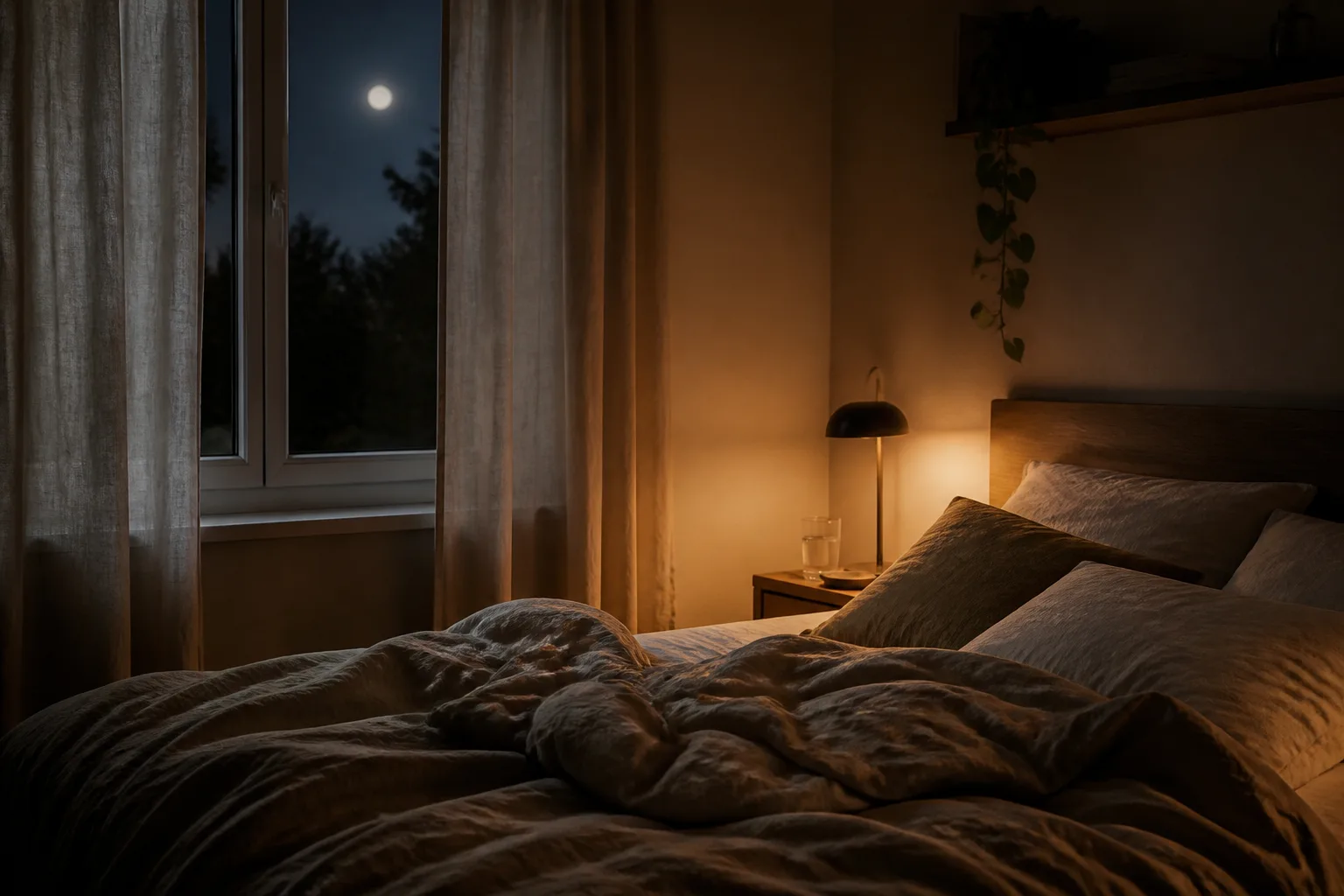
CBN Gummies vs. Indica Flower for Sleep: Which One Actually Keeps You Asleep?

Jamie
Head Cultivator
If you fall asleep fine but wake up staring at the ceiling at 3am, the question is not "indica or CBN brand." It is timing. Inhaled flower hits fast and fades. A gummy comes on slow and lasts longer. That gap — not the indica sticker — is what decides whether you stay asleep.
That 3am wake-up hits hard across metro Detroit: auto plants, hospitals, and trades run rotating and third shifts, so a lot of people here sleep days and still fight mid-"night" wake-ups. Michigan winters add another drag — shorter daylight and darker mornings make sleep schedules easier to wreck. This post is for that clock, not for a fairy-tale indica label.
CBN Gummies vs. Indica Flower: Head-to-Head Comparison #
For staying asleep through the night, a longer-acting oral product (like a CBN gummy) usually fits better than indica flower smoked at lights-out. Flower wins when you need to fall asleep now. The clock — not the jar sticker — decides.
| Factor | CBN gummy (oral) | Indica-leaning flower (inhaled) |
|---|---|---|
| How fast it kicks in | Often 45–120+ minutes before you feel much | Often minutes (peak blood THC commonly within ~10 minutes) |
| How long the main feel lasts | Often 4–8+ hours for oral cannabis effects | Often ~2–3 hours for the main acute effects |
| Best for falling asleep | Slow — you must dose early | Strong fit if you need quick onset |
| Best for staying asleep | Stronger fit for 2–4am wake-ups | Weak fit alone if effects fade mid-night |
| Next-morning feel | Higher risk of leftover grogginess if dose/timing is off | Usually clearer by morning if you only used a small bedtime hit |
| Dose control | Precise milligrams on the label (if lab-tested) | Harder — puff size, pot strength, and lungs vary |
| Cost per night | Often higher per use; one gummy = one dose | Can be cheaper per session; easy to overuse |
Peer-reviewed pharmacokinetics (how a drug moves through the body) put the timing gap in hard numbers. Reviews of human data report inhaled THC often peaking within about 6–10 minutes, while oral THC plasma peaks commonly land around 0.9–3 hours — and subjective edible effects can stretch several hours longer than a smoke session (PMC5890870; Health Canada).
If your problem is the 3am wake-up, start with the "how long it lasts" row — not the word "indica" on the bag. For the wider sleep map, see our cannabis and sleep complete guide.
Falling Asleep vs. Staying Asleep: Why Timing Matters More Than the Label #
Falling asleep and staying asleep are two different jobs. A product that helps you drift off in ten minutes can still leave you wide awake at 3am if its effects are gone by then.
Sleep doctors split insomnia into types. Two matter here:
- Sleep-onset insomnia — you lie awake a long time before you drop off.
- Sleep-maintenance insomnia — you fall asleep, then wake too early or too often (the classic 3am stare).
Cannabis does not "fix insomnia" as a single disease. It changes how long you feel sedated (sleepy and slowed down). That means you match the tool to the clock:
| Your problem | What you need | Better first fit |
|---|---|---|
| Can't fall asleep | Fast onset | Inhaled flower (or a fast sublingual) |
| Wake at 2–4am | Effects still present mid-night | Oral edible / gummy timed earlier |
| Both | Staggered plan or clinician help | Often oral base + careful small inhale — not more of the same wrong tool |
A clinical review of cannabis and sleep notes that THC may shorten time to fall asleep in the short term, while withdrawal from regular use is more consistently tied to bad sleep and rebound insomnia (PMC8116407). In plain English: the plant can help you knock out tonight — and make nights worse later if you lean on it every night.
Practical rule for Divine Toke readers on Detroit early shifts: if your alarm is 5am for the plant, the hospital, or a job site, treat leftover morning fog as a safety issue, not a soft inconvenience. That pushes you toward smaller doses, earlier edible timing, and honesty about whether flower alone can cover a full night. For how flower highs differ from slower oral routes, see tincture high vs flower high.
How Fast Does Flower Hit — and How Fast Does It Fade? #
Smoked or vaped flower usually hits in minutes and the main "high" often fades in about two to three hours. That is why a bedtime bowl can put you out — then leave a hole in the night when blood levels drop.
Here is the simple pharmacokinetics (body timing) picture from human reviews:
| Route | Typical time to peak in blood | Typical main effect window |
|---|---|---|
| Inhaled (smoke/vape) | Roughly 3–10 minutes (often ~6–10) | Often ~2–3 hours for the strongest effects |
| Oral (edible/gummy) | Roughly 1–3 hours | Often several hours longer than inhaled |
A pharmacokinetics review of cannabis notes peak THC after inhalation within minutes, with acute brain effects tapering in a few hours, while oral dosing is delayed by digestion and first-pass metabolism (the liver processes a lot of the dose before it fully hits) (PMC5890870). Health Canada's clinician summary of cannabinoid PK matches that pattern: inhalation is fast; oral is slower and longer.
What that means at 11pm:
- You smoke at lights-out.
- You feel it by ~11:10.
- By ~1–2am, the peak is often already fading for many people.
- By 3am, you may be lightly sleeping — or fully awake — with little left of the "knockout" feel.
Flower is a sharp tool. It is not a long blanket.
What "indica" actually predicts #
The word "indica" on a jar is a weak predictor of sleep. Chemical profile — especially terpenes (aromatic plant oils) — explains more of the sedating (sleepy) feel than the indica/sativa sticker.
Chemovar research (studying cannabis by chemistry, not folklore names) finds:
- Indica-labeled cultivars sometimes lean toward low-arousal subjective effects (sluggish, slowed), but the link is messy and inconsistent (PubMed 36648357).
- Labeling itself correlates with terpenes like myrcene more than with a true botanical species split — one genomics/labeling analysis found myrcene explained about 21% of variation in indica labeling (bioRxiv preprint on cultivar labeling; see also chemovar discussions in PMC8581757).
House rule at Divine Toke: shop by lab terpene panel, not by the word indica. Ask for Dominant / Strong / Moderate / Trace levels of sleepy-leaning terpenes — not a brand story. Details live in our cannabis sleep terpene approach.
How Long Do CBN Gummies Last Compared With Smoking? #
A CBN gummy is an edible: it comes on slow and can cover more of the night than a smoke session. That longer curve is why oral products are the better default match for sleep-maintenance problems — if you time them right.
Oral cannabis does not skip the gut. Digestion and the liver stretch the timeline:
| Step | What happens | Why you care at bedtime |
|---|---|---|
| Swallow gummy | Cannabinoids ride with food through the gut | Empty vs full stomach changes onset |
| Liver "first pass" | Much of the dose is processed before it circulates | Effects feel different than smoke; often stronger late |
| Peak window | Plasma THC after oral dosing often peaks around ~1–3 hours | Take it before you want to be out — not after you're already restless |
| Tail | Effects can linger hours past the peak | Better chance of covering 2–4am — and higher grogginess risk |
A systematic look at oral cannabis PK reports edible THC plasma Tmax commonly in the 0.9–2.6 hour range, with wide person-to-person spread (PMC6922062; related oral cannabis blood PK work is summarized in Johns Hopkins oral cannabis PK). Health Canada likewise notes delayed oral onset and longer duration versus inhalation.
Blunt timing for a 5am alarm:
- Take the gummy early — many people need 60–120 minutes of lead time.
- Do not redose at 1am because "it's not working yet." That is how next-day fog gets dangerous.
- Start low. Oral doses hit harder than the same milligrams smoked because of how the liver changes THC.
CBN is only one ingredient in many "sleep gummies." Read the full label for THC and CBD. Our edible buying guide walks through what to check before you buy.
First-pass metabolism in plain English #
First-pass metabolism means your liver gets a big first swing at the dose. Smoking mostly skips that. Eating does not.
Think of smoke as a text message that arrives now. Think of a gummy as a letter that goes through the post office (your liver) first. The letter can arrive later — and the message can feel rewritten. That is why edibles:
- Take longer to start
- Can feel stronger than you expect
- Last longer into the night (and morning)
That liver path is also why "I smoked 5mg-worth and was fine, so I'll eat 10mg" is a bad plan. Different route, different ride. For more on why oral and inhaled highs feel unlike each other, see tincture high vs flower high.
What Does the Science Actually Say About CBN for Sleep? #
The honest answer: CBN's sleep evidence is still thin, and "the sleepy cannabinoid" is mostly a marketing nickname. Early human trials show modest, mixed signals — not a slam-dunk sleep drug.
CBN (cannabinol) is a minor cannabinoid that forms as THC ages and breaks down. Brands love the bedtime story. Science is more careful.
What the better human data actually shows:
| Claim you hear | What trials roughly show | Source quality |
|---|---|---|
| "CBN knocks you out" | Not a clear, strong hypnotic like a prescription sleep pill | Reviews note scant objective support historically (PMC8612407) |
| "CBN fixes insomnia" | Limited RCTs; effects are modest and mixed | Newer placebo-controlled work is still small |
| "CBN cuts night waking" | A randomized, double-blind, placebo-controlled study of 20 mg CBN nightly found fewer nighttime awakenings / less overall sleep disturbance vs placebo — but did not cleanly improve sleep-onset latency or several other sleep measures | PubMed 37796540 / PMC10450062 |
| "Any CBN gummy equals the study" | Retail servings vary; many products also include THC/CBD | Label ≠ trial formula |
Key trial details worth keeping:
- The 20 mg CBN nightly study ran about a week in a double-blind, placebo-controlled design and reported reduced nighttime awakenings and sleep disturbance versus placebo (PMC10450062).
- Adding CBD in that research stream did not clearly boost the sleep benefit (PubMed 37796540).
- Older "CBN is sedating" lore often leaned on CBN + THC together, not CBN alone — so it does not prove CBN is the magic sleepy piece (PMC8612407).
So why mention CBN gummies at all for 3am waking? Because oral timing may still help sleep-maintenance more than a short flower hit — even if CBN's special reputation is oversold. The edible clock can matter more than the CBN halo. For how minor cannabinoids fit the bigger picture, see minor cannabinoids explained.
CBN alone vs CBN plus THC #
Many "CBN sleep" products are not CBN-only. They are stacks: CBN + THC, or CBN + CBD + THC.
That matters because:
- THC has clearer short-term effects on sleep onset for some people — and clearer next-day impairment risk (PMC8116407; AASM clinician viewpoint on cannabis and sleep).
- A product that "works" may be working from the THC, not the CBN badge.
- NIH/clinical commentary on OTC cannabinoid sleep products also flags limited evidence and possible Δ9-THC contamination in some non-pharmacy products (PMC9036386).
Checklist before you trust a CBN label:
- Full cannabinoid panel (CBN and THC/CBD amounts)
- Third-party lab QR / COA
- Serving size in milligrams — not just "sleep blend"
- Your own morning function after a test night (not a work night)
If a brand promises hospital-grade sleep from CBN alone, treat that as sales copy until a bigger evidence base exists.
Indica Flower for Sleep: Useful Tool, Wrong Job for 3am Wake-Ups #
Indica-leaning flower can be a great tool for falling asleep — and a weak solo plan for staying asleep. Fast onset is the feature. Short duration is the bug when your night breaks at 3am.
Use flower when:
- You need help within minutes
- Pain or racing thoughts are blocking sleep onset
- You can keep the dose small so morning work stays safe
Do not expect a bedtime bowl alone to cover:
- Early-morning wake-ups after a long gap from peak
- Eight hours of sedation from a two-to-three-hour effect window
- "Indica = automatic deep sleep" just because of the name
Polysomnography (sleep-lab) research on cannabis is mixed: acute THC has been linked in some studies to less REM sleep (the dream-heavy stage) and sometimes more slow-wave sleep, but reviews stress inconsistency across trials (PMC8116407; PMC11446118). What is more consistent: stopping regular use often brings insomnia and REM rebound (PMC8116407). So flower is not free sleep insurance — it is a short-acting plant tool with a withdrawal bill if you use it nightly for months.
| Flower job | Fit | Why |
|---|---|---|
| Lights-out onset | Good | Minutes-to-peak PK |
| Covering 3am | Poor alone | Main effects often fade in ~2–3 hours |
| Next-morning clarity after a tiny hit | Often OK | Shorter tail than many edibles |
| Nightly forever | Risky | Tolerance + rebound sleep problems |
At Divine Toke we talk about sun-grown organic flower as a clean input — not as a magic sleep brand name. Chemistry still leads.
Myrcene, linalool, and the "couch-lock" story #
Couch-lock is a vibe people describe — not a lab guarantee from the word indica. Terpenes like myrcene (earthy/mango-like aroma) and linalool (lavender-like) are the better sniff/label clues for a heavier, sleepy feel. Evidence is still mostly associative, not a prescription formula.
Directional (not percentage) shopping guide:
| Terpene | Common smell cue | Sleep-relevant note |
|---|---|---|
| Myrcene | Earthy, herbal, mango-ish | Most discussed sedating-leaning terpene in cannabis chemotype talk; linked in labeling research to "indica" reputation (bioRxiv cultivar labeling analysis; PMC8581757) |
| Linalool | Floral, lavender | Often discussed for calm; human sleep dose rules are not settled |
| Terpinolene | Fresh, piney/herbal | Often more "up" / alert in consumer reports — not a classic lights-out marker |
| Beta-caryophyllene | Peppery | More CB2 / body calm talk than pure "knockout" |
Do not memorize "Strain X has 1.1% myrcene." Batch variation makes that noise. Ask for Dominant / Strong / Moderate / Trace on the COA, then buy the jar in front of you. Full walkthrough: cannabis sleep terpene approach.
Which Option Fits Sleep-Onset Insomnia vs Sleep-Maintenance Insomnia? #
Match the product to the problem: fast flower for can't-fall-asleep nights; longer oral options for wake-at-3am nights. Mixing both without a plan is how people overshoot and feel wrecked at 5am.
Decision table:
| Pattern | First-line cannabis profile | Timing | Watch-outs |
|---|---|---|---|
| Lie awake 45+ minutes | Inhaled flower with sleepy-leaning terpenes | Near lights-out | Don't chase with huge hits |
| Fall asleep, wake 2–4am | Oral gummy / edible (CBN products included) | 60–120 min before bed | Morning grogginess; don't redose late |
| Both onset + mid-night waking | Oral base timed early; tiny flower only if still awake at lights-out | Stagger, don't stack heavy | Easy to overdo — pick one change per week |
| Sleep apnea, loud snoring, gasping | Not a DIY cannabis fix | See a clinician | Cannabis is not CPAP |
Why this maps to PK, not folklore:
- Inhaled THC peaks in minutes and the main ride is short (PMC5890870).
- Oral THC peaks later and lasts longer (PMC6922062; Health Canada).
- CBN's best-studied sleep signal so far is more about nighttime awakenings / sleep disturbance at 20 mg in a short RCT — not a guaranteed eight-hour cure (PMC10450062).
Hybrid strategy that stays honest:
- Fix one problem this week (onset or maintenance).
- Keep dose low for three nights before changing anything.
- Track wake-ups and how sharp you feel at clock-in.
- If you still wake at 3am on a properly timed edible, the answer may be sleep apnea, stress, pain, alcohol, or caffeine — not "a stronger indica."
For the full sleep stack (hygiene + cannabis), start with the cannabis and sleep complete guide.
Risks You Should Not Ignore: Grogginess, Tolerance, and Drug Tests #
If you swing a hammer, drive a truck, or climb a ladder at dawn, next-day grogginess is a safety risk — not a soft side effect. THC is the bigger driver of impairment, tolerance, and most drug-test positives; CBN products can still contain THC.
| Risk | What it looks like | What the literature flags |
|---|---|---|
| Next-day fog | Slow reaction, heavy head, unsafe on tools | Cannabis used as a sleep aid has been linked to greater next-day fatigue in diary research even when sleep feels longer (PMC9036386; clinician sleep viewpoints also caution daytime sleepiness — AASM) |
| Tolerance | Same bedtime dose stops working | Nightly use can blunt the sleep benefit over time (PMC8116407) |
| Rebound insomnia | Sleep crashes when you stop | Withdrawal commonly disrupts sleep and can trigger REM rebound (PMC8116407) |
| Drug tests | Failed urine screen at work | Standard workplace panels look for THC metabolites; CBN marketing does not make a product "test-proof," especially if THC is present or the product is contaminated (PMC9036386) |
| Dependence pattern | You "can't sleep without it" | That is a warning light — talk to a clinician, don't just keep raising the dose |
Hard rules for physical jobs:
- Never test a new edible dose the night before a workday.
- Earlier + lower beats later + stronger for morning safety.
- Assume THC is in the gummy until the COA proves otherwise.
- Plan nights off so your brain still remembers how to sleep without a plant crutch.
Next-day safety for early shifts #
Treat 5am like a safety deadline. If an edible still has you foggy when the alarm hits, the dose or timing failed — even if you "slept through" the night.
Practical cut lines:
- Prefer a smaller oral dose timed earlier over a heavy dose at midnight.
- Prefer a tiny flower hit over "one more bowl" when you are already half asleep.
- If mornings are foggy two days in a row, cut dose or pause — do not "push through" on a job site.
- Alcohol plus cannabis for sleep is a bad stack for both sleep quality and morning function.
The American Academy of Sleep Medicine has urged clinicians to take cannabis-and-sleep questions seriously, including impairment and disorder screening — not treat weed as a harmless nightcap. That matches real life on a 5am crew.
How to Choose Without Overpaying for Hype #
Buy for timing and lab numbers — not for "sleepy cannabinoid" ads. A clean COA and an honest plan beat a fancy sleep gummy name.
Shopping checklist:
- Name your problem — onset, maintenance, or both.
- Pick the clock tool — flower for fast onset; oral for longer cover.
- Read the full panel — THC, CBD, CBN, and terpenes if listed.
- Verify the COA — batch matches the jar/gummy pack.
- Start low for three nights — change only one variable.
- Judge mornings — if you feel unsafe at work, the product failed.
Label red flags:
| Red flag | Why it matters |
|---|---|
| "CBN for deep sleep" with no milligrams | You cannot compare to any trial dose |
| No THC listed on a "hemp sleep" gummy | Still may contain THC — demand a COA (PMC9036386) |
| Indica name with no terpene data | You are buying folklore |
| "Non-habit-forming" absolute claims | Nightly cannabis can still create rebound sleep debt (PMC8116407) |
Dose honesty:
- The clearest CBN sleep RCT signal people cite uses 20 mg CBN nightly in a short trial — not a free pass to mega-dose retail gummies (PMC10450062).
- Retail products vary widely; if a label's milligrams are unclear, treat dosing qualitatively (low / medium) and go slower — do not guess from internet folklore.
- THC in the same gummy may be doing more of the "knockout" than CBN.
Sleep hygiene still wins more nights than any jar:
- Same bedtime most nights
- Dark, cool room
- Cut caffeine after mid-afternoon
- No doomscrolling in bed
- Treat loud snoring / gasping as a medical visit, not a weed problem
If you're shopping edibles, use the edible buying guide. If you're comparing delivery methods, use tincture high vs flower high. And if you want the full sleep map, stay with the cannabis and sleep complete guide.
Buying Sleep Products in Michigan #
A Michigan-compliant gummy pack should tell you the THC milligrams per serving — and adult-use edibles are capped so one serving is not a mystery mega-dose. Read that number before you buy a "sleep" brand story.
What Michigan shoppers should expect:
- The Michigan Cannabis Regulatory Agency's technical bulletin on edible THC limits sets adult-use edible maxima at 10 mg THC per serving and 200 mg THC per package (with the rule framework's allowed variance). That is the ceiling math — not a recommendation to take 10 mg your first night.
- Sale labels still fall under Michigan CRA R 420.504: you should see potency info, the lab that ran passing compliance testing, the analysis date, the universal symbol, and required warnings. Use those fields to confirm the pack is a real Michigan adult-use product, then check mg THC per piece / per serving.
- CBN sleep gummies often also contain THC. Michigan's serving limit is about THC, so a "CBN" badge does not erase the THC dose on the label.
- Flower sold in Michigan shows THC/CBD and lab info on the CRA-required label, but terpene panels are not required on that label. If you want myrcene- or linalool-leaning flower for lights-out, ask the budtender for the full sheet — same habit as our cannabis sleep terpene approach.
Detroit-area timing tip: if you work third shift or swing shift, "bedtime" is whatever clock you sleep on. Dose from your lights-out, not from a 11pm national blog template. And in the darkest Michigan months, protect sleep hygiene first — dark room, consistent schedule — before you stack a heavier edible.
Frequently Asked Questions #
Should I take a CBN gummy or smoke indica flower if I keep waking up at 3am? #
Usually start with a carefully timed oral option (a CBN or sleep gummy) — not a late indica bowl alone. Waking at 3am is sleep-maintenance insomnia: you need effects that still cover the mid-night window. Inhaled THC often peaks in minutes and the main effects commonly fade in about 2–3 hours, while oral cannabis peaks later and lasts longer (PMC5890870; Health Canada). Flower is still useful if your real problem is falling asleep.
Does CBN actually help you sleep, or is that mostly marketing? #
Mostly marketing with a thin, early evidence base — not a proven sleep cure. A placebo-controlled trial of 20 mg CBN nightly reported fewer nighttime awakenings / less sleep disturbance than placebo, but it did not cleanly prove CBN is a strong sleep-onset drug (PMC10450062). Older reviews already warned that sedating claims for CBN lacked strong objective support (PMC8612407).
How long before bed should I take a CBN gummy? #
Often 60–120 minutes before you want to be asleep — not when you are already frustrated in bed. Oral THC plasma peaks commonly fall around ~1–3 hours after dosing (PMC6922062). Taking a gummy at midnight and then redosing because "nothing happened" is a classic next-day fog trap.
Why does indica flower knock me out then leave me awake at 3am? #
Because the timing curve is short, not because the jar lied about being "indica." Fast onset helps sleep onset; a ~2–3 hour main effect window often fails sleep maintenance (PMC5890870). The indica label itself is a weak predictor compared with the actual chemical profile (PubMed 36648357).
What dose of CBN was actually studied for sleep? #
One of the clearest published sleep RCTs used 20 mg CBN nightly for about a week. That study linked 20 mg to fewer nighttime awakenings versus placebo (PubMed 37796540; PMC10450062). Retail gummies vary; do not assume your pack matches the trial formula, especially if THC is also in the blend.
Will CBN gummies make me fail a drug test? #
They can — especially if the product contains THC or THC contamination. Workplace urine tests typically look for THC metabolites, not a friendly "CBN only" story. Clinical commentary on OTC cannabinoid sleep products warns about limited evidence and possible Δ9-THC content (PMC9036386). If your job tests, read the COA and assume risk unless counsel says otherwise.
Is indica always better for sleep than sativa? #
No. Indica/sativa stickers are a weak sleep predictor. Chemovar research points more to chemical profile — including terpenes like myrcene — than to folk labels (PMC8581757; PubMed 36648357). Shop the lab panel in front of you.
Can I use flower to fall asleep and a gummy to stay asleep? #
Yes, but only with a staggered, low-dose plan — stacking heavy is how mornings get dangerous. Use a small oral dose early for cover, and only a tiny inhaled amount at lights-out if you still cannot drop off. Change one variable at a time, and never "test" a new stack before a physical workday (AASM cannabis-and-sleep viewpoint).
What about next-day grogginess if I have a 5am alarm? #
Treat it as a job-site hazard. Cannabis used for sleep has been linked to greater next-day fatigue in research summaries even when sleep feels longer (PMC9036386). Earlier timing and lower oral doses beat midnight mega-doses. If you feel unsafe, cut dose or skip — do not tough it out on machinery.
Does cannabis mess with REM sleep? #
It can, especially with THC — but findings are mixed across studies. Some human sleep-lab work links acute THC to less REM and longer REM latency; reviews also report inconsistent results (PMC8116407; PMC11446118). Stopping regular use often brings REM rebound and rough nights.
How do terpenes change the sleep feel of flower? #
Terpenes help explain why one jar feels heavier than another — more than the word indica does. Myrcene is the terpene most often tied to sedating-leaning chemotypes and even to indica labeling patterns in research (bioRxiv cultivar labeling analysis). Use Dominant/Strong/Moderate/Trace language from the COA, not memorized strain percentages. See cannabis sleep terpene approach.
When should I skip cannabis and see a doctor about sleep? #
Skip the DIY weed plan if you snore loudly, gasp, choke, fall asleep while driving, or your sleep crash is sudden and severe. Those can signal sleep apnea or another medical issue cannabis will not fix. The AASM urges clinicians to screen sleep disorders seriously rather than wave cannabis through as harmless. Also get help if you cannot sleep without rising doses night after night.
The Bottom Line From Divine Toke #
If you keep waking at 3am, stop asking "indica or CBN brand" and start asking "does this last long enough?" Flower is the fast tool. An oral gummy is the longer tool. CBN's special sleep reputation is still underbuilt — so buy timing, labs, and morning safety, not slogans.
At Divine Toke in Detroit, Michigan, we grow sun-grown organic flower for people who want clean inputs and honest education — not fairy-tale sleep claims. Read the panel. Time the dose. Protect the 5am shift.
Go deeper here:
- Cannabis and sleep complete guide
- Cannabis sleep terpene approach
- Minor cannabinoids explained
- Edible buying guide
This article is for educational purposes only and is not medical advice. Always consult your healthcare provider before starting any new wellness routine.
Grown in Detroit. Shipped to your door.
Small-batch, sun-grown cannabis cultivated in living soil. Mail-order shipping to all 50 states.
You Might Also Enjoy

Cannabis and Fibromyalgia: A Complete Guide to Managing Widespread Pain
August 4, 2026 · 37 min read
Can Cannabis Kill Cancer Cells? What 6 New Lab Studies on CBD and THC Actually Show
August 2, 2026 · 36 min read

National Wellness Month: Building a Cannabis Wellness Routine That Actually Sticks
August 1, 2026 · 29 min read