Cover Crops, Companion Planting, and the Garden Ecosystem

Jamie
Head Cultivator
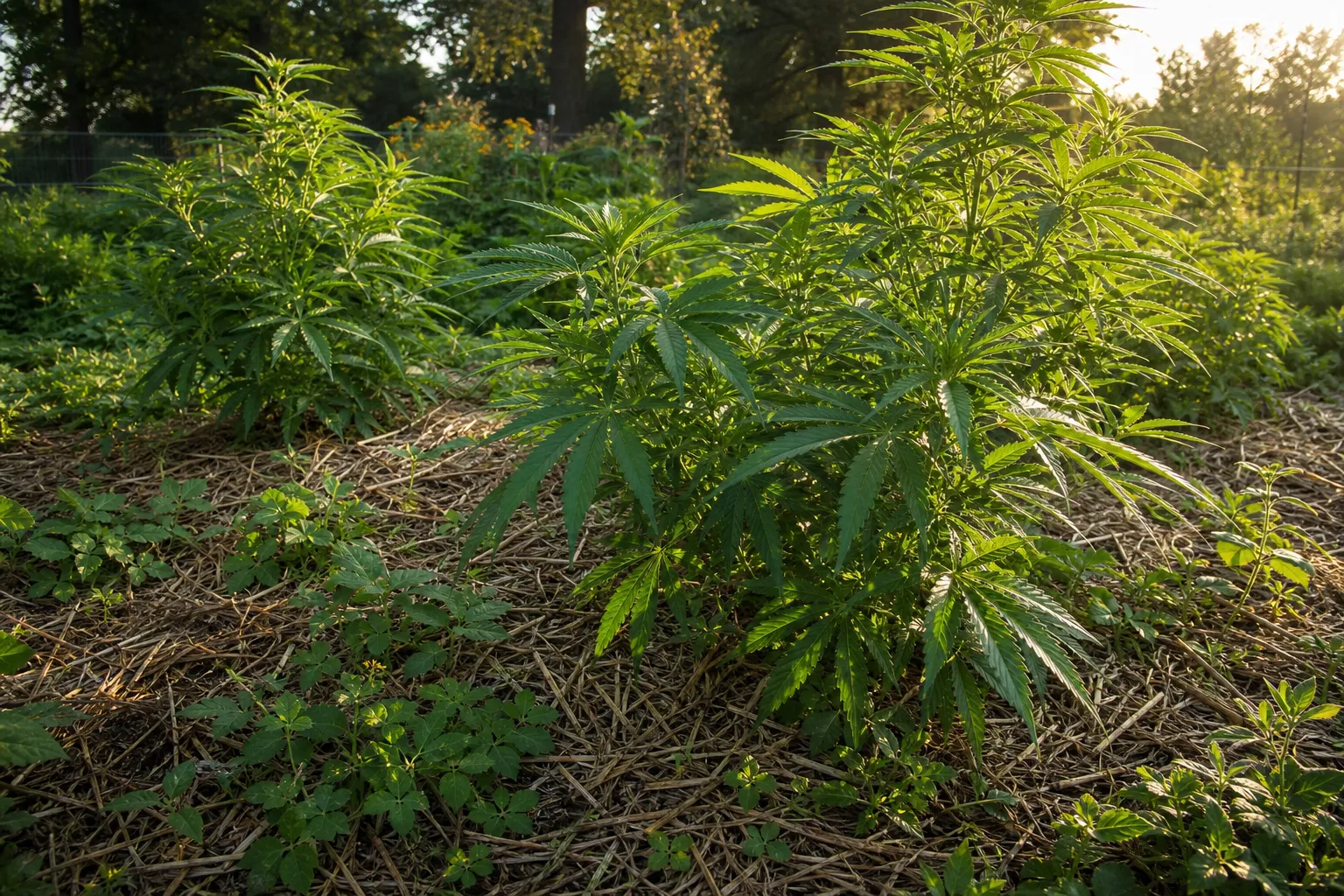
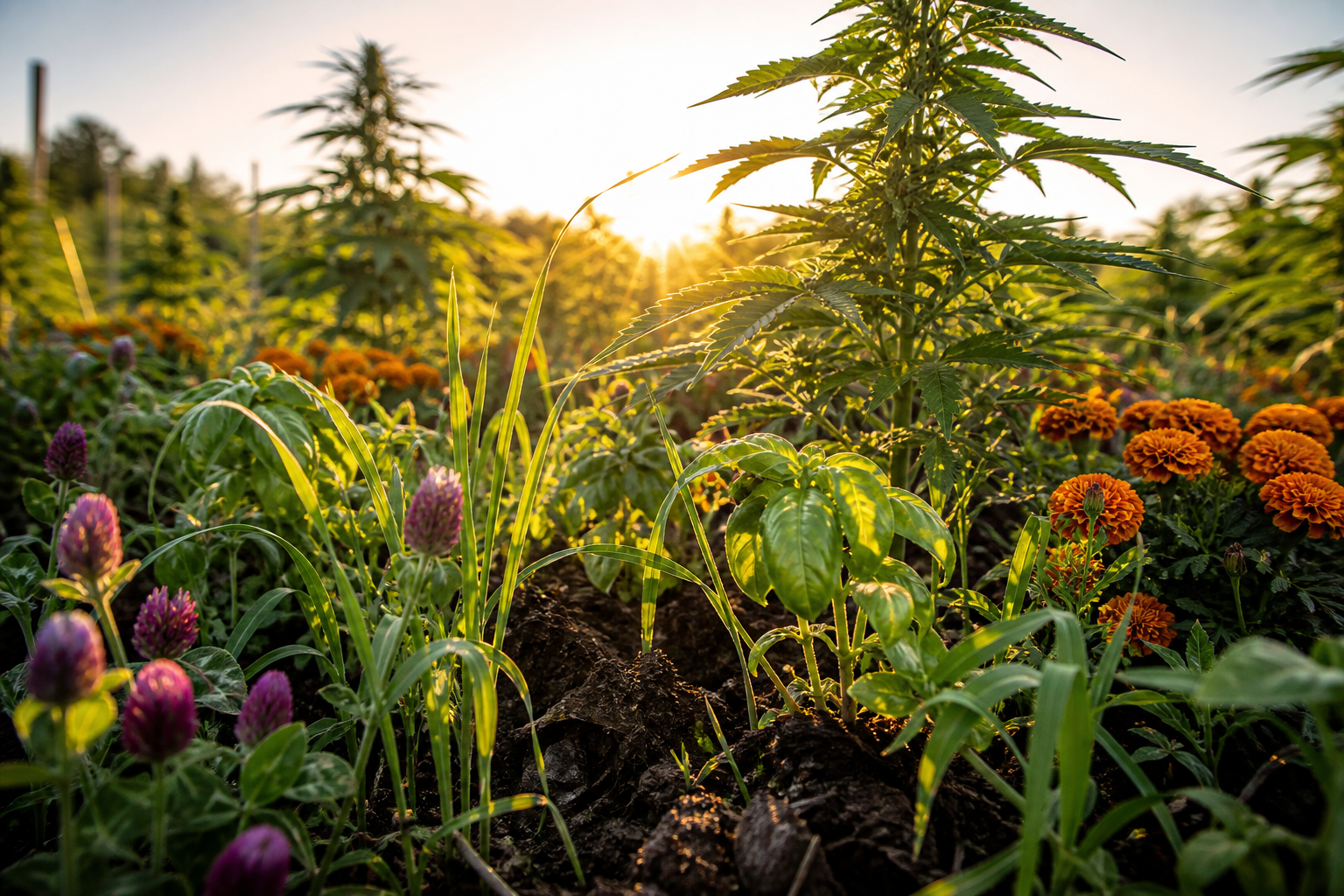
Cover crops and companion plants make cannabis cleaner, tastier, and more complex by building living soil, feeding beneficial microbes, and supporting natural pest control without synthetic chemicals. If you've ever driven past a small organic farm and noticed clover growing between crop rows, or marigolds blooming beside vegetables, you've seen these practices in action. These aren't just pretty additions — they're workhorses that create healthier soil, attract helpful insects, and keep pests away without a single spray. At Divine Toke — a Detroit-area Michigan sun-grown farm — we use these same principles inside a short southeast Michigan outdoor season. Here's why they matter, how they work, and what they mean for the flower you bring home.
What Are Cover Crops and What Do They Do for Soil? #
Cover crops are plants grown specifically to protect and improve the soil, not for harvest. Think of them as a living blanket for your garden beds — they shield the earth from harsh weather, feed beneficial microbes, and prevent weeds from taking over. At Divine Toke, we plant cover crops between cannabis cycles and sometimes right alongside our plants to keep our living soil thriving year-round.
The most popular cover crops for cannabis farming fall into three main groups:
| Cover Crop Type | Examples | Primary Benefit |
|---|---|---|
| Nitrogen-fixing legumes | Clover, hairy vetch, Austrian winter pea | Pull nitrogen from air into soil |
| Grasses | Rye, winter wheat, oats | Deep roots prevent erosion, suppress weeds |
| Broadleaves | Buckwheat, mustard | Quick growth blocks weeds, scavenges nutrients |
Each type solves different problems. Legumes like clover and hairy vetch are the nitrogen factories — they partner with soil bacteria to capture nitrogen gas from the air and convert it into plant food. This process, called nitrogen fixation, can add 25 to 75 pounds of nitrogen per acre naturally, reducing or eliminating the need for synthetic fertilizers.
Grasses like rye are erosion fighters. Their dense, fibrous root systems grip the soil and hold it in place through Michigan's freeze-thaw cycles and spring rains. Rye also germinates in cold temperatures as low as 34°F, making it perfect for late fall planting after harvest. Some grasses even release natural compounds that stop weed seeds from sprouting — a phenomenon called allelopathy.
Buckwheat is the sprinter of the group. It grows rapidly, smothering weeds before they can establish. It also mines phosphorus from deep in the soil, making this essential nutrient available to future cannabis plants. When it's done growing, buckwheat decomposes quickly, adding organic matter without tying up nitrogen during the critical flowering phase.
Cover crops also improve soil structure in ways you can't see but your plants definitely feel. Their roots create channels that let air and water penetrate deeper. When the plants die and break down, they feed earthworms and microbes that build the soil food web — the foundation of nutrient cycling in a regenerative system.
How Nitrogen Fixation Works (The Simple Version) #
Nitrogen fixation is the process where certain plants pull nitrogen from the air and convert it into a form other plants can eat. The air we breathe is about 78% nitrogen, but most plants can't use it directly — it's like having a pantry full of food locked behind a door with no key. Legumes partner with special soil bacteria called rhizobia to unlock that door.
Here's how the partnership works: when legume seeds sprout, rhizobia bacteria in the soil invade the plant's roots and set up shop in small bumps called nodules. The plant feeds the bacteria sugars and water. In return, the bacteria convert atmospheric nitrogen into ammonia — a form of nitrogen the plant can absorb through its roots. It's a classic win-win deal that's been happening in nature for millions of years.
You can actually see nitrogen fixation happening if you dig up a legume root and slice open a nodule. Young nodules look white or gray inside. But as they mature and start fixing nitrogen, they turn pink or reddish. That color comes from a protein called leghemoglobin — similar to the hemoglobin in your blood — that regulates oxygen flow to the bacteria so they can work efficiently.
Why does this matter for cannabis? Nitrogen is the nutrient cannabis plants need most during their vegetative growth phase. It's the building block of chlorophyll, which makes leaves green and powers photosynthesis. It's also essential for amino acids, the building blocks of proteins that drive every cellular process in the plant. When your cover crop fixes nitrogen naturally, you get:
- Slow-release nutrition that feeds plants gradually instead of shocking them
- Improved soil biology that supports better nutrient cycling
- No synthetic fertilizer runoff that pollutes waterways
- Cost savings on inputs over multiple growing seasons
One important note: if you're planting a legume cover crop on soil that hasn't grown that type of legume before, you may need to inoculate the seeds with the right strain of rhizobia bacteria. Inoculant is inexpensive and ensures those nodules form properly so the nitrogen factory can start production.
The Best Cover Crops for Cannabis Farms #
The best cover crops for cannabis depend on your climate, season, and specific soil needs. At Divine Toke in Michigan, we rotate several types throughout the year to maximize benefits — and that calendar is set by southeast Michigan frost windows, not California vibes. MSU Extension's Lower Peninsula garden calendar puts average last spring frost around May 1–May 15 in USDA zone 6a (common mental map for much of the Detroit metro) and lists September as the classic month to plant cover crops after the cash crop is done. NWS Detroit/Pontiac marks October as when the growing season ends across the forecast area — so fall covers have to establish before that hard stop. Here's a breakdown of our favorites and when to use them:
Crimson Clover #
Crimson clover is a go-to for spring and fall plantings. It fixes substantial nitrogen, grows quickly, and produces beautiful red flowers that attract pollinators. It also works well as a living mulch between cannabis rows during the growing season, suppressing weeds while feeding the soil. In a Detroit-area Michigan season, we often plant it in early spring before transplant risk eases, then mow it and let it decompose as a green manure.
Hairy Vetch #
Hairy vetch is a nitrogen powerhouse that produces even more plant-available nitrogen than clover. It's cold-hardy and continues fixing nitrogen late into fall when other cover crops slow down. The thick vines also do an excellent job smothering weeds. The only downside is that it can become invasive if not managed — it needs to be terminated before it sets seed.
Winter Rye #
Winter rye is our erosion prevention champion. It germinates in near-freezing temperatures and keeps roots in the ground through Michigan winters, holding soil in place during freeze-thaw cycles — the same Great Lakes freeze-thaw that can leave bare beds crusty and eroded by March. Its deep roots break up compaction layers, and it scavenges nitrogen that might otherwise leach away during the off-season. Come spring, once metro Detroit nights settle past the average frost window, we mow it and either till it in lightly or use it as mulch.
Buckwheat #
Buckwheat is our summer cover crop of choice. It matures in just 6-8 weeks, produces abundant flowers for pollinators, and mines phosphorus from the subsoil. Because it decomposes rapidly after termination, it won't tie up nitrogen when we need it for flowering cannabis. It's also great at suppressing tough weeds like thistle and quackgrass.
Austrian Winter Pea #
This legume produces high nitrogen content with a low carbon-to-nitrogen ratio, meaning it breaks down quickly and releases nutrients fast. The tender shoots are also excellent food for beneficial insects. It's less cold-hardy than rye or vetch, so we plant it in early fall or use it in spring mixes.
| Crop | Best Season | Main Benefit | Management Notes |
|---|---|---|---|
| Crimson clover | Spring/Fall | Nitrogen + pollinators | Living mulch or green manure |
| Hairy vetch | Fall | Maximum nitrogen | Terminate before seed set |
| Winter rye | Late fall | Erosion control | Allelopathic — suppresses weeds |
| Buckwheat | Summer | Quick weed suppression | Fast decomposition |
| Austrian winter pea | Early fall | Fast nitrogen release | Less cold-hardy |
The key to success is diversity. We often plant mixes — like clover and rye together — so we get multiple benefits at once. The legume provides nitrogen, the grass provides carbon and erosion control, and together they feed a more diverse soil microbiome.
Companion Plants: Nature's Pest Control and Pollinator Magnets #
Companion plants are species grown alongside cannabis that may help repel certain pests, attract beneficial insects, or improve growing conditions without competing aggressively for resources. While cover crops typically blanket the ground between cannabis rows, companion plants intermingle with your crop — occupying the same space and creating a diverse mini-ecosystem.
This practice mimics natural plant communities where diversity creates resilience. In a monoculture (one type of plant), pests find a buffet of their favorite food with no natural predators in sight. In a polyculture with companion plants, pest insects get confused by mixed signals, beneficial predators find habitat and prey, and the whole system becomes more stable.
Here are the companion plants we rely on at Divine Toke:
Basil #
Basil is a popular cannabis companion. Its strong aromatic oils may help repel flies, mosquitoes, and thrips — tiny insects that can devastate cannabis flowers. It also attracts bees and other pollinators when it flowers. Some growers report that basil planted near cannabis improves terpene complexity, possibly through volatile compound exchange in the air, though this hasn't been confirmed in controlled cannabis-specific trials.
Marigold #
Marigolds are workhorses in the pest-control department. Their roots release compounds that suppress nematodes — microscopic worms that attack cannabis roots. Above ground, the bright flowers attract hoverflies and parasitic wasps that prey on aphids, caterpillars, and other soft-bodied pests. French marigolds (Tagetes patula) are particularly effective for nematode suppression.
Yarrow #
Yarrow's flat flower heads are like landing pads for beneficial insects. Lacewings, hoverflies, and parasitic wasps all feed on yarrow nectar and then stick around to hunt pests on nearby cannabis. Yarrow is also a dynamic accumulator — its deep roots pull minerals from the subsoil and concentrate them in the leaves, making it valuable compost material.
Dill #
Dill attracts a who's-who of beneficial insects: butterflies, ladybugs, bees, and predatory wasps. It also repels aphids and spider mites, two of cannabis's most persistent pests. The umbrella-shaped flower clusters provide excellent landing platforms for tiny beneficial wasps that parasitize caterpillars and aphids.
Lavender #
Lavender's fragrant purple spikes attract bees across a long blooming season. It produces linalool — the same calming terpene found in many cannabis strains — creating potential aromatic synergy in the garden. It's also drought-tolerant once established, making it a low-maintenance addition to outdoor grows.
Sweet Alyssum #
This low-growing flower blooms for months, drawing hoverflies and parasitic wasps that attack soft-bodied pests. It grows quickly from seed and can carpet the ground between cannabis plants, acting as living mulch while supporting beneficial insect populations.
| Companion Plant | Attracts | May Help Deter | Special Benefit |
|---|---|---|---|
| Basil | Bees, butterflies | Flies, mosquitoes, thrips (insectary plant; cannabis-specific evidence limited) | Anecdotally may support terpenes |
| Marigold | Hoverflies, parasitic wasps | Nematodes (root worms) — strongest cannabis-specific evidence | Root zone protection |
| Yarrow | Lacewings, hoverflies | General biodiversity support | Dynamic accumulator |
| Dill | Ladybugs, predatory wasps | General insectary; cannabis-specific data limited | Umbrella flowers = landing pads |
| Lavender | Bees (long season) | General insectary; cannabis-specific data limited | Drought-tolerant |
| Sweet alyssum | Hoverflies, parasitic wasps | No direct repellent | Living ground cover |
The science behind companion planting works through several mechanisms. Volatile organic compounds (aromatic chemicals plants release) can confuse pest insects searching for their host plant. Visual camouflage makes it harder for pests to locate cannabis among diverse foliage. Root communication happens through chemical signals in the soil. And habitat provision simply gives beneficial insects a place to live, feed, and reproduce near your crop.
How Companion Planting Strengthens Living Soil #
Companion planting and cover crops feed the living soil food web — the community of bacteria, fungi, protozoa, and larger organisms that makes nutrients available to plants. In a sterile system with bare dirt between rows, this food web starves. But with diverse plantings, you create a thriving underground ecosystem that supports healthier, more resilient cannabis.
Different plants feed different soil microbes through their root secretions. Legumes feed nitrogen-fixing bacteria. Grasses support fungi that build soil structure. Flowering plants feed microbes that cycle phosphorus and micronutrients. When you plant diverse companions, you support diverse microbial life — and that diversity translates directly to plant health.
Mycorrhizal fungi are among the most important soil organisms for cannabis. These microscopic fungi form partnerships with plant roots, extending their reach 300 to 800 times further into the soil than roots could reach alone. In exchange for sugars from the plant, mycorrhizae bring back water, phosphorus, and micronutrients. Early research suggests plants with strong mycorrhizal networks may support terpene and cannabinoid production — though the benefit is strain-specific and depends on which fungal isolates are present, so results vary.
Companion plants help maintain these fungal networks in two ways. First, they keep roots in the ground year-round, providing continuous hosts for fungi instead of the boom-and-bust cycle of bare fallow periods. Second, different plant species host different fungal species, increasing overall fungal diversity in the soil.
Cover crops also regulate soil temperature and moisture. Bare soil in summer can reach 120°F or higher — hot enough to kill beneficial microbes near the surface. A living cover crop canopy keeps the soil cooler and moister, creating better conditions for biological activity — useful when humid continental, lake-influenced Michigan summers swing between heat and wet stretches. In winter, that same plant cover insulates the soil, protecting microbial communities from freezing damage across a Detroit-area off-season.
The organic matter from decomposing cover crops and companion plants becomes food for earthworms, springtails, and other soil animals. These creatures physically mix the soil, create channels for air and water, and further break down organic material into forms plants can use. Their excrement — yes, worm poop — is some of the most plant-available fertilizer on earth.
At Divine Toke, our living soil beds have earthworm populations in the hundreds per square foot. That's not happening by accident — it's the result of years of feeding the soil with cover crops, compost, and diverse companion plantings. Those worms are a sign of healthy soil, and they're working 24/7 to feed our cannabis.
IPM Without Pesticides: Let Nature Do the Work #
Integrated Pest Management (IPM) is a strategy that combines prevention, monitoring, and biological controls to manage pests while avoiding synthetic pesticides. Cover crops and companion planting are the foundation of our IPM program at Divine Toke. They create an environment where pests struggle to establish, while beneficial insects thrive.
The first line of defense is prevention. Healthy plants growing in biologically active soil are naturally more resistant to pest pressure. They have stronger cell walls, better immune responses, and can outgrow minor damage. Cover crops maintain that soil health between cannabis cycles, so each new crop starts with a strong foundation.
Monitoring is the second pillar. We walk our fields daily, checking undersides of leaves and stems for early signs of trouble. Yellow sticky traps help us track flying insects and identify problems before they explode. Because we know which beneficial insects our companion plants attract, we can gauge natural predator populations just by observing what's flying around.
When pests do appear, biological control — using beneficial organisms to manage harmful ones — is our primary response. The companion plants we discussed earlier are habitat for these beneficials:
| Beneficial Insect | Target Pest | Attracted By |
|---|---|---|
| Ladybugs | Aphids, mites, soft-bodied insects | Dill, yarrow, alyssum |
| Lacewings | Aphids, thrips, caterpillars | Yarrow, alyssum, clover flowers |
| Predatory mites | Spider mites | Humid microclimate from ground cover |
| Parasitic wasps | Aphids, caterpillars, whiteflies | Dill, alyssum, marigold |
| Minute pirate bugs | Thrips, spider mites | Diverse flowering plants |
| Assassin bugs | Caterpillars, beetles, flies | Ground cover providing shade |
These beneficial insects are living pesticides. A single lacewing larva can eat 200 aphids per week. A ladybug consumes up to 5,000 aphids in its lifetime. When you build habitat for these predators through companion planting, you establish a self-sustaining defense system that requires no inputs, creates no resistance, and leaves no residue on your flower.
Beneficial nematodes — microscopic roundworms that parasitize soil pests — are another biological tool we use. These organisms attack over 200 pest species including root aphids, fungus gnats, and thrips pupae in the soil. Unlike chemical pesticides, they target specific pests while leaving beneficial soil life unharmed. We apply them as a soil drench when monitoring indicates pest pressure below ground.
Physical controls round out our IPM toolkit. Row covers exclude pests during vulnerable seedling stages. Diatomaceous earth — made from fossilized algae — scratches the exoskeletons of crawling insects without chemicals. And good old hand-picking removes caterpillars and beetles when populations are low.
The result? We haven't sprayed synthetic pesticides at Divine Toke in years. Our Sun+Earth certification requires this commitment, but more importantly, it's the right way to grow. When you work with nature instead of against it, you get cleaner flower and a healthier farm ecosystem.
Biodiversity and Terpene Quality: The Science Connection #
Biodiversity above ground supports diversity below ground — and that underground diversity directly impacts the terpenes and cannabinoids in your cannabis. This isn't hippie speculation. A federally funded research study comparing conventional tilled soil with no-till cover crop fields found dramatic differences in plant chemistry.
In the study, cover-crop-grown CBG Stem Cell cultivars showed:
- CBG levels 3.7x higher than conventionally tilled fields
- Different terpene composition — with more variation and complexity
The results were nuanced: conventional tilled fields actually had 2.2x higher CBDA levels, while cover-crop fields had dramatically more CBG. That's a meaningful tradeoff — soil management doesn't simply "make everything higher." It shifts which cannabinoids the plant expresses most. For consumers seeking full-spectrum benefits, that complexity matters. The conventional tilled fields also produced higher THC in some cases — up to 6x higher — showing these effects are cultivar-specific and not universal.
Why does soil diversity affect plant chemistry? Terpenes and cannabinoids are secondary metabolites — compounds plants produce that aren't essential for basic growth but serve ecological functions like pest deterrence, UV protection, and communication with other plants. When plants grow in biologically rich soil with diverse microbial partners, they invest more energy in producing these secondary compounds.
Specific soil organisms influence specific plant chemicals:
| Soil Organism | Effect on Cannabis |
|---|---|
| Mycorrhizal fungi | Increase nutrient absorption; may support terpene production (effects are strain- and isolate-specific, not universal) |
| Plant growth-promoting rhizobacteria (PGPR) | Can increase total terpene accumulation by up to 23% (Lyu et al. 2023, J. Agric. Food Chem., DOI: 10.1021/acs.jafc.2c06961) |
| Endophytic fungi | May improve plant stress tolerance and resilience (2025 PLOS ONE research on Metarhizium, Trichoderma, and related species) |
| Nitrogen-fixing bacteria | Provide slow-release nitrogen for steady growth and resin production |
| Soil food web diversity | Reduces plant stress, allowing energy investment in secondary metabolites |
Conventional farming with synthetic fertilizers and bare soil actually suppresses many of these beneficial organisms. Salt-based nutrients can harm mycorrhizal fungi. Tillage disrupts fungal networks. Pesticides kill the soil food web. The result is plants that may look green and grow fast but produce simpler, less diverse chemistry.
At Divine Toke, we see this difference in our testing results. Our flower consistently shows broad terpene profiles — not just myrcene and limonene, but dozens of minor terpenes in meaningful quantities. That complexity translates to more nuanced effects and richer flavor. It's the difference between a single-note tone and a full chord.
What You Can Taste, Smell, and Feel in Regenerative Flower #
Regeneratively grown cannabis may offer a different terpene profile and sensory experience compared to conventionally produced flower. When you open a jar of quality regenerative flower, many people smell layers of aroma — not a single dominant note, but a bouquet that keeps revealing new scents as you dig deeper. When you smoke or vaporize it, the flavor tends to be smooth and nuanced. Keep in mind that individual experience varies, and the science on sensory differences is still developing.
Research and consumer reports point to a few areas where differences are most commonly noted:
Richer Terpene Profiles #
The most immediate difference is in the smell. Organic, slow-grown cannabis produces more diverse terpenes — the aromatic compounds that give cannabis its distinctive scents and contribute to its effects. Studies have found that organic cultivation allows plants more time to invest in terpene production, while conventional mineral fertilizers can actually reduce terpene levels.
You might notice:
- Layered aromas that evolve as the flower cures and ages
- Stronger scent that fills a room when you open the jar
- Distinct "nose" that clearly identifies the strain's character
- Terpene persistence — the smell doesn't fade quickly
Cleaner Taste #
Synthetic pesticides leave residues that affect flavor. A 2020 study found that pesticide residues in conventional cannabis created what researchers called an "unpleasant chemical taste" and altered terpene profiles. Organic flower, by contrast, offers what consumers describe as a "cleaner, fresher taste" with no harsh aftertaste.
When you smoke regenerative flower, some consumers notice:
- Smoother smoke that's less likely to make you cough
- True flavor that matches the smell — what the nose promises, the mouth receives
- Less chemical harshness on the throat compared to heavily sprayed product
Note: ash color is not a reliable indicator of cleanliness or quality — it depends on mineral content and many other variables.
Burn Quality #
The science on "burns cleaner" is less settled than many assume — burn behavior depends heavily on moisture content, cure quality, and storage rather than growing method alone. That said, many consumers report that well-grown, properly cured organic flower stays lit more easily and burns more evenly. This is likely more about craft and care during post-harvest handling than regenerative growing per se.
The "Feel" Difference #
While everyone experiences cannabis differently, many consumers report that regeneratively grown flower provides:
- More nuanced effects — not just "high" or "stoned" but complex experiences
- Smoother onset without anxiety or racing heart
- Cleaner come-down without grogginess
- Longer-lasting effects from the full spectrum of cannabinoids and terpenes
This makes sense when you consider that the entourage effect — the synergy between cannabinoids and terpenes — works best when all those compounds are present in their natural ratios. Regenerative farming, with its emphasis on soil biology and plant health, produces that full-spectrum chemistry better than systems that push plants for rapid growth.
How to Spot Real Regenerative Claims vs. Greenwashing #
Because cannabis remains federally illegal, it cannot legally carry the USDA Organic label. This creates a confusing marketplace where companies use words like "organic," "sustainable," and "natural" without any standardized meaning. Some are genuinely doing the work. Others are greenwashing — making eco-friendly claims they can't back up.
Here's how to tell the difference:
Red Flags to Watch For #
Vague language without specifics. Be skeptical of packaging that says "organic" or "sustainable" without explaining what that means. Real regenerative farms will tell you exactly what they do — cover crops, companion planting, living soil, no-till, etc. If a brand can't explain their practices in plain English, they probably aren't doing them.
Unverified certifications. Some certifications sound impressive but require little more than an application and fee. "Clean Green" certified, for example, doesn't always mandate in-person farm inspections. Look for certifications with real standards and third-party verification.
No farm information. Can you find out where the cannabis was grown? Real regenerative farms are proud of their practices and typically share farm details, photos, and stories. If a brand hides the source of their flower behind vague "partner farms" language, that's a warning sign.
Prices too good to be true. Regenerative farming requires more labor and attention than conventional methods. If organic claims come with bargain-basement pricing, something doesn't add up. Quality regenerative flower typically costs more because it costs more to produce.
What to Look For Instead #
| Greenwashing Indicator | What Authentic Brands Do |
|---|---|
| Vague "organic" claims | Specific practices named (cover crops, living soil, no-till) |
| Mystery sourcing | Named farms with verifiable locations |
| Weak certifications | Third-party verified (Sun+Earth, Demeter, etc.) |
| No proof | Photos, videos, farm tours, detailed website info |
| Buzzword salad | Plain language explaining actual methods |
Legitimate third-party certifications in cannabis include:
- Sun+Earth Certified — requires organic practices, fair labor, and community engagement; involves rigorous in-person inspection. In 2026, Sun+Earth continues to expand through alignment with CCOF (California Certified Organic Farmers) and similar regional bodies to strengthen verification standards across states.
- Demeter Biodynamic — the oldest ecological certification, with strict standards beyond organic
- Real Organic Project — add-on certification for farms that go beyond USDA baseline
Ask questions at the dispensary. A good budtender should be able to tell you:
- Where was this flower grown?
- What makes it "organic" or "regenerative"?
- Does the farm use cover crops or companion planting?
- What's their pest management approach?
If they can't answer, ask them to find out or choose a brand that provides transparency.
At Divine Toke, we're proud of our Sun+Earth certification and happy to share details about our farming practices. We welcome questions because we believe consumers deserve to know what they're consuming and how it was grown.
Bringing It Home: Companion Planting for Small Growers #
You don't need a 10-acre farm to benefit from companion planting. Even if you're growing one or two plants in your backyard or a small tent, adding companion plants can improve your results. Here's how to scale these principles down:
Container-Friendly Options #
Basil thrives in pots and can be placed right next to your cannabis containers. It repels thrips and flies while potentially enhancing terpene development. Keep it trimmed so it doesn't shade your cannabis, and you'll have fresh herbs for cooking too.
Marigolds work beautifully in containers around the base of cannabis plants. Choose compact varieties for smaller spaces. They'll help with pest control above and below ground.
Mint family herbs (spearmint, peppermint, catnip) are aggressive spreaders in the ground — keep them in separate pots to prevent root invasion. Their strong scents confuse pest insects.
Living Mulch in Small Spaces #
White clover makes excellent living mulch for container gardens. It stays low, fixes nitrogen, and suppresses weeds. Plant it around the base of your cannabis containers or in the same large container (if it's big enough — 10+ gallons recommended).
Sweet alyssum is another low-growing option that won't compete for light. It blooms continuously, attracting beneficial insects while covering bare soil to retain moisture.
Simple IPM for Home Growers #
Even without farm-scale resources, you can use biological pest control:
| Pest Problem | Home Grower Solution |
|---|---|
| Spider mites | Release ladybugs (available at garden stores) |
| Aphids | Spray with diluted neem oil or insecticidal soap |
| Fungus gnats | Apply beneficial nematodes as soil drench |
| Caterpillars | Hand-pick at dawn and dusk |
| Whiteflies | Yellow sticky traps + reflective mulch |
Inspection routine: Check your plants every day or two. Look at leaf undersides, stem joints, and new growth. Early detection means you can handle problems with gentle methods before they become crises.
The Five-Plant Mini Ecosystem #
If you have space for a small raised bed or several large containers, try this simple combination:
- One cannabis plant (your main crop)
- One basil plant (pest repellent, possible terpene enhancement)
- One marigold (pest control, pollinator attraction)
- White clover as ground cover (nitrogen fixation, living mulch)
- One dill or yarrow (beneficial insect attraction)
This tiny polyculture creates more resilience than a single cannabis plant standing alone. The diversity confuses pests, attracts predators, and keeps the soil food web fed. Even if one companion struggles, the others continue providing benefits.
Start Simple #
If all this sounds overwhelming, start with just one companion plant. Add a basil or marigold to your next grow and observe what happens. Watch for beneficial insects. Notice if pest pressure changes. Pay attention to the smell and flavor of your final product. Then build from there.
The principles that work on our farm scale down to your backyard. Nature's patterns don't care about acreage — diversity supports health whether you're growing on 10 acres or in 10 square feet.
FAQ #
What exactly is a cover crop? #
A cover crop is a plant grown specifically to protect and improve soil rather than for harvest. Common examples include clover, rye, vetch, and buckwheat. Cover crops prevent erosion, suppress weeds, fix nitrogen from the air, and feed soil biology. They're typically planted during off-seasons or between main crops, then mowed down and left to decompose — adding organic matter and nutrients back to the soil. Think of them as a living investment in your land's future productivity.
How does nitrogen fixation actually work? #
Nitrogen fixation is a partnership between legume plants and specialized soil bacteria called rhizobia. The bacteria live in nodules on the legume's roots and convert nitrogen gas from the air into ammonia that plants can absorb. The legume feeds the bacteria sugars; the bacteria feed the legume nitrogen. When the cover crop dies and decomposes, that nitrogen becomes available to other plants. A healthy legume stand can add 25 to 75 pounds of nitrogen per acre annually — free fertilizer that doesn't wash away like synthetic alternatives.
Which companion plants work best with cannabis? #
Marigold has the strongest cannabis-specific evidence — especially for nematode suppression — making it the most well-supported choice. Basil, yarrow, dill, and lavender are mainly valued as insectary plants: they attract beneficial predators like ladybugs, lacewings, and parasitic wasps that keep pests in check. Cannabis-specific peer-reviewed data on these plants is still limited, but general horticulture experience supports their use as IPM support. Avoid onions and garlic near cannabis — they can affect terpene profiles.
Do cover crops compete with cannabis for nutrients? #
Only if managed improperly. Timing matters — cover crops should be terminated (mowed or crimped) before they set seed and while they're still actively growing. At this stage, they actually release nutrients as they decompose rather than compete for them. Legumes add nitrogen; grasses add carbon that feeds soil fungi. The key is terminating them 2-4 weeks before planting your main crop so decomposition is underway but not complete. Living mulches like white clover are the exception — they're designed to grow alongside cannabis without competition.
Can companion planting really replace pesticides? #
Companion planting is a strong IPM support tool, but it's not a stand-alone replacement for pesticides in most situations. It works best as one layer in a broader strategy. The plants attract beneficial insects — ladybugs, lacewings, parasitic wasps — that prey on cannabis pests. A diverse garden gives these predators habitat and keeps their populations stable. But companion plants alone won't stop a severe infestation. When pest pressure climbs, you'll still need to step in with organic-approved options like neem oil or insecticidal soap. Think of companion planting as building your farm's immune system, not a cure-all.
How can I tell if my cannabis was grown with cover crops? #
Ask your budtender or check the brand's website. Responsible regenerative farms will explain their practices transparently. Look for specific language about "cover crops," "living soil," "no-till," or "companion planting" — not just vague "organic" claims. Certifications like Sun+Earth require these practices. If a company can't tell you what they actually do on their farm, they probably aren't doing it. You can also check for certifications and farm photos that show diverse plantings between cannabis rows.
Does regenerative cannabis really taste better? #
Many consumers and some researchers notice a difference, though the science on taste specifically is still developing. What's better supported: soil quality can influence terpene diversity, and pesticide residues can create what researchers describe as an "unpleasant chemical taste." Regenerative cannabis may offer more layered aromas and a cleaner flavor than heavily sprayed conventional flower — but sensory experience is personal and hasn't been confirmed in large controlled human studies. What you're most likely to notice is a richer terpene nose when you open the jar.
What certifications should I look for? #
Sun+Earth Certified is the gold standard for regenerative cannabis in the U.S. It requires organic practices, fair labor standards, and community engagement — verified by third-party inspection. Demeter Biodynamic certification represents even stricter ecological standards. The Real Organic Project is an add-on for farms exceeding USDA organic baselines. Be skeptical of "Clean Green" and similar certifications that may lack rigorous inspection requirements. When in doubt, ask what the certification actually requires.
Is organic cannabis worth the extra cost? #
For consumers prioritizing clean, potent flower, yes. Organic cultivation requires more labor and attention, which increases production costs. But you're paying for flower free of synthetic pesticide residues, grown in living soil that produces fuller cannabinoid and terpene profiles. Many consumers find they use less organic cannabis to achieve their desired effects, offsetting the per-gram price difference. Plus, you're supporting farming practices that improve rather than degrade the environment.
Can I use companion plants if I only grow one or two cannabis plants? #
Absolutely. Even a single basil or marigold in a pot next to your cannabis provides pest-repellent benefits. White clover makes excellent living mulch in container gardens. Keep spreading herbs like mint in separate pots to prevent root competition. The diversity principle works at any scale — nature doesn't check acreage before delivering benefits. Start with one companion and expand as you gain confidence.
What's the difference between organic and regenerative? #
Organic focuses on what you don't do — no synthetic pesticides or fertilizers. Regenerative goes further, focusing on what you actively do to improve the land — building soil carbon, increasing biodiversity, restoring water cycles, and enhancing ecosystem health. All regenerative farming is organic, but not all organic farming is regenerative. Think of organic as "do no harm" and regenerative as "leave it better than you found it." Cover crops and companion planting are hallmarks of the regenerative approach.
How long before cover crops improve my soil? #
You'll see some benefits immediately and major improvements within 1-3 years. Immediate effects include erosion control and weed suppression from the first planting. Soil structure begins improving after the first decomposition cycle. Significant increases in organic matter, earthworm populations, and microbial diversity typically take 2-3 growing seasons of consistent cover cropping. Nitrogen fixation happens during the cover crop's life, so legumes provide benefits as soon as they're incorporated. Soil building is a long game — the longer you maintain the practice, the greater the rewards.
Closing #
If you're curious to experience the difference that living soil, cover crops, and companion planting make, check out our current selection of Sun+Earth Certified flower. Open the jar and take a deep breath — that complex, layered aroma is the signature of biodiverse farming grown for Michigan's climate, not a sealed room. When you smoke it, notice the smoothness and the full spectrum of effects. That's what happens when you work with nature instead of against it.
Regenerative farming isn't the easiest way to grow cannabis in southeast Michigan. It requires more attention, more patience, and a real respect for frost calendars than conventional shortcuts. But we believe the result — cleaner, tastier, more complex flower for Detroit and metro shoppers — is worth the effort. And we believe the planet is worth farming for, not just farming on.
For a deeper dive into our farming philosophy, read our post on what "Sun+Earth Certified" actually means or explore how living soil creates better cannabis. If you're growing at home, we hope this guide inspires you to try a few companion plants in your next cycle. Start small, observe closely, and let nature show you what she can do.
Thanks for reading. This is Jamie — stay grounded.
This article is for educational purposes only and is not medical advice. Always consult your healthcare provider before starting any new wellness routine.
Grown in Detroit. Shipped to your door.
Small-batch, sun-grown cannabis cultivated in living soil. Mail-order shipping to all 50 states.