Microdosing Cannabis: Less Weed, Better Results

Jamie
Head Cultivator
Microdosing cannabis means taking 1–5 milligrams of THC — small enough that you feel benefits without the high. For Metro Detroit shift workers, tradespeople, and anyone who wants relief from stress, mild pain, or social anxiety while staying sharp and functional, microdosing offers a different path than the "get as high as possible" approach. This guide covers exactly how much to take, the best methods, what the science says, and the honest risks — including what you need to know about driving and workplace drug tests in Michigan.
What Exactly Is Cannabis Microdosing? #
Microdosing cannabis means taking a small amount of THC — typically 1 to 5 milligrams — to get therapeutic benefits without feeling noticeably high. The goal isn't to escape reality or get stoned. It's to take the edge off, ease tension, improve focus, or smooth out social anxiety while staying fully functional and clear-headed.
This approach turns the usual cannabis narrative upside down. Most dispensaries push products with the highest THC percentages, targeting experienced users who want strong effects. Microdosing is for people who want the opposite: subtle support that doesn't interfere with work, parenting, driving, or daily responsibilities.
The Core Idea: Less Is More #
The microdosing philosophy comes from a key discovery in cannabis science called the biphasic effect — the same plant compound can produce opposite effects at different doses. Low doses often create calm, focus, and mood lift. Higher doses can trigger anxiety, fog, and impairment. Microdosing stays deliberately in the low-dose zone where the benefits show up and the problems don't.
People microdose for different reasons:
- Focus and productivity — quieting mental chatter without sedation
- Mood support — subtle elevation that helps the day flow better
- Social ease — taking the edge off without obvious impairment
- Mild pain management — taking the sharpness out of chronic discomfort
- Creativity — loosening rigid thinking patterns
- Stress resilience — buffering daily stress without checking out
A 2026 nationally representative survey published in the American Journal of Preventive Medicine (May 2026) found that roughly 3.3% of US adults currently microdose cannabis — making it the most commonly microdosed substance in the country.
At Divine Toke, our Detroit-based sun-grown collective, we see more customers asking for low-dose options — people who want cannabis in their wellness toolkit without making it their whole day. If you're new to cannabis entirely, our first-timer's guide covers the basics before you experiment with microdosing.
How Much THC Counts as a Microdose? #
A cannabis microdose is typically 1 to 5 milligrams of THC. This is far below standard recreational doses and even below typical medical starting points. To understand what this means practically, it helps to compare microdoses against the doses most people actually use.
Microdose vs. Recreational Dose Comparison #
| Dose Range | THC Amount | What You Feel | Best For |
|---|---|---|---|
| Microdose (low) | 1–2.5 mg | Subtle shift, no impairment | Beginners, highly sensitive people |
| Microdose (standard) | 2.5–5 mg | Noticeable calm and focus, still functional | Most people microdosing for daily benefits |
| Threshold dose | 5–10 mg | Mild high begins, some impairment possible | Experienced users, weekend use |
| Standard recreational | 10–25 mg | Clear high, significant impairment | Traditional edible doses |
| Strong recreational | 25–100+ mg | Intoxication, heavy impairment | Experienced users with tolerance |
For context, a typical Michigan adult-use dispensary edible is often labeled at 10 mg of THC per serving. That number is a CRA R 420.404 ceiling for adult-use infused edibles (10 mg THC per dose, 200 mg per container) — not a recommended starter dose. Microdosing starts well below that: cut a 10 mg piece into quarters and take one piece — 2.5 mg — as a first experiment, then wait.
The Sweet Spot by Goal #
Different microdose levels work better for different purposes:
| Goal | Starting Dose | Typical Sweet Spot | Notes |
|---|---|---|---|
| General focus and calm | 1–2.5 mg | 2.5–5 mg | Most people land here |
| Social anxiety relief | 1–2 mg | 2.5–4 mg | Lower is often better |
| Mild pain management | 2.5 mg | 5 mg | Slightly higher threshold |
| Creative work | 1–2 mg | 2.5–4 mg | Too much can scatter focus |
| Sleep support | 2.5 mg | 5–10 mg | Sleep often needs more than daytime use |
Starting Dose Rule #
If you've never microdosed before, start with 1–2.5 mg and wait a full 90 minutes before considering more. Do not treat a full Michigan adult-use 10 mg serving as "beginner-friendly" just because it fits on one package square. Edibles and tinctures take time to kick in, and the classic mistake — taking more because you don't feel anything yet — leads to overshooting the microdose zone entirely.
Your body chemistry, metabolism, and previous cannabis experience all affect where your personal sweet spot lands. Some people feel 1 mg strongly. Others need 5 mg to notice anything. There's no right answer — only your answer, found through careful experimentation.
For help understanding how your body processes THC, our guide to the endocannabinoid system explains the biology behind why doses affect people differently.
Why the Biphasic Effect Makes Microdosing Work #
The biphasic effect means cannabis produces opposite effects at low versus high doses — and understanding this is the key to why microdosing works. Low doses often calm anxiety, improve focus, and lift mood. Higher doses can cause anxiety, fog, and impairment. The same compound does different things depending on how much you take.
This isn't unique to cannabis. Many substances work this way — including alcohol, where a small amount relaxes you and a large amount causes problems. But with cannabis, the biphasic curve is steep and surprisingly predictable once you know to look for it.
The Science Behind the Curve #
A 2017 study from the University of Illinois at Chicago demonstrated this clearly. Researchers gave participants either 7.5 mg of THC, 12.5 mg of THC, or a placebo before a stress task. The results:
- 7.5 mg group: Reported reduced stress and tension during the task
- 12.5 mg group: Reported increased anxiety, negative mood, and stress
- Placebo group: No significant change
The difference between "helps stress" and "makes stress worse" was just 5 milligrams. This study is frequently cited because it captures what microdosers discover through experience: there's a narrow window where THC helps, and going past it backfires.
What This Means Practically #
The biphasic effect explains several things microdosers notice:
- Why more isn't better: Taking 10 mg when 5 mg works can flip the experience from helpful to unhelpful
- Why beginners get anxious: Without tolerance, even modest recreational doses hit like high doses
- Why experienced users benefit from cutting back: Heavy users often find they feel better when they drop to lower doses
- Why strain matters less than dose: Two strains with identical THC percentages can feel totally different at 2 mg versus 15 mg
Finding Your Personal Threshold #
Everyone's biphasic curve is slightly different. Finding yours requires paying attention to these signals:
| Low Dose (Working) | High Dose (Too Much) |
|---|---|
| Calm, settled feeling | Anxiety or racing heart |
| Clear, present focus | Mental fog or scattered thoughts |
| Slight mood lift | Paranoia or negative self-talk |
| Body relaxation | Heaviness or couch-lock |
| Social ease | Social withdrawal or awkwardness |
If you cross from the left column to the right, you've passed your personal threshold. The fix isn't to power through — it's to drop your dose by 25–50% next time.
The Tolerance Factor #
Regular cannabis use shifts your biphasic curve. Your receptors become less sensitive, so doses that once felt strong now feel mild. This is why many heavy users report that "cannabis stopped working" — they kept increasing their dose to chase the same effect, eventually overshooting their therapeutic window into the anxiety zone.
Microdosing may slow tolerance buildup compared to higher doses, but regular breaks are still essential — tolerance can develop even at low doses with daily use.
Best Delivery Methods for Precise Microdosing #
Precision matters when you're working with 1–5 milligrams. The best microdosing methods let you measure exact amounts, not guess based on puff size or edible piece. Different methods also produce different timelines — onset speed, peak time, and duration all vary.
Tinctures: The Microdosing Gold Standard #
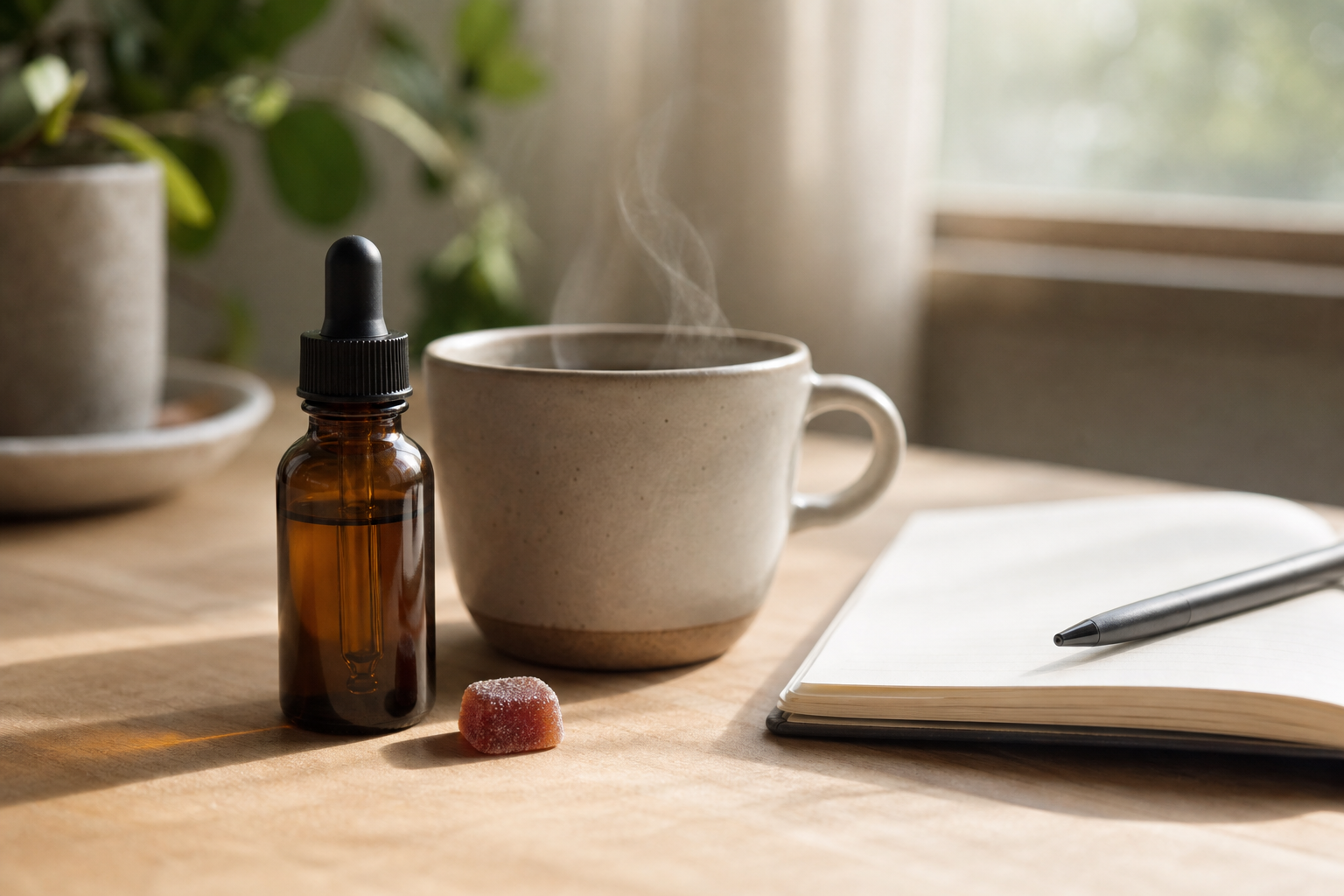
Tinctures are cannabis extract suspended in alcohol or oil, usually with a measured dropper. They're the most popular choice for microdosers because they offer exact dosing and flexible timing.
Why tinctures work for microdosing:
- Precise measurement: A typical dropper shows milliliter marks, and most tinctures list THC per milliliter (commonly 5–10 mg/mL)
- Drop-by-drop control: One drop is often 0.05 mL, meaning 0.5 mg of THC in a 10 mg/mL tincture
- Two usage modes: Under the tongue for faster onset (15–45 minutes), swallowed for slower, longer effects (60–90 minutes)
- Discreet: No smoke, minimal smell, easy to use anywhere
How to microdose with tinctures:
- Start with 0.25 mL of a 10 mg/mL tincture = 2.5 mg THC
- Hold under your tongue for 60–90 seconds before swallowing
- Wait 45–60 minutes before assessing effects
- Adjust by 0.1 mL (1 mg) next time if needed
Low-Dose Edibles: Reliable and Long-Lasting #
Edibles made for microdosing come in precise doses — 1 mg, 2.5 mg, or 5 mg pieces. They're slower to kick in but provide steady, predictable effects that last several hours.
Best edible formats for microdosing:
- Microdose gummies: Often 2.5 mg or 5 mg per piece, easy to cut smaller
- Mint strips or lozenges: Dissolve slowly, providing subtle effects
- Low-dose capsules: Most precise dosing, but slower onset
- Beverages: Some cannabis drinks offer 2.5–5 mg per serving
The edible timeline:
- Onset: 45–120 minutes (varies with metabolism and stomach contents)
- Peak: 2–4 hours after taking
- Duration: 4–8 hours total
Important: The "I didn't feel it so I took more" mistake is especially risky with microdosing. At 2.5 mg, some people feel nothing for 90 minutes, then take another 2.5 mg, then both doses hit at once. Wait the full 2 hours before redosing.
Single Inhalation: Fast but Harder to Measure #
Smoked or vaporized flower offers the fastest onset — effects begin in 1–5 minutes — but measuring exact doses is harder than with tinctures or edibles.
Making inhalation work for microdosing:
- Use a one-hitter or small pipe rather than joints (easier to control)
- Choose flower with moderate THC (12–18%), not ultra-high potency
- Take one small puff, hold briefly (2–3 seconds), exhale
- Wait 15 minutes before deciding whether to take more
- Count puffs as your dose unit rather than milligrams
The challenge: A "puff" isn't standardized. Your puff might deliver 1 mg. Someone else's might deliver 5 mg. Inhalation works better for experienced users who can feel their threshold quickly and stop in real-time.
Sublinguals and Sprays: Middle Ground Options #
Sublingual strips, sprays, and dissolvable tablets offer some benefits of both tinctures and edibles:
- Onset: 15–45 minutes (faster than edibles)
- Duration: 2–6 hours (shorter than swallowed edibles)
- Precise dosing: Usually 2.5–5 mg per unit
- Discreet and portable
Comparing Methods for Microdosing #
| Method | Onset | Duration | Precision | Best For |
|---|---|---|---|---|
| Tincture (under tongue) | 15–45 min | 4–6 hours | Excellent | Daily routine, exact dosing |
| Tincture (swallowed) | 60–90 min | 5–8 hours | Excellent | All-day coverage |
| Low-dose edible | 45–120 min | 4–8 hours | Good | Long-lasting effects |
| Single puff (flower) | 1–5 min | 2–3 hours | Fair | Quick relief, occasional use |
| Sublingual strip/spray | 15–45 min | 2–6 hours | Good | Discreet, mid-speed onset |
Product Quality Matters More at Low Doses #
At microdose levels, inconsistent products become obvious. A 5 mg dose from poorly made edibles might deliver 2 mg one day and 8 mg the next. This makes finding your sweet spot impossible. Look for:
- Lab-tested products with clear COAs (certificates of analysis)
- Consistent manufacturing from reputable producers
- Accurate labeling you can trust
At Divine Toke, we emphasize clean, consistent products because microdosing only works when you know exactly what you're taking. Browse our selection of low-dose options with verified lab results.
For a deeper dive into choosing consumption methods, see our comparison guide in tincture vs. flower vs. edible.
What Does Microdosing Feel Like? #
At the right microdose, you shouldn't feel "high" in the traditional sense. Instead, most people describe a subtle shift — a quieting of mental noise, a slight smoothing of rough edges, a gentle lift in mood that doesn't impair thinking or coordination. The goal is barely perceptible change, not obvious alteration.
This subtlety surprises people who expect cannabis to feel a certain way based on past experiences with larger doses. Microdosing operates in a different zone entirely — one where functionality stays intact and the benefits show up gradually.
Common Descriptions from Microdosers #
People describe microdose experiences in consistent ways:
- "The volume turned down" — Background anxiety, self-criticism, or mental chatter quiets without disappearing entirely
- "A half-step back" — Problems feel slightly less immediate, easier to consider calmly
- "Flow state friendly" — Creative or focused work becomes easier to start and sustain
- "Social lubricant, light" — Conversations flow naturally without the "obviously altered" feeling
- "Present but not anxious" — Tuned into the moment without the stress that usually accompanies it
- "Body comfortable" — Mild tension or discomfort softens without heaviness or couch-lock
What You Shouldn't Feel #
Just as important as what microdosing feels like is what it shouldn't feel like:
| Normal at Microdose | Sign You've Taken Too Much |
|---|---|
| Slight mood lift | Euphoria or giddiness |
| Relaxed focus | Mental fog or confusion |
| Time passes normally | Time feels distorted |
| Coordinated movement | Clumsiness or unsteadiness |
| Normal conversation | Rambling or social awkwardness |
| Clear memory | Short-term memory gaps |
| Dry mouth (mild) | Heavy dry mouth or red eyes |
If you experience anything in the right column, you've passed the microdose threshold. Note the amount you took and reduce by 25–50% next time.
The "Sub-Perceptual" Debate #
Some microdosing advocates claim the dose should be "sub-perceptual" — meaning you feel absolutely nothing. This is mostly borrowed from psychedelic microdosing culture, where the standard is truly imperceptible doses.
With cannabis, pure sub-perceptual dosing often means taking so little that there's no real benefit. Most effective cannabis microdosing sits at "perceptible but subtle" — you notice a shift if you pay attention, but someone talking to you wouldn't know you'd taken anything.
Onset and Duration at Microdose Levels #
How quickly microdosing kicks in depends on your method:
Tincture (under tongue):
- First hints: 15–30 minutes
- Full effect: 45–60 minutes
- Fading: 3–4 hours after peak
Edible:
- First hints: 45–90 minutes
- Full effect: 2–3 hours
- Fading: 5–7 hours after taking
Inhalation (one puff):
- First hints: 1–3 minutes
- Full effect: 10–20 minutes
- Fading: 1.5–2.5 hours after peak
At microdose levels, the come-up is gentle rather than sudden. There's no "oh wow, here it comes" moment like with larger doses. The shift sneaks in, does its work, and fades out quietly.
Tracking Your Experience #
Because microdosing effects are subtle, keeping a simple journal helps you identify what's working:
| Date | Dose | Method | Time | Effects Noticed | Would Repeat? |
|---|---|---|---|---|---|
| Example | 2.5 mg | Tincture | 9 AM | Calmer, better focus | Yes |
After 2–3 weeks of notes, patterns emerge. You might find that 2.5 mg tinctures work great for workdays but 1 mg is better before social events. The data lets you dial in your personal protocol rather than guessing.
Microdosing for Focus, Mood, and Daily Function #
The most common reason people microdose isn't to get high — it's to function better. Microdosing appeals to people who want support for focus, creativity, mood stability, and stress resilience without the impairment that comes with traditional cannabis use.
This is a significant shift from how cannabis has historically been framed. Instead of using cannabis to escape or check out, microdosers use it to show up more fully — to work, create, connect, and manage daily demands with a little extra support.
Focus and Cognitive Performance #
Low-dose THC affects attention and focus in interesting ways. At microdose levels, many people report:
- Easier task initiation — starting projects feels less daunting
- Reduced procrastination — less mental resistance to beginning work
- Sustained attention — staying on task longer without drifting
- Quieter mental noise — less self-interruption from anxious thoughts
The mechanism: THC at low doses appears to reduce activity in the default mode network — the brain's "wandering mind" system that's active during rumination and self-referential thought. Less wandering, more present attention.
Important caveat: This effect is dose-dependent and individual. Some people find even microdoses make focus harder. If you have naturally strong focus or don't struggle with mental chatter, microdosing might not help and could hurt. The only way to know is careful self-experimentation.
Mood and Stress Support #
Many microdosers use cannabis as part of their stress management toolkit, similar to how others use meditation, exercise, or adaptogenic herbs. The benefits at low doses include:
- General calm — daily tension feels more manageable
- Stress buffering — challenging situations don't hit as hard
- Mood stabilization — fewer dramatic emotional swings
- Outlook improvement — subtle but real shift toward positive perception
While many people report mood benefits from microdosing, a major 2026 review found limited clinical evidence for cannabis treating anxiety or depression — individual responses vary significantly. The review found only low-certainty evidence that CBD alone may reduce anxiety, and no convincing evidence for THC treating mood disorders (Cannabis and Mental Health: A Review, PubMed 2026). This isn't about treating clinical depression or anxiety disorders — those require professional care. Microdosing offers everyday stress support for people whose baseline mood is generally fine but could use gentle enhancement.
Social Ease and Connection #
Social anxiety is one of the most common reasons people explore microdosing. Low-dose THC can:
- Reduce anticipatory anxiety before social situations
- Quiet the self-critical voice that makes conversation hard
- Create present-moment focus that improves listening
- Loosen rigid thinking patterns that block natural interaction
The key is staying below the threshold where social function actually degrades. Too much THC makes conversations harder, not easier — word-finding gets difficult, paranoia can emerge, and you become obviously altered. Microdosing stays in the zone where you're still yourself, just a more relaxed version.
Creative Work and Problem-Solving #
Creativity and cannabis have a complicated relationship. High doses often scatter focus and make sustained creative work impossible. But microdoses sometimes help by:
- Reducing creative anxiety — the fear of "messing up" a blank page
- Supporting divergent thinking — making new connections between ideas
- Enabling flow states — getting absorbed in the work
- Breaking rigid patterns — seeing problems from new angles
Writers, designers, musicians, and coders report using microdosing as a creative tool, typically early in their process rather than during fine-detail execution work. The benefit seems strongest for ideation and early drafting, not final editing or precise technical work.
Physical Comfort Without Sedation #
For people with mild chronic discomfort — sore backs, tension headaches, residual pain from old injuries — microdosing offers a middle path between "suffer through it" and "take heavy medication that knocks you out."
Low-dose THC provides:
- Mild pain signal dampening without full-body numbness
- Muscle relaxation without couch-lock
- Functional relief — you can still work, drive (when fully sober), and move normally
- Lower risk of dependence compared to daily opioid use
This isn't a replacement for proper medical treatment of serious conditions. But for everyday physical annoyances that make life harder, microdosing can be genuinely helpful.
Who Benefits Most from Microdosing #
Microdosing isn't for everyone. It tends to work best for:
- People with baseline anxiety that interferes with focus and presence
- Creative professionals seeking flow states
- People in physically demanding jobs with manageable chronic discomfort
- Anyone who finds standard cannabis doses too intense
- People seeking alternatives to daily alcohol or pharmaceutical use
It tends to work less well for:
- People who already have excellent natural focus
- Those with high natural THC sensitivity (even microdoses feel too strong)
- Anyone in jobs with zero-tolerance drug policies
- People who need complete cognitive clarity for safety-critical work
Integration with Daily Life #
Successful microdosing requires honest assessment of your daily demands. A construction worker operating heavy machinery, a surgeon in the OR, or a parent responsible for young children needs stricter standards than someone doing desk work with flexibility.
In Metro Detroit, that often means timing around early plant shifts, hospital rotations, warehouse starts, or the I-75 commute — not a leisurely wellness weekend. If your day includes driving, safety-sensitive work, or random testing under a CBA, treat microdosing as an after-hours or off-day tool until you know your personal response cold.
The fundamental question isn't "can I microdose?" but "can I microdose safely and effectively given my responsibilities?" For many Michigan working people, the answer is yes — with careful protocols, appropriate timing, and full awareness of risks.
CBD Ratios: How They Change the Microdose Math #
Adding CBD to your microdosing routine changes the experience significantly. CBD doesn't get you high, but it does modulate how THC works — often smoothing rough edges, reducing anxiety potential, and allowing slightly higher functional doses than THC alone.
Understanding THC:CBD ratios helps you fine-tune microdosing for specific goals. The right ratio can mean the difference between a dose that works and one that backfires.
How CBD Modulates THC #
CBD interacts with THC in several ways that matter for microdosing:
- Reduces anxiety risk: CBD appears to counteract THC's anxiety-producing effects at CB1 receptors
- Smooths the experience: The combination feels more rounded, less "edgy" than THC alone
- May extend duration: Some evidence suggests CBD prolongs THC's therapeutic window
- Protects against going too far: Having CBD in your system provides a buffer if you slightly overshoot your THC dose
This is part of the entourage effect — the idea that cannabis compounds work better together than in isolation. For microdosing, the THC+CBD combination often outperforms pure THC products.
Common Ratios and What They Do #
| Ratio (CBD:THC) | What It Means | Best Microdosing Use |
|---|---|---|
| 20:1 or higher | Mostly CBD, tiny THC | Ultra-sensitive people; daytime anxiety with minimal psychoactivity |
| 10:1 | Strong CBD dominance | Anxiety-predominant issues; people prone to THC paranoia |
| 4:1 | CBD-forward balance | Stress + mild pain; social situations |
| 1:1 | Equal parts | General wellness; pain + anxiety combination; most versatile |
| 1:2 to 1:4 | THC-dominant | Pain-predominant issues; stubborn symptoms |
Practical Microdosing with Ratios #
When working with ratio products, you're calculating two numbers at once. Here's how to think about it:
Example: A 1:1 tincture with 10 mg/mL of each cannabinoid
- 0.25 mL dose = 2.5 mg THC + 2.5 mg CBD
- 0.5 mL dose = 5 mg THC + 5 mg CBD
The CBD in the 1:1 product means that 5 mg of THC often feels milder than 5 mg of pure THC. You might be able to functionally handle 5 mg in a 1:1 when 3 mg of pure THC would feel too strong.
Example: A 20:1 tincture with 20 mg/mL CBD and 1 mg/mL THC
- 1 mL dose = 20 mg CBD + 1 mg THC
- This delivers significant CBD therapeutic effect with minimal THC
Adjusting Your Microdose Based on Ratio #
If you're used to pure THC microdosing and switching to ratio products, consider these adjustments:
| Your Pure THC Sweet Spot | Equivalent Ratio Dose | Notes |
|---|---|---|
| 1 mg THC | 2.5 mg THC in 1:1 (2.5 mg each) | CBD smoothing allows slight THC increase |
| 2.5 mg THC | 5 mg THC in 1:1 (5 mg each) | Often the sweet spot for 1:1 microdosers |
| 5 mg THC | 5 mg THC in 4:1 (20 mg CBD, 5 mg THC) | High CBD buffers stronger THC dose |
When to Choose Which Ratio #
High CBD (20:1 or 10:1) — the CBD-dominant microdosing path:
- You're very sensitive to THC
- Your main goal is anxiety reduction without any high
- You need to stay maximally clear-headed
- You're new to cannabis and want to start cautiously
A 2026 review found that CBD-dominant products show stronger evidence for anxiety relief than THC-containing ones — making high-CBD or CBD-only microdosing a well-supported starting point if anxiety is your main goal. You can always introduce small amounts of THC later once you understand how your body responds.
Balanced 1:1:
- You want the full cannabis experience, just gentle
- You're addressing both physical and mental symptoms
- You have some THC tolerance but want to stay functional
- You want the most researched and reliable ratio
THC-dominant (1:2 to 1:4):
- Pain is your primary concern
- You've found CBD-heavy products underwhelming
- You have significant THC tolerance
- You're microdosing in the evening when slight impairment is acceptable
Finding Your Personal Ratio #
The right ratio is individual. Some people feel best with almost no THC. Others find they need the THC to "activate" the CBD. The only reliable method is systematic testing:
- Start with 1:1 — it's the most versatile starting point
- Test for 3–5 days at your target dose
- If too " THC-y," shift toward 4:1 or 10:1
- If underwhelming, try pure THC or 1:2 ratio
- Track results and adjust based on your notes
Full-Spectrum vs. Isolate Considerations #
For microdosing, full-spectrum or broad-spectrum products (which include terpenes and minor cannabinoids) usually outperform isolates. The small amounts of CBN, CBG, and terpenes like myrcene and linalool add subtle effects that matter at low doses.
Pure THC isolate can feel "sharp" or "edgy" at microdose levels — too clinical, missing the rounding effects of the plant's other compounds. This is another example of the entourage effect in action. For more on how whole-plant cannabis works differently than isolated compounds, see our guide to why whole-plant beats isolates.
The Honest Risks: Driving, Drug Tests, and Workplace Reality #
Microdosing is not risk-free. Being honest about the downsides — especially for working people, drivers, and anyone subject to drug testing — is essential. This section covers what can go wrong, what's still illegal or dangerous even at tiny doses, and how to think about these risks realistically.
The goal isn't to scare you away from microdosing. Many people navigate these risks successfully. But pretending they don't exist — or that microdosing is somehow "safe" because the dose is small — leads to bad decisions with real consequences.
Driving and Microdosing #
The safest answer is: don't drive after consuming any amount of cannabis, including microdoses. Even 1–3 mg of THC can measurably impair reaction time, coordination, and judgment — the exact skills driving requires.
The challenge is individual variability. Two people taking the same microdose might have very different impairment levels based on:
- Personal metabolism and tolerance
- Time since dosing (effects peak and fade)
- Whether they ate food with the dose
- Sleep quality, stress level, and other factors
What the research shows:
- THC impairs driving-related skills at doses far below recreational levels
- The degree of impairment varies significantly between people
- Combining cannabis with even small amounts of alcohol multiplies impairment risk
- There's no reliable way to self-assess whether you're impaired
Practical guidance:
- If you microdose in the morning, wait at least 4–6 hours before driving
- If you microdose in the evening, don't drive until the next day
- When in doubt, don't drive — use public transit, rideshare, or ask for a ride
- Never assume you're "fine to drive" just because the dose was small
Colorado's Department of Transportation specifically warns that "micro-dosing" still poses driving risks and that the only safe approach is not driving after any cannabis consumption. Michigan is the same in practice: under MCL 257.625, operating while under the influence of marihuana is illegal under an effects-based OWI standard — there is no "safe microdose" carve-out for the road.
Drug Testing Reality #
Microdosing will make you fail a drug test. This is non-negotiable and catches many people by surprise.
THC detection doesn't correlate with impairment. Cannabis metabolites store in body fat and release slowly over days or weeks. Here's roughly how long THC remains detectable:
| Use Pattern | Detection Window | Notes |
|---|---|---|
| Single microdose (2.5 mg) | 3–7 days | Varies by body fat, metabolism, test sensitivity |
| Occasional microdosing (2–3x/week) | 1–2 weeks | Builds up slightly between doses |
| Daily microdosing | 30+ days | Chronic use extends detection significantly |
Common drug test thresholds (as of 2026, unchanged):
- Federal and most workplace urine tests: 50 ng/mL initial screening / 15 ng/mL confirmation — these cutoffs have not changed in 2025–2026
- Some private tests use: 20 ng/mL initial (more sensitive)
- Hair tests: Can detect use from 90 days prior
- DOT (Department of Transportation) urine testing: unchanged as of 2026. Marijuana remains prohibited for all safety-sensitive workers — pilots, CDL drivers, railroad workers, transit operators. Rescheduling discussions have not altered DOT testing policies.
Even at 1–2 mg daily, you're accumulating THC metabolites. A "microdose" doesn't produce a "micro" test result. A positive is a positive regardless of how little you actually took.
Workplace Risks #
Cannabis impairs several skills employers care about — concentration, fine motor control, judgment, and reaction time. Even if you're not obviously high, these functions can be subtly affected.
Safety-sensitive positions: The National Safety Council states that "there is no level of cannabis use that is safe or acceptable for employees who work in safety-sensitive positions." This includes:
- Heavy machinery operators
- Commercial drivers
- Healthcare providers in direct patient care
- First responders
- Anyone whose error could cause serious injury
Union and trades considerations: Many union jobs require random drug testing. Some collective bargaining agreements explicitly prohibit cannabis use regardless of state law. Check your:
- Union contract language
- Employer handbook policies
- Federal licensing requirements (if applicable)
The "I have a medical card" defense: Even with a valid medical cannabis card, employers in most states can still fire you for testing positive. Medical marijuana protects you from state criminal prosecution — not from employment consequences. Some states are changing this, but protections remain limited.
Legal Status Reminders #
Despite state legalization:
- On April 28, 2026, the DEA/DOJ finalized a rule moving cannabis to Schedule III — but only for state-licensed medical use. Recreational use remains Schedule I federally.
- Critically: this rescheduling does NOT change federal workplace drug testing rules. The 50 ng/mL / 15 ng/mL cutoffs and the list of prohibited substances remain in place.
- Federal employees must follow federal law regardless of state
- Transportation workers follow DOT regulations, which prohibit cannabis — DOT testing policies are unchanged despite rescheduling
- Crossing state lines with cannabis is federal trafficking
Microdosing doesn't exempt you from any of these rules. A tiny dose is still a dose.
Minimizing Risk (Without Pretending It Away) #
If you choose to microdose despite these risks, harm reduction strategies help:
For drug testing concerns:
- Understand your workplace testing schedule (random vs. scheduled)
- Consider CBD-only products if THC testing is a concern
- Know that "detox" products are largely scams
- Be prepared to stop completely if testing is imminent
For driving:
- Plan transportation before you microdose
- Keep a log of dose timing to track when you're clear
- Wait longer than you think necessary
- Never combine with alcohol when driving is involved
For workplace safety:
- Never microdose before safety-sensitive tasks
- Be honest with yourself about whether subtle impairment exists
- Consider timing doses for after-work hours only
- Have a backup plan if you're unexpectedly called in
The Honest Bottom Line #
Microdosing offers real benefits for many people. But it's not free, it's not without risk, and it's not for everyone. People who drive for a living, work in safety-sensitive positions, or face regular drug testing need to weigh these factors seriously.
The "less is more" philosophy of microdosing extends to risk management too. Using less frequently, keeping doses truly minimal, and being strategic about timing can reduce — but not eliminate — the downsides.
If any of these risks are dealbreakers for your situation, that's valid information. CBD-only products, non-cannabis stress management tools, or simply abstaining might be better choices. There's no shame in deciding microdosing isn't worth the trade-offs for your particular life circumstances.
Building a Microdosing Routine That Works #
Successful microdosing isn't about finding the right dose once — it's about building a sustainable practice that continues to work over time. This means managing tolerance, tracking what works, and integrating microdosing into your life in a way that supports rather than complicates your goals.
The Tolerance Problem #
Regular cannabis use — even at microdose levels — leads to tolerance. Your CB1 receptors become less sensitive, and the same dose produces weaker effects. Without management, microdosers often gradually increase their dose, eventually leaving the microdose zone entirely.
Tolerance develops differently at microdose vs. recreational levels:
- Daily 2.5 mg: Noticeable tolerance in 2–4 weeks for most people
- Daily 5 mg: Tolerance in 1–2 weeks
- Intermittent use (3–4x/week): Tolerance develops much slower
- With regular breaks: Tolerance stays minimal indefinitely
Sustainable Microdosing Patterns #
Here are practical schedules that keep microdosing effective long-term:
The "Weekdays On, Weekends Off" Pattern:
- Monday–Friday: Morning microdose (2.5–5 mg)
- Saturday–Sunday: No cannabis
- Benefit: Regular breaks prevent tolerance buildup
- Good for: People who want weekday focus support
The "Every Other Day" Pattern:
- Monday, Wednesday, Friday, Sunday: Microdose
- Tuesday, Thursday, Saturday: No cannabis
- Benefit: Never more than one day in a row
- Good for: People concerned about dependence or tolerance
The "As Needed" Pattern:
- No fixed schedule
- Microdose only when facing high-stress days, creative blocks, or social situations
- Benefit: Preserves maximum sensitivity
- Good for: People using microdosing for specific situations rather than daily support
The "Rotation" Pattern:
- Week 1: Tincture microdosing
- Week 2: CBD-only days with occasional THC
- Week 3: Break week (no cannabis)
- Benefit: Prevents system adaptation
- Good for: Long-term sustainable use
The 72-Hour Reset #
If you notice your microdose isn't working like it used to, a 72-hour break resets your system remarkably well:
- Day 1: No cannabis. You might feel irritable or notice your symptoms return.
- Day 2: Still resetting. Sleep might be affected.
- Day 3: Receptors begin resensitizing.
- Day 4: Resume microdosing at your original dose — it should feel stronger.
Many regular microdosers plan these resets every 4–6 weeks as maintenance. Mark them on your calendar like any other health practice.
You might see "reverse tolerance" mentioned online — the idea that microdosing makes you more sensitive over time. This isn't a well-established scientific concept for cannabis; it's consumer shorthand, not academic terminology. What actually happens is simpler: when you stop using THC, your CB1 receptors gradually return to their baseline sensitivity. It's tolerance fading, not your body becoming extra-responsive.
Tracking and Refining Your Protocol #
A simple tracking system helps you optimize over time. Here's a template:
| Date | Dose (mg) | Ratio | Method | Time | Goal | Effect (1-5) | Notes |
|---|---|---|---|---|---|---|---|
| 5/16 | 2.5 | 1:1 | Tincture | 8 AM | Focus | 4 | Good work session |
| 5/17 | 2.5 | 1:1 | Tincture | 8 AM | Focus | 3 | Slightly less effective |
| 5/18 | — | — | — | — | — | — | Break day |
After 3–4 weeks, patterns emerge. You might discover:
- 2.5 mg works great Monday but not Friday (buildup?)
- Morning doses work better than afternoon
- Certain ratios work better for specific goals
- You need breaks more often than you thought
Integrating with Other Wellness Practices #
Microdosing works best as one tool in a larger wellness approach:
Pairs well with microdosing:
- Regular exercise (especially cardio)
- Meditation or breathwork practice
- Adequate sleep hygiene
- Balanced nutrition
- Therapy or counseling for underlying issues
- Time in nature
Reduces need for microdosing:
- Getting these foundations solid sometimes means you need less cannabis support
- This is a feature, not a bug — using less while feeling better is the goal
Adjusting for Life Changes #
Your microdosing needs will change over time:
High-stress periods:
- May need more frequent microdosing
- Consider slightly higher doses temporarily
- Watch for tolerance and plan a reset after the stress passes
Physical injury or illness:
- May benefit from slightly higher doses for pain
- Consider adding CBD-heavy ratios
- Be extra cautious about driving and safety
New job or responsibilities:
- May need to pause or reduce microdosing
- Be conservative until you understand new demands
- Always prioritize safety and compliance
Vacation or travel:
- Never travel across state/country lines with cannabis
- Consider CBD alternatives when away from home
- Use breaks as natural tolerance resets
Knowing When to Stop or Adjust #
Watch for these signals that your microdosing practice needs change:
Dose creep: Your dose has slowly increased 50% or more from where you started Needing it: You feel you "can't" face certain situations without microdosing Ignoring risks: You find yourself driving or working impaired because "it's just a microdose" Workplace close calls: Narrowly avoided testing positive or being caught impaired Health changes: New medications, conditions, or life circumstances that interact with cannabis
These aren't failures — they're information. The goal is a sustainable, supportive practice, not rigid adherence to any particular routine. Adjust, pause, or stop as needed.
Sample Weekly Routine #
Here's what a sustainable microdosing week might look like:
| Day | Morning | Afternoon | Notes |
|---|---|---|---|
| Monday | 2.5 mg tincture (1:1) | — | Focus for big project |
| Tuesday | — | — | Break day |
| Wednesday | 2.5 mg tincture (1:1) | — | Mid-week support |
| Thursday | — | — | Break day |
| Friday | 2 mg tincture (1:1) | — | Light dose before weekend |
| Saturday | — | — | Cannabis-free weekend |
| Sunday | — | — | Cannabis-free weekend |
This pattern gives you 3 microdosing days, 4 days off, and keeps tolerance at bay. Adjust the specifics to your needs, but maintain the core principle: regular breaks are non-negotiable for sustainable benefits.
Frequently Asked Questions #
Q: How much THC should I take for a microdose? #
A microdose is typically 1 to 5 milligrams of THC. Most people find their sweet spot between 2.5 and 5 mg. Start with 1–2.5 mg if you're new to cannabis or highly sensitive — not a full 10 mg Michigan adult-use edible serving. The University of Chicago's 2017 study showed that 7.5 mg reduced stress while 12.5 mg increased anxiety — demonstrating how narrow the effective window can be. Remember, you can always take more next time. You can't undo what you've already taken.
Q: Will I feel high when microdosing? #
At a proper microdose, you shouldn't feel "high" in the traditional sense. Instead, most people notice subtle effects — slightly calmer mood, easier focus, reduced anxiety — without the euphoria, time distortion, or impairment of larger doses. If you feel obviously altered, giggly, or foggy, you've taken too much for a functional microdose. The goal is "perceptible but subtle," not sub-perceptual and not recreational.
Q: How long do microdose effects last? #
It depends on your method. Tinctures taken under the tongue kick in within 15–45 minutes and last 4–6 hours. Edibles take 45–120 minutes to start but last 4–8 hours. A single inhalation hits in 1–5 minutes but fades within 2–3 hours. At microdose levels, the come-up is gentle and the fade-out is gradual — no dramatic peaks or sudden crashes like with larger doses.
Q: Can I drive after microdosing cannabis? #
No — even microdoses can impair driving ability. Research shows that 1–3 mg of THC can measurably affect reaction time, coordination, and judgment. Individual impairment varies based on metabolism, tolerance, and timing, but there's no reliable way to self-assess. In Michigan, MCL 257.625 prohibits driving under the influence of marihuana — including after a "small" dose. The only safe approach is not driving after any cannabis consumption. Wait at least 4–6 hours after a microdose before driving, and longer if you feel any effects at all.
Q: Will microdosing make me fail a drug test? #
Yes — microdosing will cause you to fail standard drug tests. Even 1–2 mg of THC accumulates in body fat and can be detected for 3–7 days after a single use. Regular microdosing extends this window to 30+ days. Most workplace urine tests use a 50 ng/mL cutoff, and microdoses produce metabolites well above this threshold. If your job drug tests, using cannabis in any amount — including microdosing — risks your employment.
Q: What's the best method for microdosing? #
Tinctures with measured droppers are the gold standard for microdosing. They allow precise 1 mg adjustments, work quickly when held under the tongue (15–45 minutes), and provide consistent dosing. Low-dose edibles (2.5–5 mg pieces) work well for longer-lasting effects. Single inhalation of flower is fastest (1–5 minutes) but harder to measure precisely. Avoid concentrates entirely — they're designed for high doses and make microdosing nearly impossible.
Q: Is microdosing better than regular dosing? #
It's different, not necessarily better. Microdosing works best for people who want subtle support for focus, mood, or mild discomfort while staying fully functional. Regular dosing makes sense for people using cannabis for sleep, significant pain, or intentional recreational experiences. Some people alternate — microdosing during workdays and using normal doses for specific situations. The "better" choice depends on your goals, not an objective ranking.
Q: Can I microdose every day? #
You can, but regular breaks are essential for maintaining effectiveness. Daily microdosing leads to tolerance within 2–4 weeks, meaning you'll need increasingly higher doses to feel the same effects. Sustainable patterns include 5 days on / 2 days off, or every other day. Plan a 72-hour break every 4–6 weeks to reset your system. People who microdose daily without breaks often find it stops working entirely within a few months.
Q: Does CBD help with microdosing? #
Yes — adding CBD often makes microdosing more effective and more forgiving. CBD counteracts THC's anxiety-producing effects, smooths the experience, and provides a buffer if you slightly overshoot your dose. Many microdosers prefer 1:1 THC:CBD products over pure THC. High CBD ratios (4:1 or 10:1) work well for people who are very sensitive to THC's psychoactive effects. The entourage effect means combined cannabinoids often outperform isolated THC.
Q: Will I build tolerance to microdoses? #
Yes, though more slowly than with regular doses. Your CB1 receptors become less sensitive with repeated THC exposure regardless of dose size. However, tolerance builds faster at higher doses — 5 mg daily produces more tolerance than 2.5 mg daily. The key factors are frequency (daily vs. intermittent) and total exposure. Regular breaks are the only reliable way to prevent or reverse tolerance. Many microdosers schedule break days strategically.
Q: Can beginners start with microdosing? #
Microdosing can be an excellent entry point for cannabis newcomers. Starting at 1–2.5 mg lets you learn how your body responds to THC without risking an overwhelming experience. However, complete beginners should understand the basics first — how cannabis works, the different delivery methods, and what to expect. Our first-timer's guide covers these fundamentals. Never start with both microdosing and driving, or microdosing before work, until you fully understand your personal response.
Q: Is microdosing just a wellness trend? #
The marketing around microdosing is trendy, but the practice has legitimate roots. The concept comes from psychedelic research and the documented biphasic effects of cannabis — the same principle that 7.5 mg THC reduces anxiety while 12.5 mg increases it. What makes microdosing seem trendy is wellness industry overselling ("transform your productivity!") and the flood of low-dose products hitting the market. The underlying idea — that less THC can provide benefits without impairment — is scientifically sound and practically useful for many people.
Finding Your Path with Cannabis #
Microdosing isn't magic, but it is a genuinely useful tool for people who want cannabis in their lives without making it the center of their day. The key is honesty — about what you're taking, why you're taking it, and the real risks that come with it. For Detroit union workers clocking early shifts, Michigan parents managing households, creatives grinding deadlines, and anyone else who needs to stay sharp while managing stress or discomfort, microdosing offers a middle way between abstinence and full recreational use.
At Divine Toke, our Detroit-based Michigan sun-grown collective, we're not here to push you toward any particular cannabis pattern. We're here to provide clean, consistent products that let you make informed choices. If microdosing fits your life, we stock tinctures and low-dose options with verified lab results so you can dose precisely and know exactly what you're taking. If it doesn't fit — because of your job, your driving needs, or your personal preferences — that's a valid choice too.
The cannabis conversation has been dominated for too long by two loud voices: the "just say no" crowd and the "more is better" enthusiasts. Most people live in the middle — curious about plant-based support, skeptical of hype, and wanting practical guidance they can actually use. This guide is for that middle. Whether you microdose daily, occasionally, or not at all, the goal is the same: making cannabis work for you, not the other way around.
If you're curious to try microdosing with clean, organic sun-grown cannabis, visit our shop and ask the team about low-dose tinctures and ratio products. We'll help you find something that fits your goals without the pressure to buy more than you need.
Keep Reading #
- A First-Timer's Guide to Cannabis: What Nobody Tells You — If you're completely new to cannabis, start here before experimenting with microdosing
- Cannabis and Sleep: How CBN, THC, and Terpenes Help You Rest — For nighttime use and understanding how low doses support sleep differently than microdosing for daytime
- The Entourage Effect Is Real: Why Whole-Plant Beats Isolates — Understanding why THC+CBD combinations often outperform isolated cannabinoids
- Cannabis Stress Relief Guide — More on using cannabis mindfully for anxiety and daily stress
This article is for educational purposes only and is not medical advice. Always consult your healthcare provider before starting any new wellness routine, especially if you're pregnant, nursing, taking prescription medications, or have a medical condition. Cannabis affects everyone differently — start low, go slow, and never drive or operate machinery after consuming.
Grown in Detroit. Shipped to your door.
Small-batch, sun-grown cannabis cultivated in living soil. Mail-order shipping to all 50 states.