Growing in Detroit: Urban Cannabis and Neighborhood Revival

Jamie
Head Cultivator
Detroit's cannabis industry didn't come out of thin air. It grew out of the same neighborhoods where the War on Drugs did the most damage — the same blocks where Black families got arrested for the same plant that's now being sold in clean, well-lit storefronts a few miles away.
The question worth asking — and worth being honest about — is whether the money and the licenses and the jobs are actually flowing back to those communities. Or whether Detroit got a cannabis industry that looks like equity from a distance but works like business as usual up close.
The real answer is somewhere in the middle. And if you live in Detroit, you can see both sides of that story without leaving the city limits.
What the Detroit Legacy Program Is Supposed to Do #
The Detroit Legacy program was designed to make sure longtime Detroiters — not outside investors — owned a real piece of the legal cannabis market. The city calls it "Homegrown Detroit," and the idea is straightforward: if you've lived in Detroit for 15 of the last 30 years, you qualify for a Detroit Legacy license designation. Live here and have a prior marijuana conviction — or a parent who does — and that threshold drops to 10 or 13 years, depending on your income.
The program lives inside the Detroit Department of Civil Rights, Inclusion & Opportunity — specifically the Office of Cannabis Affairs (OCA). The mission is simple: use cannabis licensing to put money and ownership in the hands of the people who were locked up or locked out of opportunity when weed was still illegal.
To get the "Detroit Legacy" badge on your license, at least 51% of the business has to be owned by people who meet that long-term residency test. It's not just a paperwork checkbox. It's supposed to be actual, documented ownership — not a side deal where someone's name is on a form but not on the profits.
What "Legacy" Actually Means for Business Owners #
Being a Legacy licensee unlocks a few real advantages inside Detroit's cannabis market. The city created two licensing tracks after its 2022 ordinance revision. Legacy applicants get priority processing, which matters in a system where delays cost months of revenue. They also get access to the statewide Social Equity Grant Program run by Michigan's Cannabis Regulatory Agency (CRA), which distributed $1 million among 103 social equity licensees in 2025 — 18 of those businesses were in Detroit.
Here's what those 18 Detroit social equity grantees looked like in the 2025 round:
| Grantee Name | Business Type |
|---|---|
| Utopia Gardens | Cannabis retailer |
| Legacy Greens | Cannabis retailer |
| Total Essence | Cannabis retailer |
| Global Tree Company | Cannabis operator |
| Khronic Queen | Cannabis retailer |
| Smart Medd | Cannabis retailer |
| Green Genie 3 | Cannabis retailer |
| Green Blaze | Cannabis retailer |
| Granny Farm | Cannabis operator |
| Graduate Level | Cannabis retailer |
| Exotic Pharms | Cannabis retailer |
| The House of Mary Jane | Cannabis retailer |
| Altered State Cannabis | Cannabis retailer |
| House of Zen Care Center | Cannabis retailer |
| MJK Pharms | Cannabis operator |
| Denisha Stokes | Cannabis operator |
| SJTC Enterprises | Cannabis operator |
| CJ Ball | Cannabis operator |
Each grantee received $9,708.73. That's the real number. Not $100,000. Not a small business loan. Less than $10,000 to help cover education, compliance costs, or community investment. It's something — and it's also a sign of how much more the system still needs to do.
Who Runs the Program #
The Detroit Legacy program is administered locally by the city, while the statewide Social Equity Program runs through the CRA. They're connected but separate. The state sets baseline requirements for social equity applicant status — including having lived in a disproportionately impacted community, defined by high rates of cannabis arrests, poverty, or both. Detroit, given its history, qualifies as one of those communities across multiple zip codes.
Detroit's Office of Cannabis Affairs helps connect applicants with resources, technical assistance, and licensing guidance. The goal is to make the process less overwhelming for first-time business owners who didn't grow up knowing how to file licensing applications or read zoning maps.
The result is a program that works better than nothing and not nearly as well as it should — which, honestly, describes most government equity efforts in any industry.
The Operators Who Are Actually Doing It #
A handful of Detroit-rooted cannabis businesses are proving that the equity model can work — when the ownership is real and the neighborhood stays at the center of the business. These aren't press-release companies. They're shops and grow operations run by Detroiters who stayed through the city's hardest years and built something when the law finally let them.
Nuggets Dispensary: A West Side Win #
Nuggets Dispensary opened on March 2023 at 18270 Telegraph Road on Detroit's west side. It was the first new "Detroit Legacy" recreational marijuana business to open under the city's equity program — and the first Black-owned one.
It's run by Dr. Louis Radden and his aunt Camille Hicks. Two Detroiters. One family. A brick-and-mortar store on a west side corridor that needed it.
That's what the program was supposed to look like. It took years of delays, paperwork, and fighting through a system not built for small operators — but when the doors opened, the ownership structure was exactly what the ordinance intended: longtime Detroiters owning something real in their own community.
Detroit had issued 34 adult-use retail licenses at that point. Seventeen of those were majority Black-owned. That's better than the statewide average of 3.8% Black ownership — but it still means the majority of cannabis money flowing through a majority-Black city is going to owners who don't reflect the community.
Nuggets matters as a symbol and as a real business. It's proof the program can work. It's also a reminder of how long it took to get even one store open.
In November 2024, the Michigan CRA issued a Formal Complaint and Consent Order against Nuggets Detroit LLC (AU-R-000914) related to an improper product sale in November 2023. The matter was resolved through a consent agreement — the kind of compliance situation any new operator can face navigating a complex regulatory environment. It's public record, and it's worth naming: an honest look at Detroit's equity operators means holding space for both the wins and the growing pains.
Hytek and The Refinery: Reviving a Block Before Opening a Dispensary #
Hytek and its retail arm The Refinery Detroit are doing something more ambitious than just opening a dispensary. They're rebuilding a block in West Detroit.
The founder of Hytek acquired property in West Detroit back in 2016 — years before the cannabis market was open to recreational operators. He spent five years rehabilitating the building and the surrounding block. By the time The Refinery opened its doors, the entire street looked different than it had before cannabis became part of the picture.
Hytek now employs more than 30 people. The grow facility sits adjacent to the retail store, which means the whole operation — from seed to sale — happens in one Detroit neighborhood. That's not an accident. That's a deliberate choice to keep the value local.
Hytek's approach is hand-trimmed flower with proprietary genetics. They're not cutting corners to survive a price war. They're building quality into every step of the process, betting that the market will eventually reward craft over volume. In a market where prices have crashed, that's a harder bet — but it's the right one for a brand that wants to still exist in five years.
DogHouse Farms: Detroit's Craft Cultivator Making Waves Statewide #
DogHouse Farms brings a different energy to Detroit's cultivation scene. Founded by Jon Hudnall — nicknamed "Hounddog" — the operation originally grew out of West Coast cannabis culture before planting roots on Detroit's east side, with Michigan operations active by 2019.
According to published reports, the numbers tell the story: 5,000+ plants growing across nine rooms, up to 40 Michigan employees on payroll, fifteen industry awards, and distribution to around 200 retailers across the state.
DogHouse is obsessed with flavor — specifically, with breeding and selecting genetics that produce distinct, recognizable terpene profiles. In an industry where a lot of flower tastes the same because it was grown to maximize yield, DogHouse's commitment to genetics is a real differentiator.
They're not a Legacy licensee in the city-of-Detroit sense, but they're a Detroit-area operation that employs dozens of Michigan workers and moves product through dispensaries across the state. The scale of their cultivation adds real economic weight to the regional cannabis ecosystem.
In September 2025, DogHouse announced a Florida expansion through a partnership with Goldflower Cannabis — bringing their award-winning genetics and cultivation approach to the Southeast market. It's a sign that a craft brand built in Detroit can grow nationally without losing the quality-first identity that made it worth following.
Growing Cannabis in Detroit: What Urban Cultivation Actually Looks Like #
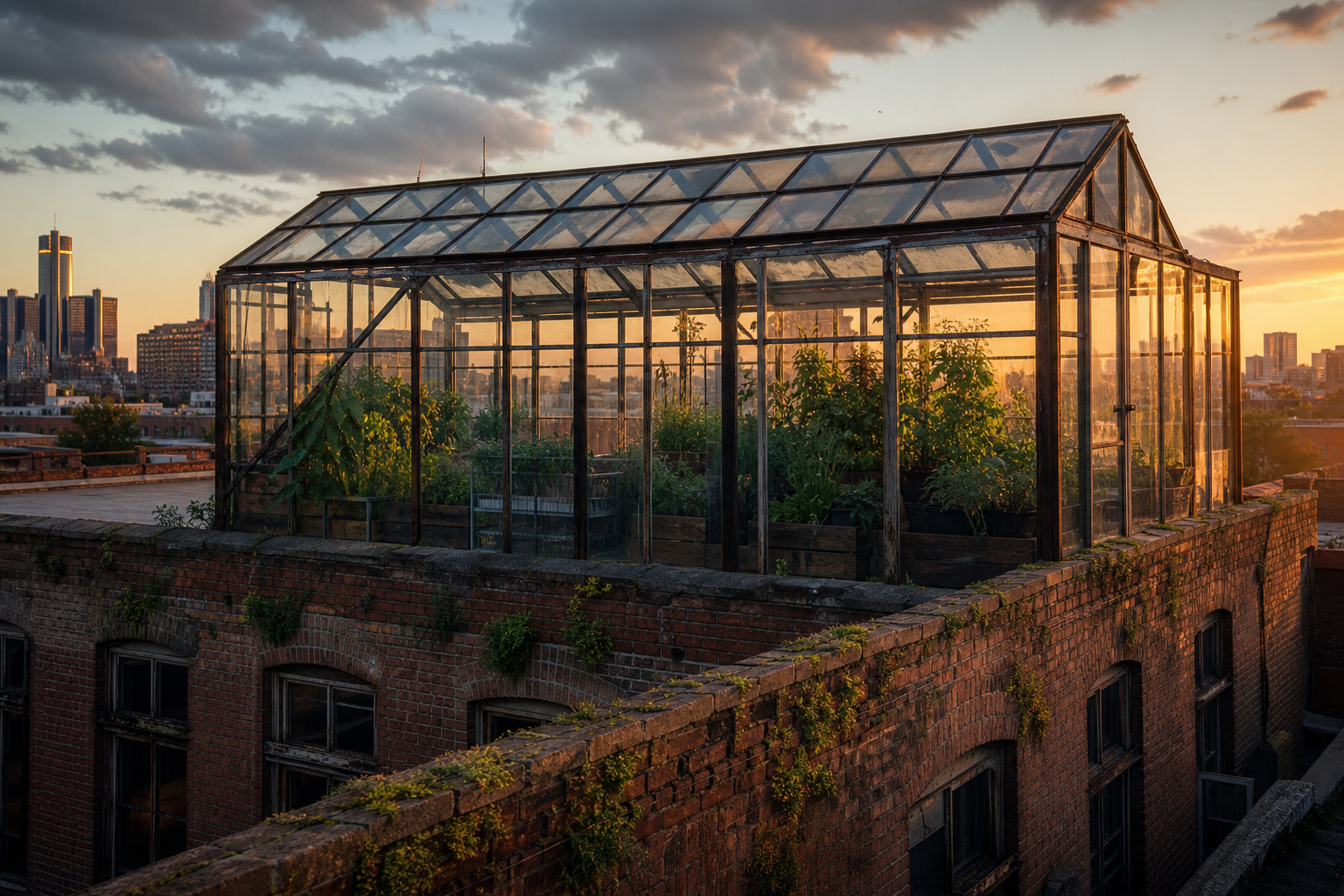
Detroit's cannabis cultivation scene is almost entirely indoors — and that's not a choice, it's a climate reality. Michigan sits in USDA growing Zone 5b/6a, which means outdoor cannabis has about five months of usable growing season, from late May through October. If you want to grow year-round and control quality, you need walls and lights.
That shapes everything about what cannabis cultivation looks like inside the city. It's not fields and greenhouses. It's warehouses and grow rooms — often inside buildings that used to make cars, auto parts, or furniture.
Why Indoor Growing Wins in Michigan's Climate #
Michigan winters kill cannabis plants. A hard freeze comes to Detroit by October most years. Even in a warm fall, outdoor growers are racing the calendar, and any late-season cold snap means a lost crop. That's why nearly every Detroit cannabis cultivator operates indoors.
Indoor growing has real advantages beyond just surviving winter:
- Year-round production — no seasonal gaps, consistent supply to retailers
- Climate control — temperature, humidity, and light cycles dialed in for each strain
- Pest management — far fewer pest and mold problems than outdoor or greenhouse growing
- Potency consistency — controlled inputs produce predictable cannabinoid and terpene profiles
The tradeoff is energy cost. Indoor cannabis cultivation uses a lot of electricity — lights, HVAC, humidity control running 24/7. That's a real operating cost that puts pressure on margins, especially when wholesale flower prices have crashed from $419 per ounce in 2020 to around $58 per ounce by late 2025.
At Divine Toke, we grow sun-grown organic flower in Michigan's natural light cycle because we believe the sun does what no grow light can fully replicate — building terpene complexity through natural stress and seasonal rhythm. But we understand why Detroit's urban cultivators choose indoor. When you're working with a building in the middle of the city, sun-grown isn't always an option.
How Old Industrial Buildings Became Grow Facilities #
Detroit has always had surplus industrial space. Decades of factory closures left behind huge, solid buildings — brick walls, high ceilings, concrete floors, loading docks, and electrical infrastructure already built for heavy use. Those buildings are cannabis grow facilities waiting to happen.
Hytek's grow operation in West Detroit is one example. A building that sat underused or empty became a working grow facility with jobs and payroll. Vive Cannabis Co. near the Packard Plant is another — they opened a dispensary and grow facility at 1601 E. Grand Blvd., with the grow side reportedly branded as "Detroit Flower Grow," and brought economic activity to a block that was part of one of Detroit's most talked-about redevelopment zones.
The Packard Plant area is worth watching. The city has proposed a $50 million redevelopment called Packard Park for the site's southern section — 393,000 square feet of new industrial space, 42 affordable housing units, an indoor skate park, and MODEM (Museum of Detroit Electronic Music). The plan is signed with Packard Development Partners LLC and estimated for completion in 2029. Cannabis businesses opening nearby aren't the whole story of that area's revival, but they're part of an ecosystem of activity that makes the neighborhood worth investing in again.
Zoning Reality: Where Cannabis Can (and Can't) Operate in Detroit #
Detroit's zoning rules allow cannabis businesses in business and industrial districts — but 1,000-foot spacing requirements keep them out of the most visible parts of the city.
Here's how it works in practice:
| Zoning District | Cannabis Allowed? | Common Uses |
|---|---|---|
| B2, B4, B5, B6 | Yes (conditional) | Commercial corridors, strip malls |
| M1, M2, M3, M4 | Yes (conditional) | Industrial, warehouse, manufacturing |
| Downtown core | Effectively no | Spacing rules exclude most parcels |
| Eastern Market | Effectively no | Spacing + overlay restrictions |
| Residential | No | Single-family and multi-family zones |
Cannabis businesses must stay 1,000 feet away from churches, schools, other cannabis facilities, and certain other regulated uses. In dense neighborhoods, that radius rules out a lot of parcels.
The practical effect: most Detroit dispensaries and grow facilities end up in industrial corridors, commercial strips, and transitional areas — not on Woodward Avenue downtown or inside Eastern Market, where foot traffic and visibility would be highest. That limits brand-building opportunities for community operators who need walk-in traffic to survive.
To get approved, cannabis operators go through BSEED (Buildings, Safety Engineering & Environmental Department) for land use approval and a building permit. The zoning review alone takes up to 40 calendar days — and that's before construction, inspections, and licensing. A well-capitalized MSO can carry those costs. A first-time equity operator running lean can't.
The Money Question: Where Does Detroit's Cannabis Tax Revenue Go? #
Detroit collected about $3.3 million in cannabis excise tax revenue in 2025 from 61 operating dispensaries — and city officials have said publicly they plan to direct those funds toward social-equity entrepreneurs. That's real money. It's also a fraction of what the community was promised when legalization passed in 2018.
What the Numbers Actually Say #
Here's a snapshot of what cannabis revenue looks like in Michigan and Detroit right now:
| Metric | Number | Note |
|---|---|---|
| Statewide cannabis sales (2024) | ~$3.29 billion | Competing methodologies; CRA Statistical Report shows $3.025B adult-use sales |
| Michigan excise tax collected (FY2024) | $331 million | Approximate |
| Distributed to municipalities statewide (FY2025) | $93.8 million | Approximate |
| Detroit dispensaries operating (2025) | ~61 | Approximate |
| Detroit dispensaries operating (2023) | 33 | |
| Detroit excise tax revenue (2025) | ~$3.3 million | Estimate |
| Michigan cannabis jobs statewide | 41,000+ | Industry economic estimate |
| Share of Michigan's net private-sector job growth | 52% | Industry economic estimate |
| Michigan monthly sales (April 2026, Headset) | $252.8 million | Average item price: $8.50 |
That 52% jobs figure is worth sitting with. After legalization, more than half of all net new private-sector jobs in Michigan came from the cannabis industry. That's not a minor economic footnote — it's a major employment driver for the state.
Detroit's 61 dispensaries represent a near-doubling since 2023. The city has grown into one of the largest cannabis retail markets in the state. And the tax money is real — $3.3 million in excise tax revenue in a year when the broader market was declining tells you Detroit's demand is holding steady even as wholesale prices crash.
The city's stated plan is to use cannabis tax revenue to support social-equity entrepreneurs and create new business opportunities for Detroiters. What that actually looks like in practice — who gets the money, through what program, and with what accountability — is worth tracking closely.
The 2025 Grant Program: $9,700 Per Licensee #
Michigan's statewide Social Equity Grant Program distributed $1 million across 103 licensees in early 2025. Each business received $9,708.73.
The funds have to be used for one of three things:
- Employee education — classes or courses at accredited institutions
- Business compliance — costs related to licensing and regulatory requirements
- Community investment — donations to nonprofits or organizations in their community
$9,700 is not enough to change a business. It's enough to pay for a compliance consultant, cover one month of employee training, or make a meaningful donation to a neighborhood organization. It's a starting point — and the program needs to grow significantly to match the scale of what equity operators are actually facing.
The FY2026 grant cycle opened applications through November 2025. The program is improving; it's just not yet at the scale that matches the problem it was built to solve.
Corporate MSOs vs. Community Operators: Who's Really Winning Detroit's Market? #
The same structural advantages that helped large multi-state operators (MSOs) dominate markets in other states are at play in Detroit. Capital, legal teams, lobbyists, real estate connections — the big players have all of it. Independent equity licensees often have none of it.
Multi-state operators — chains that operate in multiple states and are often publicly traded or venture-funded — can open a dispensary in Detroit the same way a franchise opens a location. They have templates for everything: store design, compliance workflows, supply chains, employee training. A first-time equity applicant is figuring all of that out for the first time, while also running a business with a fraction of the capital.
The Barriers That Don't Show Up in the Brochure #
Here's what the social equity brochure doesn't tell you:
- Real estate access is the hardest barrier. Cannabis businesses need to be in specific zoning districts. In those zones, the best properties are often already owned or controlled by commercial real estate investors who know cannabis operators are coming and price accordingly. Black entrepreneurs in Detroit often don't own commercial property in those zones and face higher costs to lease or purchase it.
- Partnership deals are often not real equity. The equity program requires majority ownership — but partnerships between well-capitalized operators and equity applicants can be structured in ways that look like equity on paper and aren't in practice. Profit-sharing arrangements, management fee structures, and silent investor deals can drain equity from an arrangement that's supposed to be community-controlled. Outler Media documented this pattern clearly in their reporting on Detroit's Black-owned dispensary market.
- Capital still costs more. Even with fee waivers from the Social Equity Program, starting a cannabis business in Michigan requires real money for real estate, licensing, build-out, inventory, and operations. Traditional banks don't lend to cannabis businesses in most cases because it's still federally illegal. Equity applicants without family wealth, private investors, or alternative lending relationships hit a wall that the program doesn't solve.
- The application process is long and expensive. Between city and state applications, zoning review, BSEED approval, and CRA licensing, a new cannabis operator can spend 12–24 months navigating bureaucracy before a single customer walks in. Carrying those costs through the process requires capital that many equity applicants don't have.
The Price Collapse Nobody Saw Coming #
The economic environment for cannabis operators got significantly harder in 2025. Michigan's wholesale flower price dropped from $419 per ounce in 2020 to around $58 per ounce by late 2025. That's an 86% price collapse driven by massive oversupply — too many cultivators, too many plants, not enough demand growth to absorb the flood of product.
Over 940 cannabis licenses statewide are no longer active. Businesses that looked viable in 2022 or 2023 couldn't survive 2025's economics.
The operators who are surviving tend to share a few things in common:
- They didn't overbuild during the boom
- They focused on quality and differentiation over volume
- They built loyal local customer bases before chasing statewide distribution
- They kept overhead lean
That description fits the community-rooted operators more often than the MSOs who scaled aggressively. There's a real irony in the market right now: the equity operators who were told they were being set up to fail might be the ones best positioned to survive.
What Neighborhood Revival Actually Looks Like on the Ground #
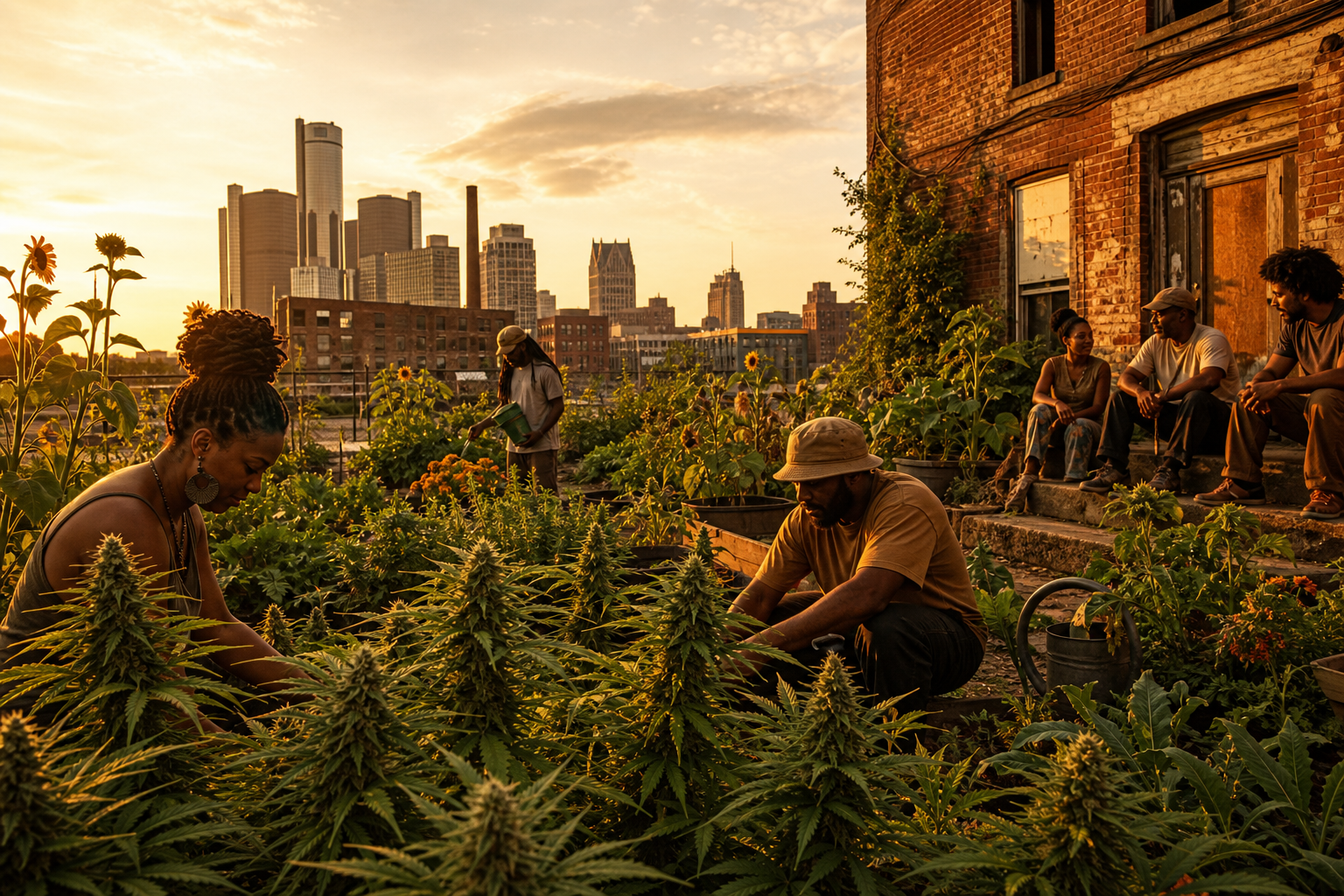
Real neighborhood investment from cannabis doesn't look like a ribbon-cutting ceremony. It looks like a building that used to be abandoned now having lights on and a payroll. It looks like a landlord finally fixing a roof because a cannabis tenant signed a lease. It looks like a block feeling safer because there's regular foot traffic again. It looks like 30 people showing up to work every morning in a building that used to sit empty.
That's not glamorous. It doesn't make headlines. But it's more durable than a press release.
The Packard Plant Area: One Neighborhood's Story #
The area around Detroit's old Packard Plant on E. Grand Boulevard has become a living example of what fragmented, imperfect, real neighborhood revival looks like.
Vive Cannabis Co. opened a dispensary and grow facility at 1601 E. Grand Blvd. Their grow side — reportedly branded as Detroit Flower Grow — sits adjacent to the retail space, a seed-to-sale operation in one of Detroit's most storied industrial corridors.
Around that same block, the city has proposed a $50 million Packard Park redevelopment of the site's southern 28 acres — a plan signed with Packard Development Partners LLC with an estimated completion of 2029. If built as proposed, it will include:
- 393,000 sq ft industrial building — targeted to create 300 permanent manufacturing jobs
- 117,000 sq ft Albert Kahn Building renovation — 42 affordable housing units
- Detroit's first indoor skate park
- MODEM — Museum of Detroit Electronic Music
Cannabis didn't cause that redevelopment. But cannabis operators locating on that corridor helped signal that the neighborhood was viable for investment. That's how mixed-use neighborhood revival actually works — no single business type does it alone. Cannabis is one piece of a larger ecosystem.
The Packard Plant area is a complicated case. It's a neighborhood that saw decades of disinvestment, and the biggest question around its revival is always who benefits. Are the 42 affordable housing units enough to counterbalance rising rents if the whole corridor starts attracting development? Are those 300 manufacturing jobs actually accessible to longtime residents? Those are questions worth asking — and the cannabis conversation is inseparable from them.
Adaptive Reuse: Cannabis and Detroit's Industrial Heritage #
Detroit has roughly 78,000 vacant lots. It also has millions of square feet of vacant or underutilized industrial space — buildings with solid bones, heavy electrical infrastructure, and more square footage than any single business usually needs.
Cannabis cultivation is one of the few industries where those old industrial buildings are genuinely useful rather than just cheap. A former auto parts warehouse becomes a grow facility: the concrete floors handle water and weight, the electrical panels support high-wattage lighting, the ceiling height allows vertical plant growth, and the loading docks make distribution easy.
When a cultivator moves into one of those buildings, a few things happen:
- The building gets renovated — at the cultivator's expense, with inspections and code compliance
- Utilities get turned on — electric, gas, water service that the city collects revenue from
- Security improves — an occupied, functioning building draws less trouble than a vacant one
- Jobs arrive — trimmers, cultivation technicians, delivery drivers, managers, security
- Neighboring properties see value increase — a working block attracts more investment
None of that is specific to cannabis. Any business moving into an empty building does those things. But cannabis operators are actively choosing Detroit's underutilized industrial stock right now, and that has real effects on real blocks.
The challenge is making sure the long-term ownership and gains flow back to the community — not just the short-term economic activity. A grow facility that employs 30 people for a decade and then sells to a national chain for a profit that leaves Detroit is a different story than an operation that stays locally owned and keeps putting money back into the neighborhood.
Who's Still Being Left Out — and Why That Matters #
Despite the programs and the promises, only a fraction of Detroit's cannabis license holders are people from the communities most affected by cannabis arrests. The equity framework exists on paper. Executing it is harder than writing it. And the people who understand this most clearly aren't the policy writers — they're the entrepreneurs who tried to enter the market and ran into the wall.
For a deeper look at the numbers and the structural barriers, check out our earlier piece: Detroit Cannabis Equity: Who Actually Benefits from Legalization?
The Real Estate Problem #
The cannabis business map in Detroit is not random. It follows the zoning map — and the zoning map follows decades of decisions about where industrial and commercial activity is allowed. The neighborhoods where cannabis businesses can operate are often the same neighborhoods where longtime Black homeowners and renters didn't accumulate commercial property ownership.
A Detroiter who qualifies for a Legacy license on every paper dimension — lived here for 20 years, had a marijuana conviction, grew up in a community that got hit hard by enforcement — may have zero path to the right commercial real estate without a well-capitalized partner. And once you have a partner with capital, you're back to negotiating what "majority ownership" really means in practice.
The spacing requirements add another layer. That 1,000-foot rule sounds reasonable in isolation. In dense urban neighborhoods, it knocks out parcel after parcel — and the parcels that survive the spacing filter tend to be in locations where leasing costs are higher or ownership is concentrated in fewer hands.
Capital Barriers Haven't Gone Away #
Fee waivers and priority processing matter. They don't solve the capital problem.
A cannabis retail license in Michigan has application fees — and those fees have been reduced for equity applicants. But the license fee is a small fraction of what it costs to open a dispensary. Build-out, fixtures, point-of-sale systems, compliance technology, security systems, inventory, payroll for your first months before revenue starts — those costs add up to six figures quickly. Sometimes seven.
The cannabis-banking problem makes it worse. Because cannabis is still federally illegal, most traditional banks won't extend credit lines or small business loans to cannabis operators. Equity applicants without existing relationships with alternative lenders, cannabis-specific funds, or wealthy private investors hit a wall that the Social Equity Program doesn't address.
Partnership Deals That Aren't Real Ownership #
This is the issue that's hardest to see from outside and most important to understand. Some of Detroit's "equity" cannabis operations are what advocates call "equity washing" — an equity applicant's name and qualifications are used to secure the license, but the actual business decisions, profits, and long-term value belong to someone else.
Real equity in a cannabis business means your name is on the ownership documents, you make operational decisions, you share proportionally in the profits, and you can't be pushed out or bought out without fair compensation. Some partnerships deliver that. Others are management agreements, consulting arrangements, or profit-sharing deals where the equity applicant has their name on a license and a paycheck, but no real stake in building the business.
The city's program requires documented majority ownership. But documentation requirements are only as good as the enforcement behind them — and first-time business owners navigating complex partnership agreements without experienced legal counsel can end up with something that looks right on paper and isn't.
What Comes Next for Detroit Cannabis #
Detroit's cannabis industry is at a crossroads. The market is oversaturated statewide, prices have crashed, and hundreds of businesses have already closed. The community operators who built slow and stayed lean have a better shot at surviving than the fast-moving investors who bet on volume. What Detroit grows next depends on who's still standing when the shakeout ends — and who gets support to stay standing.
For context on how we got here culturally, see our piece: From Underground to Main Street: The Cultural Shift in Detroit's Cannabis Scene
A Market Under Pressure #
The 2025 Michigan cannabis market told a clear story: the easy money is gone. Statewide sales dropped for the first time — from an estimated $3.29 billion in 2024 to $3.17 billion in 2025 (MJBizDaily, Jan. 2026). Wholesale flower prices that peaked at $419 per ounce in 2020 fell to $58 per ounce by late 2025. Over 940 cannabis licenses are no longer active because the businesses behind them couldn't survive.
Layer in the new 24% wholesale tax enacted in late 2025 and effective January 1, 2026 under the Comprehensive Road Funding Tax Act — designed to fund road repairs — and you have a market where margins are thin, product is cheap, competition is fierce, and costs just went up.
For community operators without capital reserves, that's a dangerous environment. For MSOs that can absorb losses across multiple states and multiple revenue streams, it's an opportunity to outlast the smaller players and consolidate market share.
The next two years will tell a lot about whether Detroit's equity operators survive this period or get pushed out by the economics of a market that was never designed with them in mind.
Federal Rescheduling: The Biggest Policy Shift in Decades #
On April 28, 2026, the DEA published its final rule moving cannabis from Schedule I to Schedule III under the Controlled Substances Act — the most significant change in federal cannabis policy since the plant was first federally criminalized in 1970. A federal hearing is scheduled for June 29, 2026 as part of the rulemaking process.
For Detroit's equity operators, this matters in three concrete ways:
- 280E tax relief. Right now, cannabis businesses can't deduct normal business expenses from their federal taxes because of a tax code provision (280E) that applies to Schedule I and II substances. Moving to Schedule III would end that penalty — immediately improving margins for every cannabis business in Michigan, but especially for undercapitalized equity operators who don't have the financial cushion to absorb the tax hit.
- Banking access pathway. Federal banks and credit unions have mostly stayed out of cannabis because of federal illegality. Schedule III doesn't solve this overnight — Congress still needs to act — but it removes the strongest legal argument against cannabis banking. More credit options mean more capital access for equity operators who currently have to rely on cash operations or high-cost alternative lenders.
- Federal legitimacy. Rescheduling signals that the federal government is moving toward treating cannabis as a regulated substance rather than a controlled substance with no accepted medical use. That shift matters for grant programs, federal contractor relationships, and the broader legitimacy of social equity frameworks built around a federally illegal industry.
None of this is guaranteed or immediate. The June 2026 hearing could surface objections, and Congress still needs to align banking rules with the new scheduling status. But for equity operators in Detroit who have been grinding through a hostile economic environment, this is the first federal tailwind they've had. Watch it closely.
The Operators Built for the Long Game #
The businesses most likely to come through this period are the ones that built for community loyalty rather than volume. Here's what that looks like:
- A customer base that drives across town because of you specifically — because the ownership is local, the staff knows them, and the vibe is right
- Cultivation that produces something distinctive — not just pounds, but flavor profiles and genetics that people come back for
- Cost structures that don't require a certain volume to survive — lean operations that don't have investors demanding 40% year-over-year growth
- Community ties that make the business feel worth supporting — hiring from the neighborhood, sponsoring local events, showing up when it matters
None of that is a guaranteed shield. A $58/oz market is hard for everyone. But operators who built that way have something that capital alone can't buy: community loyalty in a city that rewards authenticity and punishes pretenders pretty quickly.
Frequently Asked Questions About Detroit Cannabis and Neighborhood Revival #
Q: What is the Detroit Legacy cannabis program? #
The Detroit Legacy program is Detroit's local social equity initiative for cannabis licensing. It requires that at least 51% of a business be owned by Detroiters who have lived in the city for 15 of the last 30 years. People with prior marijuana convictions, or whose parents had convictions, may qualify at shorter residency periods. The program — called "Homegrown Detroit" — is run by the city's Office of Cannabis Affairs (OCA) and was strengthened by a revised ordinance in 2022.
Q: Who was the first Detroit Legacy recreational dispensary to open? #
Nuggets Dispensary was the first new "Detroit Legacy" recreational marijuana business to open in Detroit, celebrating its grand opening in March 2023. The Black-owned dispensary, located at 18270 Telegraph Road on the city's west side, is run by Dr. Louis Radden and his aunt Camille Hicks. Both are longtime Detroiters. At the time of its opening, 17 of Detroit's 34 adult-use retail licenses were majority Black-owned.
Q: Are there Black-owned cannabis grow operations in Detroit? #
Yes — Hytek and The Refinery Detroit are among the most prominent Black-owned cannabis operations with both cultivation and retail in Detroit. The founder acquired property in West Detroit in 2016 and spent five years rehabilitating a building and surrounding block before opening. The operation now employs over 30 people. DogHouse Farms, founded by Jon Hudnall on Detroit's east side (Michigan operations active by 2019), is another significant cultivator in the region, growing 5,000+ plants and distributing to about 200 Michigan retailers, according to published reports.
Q: How many dispensaries does Detroit have in 2026? #
Detroit had 61 operating dispensaries in 2025, nearly double the 33 it had in 2023. That growth makes Detroit one of Michigan's largest cannabis retail markets. The city's cannabis market has continued to grow even as the statewide market experienced its first annual sales decline in 2025.
Q: How much cannabis tax revenue does Detroit collect? #
Detroit collected approximately $3.3 million in cannabis excise tax revenue in 2025. Michigan's adult-use excise tax is collected at the state level and distributed to municipalities based on the number of licensed retailers within their borders. Detroit has publicly stated it plans to direct cannabis tax revenue toward supporting social-equity entrepreneurs and creating business opportunities for Detroiters. Statewide, Michigan collected $331 million in excise tax in FY2024.
Q: Can you grow cannabis outdoors in Detroit? #
Outdoor cannabis cultivation in Detroit is possible but limited to roughly five months a year, from late May through October. Michigan's climate (USDA Zone 5b/6a) brings hard freezes by October and unpredictable spring weather, which makes year-round outdoor growing impossible. That's why nearly all Detroit cannabis cultivators operate indoors — in warehouses, old industrial buildings, or purpose-built grow facilities — where they can control climate and produce crops year-round. Home growers (up to 12 plants per household in Michigan) can grow outdoors seasonally.
Q: What neighborhoods in Detroit have cannabis businesses? #
Cannabis businesses in Detroit are concentrated in commercial and industrial corridors — not in residential neighborhoods or downtown. Detroit's zoning rules allow cannabis operations in business districts (B2, B4, B5, B6) and industrial zones (M1–M4), but spacing requirements of 1,000 feet from schools, churches, and other cannabis facilities effectively keep them out of downtown and Eastern Market. Areas like the Packard Plant corridor, West Detroit commercial strips, and north-side industrial zones have seen cannabis business activity.
Q: What barriers do Detroit equity cannabis operators still face? #
The biggest barriers are real estate access, capital, and the structure of partnership deals. Equity applicants who qualify on paper often can't secure the right commercial property in zoned areas, don't have access to cannabis-friendly lending (since banks generally won't lend to cannabis businesses due to federal illegality), and sometimes enter partnership agreements that look like majority ownership but don't deliver real business control or proportional profit-sharing. These structural problems aren't solved by fee waivers or priority processing alone.
Q: How does Detroit's social equity program compare to other cities? #
Detroit's program is one of the more specific and well-intentioned city-level equity frameworks in the country, but it faces the same structural limits as similar programs elsewhere. Requiring documented long-term residency and offering priority processing are meaningful steps. But without solving the capital and real estate problems that prevent qualified applicants from getting through the process, equity programs in Detroit — as in Los Angeles, Chicago, and other major markets — produce fewer equity-owned businesses than they're designed to. The program is improving; the scale of the problem still exceeds the scale of the solution.
Q: What is the "Homegrown Detroit" cannabis initiative? #
"Homegrown Detroit" is the city's branding for its social equity cannabis licensing framework. It operates through the Office of Cannabis Affairs (OCA) within Detroit's Department of Civil Rights, Inclusion & Opportunity. The office provides resources, technical assistance, and licensing guidance to qualifying applicants — particularly longtime Detroit residents, low-income Detroiters, and those with prior marijuana convictions who are navigating the cannabis business application process for the first time.
Q: Has the cannabis industry created jobs in Detroit? #
According to cannabis industry economic estimates, Michigan's cannabis industry has supported more than 41,000 jobs statewide, accounting for an estimated 52% of the state's net private-sector job growth following legalization. Detroit's 61 dispensaries and multiple grow facilities represent a significant share of that employment. Individual operations like DogHouse Farms (up to 40 employees) and Hytek/The Refinery (30+ employees) show what local job creation looks like at the operator level. The challenge is ensuring those jobs are quality jobs — with fair wages, benefits, and advancement opportunities — not just entry-level positions.
Q: Where can I find Detroit-rooted, equity-focused cannabis in Michigan? #
Look for Detroit Legacy–designated dispensaries, ask budtenders about their ownership structure, and support businesses where the operator is clearly a community member. Nuggets Dispensary on Telegraph Road and The Refinery Detroit in West Detroit are two named examples of locally rooted operations worth supporting. At Divine Toke, we grow sun-grown organic cannabis in Michigan and care deeply about how the industry treats the communities it grows in — we're committed to supporting equity in the Michigan cannabis market, not just talking about it.
Detroit Built This Industry — It Deserves to Own It #
Detroit's neighborhoods gave cannabis its cultural foundation — and they deserve to hold a real stake in what the legal market builds from here. The progress is real: Nuggets Dispensary on Telegraph, Hytek's block revival in West Detroit, 18 Detroit operators sharing in Michigan's Social Equity Grant Program, 61 dispensaries generating $3.3 million in city excise tax revenue. Those are concrete wins worth naming.
The gaps are just as real. A 3.8% Black ownership rate statewide. Capital barriers that fee waivers can't fix. Partnership deals that look like equity and aren't. A price collapse that's hitting undercapitalized operators hardest.
Detroit doesn't need anyone to pretend this is working better than it is. It needs people to keep paying attention, keep supporting the operators who are doing it right, and keep pushing for a program that matches the scale of the problem it was built to solve.
If you want to find cannabis that's rooted in this community, look for Detroit Legacy–designated businesses. Ask who owns the place you're shopping at. Support operations where the money stays local.
And if you're curious about where we fit into this picture — at Divine Toke, we grow sun-grown organic cannabis in Michigan because we believe clean, community-rooted cannabis is worth building. We're not in a Detroit storefront, but we share a belief with every equity operator in this city: the industry should be built by and for the people who made it what it is.
For more on the equity story, read our companion pieces:
Grown in Detroit. Shipped to your door.
Small-batch, sun-grown cannabis cultivated in living soil. Mail-order shipping to all 50 states.