Does Eating a Mango Before You Smoke Get You Higher?
Somebody always says eat a mango before you smoke. No human trial backs it, and the mouse studies used injected myrcene. Here is what to check on the label.
Questions this article answers
- does eating a mango before smoking get you higher
- mango myrcene cannabis high evidence
- does mango make you higher

Head Cultivator
On this page
Somebody always tells you to eat a mango about 45 minutes before you smoke. The mouse studies people point to never fed a mango to a single mouse. They injected pure oil.
Does Eating a Mango Before You Smoke Get You Higher? #
No. Eating a mango before you smoke does not make the high stronger. No human trial has tested that snack against cannabis. The fruit and the flower can share a smell oil, and that is the whole connection.
I've heard this one for years, in Detroit group chats and at picnics. Eat the mango, wait, and the couch hits harder.
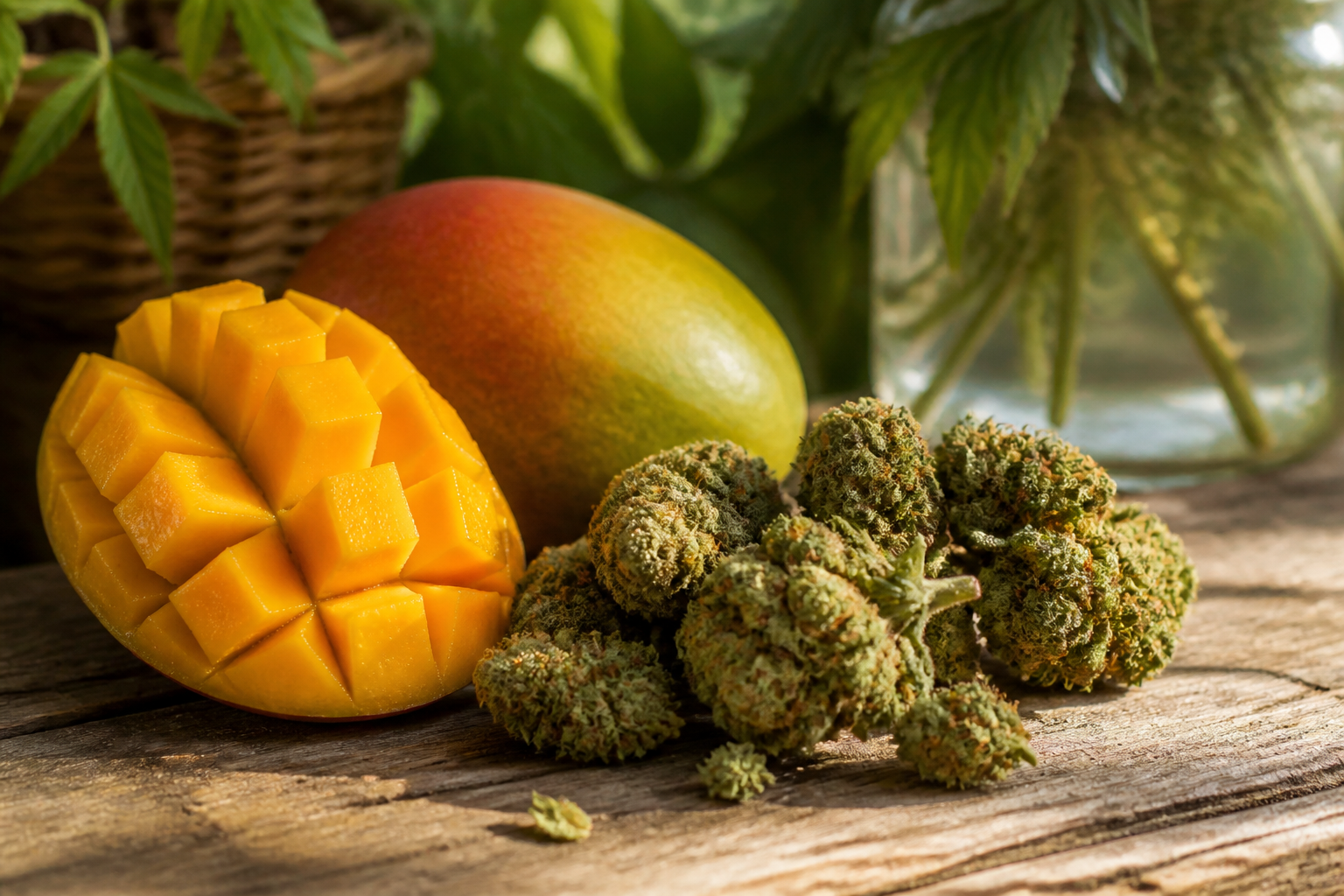
Myrcene is the oil people mean. It is a terpene, a small smell molecule plants make. It shows up in some mangoes, in hops, and in a lot of cannabis. Our myrcene guide covers the sleepy-flower side of that oil. This page is the yes-or-no on the fruit.
| What people say | What the papers actually show |
|---|---|
| Eat a mango, then smoke, and you get higher | No randomized human trial of mango plus cannabis |
| The mango is full of myrcene, so it stacks with the joint | Labs report mango myrcene as a share of the smell compounds, never as a percent of the flesh (Farag and colleagues, 2022) |
| Myrcene opens the gate into your brain so THC rushes in | A 2021 review says that idea has little solid evidence behind it (Surendran and colleagues) |
| Mouse studies prove the fruit works | Those mice got pure myrcene injected into the belly, often at 200 milligrams per kilogram (do Vale and colleagues, 2002) |
| If it felt stronger, the mango did it | Belief alone can raise a "how high" score (Metrik and colleagues, 2012) |
If a mango night felt bigger to you, I'm not calling you a liar. The feeling was real. There is not enough research yet on one person's endocannabinoid system, the body's own cannabis-like signaling, to say what caused it.
Why Do People Connect Mango With a Stronger High? #
People connect them because some mangoes and some cannabis smell a little alike, and that shared oil is myrcene. Myrcene gets called the mango terpene, so the snack trick rode along. Nobody ever gave the trick its own study.
Terpenes are the plant's smell oils. For the kitchen version, our terpene guide treats them like spices in a recipe. THC is the part that gets you high. Myrcene is the ripe, musky, hoppy note in the jar, and it doesn't light up the high by itself.
A 2011 review by Ethan Russo listed myrcene with other cannabis terpenes that might work with THC. The abstract calls that teamwork an "if proven" idea. You can read it on PubMed (PMID 21749363). It is a map of ideas, and the abstract has no mango test in it.
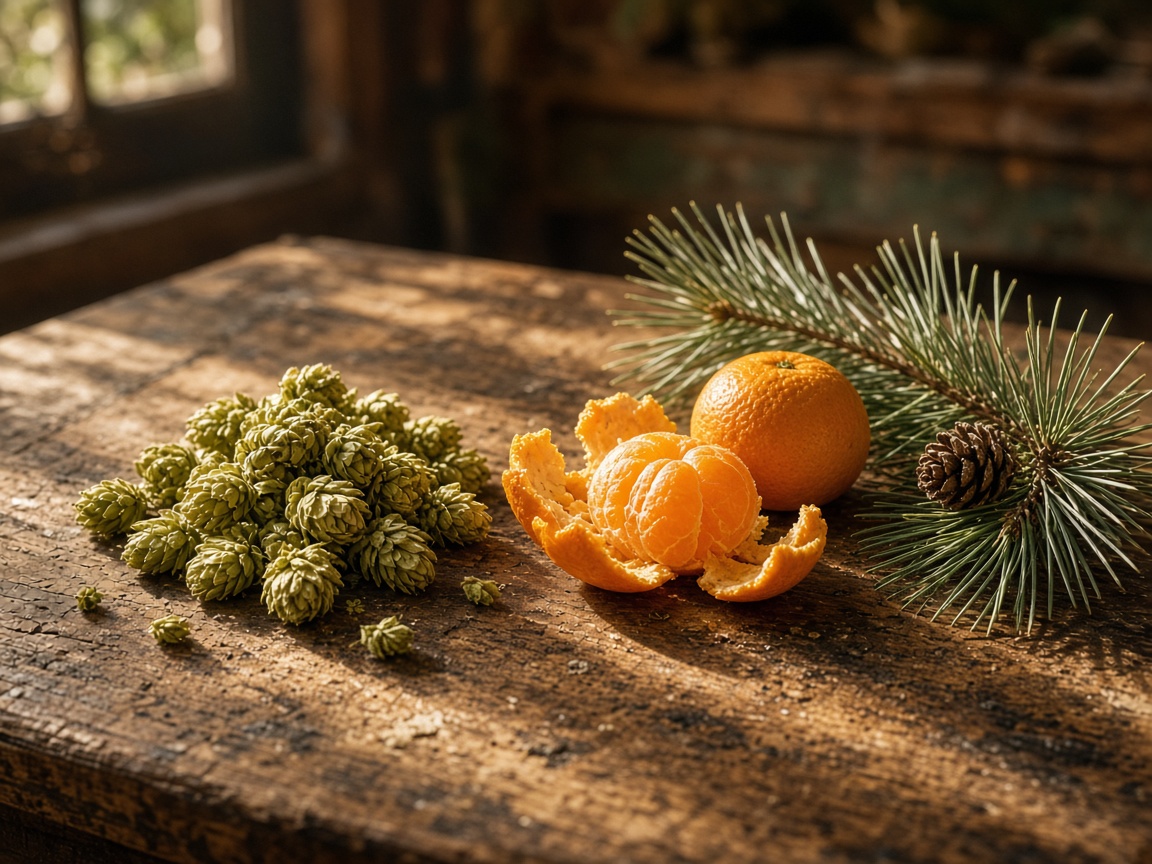
The same smell shows up outside cannabis. Hops in beer, some herbs, and some mangoes all carry myrcene. That is why the produce aisle story feels obvious. Your nose already knows the note. Our piece on terpenes in hops, citrus, and pine walks through that wider plant map.
Three things got mashed into one myth:
- The smell match. Mango skin and some flower share a musky-sweet edge, and your nose picks that up. A smell has no milligram count attached.
- The sleepy reputation. A 2021 review repeats a shop rule of thumb. Flower above 0.5 percent myrcene is "likely" to feel heavier. Flower under 0.5 percent is "likely" to feel brighter. That line comes from an interview, and no trial of people eating fruit sits behind it (Surendran and colleagues, 2021). A sleepy night depends on a longer list than one terpene, and does indica make you sleepy walks through it.
- The whole-plant idea. Cannabinoids plus the plant's own oils may shape a high. That's the entourage question, and it only covers oils that grew in the flower.
I smoke every day, and my tolerance isn't a typical tolerance. If a jar smells like mango, you've learned something about the jar.
How Much Myrcene Is Actually in a Mango? #
Labs usually report myrcene as a share of the mango's smell chemicals, and that share jumps by variety. Nobody prints "8 percent myrcene" on a mango the way a candy bar lists sugar.
A 2022 food-chemistry study measured 14 Egyptian mango cultivars. The lab used a smell trap, called headspace sampling, plus a gas chromatograph that separates the smell oils. Farag and colleagues wrote that earlier work had already found more than 285 smell compounds across mango varieties. Monoterpenes, the light smell oils, do a lot of the flavor work. Beta-myrcene is one of them.
In that study, Egyptian "founs" mangoes carried beta-myrcene at 8 to 14 percent of the volatile profile. That is the mix of smells floating off the fruit. "Founs" is the paper's spelling for a type close to Indian Alphonso. The same paper's table shows other cultivars much quieter on that oil. Some sit well under 1 percent of the detected smell mix. One sample in the table is about 0.01 percent. The variety moves the number.
Read the percent the way the lab wrote it:
| What the number is | What people mistake it for |
|---|---|
| A share of the compounds the machine pulled out of the headspace, the air above the fruit | A percent of the weight of the flesh you chew |
| High in some cultivars, low in others, in the same study | One mango number you can use at every grocery |
| A ripeness and cultivar clue for aroma chemists | Proof that eating the fruit changes a cannabis high |
An October mango in a Michigan grocery is almost always imported fruit. It didn't grow beside outdoor Michigan cannabis. A mango sticker won't say if it's a high-myrcene type or a low one. The store prints no terpene panel on the fruit.
Ripeness matters in aroma work, and different papers slice it different ways. I won't pretend one ripe-versus-green percent is settled. When a paper says myrcene is a large slice of the aroma, it means the smell fraction. The fruit you eat is mostly water, sugar, and fiber, and the oil is a trace.
Eat a mango because it tastes good. An 8 to 14 percent aroma figure can't be turned into a cannabis-sized hit of myrcene. Nobody in these papers weighed the myrcene in one eaten mango, and nobody measured it in human blood next to a joint.
How Does That Compare With Myrcene in the Flower? #
Flower myrcene is a percent of the dried plant, and mango myrcene is a percent of its smell mix. Those are different rulers, so you can't add them into a stack.
Surendran and colleagues (2021) repeat a cannabis shop line. Batches above 0.5 percent myrcene are "likely" to feel sedating. Batches under 0.5 percent are "likely" to feel more energetic. They tie that line to an interview, and no trial where people ate fruit and then smoked sits behind it. Treat 0.5 percent as folklore with a citation.
Even at face value, that 0.5 percent describes oil in the dried flower. The Egyptian mango figure describes oil in the air the lab sampled above the fruit. Put those two percents in one sentence and you get the myth.
The route is different too:
- Flower, smoked or vaporized. The plant's own myrcene rides in with the cannabinoids, through the lungs, in the same breath.
- Mango, eaten. Whatever myrcene is in that cultivar has to survive chewing, the gut, and the liver. The papers here did not measure that path in people.
- Mouse work. Pure myrcene, injected, at amounts nobody has tied to a snack. That comparison is in the next section.
I don't have a paper that says every Michigan eighth holds X milligrams of myrcene. Menus vary. Batches vary. If the jar lists terpenes, read myrcene on that sheet. If it doesn't, use your nose and don't invent a number. The myrcene guide shows how that panel ranks on sleepy flower.
A whole-plant high is still a fair thing to shop for. The oils that grew in the flower are already in the flower, and you can't glue them on later with produce. The entourage write-up goes deeper.
Does Myrcene Open the Blood-Brain Barrier? #
No study here shows that myrcene opens the blood-brain barrier so THC reaches your brain faster. The line is a suggestion that reviews repeat. The 2021 review says the support is thin.
The blood-brain barrier is a tight filter around the blood vessels in your brain. It keeps a lot of random chemicals out. Marketing talks about it like a locked door that mango oil swings open.
- A later review points to a 2016 book chapter for the barrier idea: Hartsel and colleagues, in the book Nutraceuticals. A book chapter has no brain-level THC numbers in it.
- Surendran and colleagues (2021) say myrcene may help cannabinoids cross that barrier. In the same breath they say there is not much solid data for the claim.
- The same review later says myrcene in the cannabis plant might lower resistance across the barrier. Again it points at that chapter. It adds no human experiment.
- Russo's 2011 review is the entourage essay most people cite. The abstract we can verify lists myrcene. It says terpene teamwork is still an "if proven" idea. It reports no mango test and no THC brain-level test.
A real test would give people, or at least animals, THC with and without myrcene. Then it would take blood and brain samples over time and look for a faster, bigger peak. That experiment isn't in these papers. Until it is, "opens the barrier" is a slogan.
Skin creams and brain filters are different problems. Some terpene papers are about getting a drug through the skin. A terpene that helps a cream pass the skin hasn't been shown to open the brain's filter.
Nobody has shown that myrcene holds the door for THC. The flower's THC gets in because you inhaled THC.
What Did the Mouse Studies Actually Test? #
The mouse studies tested pure myrcene, injected, at large amounts per kilogram of body weight. They did not test a person eating a mango and then smoking.
The classic paper is do Vale and colleagues in Phytomedicine, December 2002. Mice got citral, myrcene, or limonene injected into the belly. For myrcene, the amounts were 100 and 200 milligrams per kilogram of body weight.
| Check | Amount of myrcene | What happened |
|---|---|---|
| Open field (how much they walked, reared, and groomed) | 100 and 200 mg/kg, injected | They did less of all three. That is a sedation-type signal in mice. |
| Rota-rod (a spinning bar they have to stay on) | 100 and 200 mg/kg, injected | Muscle relaxation showed up at both of those amounts. |
| Barbiturate sleep (a lab sedative, then a timer) | 100 and 200 mg/kg, injected | Sleep lasted longer. At 200 mg/kg, about 2.6 times the control sleep. |
A 2021 review restates the high end of that work. At 200 mg/kg, time on the spinning bar fell about 48 percent and barbiturate sleep stretched about 2.6 times (Surendran and colleagues). Same mice, same injected oil, still no mango.
A newer paper asked a lavender question. Chen and colleagues (2024) gave insomnia mice beta-myrcene at 50 and 200 mg/kg, again by injection. Then they gave a low amount of a barbiturate sedative. After one injection, 6 of 12 mice slept at 50 mg/kg myrcene. All 12 slept at 200 mg/kg. That is a real sleep signal in a lab model. It is still pure myrcene, injected, in mice already pushed into an insomnia model.
Why that doesn't prove the snack:
- The mice didn't eat fruit. They received purified myrcene.
- The oil went in by needle into the belly. Nobody bit a fruit or inhaled smoke.
- 200 milligrams per kilogram is a lot of pure oil for a small animal. A mango's myrcene is a slice of its aroma, and a fruit doesn't come with a syringe of the pure chemical.
- Several of the "sleepy" tests stacked myrcene on a barbiturate, a lab sedative. That tests how two drugs interact in mice, which says nothing about fruit and weed.
I won't convert 200 mg/kg into "you would need a truck of mangoes." That kind of conversion sounds precise and usually lies. The only sedation numbers we have come from injected pure myrcene in mice. Nobody has shown that eating a mango gets anywhere near those amounts.
Can Expecting a Stronger High Change What You Feel? #
Yes. Being told you smoked THC can raise how high you feel, separate from the THC itself. Eating a mango first is a perfect setup for that kind of expectation, which makes it a poor test of the fruit.
The human study is Metrik and colleagues (2012). They enrolled 136 regular cannabis users. Each person smoked either cannabis with 2.8 percent THC or a placebo cigarette with the THC removed. Separately, each person was told they got THC or told they did not. Four groups. That layout is called a balanced placebo design. It lets belief and chemistry pull apart.
On the ARCI marijuana scale, a short checklist for subjective cannabis effects, both things mattered:
- Getting real THC, versus placebo, raised the score by a wide margin (p < 0.001, so chance is a very unlikely reason).
- Being told it was THC also raised the score, by less (p = 0.01, still unlikely to be chance).
- The two effects were independent. Belief moved the feeling, and THC moved it more.
So expectancy is real, and it was smaller than the drug in that study. If you walk in sure the mango will "do something," your brain has a script. The script can change the report. That doesn't make you foolish.
The study never fed anyone a mango, so I won't paste its numbers onto fruit. A mango-before-you-smoke habit has never been tested that way.
Bodies also differ before any fruit enters the picture. Genetics, receptors, tolerance, and the rest of the day change the same jar from friend to friend. That map is in why everybody's high is different. If your cousin swears by the mango and you feel nothing, nobody has to be wrong.
Does Black Pepper Change a Cannabis High? #
No human trial here shows that sniffing or eating black pepper changes a cannabis high. Pepper does contain a different oil, beta-caryophyllene, and that oil has a real lab story. Nobody has shown it works as an antidote you can grind over a bad night.
Gertsch and colleagues (2008) found that (E)-beta-caryophyllene binds the CB2 receptor. The binding number was a Ki of 155 ± 4 nM, which means it grabs that receptor at a low lab concentration. CB2 is a receptor tied more to swelling and immune signals than to the high. In their tests it did not meaningfully bind CB1, the receptor THC uses to get you high. They called this oil nonpsychoactive.
The same paper names the plants. Beta-caryophyllene shows up in the essential oils of oregano, cinnamon, and black pepper (Piper nigrum). It is also common in cannabis. So the "pepper and weed share a molecule" line is fair.
In animals, mice drank the oil at about 5 milligrams per kilogram, and it cut a lab model of swelling. Mice without CB2 got no anti-swelling effect, which points to CB2. Nobody tested a person sniffing a peppercorn while too high.
Russo's 2011 review does call non-cannabinoid plant compounds possible "antidotes" to some THC effects. By that it means a wider gap between a useful amount and a too-strong one. The abstract argues for future tests. It sets out no peppercorn protocol.
If you like black pepper on food, eat it because dinner tastes better. If a night got too strong, pepper isn't the studied fix. Sit down, skip the car, and let time do the work. For the flower side of caryophyllene, the entourage effect piece is the better read.
What Should a Michigan Shopper Do Instead? #
Shop the flower's own smell and lab sheet. Leave the mango in the lunch cooler. A Detroit grocery run does not change what the jar will do.
Michigan already wrote the adult-use rules without a fruit clause. Under MCL 333.27955, a person 21 or older may possess, use, buy, and transport 2.5 ounces or less in public. Not more than 15 grams of that may be concentrate. At home, the same law allows not more than 10 ounces, with separate plant rules. A mango doesn't change that math.
If you live around here:
- After a shift. If you work swings at a plant, a hospital, or on a job site, the fruit in the cooler is food. Don't plan the night as if the mango were a second product.
- In October. A mango in a Michigan store is imported fruit, and Michigan outdoor flower runs on its own season. They don't come from the same field.
- On the label. Read THC and, when the batch has it, the terpene list. Myrcene on the flower is the myrcene you can actually smoke. The sleepy myrcene guide covers that panel.
- On the drive. If you feel high, you are impaired. Fruit doesn't make driving legal or safer. Don't drive.
- From friend to friend. The same jar can feel different in two people. Start with why highs differ before you blame the produce aisle.
Divine Toke is a Detroit-rooted, sun-grown, living-soil brand. We sell online at divinetoke.org by mail order. There is no storefront and no street address. We sell flower and 1 gram pre-rolls. The 20-pack is 20 of those 1 gram joints for $120. There is no mango edible and no myrcene add-on.
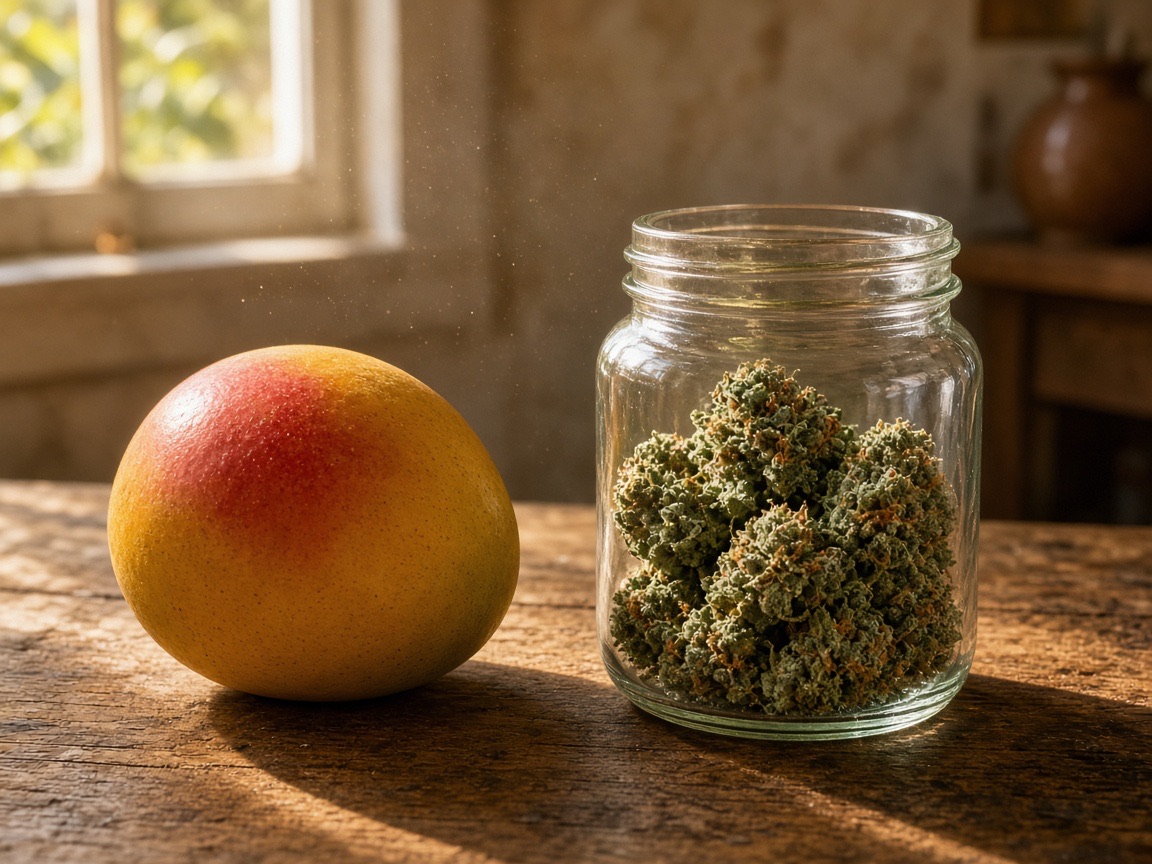
If you want the mango note, smell the jar. If it smells like mango skin and hops, myrcene is a fair guess. Then check the lab sheet if you have one.
Frequently Asked Questions #
No, a mango will not make you higher. Each answer below names the study or the Michigan rule behind it.
Does eating a mango before you smoke get you higher? #
No. There is no human trial showing that a mango makes a cannabis high stronger. The shared piece is myrcene, a smell oil. Labs measure mango myrcene as a share of the aroma. Nobody reports it as a percent of the flesh. Farag and colleagues (2022) found 8 to 14 percent myrcene in the volatile profile of Egyptian "founs" mangoes. That profile is the mix of smells floating off the fruit. Other cultivars in the same study had much less.
How long before smoking should you eat the mango? #
There is no studied wait time, because the snack itself has not been studied. The 30 to 60 minute advice is picnic lore. It does not come from a trial that timed mango, then THC, then a high score. If you eat a mango, eat it because you are hungry. Do not clock it against the joint.
Does a ripe mango work better than a green one? #
Ripeness can change the smell mix, and it still does not prove a stronger high. Aroma papers do show cultivar and ripeness shifting which oils dominate. The useful number from the Egyptian work is the cultivar gap. "Founs" sat at 8 to 14 percent of the smell mix, and other mangoes in that table were far lower (Farag and colleagues, 2022). Green or ripe, that percent describes the smell mix and says nothing about the fruit you eat.
Will mango juice or a smoothie do the same thing? #
Juice and smoothies are not a workaround. They were not tested either. Blending does not turn an aroma fraction into the injected myrcene mice received at 100 and 200 milligrams per kilogram (do Vale and colleagues, 2002). A smoothie is still food. It is not a measured cannabis add-on.
Can myrcene get you high by itself? #
No. Myrcene is a smell oil, and THC is the cannabinoid that gets you high. Injected pure into mice, myrcene showed sedation-type signals, including about 2.6 times longer barbiturate sleep at 200 mg/kg (do Vale and colleagues, 2002). That was a sleep test in mice, with no high and no mango involved.
Does myrcene open the blood-brain barrier for THC? #
The papers do not show that. The blood-brain barrier is the tight filter on blood vessels in the brain. Surendran and colleagues (2021) say myrcene may help cannabinoids cross it, and they also say the data for that claim are thin. The citation behind the claim is a 2016 book chapter. None of these papers measured THC in the brain with and without myrcene.
Will a mango make cannabis feel sleepier? #
Not as a fruit snack. Sleepiness in the mouse work came from pure, injected myrcene. At 200 mg/kg, myrcene stretched barbiturate sleep about 2.6 times (do Vale and colleagues, 2002). In a 2024 insomnia-mouse paper, 12 of 12 mice slept after 200 mg/kg of injected myrcene plus a sedative. At 50 mg/kg, 6 of 12 slept (Chen and colleagues). The myrcene guide covers the sleepy reputation of myrcene in flower. Does indica make you sleepy covers what else decides a heavy night.
Does sniffing black pepper calm a too-strong high? #
No controlled human test of that pepper trick showed up in the sources for this page. Black pepper does contain beta-caryophyllene. It binds the CB2 receptor tightly in lab tests (a Ki of 155 ± 4 nM) and is described as nonpsychoactive (Gertsch and colleagues, 2008). CB2 isn't the receptor that makes you high. Oral caryophyllene at 5 mg/kg cut swelling in mice, and nobody tested it on a person having a strong night.
Is it unsafe to eat a mango and then smoke? #
A normal mango is food, so the risk to plan for is the cannabis. Do not drive impaired. Do not treat the mango as a reason to smoke more. Michigan adult-use law still starts at 21, and public possession still caps at 2.5 ounces under MCL 333.27955. If you have a medical condition or you take other medicine, talk with your clinician. This page is not a clearance to mix anything.
Why did the high feel stronger if the studies say no? #
The feeling can be real without the mango being the cause. In 136 regular users, being told they smoked THC raised how high they felt, apart from the actual THC. The belief effect was real (p = 0.01, roughly a 1-in-100 shot at a fluke). The THC effect was larger (p < 0.001, under 1 in 1,000) (Metrik and colleagues, 2012). Your night still happened, and the fruit has not been shown to be the reason.
Does this change Michigan possession limits? #
No. Fruit is not part of the ounce math. MCL 333.27955 lets a person 21 or older possess up to 2.5 ounces in public, and no more than 15 grams of that can be concentrate. At home the limit is 10 ounces. A mango before a joint does not move those lines. Metro Detroit shift workers do not get a special fruit exception on the way home from a plant or a job site.
Does Divine Toke sell a mango booster? #
No. We do not sell a mango product or an edible booster. Divine Toke is Detroit-rooted, sun-grown, and living soil. Orders are mail order from divinetoke.org. There is no storefront. We sell flower and 1 gram pre-rolls. The 20-pack is 20 of those 1 gram joints for $120. If you want a mango-like smell, you want it in the jar.
If You Still Want the Mango Smell, Shop the Jar #
A mango before a joint has plenty of fans and no human trial behind it. No human study we have says a mango makes you higher. Myrcene in mango is a cultivar-by-cultivar slice of the aroma. The mouse papers used pure injected oil at 100 to 200 milligrams per kilogram. The blood-brain-barrier line is a book-chapter idea that a 2021 review already calls thinly supported.
If you're curious about flower with a mango-like smell, start with the jar. Divine Toke's sun-grown flower and 1 gram pre-rolls are on the shop, and the 20-pack is 20 one-gram joints at $120. Smell it. If the sheet lists terpenes, read myrcene there.
If you want the neighboring answers:
- The sleepy-flower side of this oil: myrcene, the mango terpene
- What really decides a sleepy night: does indica make you sleepy
- The same oils in beer, citrus, and pine: terpenes beyond cannabis
- Why the whole plant is the interesting part: entourage effect
- Why your friend felt a different night: why everybody's high is different
This article is for educational purposes only and is not medical advice. Always consult your healthcare provider before starting any new wellness routine.
Grown in Detroit. Shipped to your door.
Small-batch, sun-grown cannabis cultivated in living soil. Mail-order shipping to all 50 states.