Hermaphrodite Cannabis and Nanners vs Pollen Drift
A female bud can grow a few yellow bananas and shed its own pollen. How a stressed plant makes those male parts, and how that differs from drifted pollen.
Questions this article answers
- what are nanners on cannabis
- how does a female cannabis plant grow male flowers
- nanners vs pollen drift
- do light leaks cause hermaphrodite cannabis
- are nanner seeds feminized

Head Cultivator
On this page
A female bud with a yellow banana in it is carrying its own pollen sac. Growers call that banana a nanner, and once it splits it can dust the bud around it.
When one plant grows both female flowers and male parts, the papers call it hermaphrodite cannabis. Michigan growers blame a light leak or a hot hoop house when bananas show up, so those two get their own section below. Pollen that drifted in from a male plant is a separate path. Wind, hemp fields, and miles belong to the seeds in Michigan bud page.
Divine Toke is sun-grown flower by mail from divinetoke.org. We have no shop counter and no street address. I don't have a story of one of our plants growing nanners.
What Is a Nanner on a Cannabis Bud? #
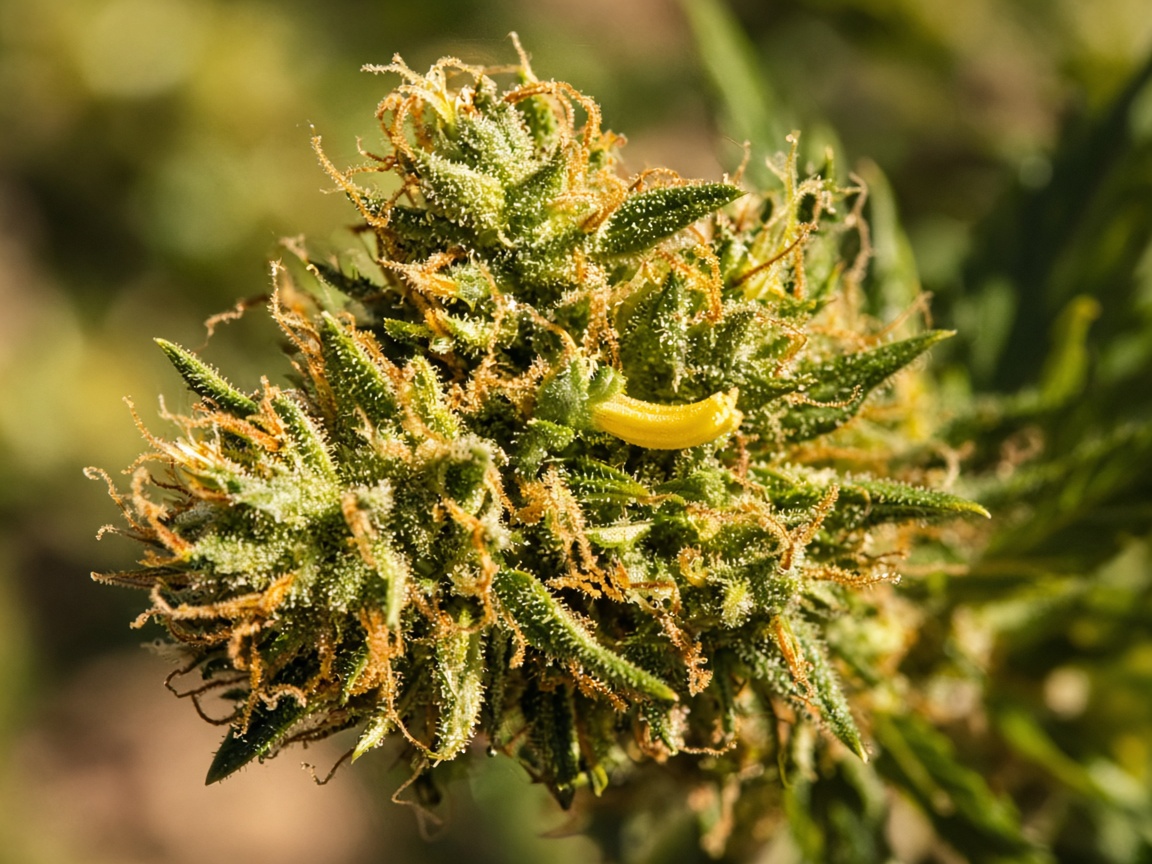
A nanner is a small yellow male part growing out of a female bud. It is a pollen sac, and it can open and shed pollen.
The name comes from the shape, a tiny banana. Papers call that part an anther. An anther is the pollen sac, the little bag that holds the pollen grains.
The calyx is the small green cup around the female flower. Punja and Holmes watched anthers form inside that cup, the tissue that normally wraps the ovary. The clusters were bright yellow. They measured about 2 to 3 millimeters. The flower hairs sat around them.
A 2026 review in Plants puts those same yellow parts in weeks 4 to 7 of flower. Early on they hide in the bud. In a heavier case, a whole female flower cluster can turn into a mass of these sacs.
| What you see | Plain name | What the papers call it |
|---|---|---|
| Yellow banana in the bud | Nanner | Anther, a pollen sac |
| Green cup around the flower | Calyx | Calyx around the ovary |
| Split running down the yellow sac | The sac opening | Dehiscence, the line where pollen leaves |
| Hairs sticking out of the bud | Pistil hairs | Stigmas, the parts that catch pollen |
A full male plant hangs pollen sacs in the open, on their own branches. A nanner is a few of those sacs stuck in a bud that otherwise looks female. The sac can still make pollen. Punja and Holmes found the anthers and the pollen looked like the anthers and pollen on male plants.
Pollen leaves through a split down the sac, and the papers call that line the stomium. Before the split, the grains are still inside. After the split, they can fall on the hairs of that same bud.
One closed banana is a small find. A cola packed with open sacs is a pollen source sitting in the flower you meant to keep seedless. Punja and Holmes studied this because seed formation cuts flower quality. Growers pull male plants for that reason. A female that builds her own sacs skips the need for a male in the row.
Sugar leaves and frosty trichomes look different. The trichomes are the shiny glands on the outside of the bud. A nanner is yellow, smooth, and shaped like a little horn. If the bud is gray and mushy after a wet week, that is rot. The check is on the late September bud rot page.
I look inside the bud, under the sugar leaves. Weeks 4 to 7 of flower are when the 2026 review says these sacs often show. On an outdoor plant here, that window lands in late summer and early fall. On a timed indoor plant, it lands after you flip to a short day.
How Does a Female Plant Grow Male Flowers? #
The plant can stay genetically female and still grow male flower parts. A flower site changes job and builds pollen sacs.
Cannabis usually splits male plants and female plants. Flower growers keep the females. Punja and Holmes say males get destroyed because seed formation reduces flower quality. Sometimes a female still grows anthers. They write that the mechanism is poorly understood.
They checked the tissue. Anthers from those hermaphrodite flowers showed a female genetic makeup, and so did the seedlings from the seeds on those plants. The paper puts it this way: hermaphroditic inflorescences produced seeds which gave rise only to genetically female plants.
An ordinary cross told a different story in the same lab. Seedlings from female plants crossed by male plants showed about a 1 to 1 male-to-female sex expression. Half the kids expressed male. Half expressed female.
So in that study the yellow sac was a change in how a female plant developed. The anther tissue still tested female. The plant had built a male part on female genes.
Richards, Ryu, Gim, and Park reviewed this in May 2026. They call sex expression plastic. Genes, hormones, the age of the flower site, and the environment all push it. A plant that throws bananas under one schedule can stay female under another. The review says current evidence has no named cannabinoid cultivar proven to do this every time.
| What Punja and Holmes measured | Result in their plants |
|---|---|
| Shape of the anthers | Similar to anthers on male plants |
| Pollen from those anthers | Formed, and could be compared with male pollen |
| Genes in the anther tissue | Female genetic composition |
| Seedlings from those seeds | Genetically female only |
| Seedlings from a normal male-female cross | About 1 male for every female |
| Why it starts | Poorly understood |
That table covers one lab's plants, and it is the clearest look at a spontaneous nanner I can point to. A 2026 review treats sex as a stack. Genotype sits in the stack with the room, the hormones, and the week of flower.
I treat a nanner as a flower problem first. The genes explain why the seeds can come out female. They can't tell you which day flipped the bud. The next sections cover the conditions the papers did measure.
What Does a Short Day Do to Cannabis Sex? #
An 8-hour or 11-hour day made male flowers on many female hemp plants in a 1954 study. A 14-hour day kept that male flowering rare.
The May 2026 Plants review reports work by Borthwick and Scully from 1954. About 25 to 45 percent of female plants produced male flowers under 8-hour and 11-hour days. A photoperiod is the split between light hours and dark hours. Under a 14-hour light period, male flower formation stayed down.
| Day length in that 1954 hemp test | What the female plants did |
|---|---|
| 8 hours of light | About 25 to 45 percent grew male flowers |
| 11 hours of light | Same band, about 25 to 45 percent |
| 14 hours of light | Male flower formation stayed down |
That result is about day length, and the review is passing along an old hemp experiment. Cultivar name, light intensity, and plant count from 1954 are missing from that summary. I use the day-length number anyway. It is the cleanest one I can cite.
Outdoor plants here ride the real sun. After midsummer, nights get longer. Farther north in Michigan, long nights arrive sooner than they do around Detroit. The season clock, frost, and hoop houses are on farming on Michigan time.
An indoor flower tent is on a timer. Twelve hours of light and twelve hours of dark is a common flower schedule. Twelve hours of light sits near the 11-hour treatment in that old test. Fourteen hours of light is closer to a long summer day. That is the schedule where male flowers stayed rare.
A timer that dies in the ON position stretches the day. That lines up with the 14-hour side of the old result, the side where male flowers stayed down. A timer that cuts the day toward 8 hours sits on the other side. In that test, about a quarter to almost half of the females grew male flowers.
I would still fix a stuck timer, since a long day can stall the flower you wanted. The nanner result in the 1954 work is tied to the short day. Those are two separate failures, and both are worth catching in a spare room.
The review's authors are careful. Outcome can depend on light intensity, how long the plant sees it, the week of growth, and the rest of the schedule. An 8-hour day in a 1954 hemp room is evidence, and it is one experiment. Your plant can carry a different genotype.
Did a Light Leak or a Hot Week Cause the Bananas? #
A low light leak in the dark showed no significant link to male flowers in a 2024 check. A cool spell before flower did raise the rate in 1954.
When bananas show up, people in Michigan point at one of two things: a light leaked into the dark, or the hoop house got hot. Here is what the papers measured.
Light during the dark hours #
Richards and colleagues report a 2024 check by Oliver and colleagues. Low-intensity light leaking into the dark period had no significant association with male flower formation. A tiny glow and a day cut to 8 hours are different treatments. The old study tested the short day. The 2024 check tested a low leak and found no significant association with male flowers.
I still want the flower tent dark. A porch bulb on a Detroit block can wash an outdoor plant all night, and a second-shift worker who opens a basement tent after work lets the room light hit the flowers. Those are real light problems, and flowering does care about night length. The paper that looked for a link between a low leak and male flowers found no significant association.
A phone flashlight during a night check counts as a low leak. I keep the check short anyway. As a nanner switch, the phone is an open question. The day-length result I can cite is the 8-hour and 11-hour schedule from 1954, as reported in the 2026 review.
Cool air, drought, and August heat #
The same 1954 work, again through the 2026 review, cooled plants before the flowering light schedule. About 13°C raised the share of female plants that grew male flowers. The rise was about 26 percentage points compared with plants held near 21°C. 13°C is 55°F. 21°C is about 70°F.
That cool treatment happened before they pushed the plants to flower. A 55°F night during late flower is a similar temperature in a different week. Southern Michigan gets cool September nights in the field and in a hoop house. The study cooled plants before induction, so a cold snap in week 6 of flower is a related situation and a different test.
Heat is the rumor I hear most in late August. A hoop house south of Detroit holds the afternoon under the plastic. The plant droops. Growers blame the heat when bananas show up the next week. The 2026 review ties temperature stress to sex expression with a cucumber example, a different crop. I'm leaving that number off this page. I don't have a cannabis trial that sets a heat trigger for nanners.
Drought has a cannabis measurement. Wizenberg, Muir-Guarnaccia, and Campbell grew a CBD hemp line called CFX-2. They cut watering from 250 milliliters to 150 milliliters, three times a week, to mimic a mild drought. They also shortened the day. Within two weeks, seven female plants grew both female flowers and male flowers.
| What people blame | What a study did | Result |
|---|---|---|
| A short day | 8-hour and 11-hour light, hemp, 1954 | About 25 to 45 percent of females grew male flowers |
| A low leak in the dark | 2024 check, reported in 2026 | No significant association with male flowers |
| Cool air before flower | About 13°C versus about 21°C, 1954 | About 26 percentage points more females with male flowers |
| Mild drought plus a shorter day | 150 mL, down from 250 mL, three times a week, 2023 | Seven females grew both flower types within two weeks |
| Late August heat under hoop plastic | Growers watch the afternoon cook | No cannabis heat setting I can cite |
A missed watering in a home tent is a smaller event than that protocol. They ran milder water and a short day together, and seven plants then built both kinds of flowers. A week of dry pots plus a short timer is closer to what they ran.
I still vent a hot hoop house, because heat stresses the crop and a stressed finish is a bad finish. The nanner evidence I can quote is the cool spell, the short day, and that mild drought paired with a shorter day. The hot week stays a grower rumor until a cannabis trial measures it.
Where Does Ethylene Sit in the Switch? #
Ethylene is a plant hormone that holds cannabis flowers on the female side. Block that signal and female plants grow male flowers.
This is the cleanest lever in the modern papers. Stress is messy. The hormone spray is a lab tool, and it shows which signal matters.
Garcia-de Heer, Kretzschmar, and Mieog sprayed clones from two cannabis lines. The paper is from April 2026. Silver thiosulfate blocks the plant's ability to sense ethylene. That spray pushed female plants hard toward male flowers. Ethephon is a spray that releases ethylene. That spray pushed male plants hard toward female flowers.
Gibberellin is another growth hormone. On its own, it grew male flowers on female plants at the side nodes. Side nodes are the joints along the stem, away from the main cola. Silver plus gibberellin gave the fullest female-to-male change in that trial. The flowers that flipped were fertile. Auxin, cytokinin, and jasmonate barely moved sex.
| Spray in the 2026 clone trial | What it did to sex |
|---|---|
| Silver thiosulfate, an ethylene block | Strong female-to-male flip |
| Ethephon, an ethylene release | Strong male-to-female flip |
| Gibberellin alone | Male flowers on female plants at the side nodes |
| Silver plus gibberellin | The most complete female-to-male change |
| Auxin, cytokinin, or jasmonate | Little change in sex |
Flajšman, Slapnik, and Murovec had tested silver in 2021 on two high-CBD breeding populations. One spray over the whole plant beat a spray on the shoot tips only. Gibberellic acid at 0.01 percent did not grow male flowers. Cutting the plants hard did not either. Colloidal silver grew as many as 379 male flowers on a plant. The pollen was fertile. They checked it with a stain, with germination tests, and by counting seeds.
The 2026 review calls silver thiosulfate the strongest tool for this forced male flowering. Breeders also use it to make feminized seed. Silver ions get in the way of the ethylene receptor. That receptor uses copper. Silver disrupts the copper step, so the ethylene message drops.
I am leaving the mix rates off this page. Those sprays are breeding tools. A home flower room is a rough place to improvise a silver spray on a plant you plan to smoke. The point of the studies is the signal. Ethylene sensing keeps the flower female. Drop that sensing, and male parts show up. Add ethylene, and male plants swing female.
A spontaneous nanner is the unplanned version of that swing, though Punja and Holmes still call the spontaneous mechanism poorly understood. The spray work shows a lever. Which day pulls that lever on a given plant is still unmapped.
How Does One Bud Go From Female Flower to Seed? #
A pollen sac starts inside the calyx, turns yellow, splits, and the hairs next to it can catch the grains.
The calyx is still that small green cup. Inside a normal female flower, the cup wraps the ovary. The ovary is the part that can become a seed. Punja and Holmes saw the first anther clusters forming in that cup. From the outside, the bud can still look like every other female cola.
The cluster then shows as a bright yellow horn, about 2 to 3 millimeters long. The hairs stand around it. Those hairs are stigmas. Their job is to catch pollen. At this point you can miss the sac if you only look at the sugar on the outside.
Next the sac splits. Punja and Holmes describe pollen leaving along a groove in the anther. Before the groove opens, the grains are still in the bag. After it opens, they can fall on the hairs of that same bud, or ride the air to a neighbor.
A seed can start once a grain sticks. How a grain finishes into a hard seed is the landing story on the seeds in Michigan bud page. What this page adds is the source of the grain. The sac was on the female. A male plant down the row is optional.
The cost shows up as flower quality. Punja and Holmes say seed formation reduces it. The plant spends the rest of bloom building that seed. The cola you wanted is sharing its effort with a hard oval.
| Step | What you can see | What the flower is doing |
|---|---|---|
| Early flower | Green cup, hairs, no yellow horn | Female flower. Calyx around the ovary |
| Weeks 4 to 7 | Yellow horn about 2 to 3 mm in the cup | Anther cluster, the pollen sac |
| Split along the horn | A groove opens on the yellow sac | Pollen can leave |
| Hairs next to the split | Orange or brown pistil hairs | They can catch a grain from that sac |
| Dry bud | A hard oval tucked in the flower | A seed finished. Flower quality took the hit |
A sac that stays closed sheds nothing. A sac that splits in a closed room shares air with the other flowers. Wizenberg and colleagues found a similar pollen load per flower on ordinary males and on masculinized females. The ordinary males made 223 percent more pollen for the whole plant. They flowered earlier and longer. More days, more flowers, more grains in the room.
That is why one banana can matter, and a whole male plant can matter more. Each flower carried a similar load in that study. The male just had a bigger total. If the grain came from the female's own sac, Punja's seedlings tested female. If a male supplied the grain, that cross came out about half and half. The steps on the bud look the same. The father is the difference.
| Flower week | What I check |
|---|---|
| Weeks 1 to 3 | Hairs and calyxes. The review's window for yellow sacs is still ahead |
| Weeks 4 to 7 | Open a few buds. Look in the cup for a yellow horn |
| The day a sac splits | Treat pollen as loose. Watch the plants that share the air |
| Dry-down | A hard seed is finished. A missed closed sac can still be in the bud |
What gets mistaken for a nanner? #
A pistil hair, a swollen calyx, and a frosty gland are different parts. The nanner is the yellow horn.
I see people pull a bud apart and name the wrong thing. The fix is the shape and the color.
- Orange or brown hairs are stigmas. They catch pollen. They darken late in flower on seedless buds too. A hair is skinny and floppy. A nanner is thicker, smooth, and yellow.
- A fat green calyx can swell because a seed is starting, or because the flower is just filling in. The cup itself is the calyx. The yellow horn inside the cup is the pollen sac.
- Frosty glands are trichomes. They sparkle. They sit on the outside of the sugar leaf and the bud. They are clear, cloudy, or amber. They are a coating. A nanner is one solid yellow piece.
- A whole male plant shows clusters of sacs on open branches, with few hairs. A hermaphrodite bud shows a few of those sacs buried in a hairy female flower. Punja and Holmes found the sac itself looks like a male anther. What changed is where it sits.
- Gray mush is rot. Leave that bud. The bud rot page is the check for a wet finish.
A closed horn can still open tomorrow. I treat a yellow horn as pollen on the way, even while it is shut. Waiting to see if it stays small gives the split a head start. Once the groove opens, grains can be on the hairs the same day.
Hairs also darken to brown on a seedless bud. That color change is the pistil aging. It is a normal late-flower look.
I use the yellow horn as the pollen clue. Hair color alone is a weak clue. A brown hair on a fat green bud can still be a seedless female flower.
If you are buying flower, you may never see the live plant. Look for the horn in the dried bud, and listen for a seed in the grinder. The horn points at self-made pollen. The seed only proves a grain landed. Use the seed page when the question is how far that grain might have flown.
How Is Self-Made Pollen Different From Drift? #
Self-made pollen starts on that female plant. Drift pollen starts on another plant and moves through the air.
A seed in the jar means pollen landed. The landing can happen two ways. The bud grew its own pollen sacs. Or a grain blew in from somewhere else. The somewhere else, including a male plant and a hemp field, is the whole subject of seeds in Michigan bud. This page stays on the sacs the plant grew.
| Male flowers the plant grew | Pollen from another plant | |
|---|---|---|
| Where the pollen starts | On that female plant, inside the bud | On a separate plant, then the air carries it |
| What you can see on the bud | Yellow bananas, about 2 to 3 mm, in the flower | A seed later. The donor can be out of sight |
| Genes in Punja and Holmes | Anther tissue and those seedlings tested female | A normal male-female cross came out about half and half |
| How much pollen in the 2023 study | Masculinized plants made less pollen per plant. Each flower made a similar amount | Ordinary males made 223 percent more total pollen |
| Pollen fitness in that study | Drought-route pollen tested with the ordinary males | Silver-route pollen tested lower than both |
| What the finished seed looks like | Hard and oval when it finishes | Hard and oval when it finishes |
| Where to read the long trip | You are on the short trip | Seeds in Michigan bud |
Wizenberg and colleagues measured the pollen gap. Ordinary male plants made 223 percent more total pollen than the plants that had been pushed to grow male flowers. Counted one flower at a time, the amount of pollen was similar across the groups. The plant-level gap came from how long and how fully the males flowered. Ordinary males flowered earlier and longer.
Ordinary males made highly viable pollen. So did the females that grew male flowers after the milder watering. That pollen was 200 percent more viable than pollen from the colloidal-silver plants. Viable means the grain is alive enough to do its job. A drought-route sac can throw living pollen. A silver spray, in that study, threw weaker pollen.
A closed tent gives a nanner a short ride. The plants share one box of air. One open sac can dust the colas in that room. Outdoor flower in Michigan adds wind, and a field gives a grain a longer road. For how sun-grown and indoor plants compare, see the sun-grown versus indoor page. The miles and the hemp fields stay on the seed page.
You cannot see which path made a seed by looking at the shell. Color, stripes, and size fail that job. Punja and Holmes told the paths apart after they grew the seedlings and ran a DNA sex test. A hard brown seed is a finished seed. It is quiet about the father.
Both paths can land in one jar. A nanner on the plant you bought, and a grain from down the road, make seeds that look alike. The banana in the bud is the clue that this plant may have made pollen. The seed alone is the clue that some pollen landed. I use both clues and I don't pretend the seed names the source.
What Do Seeds From a Nanner Grow Into? #
In the Punja and Holmes study, seeds from the hermaphrodite flowers grew only genetically female plants.
That is the finding people mean when they say nanner seeds are feminized. Feminized, here, means the seedlings tested female. Punja and Holmes saw a female genetic makeup in the anther tissue and in those seedlings. Their ordinary cross, a female pollinated by a male, came out about one male seedling for every female seedling.
Breeders use the same idea on purpose. They push a genetic female to grow male flowers, then use that pollen on another female. The pollen has no male chromosome to pass on, so the kids are genetically female. Flajšman and colleagues did that with silver and got fertile pollen and seed. The 2026 review calls silver thiosulfate the main tool for that breeding step.
A nanner on a plant nobody sprayed is the accidental version. The seedlings in Punja's test were genetically female. The review also says genes and the environment still shape whether a plant stays female-looking. A female seedling can still grow a few bananas later, the same way her parent did. Female genes were the sex result in that test. The next flower can still build a sac.
I would not plant a mystery seed from a seeded cola and call it a feminized pack. The shell hides the father. If the pollen was from a true male, Punja's cross came out about half and half. If the pollen was from the hermaphrodite flowers, the seedlings tested female. You learn which one you had by growing a batch and watching the flowers, or by a lab test. One seedling is a small sample.
Choosing a start for next season is a different page. Seed versus clone, for a Michigan outdoor year, is here. Bag seed, and the state's home-grow plant cap, stay on the pollen-drift page. I am keeping this one on the flower the plant grew.
| What you have in your hand | What Punja and Holmes could say |
|---|---|
| Seed from their hermaphrodite flowers | Seedlings were genetically female |
| Seed from their male-female cross | About 1 male seedling for every female |
| The anther itself | Female genetic composition |
| The outside of a seed | They needed seedlings and a DNA test |
Wizenberg and colleagues add a pollen warning to that table. Less pollen per plant still matters if the grains are alive. Their drought-route pollen was in the high-viability group with the ordinary males. A few open bananas can seed a cola. They do not have to match a male plant's total pollen count to do it.
What Do You Do When You See Bananas in the Bud? #
Look in weeks 4 to 7 of flower, and keep open sacs from shaking pollen onto the cola.
The 2026 review says these yellow 2 to 3 millimeter parts often first show in that window. They sit in the bracts, next to the hairs, and they are easy to miss. I pull a bud open. I look for yellow, smooth, banana-shaped sacs. I ignore the orange hairs. Hairs are the pollen catchers. They are normal on a female flower.
- A closed yellow banana still holds its pollen.
- A split down the sac means pollen can already be out.
- A few sacs on one plant can dust the other plants that share the air.
- A closed tent makes that trip short. Outdoor wind in Michigan makes it longer.
- A gray, wet, sour bud after a Michigan rain is rot. That check is the bud rot page.
If the sac is still closed, you have a short window. Pinching it off can shake pollen if you are rough. I move slow, and I bag the branch if I can do it gently. Once the sac has split, assume grains are loose. The plants in that room, or that corner of the field, are the ones I watch for seed over the next weeks.
A home grower can run this check with a headlamp, used briefly. I already said a phone light is a weak suspect for causing nanners. It is still extra light in the dark, so I click it on, look, and click it off. The timer is what I trust for day length. Twelve hours is the usual flower night in these tents. An 8-hour day is the old hemp schedule that grew male flowers on a large share of females.
On the buyer's side, the clue is the bud in the jar. A yellow horn still stuck in the flower means that plant grew a male part. A hard seed means pollen landed and the flower finished a seed. Punja and Holmes tie that seed formation to lower flower quality.
Can you smoke a bud that grew a nanner? #
A nanner is a flower part. The quality hit they measured is the seed, because seed formation cuts flower quality.
I don't have a study that calls the banana itself a poison. Punja and Holmes cared about flower quality and about the seeds those anthers made. Mold, a wet Michigan harvest, and unknown sprays are separate problems. If the bud smells like a wet basement and crumbles gray, I treat that as rot and I leave it. The September rain page covers that look.
A seeded nug smokes harsher for a plain reason. You are lighting flower plus a hard seed. Pick the seeds out if you are going to smoke it. The high is still the flower that is left. A potency percent for that loss lives on the pollen page. I am leaving that number there.
Divine Toke flower ships by mail, and I can't promise a jar is always seedless. If a jar has a seed, pollen landed. If it has a banana, the plant may have made the pollen. Both clues can show up in outdoor flower in this state.
FAQ #
These are the questions I get when someone finds a yellow horn in an otherwise female bud.
What is a nanner? #
A nanner is a yellow, banana-shaped pollen sac growing on a female bud.
Papers call it an anther. Punja and Holmes measured clusters like these at about 2 to 3 millimeters, bright yellow, with the flower hairs around them. The sac can open along a split and shed pollen. A full male plant grows sacs like these in the open. A nanner grows them inside a bud that otherwise looks female.
Is a nanner the same thing as a male plant? #
A nanner is a male part. The plant under it can still be genetically female.
Punja and Holmes found a female genetic makeup in the anther tissue of the hermaphrodite flowers they studied. A true male plant is male through the whole body. A normal cross in that paper came out about half male seedlings. The banana is the part. The genes of that part, in their test, were female.
Can one banana seed the cola? #
Yes, if the sac opens and the grains are alive. The female plant can supply the pollen.
Wizenberg and colleagues found ordinary males made 223 percent more total pollen than the masculinized plants. Per flower, the amount was similar. Their drought-route pollen was highly viable. In a closed tent, that pollen shares a small box of air with every cola.
Do light leaks cause hermaphrodite cannabis? #
A low leak in the dark showed no significant link to male flowers in the 2024 check a 2026 review reports.
The result that did line up was day length. Richards and colleagues report a 1954 hemp study. About 25 to 45 percent of female plants grew male flowers on 8-hour and 11-hour days. A 14-hour day kept male flowers down. I still keep a flower tent dark, and I treat the short day and the tiny leak as separate questions.
Does heat make a cannabis plant herm? #
I don't have a cannabis trial that sets a heat trigger for nanners.
The same 1954 work, via the 2026 review, cooled plants to about 13°C before flowering. That group grew male flowers at a rate about 26 percentage points higher than plants held near 21°C. A hot August afternoon in a Michigan hoop house is still hard on the crop. It stays a grower rumor until someone measures it in cannabis.
Are nanner seeds feminized? #
In one study, seeds from the hermaphrodite flowers grew only genetically female plants.
That study is Punja and Holmes. Their male-female cross came out about half and half. You cannot see which kind of seed you hold. A female seedling can still throw bananas later. Female genes were the result they measured. A stable pack is a different claim.
Can the seed show whether pollen drifted in? #
The shell cannot show the father. Color and stripes fail that test.
Punja and Holmes separated the paths by growing seedlings and running a DNA sex test. Self-made pollen and drift pollen can both finish a hard oval seed. The long trip, including hemp pollen on the wind, is the seeds in Michigan bud page.
Can you smoke flower that grew a nanner? #
The banana is a flower part. Seed formation is the quality problem they documented.
Punja and Holmes say seed formation reduces flower quality. I don't have a paper that treats the yellow sac as a toxin. Mold after a wet Michigan week is a different reject. If the bud is gray and sour, use the bud rot check before you think about smoking it.
When in flower do nanners usually show? #
Often in weeks 4 to 7, and they hide in the bud.
The 2026 review puts the yellow 2 to 3 millimeter sacs in that window, inside the flower tissue next to the hairs. On outdoor plants here, that is late summer into early fall. In a tent, count the weeks from the day you flipped the lights. A look at the outside sugar can miss a sac tucked in the calyx.
What should a Detroit home grower check first? #
The timer, the dark hours, and the inside of the bud in weeks 4 to 7.
An 8-hour or 11-hour day is the schedule tied to male flowers in the 1954 hemp work the review cites. A low light leak showed no significant link in the 2024 check. Mild drought plus a short day grew both flower types on seven females within two weeks in the 2023 study. I would check water, the clock, and the buds. I would leave silver sprays to a breeding lab.
If You Want the Flower Without Running the Tent #
Self-made pollen and drifted pollen can both finish a seed. The paths start on different plants.
A nanner means the female grew the sac. Drift means some other plant made the grain. With a bud in your hand, the yellow horn is the clue to look for.
Divine Toke sells sun-grown flower by mail at divinetoke.org. There is no shop counter and no street address. The list is flower, 1 gram pre-rolls, and the 20-pack, which is 20 one-gram joints for $120. Solventless rosin from Honey Bananas, and bio hash from Sundog, are on that list too.
I don't have a Divine Toke plant to point at for this story, and none of those products comes with a promise that a flower never grew a sac. Seedless is the goal for the jars we mail. The season those plants ride is farming on Michigan time.
This article is for educational purposes only and is not medical advice. Always consult your healthcare provider before starting any new wellness routine.
Try Honey Bananas — sun-grown in Detroit
Small-batch, living-soil flower cultivated in our Detroit sun-houses. Ships to all 50 states.