Licensed vs. Gas-Station THC: Michigan's Hemp Crackdown This Month
CRA suspended Loud Labs for hemp products over 0.3% THC. Most federal hemp restrictions now wait until Dec. 11. Here's what a Detroit shopper should do.
Questions this article answers
- did Michigan ban hemp-derived THC 2026
- Loud Labs Michigan CRA hemp suspension
- gas station THC vs licensed dispensary Michigan
- federal hemp ban delayed to December 11 2026
- is 7-OH illegal in Michigan
- licensed flower vs smoke shop gummies Detroit

Head Cultivator
On this page
If you buy THC in Metro Detroit this month, two clocks just moved — and they do not move the same way. On August 25, Michigan's Cannabis Regulatory Agency suspended the hemp processor-handler license held by Loud Labs of Michigan LLC after an investigation into products the agency says tested above hemp's 0.3% delta-9 THC line. On September 4, MITechNews reported that a federal stopgap spending bill pushed most of a new national hemp definition from November 12 to December 11, 2026 — while some synthetic-cannabinoid pieces still point at the earlier date. This is a shopper update, not a rewrite of the chemistry-and-loophole explainer. The question this post answers: does any of that change what you should buy at a licensed Detroit counter versus a gas-station or smoke-shop "hemp THC" display?
Michigan did not outlaw industrial hemp this week, and it did not reopen a convenience-store high. Licensed adult-use flower is still the regulated lane. A neon gummy is still not a CRA safety badge. Chemistry and Farm Bill history live in hemp-derived vs. marijuana-derived THC. This page is what moved in late August and early September.
At a Glance: What Changed and What It Means for a Detroit Buyer #
Two enforcement stories and one federal calendar tweak — none of them turned licensed adult-use flower illegal, and none of them made unlicensed intoxicating hemp a bargain.
| What changed | What it means for a Detroit-area buyer | Date |
|---|---|---|
| CRA immediately suspended Loud Labs of Michigan LLC hemp processor-handler license HPHL-000047 and issued a notice of intent to revoke, alleging products over 0.3% delta-9 THC | This is an administrative hemp-license case in Lansing, not a new statewide statute and not a criminal conviction. Your licensed Grand River or 8 Mile counter still sells marijuana under CRA adult-use rules. | Aug. 25, 2026 CRA/LARA release |
| CRA notice cites concentrate COAs up to 92.84% delta-9 THC, plus patches at 0.59% and 0.45% | Those numbers are alleged lab readings in an enforcement file, not a verdict. They show why a hemp label and a marijuana-strength product are not the same conversation. | CRA notice ENF 26-00487 (PDF) |
| Stopgap spending bill H.R. 6500 delays most of the 2025 federal hemp-definition change from Nov. 12 to Dec. 11, 2026 | A one-month federal reprieve for most hemp products is not a Michigan gas-station green light. Delta-8 still sits in the licensed marijuana system here. | Congress.gov on H.R. 6500; MITechNews, Sept. 4 |
| Cannabinoids not capable of being naturally produced by Cannabis sativa L. still track the November 12 federal date | Do not flatten the calendar. Synthetic / non-natural cannabinoid exclusions were written as a separate clock. | Fox Rothschild on H.R. 6500; Akerman, Sept. 2 |
| Canton tobacco-shop inspection with MDARD and MSP; hundreds of kratom, 7-OH, and alleged illegal THC items seized | Local food-law and sales allegations — not proof Michigan passed a statewide 7-OH criminal ban. The case is headed toward the Wayne County prosecutor, per local reporting. | Inspection Aug. 28, 2026; coverage Sept. 3–4 |
Remember three things: licensed adult-use flower did not get banned; a hemp license suspension is allegations plus process, not a conviction; a Washington delay does not put CRA approval on a smoke-shop shelf along I-275 or 8 Mile. August's tax-and-DEA wrap is the August 2026 policy roundup.
Did Michigan Just Ban Hemp-Derived THC? #
No. Michigan did not pass a brand-new statute this week that wipes industrial hemp off the map, and it did not invent a fresh ban on every CBD bottle. What moved is enforcement: the CRA used existing hemp-processor rules, while intoxicating THC isomers such as delta-8 have been pulled into the licensed marijuana system since 2021.
People mash three stacks into one headline. They are not the same stack.
| Stack | Who runs it | What it is | What it is not |
|---|---|---|---|
| Industrial hemp as a crop | MDARD's industrial hemp program | Grower registration for fiber, grain, floral hemp, and related cultivation | A license to sell a marijuana-strength gummy at a gas station |
| Hemp processing / marketing | CRA hemp processor-handler licenses after Executive Reorganization Order 2022-1 (signed Feb. 11, 2022) | Processing, handling, brokering, or marketing industrial hemp under the Industrial Hemp Research and Development Act | A free pass to possess cannabis over 0.3% delta-9 THC dry weight |
| Intoxicating marijuana retail | CRA adult-use / medical marijuana rules | Flower, edibles, and concentrates sold 21+ (adult-use) through licensed shops | Convenience-store "hemp THC" by default |
On the intoxicating-isomer piece, Michigan already drew a hard line. The CRA's delta-8 page says that effective October 11, 2021, businesses cannot sell delta-8 without proper marijuana licensing. That rule did not flip because Loud Labs got a notice, and it did not flip because Congress delayed part of a federal hemp definition.
True low-THC hemp — fiber, grain, many CBD products that stay under the cap — is not a gummy built to get you high. CRA hemp-processing FAQs still describe hemp-derived topicals and tinctures at 0.3% THC or less as the lawful hemp-marketing lane with a processor-handler license, and they note no legal pathway for hemp processors to handle concentrated extract above 0.3% THC. This month is the state using that split, not inventing it. CRS IF13136 is about the federal hemp definition — not a Detroit adult-use rewrite.
What Did the CRA Actually Do to Loud Labs? #
The CRA immediately suspended Loud Labs of Michigan LLC's hemp processor-handler license (HPHL-000047), alleged a violation of the Industrial Hemp Research and Development Act's 0.3% delta-9 THC possession rule, and issued a notice of intent to revoke the license and impose a $500 administrative fine — with the explicit caveat that the claims remain allegations until the administrative process says otherwise.
Start with the August 25, 2026 LARA/CRA press release, not a group chat. Official identity facts: Loud Labs of Michigan LLC, hemp processor-handler license HPHL-000047, licensed at 736 N. Larch St. in Lansing. CRA staff inspected on March 25, 2026 and audited inventory on May 18, 2026. The agency alleges possession of cannabis with delta-9 THC above 0.3%, including products whose COAs exceeded that line. It immediately suspended the license, issued a notice of intent to revoke, and cited Section 12(1)(a) of the IHRDA — suspension when a licensed processor-handler intentionally possesses cannabis containing more than 0.3% delta-9 THC on a dry-weight basis. After notice and a hearing, the CRA must revoke if it finds a violation by a preponderance of the evidence. The release's own brake pedal: "The allegations contained in the CRA notice remain allegations unless and until established through the administrative process."
The longer charging paper is the Notice of Suspension, Intent to Revoke, and Imposition of Fines (ENF 26-00487). That notice repeats the Lansing address, cites the CRA's hemp-processor authority under Executive Reorganization Order 2022-1 and MCL 333.27002, and lists specific COAs the agency says it reviewed on May 18:
| Product described in the notice | Lab named on the COA (as alleged) | Reported delta-9 THC in the notice |
|---|---|---|
| Concentrate jar, tested Oct. 29, 2024 | FESA Labs, sample 51041029-1 | 92.84% |
| Concentrate jar, tested Sept. 28, 2024 | Bluebonnet Labs, sample NHTL-WSP-D9-0924 | 21.38% |
| Concentrate jar, tested Nov. 13, 2024 | California Ag Labs, sample 2411CRG2460.7142 | 20.35% |
| Topical transdermal patches, tested Oct. 31, 2025 | Chem History Labs, sample 2510CH0774.3712 | 0.59% |
| Topical transdermal patches, tested Oct. 31, 2025 | Chem History Labs, sample 2510CH0774.3710 | 0.45% |
Those are the CRA's alleged readings, not a jury finding. The same notice intends $500 in administrative fines under MCL 286.857(1)(a) and a revocation hearing through the Michigan Office of Administrative Hearings and Rules. The public release does not announce a criminal conviction.
News outlets framed this as the CRA's first hemp processor-handler suspension (MMJ Daily; MLive) — reporting, not a sentence in the official release. It is not a Detroit shop shutdown or a reason to dump a sealed licensed eighth. It is a reminder that hemp-processor and marijuana-processor licenses have different THC ceilings. Whether Loud Labs keeps the license is for the hearing. Buy from the lane that already tests marijuana as marijuana.
Why Does 0.3% vs. 93% THC Matter at a Gas Station Counter? #
Because 0.3% delta-9 THC by dry weight is the legal line that keeps a product in the hemp category — and a concentrate COA near 93% is not a rounding error. It is the difference between industrial hemp and marijuana-strength extract, even if a pouch on a Canton or Detroit smoke-shop shelf still says "hemp."
The IHRDA threshold the CRA quoted is not a vibe. It is a number. The August 25 release and the ENF 26-00487 notice both hang the case on more than 0.3% delta-9 THC on a dry-weight basis. That is the same family of test the 2018 Farm Bill used to carve hemp out of federal marijuana: delta-9 only, dry weight, 0.3%.
Here is the shopper translation, without a chemistry lecture (that lecture is already in the July hemp explainer):
| Number you hear | What it usually means at a counter | Why it matters this month |
|---|---|---|
| ≤ 0.3% delta-9 THC dry weight | The hemp category under 2018-style rules and Michigan's IHRDA hemp-processor line | Industrial hemp / many true CBD products live here — if the number is real |
| 0.45%–0.59% (the alleged patch COAs) | Over the hemp line, even if it does not look like a dab jar | "A little over" is still over |
| ~20–93% (the alleged concentrate COAs) | Marijuana-strength extract territory | A hemp processor-handler license is not a concentrate free-for-all |
| "Hemp-derived THC" on a gas-station gummy | A marketing claim, not a CRA adult-use test panel | Seeing it next to chips does not mean it passed Michigan marijuana testing |
A licensed Michigan adult-use jar is supposed to carry potency from a state-licensed safety compliance lab, then sit in METRC before it hits a dispensary. That process — potency plus contaminants — is what "lab tested" means in Michigan. A smoke-shop pouch can still print "lab tested" from whoever the brand hired. Those are not the same sentence.
Why the other counter exists is the 2018 delta-9-only gap. CRS IF13136 and CRS IN12620 describe the later move toward total THC (including THCA) and a tiny finished-product milligram cap. Michigan already treated many of those intoxicants as marijuana for retail, which is why a Detroit shopper can live in a legal-weed state and still see unlicensed pouches on a fluorescent shelf. Full chemistry is in the July explainer; the parallel-market cost is in why illicit cannabis still competes.
If a concentrate COA in a hemp file reads 92.84% delta-9, you do not need a lawyer to feel the mismatch. Buy THC from a licensed marijuana counter. Do not treat a neon bag as a CRA badge. This farm will not walk anyone through how to keep selling unlicensed hemp-THC or how to dodge a CRA inspection. We grow sun-grown, state-licensed flower for adults who want the known-quantity path.
Is Licensed Adult-Use Flower Safer Than Smoke-Shop Gummies? #
Safer as a process, yes — licensed Michigan adult-use flower has to pass CRA-required testing, age gates, and a seed-to-sale trail that most gas-station gummies never see. Safer as in "cannabis cannot impair you," no. A tested eighth can still get you high, still show up on a drug test, and still is not medicine unless a clinician says so.
This is a process ranking, not a halo. The FDA's delta-8 consumer page is blunt: those products have not been evaluated or approved by FDA for safe use, they can be made with potentially harmful chemicals, they are often packaged like candy, and they should be kept away from kids and pets. The agency has also warned about copycat THC edibles after accidental ingestions.
Michigan's licensed lane is built to fight that pattern: 21+ ID checks, licensed-lab batch tests before retail, and packaging rules so an eighth does not pretend to be breakfast cereal. When a product is off, the CRA can post a public-health advisory — the point of a regulated market, even when it is annoying.
| Checkpoint | Licensed adult-use flower (CRA shop) | Typical smoke-shop / gas-station "hemp THC" gummy |
|---|---|---|
| Who can buy | Adults 21+ with ID culture built in | Often inconsistent |
| Whose lab | State-licensed safety compliance lab; results in METRC | Brand-picked COA, sometimes missing or stale |
| What got tested | CRA panel (potency and contaminants) — see lab testing explained | Maybe potency, maybe nothing you can verify |
| If a batch is wrong | Licensee + CRA complaint path + possible recall | Harder to find who to call |
| Legal story in Michigan | Adult-use marijuana under MRTMA / CRA | Intoxicating isomers are not a hemp shortcut (CRA delta-8 page) |
| Looks like candy? | Child-resistant / not-candy rules apply in the licensed system | Gummies, shots, and bright pouches are the business model |
Honest caveats: licensed cannabis impairs, can still fail a workplace test, and "lab tested" means a batch sample was tested — not that every nug was personally blessed. The lab-testing guide is honest about those gaps. A cheap unlicensed gummy is not safer because the bag says hemp. Hemp is a category claim. Your liver does not read Farm Bill recitals.
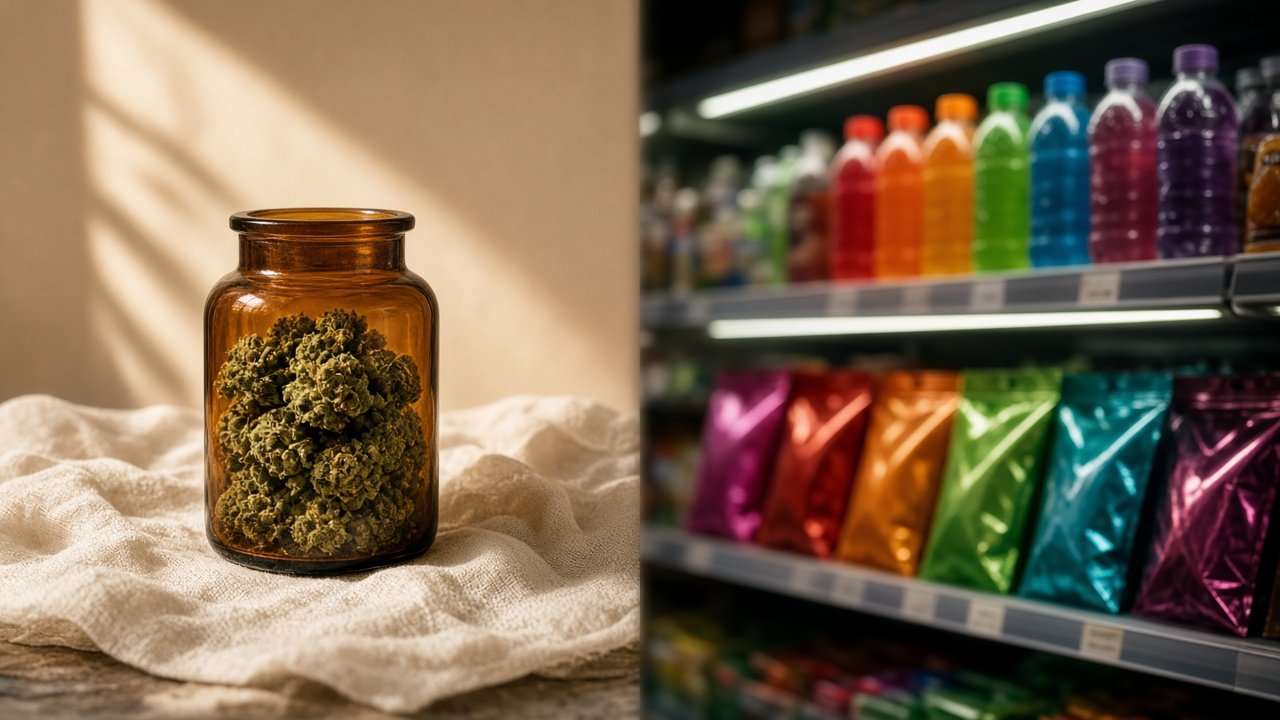
Divine Toke's lane is the left side of that table: sun-grown, state-licensed, lab-tested marijuana-derived flower for Detroit adults. See the shop.
Did Washington Delay the Federal Hemp Crackdown to December 11? #
Most of it, yes — according to September reporting and the text of the stopgap — but not the whole crackdown, and not Michigan's already-tighter retail rules. The new federal hemp definition was set for November 12, 2026; a continuing resolution moved most of that date to December 11, 2026. Cannabinoids the cannabis plant cannot naturally produce still track November 12.
What Congress already enacted in 2025. The FY2026 Agriculture appropriations package (P.L. 119-37; the hemp rewrite tracked as H.R. 5371 / §781) changed hemp in 7 U.S.C. § 1639o. CRS IF13136 and CRS IN12620 describe the shift: from a 0.3% delta-9-only dry-weight test (2018 Farm Bill) to a 0.3% total THC test including THCA, plus exclusions for finished products over 0.4 milligrams of THC (and similarly acting cannabinoids) per container, certain intermediates, and cannabinoids not naturally produced by the plant or synthesized outside the plant. Products outside hemp can be treated as marijuana under the Controlled Substances Act. Fiber and grain hemp is what lawmakers describe as remaining protected. Full-spectrum CBD is what iHemp Michigan told MITechNews they fear becomes collateral damage.
What the September stopgap did. H.R. 6500 funds the government through December 11, 2026 and, in Congress.gov's summary, delays implementation of certain hemp-definition changes. The Senate passed it 90–6 on August 8 (after a 61–32 vote to keep the hemp delay); the House passed it 370–48 on September 1. MITechNews (Sept. 4) reports President Trump signed it, moving most restrictions from November 12 to December 11.
What it did not delay. The CR does not extend to products containing cannabinoids "that are not capable of being naturally produced by a Cannabis sativa L. plant." That exclusion still points at November 12, 2026 (Fox Rothschild; Akerman). Converted isomers are why you should not tell a friend "Congress postponed the whole hemp crackdown."
| Federal clock | What it covers (plain English) | Date to watch |
|---|---|---|
| Most of the new hemp definition (total THC, 0.4 mg/container cap, many finished-product rules) | Delayed by the CR | December 11, 2026 |
| Cannabinoids the plant cannot naturally make | Still on the original runway | November 12, 2026 |
| Michigan delta-8 / intoxicating-hemp retail | Already in the licensed marijuana system | October 11, 2021 (unchanged by this CR) |
| Lame-duck Congress after Nov. 3 midterms | May pass a longer framework, delay again, or let Dec. 11 hit | Unknown — not a Detroit price cut |
A delay is not a new Farm Bill and not a Michigan statute. The Barr–Craig Lawful Hemp Protection Act is still committee paper (MITechNews). Last month's unfinished-House snapshot is in the August 2026 policy roundup. The after-signature version for a Detroit buyer: your licensed counter did not become illegal, and an unlicensed intoxicant did not become a federal vitamin.
What About 7-OH and Kratom Shops in Metro Detroit? #
Canton police, MDARD, and Michigan State Police inspected a Canton-area tobacco shop on August 28, 2026, and MDARD seized hundreds of kratom and concentrated 7-OH products plus hundreds of THC items allegedly sold illegally — but Michigan has not enacted a statewide criminal ban that simply names 7-OH as illegal. Regulators are using food-adulteration law, and a separate federal scheduling fight is still split between finished orders and unfinished proposals.
ClickOnDetroit (late Sept. 3, 2026) is the local primary; Hoodline (Sept. 4) repeats it. I am using inspection, not a TV-raid montage. On August 28, 2026, Canton police, MDARD, and MSP inspected a Canton-area tobacco shop. MDARD seized hundreds of kratom and concentrated 7-OH products plus hundreds of THC items allegedly sold illegally. The case is headed toward the Wayne County prosecutor. Canton police said more local enforcement could follow — a warning, not a countywide conviction.
7-OH is short for 7-hydroxymitragynine, an alkaloid that occurs in small amounts in kratom (Mitragyna speciosa) and can be concentrated into tablets, gummies, shots, and extracts. ClickOnDetroit notes opioid-receptor effects and added risk when mixed with alcohol, opioids, or benzodiazepines. That is reporting, not a diagnosis, and not medical advice.
Is 7-OH banned statewide in Michigan? ClickOnDetroit is explicit: Michigan has not enacted a statewide ban specifically making 7-OH illegal. What the state has said is that kratom and other unapproved psychoactives cannot legally be marketed as food or dietary supplements. MDARD's May 15, 2025 advisory lists kratom among unapproved ingredients and calls those foods adulterated under the Michigan Food Law. That is the hook for pulling product without a new "7-OH felony" statute. House Bill 5537 (2026) would prohibit kratom production and sale; it passed the House 56–48 and sits in the Senate Committee on Government Operations. It is a bill, not a ban.
Federal clocks, unflattened:
| Action | What it covers | Status as of early September 2026 |
|---|---|---|
| DEA notice of intent (July 6, 2026) to temporarily place 7-OH above a specified threshold in Schedule I | Concentrated / high-7-OH products, not a blanket botanical-kratom leaf ban in the notice's own framing | ClickOnDetroit (Sept. 3) still described the 7-OH federal change as not yet in effect |
| DOJ announcement (Aug. 25, 2026) and Federal Register temporary order (effective Aug. 26, 2026) | Mitragynine pseudoindoxyl (MGPI), MGM-15, and MGM-16 — three 7-OH-related synthetics | In effect as Schedule I through Aug. 26, 2028 (temporary). DOJ says this targets manufactured opioid products, not traditional botanical kratom |
Shopper translation: Canton is a different aisle — kratom, 7-OH, alleged unlicensed THC — running on food law, not a CRA marijuana license. If someone says "Michigan banned 7-OH last week," the accurate reply is: MDARD can seize adulterated food; the Legislature has not finished a statewide 7-OH criminal ban; DEA scheduled three related synthetics and had not, as of that local coverage, finished scheduling 7-OH itself. Stay in the licensed cannabis lane if cannabis is what you wanted.
What Should a Michigan Shopper Do This Month? #
Buy intoxicating cannabis from a CRA-licensed adult-use shop, ask for a real batch COA, ignore "Farm Bill legal high" stickers, and treat December 11 as a federal hemp-definition deadline — not as a Detroit panic button.
Practical list for a Friday after a Detroit shift:
- If you want THC, use the licensed counter. Adult-use is 21+. Divine Toke sells licensed flower, not a gas-station lottery.
- Read the molecule, not the vibe word. Delta-8, HHC, THCA, 7-OH, and kratom are different substances. The July explainer is the chemistry map; this page is the September calendar.
- Ask for the COA that matches the batch. How to read it: what lab tested means.
- Do not treat a D.C. vote as a shelf rewrite. H.R. 6500 delayed most of a federal hemp definition to Dec. 11. It did not license a smoke shop on Michigan Avenue. Keep November 12 for non-natural synthetics (Fox Rothschild).
- If you use CBD without wanting a high, keep the COA anyway. Hemp farmers told MITechNews the 0.4 mg/container cap could hit full-spectrum CBD. That is not a reason to buy an intoxicating gummy "while you still can."
- Leave 7-OH and kratom food products out of the "it's natural" folder. MDARD already calls those unapproved food ingredients.
- Do not drive impaired, and do not ask this farm how to stay in the unlicensed hemp-THC business. We grow regulated flower. We will not workshop evasion.
Frequently Asked Questions #
Did Michigan ban hemp-derived THC this month? #
No. Michigan did not pass a new statute this week that bans industrial hemp or every CBD bottle. The CRA used existing IHRDA hemp-processor rules against one Lansing licensee, and intoxicating delta-8 has been treated as marijuana for unlicensed sales since October 11, 2021. See the August 25 CRA release and the CRA delta-8 page.
Was Loud Labs convicted of a crime? #
No. The August 25 release is a license suspension, alleged IHRDA violation, and notice of intent to revoke and fine — with the explicit statement that the claims remain allegations until the administrative process establishes them. See the press release and ENF 26-00487. A hearing is next, not a comment-section verdict.
Why would a "hemp" concentrate test near 93% THC? #
If the COA in the CRA's file is right, that number is marijuana-strength extract, not industrial hemp. The IHRDA line is 0.3% delta-9 THC dry weight; the notice alleges a FESA Labs concentrate COA at 92.84%. That alleged reading is in ENF 26-00487 — an allegation, which is why shoppers should care which license and which lab sit behind a product.
Does the December 11 delay make gas-station THC legal in Detroit? #
No. A federal continuing resolution delayed most of a national hemp-definition change. It did not repeal Michigan's rule that intoxicating delta-8 belongs in the licensed marijuana system. H.R. 6500 is a funding bill with a hemp-date tweak. MITechNews and CRS IF13136 are about federal hemp status, not a Detroit adult-use rewrite.
What still happens on November 12 if December 11 is the new headline? #
Analyses of H.R. 6500 say cannabinoids not capable of being naturally produced by Cannabis sativa L. still lose federal hemp status on November 12, 2026; most of the rest waits until December 11. See Fox Rothschild and Akerman. Keep both dates.
Is 7-OH illegal in Michigan after the Canton inspection? #
There is no statewide Michigan criminal ban that simply names 7-OH as illegal. MDARD treats kratom and similar unapproved psychoactives as adulterated food; Canton seized product after an August 28 inspection; federal scheduling of 7-OH itself was still described as not in effect in early-September local coverage, while three related synthetics are already temporary Schedule I. See ClickOnDetroit, MDARD's May 15, 2025 advisory, and the DOJ Aug. 25 order. HB 5537 is still in the Senate.
Is licensed adult-use flower safer than a smoke-shop gummy? #
As a testing, labeling, and age-gate process, licensed Michigan flower is the stricter lane. As a promise that you cannot get too high, no. The FDA delta-8 page documents unapproved status and kid-appeal packaging. CRA-licensed product has to pass the panel in what lab tested means. This is not medical advice.
Can I still buy CBD after Loud Labs and the federal delay? #
Non-intoxicating, truly low-THC hemp CBD is not what the Loud Labs notice is about — but the forthcoming federal 0.4 mg/container total-THC cap is why full-spectrum brands are lobbying Congress. MITechNews quotes Michigan hemp groups drawing that line. If a "CBD" gummy also lists delta-8 or a heavy THC milligram count, treat it as an intoxicant.
Where should a Detroit shopper buy THC this month? #
From a CRA-licensed adult-use retailer, with a batch COA you can actually read. Unlicensed hemp-THC and smoke-shop 7-OH are not that path. Divine Toke's version is sun-grown flower in the shop. For the price-and-safety cost of the parallel market, see the illicit-market piece.
Does this article tell me how to keep selling unlicensed hemp-THC? #
No. This is a consumer update for Metro Detroit shoppers — not a compliance manual for unlicensed retailers, not a guide to staying under 0.3% on paper, and not a playbook for evading the CRA or MDARD.
What's the Bottom Line for a Detroit Shopper? #
This month is enforcement plus a short federal calendar tweak — not a ban on licensed flower, and not a green light for gas-station THC. The CRA suspended Loud Labs of Michigan LLC (HPHL-000047, 736 N. Larch St., Lansing) and alleged hemp products over the 0.3% delta-9 IHRDA line, including concentrate COAs in the notice that run up to about 93%. Those are allegations in an administrative file. Congress, via H.R. 6500, delayed most of a new federal hemp definition to December 11, 2026, while non-natural synthetic cannabinoids still sit on November 12. Canton showed another aisle: kratom and 7-OH pulled as adulterated food, not a finished statewide 7-OH criminal code.
If you want a high in Detroit, the cleaner process is still lab-tested adult-use flower from a licensed shop — the known grow, the known test, the known age gate. That is the jar we grow at Divine Toke. The fluorescent pouch is a different gamble.
Background, not clones of this page:
- Hemp-derived vs. marijuana-derived: the legal gray area
- August 2026 monthly policy roundup
- The illicit cannabis market is still everyone's problem
- What "lab tested" means in Michigan
- Shop licensed flower
This article is for educational purposes only. It is not legal advice and not medical advice. Cannabis, hemp, kratom, and 7-OH rules change quickly and stack federal, state, and local desks. The Loud Labs matter is an administrative enforcement case with allegations that remain allegations until established in that process. Nothing here is a guide to selling unlicensed hemp-THC or evading the CRA, MDARD, or any other agency. If you have a court, licensing, health, or employment question, talk to a qualified attorney or healthcare provider — and check the Michigan CRA, MDARD, CRS hemp products, and your local rules before you buy, sell, or travel with any of these products.
Grown in Detroit. Shipped to your door.
Small-batch, sun-grown cannabis cultivated in living soil. Mail-order shipping to all 50 states.