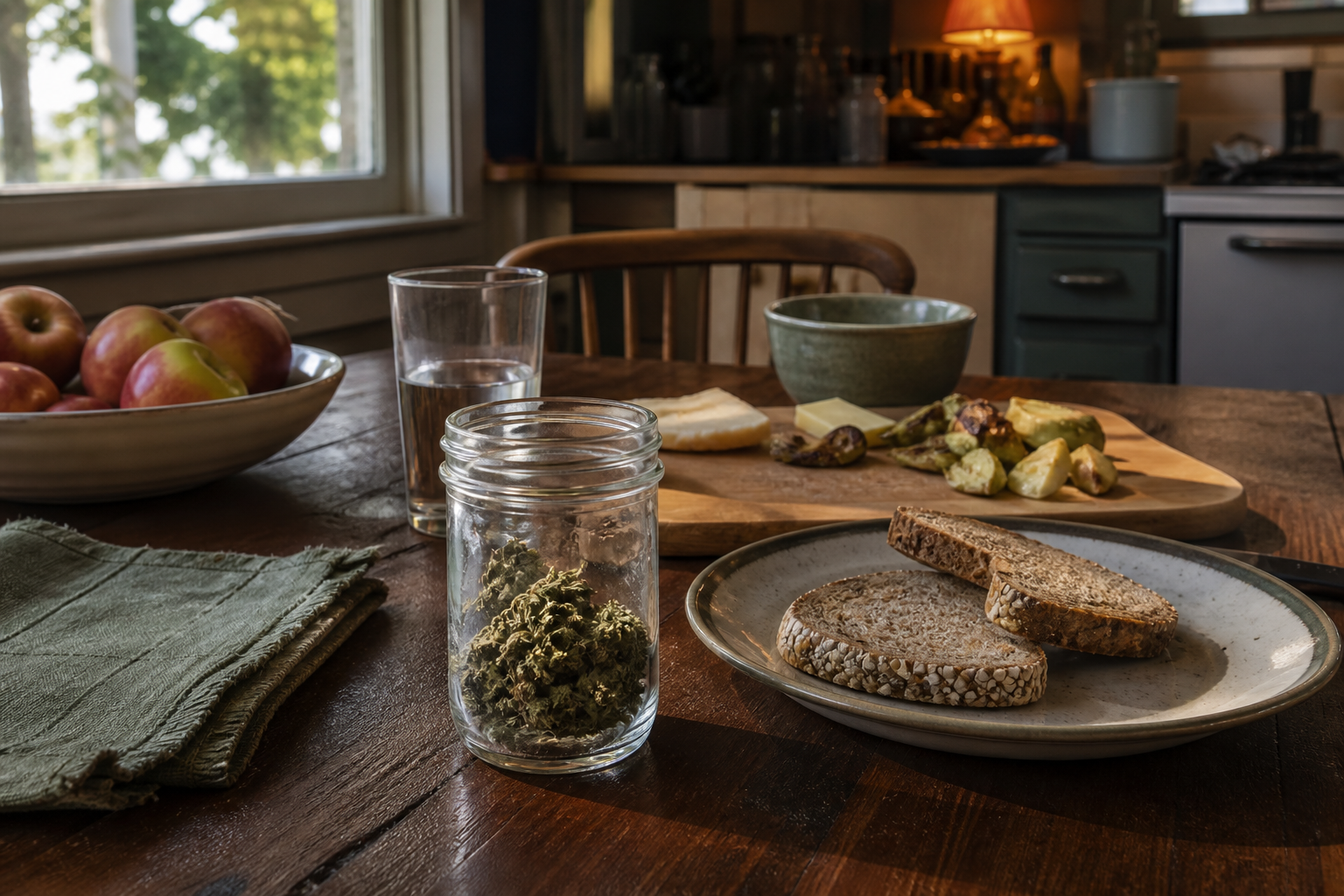
Cannabis, Appetite, and Weight: Munchies, THCV, and What Actually Changes Hunger
Why cannabis causes the munchies, whether THCV goes the other way, and what a Michigan adult should know about appetite, hunger, and weight.

Head Cultivator
On this page
THC can turn hunger up. THCV might turn it down a notch. Weight on the scale is a different story. This is the hunger-mechanism frame for Michigan adults — not a diet pitch.
Why Does Cannabis Give You the Munchies? #
THC — the main intoxicating cannabinoid — turns on CB1 receptors in the brain's hunger hub and makes food smell, taste, and look more worth chasing. That stack is the munchies. It is not a moral failing. It is chemistry plus a fridge.
CB1 receptors are locks on nerve cells. THC is a key that partly opens them. A lot of those locks sit in the hypothalamus — a small brain region that asks “eat now or wait?” When CB1 signaling in that neighborhood goes up, feeding goes up. Reviews of hypothalamic cannabinoid signaling describe this as a real energy-balance circuit, not a stoner joke (PMC11331011; older CB1 feeding work in PMC3150924 and PMC4850587).
Three things happen at once for many people:
- “Eat now” gets louder. Hunger feels earlier and sharper.
- Fullness gets quieter. You can keep going past the point you’d normally stop.
- Food gets more interesting. Smell, taste, and “I want that” all rise.
A 2025 Current Obesity Reports review (PMC12062030) puts it in clinic language: THC is tied to more appetite, more cravings, and overeating, plus a higher pull toward tasty, high-calorie food. That paper also notes most of the colorful “munchies” stories started in animals. Human trials are fewer and often small. Treat the mechanism as well supported and the exact calorie count as your night, your dose, your kitchen.
What “the munchies” feels like #
Many people find the munchies are both a stomach signal and a brain reward signal. One questionnaire study of frequent users (summarized in PMC12062030) split the experience into two piles:
| Piece | Plain English | Example |
|---|---|---|
| Motivational | You start eating and keep going | Food pops into your head; you eat past full |
| Hedonic | Food feels better | Chips smell louder; sugar hits harder |
| Sensory | Smell and taste amp up | Leftover pizza becomes a project |
| Decision | Restraint gets thinner | “One cookie” becomes the sleeve |
That same write-up said those munchie scores did not line up with BMI. Feeling ravenous on a Tuesday does not prove the scale will move by Friday. Acute hunger and long-term weight are different questions. We will get to the scale later.
A small lab trial (N = 17, also discussed in PMC12062030) gave THC by mouth or into the stomach. Oral THC raised “liking” and “wanting” for high-calorie pictures and increased milkshake intake. Intragastric THC was weaker on how much people drank. Taste in the mouth mattered. That is one reason a gummy plus a bag of chips is a different night than a joint after a real meal.
A Frontiers in Neuroscience review of CB1 and palatable food makes the same practical point: the system is built to make good food more rewarding, not just to fill an empty tank.
If you work a Metro Detroit plant, hospital, or warehouse shift, this is not abstract. You get home late. The house is quiet. The only food that is ready is whatever is salty or sweet. THC did not invent that pantry. It just turned the volume up.
What happens in the first hour #
The clock depends on the door you used. Inhaled THC can change hunger while you are still on the porch. Swallowed THC often waits until you have already decided you “didn’t feel it.”
A simple inhaled night, in plain order:
- Minutes 0–10. The high starts. Smell gets louder. Leftovers you ignored at dinner start arguing.
- Minutes 10–40. Wanting peaks for many people. This is when a “taste” becomes a project.
- Hour 1–2. If you already ate, you may still pick. If you did not eat, this is the raid.
- After. Hunger usually falls with the high. The calories stay.
A swallowed night stretches that same arc. Onset is often 30–90 minutes. The peak can sit at 2–4 hours (PMC5260817). You have more empty time to open cabinets “just in case.” That is a setting problem as much as a molecule problem.
Olfaction — smell — is part of the story, not the whole story. Reviews talk about food becoming more rewarding and more sensory (Frontiers CB1 palatable-food review; PMC11331011). Human smell trials are thinner than the CB1-in-the-hypothalamus work. So the honest line is: food gets more interesting, and the eat-now switch gets louder. Which one you notice first is personal.
Divine Toke is a Detroit-area Michigan sun-grown organic cannabis farm. We grow flower. We do not sell a “no munchies” guarantee. Anyone who does is selling a story.
What Is Ghrelin and How Does THC Talk to It? #
Ghrelin is a hunger hormone made mostly in the stomach. It rises before meals and tells the brain “find food.” Early research suggests THC and ghrelin talk to each other, but human ghrelin numbers after cannabis are still messy. CB1 in the brain is the cleaner story. Ghrelin is the supporting actor.
Think of ghrelin as the empty-tank light. Leptin (made in fat) is closer to the “you’ve had enough” signal. Sleep loss can raise ghrelin and drop leptin — we cover that in the shift-work section. Cannabis sits on top of whatever those hormones are already doing.
Mechanistic papers show the two systems share wiring:
- Ghrelin’s “eat” effect looks CB1-dependent in animal and hypothalamic work (PMC2258435).
- In some models, cannabinoids and ghrelin both need the ghrelin receptor to change food intake (PMC3566541).
- The 2024 hypothalamic review (PMC11331011) notes ghrelin may raise food intake in part by increasing endocannabinoid content in that brain region.
A rodent paper also reported Cannabis sativa can raise feeding through a ghrelin-related path (PMC8696263). That is a mouse or rat finding. Do not treat it as your after-work snack plan.
Does THC raise ghrelin in people? #
Sometimes, especially with eaten THC — but it is not a lab-guaranteed spike every time you light up. The 2025 weight-and-cannabis review (PMC12062030) cites a laboratory study of about 20 cannabis users where oral THC produced higher ghrelin than smoked or vaped THC — the source trial is Farokhnia 2020 (PMC7031261). Same molecule. Different door into the body. Different hunger chemistry.
| Route | Typical hunger clock | Ghrelin note from that review |
|---|---|---|
| Smoke or vape | Fast on, shorter | Lower ghrelin signal than oral in that small lab study |
| Edible / swallowed THC | Slow on, longer | Higher ghrelin in that study; hunger can last hours |
| Tincture held in the mouth | Mixed | Some swallow = more like an edible |
That lines up with what Michigan adults already know: a joint after dinner is one kind of hungry. A 10 mg gummy on an empty stomach is another. For why edibles feel like a different drug, see 11-hydroxy-THC explained.
Honest limits:
- Human ghrelin trials are small.
- Food in the stomach, sleep, and stress change ghrelin without any cannabis.
- “THC always doubles ghrelin” is not a sentence you can defend.
A quick hormone map in kitchen English:
| Signal | Where it comes from | What it usually means | Cannabis note |
|---|---|---|---|
| Ghrelin | Mostly stomach | “Find food” | May rise more after eaten THC in one small lab study (PMC12062030) |
| Leptin | Fat tissue | “You’ve had enough” | Sleep loss can drop it (PMC2084401); not a THC on/off switch you can buy |
| CB1 “on” (THC) | Brain (and elsewhere) | Eat, enjoy, store | Main munchies key (PMC11331011) |
| CB1 “block” (low-dose THCV) | Same receptor, other move | May quiet cues | Human appetite proof still thin |
If you cannot eat after a 12-hour Detroit hospital shift, ghrelin may already be confused by clock and stress. A little THC might bring hunger back. If you already want food, the same THC may send you to the gas station chips. Same hormone. Different starting point.
Does Cannabis Make You Gain Weight? #
No. Acute munchies can add calories that night, but most studies do not show a clear, consistent weight-gain effect from cannabis use — and some surveys even show lower BMI in users. That is an association, not proof that weed makes you lean. It is also not permission to treat a joint like a diet pill.
The 2025 Current Obesity Reports paper (PMC12062030) says the quiet part out loud: THC is tied to hungrier, less careful eating, and sometimes less movement. And yet most studies do not find weight gain. Some even hint at weight loss or a flatter BMI curve. The authors warn that papers rarely split THC from CBD, smoked from eaten, or “I use sometimes” from a real problem pattern.
A 2019 meta-analysis (PMC6340377) pooled BMI data and found users leaner on average than non-users — roughly 25.5–26.0 vs 27.5 kg/m² in the highest-use cuts they reported — even when calorie intake looked higher. That is the so-called paradox. It is observational. People who use cannabis are not randomly assigned. They smoke more tobacco, work different hours, get sick differently, and tell the truth at different rates.
What you can say without lying:
| Claim | Evidence strength | Better wording |
|---|---|---|
| THC can make you eat more tonight | Stronger — human + animal | Many people eat more after THC |
| Cannabis use causes obesity | Weak / not supported | Not what most surveys show |
| Cannabis use causes weight loss | Weak — residual confounding likely | Some users have lower BMI; cause unknown |
| A Mendelian (gene-as-randomizer) analysis found no causal BMI link | One method, still limited | Lifetime use did not look like a BMI cause in that analysis discussed in PMC12062030 |
A 30-year follow-up discussed in the same 2025 review (Jakob and colleagues) found current use tied to lower BMI, but lifetime pile-up of days was not, and people who quit did not balloon the way some tobacco quitters do. The authors’ read: leftover confounding is a better explanation than “cannabis melts fat.” The review quotes them saying recreational use may not move BMI in a clinically big way — and also should not be sold as an obesity fix.
Activity muddies the picture too. The same 2025 review (PMC12062030) cites a large adult sample where current and past users reported less moderate or vigorous movement than non-users, and a teen-focused review that tied cannabis to more sitting. A smaller adult study found no exercise difference. So “weed makes you lazy” is not a law. “Some people move less, some don’t” is the adult version.
If you are a tradesperson in Detroit eating gas-station food on a 10-hour job, your weight is mostly sleep, beer, lunch options, and joints that hurt too much to walk. Cannabis is one input. It is not the whole shop.
Two more hedges before anyone screenshots a BMI chart:
- Eating-disorder overlap is not the same as “I got the munchies.” PMC12062030 says cannabis use disorder tracks with loss-of-control eating more than casual use does. If food already feels like a fight, adding THC is not a hobby experiment.
- Withdrawal can dump appetite the other way. The DSM-5-TR list reprinted in that review includes decreased appetite or weight loss as a withdrawal sign after heavy daily use. People who “only feel hungry when they smoke” may be chasing a rebound, not discovering a new metabolism.
For recovery and movement after work — without treating weed as cardio — see cannabis and fitness for athletes and recovery. That post is about sore muscles and rest, not a cut.
The Cannabis-Weight Paradox: Hungry Tonight, Lower BMI in Surveys #
The paradox is simple: THC can make you raid the kitchen, yet many population studies find cannabis users with lower BMI or lower odds of metabolic syndrome. Early research suggests that mismatch is real in the data. It is not proof of a magic metabolism. Confounding, reverse causation, and CB1 tolerance are the honest candidates.
A classic observational paper on cannabis, appetite, and body weight (PMC4204468) helped set the frame: munchies are acute; the scale is chronic. A 2019 synthesis (PMC6340377) then asked why users could eat more and still look leaner. Their theory: after the acute CB1 “on” switch, receptors downregulate — they get quieter with repeat use — which might blunt energy storage over time. That is a theory, not a prescription. Rimonabant, an old CB1-blocker drug, did cut weight in trials and then left the market over mood harm. That history is a warning, not a DIY protocol (PMC6340377; also discussed in PMC12062030).
Newer observational cuts keep rhyming:
- A 2024 emerging-adult sample (PMC11256325) found current users with lower odds of metabolic syndrome (AOR 0.58) after some adjustment.
- An older large study reported metabolic syndrome odds around 0.69 in current users vs non-users (PMC4718895).
- A 2024–2025 review of weight-related behaviors (PMC12062030) still says: most papers point toward lower BMI, and you cannot call that cause.
Possible explanations that do not require a miracle:
- Who uses. Younger, more active, or sicker people show up differently in surveys.
- What else they smoke. Tobacco still confuses weight data.
- Tolerance. Daily THC may not punch hunger like the first Saturday joint.
- Reverse causation — and a two-way slide. One youth paper found higher starting BMI predicted later cannabis use. The same paper also found that as use rose, BMI slope fell (PMC7173669). Reverse causation is one candidate, not the only finding.
- Gut and inflammation. Cannabinoids talk to the gut and immune tone. That is a long, early story — see the gut microbiome and cannabinoids. Do not jump from stool bacteria to a waistline promise.
What this is not #
This is not “Michigan weed will make you skinny.” The 2025 review (PMC12062030) says patients who already came in for weight care should still be cautioned that THC can worsen eating patterns. If your goal is fat loss, the plant is a poor coach. If your goal is understanding why you ate a family-size bag after one bowl, the paradox just means tonight’s calories and next year’s BMI are not the same number.
A gene-as-randomizer (Mendelian randomization) analysis discussed in PMC12062030 found no evidence that lifetime cannabis use causes BMI, waist, or waist-to-hip change. That method is not perfect. “Lifetime use” is a blunt stick. It still undercuts the idea that legal weed will shrink Michigan by itself.
What a Detroit adult can do with a paradox:
- Do not use a survey BMI as a license to free-eat every night.
- Do not panic that one munchie night equals a new clothing size.
- Do log a week: sleep hours, cannabis format, and whether you ate a meal or a raid. Patterns show up faster than theories.
Metro Detroit has plenty of both stories: the guy who cannot keep weight on after overtime, and the guy whose only hobby after a joint is the kitchen. Same plant. Different bodies. Surveys average them. You live in one body.
Can THCV Go the Other Way? #
Early research suggests THCV — tetrahydrocannabivarin — may blunt food-cue brain signals and sometimes soften THC munchies, but human trials have not proven it as a reliable appetite-kill or weight-loss drug. The nickname “diet weed” came from chemistry and rodents first. People are still waiting on the proof.
THCV is a minor cannabinoid. At low doses it can act more like a CB1 blocker. THC does the opposite — it turns CB1 on. That is the whole “reverse munchies” idea in one sentence. For the full chemistry, African landrace story, label-reading, and dosing caveats, use the spoke: THCV, the energizing cannabinoid and appetite. This pillar will not redo that post.
What human studies actually showed:
| Study type | Dose / time | Appetite or weight | Takeaway |
|---|---|---|---|
| fMRI food-cue crossover | About 10 mg THCV once | Brain response to chocolate/aversive food changed; subjective hunger ratings did not clearly differ (PMC4438540; IJNP paper) | Cue wiring ≠ skipped dinner |
| Type 2 diabetes RCT | 5 mg twice daily, 13 weeks | Better some glucose markers; no clear appetite or body-weight win (PubMed 27573936; discussed in PMC12011981 and PMC7157797) | Metabolic signal ≠ diet pill |
| 2025 review of minor cannabinoids | Mixed small studies | Appetite drop not statistically solid (PMC12011981) | Still preliminary |
| Registry trial on energy/focus without THC hunger | NCT06213064 | Question still being asked | Scientists do not treat this as settled |
A 2025 THCV/CBD strip RCT (N=44) is small and is not a diet drug (PMID 39968488). Animal obesity models are friendlier to the “less food, less gain” story (PMC7819335). UCR’s May 2026 extract work was in mice. Mice are not a Detroit kitchen.
How to read a “THCV” jar without getting played #
If the COA shows a whisper of THCV next to 28% THC, you bought THC. The munchies will still have a vote.
- Ask for the certificate of analysis.
- Look for THCV in mg or percent — not a vibe name.
- Compare THCV to total THC. The bigger number usually runs the night.
- Divine Toke does not sell a named THCV house strain or a “reverse munchies” SKU. If a budtender invents one for our farm, they are guessing.
High-dose THCV can still feel psychoactive. Low-dose THCV is often shorter and clearer. None of that replaces sleep or a real meal. If a brand promises fat burn, walk.
If your real question is “can I keep my usual THC and add THCV so I don’t eat the house,” treat it as an n-of-1 test, not a protocol. Log two THC-only nights and two nights with a labeled THCV milligram amount. Same dinner. Same sleep. If late-night trips do not change, you have your answer and you did not need a guru. If anxiety or restlessness jumps — THCV can feel stimulating — stop. Stimulating minors are not free.
Michigan shops will sometimes talk like THCV is on every African-sativa menu. Ask for the number. A Detroit budtender who cannot show a COA line is selling a story. Divine Toke is not going to invent a house THCV jar to make this paragraph tidier.
Humulene, CBD, and Other Reverse-Munchies Claims #
No terpene panel is a diet plan. Humulene’s “anti-munchies” line is mostly folklore at flower doses. CBD has mixed human appetite data. CBG does not have a clean human hunger answer yet. If someone sells you “hoppy weed that kills appetite,” they are ahead of the trials.
Humulene is the hoppy, woody terpene you also smell in beer hops. A 2021 terpene review (PMC8489319) calls α-humulene an appetite suppressant, but the papers behind that line are mostly swelling studies, not lunch studies. We already unpacked that citation leak in humulene and the hoppy daytime profile. Bitter hop extract capsules are a different product than a Detroit eighth. Pointer, not a rewrite.
CBD is not THC’s twin on hunger. A 2022 systematic review of 11 clinical trials (PMC9525229) found CBD more often tied to less appetite or weight, with some null results and one trial that went the other way. Dose, starting BMI, and why the person was taking CBD all matter. “CBD melts fat” is still a sales line.
CBG (cannabigerol) has animal work suggesting it can raise feeding. Human appetite trials are still thin. Listings such as the UCSD Center for Medicinal Cannabis Research CBG protocol exist because the question is open. Do not treat CBG as either a hunger drug or a hunger brake.
| Compound | Typical hunger story | Human evidence |
|---|---|---|
| THC | Turns hunger up | Stronger |
| THCV (low dose) | May blunt cues / THC munchies | Early, mixed |
| CBD | Often neutral to slightly down | Mixed trials (PMC9525229) |
| CBG | Animals: maybe up | Human: not settled |
| Humulene | Shop-floor “diet terpene” | Unproven in people at cannabis doses |
If your gut is the real problem — cramping, IBS, “I can’t tell if I’m hungry or nauseous” — hunger chemistry is only one layer. See IBS and cannabis and the gut microbiome connection. Those posts own digestion. This one owns appetite and the scale story.
Who Is This For — and Who Should Skip the Hunger Game? #
This pillar is for Michigan adults who either cannot get food down after a brutal shift or cannot stop eating after a joint — and want the mechanism without a weight-loss ad. It is not for anyone chasing a skinny-weed protocol. It is not a stand-in for an eating-disorder clinic or an oncology team.
Who often recognizes themselves:
- The empty-tank worker. Night shift at a hospital, line job, or warehouse around Detroit. You get home and food sounds like a chore until you smoke, then you can finally eat.
- The full-tank snacker. You ate dinner. One bowl later the kitchen is a second job.
- The edible stacker. You took 10 mg, felt nothing at 45 minutes, took 10 more, then ate everything and still felt too high. Michigan’s adult-use cap makes that stack easy to do with a whole bag.
- The “I heard THCV is diet weed” shopper. You want the honest trial table, not a TikTok.
Who should not treat this as a plan:
| Situation | Why this post is not enough |
|---|---|
| Active eating disorder, binge-purge, or loss-of-control eating | The 2025 review (PMC12062030) ties cannabis use disorder more tightly to loss-of-control eating than casual use. Get clinical care. |
| Trying to lose weight as the main goal | Evidence does not support cannabis as a fat-loss tool |
| Cancer treatment, cachexia, or “I need to keep weight on” | Different problem — see the cancer section and talk to your team |
| Pregnancy, breastfeeding, or a clinician already managing nutrition | Stay in that lane |
| Workplace that tests | Hunger tips do not change a failed test |
Michigan’s medical card pathway is its own paperwork. Most “I just want my appetite back” stories are not a named qualifying condition by themselves. Severe nausea and some disease paths can be. Do not invent a card story for a snack problem. If you already have a clinician in the mix, ask them — not a budtender, and not this blog — before you change anything.
Adult-use vs medical still changes the edible math even if your reason is just hunger. Same state. Different serving caps. A medical 50 mg infused piece is legal size, not beginner size. An adult-use 10 mg grid is what most Detroit shoppers will see. Tax and purchase limits differ too. Those are Michigan CRA rules, not farm folklore.
Divine Toke grows sun-grown organic flower in Michigan. We will talk about set, setting, labels, and CRA caps. We will not diagnose you. We will not name a fake house cultivar that “won’t make you hungry.”
Cancer Appetite and Cachexia: A Different Problem #
Cancer appetite loss and cachexia are medical problems. THC may help some people want food again. Evidence that cannabis reverses cachexia — the deep muscle and weight loss driven by the disease — is weak. This section is a pointer, not a treatment guide. The full stack lives in cannabis and cancer support: nausea, pain, and appetite.
Cachexia is not “I forgot to eat.” It is a disease-driven waste of muscle and weight. Wanting a sandwich and rebuilding lean mass are not the same job.
What major sources actually say:
- The NCI PDQ on cannabis and cannabinoids treats evidence as insufficient for a firm recommendation. It notes no published studies of inhaled cannabis for appetite in cancer patients.
- The 2024 ASCO cannabis guideline did not hand clinicians a cachexia green light. Outside some refractory nausea contexts, evidence is thin.
- Cachexia-focused reviews report no high-quality proof that cannabinoids reliably improve appetite, weight, or quality of life as a cachexia package (PMC8818598; PMC8713261).
Prescription cannabinoids such as dronabinol have history in AIDS-related wasting and chemo nausea. That is a doctor-and-pharmacy lane. It is not a Michigan adult-use gummy plan.
| Goal | What research supports | What it does not |
|---|---|---|
| “Food smells okay again” | Some THC / older oral-THC experience | Not guaranteed |
| Keep meals down (nausea) | Stronger story in CINV than in cachexia | Still individual |
| Reverse cachexia / add muscle / live longer | Insufficient | Do not sell this |
If you or someone you love is in treatment in Metro Detroit, talk to the oncology team before you add cannabis. Drug interactions are real. Immunocompromised patients need clean, lab-tested product — not a mystery bag. The cancer post covers that. This pillar stops here on purpose.
Edibles, 11-Hydroxy-THC, and Michigan CRA Serving Caps #
Swallowed THC is a longer, later hunger and a longer high, because the liver makes 11-hydroxy-THC. In Michigan, adult-use infused edibles are capped at 10 mg THC per serving and 200 mg per container under CRA Rule R 420.404. Stacking servings because “I don’t feel it yet” is how people overeat and overshoot.
Your liver turns eaten delta-9-THC into 11-hydroxy-THC (11-OH-THC). That metabolite hits harder for many people and lasts longer. A high-fat meal can delay the peak and raise exposure (PMC6922062). Reviews put typical edible onset around 30–90 minutes and a peak around 2–4 hours (PMC5260817). Full chemistry: why edibles feel completely different. Dosing walk-through: edibles dosing guide.
The Michigan CRA technical bulletin (April 24, 2025) issued under R 420.404 is the primary source. Numbers below are from that table, not from memory.
| Product type | Medical per dose | Medical per container | Adult-use per dose | Adult-use per container |
|---|---|---|---|---|
| Infused edibles (gummies, baked goods, syrups) | 50 mg | 200 mg | 10 mg | 200 mg |
| Beverages | 10 mg | 100 mg | 10 mg | 100 mg |
Other bulletin rules that change what you swallow:
- Total THC = delta-8 + delta-9.
- Delta-8 may not exceed 10% of the total THC limit. On a 200 mg adult-use gummy pack, that example is 20 mg delta-8 max.
- Beverage 100 mg is per bottle/container. A 4-pack or 6-pack is not capped at 100 mg for the whole sleeve (CRA April 24, 2025 bulletin).
Those caps are package law, not a recommended dose. A new consumer can feel a lot at 2.5–5 mg. A medical 50 mg piece is not a “start here” for appetite experiments.
What that looks like on a Detroit shelf: an adult-use gummy pack can legally hold twenty 10 mg pieces. That is a container, not a night. The CRA bulletin also reminds licensees that servings must be homogeneous — the THC is supposed to be even, not a surprise hot piece. If a pack feels uneven, that is a quality problem, not a reason to take a second piece “to catch up.”
Michigan marketing rules also bar licensees from dressing flower up as medicine. Mich. Admin. Code R 420.507 is the deceptive-and-medical-claims lane. This blog can teach mechanisms. A jar cannot claim it treats obesity, anorexia, or cancer wasting. If a label says it does, treat that as a red flag, not a feature.
Why edibles punch hunger differently #
The 2025 review (PMC12062030) notes inhaled THC tends to raise appetite faster and shorter. Swallowed THC tends to raise it later and longer, and that small oral-vs-smoked lab study showed higher ghrelin after oral THC. You also have more clock time to wander the kitchen while you wait.
Common Michigan edible mistakes:
- Redose at 40 minutes. The first serving has not peaked.
- Eat a greasy meal with the gummy, then wonder why it hits at hour two (PMC6922062).
- Treat the 200 mg bag as the serving. The serving is on the label. The bag is the legal package max.
- Chase munchies with more THC. That usually adds calories and impairment, not control.
The Michigan CRA writes rules for licensees. It does not write your dinner. Start low. Wait. Write down what you ate. If you cannot wait two hours, flower is the shorter clock — if your lungs and your job allow it.
Shift Work, Sleep Debt, and Detroit Lunch-Break Munchies #
Sleep loss already raises ghrelin, drops leptin, and pushes snack calories. Shift work is tied to higher overweight and obesity risk. THC on top of that is not a fair fight. Metro Detroit runs on plants, hospitals, trades, and logistics. A lot of those jobs eat the clock first and the lunch second.
Classic sleep-restriction work by Spiegel 2004 (PMID 15583226) found roughly leptin down ~18%, ghrelin up ~28%, and hunger up ~24% after short nights. Later reviews keep the same direction: short sleep, more hunger, easier weight gain (Knutson review, PMC2084401; PMC8138234; PMC9783730; PMC9031614). One sleep-restriction study saw extra energy from snacks, especially carbs (PMC4688118).
Shift work adds circadian mess on top of sleep debt. A meta-analysis of 26 studies (hundreds of thousands of people) reported about 25% higher relative risk of overweight and 17% higher relative risk of obesity in shift workers (PubMed 29850840). CDC materials have long flagged night shift and extra obesity odds (CDC stack on shift work and obesity).
| Job reality around Detroit | Hunger trap | Cannabis wrinkle |
|---|---|---|
| Third shift / rotating plant | Eat at biological night; vending is the cafeteria | THC after the ride home hits a body already primed to snack |
| Hospital 12s | Missed meals, then a huge one | A joint so you can finally eat can overshoot |
| Trades lunch in the truck | Gas-station food is the only hot option | Munchies + a 30-minute lunch = the whole bag |
| Warehouse / logistics OT | Irregular clock, energy drinks | Late edible + fridge at 1 a.m. |
None of that needs a fake city ordinance. It is how the region works.
Practical, non-guru moves many people find useful:
- If you cannot eat after a shift: a small real meal before you smoke often beats smoking on fumes and then losing the plot.
- If you cannot stop after a joint: do not shop hungry, and do not open a family-size bag. Plate it. Leave the rest in the cupboard.
- If you use edibles on a night off: remember the CRA 10 mg adult-use serving cap is not a dare. Wait the full clock.
- Alcohol plus cannabis loosens the brakes. Human combo-eating trials are thin. The everyday risk is obvious: less judgment, tastier food, longer night. Skip the “crossfade then pizza” experiment if weight or reflux is already a fight.
A third-shift kitchen, written out #
Example A — cannot eat. You get off at 7 a.m. after a hospital night. The freeway is already loud. Food sounds like work. A small inhaled dose, a shower, and leftovers you plated before the shift often beat waiting until you are shaking. If even warm food fails and you are losing weight, that is a clinic conversation, not a new terpene.
Example B — cannot stop. You laid tile in a Detroit bungalow all day. Dinner was a burger in the truck. You smoke on the porch, then the cupboard is open before the high has a name. The fix is boring: close the cupboard before you go outside, leave a plated snack on the table, and do not buy family-size anything on payday if you already know this pattern.
Michigan winters make both examples worse. Dark at 5 p.m. Late food is whatever is shelf-stable. THC did not build the gas station. It just makes the taquitos smell like a plan.
This is set and setting with steel-toes on. Your hypothalamus does not care that the overtime was mandatory.
Set, Setting, and How to Not Eat the Whole Kitchen #
Set is your body and head before you consume. Setting is the room, the food, and the clock. Together they change hunger as much as the strain name on the jar. You cannot out-terpene a sleepless night and an open chip bag.
This is not a cleanse. It is harm reduction for adults who already know they get dumb around food when they are high.
If the problem is too much hunger #
Many people find these boring steps beat a “diet cannabinoid”:
- Eat protein and salt before you get high — eggs, leftover chicken, yogurt. THC loves empty-stomach carbs.
- Plate the snack. Put a serving in a bowl. Close the box. Leave the kitchen.
- Brush your teeth or chew gum when the wave hits if you already ate. Taste reset is cheap.
- Pick a shorter clock. Flower or a low inhaled dose ends sooner than a swallowed 10–20 mg stack. See edibles dosing.
- Do not pair with beer if the fridge is the hobby.
- Sleep. The ghrelin data above is not optional flavor text.
If the problem is too little hunger #
Many people find the opposite:
- Use THC when you can sit with food, not when you have 11 minutes before a meeting.
- Start lower than your “fun” dose. Enough to want a plate. Not enough to chase dessert for an hour.
- Smell and taste help. Warm food. Something you already like. The oral THC lab work in PMC12062030 is a reminder that the mouth is part of the circuit.
- If nausea or a wrecked gut is the real block, that is a different post: IBS or cancer support as it applies.
| Goal | Set | Setting |
|---|---|---|
| Eat a real meal after a shift | Slightly hungry, not starving, not already high | Table, plate, 20 minutes, phone down |
| Avoid the second dinner | Already fed | No open bags; water in reach |
| Test THCV or a high-CBD jar | Same sleep and caffeine for a week | Notebook, not vibes |
Write hunger on a 1–10 scale at 11 a.m., 3 p.m., and 9 p.m. for two weeks if you are changing products. Marketing cannot mark that scale. You can.
A two-night test that does not require a wearable:
| Night | Rule | What you write down |
|---|---|---|
| 1 | Same dinner, no cannabis | Hunger 1–10 at 8 p.m. and 10 p.m.; what you ate after 8 |
| 2 | Same dinner, your usual inhaled dose | Same two numbers; same after-8 food |
| Optional 3 | Same dinner, one 5–10 mg edible, no redose | Same two numbers; clock when it actually hit |
If night 2 is a raid and night 1 is not, you learned more than a budtender speech. If both nights are a raid, the plant is not the only input. Sleep and the pantry still vote.
Divine Toke’s sun-grown flower will still be flower. Set and setting are free and legal in every Michigan county.
Common Appetite Mistakes Michigan Adults Make #
The usual mistakes are stacking edibles, treating THCV marketing as a prescription, smoking on no sleep, and confusing tonight’s munchies with next year’s weight. None of those need a new cultivar name. They need a slower clock and honest labels.
- Calling the munchies “proof I’ll get fat.” Acute intake can rise. Long-term BMI data often go the other way or nowhere (PMC12062030; PMC6340377). Track both if you care. Do not merge them.
- Calling a lower BMI in surveys “proof weed is a cut.” Observational. Residual confounding. Jakob’s long follow-up (in PMC12062030) is a cold shower for both the fear and the hype.
- Buying “diet weed” with no THCV milligrams. If it is not on the COA, it is incense.
- Trusting humulene as an appetite kill-switch. Unproven at flower doses. Details in the humulene post.
- Redosing a Michigan 10 mg serving at 35 minutes. Adult-use infused edibles are 10 mg per dose / 200 mg per pack per the CRA R 420.404 bulletin. The second piece is not “still sober.” It is a delayed double.
- Using a medical 50 mg edible as a first appetite experiment. That is the medical per-dose max for infused edibles, not a beginner serving.
- Skipping food, then smoking, then standing in front of the fridge. Set yourself up and you will follow through.
- Treating cannabis as cancer-cachexia treatment without an oncologist. NCI PDQ and ASCO 2024 are not casual.
- Ignoring workplace testing because “it’s just for hunger.” Michigan legal status does not bind every employer.
- Drinking and smoking, then calling the pizza “the plant.” The plant had help.
A short checklist before the next session:
- Have I slept?
- Have I eaten something real?
- Is this flower or an edible clock?
- Is the snack plated?
- Am I trying to lose weight with a cannabinoid? (If yes, stop. That is not what the trials support.)
How to Shop a Michigan Label If Hunger Is the Goal — or the Problem #
Shop the COA and the clock, not the nickname. Michigan labels and lab panels tell you THC, sometimes minors and terpenes. They do not tell you what your stomach will do. Divine Toke will not invent a house THCV strain or a “skinny” pre-roll to fill this paragraph.
What to look for on a Michigan adult-use package:
| If you want… | Look for | Avoid assuming |
|---|---|---|
| A chance at appetite | THC you can actually feel, in a format you can time | That 30% flower is automatically more munchies than 18% with a rich panel |
| Less snack-raid risk | Lower THC; consider CBD-forward; ask if THCV is listed in mg | That “Durban” or “hoppy” on the menu equals reverse munchies |
| A short hunger window | Inhaled flower, small dose | That a gummy will be “done by bedtime” |
| A long window to finish a plate | Low-dose edible, wait the full 2 hours | That 10 mg is gentle for every liver |
| Cleaner inputs | Full panel: pesticides, metals, yeast | A gas-station delta-8 bag with no CRA mark |
Adult-use infused edibles in this state are built around 10 mg servings and 200 mg packs (CRA R 420.404 bulletin, April 24, 2025). Beverages sit at 10 mg / 100 mg container. That is why a Detroit gummy looks like a 10 mg grid. The grid is the law. Your dose can be a half.
How to read minors without folklore:
- THC — main hunger-up signal for most people (PMC12062030).
- THCV — only counts if the milligrams are real. Full spoke: THCV and appetite.
- CBD — mixed, often not a hunger bomb (PMC9525229).
- Humulene — smell, not a calorie plan (humulene guide).
What to say at the counter #
Keep it dull. Dull gets you a COA instead of a pitch.
- “I get too hungry on THC. Do you have a panel with listed THCV milligrams, or a CBD-forward option? I want the number, not a nickname.”
- “I cannot eat after night shift. I want a low inhaled option I can time with a meal — not a 50 mg medical gummy.”
- “Show me the CRA serving size on that edible. I’m not treating the pack as the dose.”
If the answer is a strain name and a vibe, you are not shopping. You are being sold. Walk to the next case.
If you train or work a physical job and care about recovery more than the scale, stay in cannabis and fitness. If the gut is chaotic, stay in IBS. This pillar’s job is hunger mechanism and the weight frame. It is done when you can say: THC can make me hungry; THCV might take the edge off; the scale is a longer, muddier story; Michigan law caps the gummy, not my common sense.
What actually changes hunger — one screen #
Hunger moves when the receptor, the hormone, the clock, and the room move. The nickname on the jar is last.
| Lever | Turns hunger up | Turns hunger down or sideways | Evidence honesty |
|---|---|---|---|
| THC / CB1 | Most nights, for many people | Tolerance can dull it | Stronger (PMC12062030) |
| Ghrelin | Empty stomach, sleep loss, some oral THC | A real meal, better sleep | Mixed human THC numbers |
| THCV | High dose can still feel like a cannabinoid | May change cue wiring; not a diet RCT win | Early (PMC4438540; PubMed 27573936) |
| CBD | Rare; check for leftover THC | Often neutral to slightly down | Mixed (PMC9525229) |
| Humulene | — | Folklore at flower doses | Unproven in people |
| Sleep / shift work | Short nights, night eating | Protected sleep | Stronger without cannabis in the model (PMC2084401; PubMed 29850840) |
| Edible clock | Stacking, high-fat delay | One serving, wait 2 hours | PK is clear (PMC6922062); CRA caps are law |
| Kitchen | Open bags, beer, 1 a.m. | Plate, close the cupboard | Behavior, not a study |
That table is the article. Everything else is receipts.
Frequently Asked Questions #
Does cannabis always give you the munchies? #
No. THC often raises hunger, but dose, tolerance, sleep, and what else is in the product change the night. Many daily users notice less of a punch than they did as beginners, which matches CB1 downregulation talk in the 2019 BMI meta-analysis (PMC6340377) and the 2025 review (PMC12062030). CBD-forward products are less likely to send you to the cupboard. If you feel nothing, you may be tired, tolerant, or on a tiny dose — not broken.
Will smoking weed make me gain weight? #
Not as a rule. Most studies do not show a clean weight-gain link, and some find lower BMI in users — but that is not proof cannabis slims you. The 2025 Current Obesity Reports review (PMC12062030) says THC can worsen eating in the moment while the scale data stay mixed. A 2019 meta-analysis (PMC6340377) reported lower average BMI in users despite higher calories. Association is not causation. Your kitchen still counts.
Does THCV stop the munchies? #
Not in a way you can take to the bank. About 10 mg THCV changed brain responses to food pictures without a clear win on hunger ratings (PMC4438540). A 13-week diabetes trial at 5 mg twice daily helped some glucose markers and did not clearly cut appetite or weight (PubMed 27573936). Read the THCV spoke for the full hedge.
Are edibles worse than flower for overeating? #
They are easier to overshoot because hunger and the high arrive late and last longer. Oral THC showed higher ghrelin than smoked or vaped in a small lab study cited by PMC12062030. Peaks often sit around 2–4 hours (PMC5260817). A high-fat meal can still delay that peak (PMC6922062). A Michigan 10 mg serving is still a serving. Two servings an hour apart is how people eat the pantry.
What are Michigan edible THC limits? #
For adult-use infused edibles: 10 mg THC per serving and 200 mg per container. Medical infused edibles: 50 mg per serving, same 200 mg container cap. Beverages: 10 mg per serving and 100 mg per container. Those numbers come from the CRA bulletin under R 420.404 (April 24, 2025). Total THC is delta-8 plus delta-9. Delta-8 cannot be more than 10% of the total THC limit.
Why can I not eat after a night shift but I raid the fridge after a joint? #
Shift work and short sleep scramble ghrelin and leptin. THC then turns food reward up on a tired brain. Sleep restriction has been shown to raise ghrelin about 28% and hunger about 24% (Spiegel 2004, PMID 15583226). Shift work itself tracks with higher overweight and obesity risk (PubMed 29850840). Around Detroit, the third-shift kitchen is a real setting. Eat something small before you smoke if the goal is a meal, not a raid.
Does CBD make you hungry? #
Usually not the way THC does. A review of 11 trials found CBD more often tied to less appetite or weight, with mixed and even opposite results in a few studies. See PMC9525229. If a CBD oil made you ravenous, look at dose, what you ate with it, and whether it was full-spectrum with enough THC to matter.
Can cannabis help if I have no appetite? #
Many people find low-dose THC brings hunger back. That is a common wellness report, not a guarantee, and it is a different problem in cancer cachexia. The NCI PDQ does not treat cannabis as proven cachexia care. If you cannot eat because of treatment or disease, use the cancer support post and your clinicians. If you cannot eat because of a wrecked gut, start with IBS.
Is humulene diet weed? #
No. There is no good human flower trial showing humulene turns off the munchies. A terpene review repeats the claim (PMC8489319) on the back of inflammation papers. Hop extract studies are not your eighth. Full myth-bust: humulene and the hoppy profile.
How do I stop the munchies without quitting cannabis? #
Eat first, plate the snack, pick a shorter clock, and protect sleep. Those steps cost nothing and match the mechanism: THC raises food reward, and sleep loss already raises ghrelin (PMC2084401). THCV is an optional experiment only if the COA shows real milligrams. It is not a mute button.
Should I use cannabis to lose weight? #
No. That is not what the human trials support, and selling it that way is hype. Observational lower BMI (PMC6340377; PMC12062030) is not a fat-loss protocol. THCV’s diabetes RCT did not deliver a weight win (PubMed 27573936). If weight is a medical goal, talk to a clinician who is not selling flower.
When should I talk to a doctor about appetite and cannabis? #
Talk to a clinician if weight is dropping fast, you cannot keep food down, you lose control around food, you have cancer or a metabolic disease, or cannabis is the only way you eat. Cachexia and eating disorders are above this blog’s pay grade. The 2025 review (PMC12062030) flags cannabis use disorder plus loss-of-control eating as a pair that needs real care. Bring your actual product and dose. Guessing helps no one.
Closing Thoughts #
If you came here asking why the munchies happen, the short answer is THC, CB1, and a hunger system that also answers to ghrelin, sleep, and whatever is in the kitchen. If you came here hoping THCV would cancel dinner, the honest answer is maybe a little, not as a pill. If you came here scared the scale is doomed, the surveys do not tell that simple story.
If you're curious to try a cleaner starting point, look for lab-tested, sun-grown flower from Divine Toke — a Detroit-area Michigan organic farm — at the shop, and match the format to the clock you actually have. We do not bottle a weight-loss cannabinoid. We grow the plant. You run the night.
Keep going here if a spoke fits better than this pillar:
- THCV and appetite
- Cancer support: nausea, pain, appetite
- Humulene and hoppy daytime flower
- Edibles dosing guide
- 11-hydroxy-THC
- Gut microbiome and cannabinoids
- Cannabis and fitness
- IBS and cannabis
This article is for educational purposes only and is not medical advice. Always consult your healthcare provider before starting any new wellness routine.
Grown in Detroit. Shipped to your door.
Small-batch, sun-grown cannabis cultivated in living soil. Mail-order shipping to all 50 states.
You Might Also Enjoy

CBN Gummies vs. Indica Flower for Sleep: Which One Actually Keeps You Asleep?
August 2, 2026 · 24 min read

Why Everybody's High Is Different: Genetics, Receptors, and Your Baseline
August 19, 2026 · 29 min read

Detroit Trades and Cannabis Wellness: Shift Work, Pain, and Recovery
August 16, 2026 · 29 min read