The Gut Microbiome and Cannabinoids: An Emerging Connection

Jamie
Head Cultivator
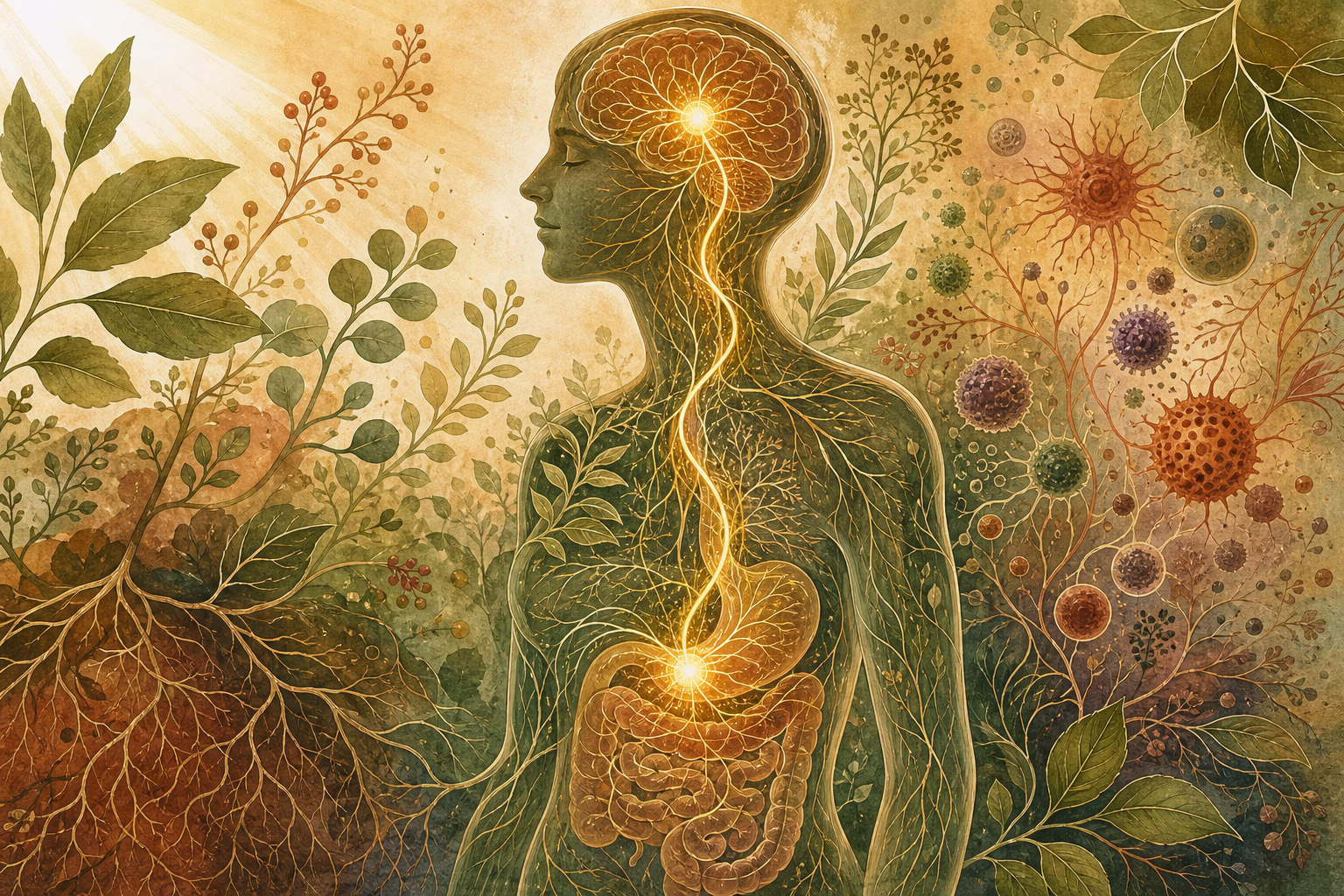
Your gut is home to trillions of tiny bugs — bacteria, fungi, and other microbes — called your gut microbiome. Your body also runs its own cannabis-like "thermostat," the endocannabinoid system (ECS). Early research suggests these two systems talk to each other. That conversation may shape digestion, swelling, and how calm your belly feels. This is still frontier science — not settled medicine — so we'll stay honest about what's known and what's guesswork.
If you want the broader gut picture first, start with our cannabis gut health digestion guide. For the belly–brain hotline, see the gut-brain axis and cannabis.
What Is the Gut Microbiome–Cannabinoid Connection? #
Your gut bugs and your body's cannabis-like chemicals send signals both ways — microbes nudge endocannabinoid levels, and cannabinoid receptors help steer gut motility, barrier strength, and immune calm. Scientists often call this wider network the endocannabinoidome (eCBome): endocannabinoids like anandamide and 2-AG, their receptors, and related fat-based messengers that sit next to your microbiome.
Think of your gut as a busy neighborhood. The microbiome are the residents. The ECS is the traffic lights and thermostat. When both work, traffic flows. When they don't, you get bloating, cramps, or that "something's off" feeling after meals.
| Key Player | Plain-English Job |
|---|---|
| Gut microbiome | Trillions of microbes that help digest food, train immunity, and make chemical signals |
| Endocannabinoid system (ECS) | Your body's built-in balance network that uses cannabis-like messengers |
| Anandamide (AEA) | One of your body's own "bliss" molecules — an endocannabinoid |
| 2-AG | Another main endocannabinoid involved in gut tone and barrier signaling |
| CB1 / CB2 receptors | Docking sites plant and body cannabinoids can activate (see CB1 and CB2 explained) |
| Akkermansia muciniphila | A mucus-loving gut microbe linked to barrier health and endocannabinoid tone in research |
A 2022 review in PMC9130962 maps this two-way crosstalk: the microbiota shapes endocannabinoid tone, and ECS activity can feed back into microbial composition. A related endocannabinoidome overview (PMC8833664) places the gut at the center of that conversation.
Here is the same idea in three plain steps:
- You eat. Fiber and plant compounds feed certain microbes.
- Microbes signal. Those bugs change local levels of endocannabinoids and related fats.
- The gut responds. CB1/CB2 and nearby sensors adjust motility, mucus, and immune volume.
Cannabis (THC, CBD, and friends) can step into step 3 by docking on some of those same receptors. That is why people with IBS, Crohn's, or a "nervous stomach" sometimes feel relief — even when a stool test never changes.
What this connection is not:
- Not a promise that weed rebuilds your microbiome like a probiotic capsule
- Not proof that CBD "heals leaky gut" overnight
- Not a reason to skip gastroenterology care for blood in stool, weight loss, or night sweats
Bottom line for everyday life: cannabis doesn't "kill your microbiome" like bleach. Plant cannabinoids may nudge the same pathways your body already uses. How much that helps your gut is still being figured out — especially in people, not just mice.
How Do Gut Bacteria Talk to Your Endocannabinoid System? #
Gut bacteria can raise or lower your body's own cannabis-like chemicals and change how many CB1 and CB2 docking sites your gut cells put out. That is the core of microbiome–ECS crosstalk: microbes do not make THC, but they can dial the volume on your endogenous (body-made) cannabinoid tone.
Your Body's Own Cannabis-Like Chemicals #
Anandamide and 2-AG are fat messengers your cells make on demand. They bind CB1 and CB2 the way a key fits a lock. In the gut, those keys help decide how fast food moves, how tight the gut wall seals, and how loud immune cells shout.
A 2023 gut endocannabinoid system review (PMC9909364) describes the gut ECS as a local control board for motility, barrier function, and inflammation — not just a brain system that happens to spill into the belly.
How Microbes Nudge Receptor Settings #
Certain bacteria change receptor "volume knobs" and enzyme levels:
- Lactobacillus acidophilus — early work linked this probiotic strain to higher CB2 expression in the gut lining, which may calm pain signaling (PMC6203867 discusses CB2–microbiota context)
- Akkermansia muciniphila — linked to higher gut levels of 2-oleoylglycerol (2-OG), 2-AG, and related acylglycerols that support barrier and metabolic signaling (PMC9130962; foundational Everard et al., PNAS 2013)
- Short-chain fatty acids (SCFAs) — waste products from fiber-eating bugs that also talk to immune and gut cells; they sit next to the ECS conversation even when they are not pure cannabinoids
| Direction | What Happens | Everyday Analogy |
|---|---|---|
| Bugs → ECS | Microbes change endocannabinoid levels and CB1/CB2 expression | Neighbors adjusting your thermostat |
| ECS → Bugs | Cannabinoid signaling can change motility and the gut environment bugs live in | Changing traffic lights so different cars show up |
| Plant cannabis → both | THC/CBD may tap CB1/CB2 and indirectly shift the neighborhood | Turning a dial that both systems feel |
A 2025 Frontiers review on microbiome–ECS interplay stresses the same point: the loop is bidirectional, and most hard mechanistic detail still comes from animals and cell models.
Why motility matters for your bugs: if CB1 signaling slows how fast food moves, the "neighborhood" changes. Slower transit can mean more time for fermentation — good for some people, miserable for others (bloating, constipation). That is one reason the same cannabis session can feel like a gift for cramps and a problem for stool regularity.
Enzymes are part of the story too. Your body breaks down anandamide with FAAH (fatty acid amide hydrolase) and breaks down 2-AG with MAGL (monoacylglycerol lipase). Some microbes and diet patterns may influence those pathways indirectly. You do not need to memorize the acronyms — just know the volume knobs have more than one setting.
Blue-collar translation: stress, junk sleep, antibiotics, and ultra-processed food can shove this loop off balance. Cannabis may soften symptoms. It does not automatically restore the neighborhood after a week of drive-thru and four hours of sleep.
Where Are CB1 and CB2 Receptors in Your Gut? #
CB1 receptors sit heavily on gut nerves that control movement and sensation; CB2 receptors sit more on immune cells that handle swelling and repair. Both types show up along the digestive tract — so cannabis chemistry is not only a "brain high" story when it comes to your belly.
For a full receptor map outside the gut, see CB1 and CB2 receptors explained.
| Receptor | Where in the Gut (Plain English) | What It Roughly Does |
|---|---|---|
| CB1 | Nerve endings in the gut wall; some epithelial (lining) cells | Can slow gut movement, ease cramping signals, affect appetite cues |
| CB2 | Immune cells in the gut lining and deeper tissue | Can dial down overactive immune "alarms" that drive swelling |
| Other eCBome targets | PPAR receptors, TRP channels, related fat sensors | Extra dials that CBD and body fats may touch without classic CB1 "high" |
According to PMC9909364 and PMC9130962, gut CB1 signaling is tightly tied to motility and barrier tone, while CB2 is more about immune calm. That split matters if you care about comfort vs. inflammation:
- Cramps / urgency / "racing gut" → often discussed in CB1 / motility language
- Swelling / immune flare patterns → more CB2 / immune language
- Feeling low on your own balance chemicals → related idea in endocannabinoid deficiency — still a theory, not a lab test you walk into a clinic for
How plant cannabinoids fit those docks:
- THC — strong CB1 activity (the classic "high" key); in the gut that can mean slower movement and changed hunger signals
- CBD — weaker classic CB1 binding; more interest around other eCBome targets and immune calm; less intoxicating for most people
- Beta-caryophyllene — a peppery terpene that can activate CB2; sometimes discussed as a dietary cannabinoid in food and cannabis
Dose personality matters. A tiny amount of THC may ease a cramp. A big edible may leave you glued to the couch with a stalled gut. That is CB1 doing its job too hard — not "your microbiome dying."
Important hedge: finding receptors in the gut does not mean smoking a joint fixes IBS or Crohn's. It only means the wiring is there. Clinical proof for microbiome repair from cannabis is still early.
What Is Akkermansia — and Why Do Scientists Care? #
Akkermansia muciniphila is a mucus-loving gut bacterium that research links to a stronger gut barrier and higher levels of certain endocannabinoid-related fats. It is not a cannabis plant — and cannabis is not a probiotic. Scientists care because Akkermansia sits at a crossroads of mucus health, metabolism, and ECS tone.
The landmark Everard et al. PNAS 2013 study showed that A. muciniphila could reverse diet-driven metabolic problems in mice and raised intestinal levels of endocannabinoids like 2-AG and related acylglycerols. Later reviews keep that finding front and center:
- PMC9130962 — positions Akkermansia as a key microbe in microbiota–ECS dialogue
- PMC11979265 — a 2025 review tying Akkermansia to endocannabinoid signaling and metabolic health
| Why Akkermansia Matters | What Research Suggests | Caveat |
|---|---|---|
| Mucus layer | Lives in and helps maintain the mucus coat that protects your gut wall | Too much or too little can both be bad in different contexts |
| Barrier signals | Linked to higher 2-OG / 2-AG–family lipids that support barrier tone | Mostly animal and mechanistic data |
| Metabolism | Often lower in people with obesity/metabolic strain (observational) | Correlation ≠ cannabis cure |
| Cannabis angle | Some animal THC studies report Akkermansia increases | Human cannabis→Akkermansia data is thin |
Everyday ways people support Akkermansia-friendly conditions (none of these are medical prescriptions):
- Eat a variety of plant fibers when your belly allows (oats, beans, onions, berries — introduce slowly if you have IBS)
- Include polyphenol-rich plants (colorful produce, cocoa, green tea if you tolerate caffeine)
- Avoid swinging from zero fiber to a huge "gut reset" shake that blows up your abdomen
- Sleep and stress care — cortisol does not care about your probiotic brand
What not to do:
- Buy an unregulated "Akkermansia miracle" powder off a random website without clinician input
- Assume cannabis flower equals an Akkermansia probiotic
- Panic if a stool test shows low Akkermansia — context and trends matter more than one scary number
For someone with a touchy stomach: fiber-rich foods, polyphenol-rich plants, and overall diet still matter more for Akkermansia than any single cannabinoid claim on Instagram. Cannabis may sit in the same signaling neighborhood — it is not a substitute for food, sleep, or medical care.
Does Cannabis Change Your Gut Bacteria? #
Early research suggests cannabis can shift which gut bacteria thrive — but results differ between animals and people, and human data is still mixed and confounded by diet, lifestyle, and how cannabis is used. Nobody should promise "THC rebuilds your microbiome" as a fact.
A 2024 review on cannabis and gut microbiota (PMC10815411) and a 2024–2025 cannabinoid–microbiome analysis (PMC11678570) both land on the same theme: signals are interesting, proof of clinical benefit is incomplete.
What Animal Studies Suggest #
In rodents and related models, researchers have reported patterns like:
- THC — sometimes associated with rises in beneficial taxa such as Akkermansia and Bifidobacterium, plus metabolic improvements in obese models (PMC11678570)
- CBD — can reverse some forms of dysbiosis (unbalanced bugs) in animal gut models; PMC7470626 explores CBD–microbiota interactions in disease contexts
- High-dose paradox — very high cannabinoid exposure in some animal work may reduce diversity or stress the barrier — more is not always better (PMC10815411)
Think of it like watering a garden. A steady sprinkle can help. A flood can drown the seedlings.
What Human Evidence Actually Shows #
Human findings are messier:
| Finding Area | What Shows Up | How Strong? |
|---|---|---|
| Diversity | Some cannabis-user cohorts show lower diversity or shifts toward inflammation-linked taxa | Observational — diet and smoking confound results |
| Beneficial bugs | Animal THC → Akkermansia story does not cleanly copy-paste to humans yet | Preliminary |
| CBD products | Anecdotes abound; controlled microbiome trials in healthy people are scarce | Emerging |
| IBD / IBS patients | Symptom relief reports ≠ proven microbiome repair | Symptom ≠ stool test |
PMC10815411 notes that lifestyle, tobacco, diet, and route of use (smoke vs. edible vs. oil) make it hard to isolate "cannabis alone" as the cause of any microbiome shift.
Confounders that trick people (and studies):
| Confounder | Why It Messes Up the Story |
|---|---|
| Diet | Cannabis users may eat differently (more snacks, different fiber) |
| Tobacco / vapes | Smoking anything can change oral and gut microbial patterns |
| Alcohol | Separately reshapes the microbiome |
| Medications | Antibiotics, PPIs, and opioids all leave fingerprints |
| Disease itself | IBD already changes bugs — cannabis use may be a response, not a cause |
Honest takeaway: cannabis may interact with your gut bacteria. It is not a proven probiotic replacement. If your main goal is microbiome health, food and medical care still lead; cannabis is a possible comfort tool that might sit nearby.
If symptom relief is your real goal — less cramping, less nausea, better appetite during a flare — that is a different, more practical win than "I optimized my Akkermansia." Keep those goals separate in your head.
Can Cannabinoids Help a Leaky Gut Barrier? #
Endocannabinoids help control how "tight" your gut wall seals — but anandamide and 2-AG do not always pull the same way, and plant cannabis is not a proven leaky-gut cure. "Leaky gut" here means higher intestinal permeability: the spaces between gut lining cells get too loose, so bigger particles and immune triggers slip through more easily.
Cell and tissue studies show a nuanced picture:
- Anandamide (AEA) often acts like a "gate opener" — increasing permeability in some Caco-2 (human gut cell) models when applied certain ways (PMC5783846)
- 2-AG has been discussed more as a possible "gate keeper" in some contexts, though human proof is thinner (PMC9143287; PMC5783846)
- Where the chemical hits the cell (lumen side vs. blood side) can flip the result — biology is picky
| Barrier Factor | Plain English | Cannabinoid Angle |
|---|---|---|
| Tight junctions | Protein "zippers" between gut cells | ECS signaling can loosen or tighten them depending on the messenger |
| Mucus coat | Slippery shield bugs and food sit on | Akkermansia lives here; mucus health supports barrier tone |
| Immune calm | Less needless swelling at the wall | CB2 talk is more about immune volume than zipper proteins |
| Plant THC/CBD | External keys to those locks | May ease symptoms; barrier repair claims remain early |
A 2025 microbiome–ECS review frames barrier control as one of the hottest — and still unfinished — parts of this field.
Signs people casually call "leaky gut" (not a diagnosis by themselves):
- Bloating after many different foods
- Brain fog that tracks with belly flares
- Skin flares that rise with gut bad days
- Food sensitivities that seem to multiply
Those symptoms have many causes. Do not self-diagnose from a podcast. Get checked for celiac disease, IBD, infections, and other treatable problems first.
Where cannabis may still help even if "leakiness" is unproven for you:
- Lower perceived pain from gut spasms
- Reduced nausea so you can eat again
- Calmer stress loop via the gut-brain axis
Practical honesty: if you have diagnosed IBD, celiac disease, or severe food reactions, talk to your clinician before experimenting. Symptom relief from cannabis (less pain, less urgency) can feel huge even when a lab marker of "leakiness" never moves. Those are different wins.
Prebiotics, Probiotics, and Your Endocannabinoid Tone #
Yes — diet and some probiotics can change endocannabinoid system activity by shifting your microbiome and receptor expression, even without using cannabis. That means yogurt, fiber, and fermented foods can matter for the same "thermostat" cannabis also touches.
A concrete human example: a 2023 clinical study (PMC10867495) found that co-administering the prebiotic inulin with Lactobacillus rhamnosus significantly upregulated CB2 receptor mRNA in patients with coronary artery disease, alongside better inflammation markers — without a big CB1 change.
| Tool | What It Is | ECS-Related Signal |
|---|---|---|
| Prebiotic | Fiber that feeds good bugs (e.g., inulin) | Can shift microbes that then change CB2 / eCB tone |
| Probiotic | Live helpful bacteria (e.g., L. rhamnosus) | Some strains linked to receptor expression changes |
| Synbiotic | Prebiotic + probiotic together | The inulin + L. rhamnosus combo above |
| Cannabis | Plant cannabinoids | Direct CB1/CB2 keys — separate from food microbes |
Additional diet–microbiome–ECS context appears in PMC11171887 and the broader PMC8833664 endocannabinoidome framing.
For gut-sensitive folks, a simple stack to talk over with a provider:
- Eat the bugs' groceries — diverse plant fiber when your belly tolerates it
- Add fermented foods if you tolerate them — not every IBS belly loves kimchi on day one
- Consider cannabis as comfort support, not the whole microbiome plan
- Choose clean inputs — pesticide residue is the last thing a touchy gut needs (more in the tips section)
Cannabis and probiotics are teammates at best — not rivals, and not magic.
What's Proven vs. Still Emerging? #
The microbiome–ECS conversation is real in biology; using cannabis as a proven microbiome therapy in humans is still emerging and mostly unproven. Separating those layers keeps you from buying hype — and from throwing out useful early science.
| Claim | Status (as of mid-2026) | Best Evidence Tier |
|---|---|---|
| Gut has CB1/CB2 and makes anandamide / 2-AG | Established | Tissue / review (PMC9909364) |
| Microbiota and eCBome talk both ways | Well supported (mostly preclinical + reviews) | PMC9130962, PMC8833664 |
| Akkermansia raises gut endocannabinoid-related lipids | Strong animal / mechanistic | Everard PNAS 2013, PMC11979265 |
| Prebiotics/probiotics can raise CB2 expression in people | Early human clinical | PMC10867495 |
| THC reliably "fixes" human microbiome diversity | Unproven / mixed | Observational + animal conflict (PMC10815411) |
| Cannabis cures leaky gut | Not established | Barrier data is nuanced (PMC5783846) |
| Cannabis helps some gut symptoms (pain, nausea, cramping) | Plausible / patient-reported + some clinical IBD signals | Separate from microbiome repair — see gut pillar |
How to read headlines:
- "Mice given THC grew more Akkermansia" → interesting, not a dosing guide
- "Cannabis users had different stool bacteria" → could be pizza, smoking, sleep, or weed
- "CBD heals leaky gut" → marketing until a controlled human barrier trial says so
If you only remember one sentence: the wiring is real; the wellness product claims are ahead of the human trials.
Practical Tips If You Have a Touchy Stomach #
If your belly is sensitive, treat cannabis as a careful comfort experiment: start low, go slow, prefer clean flower or simple oils, and track symptoms — do not chase microbiome miracles. The goal is fewer bad nights, not a reinvented stool test.
| Tip | Why It Helps a Touchy Gut |
|---|---|
| Start low, go slow | Gut CB1 signaling can slow motility; too much THC can leave you constipated or queasy |
| Prefer simple formats | Flower or clean tinctures mean fewer mystery additives than gummy factories |
| Mind the smoke | Combustion irritates some people; vaporizing at lower temps or sublinguals may feel gentler |
| Watch edible timing | Edibles hit later and harder; a sensitive gut may also react to carriers (oils, sugar alcohols) |
| Pair with basics | Sleep, fiber you tolerate, hydration, and stress tools still outrank any cannabinoid for microbiome health |
| Choose clean inputs | Lab-tested, pesticide-conscious flower matters when your lining is already reactive |
A simple tracking checklist (one week):
- Note dose, product type, and time
- Rate belly pain, bloating, urgency, and stool ease (0–10)
- Note food + stress that day (they confound everything)
- Look for patterns — not miracles after one session
Divine Toke angle (generic, honest): at Divine Toke in Detroit, we grow organic sun-grown flower with clean living-soil practices because gut-sensitive consumers deserve fewer mystery chemicals in what they inhale or ingest. That is a purity preference, not a claim that our flower rebuilds Akkermansia.
For digestion-wide context, return to the cannabis gut health digestion guide. For the stress–belly loop, see the gut-brain axis post.
Which Cannabis Format Is Gentlest for Gut-Sensitive People? #
There is no single "best" format for every touchy stomach — flower, vapor, tinctures, and edibles each trade speed, intensity, and gut irritation differently. Pick based on what bothers you most: smoke, delayed onset, or oily carriers.
| Format | Speed | Gut Notes | Best When… |
|---|---|---|---|
| Inhaled flower / vapor | Minutes | Skips most digestion; smoke can irritate airways | You need fast cramp or nausea relief |
| Tincture / oil (under tongue) | 15–45 min | Less GI load than a heavy edible if you hold under tongue | You want measurable drops without cooking |
| Capsule | 45–120+ min | Goes through the gut; dose can feel sudden | You like routine, smoke-free dosing |
| Edible / drink | 45–180+ min | Carriers (sugar alcohols, dairy, oils) can flare IBS | You know your food triggers and dose tiny |
Format tips for microbiome-curious (but realistic) consumers:
- If smoke bothers you — try a dry herb vaporizer at lower temps, or a CBD/THC tincture
- If edibles wreck you — it may be the carrier, not the cannabinoid; test a plain oil
- If THC stalls your bowels — reduce dose or shift CBD-forward; track stool changes
- If you take other meds — read our cannabis–medication interaction safety guide and ask a pharmacist or clinician
Clean input checklist before you buy:
- State lab test with pesticide / heavy metal / microbials panel
- Clear cannabinoid percentages (not mystery "house blend" math)
- Minimal ingredient list on oils and edibles
- Storage that protects terpenes (cool, dark, sealed) — stale flower is harsh flower
Divine Toke's focus on organic sun-grown flower is aimed at that clean-input bar. We are not claiming a patented microbiome formula. We are saying: if your gut is already loud, do not add dirty inputs on purpose.
Frequently Asked Questions #
Does cannabis kill good gut bacteria? #
No — cannabis is not an antibiotic that wipes out good gut bacteria. Early reviews such as PMC10815411 describe shifts in which microbes are more or less common, not a bleach-style kill-off. Some animal THC work even links to rises in helpful taxa. Human results stay mixed because diet and lifestyle muddy the picture.
Can CBD improve my microbiome? #
Maybe in specific contexts — it is not a proven microbiome reset for everyone. Animal and disease-model studies (including PMC7470626) suggest CBD can ease some forms of dysbiosis, but large controlled trials in everyday healthy adults are still thin. Treat CBD as a possible comfort aid, not a probiotic substitute.
What is the gut microbiome–endocannabinoid connection? #
It is a two-way chat: gut microbes change your body's cannabis-like chemical tone, and cannabinoid receptors help steer gut movement, barrier strength, and immune calm. Reviews like PMC9130962 and PMC8833664 call this the microbiota–endocannabinoidome loop. Plant cannabis can tap some of the same locks your body already uses.
Does THC change gut bacteria diversity? #
It can in animals; in humans the answer is "sometimes, and we are not sure why." PMC11678570 highlights animal THC benefits for certain beneficial bugs, while human observational work in PMC10815411 often shows mixed or lower diversity signals that may reflect lifestyle, not THC alone.
Is Akkermansia related to cannabis use? #
Indirectly in research models — Akkermansia is linked to endocannabinoid lipids, and some animal THC studies report more of it. The classic Everard PNAS 2013 paper and the 2025 review PMC11979265 center Akkermansia in barrier and metabolic signaling. That does not mean a joint is an Akkermansia probiotic.
Can probiotics help my endocannabinoid system? #
Early human data says some combinations can. In PMC10867495, inulin plus Lactobacillus rhamnosus raised CB2 receptor gene expression in patients with coronary artery disease and improved inflammation markers. Food-first microbiome care can touch the same thermostat cannabis uses.
Does cannabis help leaky gut? #
Not as a proven repair therapy — barrier biology is more complicated than marketing. Cell work such as PMC5783846 shows anandamide can increase permeability in some setups, while 2-AG looks more protective in others (PMC9143287). Cannabis may still ease pain or urgency without "sealing" the gut wall.
Should I pair cannabis with fermented foods? #
You can if your stomach tolerates fermented foods — they are not required for cannabis to work. Fermented foods and fiber support microbes that may nudge ECS tone (PMC11171887). If kimchi or yogurt flares your IBS, skip them; forcing probiotics during a flare helps no one.
Is this research proven in humans or only animals? #
The crosstalk idea is supported by strong animal and cell science plus growing human clues; cannabis-as-microbiome-medicine is not proven. Reviews (PMC9130962, PMC10815411) keep repeating that human mechanistic and interventional data lag the mouse papers. Respect the frontier — do not skip your doctor.
What's a gentle way to try cannabis for gut comfort? #
Start with a very low THC dose (or a CBD-forward option), choose clean lab-tested flower or a simple oil, and track symptoms for a week. Avoid giant edibles on night one. Pair the experiment with sleep, hydration, and foods you already tolerate. For broader digestion guidance, use the cannabis gut health digestion guide.
Closing Thoughts #
Your gut bugs and your body's cannabis-like system really do talk — and early science is mapping that conversation faster every year. What we still lack are big, clean human trials that prove "this dose of cannabis rebuilds this microbiome." Until then, curiosity beats hype.
If you have a touchy stomach and want to explore plant support, prioritize clean, organic sun-grown flower and simple formats over mystery blends. At Divine Toke — a Detroit, Michigan sun-grown organic cannabis farm — that clean-input standard is the whole point: fewer pesticides and additives for people whose guts already complain for a living.
Keep learning in the gut-health cluster:
- Cannabis gut health digestion guide — the pillar overview
- Gut-brain axis and cannabis — stress, serotonin, and the belly–brain hotline
- CB1 and CB2 receptors explained — where the locks sit in your body
- Endocannabinoid deficiency — the "running low" theory, with honest limits
This article is for educational purposes only and is not medical advice. Always consult your healthcare provider before starting any new wellness routine.
Grown in Detroit. Shipped to your door.
Small-batch, sun-grown cannabis cultivated in living soil. Mail-order shipping to all 50 states.