Mid-Summer Harvest Preview: What's Growing Right Now

Jamie
Head Cultivator
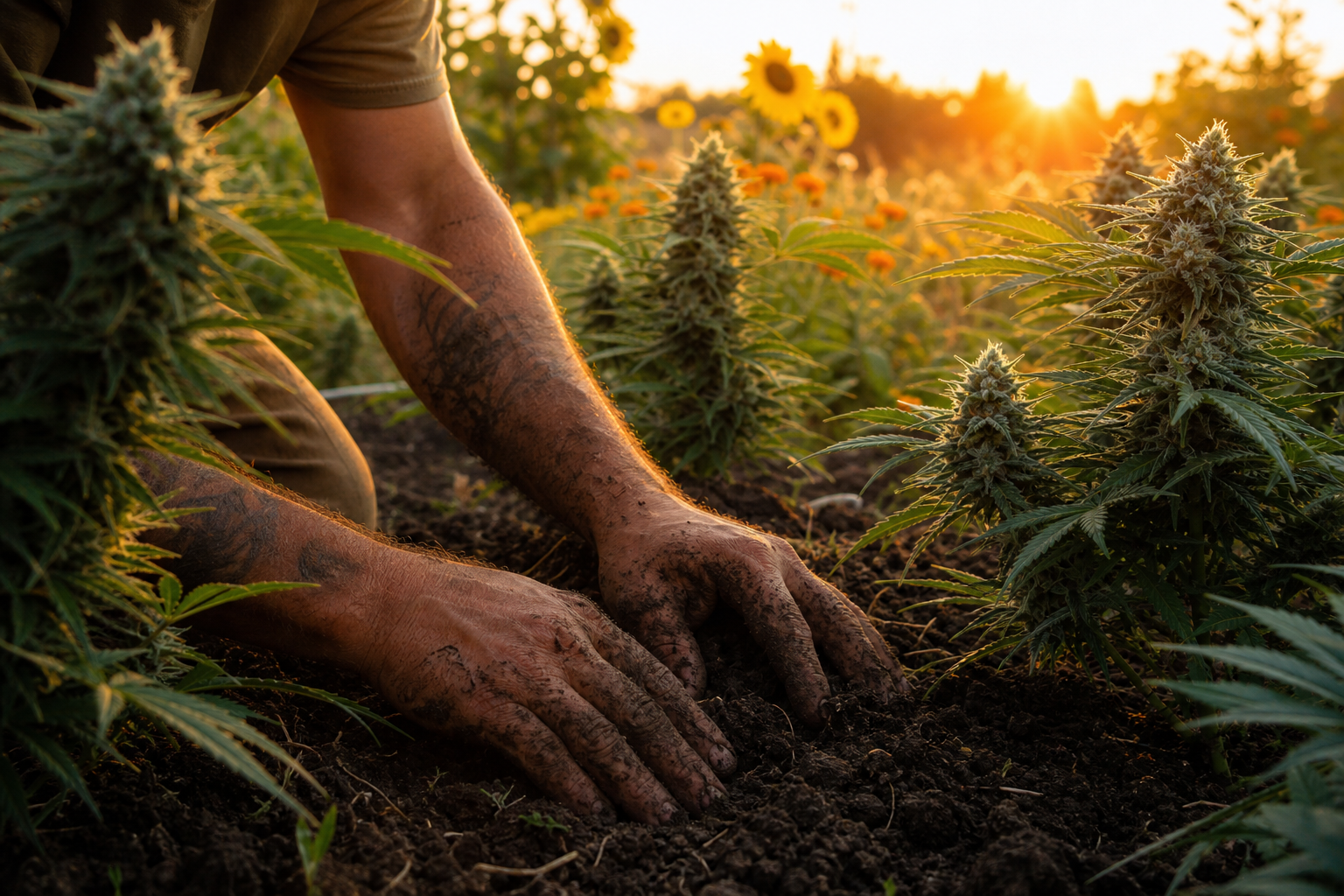
Mid-July on a sun-grown farm feels like the quiet stretch before the big finish. The plants are tall, green, and hungry for sun. Fall harvest is still weeks away — but the clock is already ticking.
What Stage Are Outdoor Cannabis Plants In During Mid-Summer? #
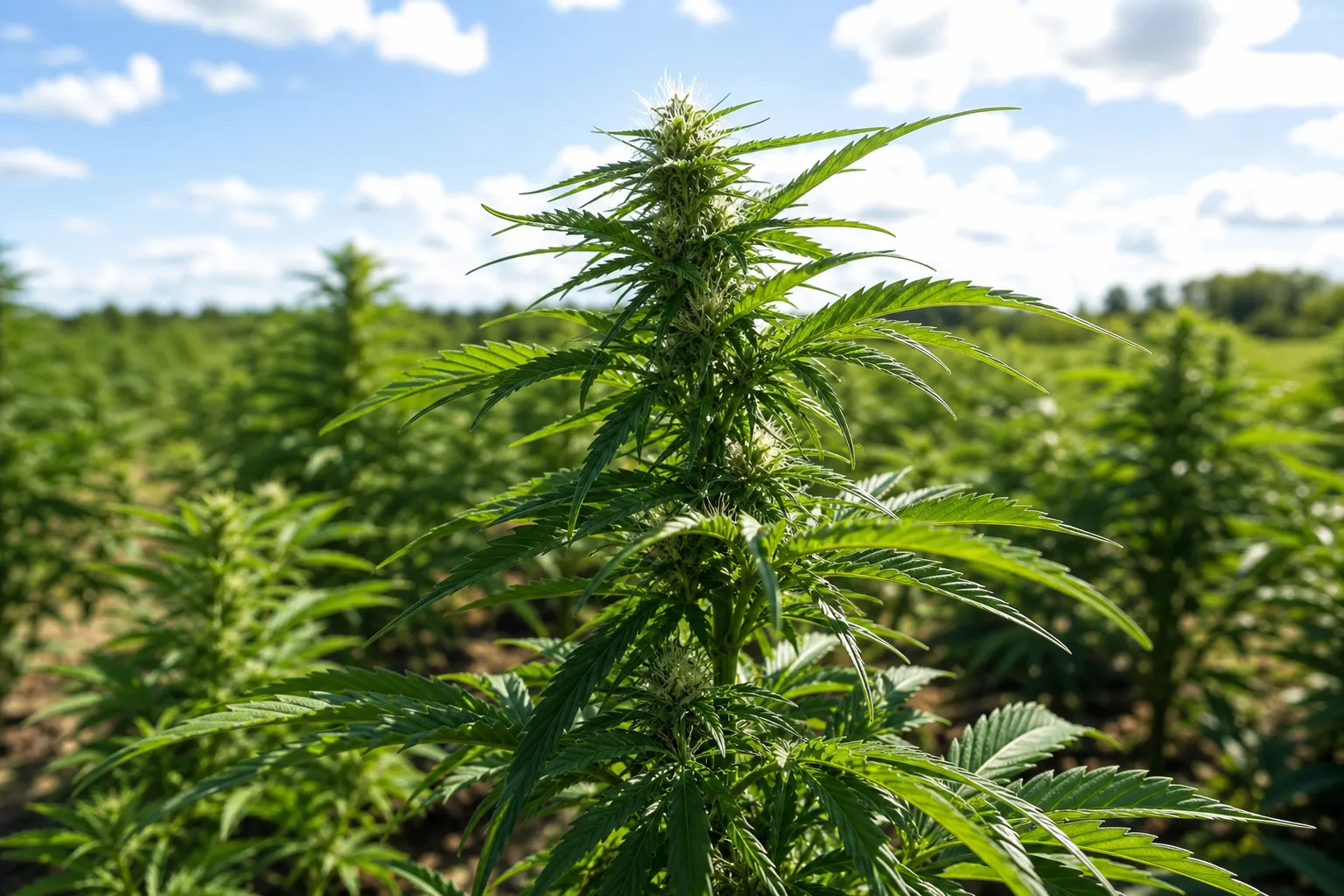
In mid-summer, outdoor photoperiod cannabis is usually in late vegetative growth — packing on height and leaves — and starting to tip into pre-flower as nights slowly get longer after the summer solstice. On a Michigan sun-grown farm like Divine Toke, July is the stretch where the plants look full and strong, but the finished flower you buy in fall is still forming on nature's clock.
Late Vegetative Growth vs. Pre-Flower #
Vegetative growth is the "build the plant" phase. Roots dig deep. Stems thicken. Fan leaves catch as much sun as they can. Pre-flower is the quiet handoff into bloom — the plant starts sensing longer nights and may show early sex signs (small white pistils on females) before true bud stacks take off.
According to the NCAT Cooperative Extension hemp overview, the hemp life cycle runs about four to six months and moves through germination, vegetative growth, flowering, and senescence. Mid-summer sits right in that middle band for outdoor photoperiod plants in the Upper Midwest.
| Stage | What you see | Rough mid-summer timing (Michigan outdoor) |
|---|---|---|
| Late vegetative | Rapid height and leaf growth; plants look "full size" | Early–mid July |
| Pre-flower | Early pistils; growth still strong; bloom hormones rising | Mid–late July |
| Early flower | More pistils; bud sites stacking; stretch continues | Late July–August |
| Mid–late flower | Dense flowers; ripening toward harvest | August–September |
| Harvest window | Trichomes cloudy/amber; frost risk rising | Late Sept–mid Oct |
Why July Feels Like "Almost There" #
July feels exciting because the field finally looks like a real crop. The plants are tall. The soil is warm. The sun is still long. But "almost there" is not "ready." Flower weight, smell, and resin build mainly in late summer. Mid-summer is when our team protects plant health so that fall finish has something strong to work with.
If you want the full farm-day picture of how that care looks on the ground, our seed-to-smoke day in the life walkthrough shows the same patient rhythm from another angle.
How Does the Summer Solstice Start the Flowering Clock? #
The summer solstice does not flip outdoor cannabis into full flower overnight. It starts the night-lengthening clock — and photoperiod plants flower when those longer nights hit each cultivar's trigger. Think of June 20–21 as the turning point on a dimmer switch, not a light switch.
Cannabis (including hemp forms of Cannabis sativa) is a short-day plant. That means flowering is tied to lengthening darkness, not to a calendar holiday. An ASHS HortTechnology review of photoperiod-sensitive hemp notes that after a juvenile phase, many cultivars may initiate flowering when day length drops below about 14 to 16 hours. The NCAT hemp guide similarly pegs the common critical photoperiod near 14 hours once that juvenile stage is done.
Short Days, Long Nights — What That Means for the Plant #
Indoors, growers often force flower with a hard 12 hours light / 12 hours dark schedule. Outdoors, nature softens that change. Days shorten a little each evening after the solstice. The plant keeps reading the night length until its genetics say "go."
A Frontiers in Plant Science photoperiod study of 27 hemp cultivars found that a day-length change of as little as 15 minutes can meaningfully shift floral initiation in some essential-oil types. That is why two neighboring plants can look similar in July and still enter bloom a week or two apart.
| Signal | What happens | Why it matters mid-summer |
|---|---|---|
| Summer solstice (~June 20–21) | Longest day; nights begin lengthening | Biological "turn" starts |
| Early–mid July | Days still long; plants often still veg hard | Bulk canopy build |
| Late July–August | Nights longer; many cultivars show pre-flower / early flower | Visible bloom begins |
| Cultivar critical photoperiod | Often near ~14 hours light (varies by genetics) | Not every plant flips on the same date |
We wrote more about this turning point in our summer solstice sun-grown cannabis post — mid-summer is the next chapter of that same story.
Why Flowering Does Not Flip Overnight #
Two things slow the drama:
- Genetics. Different cultivars have different critical day lengths. Some start earlier; some wait for shorter days.
- Actual day length where we grow. At Detroit's latitude (~42°N), mid-July daylight is still well above 14 hours. U.S. Naval Observatory daylight duration tables are the clean way to track when local day length crosses any given hour mark — and that crossing often lands later in summer than people expect.
So when someone asks, "Are the plants flowering yet?" the honest mid-summer answer is: they're listening to the night, and many are just starting to answer. Full bud set is still a late-summer job.
What Does a Michigan Outdoor Season Timeline Look Like? #
A typical Michigan outdoor sun-grown season runs from late-spring transplant after frost risk eases, through summer vegetative growth, into late-summer flowering, and finishes near the first fall frost — often late September into mid-October depending on your hardiness zone. Mid-July sits in the middle of that arc: the build phase ending, the bloom phase beginning.
MSU Extension's Lower Peninsula garden calendar publishes average frost windows by USDA zone. Those dates are for warm-season gardening in general — not a Divine Toke harvest promise — but they explain why outdoor cannabis here has a real finish line.
| USDA zone (common in MI) | Avg. last spring frost | Avg. first fall frost |
|---|---|---|
| 5b | May 10 – May 25 | Sept 25 – Oct 10 |
| 6a | May 1 – May 15 | Oct 6 – Oct 21 |
| 6b | April 15 – April 30 | Oct 15 – Oct 31 |
Spring Transplant Through Peak Summer #
| Month | What the crop is usually doing | Farm focus |
|---|---|---|
| May–early June | Harden off and transplant after frost risk drops | Roots, spacing, establishment |
| June | Strong vegetative growth under long days | Training, feeding living soil, IPM baseline |
| Early–mid July | Late veg / bulk canopy | Support structures, water, scouting |
| Late July | Pre-flower / early flower for many photoperiod plants | Stop hard topping; protect bloom sites |
Warm-season crops need warm soil and nights, not just a warm afternoon. MSU Extension stresses soil temperature and local weather over a single statewide date — same logic outdoor cannabis farmers use when they wait for a safe transplant window.
For a Detroit-area feel, zones 5b–6a are a useful mental map: spring planting waits until May is truly warm, and fall finish lands before nights get sharp. That is why July is never "almost done." It is the long middle where the season still has room to run — and room to lose quality if pests or mildew get ahead.
Late Summer Bud Set Through Fall Harvest #
| Month | What the crop is usually doing | Farm focus |
|---|---|---|
| August | Flower set and stretch; resin beginning to build | Airflow, mildew watch, branch support |
| September | Bulk flower fill; ripening starts | Mold risk rises with cool nights + humidity |
| Late Sept–mid Oct | Harvest window for many outdoor runs | Cut by maturity + weather, not hype |
Northern counties often face an earlier first frost than southern Lower Peninsula sites. That is why "Michigan harvest" is a range, not one magical date. Our land's soil and weather story also shapes how the flower finishes — more on that in Michigan terroir: how the land shapes flower.
What Are Sun-Grown Farmers Doing in July? #
In July, sun-grown farmers are not harvesting — they are protecting the crop through heat, pests, and the veg-to-flower handoff: support heavy branches, water deeply, keep airflow open, and scout every day. On our team, mid-summer is quiet hard work. The glamorous jars come later.
Training, Support, and Canopy Airflow #
By mid-summer, aggressive topping is usually done. Cutting the main growing tip late in the season steals energy the plant needs for flowers. The focus shifts to:
- Support — stakes, trellis, or netting so branches do not snap in wind or under later flower weight
- Light selective leaf work — remove dead or heavily shaded leaves that block airflow
- Open the middle — still air holds humidity; humidity invites mildew
The goal is simple: keep the canopy breathing without stripping the plant bare.
Water, Heat, and Soil Care #
July heat pulls water hard. Outdoor plants in full sun drink deep. Good practice looks like:
| Task | Mid-summer habit | Why it helps |
|---|---|---|
| Watering | Deep, less often; early morning preferred | Roots go down; less midday stress |
| Mulch | Keep soil covered | Holds moisture; buffers heat |
| Soil check | Feel moisture a couple inches down | Avoids both drought and soggy roots |
| Living soil care | Feed the soil life, not just the plant | Steady nutrition through flower |
Sun-grown flower depends on healthy soil as much as healthy leaves. Rushing fertilizer tricks in July rarely beats steady soil biology.
Watching for Pests and Mold Early #
Mid-summer IPM (integrated pest management) is mostly looking before spraying. Aphids, mites, and caterpillars love warm weather. Powdery mildew loves still, humid air on crowded leaves.
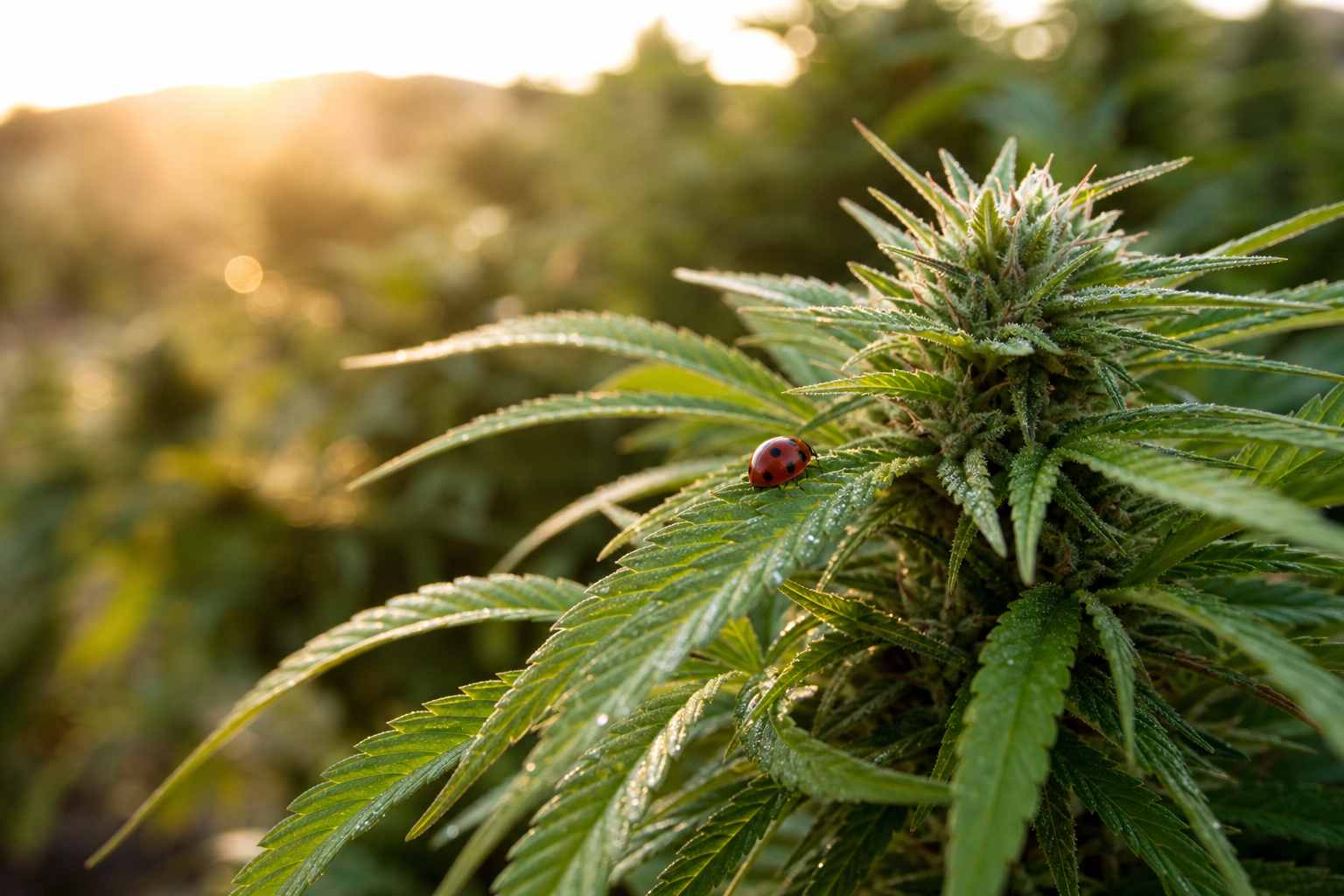
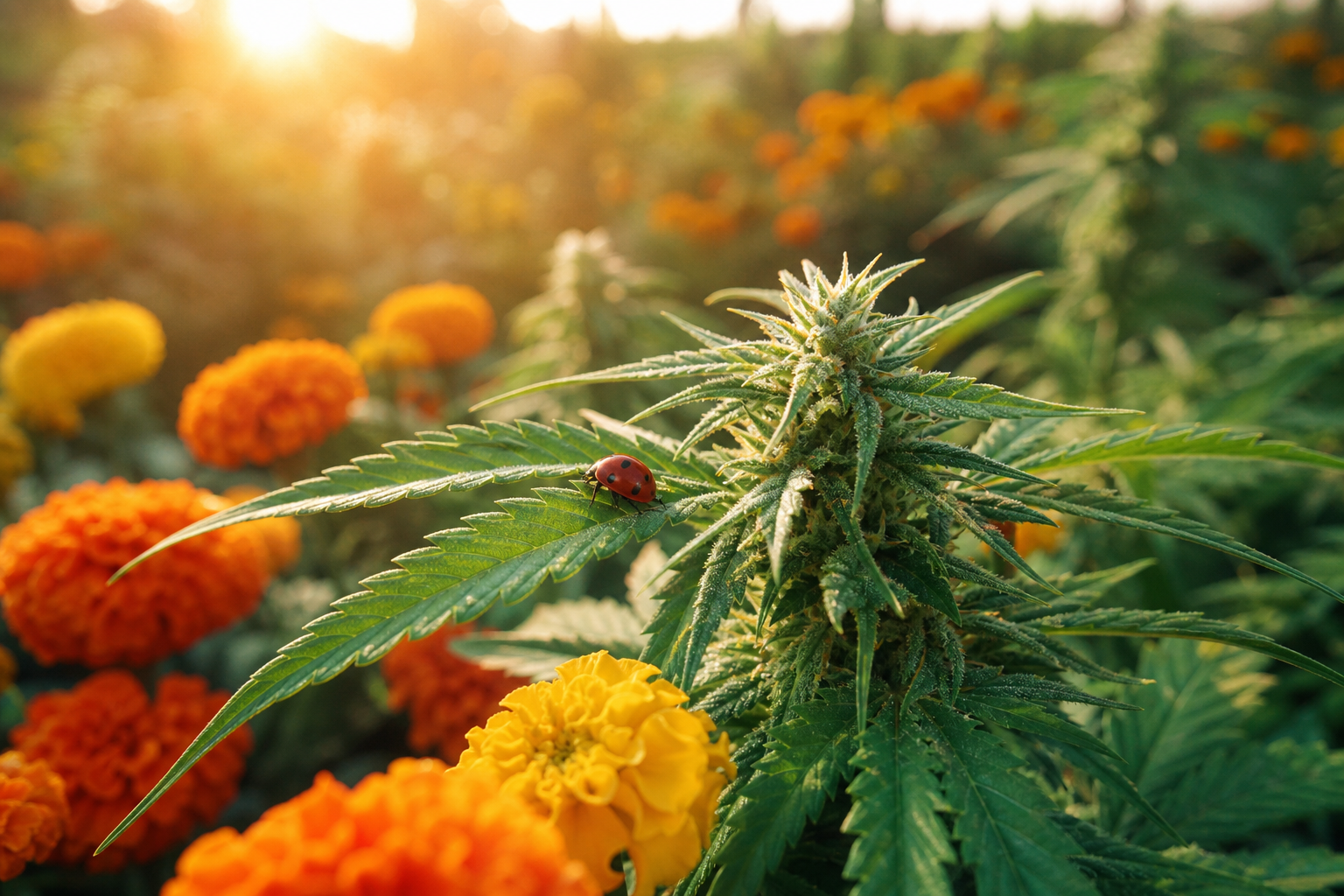
MSU Extension's powdery mildew guidance stresses cultural controls first — airflow, spacing, and sanitation — because mildew is a fungus problem, not something beneficial insects "eat." Beneficial predators still matter for soft-bodied pests; Virginia Tech Extension covers how lacewings, lady beetles, and other helpers fit a garden IPM plan. For hemp-specific outdoor practices, the Maine DACF hemp IPM practices guide (2022) is a solid state-agency playbook on scouting and prevention.
Daily scouting beats weekend panic. A five-minute walk through the rows in the morning — underside of leaves, sticky new growth, white powdery spots — catches problems while they are still small. Mid-summer humidity after a rain is when mildew likes to start. Shake or support plants so water does not sit in the canopy, then keep watching.
If you like the bug side of this story, we go deeper in beneficial insects and cannabis IPM.
When Is Outdoor Cannabis Usually Ready to Harvest in Michigan? #
Most Michigan outdoor sun-grown cannabis finishes in a late-September to mid-October window — earlier up north, later in warmer southern zones — and the real call is plant maturity plus weather, not a single calendar day. Mid-summer "harvest preview" means looking ahead to that finish line, not cutting plants now.
We are not publishing a Divine Toke cut date here. Every season, every cultivar, and every patch of weather is a little different. What we can say with public climate data is where the frost risk lands.
Frost Windows vs. Plant Readiness #
Using MSU Extension frost ranges:
| Region feel (by zone) | First fall frost (average) | Practical outdoor takeaway |
|---|---|---|
| Cooler / northern-leaning (e.g. 5b) | Sept 25 – Oct 10 | Finish often tighter; early frost risk is real |
| Milder Lower Peninsula (e.g. 6a) | Oct 6 – Oct 21 | Often a longer ripening window |
| Warmest pockets (e.g. 6b) | Oct 15 – Oct 31 | More room — still not infinite |
Frost ends the season for tender warm-season plants. Cannabis flowers that are still immature when a hard freeze hits can lose quality fast. That is why outdoor farmers plan genetics and planting dates around the fall cliff, not just around July optimism.
How Growers Judge "Ready" Without Rushing #
Calendar ranges are the fence posts. Ripeness is the gate:
- Trichomes — resin heads shift from clear toward cloudy, then some amber (the classic maturity cue)
- Pistils — many white hairs darken and tuck in as flowers mature
- Smell and swell — terpene intensity and flower density rise late
- Weather forecast — a clean dry window can beat waiting through a mold week
NCAT's hemp life-cycle framing treats flowering and harvest maturity as distinct stages. Mid-summer plants may look huge and still be weeks from that maturity stage. Patience is not branding — it is horticulture.
A simple way to hold the timeline in your head:
- July — protect growth and catch the bloom start
- August — flower set, stretch, early resin
- September — fill and ripen while watching mold weather
- Late Sept–mid Oct — harvest when the plant and the forecast both say yes
That is the mid-summer harvest preview in one breath: we are in step one, aiming at step four.
Why You Cannot Rush a Sun-Grown Fall Harvest #
You cannot force a quality outdoor harvest early without paying for it — photoperiod genetics, resin maturity, and Michigan weather all need time, and cutting too soon usually means thinner smell, weaker finish, and less of what people actually want from sun-grown flower. Mid-summer excitement is good. Mid-summer scissors are not.
Here is why the rush fails:
| Shortcut people want | What actually happens | Better mid-summer move |
|---|---|---|
| Cut in August because plants look big | Flowers often underripe; resin and aroma still building | Keep supporting bloom and scouting |
| Force earlier flower with light tricks outdoors | Hard to do at field scale; stress can hurt yield | Let natural night length work |
| Heavy late topping / hard stress | Redirects energy away from flower sites | Stop aggressive training; protect buds |
| Ignore mildew until harvest week | Late mold can wipe good flower | Fix airflow and scout now |
Photoperiod science backs the slow approach. An ASHS HortTechnology paper on planting date and photoperiod-sensitive hemp shows that flowering timing is tightly tied to day length and planting timing — not farmer impatience. A Frontiers photoperiod study adds that cultivars differ in how fast they respond; some need that gradual night stretch.
And weather still gets a vote. Cool, wet September nights raise Botrytis and mildew risk. Harvesting a week early to dodge a storm can be smart. Harvesting a month early because July feels long is how you get grassy, unfinished flower.
Sun-grown quality is a season-long bet. July is when we protect the bet. Fall is when we cash it.
How Mid-Summer Shapes What You'll Smell and Taste This Fall #
Mid-summer does not put finished aroma in the jar yet — it builds the plant factory that will make that aroma later: big healthy canopy, strong roots, and clean leaves under real Michigan sun. The smell you remember from a good outdoor jar is mostly a late-season product. July decides whether that late season has enough plant to work with.
Sun-grown flower spends months under full-spectrum daylight. That long light diet is different from a sealed indoor room. Soil, weather swings, and the slow photoperiod flip all leave a mark — what growers and consumers often call terroir. We unpack that land-and-flower link in Michigan terroir: how the land shapes flower.
| Mid-summer input | What it sets up for fall |
|---|---|
| Long sunny days | Energy for growth and later resin production |
| Living soil biology | Steady nutrition through flower fill |
| Open canopy / IPM | Cleaner flower, fewer late losses |
| Natural night lengthening | On-time bloom instead of stressed bloom |
| Patience past July | Time for terpenes and trichomes to finish |
Research on hemp photoperiod and planting date — including the ASHS HortTechnology planting-date study — shows that when plants flower relative to the season can change yield and cannabinoid outcomes. Timing is part of quality, not just quantity.
So when our sun-grown plants look lush right now, that is not the finished story. It is the middle chapter. The fall chapter is when the nose and the resin catch up to the height.
Frequently Asked Questions #
What stage are outdoor cannabis plants in during July in Michigan? #
Most outdoor photoperiod plants are in late vegetative growth and moving into pre-flower or early flower by late July. They still look leafy and tall while the bloom clock starts. The NCAT hemp life-cycle guide places flowering after a multi-month vegetative build — July is usually that handoff, not harvest.
Does outdoor cannabis start flowering on the summer solstice? #
No. The solstice starts longer nights; visible flowering usually lags weeks as day length keeps dropping. Cannabis is a short-day plant, and many cultivars wait until photoperiods fall near the 14-hour range described by ASHS HortTechnology and NCAT. Think "dimmer switch," not "flip switch."
When is Michigan outdoor cannabis usually harvested? #
Often late September through mid-October, depending on zone, cultivar, and weather. MSU Extension frost tables put first fall frost around Sept 25–Oct 10 in zone 5b and Oct 6–Oct 21 in zone 6a — those windows explain why outdoor finish is a range, not one statewide day.
Why do outdoor plants get so big in mid-summer? #
Long days, warm soil, and a long vegetative run let outdoor plants pack on height before bloom. After the solstice, nights lengthen slowly, so many plants keep growing hard through early–mid July. That bulk is why branch support becomes a real July job.
What pests and mold risks show up in July and August? #
Warm-weather insects plus rising mildew pressure as humidity and dense canopies meet. MSU Extension powdery mildew guidance puts cultural controls — airflow, spacing, sanitation — first. Soft-bodied pests are where beneficial insects help; see Virginia Tech Extension on beneficials and Maine's hemp IPM practices.
How do farmers know harvest is getting close? #
They read the plant — trichomes, pistil change, smell, density — then weigh that against the weather. Calendar ranges from frost data only set the fence. Cloudy trichomes and a workable dry window matter more than "it's October, so cut."
Is sun-grown cannabis different from indoor at this stage of the season? #
Yes in method: outdoor plants follow natural day length, while indoor rooms force flower with timers. Outdoors, bloom timing tracks the sun. Indoors, a grower can run 12/12 any month. Mid-summer outdoor plants are still tied to Michigan's night length — that is the whole point of sun-grown.
Can you speed up outdoor flowering to harvest earlier? #
Not in a clean, field-scale way without tradeoffs. Photoperiod genetics and planting date drive outdoor timing, as shown in photoperiod and planting-date hemp research. Light-deprivation tricks exist for some outdoor styles, but they are stress tools — not a free faster season — and they do not rewrite frost risk.
What is "pre-flower" on a cannabis plant? #
Pre-flower is the short transition when the plant starts showing sex signs and bloom hormones rise, before heavy bud stacking. You may see early white pistils while the plant still stretches. A Frontiers photoperiod study notes that pre-flowering itself can be photo-insensitive, while the jump into full flowering responds to day length — sometimes to changes as small as 15 minutes.
Does a wet August or early September frost change the harvest window? #
Yes. Wet stretch weeks raise mold risk; an early frost can force an earlier cut. Zone averages from MSU Extension are only averages — a cold snap can arrive early. Good outdoor teams watch forecasts as hard as they watch trichomes.
Looking Ahead to This Fall's Crop #
Mid-summer is the honest middle of the story. Our sun-grown plants are strong, green, and listening to longer nights. The jars you will want this fall are still weeks of weather, resin, and careful work away — and that wait is the point.
When this crop is ready this fall, it will carry a full season of Michigan sun and soil, not a rushed indoor shortcut. If you want to follow the season's arc, start with our summer solstice sun-grown cannabis piece, walk a farm day in seed to smoke, and read how place shapes the finish in Michigan terroir. For the bug-and-prevention side of mid-summer care, beneficial insects and cannabis IPM is the next stop.
Until then, we keep scouting, watering, and trusting the plant's clock — same as every outdoor season worth smoking.
If you are browsing jars right now and wondering what this year's sun-grown run will feel like, remember July's job: build the plant, protect the canopy, and let night length do its quiet work.
Fall will tell the rest.
Grown in Detroit. Shipped to your door.
Small-batch, sun-grown cannabis cultivated in living soil. Mail-order shipping to all 50 states.