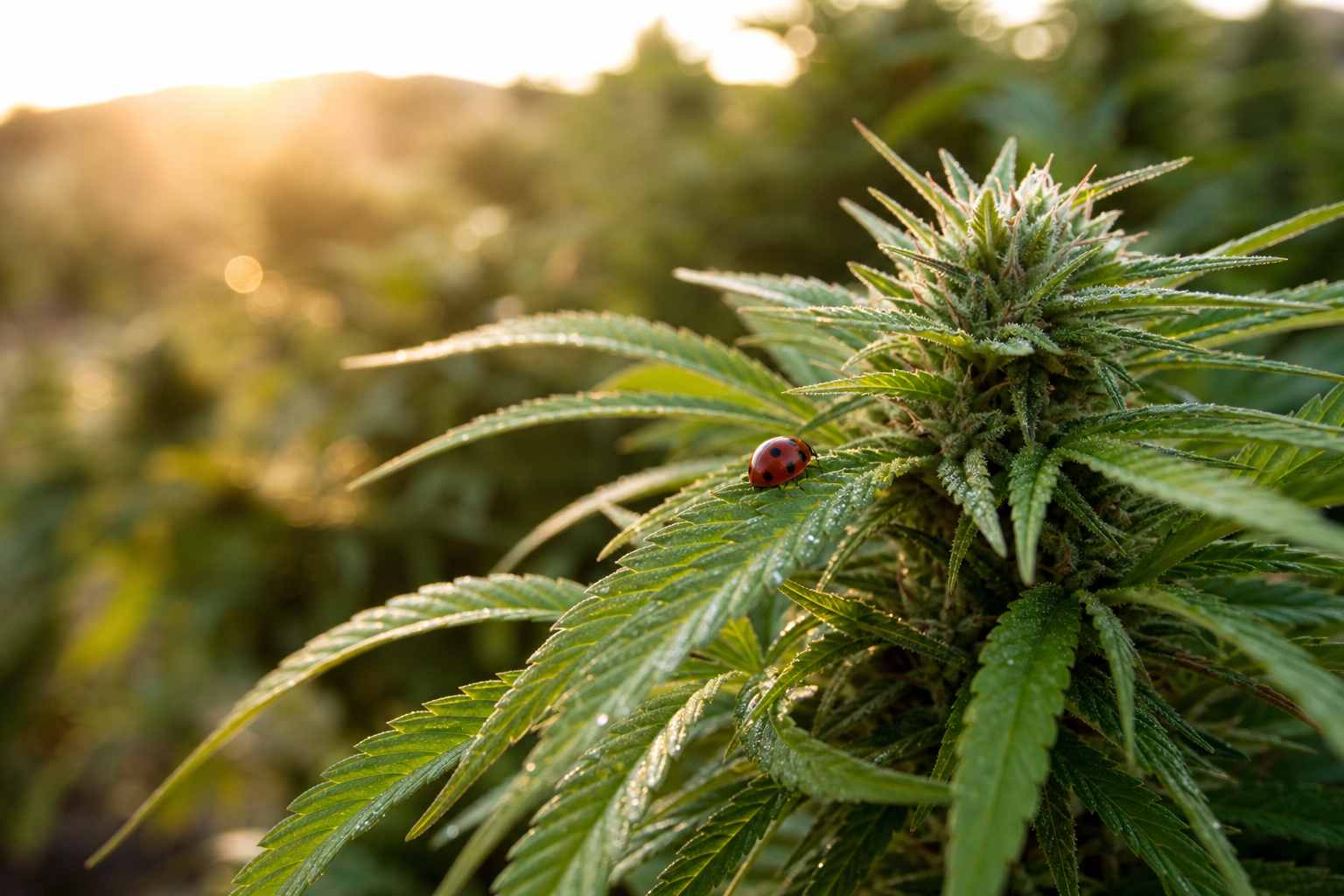
Beneficial Insects: The Tiny Army Protecting Our Cannabis

Jamie
Head Cultivator
When you buy sun-grown flower, you're not just buying a plant. You're buying the whole food web that kept that plant healthy — including a tiny army of predators most people never notice.
This post answers one consumer question straight: how do beneficial insects protect cannabis plants without pesticides? The short version is predators and tiny wasps do the pest control living soil and habitat make possible. The long version is below.
What Are Beneficial Insects in Cannabis Farming? #
Beneficial insects are predators and parasites that eat cannabis pests — aphids, spider mites, thrips, whiteflies — without harming the plant or leaving spray residue. Growers use them as living pest control instead of (or before) chemical pesticides.
This approach sits inside integrated pest management (IPM) — a system that starts with watching the crop, keeping plants strong, and only stepping up control when pests show up. The N.C. State Extension IPM handbook frames IPM as prevention first, then the least-toxic tools that work. The Bio-Integral Resource Center's cannabis IPM manual applies that same ladder to marijuana: monitor, identify, prevent, then use biological controls before hard chemistry.
In plain terms, beneficials are the farm's cleanup crew:
| Role | What they do | Everyday analogy |
|---|---|---|
| Predator | Hunt and eat pests (ladybugs, lacewing larvae, predatory mites) | Cats in a barn full of mice |
| Parasitoid | Lay eggs in or on a pest; the young kill the host (tiny wasps) | A locksmith who only works on the wrong keys |
| Soil helpers | Attack root-zone pests like fungus gnat larvae (nematodes, rove beetles) | Underground security |
You will also hear "biocontrol" or "beneficials." Same idea: put the right hunter on the right pest, and keep the habitat alive so those hunters stick around.
What beneficials are *not* #
Beneficial insects are not a free pass to ignore scouting, watering, or plant stress. They are one tool on the IPM ladder — usually after prevention, usually before hard chemistry.
They also are not:
- Pollinators only — bees matter for many crops, but cannabis flower quality is not about fruit set the way tomatoes are
- Random bugs from a jar — species matter; the wrong mite will not fix aphids
- A one-week miracle — populations need time, food, and the right temperature to settle in
- Proof a farm is "organic" by itself — clean flower still needs soil practice, testing, and restraint on sprays
IPM, as N.C. State Extension teaches it, is a system. Beneficials are the part you can see crawling if you look close.
Why Cannabis Farms Skip Sprays When They Can #
Cannabis is smoked or vaporized, so anything left on the flower can go into your lungs — and Michigan still tests every batch for pesticide residue before it can be sold. That is why serious sun-grown farms treat sprays as a last resort and lean on bugs, soil health, and habitat first.
In Michigan, only pesticides on the official Michigan Marijuana Pesticide List may be used on cannabis. The Michigan Department of Agriculture and Rural Development (MDARD) is clear: a product labeled "organic" or "OMRI Listed" is not automatically allowed. It has to appear on that state list. MDARD's FAQ on pesticides and marijuana walks through the same rule for growers.
Even when a spray is legal, it can still:
- Kill the good bugs along with the bad ones
- Stress living soil microbes that feed the plant
- Push a batch toward a failed residue test with no easy do-over
We unpack that consumer side in full in Why We Don't Use Pesticides — and What We Do Instead. This post is the next layer: what "what we do instead" looks like when the tool is a living insect.
British Columbia's government cannabis IPM manual makes the same point growers hear in Michigan trade circles: biological control and cultural practices come before broad-spectrum chemicals, especially on a crop people inhale.
The smoke-test difference #
Food crops get washed. Much of what people do with cannabis does not. Flower goes into a joint, a bowl, or a vaporizer. That changes how careful a farm should be about what touches the plant late in bloom.
A clean IPM program aims for:
- Fewer spray events — especially in flower
- No surprise actives — only what the state list allows, if anything
- Living predators on site — so a small pest hitch does not become a crop fire
That is the consumer-facing reason this "tiny army" story matters. The farm-facing reason is simpler: once you kill your predators with a broad spray, you often need more sprays to finish the job. Biocontrol breaks that treadmill.
The Core Crew: Ladybugs, Lacewings, Predatory Mites, and Parasitic Wasps #
Four groups do most of the heavy lifting on cannabis: ladybugs, green lacewings, predatory mites, and parasitic wasps. Each has a preferred menu. Matching the crew to the pest is what makes IPM work.
Ladybugs — Aphid Control on Four Wings #
Ladybugs (family Coccinellidae) eat soft-bodied pests — especially aphids — in both the adult and larval stages. The BIRC cannabis IPM manual lists ladybugs among the core biological controls for aphids, mealybugs, mites, scale, and whiteflies.
What that looks like on a farm:
- Adults cruise leaves hunting colonies
- Larvae look nothing like the polka-dot cartoon bug — they are elongated, dark, and often hungrier than the adults
- Best used when aphids are present (or clearly building), not as a one-and-done magic dump with no food
Ladybugs are the beneficial most people recognize. They are also the ones that wander if there is nothing to eat. Habitat and timing matter as much as the release itself.
A few practical notes growers learn the hard way:
- Release near the infestation, not at the far end of the field "for vibes"
- Evening or cooler hours often help them settle before flying off
- Water and shelter nearby beat a bare, sprayed strip of dirt
- Larvae stay put more than adults — some programs prefer larval releases for that reason
None of this requires inventing farm folklore. It is basic predator ecology: food, shelter, and a soft landing.
Green Lacewings — The "Aphid Lions" #
Green lacewing larvae are nicknamed "aphid lions" because they crush soft pests with hooked jaws — aphids, thrips, whiteflies, spider mites, and small caterpillars. Adults mostly sip nectar and pollen; the larvae do the hunting. That split is why farms often release lacewings as eggs or larvae rather than counting on pretty adults alone.
Per the same BIRC cannabis IPM guidance, lacewings earn a seat next to ladybugs for broad canopy pressure. Trade coverage in Cannabis Business Times also treats lacewings as a workhorse when growers want one predator that covers several soft-bodied pests.
Think of lacewings as the Swiss Army knife of the canopy crew — less famous than ladybugs, often more useful in a mixed-pest year.
Why farms like them next to ladybugs:
| Factor | Lacewing larvae | Ladybugs |
|---|---|---|
| Menu width | Broad soft-pest menu | Strong on aphids; wider menu in practice |
| Stay-put tendency | Larvae tend to hunt locally | Adults can disperse farther |
| Adult diet | Nectar/pollen heavy | Predatory as adults too |
| Best story for consumers | "Aphid lions" — easy to explain | Instant recognition |
You do not have to pick only one. Many IPM programs stack lacewings with mites or wasps when scouting shows mixed pressure. Cannabis Business Times' beneficials tips keep returning to that stack-the-right-tools idea.
Predatory Mites — Fighting Spider Mites With Mites #
Spider mites are controlled best by other mites — especially Phytoseiulus persimilis for outbreaks and Neoseiulus californicus for prevention. It sounds odd until you see it: the "good" mite does not feed on the cannabis plant. It feeds on the pest mite.
The University of California IPM program documents predatory mites as a primary biological tool against spider mites in many crops. UC IPM's notes on the western predatory mite and related species explain the specialist vs. generalist tradeoff growers use every season:
| Predator | Role | Diet style | Best use |
|---|---|---|---|
| Phytoseiulus persimilis | Curative | Specialist — spider mites only | Active outbreaks, dense webbing |
| Neoseiulus californicus | Preventative | Generalist — mites, pollen, some other soft prey | Early season, low pest pressure |
| Other Amblyseius / Neoseiulus spp. | Mixed | Often broader (thrips, whitefly eggs in some species) | Warm greenhouses / mixed pests |
Biobest's guidance on spider mite control in medicinal cannabis and UConn's biological control fact sheet on spider mites both stress the same playbook: release early, match humidity and temperature to the species, and do not wait until leaves look like lace.
Parasitic Wasps — Tiny, Precise, Harmless to People #
Parasitic wasps used in cannabis IPM are millimeters long, do not sting people, and kill pests from the inside by laying eggs in aphids, whiteflies, or other hosts. Species such as Aphidius colemani (aphids) and Encarsia formosa (whiteflies) show up across cannabis IPM manuals, including BIRC and the British Columbia cannabis IPM manual.
You may never see them without a hand lens. What you do see is the aftermath: swollen, papery "mummy" aphids, or whitefly scales that turn dark when parasitized. That is the wasps working.
They are precision tools — not a cartoon swarm. Farms release them when scouting shows the right host pest starting to build.
Consumer myth to kill here: "Wasps on my weed" does not mean yellow jackets in the bag. These parasitoids are so small they look like flying grains of pepper. They are not interested in people. They are interested in aphids and whiteflies.
Maine's medical marijuana IPM guidance groups parasitoids with other biocontrols under the same prevention-first ladder used across regulated cannabis markets. The Latin names change by pest. The logic does not: match the hunter, release early, protect the release from broad sprays.
Matching the Bug to the Pest #
The right beneficial depends on the pest — and whether the problem is on the leaves or in the soil. Dumping ladybugs on a spider-mite outbreak is the wrong tool. Using predatory mites for aphids is the same mistake in reverse.
| Pest | Where it lives | First-line beneficials | Notes |
|---|---|---|---|
| Aphids | Soft new growth, stems | Ladybugs, lacewing larvae, Aphidius wasps | Watch undersides of leaves |
| Two-spotted spider mites | Undersides; fine webbing | P. persimilis, N. californicus | Hot, dry stress makes mites worse |
| Thrips | Flowers, leaves | Lacewings, some predatory mites (A. swirskii, etc.) | Harder in mid-flower — scout early |
| Whiteflies | Undersides | Encarsia wasps, lacewings, some mites | Sticky cards help monitoring |
| Fungus gnats | Soil / media surface | Beneficial nematodes (Steinernema feltiae), rove beetles | Fix overwatering too |
That table is the mental model. Scout → name the pest → pick the hunter. Cannabis Business Times' IPM interview coverage keeps landing on the same lesson: identification and timing beat panic spraying every time.
Quick ID tips for everyday scouting #
You do not need a lab coat. You need a habit and a hand lens.
| What you see | Likely pest | First beneficials to think about |
|---|---|---|
| Sticky leaves, clustered soft bugs on tips | Aphids | Ladybugs, lacewing larvae, Aphidius |
| Fine webbing, stippled yellow dots under leaves | Spider mites | P. persimilis, N. californicus |
| Silvery scrapes, black flecks, twisted tips | Thrips | Lacewings, thrips-focused predatory mites |
| White moths that lift when you shake a leaf | Whiteflies | Encarsia, lacewings |
| Tiny flies around wet soil; larvae in media | Fungus gnats | Nematodes, rove beetles + drier cycles |
Write it down. Date the find. Order the matching beneficial the same week — not "when we get around to it."
Soil-Level Allies: Nematodes, Rove Beetles, and the Root Zone #
Not every pest lives on the leaf. Fungus gnats and some thrips stages hide in the root zone — and that is where beneficial nematodes and soil predators earn their keep. Canopy ladybugs will not fix a wet-media gnat problem.
Beneficial nematodes #
Beneficial nematodes are microscopic roundworms (not plant-parasitic nematodes) that hunt fungus gnat larvae and similar soil pests. Species such as Steinernema feltiae are a standard biocontrol tool in greenhouse and indoor media. They need moisture to move, which is why they fit damp root zones — and why fixing chronic overwatering still matters.
Think of them as underground search-and-destroy, not a foliar spray.
Rove beetles and soil mites #
Rove beetles (often Atheta / Dalotia types in biocontrol catalogs) and soil-dwelling predatory mites patrol the top layer of media for gnat larvae and other soft soil prey. They are the below-ground cousins of the lacewing story: less photogenic, very practical.
The BIRC cannabis IPM manual and greenhouse IPM practice both treat the root zone as its own battlefield. A farm that only releases canopy predators is only half-armed.
Why soil health still comes first #
Beneficials in the media work better when:
- Media is not constantly soggy (gnats love wet)
- Compost and biology are alive (see Composting at Scale)
- Nobody nuked the top inch with a harsh drench that kills predators and pests alike
Living soil and soil beneficials are teammates. One builds resilience. The other mops up the pests that still show up.
How Living Soil and Habitat Keep Beneficials Working #
Beneficial insects work best when the farm is already a living system — rich soil biology below, nectar and cover above, and few broad sprays that wipe out the good guys. Bugs alone cannot fix a stressed plant in dead dirt.
Living soil — compost, microbes, fungi, and organic matter cycling nutrients — builds tougher plants that attract fewer opportunistic pests. We break that down in Living Soil Isn't Dirt — It's an Ecosystem. The short version: healthy roots and a full soil food web mean less "ambulance" pest control later.
Above ground, cover crops and companion plants give predators a reason to stay:
- Nectar and pollen feed adult lacewings, hoverflies, and parasitic wasps between pest meals
- Living mulch (clovers, buckwheat, and similar mixes) shelters ground predators and holds moisture
- Diverse edges confuse pests and support a wider predator mix
Michigan State University Extension explains how companion, trap, and cover crops fit together for home gardens — the same habitat logic scales on a cannabis farm. Our deeper dive lives in Cover Crops, Companion Planting, and the Garden Ecosystem.
Spray once with a broad product and you can erase weeks of that investment. That is why regenerative farms treat beneficials and living soil as one system, not two separate hobbies. For the carbon and soil-building side of that story, see Regenerative Farming and Carbon: How Cannabis Helps the Planet.
Habitat checklist farms actually use #
A beneficial program without habitat is a subscription to re-buy bugs every week. A simple outdoor or hoop-house checklist looks like this:
- Flowering strips or companions that bloom across the season (alyssum, dill, buckwheat mixes — pick what fits your climate)
- Cover between rows so soil does not cook bare in July
- Water edges that do not create fungus-gnat swamps
- No broad spray drift onto the predator strip
- Compost and mulches that feed soil life instead of sterilizing it
That list is boring on purpose. Boring is how living farms stay ahead of aphids.
Timing: When Farms Release Beneficial Insects #
Release beneficials at the first clear signs of a pest — or on a preventative schedule for mites — not after the room or field is already overrun. Late releases waste money and force harder tools.
A practical rhythm most IPM programs share:
- Scout weekly (more often in heat waves) — undersides of leaves, soft tips, sticky cards
- Identify the pest before ordering bugs — wrong predator = wasted release
- Preventative mites (N. californicus and similar) can go out early when spider mites are a known seasonal risk
- Curative specialists (P. persimilis, lacewing larvae, Aphidius) go out when scouting confirms the host pest
- Hold sprays that would kill the release — check labels and MDARD rules if anything chemical is even considered
UConn's spider mite biocontrol guidance and UC IPM spider mite pages both stress early, repeated releases over a single heroic dump. Maine's medical marijuana IPM guidance hits the same theme: prevention and monitoring first, then biologicals.
Outdoor Michigan farms also watch the weather. Hot, dry stretches favor spider mites. Cool, wet stretches change fungus gnat and mold pressure. Beneficials are part of the plan — not a substitute for knowing the season.
Preventative vs. curative — a simple split #
| Approach | When | Example tools | Goal |
|---|---|---|---|
| Preventative | Before pests explode; known risk windows | N. californicus, habitat strips, sticky cards | Keep pressure low |
| Curative | Pest confirmed and climbing | P. persimilis, lacewing larvae, Aphidius | Knock the outbreak down |
| Cultural | Always | Clean starts, airflow, right irrigation, living soil | Make the crop a harder target |
| Chemical (last) | Only if legal, needed, and timed carefully | MDARD-listed products only in Michigan | Bridge a crisis without torching the system |
Biobest's medicinal cannabis spider-mite guidance is blunt about that split: generalists hold the line; specialists put out the fire. Mixing them on purpose is smart. Mixing them with a spray that kills both is not.
Common Mistakes When Using Beneficial Insects #
Most biocontrol failures are timing, mismatch, or spray conflicts — not "bugs don't work." Farms that treat beneficials like a novelty pack get novelty results.
Mistake 1: Wrong predator for the pest #
Ladybugs on spider mites. Predatory mites on aphids. Pretty packaging, wrong job. Use the pest-to-beneficial table above before you order.
Mistake 2: Releasing into a chemical hangover #
If a room or field was just sprayed, many beneficials die on arrival. Check re-entry and compatibility. When in doubt, wait and scout again. Michigan growers also have to stay inside the MDARD-allowed pesticide list if any product is used at all.
Mistake 3: One dump, no follow-up #
Specialist mites burn through prey and then crash. Aphid pressure can rebound. Plan for repeat releases or a standing preventative program, as UConn's spider mite biocontrol sheet describes.
Mistake 4: Starving the army #
No nectar, no cover, no alternative food — predators leave or die. Cover crops and companions are not decoration. They are logistics for the insect army. Details live in Cover Crops, Companion Planting, and the Garden Ecosystem.
Mistake 5: Ignoring the environment #
P. persimilis wants the right humidity and temperature band. Hot, dry mite weather can outrun a weak release. Hot rooms can also cook a specialist that preferred milder conditions. Match the species to the season — UC IPM has been saying that for years across crops.
Mistake 6: Skipping the hand lens #
If you cannot name the pest, you are guessing. Sticky cards help. Underside leaf checks help more. Guessing is how farms end up spraying "just in case" — and then wondering why the beneficials never stuck.
What This Means for the Flower You Smoke #
When farms protect cannabis with beneficial insects instead of leftover sprays, you get flower that is cleaner to inhale, grown in a living system that usually tastes and smells richer. The bugs themselves do not leave a chemical residue on the bud.
What consumers actually feel from this system:
| Farm choice | What it means in the jar |
|---|---|
| Predator-first IPM | Lower chance of banned or questionable spray residues |
| Living soil + habitat | Plants under less stress; fuller aroma when done right |
| No panic sprays mid-flower | Terpenes and trichomes are not washed or scorched by chemistry |
| Michigan compliance testing | Batches still face pesticide screens before retail |
You will not taste a ladybug. You will taste the difference between a plant that was nursed through bloom with living allies and a plant that was "rescued" with whatever was in the spray shed.
At Divine Toke, sun-grown organic flower is the point of the whole chain — soil, insects, sun, cure. Beneficials are one quiet reason that flower can stay clean from seed to smoke. If you want the full pesticide story side-by-side with this one, start with Why We Don't Use Pesticides and come back here for the bug roster.
How to shop with this in mind #
You cannot see ladybugs in a sealed jar. You can ask better questions:
- How do you control pests? — Listen for IPM, beneficials, living soil — not only "we spray organic stuff"
- What does your COA show for pesticides? — Michigan batches run through safety testing; clean panels matter
- Is this sun-grown in living soil? — Habitat-friendly farms and beneficial programs usually travel together
- Smell the flower — stressed, sprayed, rushed flower often smells flat; healthy sun-grown usually does not
None of that requires memorizing Latin names. It requires caring who stood between the aphids and your lungs.
Frequently Asked Questions #
What beneficial insects are best for cannabis? #
Ladybugs, green lacewings, predatory mites (P. persimilis and N. californicus), and parasitic wasps (Aphidius, Encarsia) cover most canopy pests. Soil pests like fungus gnats need different tools — beneficial nematodes and rove beetles. The BIRC cannabis IPM manual lists these groups as core biological controls for marijuana crops.
Do ladybugs really work on cannabis aphids? #
Yes — when aphids are present and ladybugs stay on the crop long enough to feed. Both adults and larvae eat aphids and other soft pests. If you release them into a clean room with no food, many simply leave. Pair releases with scouting and habitat (nectar plants, cover) so the hunters have a reason to stick around.
Which predatory mites kill spider mites? #
Phytoseiulus persimilis is the specialist "firefighters" mite for active spider-mite outbreaks; Neoseiulus californicus is the generalist used more for prevention. UC IPM and Biobest's medicinal cannabis mite guidance both describe that two-step approach. Neither species eats the cannabis plant.
Are parasitic wasps dangerous to humans or pets? #
No. The wasps used in cannabis IPM are tiny, do not sting people, and target specific insect hosts. They are measured in millimeters. You are more likely to notice their work (mummy aphids, darkened whitefly scales) than the wasps themselves. They are a precision tool, not a yard full of yellow jackets.
Can beneficial insects work outdoors in Michigan? #
Yes — outdoor and hoop-house farms use the same predator groups, timed to Michigan weather and pest pressure. Heat and drought favor spider mites; cover crops and flower strips help keep predators on site. MSU Extension's companion and cover-crop guidance explains the habitat piece that makes outdoor biocontrol stick.
Will pesticide sprays kill beneficial insects too? #
Often yes — many broad sprays kill predators and parasites along with pests. That is why IPM puts biological control ahead of chemistry. In Michigan, even "organic" products must appear on the MDARD Marijuana Pesticide List before legal use, and residue testing still applies.
How does living soil help beneficial insects? #
Living soil grows stronger plants that invite fewer pest explosions, while cover crops and compost support a fuller food web above and below ground. Beneficials are the security team; soil biology is the foundation. Read Living Soil Isn't Dirt — It's an Ecosystem for the underground half of that partnership.
When should a grower release beneficial insects? #
At first detection for most pests — and on a preventative schedule for spider mites if they are a known seasonal risk. Waiting until webbing covers the canopy is usually too late for a clean biological fix. UConn's spider mite biocontrol sheet stresses early, repeated releases over one late dump.
Do beneficial insects leave residue on flower? #
No chemical pesticide residue comes from the insects themselves. They hunt, then leave (or die off) as prey drops. That is a main reason biocontrol fits flowering cannabis better than late sprays that can fail a Michigan CRA-required pesticide screen.
Why does pesticide-free cannabis matter more than pesticide-free food? #
You inhale cannabis smoke or vapor — so residues go to the lungs, not just the stomach. Food crops have their own residue rules, but combustion and inhalation change the risk picture. That is why clean IPM and state testing both matter. We cover the consumer angle in Why We Don't Use Pesticides.
The Bottom Line #
Beneficial insects are the quiet half of clean cannabis farming: the right predators, released at the right time, in a living habitat that does not need a spray closet to stay healthy. Ladybugs, lacewings, predatory mites, and tiny wasps are not a gimmick. They are how regenerative farms keep aphids, spider mites, and friends from owning the crop — without painting the flower in chemistry.
The next time someone shrugs and says "weed is weed," remember the food web that stood between a mite outbreak and your lungs. Clean flower is not an accident. It is soil, sun, patience — and a tiny army doing quiet work.
If you're curious to try flower grown in that kind of system, look for sun-grown, living-soil cannabis from farms that talk about IPM in plain language — not just "organic" as a sticker. At Divine Toke, that living chain — soil, insects, sun, and a patient cure — is the whole point.
Want to go deeper on the farm side?
- Why We Don't Use Pesticides — and What We Do Instead
- Living Soil Isn't Dirt — It's an Ecosystem
- Cover Crops, Companion Planting, and the Garden Ecosystem
This article is for educational purposes only and is not medical advice. Always consult your healthcare provider before starting any new wellness routine.