Regenerative Farming and Carbon: How Cannabis Helps the Planet

Jamie
Head Cultivator
Most people don't think about the planet when they light up. But how your cannabis was grown matters—a lot. Some methods pump out thousands of pounds of carbon dioxide. Others actually pull carbon from the air and lock it in the soil. The difference comes down to one word: regenerative.
Regenerative cannabis farming captures carbon dioxide from the atmosphere and stores it in healthy soil while producing clean, sun-grown flower. This article breaks down the numbers behind sustainable cannabis, compares growing methods, and shows you how to spot truly eco-friendly weed.
How Much Carbon Does Cannabis Farming Produce? #
Indoor cannabis can generate 2,500 to 5,000 kg of CO₂ for every kilogram of dried flower—while outdoor sun-grown cannabis produces just 62 to 111 kg CO₂ per kilogram, according to a 2024 PMC NIH life-cycle assessment study (PMC11253875). That's a difference of 20 to 50 times.
The Indoor Energy Problem #
Growing cannabis indoors is like running a factory that never sleeps. Lights blaze 12 to 18 hours daily. Air conditioners and dehumidifiers fight the heat and moisture those lights create. CO₂ systems pump extra gas to boost plant growth. All of this burns electricity.
A Colorado State University analysis published in 2021 found indoor grows produce between 143 and 324 pounds of CO₂ per ounce of flower depending on location. Places with dirty power grids (like the Midwest) or extreme climates (like Hawaii) hit the high end. Even in California with cleaner energy, indoor growing still creates massive emissions.
| Growing Method | CO₂ Emissions per kg Flower | CO₂ Emissions per oz Flower | Primary Energy Source |
|---|---|---|---|
| Indoor | 2,500–5,000 kg | 143–324 lb | Grid electricity for lights, HVAC, dehumidifiers |
| Greenhouse | 500–2,000 kg (estimated) | 29–114 lb (estimated) | Mixed: sun + supplemental lighting/heating |
| Outdoor Sun-Grown | 62–111 kg | 3.5–6.3 lb | Solar energy (direct sunlight) |
Data sources: PMC NIH 2024 LCA study (PMC11253875); Colorado State University 2021; ACS Axial 2024
Why the Gap Is So Huge #
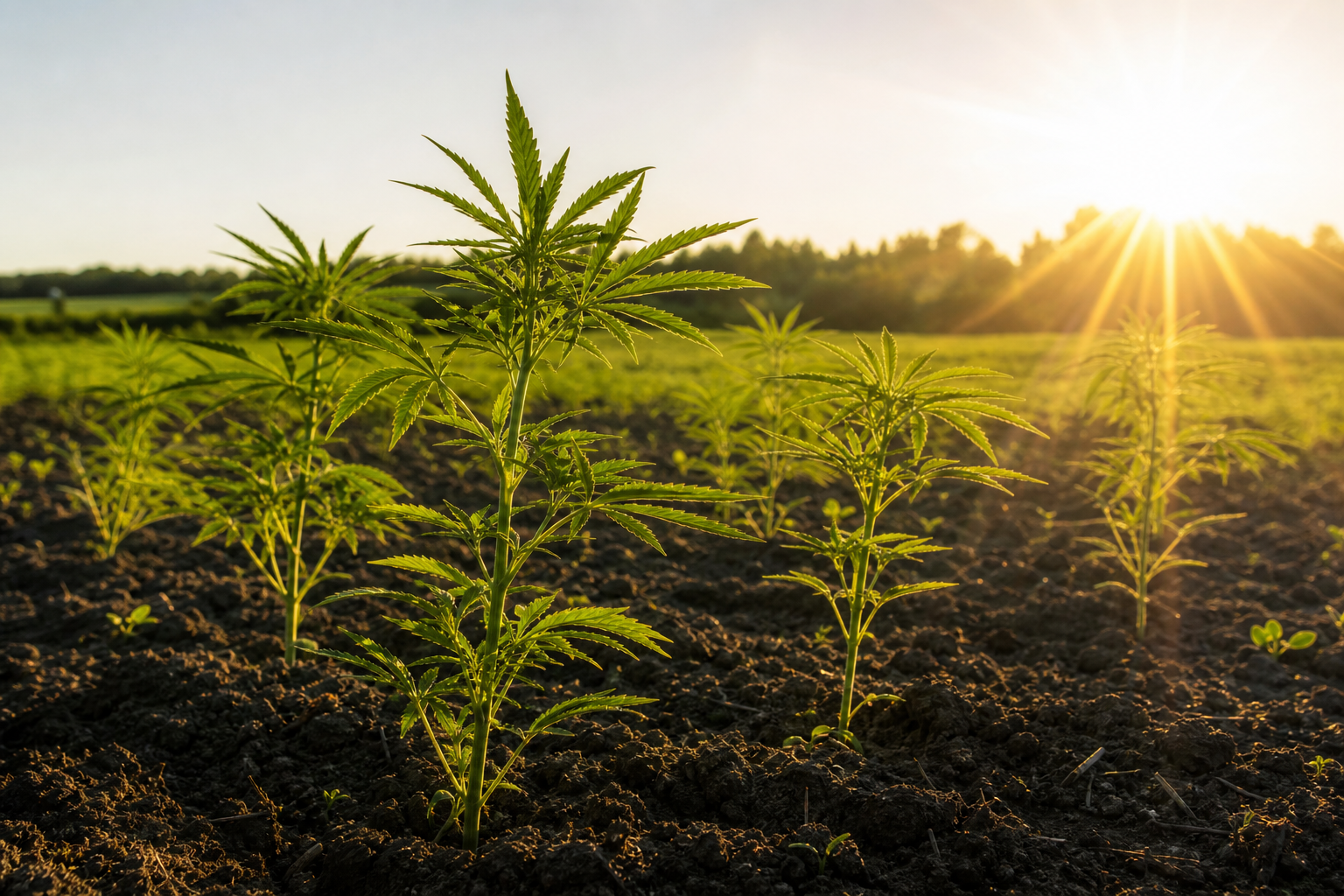
Outdoor cannabis runs on free solar power. The sun provides all the light plants need. Natural airflow handles ventilation. Rain and soil moisture reduce irrigation demands. When outdoor farms do use electricity—mainly for drying and curing—it is a fraction of what indoor operations consume.
A 2024 NIH PMC life-cycle assessment study (PMC11253875) confirmed outdoor production can be 50 times less carbon-emitting than indoor cultivation. Transport added less than 10% to outdoor's total footprint because freight trucks hauling compact, dried flower are efficient compared to keeping lights on for months.
How Cannabis and Hemp Capture Carbon #
Hemp plants sequester approximately 1.3 to 6 tons of CO₂ per acre annually through biomass growth, with additional carbon stored in soil through regenerative practices. This makes hemp one of the most efficient carbon-capturing crops available.
Above-Ground Carbon Capture #
Plants are nature's carbon vacuums. They breathe in CO₂ and breathe out oxygen through photosynthesis. The carbon gets locked into stems, leaves, flowers, and roots. Hemp is especially hungry for carbon because it grows fast and tall—some varieties reach 15 feet in a single season.
Research from Portland State University's 2022 hemp review estimated industrial hemp captures 3.15 to 3.68 metric tons of CO₂ per hectare per year. Converted to acres (1 hectare = 2.47 acres), that's roughly 1.28 to 1.49 tons of CO₂ per acre annually just from the harvested biomass.
Other studies put the number higher. The Axfoundation hemp carbon sequestration project reported hemp plantations sequester 10 to 15 metric tons of CO₂ per hectare annually—about 4 to 6 tons per acre. The range reflects different growing conditions, hemp varieties, and whether researchers count just the stalk or the whole plant.
Below-Ground Carbon Storage #
The real magic happens underground. Plant roots pump carbon-rich sugars into the soil to feed microbes. When those microbes die, some of that carbon stays trapped in soil organic matter. Regenerative practices maximize this process.
An SDSU Extension study on managing soil carbon storage found no-till farming increased soil organic carbon by 7% after 23 years in the top foot of soil. That might sound modest, but spread across hundreds of acres over decades, it adds up to serious carbon storage. Some estimates suggest well-managed soil can sequester an additional 1 ton of CO₂ per acre annually beyond what the plant biomass captures.
| Carbon Storage Method | Tons CO₂ per Acre per Year | Timeframe | Notes |
|---|---|---|---|
| Hemp biomass (conservative) | 1.3–1.5 | Annual | Based on 2.3 tons/hectare yield (Portland State) |
| Hemp biomass (optimistic) | 4–6 | Annual | High-yield varieties, ideal conditions (Axfoundation) |
| Soil carbon (no-till) | ~1 | Annual | Long-term accumulation, varies by soil type |
| Total potential | 2.3–7 | Annual | Combined biomass + soil storage |
Data sources: Portland State University 2022; Axfoundation 2026; SDSU Extension 2025
Regenerative Practices That Lock Carbon in Soil #
Regenerative cannabis farming uses cover crops, no-till methods, and living soil to capture and store atmospheric carbon while building healthier, more productive farmland. These practices work together to turn farms into carbon sinks rather than carbon sources.
Cover Crops: Living Carbon Sponges #
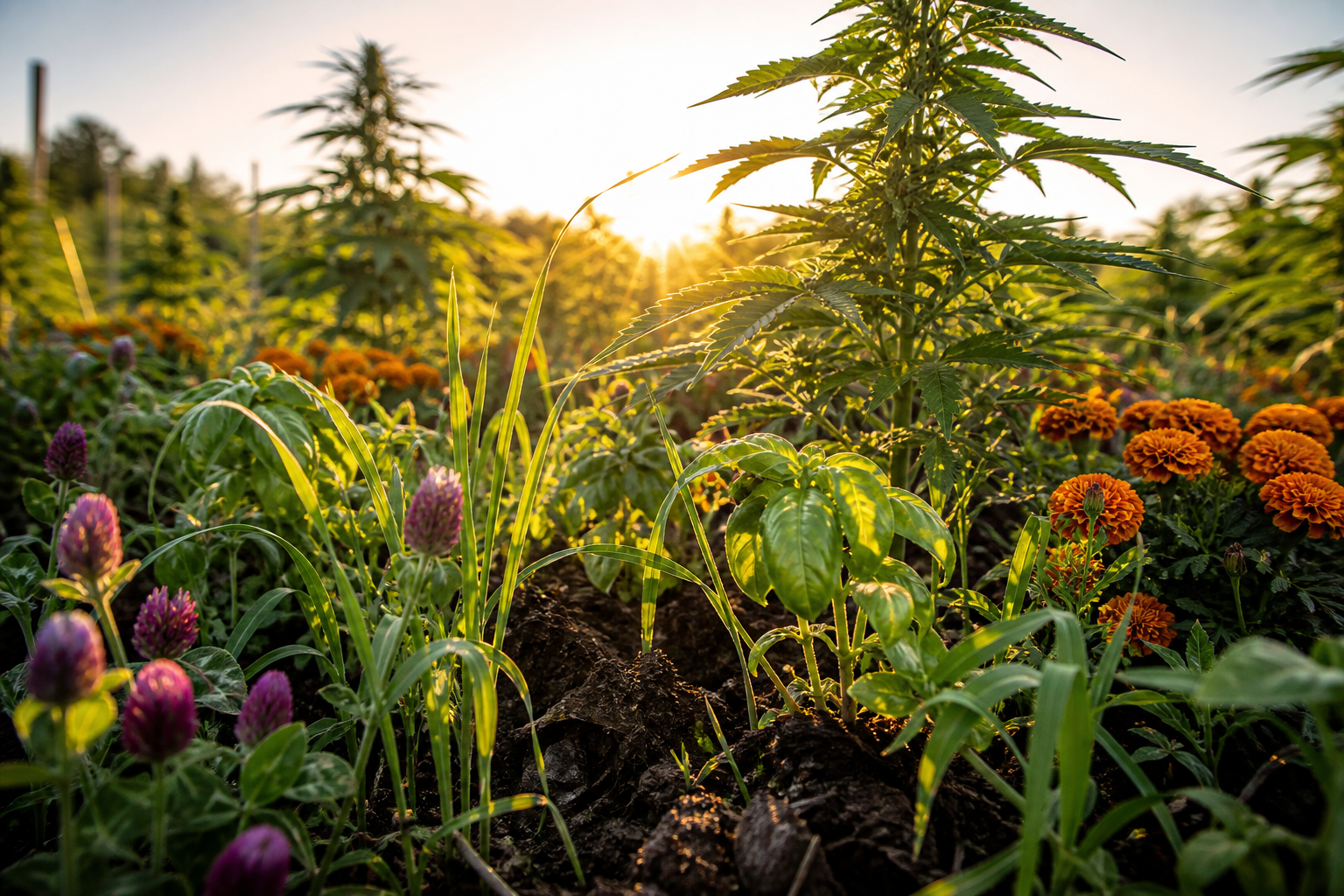
Cover crops are plants grown between cannabis seasons—not for harvest, but to protect and feed the soil. Clover, vetch, rye, and buckwheat are common choices. They photosynthesize continuously, pulling carbon from the air even when cannabis isn't growing.
Research from the University of Nebraska on cover crops and carbon sequestration estimates cover crops sequester about 0.22 tons of carbon per acre per year—roughly 0.8 tons of CO₂ when converted. Legumes like clover and vetch add nitrogen too, reducing the need for synthetic fertilizers that carry their own carbon footprint.
A Penn State study on mixed cover crops and carbon capture found mixed cover crop species capture more carbon than single-species plantings. The diversity above ground feeds diversity below ground, creating richer, more stable soil carbon.
For cannabis farmers, cover crops mean:
- Carbon capture during off-seasons when main crops aren't growing
- Natural nitrogen fixation that replaces synthetic fertilizer
- Soil protection from erosion and temperature extremes
- Pest management by hosting beneficial insects
Learn more about cover crops in our complete guide →
No-Till Farming: Leaving Carbon Undisturbed #
Conventional farming tears up soil with tractors and plows. This releases stored carbon as CO₂—like opening a sealed container. No-till farming never disturbs the soil structure, keeping carbon locked underground.
Every time soil is tilled, millions of microbes get exposed to oxygen. They decompose rapidly, releasing carbon. No-till prevents this death spiral. Roots stay intact. Fungal networks remain connected. Carbon keeps accumulating year after year.
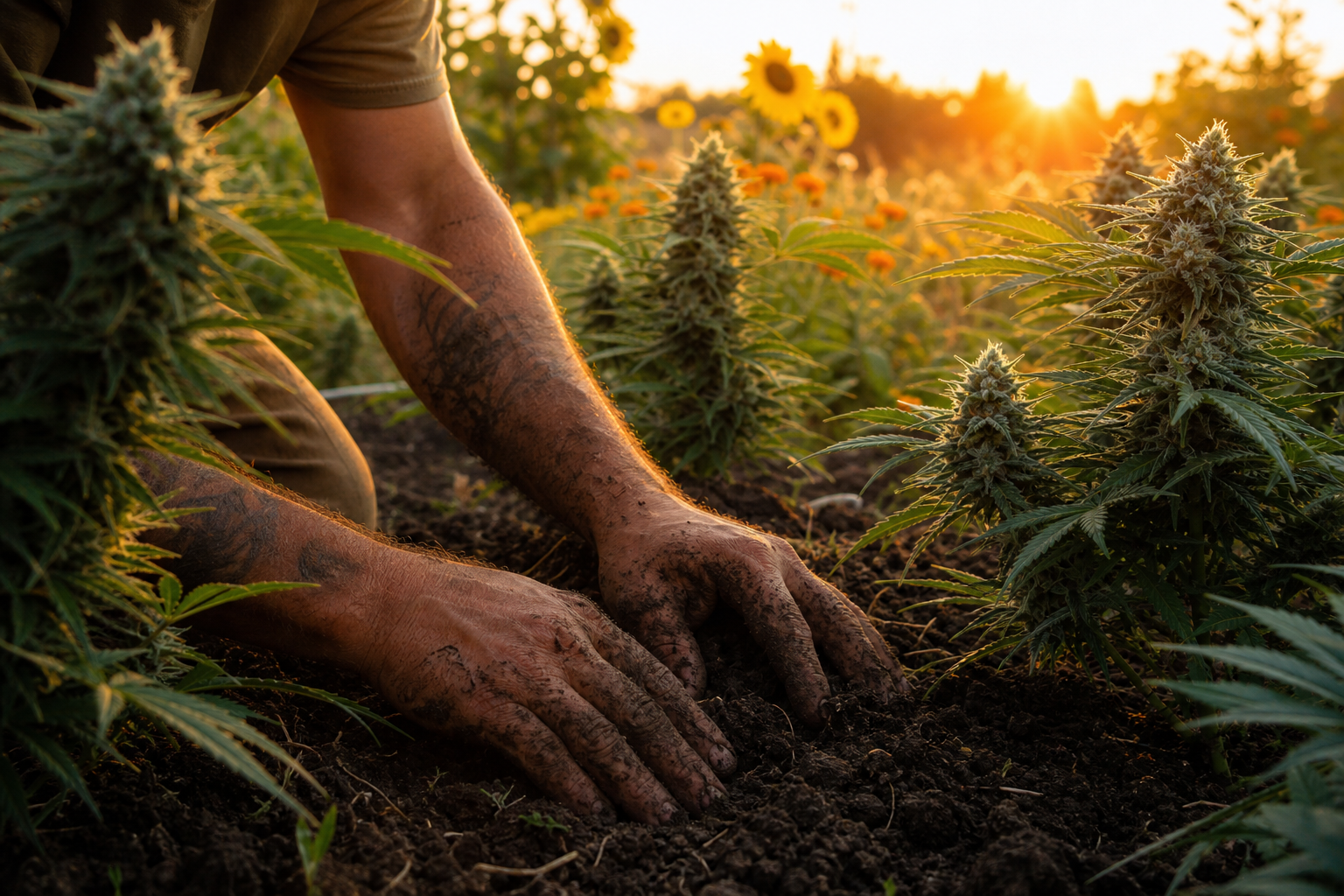
For cannabis specifically, no-till living soil systems create self-sustaining ecosystems. Soil isn't replaced between grows—it just keeps getting better. This matches how cannabis evolved: as a perennial plant in undisturbed soil, not an annual yanked from pots every few months.
The SDSU Extension research on managing soil carbon confirms: farms that stopped tilling saw soil carbon rise steadily over two decades. The gains were strongest in the top layers where roots and microbes interact most actively.
Read about living soil systems →
Living Soil: The Underground Carbon Economy #
Living soil is exactly what it sounds like—soil teeming with bacteria, fungi, worms, and microorganisms. These creatures are the workers of carbon sequestration. Plants feed them sugars. They process organic matter. Some carbon gets respired back as CO₂, but much gets converted into stable compounds that resist decomposition.
Compost, worm castings, and mulch feed this underground economy. Every addition of organic matter is a carbon deposit. Over seasons, these deposits compound into substantial soil carbon banks.
The best part? Living soil gets more productive as carbon increases. Higher organic matter holds more water, needs less irrigation, and supports healthier plants. It is a positive feedback loop: healthy soil grows better cannabis, which feeds more carbon into the soil, which grows even better cannabis.
Hemp vs. Cannabis: Different Carbon Profiles #
Hemp and high-THC cannabis are the same plant species (Cannabis sativa), but their carbon profiles differ because hemp is grown for biomass while cannabis is grown for flower. Understanding this distinction matters for climate impact claims.
Hempcrete and Long-Term Carbon Storage #
Hemp grown for fiber and hurd (the woody core of the stalk) can become hempcrete—a building material that locks carbon in walls for decades or centuries. When hemp is mixed with lime to make hempcrete, the carbon stays put as long as the building stands. This creates a true carbon sink.
Some researchers call hemp "carbon negative" in this context because the carbon removed from the atmosphere exceeds what the farming and processing emit. But this label only applies to specific end uses like hempcrete or biochar, not to all hemp farming.
Cannabis Flower Production Reality #
High-THC cannabis grown for smoking or vaping has a tougher climate profile. The flower is the product, not the stalk. After harvest, most plant biomass gets composted or discarded—releasing carbon back to the atmosphere within months or years. Only the roots remain in the ground, continuing to sequester a fraction of the plant's captured carbon.
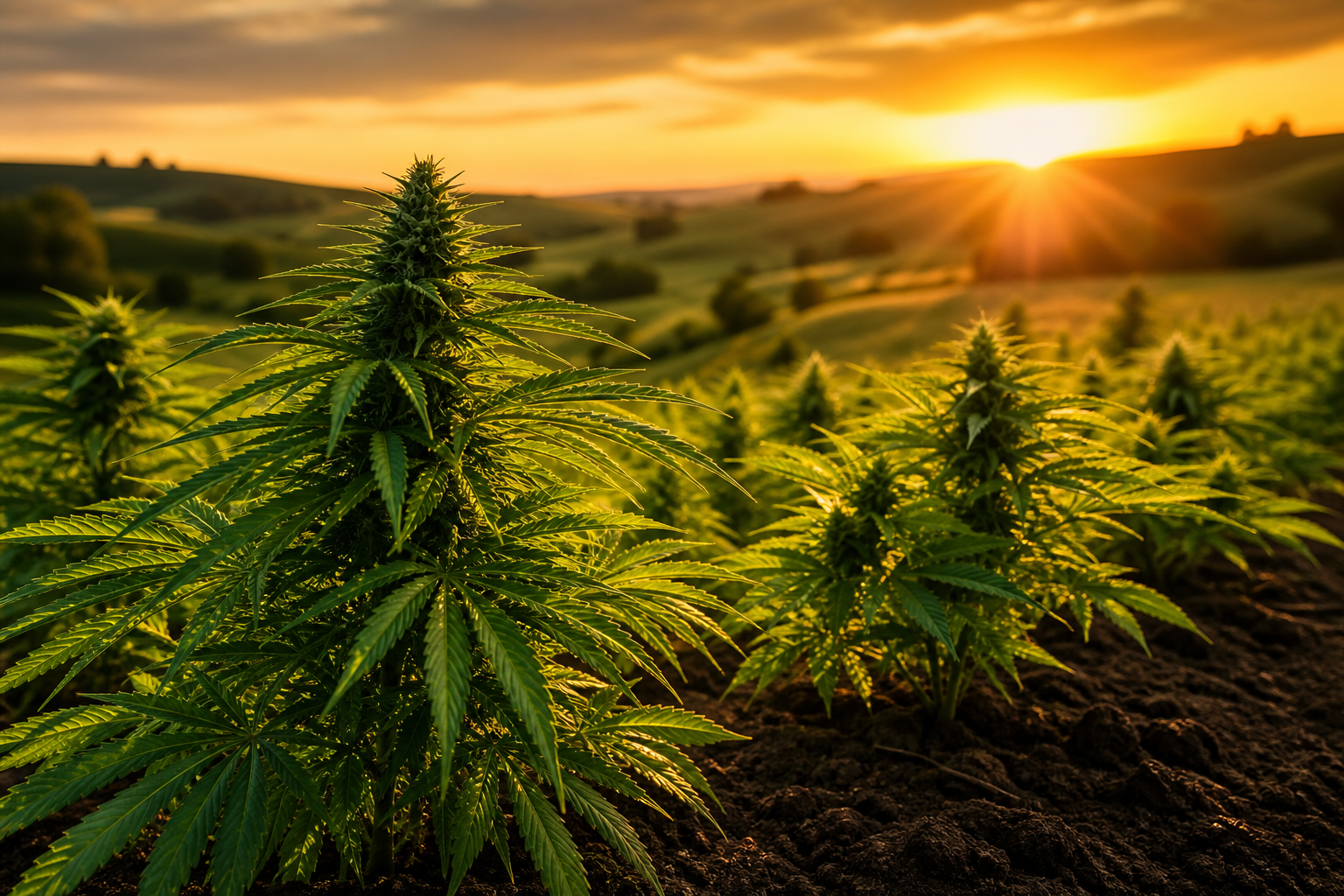
This is why growing method matters so much for cannabis. If you cannot store carbon in the final product (like hempcrete walls), you must store it in the soil through regenerative practices. Sun-grown, no-till, cover-cropped cannabis farms can approach carbon-neutral or even carbon-negative operations. Indoor warehouse grows never will.
Indoor vs. Greenhouse vs. Sun-Grown: The Full Comparison #
Sun-grown outdoor cannabis produces 20 to 50 times less CO₂ than indoor cultivation, while greenhouse growing falls somewhere in between depending on climate and equipment. Your choice of cannabis directly impacts the planet.
Indoor: The Carbon Heavyweight #
Indoor facilities can generate 5.5 tons of CO₂-equivalent per kilogram of dried flower according to ACS Axial 2024 research on outdoor cannabis cultivation. That is roughly the same emissions as:
- Burning 600 gallons of gasoline
- A round-trip flight from Detroit to London
- Driving the average car for 15,000 miles
The reasons are simple physics. High-intensity discharge (HID) or LED lights generate heat. That heat must be removed with air conditioning. Dehumidifiers pull moisture from the air. All this equipment runs constantly for months per grow cycle.
Even "efficient" indoor grows using LED lights still require massive HVAC systems. LEDs produce less heat than old metal halide bulbs, but they still add warmth to enclosed spaces. And plants themselves release moisture that must be controlled to prevent mold.
Greenhouse: The Middle Ground #
Greenhouses capture solar heat and light, reducing energy needs. In sunny climates like Southern California, a well-designed greenhouse might need minimal supplemental lighting. In Michigan winters, the same structure requires serious heating and lighting for part of the year.
The carbon footprint of greenhouse cannabis varies widely:
- Passive greenhouses (minimal heating/lighting): Close to outdoor emissions
- Active greenhouses (full climate control): Approach indoor emissions
- Hybrid light-deprivation greenhouses: Use blackout systems to control flowering with some supplemental lighting—moderate emissions
Greenhouse growing can be a reasonable middle path in regions with strong seasons, but it is not automatically low-carbon. The equipment and energy sources matter more than the building type.
Sun-Grown Outdoor: Nature's Way #
Outdoor cannabis uses zero electricity for lighting. Rain provides much of the water. Natural wind handles ventilation. The carbon footprint comes mainly from:
- Fertilizer production and transport (10–30% of emissions)
- Drying and curing electricity (varies by method)
- Transport to market (under 10% of total)
A 2024 NIH PMC life-cycle assessment (PMC11253875) measured outdoor cannabis at 61.8 to 110.7 kg CO₂-equivalent per kilogram of dried flower. Even the high end of this range is tiny compared to indoor production.
The environmental tradeoff is land use. Outdoor farms need more physical space than stacked indoor grows. But cannabis is a high-value crop, so farmers can earn good returns on modest acreage. Well-managed outdoor farms also support biodiversity, pollinators, and soil health—ecosystem services that indoor warehouses provide none of.
| Factor | Indoor | Greenhouse | Sun-Grown Outdoor |
|---|---|---|---|
| Energy use | 2,000–3,000+ kWh/lb | 500–2,000 kWh/lb (varies) | Near zero for lighting |
| CO₂ per kg flower | 2,500–5,000 kg | 500–2,000 kg | 62–111 kg |
| Primary emission source | Electricity (HVAC, lights) | Mixed (lighting + heating) | Fertilizer, drying |
| Terpene diversity | Lower (controlled environment) | Moderate | Higher (natural stressors) |
| Soil carbon impact | None (containerized) | Minimal | Positive (can sequester carbon) |
| Biodiversity support | None | Minimal | High (habitat for beneficial insects) |
| Water efficiency | High (recirculating systems possible) | Moderate | Lower (but rain-fed possible) |
Sources: PMC NIH 2024 (PMC11253875); Colorado State University 2021; ACS Axial 2024; Fresh Bros 2025
Explore sun-grown benefits in our pillar guide →
Can Cannabis Farming Reverse Climate Change? #
Cannabis and hemp farming alone cannot reverse climate change, but regenerative cultivation practices can significantly reduce agriculture's carbon footprint while producing food, fiber, and medicine. The key is honest accounting about what these crops can and cannot do.
What Hemp Can Do #
Industrial hemp shows real promise as part of climate solutions:
- Rapid carbon capture: Fast growth means fast CO₂ uptake
- Biomass for biochar: Converting hemp stalks to biochar locks carbon in soil for centuries
- Hempcrete construction: Building materials that store carbon for decades
- Soil remediation: Hemp cleans contaminated soil (phytoremediation) while sequestering carbon
- Crop rotation benefits: Breaking pest cycles and improving soil for subsequent food crops
When hemp is processed into durable goods—especially hempcrete—the carbon stays out of the atmosphere for the product's lifespan. A hempcrete wall built today might hold carbon for 50 to 100 years. That is meaningful climate action, but it is not enough by itself.
What Cannabis Flower Cannot Do #
Smokable cannabis flower is a consumable product, not a durable good. The carbon captured during growth gets released back when the plant matter burns or decomposes. The climate benefit comes from:
- How it was grown (sun-grown vs. indoor)
- What practices built the soil (cover crops, no-till, compost)
- How long soil carbon stays stored (decades in healthy soil)
Even the most regenerative cannabis farm only sequesters a few tons of CO₂ per acre. The United States emits over 5 billion tons annually. Cannabis farming is a drop in that bucket—but it is a drop that moves in the right direction while conventional agriculture often moves backward.
The Honest Bottom Line #
No single crop can reverse climate change. The solution requires systemic transformation across energy, transport, industry, and agriculture. But regenerative cannabis farming demonstrates what sustainable agriculture looks like:
- Working with natural cycles instead of against them
- Building soil instead of depleting it
- Capturing carbon instead of emitting it
- Supporting ecosystems instead of sterilizing them
When you choose sun-grown, organic, regenerative cannabis, you vote for this model with your wallet. You support farms that heal the earth while producing clean medicine. That matters, even if it cannot save the planet alone.
How to Spot Truly Eco-Friendly Cannabis #
Look for sun-grown, organic or Sun+Earth certified cannabis from farms using living soil, cover crops, and no-till practices. These labels actually mean something in an industry full of greenwashing.
What to Ask Your Budtender #
- "Is this sun-grown or indoor?" Sun-grown has the lower carbon footprint
- "Do you know if the farm uses living soil?" Living soil farms sequester carbon
- "Is this Sun+Earth certified?" The gold standard for regenerative cannabis
- "Where was this grown?" Local = less transport emissions
- "Does the farm use cover crops or no-till methods?" These practices build soil carbon
Red Flags to Avoid #
- "Energy efficient indoor" - Still uses massive electricity
- **Vague "sustainable" claims without specifics
- Plastic packaging - Contradicts environmental claims
- No information about growing method
- Lab results that show pesticide residue - Synthetic chemicals harm soil life
The Price Question #
Sun-grown organic cannabis sometimes costs more than warehouse weed. That price reflects:
- Real estate for outdoor land vs. cheaper warehouse rentals
- Living soil inputs (compost, amendments) vs. bottled synthetic nutrients
- Seasonal harvests vs. year-round indoor production
- Slower, more careful curing processes
But the true cost comparison includes what you are not paying for: the carbon emissions, soil depletion, and ecosystem damage of industrial growing. When you choose regenerative cannabis, you invest in farms that will still be fertile in 50 years.
Read more about Sun+Earth certification →
FAQ: Cannabis, Carbon, and Climate #
Q: Is cannabis farming bad for the environment? #
A: Indoor cannabis farming creates significant emissions, but sun-grown regenerative cannabis can actually help the environment by sequestering carbon in soil. The 2024 NIH study found outdoor cannabis produces 50 times less CO₂ than indoor. When grown using cover crops, no-till methods, and living soil, cannabis farms become carbon sinks rather than carbon sources.
Q: How much carbon does one cannabis plant absorb? #
A: A single cannabis plant absorbs roughly 10 to 20 pounds of CO₂ during its lifecycle, but most of that carbon returns to the atmosphere when the plant is harvested, dried, and consumed. Only a fraction remains sequestered—mainly in the roots and any soil organic matter built up through regenerative practices. Hemp plants grown for fiber capture more carbon per plant because they grow larger and the stalk becomes durable products.
Q: What's the difference between hemp and cannabis for carbon sequestration? #
A: Hemp sequesters 1.3 to 6 tons of CO₂ per acre annually through biomass, and when processed into hempcrete, that carbon stays stored for decades. High-THC cannabis sequesters similar amounts during growth, but the carbon is released when flower is consumed. Hemp's advantage comes from durable end products that lock carbon away long-term, not from the plant itself being different.
Q: Does indoor growing create more emissions than outdoor? #
A: Yes—indoor cannabis produces 20 to 50 times more CO₂ per pound than outdoor sun-grown cannabis. Indoor facilities use 2,000 to 3,000 kWh of electricity per pound of flower for lighting, HVAC, and dehumidification. Outdoor cannabis runs on free sunlight with minimal electrical needs. A Colorado State analysis found indoor grows produce 143 to 324 pounds of CO₂ per ounce of flower depending on local electricity sources.
Q: Can cannabis farming actually help fight climate change? #
A: Cannabis farming alone cannot reverse climate change, but regenerative practices significantly reduce agriculture's carbon footprint. Well-managed hemp operations sequester 2 to 7 tons of CO₂ per acre annually through biomass and soil storage. When scaled across thousands of acres and combined with durable products like hempcrete, this becomes meaningful climate action—though still just one piece of a much larger puzzle.
Q: What are cover crops and why do they matter? #
A: Cover crops are plants grown between main crops to protect soil, capture carbon, and feed beneficial insects—sequestering about 0.8 tons of CO₂ per acre annually. Common cover crops for cannabis farms include clover, vetch, rye, and buckwheat. They photosynthesize during off-seasons when cannabis isn't growing, continuously pulling carbon from the atmosphere while improving soil health and reducing erosion.
Q: How does no-till farming store carbon in soil? #
A: No-till farming keeps soil undisturbed, preventing carbon from oxidizing and escaping as CO₂—building soil organic carbon up to 7% over 23 years. Every time soil is plowed, millions of soil microbes decompose rapidly, releasing stored carbon. No-till maintains soil structure, preserves fungal networks, and allows continuous carbon accumulation year after year instead of regular carbon loss events.
Q: Is sun-grown cannabis really better for the planet? #
A: Yes—sun-grown outdoor cannabis produces 62 to 111 kg CO₂ per kg of flower compared to 2,500 to 5,000 kg for indoor, making it 20 to 50 times more climate-friendly. Sun-grown also supports biodiversity, builds soil health, and avoids the massive electricity consumption that makes indoor growing so carbon-intensive. The tradeoff is seasonal availability and larger land footprint, but for climate impact, sun-grown wins decisively.
Q: What is hempcrete and how does it store carbon? #
A: Hempcrete is a building material made from hemp hurd and lime that locks carbon in walls for 50 to 100 years or longer. When hemp stalks are mixed with lime, the carbon captured during growth stays stored in the building structure. This makes hempcrete a true carbon sink—unlike burning or composting hemp, which releases carbon back to the atmosphere within months or years.
Q: How can I choose eco-friendly cannabis products? #
A: Choose sun-grown, organic or Sun+Earth certified cannabis from local farms using regenerative practices like living soil, cover crops, and no-till cultivation. Ask your budtender about growing methods. Avoid products with excessive plastic packaging. Support farms that are transparent about their practices. Remember: "energy efficient indoor" is still high-emission compared to sun-grown.
Q: Do cover crops really make a difference for carbon capture? #
A: Yes—cover crops sequester approximately 0.8 tons of CO₂ per acre annually while improving soil health and reducing the need for synthetic fertilizers. A Penn State study found mixed-species cover crops capture more carbon than single-species plantings. For cannabis farms, cover crops mean continuous carbon capture even during off-seasons when main crops aren't growing.
Q: How long does soil carbon stay stored? #
A: Carbon stored in healthy soil through regenerative practices can remain sequestered for decades to centuries depending on soil type, climate, and management. Stable soil organic matter resists decomposition. No-till farming, perennial cover crops, and high organic matter inputs all extend carbon storage time. Disturbing soil through tilling or development releases stored carbon, which is why long-term regenerative management matters.
Q: What is biochar and how does it relate to cannabis farming? #
A: Biochar is a charcoal-like material made by burning plant matter in low-oxygen conditions, and it can lock carbon in soil for hundreds of years while improving water retention and fertility. Cannabis stalks and trim waste make excellent biochar feedstock. When farmers convert waste biomass to biochar instead of composting or landfilling, they create a permanent carbon sink. Adding biochar to soil also improves structure, water retention, and nutrient availability—benefits that persist for centuries.
Q: Why does indoor cannabis create so much more carbon than outdoor? #
A: Indoor cannabis requires artificial lighting, HVAC systems, dehumidifiers, and CO₂ enrichment that run 12 to 18 hours daily for months, consuming 2,000 to 3,000 kWh per pound of flower. All that electricity comes from power grids, most of which still burn fossil fuels. The 2024 NIH study found indoor production creates 2,500 to 5,000 kg of CO₂ per kg of flower. Outdoor cannabis uses free sunlight for energy and natural wind for ventilation, cutting emissions by 95% or more.
Regenerative Agriculture: Bigger Than Cannabis #
The practices that make cannabis farming sustainable—cover crops, no-till, living soil, biodiversity—are part of a global movement to transform agriculture from a climate problem into a climate solution. Regenerative agriculture goes beyond "do less harm" to actively heal ecosystems.
From Extractive to Regenerative #
Industrial agriculture extracts: it mines soil nutrients, burns fossil fuels, and treats farms like factories. After decades of this approach, over one-third of Earth's arable land has degraded. Topsoil—the foundation of food production—disappears 10 to 40 times faster than it regenerates naturally.
Regenerative agriculture reverses this damage by:
- Building soil organic matter rather than depleting it
- Sequestering carbon rather than emitting it
- Supporting biodiversity rather than monocultures
- Capturing and holding water rather than causing runoff
- Reducing synthetic inputs rather than depending on chemicals
Cannabis farmers have unique advantages in this movement. High-value crops justify labor-intensive practices. Small-scale operations can pivot faster than commodity farms. The cannabis community already values "craft" over mass production. These factors make cannabis an ideal testing ground for regenerative methods that can scale to other crops.
The 1% Solution #
Agriculture occupies about 40% of global land area. If every farm sequestered just 1 ton of CO₂ per acre annually—the low end of what regenerative practices achieve—that would remove billions of tons of carbon from the atmosphere. Combined with emissions reductions in energy and transport, regenerative farming becomes part of a viable climate solution.
Cannabis will not save the planet alone. But cannabis farmers demonstrating profitable, regenerative, carbon-sequestering operations prove that healing the earth and running a business are not opposing goals. They are the same goal done right.
Practical Steps for Regenerative Transitions #
Farmers interested in shifting toward carbon-sequestering operations can start with these fundamentals:
| Step | Action | Timeline | Carbon Impact |
|---|---|---|---|
| 1. Stop tilling | Convert to no-till beds or living soil pots | Immediate | Prevents carbon release, builds soil over time |
| 2. Add cover crops | Plant clover, vetch, or rye between seasons | Next planting cycle | Continuous carbon capture, nitrogen fixation |
| 3. Build compost systems | Convert waste to soil amendments | 3–6 months to first batch | Reduces inputs, adds organic matter |
| 4. Diversify plantings | Add companion plants, hedgerows | Next season | Supports pollinators, builds ecosystem |
| 5. Reduce synthetic inputs | Replace with organic amendments | Gradual transition | Protects soil biology, reduces petrochemicals |
| 6. Water smart | Install drip irrigation, capture rainwater | 1 season | Reduces pumping energy, supports consistent growth |
None of these changes require massive upfront investment. They require attention, patience, and a willingness to work with natural systems instead of fighting them. The carbon benefits accumulate year over year as soil organic matter builds and ecosystems mature.
The Bottom Line: Farm with the Future in Mind #
Regenerative cannabis farming shows that agriculture can heal the earth while producing exceptional medicine. The numbers don't lie: sun-grown beats indoor on carbon. Cover crops and no-till build soil carbon. Living soil creates self-sustaining ecosystems.
At Divine Toke, we grow our cannabis under the Michigan sun in living soil enriched with compost and cover crops. We never till—preserving the fungal networks and soil structure that store carbon. Our regenerative farming process prioritizes the planet alongside potency.
If you are curious to try cannabis grown the way nature intended, explore our sun-grown organic flower. Every bowl, joint, or edible made from regenerative cannabis carries a smaller carbon footprint—and supports farms building soil for the next generation.
This article is for educational purposes only and is not medical advice. Always consult your healthcare provider before starting any new wellness routine.
Related Reading: