Water: The Invisible Ingredient in Your Weed

Jamie
Head Cultivator
Water is the silent partner in every cannabis plant's life. It carries nutrients from soil to bud. It shapes how those aromatic terpenes develop. It even determines whether your smoke burns smooth or harsh. Yet most consumers never think about the water that fed their weed. At Divine Toke, water stewardship isn't an afterthought—it's central to how we grow sun-grown organic cannabis that actually delivers on its promise.
How Water Quality Changes What You Smoke #
Clean, balanced water directly affects cannabinoid production, terpene expression, and overall plant health. Poor water quality can lock out nutrients, stress the root system, and reduce both yield and quality. A 2021 review in PMC found that cannabis is particularly water-intensive and sensitive to irrigation quality, with both indoor and outdoor cultivation requiring careful water management to avoid negative impacts.
When water contains excess salts, chlorine, or minerals at the wrong pH, the plant struggles to absorb the nutrients it needs. This creates what growers call "nutrient lockout"—the fertilizer is in the soil, but the plant can't take it up. The result is weaker plants with less potent flower and fewer of those aromatic compounds that make each strain unique.
| Water Problem | What Happens to the Plant | What You Notice in the Flower |
|---|---|---|
| High chlorine/chloramines | Kills beneficial soil microbes | Less complex aroma, flatter taste |
| High pH (alkaline) | Iron, zinc, manganese lockout | Yellowing leaves, weaker growth |
| Low pH (acidic) | Calcium, magnesium lockout | Brown spots, brittle tissue |
| High dissolved salts | Osmotic stress, root damage | Smaller buds, reduced resin |
| Hard water minerals | Calcium buildup in soil | pH drift, nutrient imbalance |
The connection between water and your experience isn't theoretical. Research from Blimburn Seeds shows that water stress triggers the plant's defense systems—which can actually increase terpene production in controlled doses. But there's a fine line between beneficial stress and harmful damage. Poor water quality pushes plants past that line into decline rather than enhancement.
At Divine Toke, we monitor our irrigation water constantly because we know it ends up in the final product—not chemically, but in the plant's expression of its genetics. When you smoke our sun-grown organic flower, you're experiencing the result of water that was balanced, clean, and alive.
The pH Sweet Spot: Why Acidity Matters #
The ideal pH range for cannabis irrigation water is 5.5 to 7.0. Values outside this range block nutrient uptake even if those nutrients are present in the soil. According to RX Green Technologies, water above pH 8.5 or below 5.5 significantly increases the risk of nutrient-availability problems that stunt growth and reduce yield.
pH measures how acidic or alkaline a solution is on a scale from 0 to 14. Pure water is neutral at 7.0. Most tap water runs slightly alkaline, between 7.5 and 8.5, because municipalities add minerals to protect pipes. This might be good for infrastructure, but it's not ideal for cannabis roots.
Here's what happens at different pH levels:
Below 5.5 (too acidic): Calcium and magnesium become unavailable. The plant can't build strong cell walls. You'll see twisted new growth, brown spots on leaves, and weak stems that can't support heavy buds.
5.5 to 6.0 (slightly acidic): Best for hydroponic and soilless systems where there's no soil buffer. Cannabis in coco coir or rockwool thrives here because there's nothing between the roots and the water to stabilize pH.
6.0 to 7.0 (the sweet spot): Ideal for soil-grown plants. The soil itself buffers minor pH swings, and this range makes all major nutrients available. Most organic living soil operations—including ours at Divine Toke—target the upper end of this range.
Above 7.5 (too alkaline): Iron, zinc, copper, and manganese lock out. New growth turns yellow while veins stay green. The plant looks hungry despite being fed.
In soil-based cultivation like we practice with our living soil approach, the earth itself provides some pH buffering. The organic matter, beneficial microbes, and mineral content help stabilize the root zone. But that doesn't mean we ignore water pH—we start with balanced water so the soil's buffering capacity isn't exhausted fighting poor inputs.
Testing pH is simple and cheap. Digital pH pens cost under $20 and last for years. Test your water before adding nutrients, after mixing nutrients, and check your runoff periodically to see what's happening in the root zone. Small adjustments now prevent big problems at harvest.
EC and Salts: When Water Works Against Your Plant #
Electrical conductivity (EC) measures how much dissolved salt is in your water, and cannabis is sensitive to salt buildup above about 0.4 EC in hydroponic systems. EC is measured in millisiemens per centimeter (mS/cm), and it tells you the total dissolved solids (TDS) in your water—including both beneficial minerals and harmful contaminants.
Salt might not sound scary, but to a cannabis plant, it's an osmotic threat. Water naturally moves from areas of low salt concentration to high salt concentration. When the water outside the roots has more salt than the water inside the roots, the plant loses moisture trying to balance the equation. It's like being thirsty while surrounded by ocean water—you can't drink it, and it actually pulls moisture out of you.
Dutch Passion research confirms that hard water with high calcium and magnesium can complicate nutrient programs. These aren't bad minerals—they're essential for plant health—but when they come from water in unpredictable amounts, they throw off the carefully balanced fertilizer ratios you're trying to maintain.
| Water Source | Typical EC Range | Common Issues |
|---|---|---|
| Reverse osmosis (RO) | 0.0 – 0.1 | Too pure; needs calcium/magnesium added |
| Rainwater | 0.0 – 0.3 | Generally excellent; test for pollutants |
| Tap water (soft) | 0.2 – 0.5 | Usually workable; check for chlorine |
| Tap water (hard) | 0.5 – 1.5 | High calcium/magnesium; may need treatment |
| Well water | 0.3 – 2.0+ | Highly variable; test annually |
The University of California Berkeley Cannabis Research Center notes that water quality impacts from excess nutrients and agricultural runoff are a major concern in cannabis cultivation regions. High-EC water doesn't just hurt the plant directly—it can accumulate in soil over time, creating a toxic environment that requires flushing or soil replacement.
At Divine Toke, we use natural water sources that come in at moderate EC levels. Our living soil systems with organic matter and compost teas help buffer against salt accumulation. Beneficial microbes process and cycle nutrients in ways that prevent the buildup that plagues synthetic fertilizer programs. It's another reason regenerative farming practices produce cleaner, healthier cannabis.
Drought Stress vs. Overwatering: Finding the Balance #
Controlled drought stress during late flowering can increase cannabinoid concentration by 12-13%, but overwatering consistently reduces both quality and yield. A University of Guelph study cited by Cannabis Business Times found that a single drought event during flowering increased THCA by 12% and CBDA by 13% compared to non-stressed controls. Yield per unit area increased even more dramatically—43% for THCA, 47% for CBDA, and 67% for CBD.
This phenomenon is called "controlled drought stress" or deficit irrigation. The plant, sensing water scarcity, ramps up production of protective compounds including cannabinoids and terpenes. It's a survival mechanism—when stressed, the plant invests more energy in chemical defense. Brothers Grimm Seeds explains this technique as a way to enhance both potency and flavor by carefully timing water restriction.
But timing is everything. The same research notes that drought stress during vegetative growth reduces yield rather than enhancing it. A stressed seedling won't recover fully. A stressed flowering plant, handled correctly, produces more concentrated medicine.
Overwatering has no such silver lining. When roots sit in waterlogged soil:
- Oxygen is displaced from root zone pore spaces
- Beneficial aerobic microbes die off
- Anaerobic bacteria take over, producing toxins
- Root rot pathogens thrive
- Nutrients leach away before roots can absorb them
The visual signs of overwatering are wilting (ironically, just like underwatering), yellowing lower leaves, and a general "sad" appearance that doesn't improve after watering. The cure is simple: water less, let the soil dry between irrigations, and ensure good drainage.
| Condition | When It Happens | Effect on Cannabinoids | Effect on Terpenes | Risk Level |
|---|---|---|---|---|
| Controlled drought | Late flowering only | Increases 12-67% | May increase | Low if timed right |
| Mild water stress | Vegetative/early flower | Slight reduction | Minimal change | Moderate |
| Overwatering | Any stage | Decreases | Decreases | High |
| Severe drought | Any stage | Decreases (plant survival mode) | Decreases | High |
At Divine Toke, we use deficit irrigation techniques selectively on certain genetics that respond well, always late in flower and always monitored closely. It's part of the craft that separates artisan sun-grown cannabis from mass-produced warehouse weed. Our regenerative farming approach includes water as a tool for quality, not just a necessity for survival.
From Tap to RO: Comparing Water Sources #
Reverse osmosis (RO) water gives growers the cleanest baseline but requires adding calcium and magnesium back in; tap water is convenient but often contains chlorine and variable mineral content that can harm soil biology. Each water source has tradeoffs, and the best choice depends on your cultivation style and local water quality.
According to Royal Queen Seeds, tap water's main problems for cannabis are high pH and compounds that can damage the grow—including chlorine, chloramines, fluoride, and volatile organic compounds (VOCs) depending on your municipality. These aren't just theoretical concerns. Chlorine kills beneficial microbes in living soil. Chloramines persist longer in soil than plain chlorine. Fluoride can accumulate to toxic levels over time.
Well water is unpredictable by nature. ModernCanna testing guidance warns that animal and human waste in source water can promote bacterial growth that compromises cannabis quality. Nitrates from upstream agriculture, heavy metals from geological formations, and bacterial contamination are all common well water issues that vary by location and season.
RO water solves most contamination problems by forcing water through a membrane that blocks dissolved solids. The result is near-zero EC water that's a blank slate for nutrient programs. But that purity is also a problem—RO water lacks the calcium and magnesium plants need for cell structure and enzyme function. Without supplementation, plants in RO water develop deficiencies even when you're feeding them perfectly.
Here's a practical comparison:
| Water Source | Pros | Cons | Best For |
|---|---|---|---|
| Tap water | Free, convenient, consistent year-round | Chlorine/chloramines, variable pH/minerals, potential fluoride | Large operations with good local water and dechlorination systems |
| Well water | No municipal additives, potentially mineral-rich | Highly variable, requires regular testing, contamination risk | Rural farms with clean aquifers and testing discipline |
| RO water | Clean, consistent, controllable | Removes beneficial minerals, requires re-mineralization, wastes water | Hydroponic systems, precision nutrient control |
| Rainwater | Free, naturally soft, no chlorine | Collection needed, inconsistent supply, potential air pollution | Supplemental use, sustainable operations |
| Spring water | Often mineral-balanced, clean | Expensive at scale, variable source quality | Small craft operations, premium markets |
At Divine Toke, we use a hybrid approach. Our main irrigation starts with high-quality natural water that's tested regularly. We adjust pH organically through soil biology rather than chemical inputs. For certain applications, we use filtered water to ensure consistency. It's more work than just turning on the tap, but the result is sun-grown flower that expresses its full genetic potential without chemical interference.
Water Activity: The Hidden Number That Protects Your Bud #
Water activity between 0.55 and 0.62 preserves cannabis quality; above 0.65, mold and microbial growth become serious risks. Water activity (a_w) measures how much moisture is available for biological reactions—not the total moisture content, but the "free" water that microbes can use to grow. It's a critical but often overlooked metric that determines both safety and quality.
According to AROYA.io's testing guide, water activity limits are used to maximize quality while minimizing terpene destruction. The science is clear: cannabis flower that is too dry loses volatile terpenes and cannabinoids through degradation and mechanical damage to trichomes. Flower that is too wet supports mold, yeast, and bacterial growth that can make consumers sick.
The key thresholds are:
Below 0.55: Too dry. Terpenes evaporate. Trichomes become brittle and break off. The smoke becomes harsh and the flavor dull. You've seen this in old, poorly stored weed that crumbles to dust.
0.55 to 0.62: The sweet spot. Mold can't grow. Terpenes stay intact. The cure continues slowly, improving smoothness and flavor. This is where premium craft cannabis lives.
0.62 to 0.65: The caution zone. Still generally safe, but requiring careful monitoring and proper storage conditions. Some producers target this range for specific markets.
Above 0.65: Danger zone. Mold risk increases exponentially. Many regulated markets use 0.65 as the legal cutoff for sale. Flower above this threshold fails testing and can't be sold.
Water activity is different from moisture content. Flower can have 12% moisture content and be safe (low water activity) or dangerous (high water activity) depending on how that water is bound within the plant material. Salt and sugar content, density, and structure all affect water activity independent of total moisture.
For consumers, water activity matters because it predicts:
- Mold risk: High a_w means potential for aspergillus and other harmful molds
- Shelf life: Proper a_w extends how long flower stays fresh
- Smoke quality: The right a_w burns smooth and even
- Terpene preservation: Properly dried and cured flower keeps its aroma
At Divine Toke, we monitor water activity throughout drying and curing, not just at harvest. Our slow-cured sun-grown flower hits that 0.55-0.62 window through patience, not forced drying with heat or desiccants. It's why our bud still smells loud months after harvest while rushed commercial cannabis goes stale in weeks.
How Much Water Does Cannabis Actually Need? #
Cannabis needs about 6 gallons (22.7 liters) per plant per day during peak growing season, but actual usage varies dramatically by growth stage, weather, and growing method. According to research published in PMC, cannabis water demand can be about twice that of conventional crops like maize, soybean, and wheat—making efficient irrigation critical for both environmental and economic reasons.
Water needs change throughout the plant's life:
Seedlings (Weeks 1-3): Start with about 2 cups (500ml) per plant, increasing gradually. Keep the soil consistently moist but never waterlogged. Seedlings have tiny root systems and can't handle drought or flooding. Premium Cultivars recommends about 500ml per plant initially, increasing to roughly 2 liters every 3 days by day 29.
Vegetative stage (Weeks 4-8+): Water when the top inch of soil is dry. A good rule is 5-10% of container volume per watering. For a 5-gallon pot, that's roughly 1-2 liters. Don't water on a schedule—water when the plant needs it. Lift the pot; if it feels light, it's time to water.
Flowering stage (Final 8-12 weeks): Peak water consumption happens here. Plants are larger, temperatures often higher, and evapotranspiration increases. But the pattern shifts to deeper, less frequent watering as roots mature. Many growers water to runoff to ensure even saturation and nutrient distribution.
| Growth Stage | Water Frequency | Amount per Plant | Key Principle |
|---|---|---|---|
| Seedling | Every 2-3 days | 500ml – 2 liters | Keep moist, never soaked |
| Early veg | Every 2-3 days | 1-2 liters | Water when top inch dries |
| Late veg | Every 2-3 days | 2-4 liters | Lift pot to check weight |
| Early flower | Every 1-2 days | 2-4 liters | Increased uptake begins |
| Peak flower | Daily in heat | 4-6+ liters | Highest demand period |
| Late flower/flush | Every 2-3 days | 2-3 liters | Tapering before harvest |
The Yuba River research summary notes that licensed cannabis farms in California's Humboldt and Mendocino counties used about one-tenth of household water on average—suggesting that while cannabis is water-intensive per plant, total regional impact depends on scale and cultivation area.
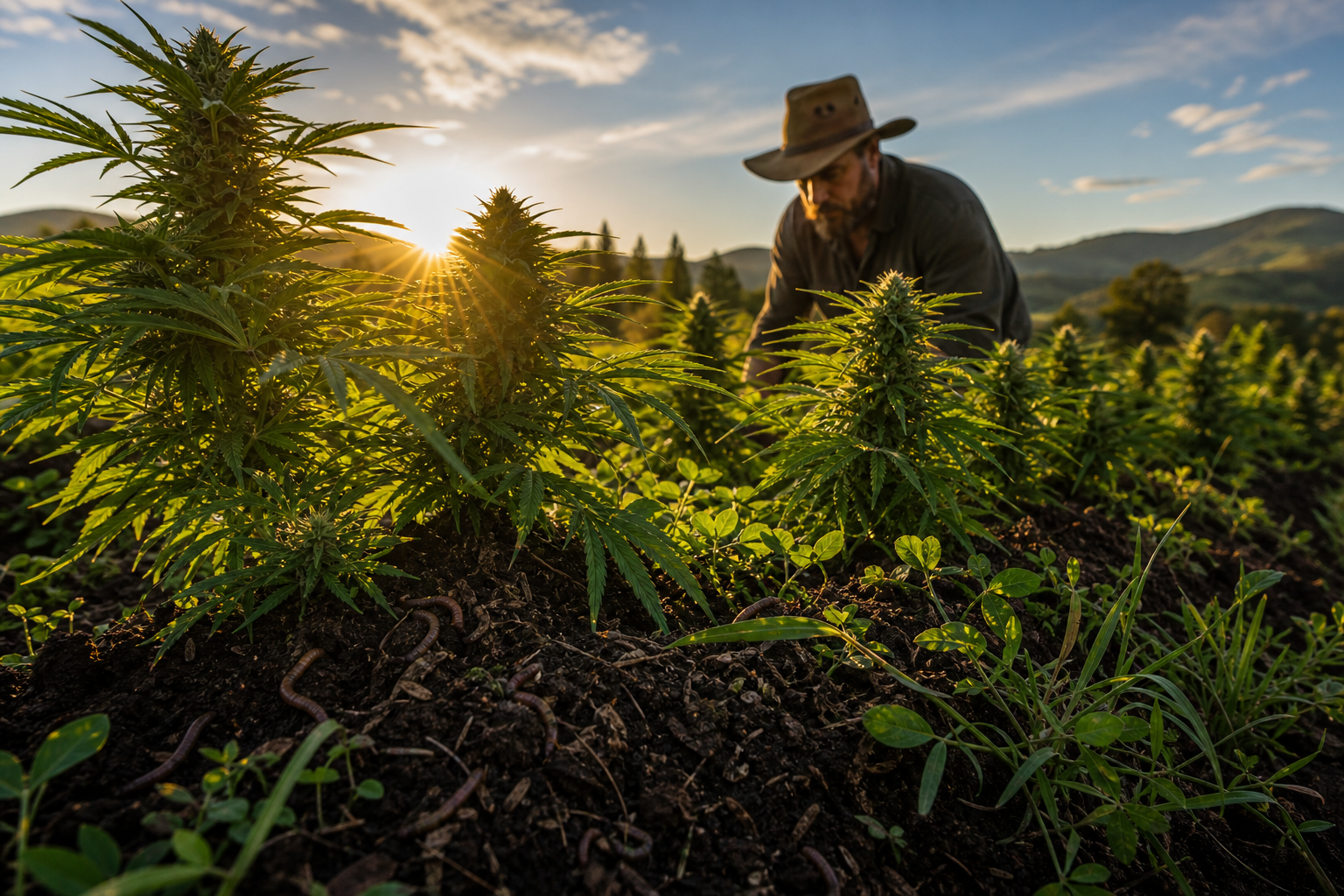
Sun-grown operations like Divine Toke have an advantage here. Natural rainfall reduces irrigation needs. Deep-rooted plants in living soil access water from a larger volume of earth. The soil's organic matter acts like a sponge, holding moisture and releasing it slowly. Our living soil systems with compost, mulch, and cover crops create a water-wise ecosystem that needs less intervention than bare-ground or container cultivation.
The lesson for consumers: water-efficient growing isn't just environmentally responsible—it often produces better cannabis. Plants that have to work a bit for their water develop stronger root systems and more complex chemistry.
Sustainable Water Practices in Cannabis Farming #
Drip irrigation, water recycling, and rainwater capture can reduce cannabis water use by 60-70% compared to overhead sprinklers or flood irrigation. As the industry scales, sustainable water practices aren't optional—they're essential for both environmental stewardship and regulatory compliance. The PMC environmental review flags water diversion and pollution as major concerns requiring immediate attention from cultivators.
The most effective water-saving techniques include:
Drip and micro-irrigation deliver water directly to the root zone, eliminating evaporation loss from spraying water through the air. Massachusetts Cannabis Control Commission guidance emphasizes that recycled water can be treated to acceptable levels with no significant difference in plant growth compared to fresh water under proper management.
Moisture sensors and automated irrigation take the guesswork out of watering. Soil moisture probes, weather stations, and automated valves ensure plants get exactly what they need when they need it—not extra water because someone forgot to turn off the timer.
Water audits and leak detection catch problems early. A single leaking valve or broken drip line can waste thousands of gallons. Regular monitoring—monthly at minimum, weekly for large operations—keeps systems efficient.
Rainwater harvesting captures free, soft water without chlorine or municipal additives. Large cisterns can store enough to significantly reduce municipal or well water demand during dry periods.
Condensate recovery in indoor and greenhouse operations captures water from dehumidifiers and HVAC systems—pure water that would otherwise go down the drain. Some facilities recover thousands of gallons monthly this way.
Living soil and mulching reduce irrigation frequency by increasing water retention. Nine Point Strategies research notes that organic matter acts like a sponge, holding moisture available to roots while reducing surface evaporation.
| Practice | Water Savings | Implementation Cost | Best For |
|---|---|---|---|
| Drip irrigation | 30-50% | Medium | All cultivation types |
| Automated sensors | 20-30% | Low-Medium | Large operations |
| Rainwater capture | 10-40% | Medium-High | Regions with adequate rainfall |
| Condensate recovery | 5-15% | Low | Indoor/greenhouse |
| Living soil/mulch | 20-30% | Low | Sun-grown, regenerative farms |
| Water recycling | 40-60% | High | Controlled environment agriculture |
At Divine Toke, sustainable water use is woven into our regenerative farming approach. Our living soil holds moisture like a reservoir. Cover crops reduce evaporation. Mulch layers protect the soil surface. When we do irrigate, precision drip systems deliver exactly what's needed. We're not just growing cannabis—we're building a water-resilient farm that can thrive even as climate patterns shift.
For consumers, choosing cannabis from water-conscious farms means supporting practices that protect watersheds, reduce energy use for pumping, and create more resilient agricultural systems. The water that grows your weed matters for the planet, not just the plant.
FAQ #
Q: Does water quality really affect how high I get? #
Yes, indirectly. Water quality affects nutrient uptake, which affects cannabinoid and terpene production. Research shows that controlled drought stress during flowering can increase THCA by 12% and CBDA by 13%. Poor water quality creates nutrient lockout that reduces the plant's ability to produce these compounds. While water doesn't change THC chemically, it absolutely affects how much the plant can produce.
Q: Can you taste the difference between tap water and filtered water cannabis? #
Yes, especially in the smoothness and complexity of the smoke. Tap water often contains chlorine and chloramines that kill beneficial soil microbes responsible for breaking down organic matter into available nutrients. This reduces terpene diversity and complexity. RX Green Technologies research confirms that unwanted water components interfere with nutrient availability and ultimately flavor. Clean water supports the full soil food web that creates rich, layered terpene profiles.
Q: How much water does a cannabis plant need per day? #
About 6 gallons (22.7 liters) per day during peak flowering, but this varies dramatically by stage and conditions. Seedlings need only 500ml every few days. Vegetative plants need 1-2 liters every 2-3 days. The key is not daily watering but responsive watering—giving plants what they need when they need it. Premium Cultivars guidance recommends increasing from 500ml to 2 liters over the first month, then adjusting by pot size and plant demand.
Q: What's the best pH for watering cannabis? #
The ideal range is 5.5 to 7.0. Below 5.5, calcium and magnesium lock out. Above 7.5, iron, zinc, and manganese become unavailable. In soil, aim for 6.0-7.0. In hydroponic systems, target 5.5-6.0. According to RX Green Technologies, values outside 5.5-7.0 significantly increase nutrient-availability problems. Most tap water runs 7.5-8.5 and needs adjustment for optimal cannabis growth.
Q: Can overwatering ruin a cannabis crop? #
Yes, and it's one of the most common beginner mistakes. Overwatering displaces oxygen from the root zone, kills beneficial microbes, and promotes root rot pathogens. Unlike controlled drought—which can increase potency—overwatering consistently reduces both quality and yield. The signs are wilting (ironically), yellowing lower leaves, and stunted growth. The fix is simple: let soil dry between waterings and ensure good drainage.
Q: Is drought-stressed cannabis more potent? #
Yes, when timed correctly during late flowering. A University of Guelph study cited by Cannabis Business Times found that controlled drought increased THCA by 12%, CBDA by 13%, and total CBD yield by 67%. However, timing is critical—drought stress during vegetative growth reduces yield rather than enhancing it. This is an advanced technique that requires experience to execute properly without damaging plants.
Q: How do I know if my weed was dried properly? #
Properly dried cannabis snaps cleanly when bent, doesn't feel wet or crumbly, and has maintained its color and aroma. Stems should snap, not bend. Buds should feel dry on the outside but still have some give when squeezed—indicating internal moisture that continues the cure. Flower that's too wet (above 0.65 water activity) risks mold. Flower that's too dry (below 0.55 water activity) has lost terpenes and will smoke harsh. AROYA.io guidance identifies 0.55-0.62 water activity as the quality preservation zone.
Q: What's water activity and why does it matter? #
Water activity measures available moisture for biological reactions—not total moisture, but "free" water that microbes can use. Below 0.55, cannabis is too dry and loses terpenes. Above 0.65, mold and bacteria can grow. The sweet spot is 0.55-0.62, where quality is preserved and safety is maintained. Many regulated markets use 0.65 as the legal cutoff for sale. Unlike moisture content, water activity accounts for how water is bound within the plant material.
Q: Does cannabis use more water than other crops? #
Per plant, yes—about twice as much as maize, soybean, or wheat. According to PMC research, cannabis can need roughly 22.7 liters per plant per day during the growing season. However, total regional impact depends on cultivation scale. A Yuba River study found that licensed cannabis farms used about one-tenth of household water on average in California's cannabis regions, suggesting limited land area means cannabis isn't the dominant water user despite high per-plant demand.
Q: Why does some weed burn harsh vs smooth? #
Harsh smoke usually indicates improper drying, curing, or nutrient problems—often traceable back to water management. Cannabis harvested with excess fertilizer (especially synthetic nitrogen) burns harsh and tastes chemical. Flower dried too fast with heat is harsh and loses terpenes. Flower that's too dry crumbles and burns hot. Flower that's too wet sizzles and won't stay lit. Properly water-managed cannabis—grown with balanced irrigation, flushed properly before harvest, and slow-cured—burns smooth and even with white ash.
Closing Thoughts #
Water is the unsung hero—or the hidden villain—of every cannabis experience. From the moment a seed germinates to the final cure, water quality, quantity, and management shape what ends up in your jar. The pH affects nutrient uptake. The source determines what microbes live or die in your soil. The drying process preserves or destroys the very compounds you're seeking.
At Divine Toke, we treat water as a craft input, not just a utility. Our sun-grown plants drink from natural sources that we've tested and monitored. Our living soil retains moisture while feeding beneficial biology. Our slow-curing process locks in quality at the optimal water activity range. When you choose our organic cannabis, you're benefiting from water wisdom accumulated through seasons of careful observation and adjustment.
If you're curious about how our water-conscious approach affects the final product, explore our Sun+Earth Certified farming practices or learn more about the living soil that holds moisture like a sponge. Every element connects back to water—because in the end, water is life, even for your weed.
This article is for educational purposes only and is not medical advice. Always consult your healthcare provider before starting any new wellness routine.
Grown in Detroit. Shipped to your door.
Small-batch, sun-grown cannabis cultivated in living soil. Mail-order shipping to all 50 states.