Why We Don't Use Pesticides — and What We Do Instead

Jamie
Head Cultivator
When you light a joint, you're not just burning flower. You're inhaling whatever was sprayed on that plant — fungicides, bug killers, growth regulators — and heat can turn some of those chemicals into things that were never on the label. This guide explains why pesticide-free growing matters for smokers, what Michigan requires at the lab, and how sun-grown farms like ours keep pests in check without reaching for poison.
Quick answer: Pesticides on smoked cannabis are a bigger inhalation risk than pesticides on food. Michigan tests for 58 banned compounds before sale, but the cleanest path is growing with integrated pest management (IPM) — living soil, beneficial bugs, companion plants, and prevention — instead of synthetic spray programs.
If you've ever wondered why a wellness brand makes such a big deal about "clean" flower, this is the whole reason. You're not eating a gummy that gets filtered through your liver. You're drawing hot smoke into tissue that was never meant to be a chemical processing plant.
Why Are Pesticides on Cannabis a Bigger Deal Than on Food? #
Pesticides on smoked cannabis are a bigger deal than on food because you inhale residues straight into your lungs, heat can turn sprays into new toxins, and no federal agency has set "safe" pesticide limits for marijuana the way the EPA does for groceries. Food gets washed, cooked, and filtered through your gut. Smoke goes direct to lung tissue.
Here's the plain version: when you eat an apple, your stomach and liver break down a lot of what was sprayed on it. When you smoke a bowl, there's no filter like that. Residues ride the smoke into your airways. A 2013 peer-reviewed review in PMC3666265 notes that smoking can recover a large share of pesticide residues from plant material — far more direct exposure than you'd get from eating the same weight of produce.
| Route | What Happens to Pesticide Residue | Body's First Line of Defense |
|---|---|---|
| Eating food | Residue travels through stomach, liver, kidneys | Digestive breakdown + metabolism |
| Smoking cannabis | Residue vaporizes with cannabinoids and terpenes | Lungs absorb directly — no digestive buffer |
| Vaping cannabis | Lower burn temp, but concentrates can still carry residues | Same direct lung exposure |
The King County Public Health "Pesticides and Pot" guide puts it bluntly: no pesticides are federally approved for use on cannabis, so there is no EPA "safe level" for residues on the plant you buy at a Michigan dispensary. Food crops have decades of residue limits. Cannabis does not — even in legal states.
That gap matters because growers under pressure sometimes reach for chemicals that are banned on food or meant for ornamental plants, not something you set on fire and inhale. A February 2025 Beyond Pesticides report found banned food pesticides at extreme levels in some commercial cannabis products — including compounds flagged as reproductive toxicants.
Pyrolysis — the chemistry word for "what happens when you burn something" — makes the risk worse. Heat doesn't just carry pesticides into your lungs. It can change them into new compounds that weren't in the original bottle. We'll get into the most famous example — Eagle 20 — in the next section.
Does that mean every sprayed bud will make you sick tomorrow? Not necessarily. Research on human illness from inhaled cannabis pesticides is limited. But the exposure path is real, the regulatory hole is real, and if you're buying flower to unwind after a shift, you deserve to know what's on it.
What Happens When You Smoke a Bud That Was Sprayed? #
When you smoke cannabis that was treated with certain fungicides or insecticides, the flame doesn't "burn off" the chemicals — it can convert them into new toxins you inhale with the smoke. The most documented case is myclobutanil (sold as Eagle 20), which breaks down into hydrogen cyanide when heated.
Think of it like this: the label on a spray bottle was written for a living plant in a field. Nobody tested what happens when that same chemical hits a cherry ember at 800°F inside a bowl. Your lungs are the lab.
| Stage | What Happens | Why It Matters |
|---|---|---|
| On the plant | Pesticide sits on leaves, stems, and trichomes | Residue can stick to the parts you smoke |
| In the flame | Heat causes pyrolysis — chemical breakdown | New compounds form that weren't on the label |
| In your lungs | Vapor and particles deposit on lung tissue | No digestive filter; fast absorption |
Research on cannabis contaminants published in Drug Testing and Analysis (Wiley, 2021) tracks how pesticide residues behave on cannabis products — and confirms that inhalation routes carry unique risks compared to other consumption methods.
Myclobutanil (Eagle 20) and Hydrogen Cyanide #
Myclobutanil is a fungicide used on ornamental plants and some food crops — but when cannabis containing it is burned or vaped, it can release hydrogen cyanide, a poison that interferes with your body's ability to use oxygen.
Eagle 20 was a brand name growers used for years before regulators caught on. Health Canada's 2017 clarification on myclobutanil and cannabis led to massive recalls because myclobutanil is not approved for use on plants meant to be inhaled. Canada treated it as a public health emergency.
Lab testing specialists at ACS Laboratory explain that myclobutanil begins breaking down into hydrogen cyanide above roughly 401°F (205°C) — well below typical combustion temperatures. A 2021 PMC review on cannabis contaminants (PMC8296824) lists myclobutanil among the highest-risk pesticide residues found on cannabis products in North American testing.
Hydrogen cyanide is the same class of compound associated with cigarette smoke toxicity. You won't drop from one hit. But repeated exposure to cyanide-forming residues is not something any wellness-minded consumer should accept — especially when clean flower exists.
Other Pesticides That Get Worse When Burned #
Organophosphate and carbamate insecticides — common in agriculture — can cause rapid neurological and respiratory symptoms when inhaled, and pyrolysis may intensify their toxicity compared to eating trace residues on food.
Project CBD's "Burning Issue" safety analysis argues that cannabis pesticide rules were written with food crops in mind, not combustion. Chemicals like chlorfenapyr (a broad-spectrum insecticide) and bifenthrin (a pyrethroid) show up on failed cannabis tests and in Michigan recalls — neither belongs in your lungs.
The Maine Office of Cannabis Policy toxicity briefing on cannabis contaminants lists inhalation as the highest-concern route for several pesticide classes because lung tissue absorbs them faster than your gut would.
Bottom line for smokers: if a farm sprayed it, you're smoking it — and heat may make it worse. That's why "passes lab tests" matters, but it's also why many of us choose farms that never spray synthetics in the first place.
Has Michigan Recalled Cannabis for Pesticides? #
Yes — Michigan regulators have recalled cannabis products over banned pesticide residues, most recently in September 2025 when flower and pre-rolls tested positive for bifenthrin and chlorfenapyr linked to contaminated trimming equipment. Lab testing catches most bad batches before sale, but recalls prove dirty product still reaches shelves sometimes.
Michigan's Cannabis Regulatory Agency (CRA) publishes public health and safety advisories and recall bulletins when products fail safety screening or when consumers face real risk. You can check that page any time you hear about a recall in the news.
| Date | Trigger | Product | Key Chemicals | Source |
|---|---|---|---|---|
| Sept 2025 | Failed safety testing / microbial + chemical residue | Flower and pre-rolls (Glo brand) | Bifenthrin, Chlorfenapyr | Cannabis Business Times recall report |
| Aug 2025 | Banned diluting agent (not pesticides) | 26,000+ vape cartridges (Sky Cannabis) | MCT oil | Detroit Free Press recall coverage |
The September 2025 incident is the clearest recent Michigan example of banned pesticides on smokable flower. According to Cannabis Business Times, regulators traced bifenthrin and chlorfenapyr — both restricted-use pesticides — to contaminated mechanical trimmers. Affected batches were sold at a Kalamazoo retailer, and roughly 1.69 pounds of product had already reached consumers before the recall.
That's a small number in pounds, but it only takes one contaminated pre-roll in your pocket to matter — especially if you're smoking for pain, sleep, or anxiety and your body is already under stress.
Important nuance: Michigan's safety net is lab testing, not farm visits on every harvest day. The Michigan Marijuana Pesticide List (MDARD, updated Sept 2024) tells growers which products may be used on marijuana in Michigan — a narrow approved list — while compliance labs screen finished product against a panel of 58 banned pesticides. Failed flower generally cannot be remediated and must be destroyed.
Recalls are the last line of defense. The first line is how the plant was grown — which is why we focus on prevention instead of sprays.
What Is Integrated Pest Management (IPM)? #
Integrated pest management (IPM) is a step-by-step system for controlling crop pests by preventing problems first, monitoring early, and using the gentlest effective tool — with synthetic sprays as a last resort, if allowed at all. It's how serious organic and sun-grown cannabis farms stay clean without nuking the field.
IPM is not "hope for the best." It's closer to how a good mechanic maintains a truck: fix small issues before they strand you on I-75, keep the engine clean, and don't pour random chemicals in the gas tank unless you've tried everything else.
The Massachusetts Cannabis Control Commission IPM guidance document (2021) — widely referenced across legal states — defines IPM as an ecosystem-based strategy that combines cultural, biological, mechanical, and (only when necessary) chemical controls. Medicinal Genomics' cannabis IPM overview breaks the same idea into daily farm practice: identify pests accurately, track population levels, set action thresholds, and intervene with the least toxic option that works.
| IPM Stage | What Growers Do | Example on a Sun-Grown Farm |
|---|---|---|
| Prevent | Remove pest habitat, quarantine new plants, build healthy soil | Clean rows, strong airflow, disease-resistant genetics |
| Monitor | Sticky traps, scouting walks, photo logs | Weekly leaf checks for spider mites or aphids |
| Intervene (gentle first) | Beneficial insects, companion plants, organic oils | Release predatory mites; plant marigolds at row edges |
| Intervene (last resort) | Approved products only, documented application | State-listed sprays — if ever needed — with strict timing |
At Divine Toke, we frame IPM as our default operating system: sun, soil, biodiversity, and early action — not a calendar spray program. We don't name specific vendors or product SKUs here because those change. The principle doesn't: work with the ecosystem, not against it.
The Four Pillars of a Real IPM Program #
Every legitimate cannabis IPM program rests on four pillars: correct identification, constant monitoring, prevention culture, and controlled intervention — in that order.
- Identification — Know exactly which pest you're fighting. Spider mites, thrips, aphids, and fungus gnats need different responses. Misidentification leads to wrong treatments and wasted money.
- Monitoring — Use sticky cards, magnifiers, and scheduled scouting. The goal is catching a handful of mites before they become a web-covered disaster.
- Prevention — Sanitation, quarantine for new clones, balanced irrigation, and healthy soil biology. Most outbreaks start because something in the environment invited pests in.
- Control — Escalate gradually: remove infected leaves, deploy beneficial insects, use approved organic tools, and only then consider synthetic options where regulations allow.
The Denver Environmental Quality cannabis IPM best practices guide emphasizes documentation — logging what you saw, what you did, and what changed. That's how clean farms prove their process to regulators and to customers who ask hard questions.
If a grower tells you they "don't need IPM because they spray preventatively every week," they're not running IPM. They're running a chemical schedule — and you're the one inhaling the leftovers.
How Do Beneficial Insects Control Cannabis Pests? #
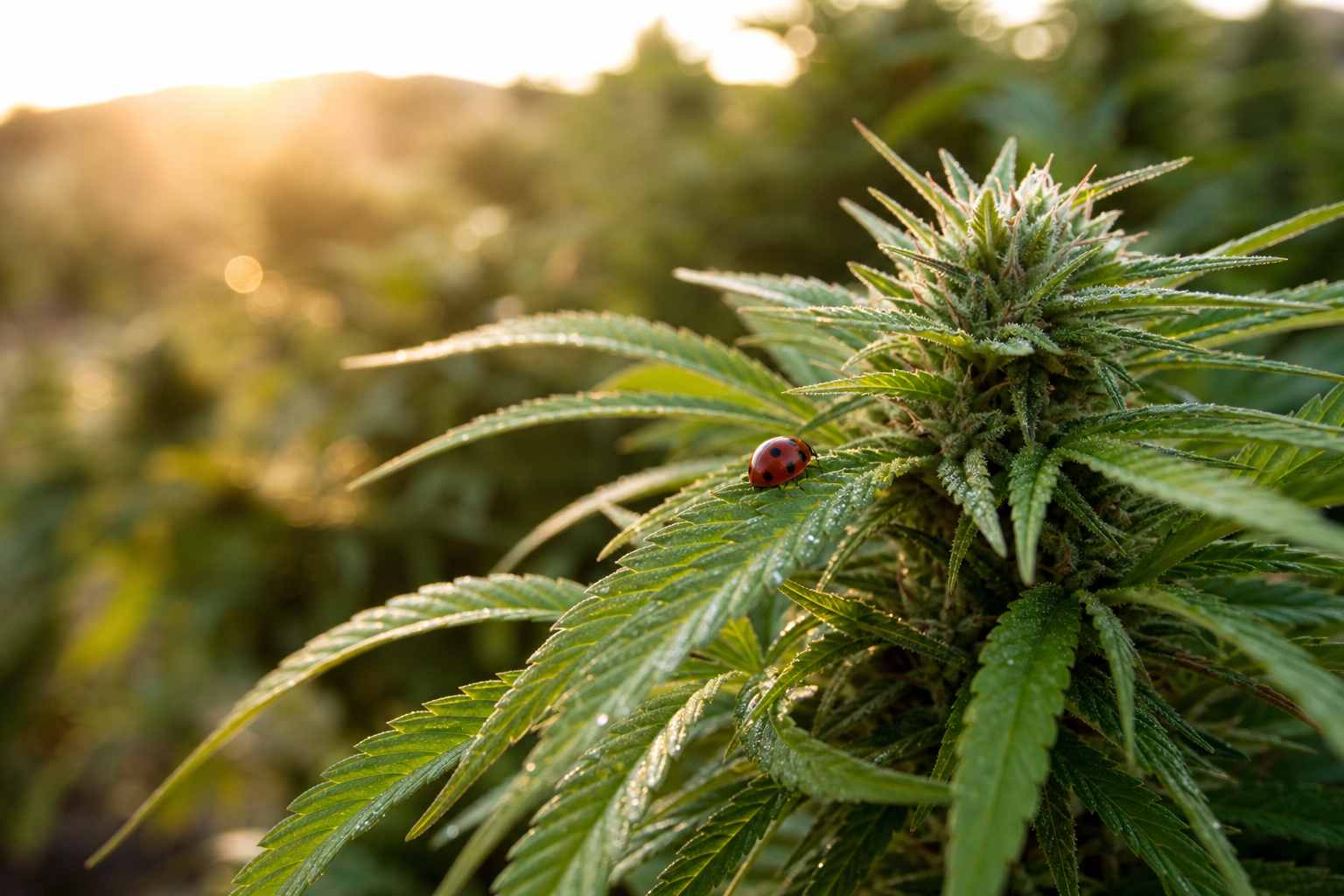
Beneficial insects — like ladybugs, predatory mites, and parasitic wasps — eat or outcompete cannabis pests so growers don't need synthetic sprays. They're living tools in an IPM toolbox, not a gimmick.
A single two-spotted spider mite can reproduce explosively in hot, dry conditions — the same conditions that stress outdoor plants in mid-summer. Predatory mites such as Phytoseiulus persimilis hunt spider mites the way cats hunt mice. Ladybugs and their larvae devour aphids. Green lacewing larvae — sometimes called "aphid lions" — chow through soft-bodied insects.
| Beneficial | Targets | How Growers Deploy Them |
|---|---|---|
| Ladybugs | Aphids, soft-bodied insects | Released at dusk near infested canopy zones |
| Predatory mites | Spider mites, thrips eggs | Sachets hung on plants or bulk release in rows |
| Parasitic wasps | Fungus gnats, whiteflies | Often used in greenhouse settings |
| Nematodes (Steinernema spp.) | Fungus gnat larvae in soil | Soil drench in living-soil containers |
The Massachusetts CCC IPM guidance lists biological control agents as the preferred intervention tier — before horticultural oils, before neem, and long before synthetic pesticides.
Beneficials work best as prevention and early response, not as a Hail Mary after a full-blown infestation. If spider mites already webbed half the field, you'll need to combine biocontrol with pruning, environmental fixes (humidity, airflow), and possibly approved organic knockdown tools.
Timing matters: release beneficials when pest pressure is low-to-moderate, avoid broad-spectrum sprays that kill predators and pests alike, and give the good bugs a few days to establish. Many sun-grown farms schedule releases on a calendar — just like planting — because waiting until you see damage often means you're already behind.
Common cannabis pests and their biocontrol matches:
| Pest | What You See | Biocontrol Ally |
|---|---|---|
| Spider mites | Tiny dots, fine webbing on undersides | Predatory mites (Phytoseiulus, Amblyseius) |
| Aphids | Clusters on new growth, sticky honeydew | Ladybugs, lacewing larvae |
| Thrips | Silver scarring on leaves | Predatory mites, minute pirate bugs |
| Fungus gnats | Small flies near soil surface | Nematodes (Steinernema), dry-back watering |
The Auburn University cannabis IPM thesis literature and state guidance documents consistently rank biological controls above reactive chemistry because they preserve the predator-prey balance instead of wiping the slate — and the slate includes your microbiome.
For consumers, beneficial insect programs are a signal: the farm is thinking in ecosystems, not just chemistry. That aligns with how we grow at Divine Toke — building a field where pests have predators waiting for them.
How Does Companion Planting Help Keep Bugs Away? #
Companion planting places helper plants near cannabis to repel pests, attract beneficial insects, and confuse bugs that hunt by smell — reducing the need for sprays. It's old-school farming wisdom that outdoor cannabis growers are bringing back.
The idea is simple: monoculture — one crop, bare dirt, same smell everywhere — is a buffet sign for pests. Mix in the right neighbors and you break up the pattern.
Common companions in cannabis rows include:
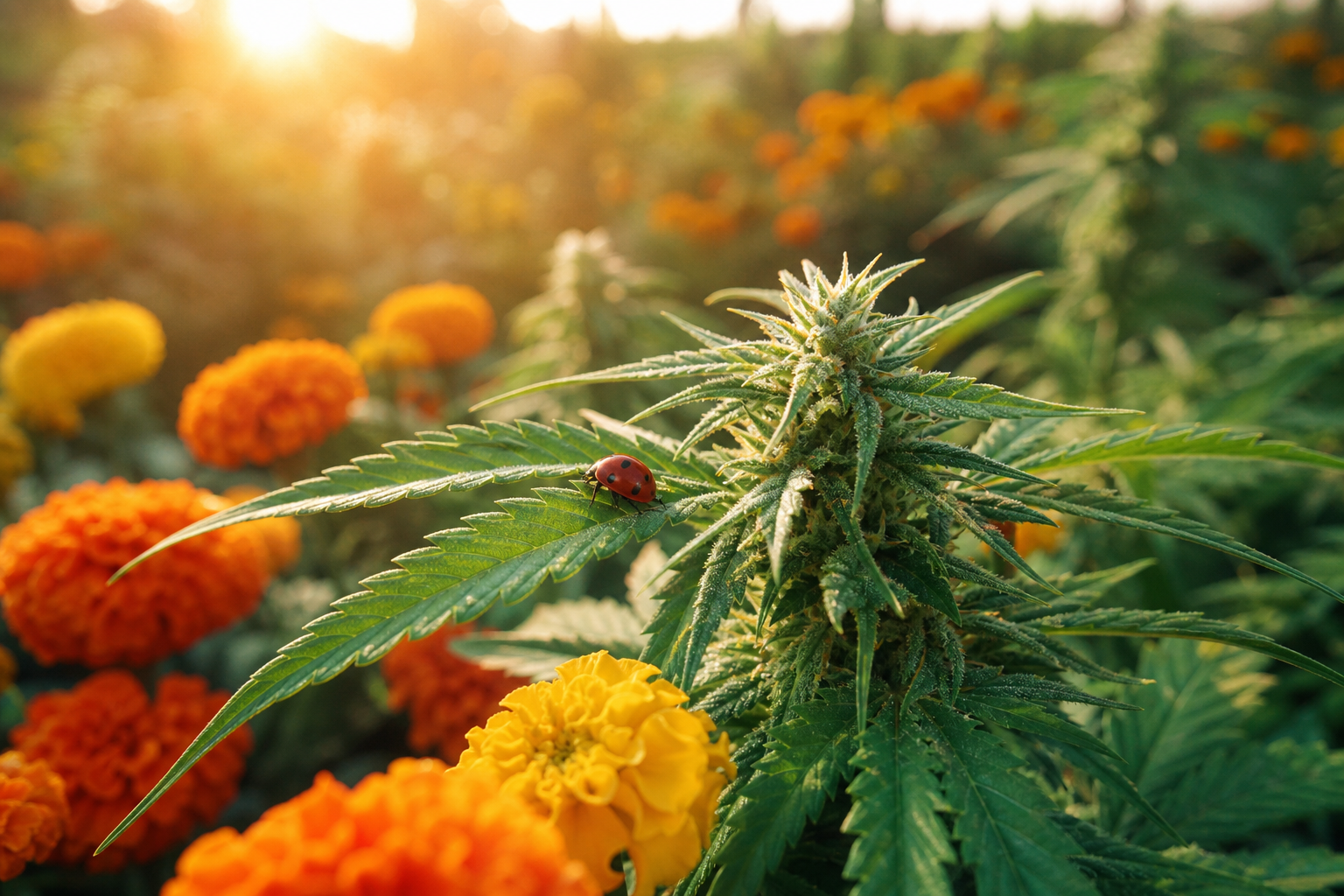
- Marigolds — root exudates can suppress nematodes; flowers attract pollinators and some predatory insects
- Basil and cilantro — strong aromas may mask cannabis scent from certain pests
- Yarrow and alyssum — tiny flowers feed adult beneficial insects between pest hunts
- Clover and vetch — cover crops that fix nitrogen and keep soil covered (fewer bare-dirt pest habitats)
| Companion Role | Plant Examples | Pest-Management Benefit |
|---|---|---|
| Repel | Marigolds, garlic, chrysanthemum | Deter nematodes, aphids, some beetles |
| Attract beneficials | Yarrow, dill, alyssum | Feed ladybugs, lacewings, parasitic wasps |
| Cover soil | Clover, rye, vetch | Reduce dust, cut temperature swings, block weed hosts |
Our deeper dive on row design lives in /blog/cover-crops-companion-planting-cannabis — same cluster, same philosophy: stack functions in the field so you're not fighting nature with a spray bottle.
Companion planting alone won't save a neglected field. It works inside IPM — paired with scouting, beneficial releases, and healthy soil. But on a sun-grown Michigan farm, those border rows of marigolds aren't decoration. They're part of the pest defense plan you never see on a jar label.
Why Does Healthy Living Soil Mean Fewer Pests? #
Healthy living soil — full of fungi, bacteria, protozoa, and micro-arthropods — creates a "suppressive" environment where pests and pathogens struggle to take over, so plants need fewer interventions. Weak plants in dead dirt attract bugs the way a wounded deer attracts flies.
Living soil means soil that's treated as a living system, not an inert bag of medium. Cannabis roots leak sugars (root exudates) that feed beneficial microbes. Those microbes, in turn, cycle nutrients and compete with disease organisms — a trade that keeps roots strong and leaves less stressed.
| Dead / Synthetic Soil | Living Soil Ecosystem |
|---|---|
| Few microbes, frequent fertilizer salts | Diverse food web, slow-release nutrients |
| Stressed plants send "weak" chemical signals | Robust plants produce defensive compounds |
| Pests detect easy targets | Suppressive microbes limit pathogen growth |
Researchers and growers describe this as the suppressive soil effect — documented across many crops, including cannabis. Cannabis Business Times' living soil maintenance guide notes that organic living soil grows often need fewer pesticide inputs because the biology does ongoing defense work.
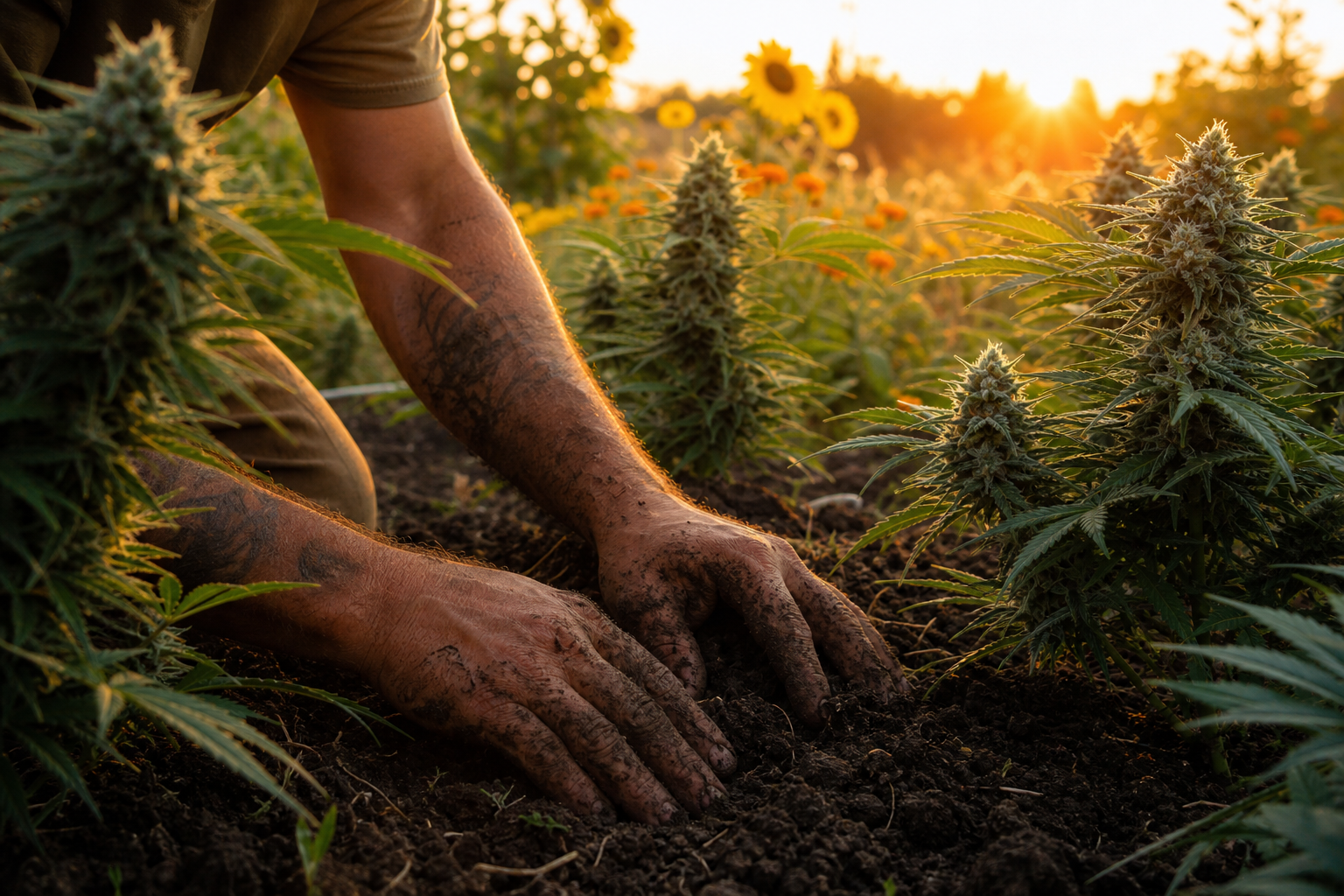
Outdoor sun-grown farms add another layer: cover crops, compost teas, and minimal tillage keep that biology intact season to season. When you rip soil constantly, you destroy fungal networks that help plants fight root rot and soil-borne pests.
Want the full picture of what's happening under your boots? Read /blog/living-soil-isnt-dirt-ecosystem. The short version for this article: pest control starts underground. A plant with a deep, microbe-fed root system handles stress better — and stressed plants are pest magnets.
Practical living-soil pest habits growers use:
- Quarantine new clones for 1–2 weeks before introducing them to the field
- Avoid overwatering — fungus gnats love wet, compacted soil
- Remove dead leaf matter that harbors larvae and mold
- Add beneficial nematodes for soil-dwelling pests when monitoring shows pressure
None of this shows up on a COA. But it's why two jars can both "pass" lab tests while one came from a farm that fights pests with biology and the other from a farm that fights pests with bottles.
How Do You Read Pesticide Results on a Michigan COA? #
On a Michigan Certificate of Analysis (COA), every pesticide on the state panel must show PASS or ND (None Detected) — if any banned compound FAILs, the batch cannot legally be sold. The COA is your receipt that someone actually tested what's in the jar.
Michigan requires safety compliance testing at a CRA-licensed lab before adult-use products reach shelves. Pesticide screening is one mandatory panel alongside potency, heavy metals, microbials, and more. The Michigan CRA oversees the program; SCLabs' Michigan compliance overview notes screening for 58 banned pesticides on finished product.
| COA Field | What to Look For | Red Flag |
|---|---|---|
| Batch / lot number | Must match packaging | Mismatch = wrong test attached |
| Pesticide panel | List of 58 compounds | Missing section entirely |
| Result per compound | ND or numeric value in ppb/ppm | Any FAIL |
| Overall status | PASS on safety panels | FAIL or incomplete |
| Lab accreditation | Licensed MI compliance lab | Unknown or out-of-state lab with no MI license |
ND means the lab's instruments didn't detect that pesticide above their limit of detection — that's what you want on every line. ppb (parts per billion) and ppm (parts per million) tell you how much was found if the number isn't zero.
Steps every buyer can take:
- Scan the QR code on Michigan packaging — many brands link to the full COA
- Match the batch number on the label to the batch on the PDF
- Scroll to the pesticide section — don't stop at THC percentage
- Confirm PASS on the full panel, not just potency
- Ask about farm practices — IPM, outdoor vs indoor, organic certification
Sample reading — what good looks like:
| Pesticide (example row) | Result | Status |
|---|---|---|
| Myclobutanil | ND | PASS |
| Bifenthrin | ND | PASS |
| Chlorfenapyr | ND | PASS |
| Abamectin | ND | PASS |
ND on every line is the goal. A numeric value above the state action limit should show FAIL and trigger a hold — though recalls like the September 2025 Michigan incident prove the system isn't perfect after product ships.
Our walkthrough of lab testing basics — molds, metals, potency, and how recalls happen when labs fail — is in /blog/what-lab-tested-means-cannabis-michigan. Lab tests are a safety floor, not a quality ceiling. A PASS means no banned pesticides were detected at the lab's sensitivity — not that the farm never used questionable inputs upstream.
If staff can't produce a COA, or the batch numbers don't line up, you have permission to walk. Your lungs aren't the place to gamble.
What Does "Clean" or "Pesticide-Free" Cannabis Actually Mean? #
"Clean" cannabis means no detectable banned pesticides on the compliance COA, no harmful contaminants above state limits, and — for many consumers — flower grown without synthetic spray programs in the first place. The word "clean" isn't a legal term; "PASS on pesticide panel" is.
Michigan law is binary at the lab: each of the 58 screened pesticides must pass. The Michigan Marijuana Pesticide List (MDARD) separately lists a small set of products growers may apply to marijuana in Michigan if they follow label rules — everything else is off limits.
| Term on Packaging | What It Usually Means | What It Does NOT Guarantee |
|---|---|---|
| Lab tested / PASS | Meets Michigan safety panels at time of test | Farm never used any inputs you dislike |
| Pesticide-free (marketing) | Brand claims no synthetic pesticides used | Not a CRA-defined legal label by itself |
| Organic / Sun+Earth | Third-party or certification standards | Still read the COA — certifications and tests overlap but differ |
Third-party certifications add another layer. Sun+Earth Certified farms, for example, must meet regenerative organic standards that restrict synthetic pesticides beyond what state law requires. We break that down in /blog/sun-earth-certified-cannabis-farming.
"Clean" for a smoker also means:
- No combustion surprises — avoiding chemicals that pyrolyze into worse toxins (myclobutanil, certain organophosphates)
- No hidden diluents — unrelated to pesticides but part of the same trust issue (see Michigan's 2025 vape recalls)
- Transparent farm practices — IPM, living soil, beneficial insects, companion planting
A product can legally PASS while still coming from a farm that sprays approved products you don't want to inhale. That's why we talk about process, not just test results. Lab tests catch failures. Farm philosophy prevents them.
How Does Divine Toke Control Pests Without Synthetic Sprays? #
At Divine Toke, we control pests through integrated pest management — healthy living soil, beneficial insects, companion planting, constant scouting, and prevention — instead of relying on synthetic pesticide spray programs. We grow sun-grown organic flower in Michigan; our goal is strong plants in a balanced field, not weekly chemical calendars.
We won't invent specifics we can't stand behind — no made-up acreage numbers, no vendor name-drops, no pretend strain lists. What we will say plainly: our approach matches the IPM hierarchy regulators and organic certifiers recommend — prevent first, monitor always, intervene gently, document everything.
| Layer | What It Does for Pest Control |
|---|---|
| Living soil | Feeds roots, supports suppressive microbes, reduces plant stress |
| Sun + airflow | Outdoor conditions that differ from stagnant indoor rooms where mites explode |
| Companion plants & cover crops | Border rows and soil cover that support beneficials — see our companion planting post |
| Beneficial insects | Predatory mites and other biocontrols when monitoring shows early pressure |
| Scouting & SOPs | Daily walks, sticky traps, quarantine for new genetics — catch problems while they're small |
| Compliance testing | Every batch still hits a Michigan licensed lab before sale |
Curious what a day on a farm like ours actually looks like — from soil check to harvest handling? /blog/seed-to-smoke-day-in-life-divine-toke-farm walks through the rhythm without the fairy-tale marketing.
Why we skip synthetic pesticides: because you're going to inhale this flower. Heat changes chemistry. Michigan's lab panel catches many problems, but we'd rather not create them in the first place. Prevention costs more time than spraying. It also costs less trust when something goes wrong.
If you're comparing brands, ask how they farm — not just THC percentage. The answer tells you more about what's in the smoke than any hype label.
Frequently Asked Questions #
Are pesticides on cannabis worse than pesticides on food? #
Yes — for smoked cannabis, pesticide exposure is generally higher-risk than dietary exposure because residues enter the lungs directly and heat can create new toxins. Food pesticides have EPA residue limits; cannabis has no federal approved list. The King County Public Health cannabis pesticide guide notes that no pesticides are federally approved for marijuana, unlike regulated food crops.
What is myclobutanil (Eagle 20) and why is it banned from cannabis? #
Myclobutanil is a fungicide that can release hydrogen cyanide when cannabis containing it is burned or vaped — which is why regulators banned it from inhalable products. Health Canada's 2017 myclobutanil clarification triggered widespread recalls after labs found it on cannabis meant to be smoked.
What is integrated pest management (IPM) for cannabis? #
IPM is a prevention-first pest system that combines monitoring, cultural practices, beneficial insects, and gentle interventions — using synthetic chemicals only as a last resort when regulations allow. The Massachusetts CCC IPM guidance (2021) defines it as an ecosystem-based strategy, not a fixed spray schedule.
Can ladybugs and predatory mites really protect a cannabis crop? #
Yes — when deployed early, ladybugs, predatory mites, and other biocontrols can suppress aphids, spider mites, and thrips without synthetic sprays. Medicinal Genomics' cannabis IPM overview lists biological controls as a core tier before chemical options.
Does companion planting work for outdoor cannabis? #
Companion planting helps by repelling some pests, feeding beneficial insects, and breaking up monoculture patterns that attract outbreaks. Marigolds, yarrow, clover, and herbs are common row partners — we detail the approach in /blog/cover-crops-companion-planting-cannabis.
How does living soil help prevent pest outbreaks? #
Living soil supports a diverse microbiome that competes with pathogens and keeps plants healthier — stressed plants attract more pests. The suppressive soil effect is why many organic growers report fewer spray needs over time, as noted in Cannabis Business Times' living soil guide.
How many pesticides does Michigan test for on cannabis? #
Michigan compliance labs screen finished cannabis for a panel of 58 banned pesticides before products can be sold. SCLabs' Michigan compliance page lists pesticide screening among mandatory safety tests alongside heavy metals and microbials.
How do I read pesticide results on a Certificate of Analysis (COA)? #
Look for ND (None Detected) or PASS on every compound in the pesticide panel, and confirm the batch number matches your package. Any FAIL means the product should not be on shelves. See our full guide at /blog/what-lab-tested-means-cannabis-michigan.
Has Michigan recalled flower for banned pesticides? #
Yes — in September 2025 Michigan regulators recalled flower and pre-rolls after detecting bifenthrin and chlorfenapyr linked to contaminated trimming equipment. Cannabis Business Times reported that about 1.69 pounds had reached consumers before the recall.
Is neem oil safe to use on cannabis? #
Neem oil is an OMRI-listed organic tool many growers use in vegetative stages for prevention — but it must be used correctly, timed away from harvest, and only where state rules allow. It's a repellent and growth disruptor, not a license to soak buds you'll smoke tomorrow; always confirm the product appears on Michigan's approved list if a grower uses it.
What does "pesticide-free" mean on a cannabis label? #
"Pesticide-free" is usually a brand marketing claim — the legal standard in Michigan is passing the 58-compound compliance panel on your COA. A PASS means no banned residues were detected at lab sensitivity, not that zero inputs were ever used in the grow.
Why don't organic farms just use "safer" synthetic sprays? #
Because inhalation and combustion change the risk profile — and because organic/regenerative standards prioritize prevention over chemical dependency. IPM hierarchy puts biological and cultural controls first; synthetics are last resort. That's the model we follow at Divine Toke and the standard described in /blog/sun-earth-certified-cannabis-farming.
The Bottom Line #
Pesticides on cannabis matter because you inhale what was sprayed — and fire can make some chemicals more dangerous, not less. Michigan's 58-compound lab panel and recall system catch a lot, but the best outcome is a farm that never puts those compounds on the plant in the first place.
Integrated pest management — living soil, beneficial insects, companion planting, scouting, and gentle interventions — is how sun-grown farms keep pests down without poison. It's slower than a spray tank. It's also the reason you can light up without wondering what Eagle 20 turns into at 800 degrees.
If you're shopping Michigan flower and want the full picture:
- Soil biology: /blog/living-soil-isnt-dirt-ecosystem
- Lab tests & COAs: /blog/what-lab-tested-means-cannabis-michigan
- Certification standards: /blog/sun-earth-certified-cannabis-farming
If you're curious to try sun-grown flower from a farm that builds pest defense into the field — not the bottle — check what Divine Toke has on shelf this week. Ask your budtender for the COA, read the pesticide panel, and smoke something that matches how much you care about what goes in your lungs.
This article is for educational purposes only and is not medical advice. Always consult your healthcare provider before starting any new wellness routine.
Grown in Detroit. Shipped to your door.
Small-batch, sun-grown cannabis cultivated in living soil. Mail-order shipping to all 50 states.