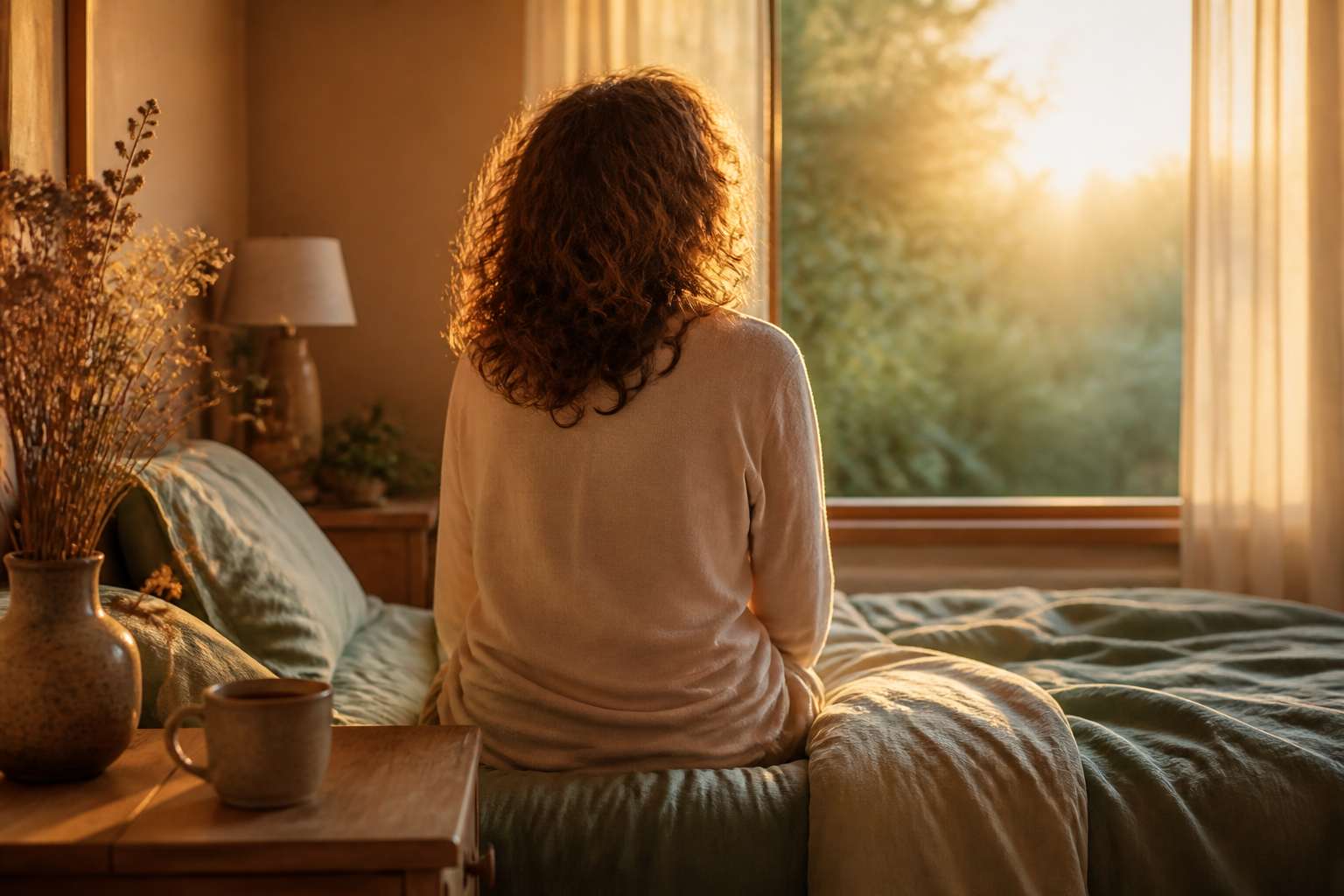
Menopause and Cannabis: Sleep, Hot Flashes, and Hormonal Balance

Jamie
Head Cultivator
Hot flashes at 2 a.m. Mood that flips on a dime. Sleep that never sticks. If that sounds like your midlife chapter, you are not alone — and you are not imagining it. This pillar walks through what cannabis may (and may not) do for menopause symptoms, with doctor-first framing for Metro Detroit and Michigan women shopping a legal market.
Primary question this guide answers: Does cannabis help menopause symptoms like hot flashes, sleep problems, and mood swings? Short preview — sleep and mood show the strongest real-world signal; hot flashes stay an evidence gap; your clinician still leads.
Use the sections below as a checklist, not a substitute for care.
What Happens to Your Body During Menopause and Perimenopause #
Menopause is when your ovaries wind down estrogen and progesterone production — and the years leading up to that (perimenopause) are often when symptoms hit hardest. Periods get irregular. Sleep frays. Temperature swings show up without warning. For many Metro Detroit women juggling plant shifts, hospital nights, or long commutes, that stack hits daily life hard.
Perimenopause can last several years before your final period. Menopause is officially marked after 12 months without a period. After that, you are postmenopausal — but symptoms can linger. The Office on Women's Health notes that hot flashes can continue for years after the last period, and sleep problems are common across the transition.
| Stage | Rough timing | What often changes |
|---|---|---|
| Perimenopause | Years before final period | Irregular cycles, mood swings, early hot flashes, worse sleep |
| Menopause | 12 months with no period | Official milestone; symptoms may still be active |
| Postmenopause | Years after | Hot flashes may continue; vaginal dryness and joint aches common |
You do not need a perfect label to take symptoms seriously. If nights are wrecked or mood is off, talk with a clinician who knows midlife care — then decide whether cannabis belongs in the plan.
Hot Flashes, Night Sweats, and the Body Thermostat #
Hot flashes are the most common menopause symptom — as many as three out of four women get them, according to the Office on Women's Health. A hot flash is a sudden wave of heat in the upper body. Face and neck may flush. Sweat can follow. Then you may get a chill. At night, the same pattern is called night sweats.
Doctors call these vasomotor symptoms — fancy words for blood-vessel and temperature swings. Your brain's thermostat (the hypothalamus) gets jumpy when estrogen drops. Triggers can include spicy food, alcohol, caffeine, stress, and warm rooms. Michigan summers in an upstairs bedroom without good airflow can make night sweats worse. So can bundling up for a cold Detroit winter commute and then overheating indoors.
Sleep Disruption in Midlife #
Sleep problems in menopause are rarely "just stress" — hormone shifts, night sweats, and a racing mind often pile on together. The Office on Women's Health notes that low progesterone can make it harder to fall and stay asleep, while night sweats wake you soaked. Bladder trips, joint pain, and anxiety add more wake-ups.
For shift workers across Metro Detroit — auto plants, logistics warehouses, hospitals — the menopause sleep hit stacks on top of an already odd schedule. Short winter daylight in Michigan can make mood and sleep even harder. That is why many women hunt for something that helps them shut off at night without a hangover the next morning. Our fuller sleep deep-dive lives in the cannabis and sleep complete guide.
Mood, Pain, and Everyday Energy #
Mood swings, irritability, anxiety, joint aches, and brain fog are common midlife companions — not character flaws. The Office on Women's Health explains that mood changes can track hormone shifts, sleep loss, and life stress at the same time. Depression and anxiety risk also rise around menopause, and those need real clinical care — not a plant alone.
Body-wise, many women notice stiffer joints, more aches after physical work, and less recovery between shifts. Pain and poor sleep feed each other. That loop is one reason cannabis shows up in midlife conversations — not as a cure, but as one tool some people try for comfort while they work with a doctor on the bigger picture. For the wider hormone map, see our women's health cannabis pillar and the women and cannabis hormones guide.
Can Cannabis Help Menopause Symptoms? #
Early research and surveys suggest cannabis may help some menopause-related sleep and mood symptoms for many people — but it is not a proven fix for hot flashes, and major menopause groups still say more evidence is needed. That honesty matters more than hype.
A Harvard-covered survey of midlife women found that nearly 79% of cannabis users in the sample used it for menopause-related symptoms, with 67% citing sleep and 46% citing mood/anxiety as areas of help, while hot flashes improved less (Harvard Health; study context also discussed via PMC10314536). Those numbers are self-report from a selected sample — not a randomized trial proving cannabis "treats menopause."
What clinical reviews keep repeating:
- Hot flashes / night sweats: evidence is weak; cannabinoids are not an established vasomotor treatment (Healio coverage of the evidence gap; The Menopause Society materials on rising cannabis use).
- Sleep and mood: stronger consumer signal in surveys, still thin menopause-specific trial data (PMC9422771).
- Long-term safety in midlife women: largely unknown over the multi-year span many symptoms last (Harvard Health).
| Symptom area | What people often report | What evidence looks like in 2026 |
|---|---|---|
| Sleep | Easier wind-down, fewer wake-ups for some | Promising for some cannabinoids broadly; menopause RCTs still scarce |
| Mood / anxiety | Quieter racing thoughts | Survey support; dose and product matter a lot |
| Hot flashes | Mixed / weaker reports | Not proven; experts call for more trials |
| Joint aches | Comfort for some | Indirect pain research; not menopause-specific proof |
Bottom line: cannabis can be worth a careful, doctor-aware experiment for sleep and stress comfort. It should not replace proven care for severe hot flashes, depression, or other red-flag symptoms.
What "help" usually means in real life #
Most midlife success stories are about sleep continuity and a quieter nervous system — not a miracle cool-down of every flash. That matches how Harvard clinicians framed survey results: sleep and anxiety pathways are more plausible than a direct thermostat reset (Harvard Health).
Useful ways to define success before you spend money:
- Fall asleep 20–30 minutes faster on most nights.
- Wake fewer times for racing thoughts (even if sweats still happen).
- Wake less angry or brittle the next morning.
- Use a lower dose of a sedating OTC sleep aid under a doctor's plan (never change prescriptions alone).
Not useful definitions of success:
- "This strain cured my menopause."
- "I do not need to see a doctor anymore."
- "If 5 mg was okay, 25 mg will be five times better."
A 2022 scoping-style research gap pattern still holds into 2026 reporting: lots of lived experience, not enough menopause-targeted randomized trials. Divine Toke's job is to keep that honesty intact while you shop a legal Michigan market.
How the Endocannabinoid System Talks to Your Hormones #
Your endocannabinoid system (ECS) — the body's built-in network that helps balance sleep, mood, pain, and stress — has a two-way relationship with estrogen. When estrogen shifts in perimenopause, that ECS "thermostat" can feel off too. That does not mean cannabis fixes hormones. It means the systems talk to each other.
Think of the ECS like a dimmer switch for comfort signals. Your body makes its own cannabinoids, including anandamide (sometimes called the "bliss molecule"). Plant cannabinoids like THC and CBD plug into related pathways. Reviews of reproductive neurobiology describe bidirectional links between sex hormones and ECS tone (PMC7139952; PMC4918871).
| Piece | Plain English | Why midlife women care |
|---|---|---|
| CB1 receptors | Main "brain and nerve" cannabis locks | Mood, sleep, pain feel |
| CB2 receptors | More "body and immune" locks | Swelling and body discomfort |
| Anandamide (AEA) | Your homemade cannabinoid | Comfort and stress buffering |
| FAAH | Enzyme that breaks down anandamide | When FAAH runs high, AEA drops faster |
| Estradiol | A main form of estrogen | Helps shape ECS tone in many models |
This is also why the same dose can feel different week to week in perimenopause. Hormones are moving. Sleep debt piles up. Stress from caregiving or shift work in Southeast Michigan adds another layer. For a wider map, pair this section with our women and cannabis hormones guide.
Anandamide, FAAH, and Falling Estrogen #
Early research suggests estrogen can raise anandamide signaling — often by slowing FAAH, the enzyme that chews anandamide up. When estrogen falls, that support may weaken. Reviews describe estradiol effects on endocannabinoid synthesis and breakdown pathways in animal and cellular models (PMC2933663; PMC3702272; PMC5028287).
In plain terms:
- Higher estrogen periods (in cycling years) often pair with a more "cushioned" ECS feel for some women.
- Falling/fluctuating estrogen in perimenopause may leave stress, sleep, and pain systems more jumpy.
- Cannabis does not replace estrogen. It may nudge comfort pathways some people feel as calmer sleep or less edge — which is different from restoring hormonal balance.
Human menopause-specific ECS biomarker studies are still limited. Treat mechanism talk as a helpful map, not a promise.
What this means for shopping (without the science lecture) #
You are not "low on weed hormones" — you are navigating a life stage where comfort systems feel less buffered, so small, steady experiments beat megadoses. That framing keeps expectations honest.
Shopping implications:
- Prefer full-spectrum or broad products when you want terpene + cannabinoid teamwork, unless your clinician prefers isolates for interaction reasons.
- Prefer known milligrams over mystery house pre-rolls when you are learning.
- Prefer night-time first trials over inventing a daytime microdose routine on a workday.
- Prefer Michigan-tested goods so the label matches the jar under CRA oversight (Michigan CRA).
If a budtender promises hormone balance from a single cultivar name, smile, thank them, and look at the COA instead. Our women's health pillar covers the broader life-cycle view from PMS through menopause if you want the wider map.
Cannabis for Hot Flashes and Night Sweats #
Cannabis is not a proven treatment for hot flashes — and many people who feel "better" may be sleeping deeper or feeling less anxious rather than cooling the flash itself. That distinction matters when you are shopping Michigan dispensary shelves for relief.
Harvard Health summarized survey findings where sleep and mood ranked ahead of hot-flash relief. Clinicians quoted there note the brain's temperature center is not thought to be strongly moved by cannabis the way sleep circuitry can be. Healio and The Menopause Society's public materials likewise stress that more rigorous evidence is needed before cannabinoids can be treated as vasomotor therapy. The Society's 2023 nonhormone therapy position statement materials focus on options with clearer trial support for hot flashes — cannabis is not in that proven lane.
What many women still notice in real life:
- Night sweats wake them; poor sleep makes the next day worse.
- A small evening dose that helps sleep can feel like it helped night sweats — even if flash count did not change much.
- Alcohol, late caffeine, and overheated bedrooms remain big drivers. Fix those first.
| Approach | Role for hot flashes | Notes |
|---|---|---|
| Menopausal hormone therapy (when appropriate) | Often strongest medical option | Doctor decision; risks and benefits vary |
| Nonhormone prescriptions | Evidence-backed for some women | Ask your clinician |
| Lifestyle triggers | Real, free wins | Layers, fans, spicy food, alcohol |
| Cannabis | Not proven for the flash itself | May help adjacent sleep/mood for some |
If hot flashes are severe, start with a menopause-informed clinician — not a budtender alone. Cannabis can sit beside that plan for sleep comfort, not instead of it. The Office on Women's Health lists practical flash management steps worth trying tonight.
Separating "I slept better" from "my flashes stopped" #
Track flash count and sleep quality as two different columns — otherwise you will credit cannabis for cooling flashes when it mainly helped you stay asleep through them. That tracking habit is how you keep yourself honest and keep your clinician informed.
Simple two-week log:
| Night | # of hot flashes / sweats you noticed | Minutes to fall asleep | Wake-ups | Cannabis mg + product | Morning feel |
|---|---|---|---|---|---|
| Example | 3 | 35 | 2 | 2.5 mg THC tincture | Slight fog |
Patterns to look for:
- Sleep improves, flash count unchanged → plant may still be worth it for rest.
- Flash count drops without other changes → interesting, but still not proof; tell your doctor.
- Anxiety climbs as THC climbs → you overshot; step down.
- Everything improves after starting HRT the same week you tried a gummy → do not give the gummy all the credit.
The Menopause Society materials on rising cannabis use among midlife women are a reminder that popularity is not the same as a treatment guideline (press PDF). Popularity means your questions are normal. Guidelines mean we still need better trials.
Cannabis for Menopause Sleep Problems #
Sleep is the menopause symptom where cannabis has the clearest consumer signal — many midlife women report it helps them wind down, even though menopause-specific clinical trials are still thin. In the Harvard-covered survey, sleep disturbance was the top menopause reason for cannabis use (Harvard Health; PMC10314536). A related medical-cannabis survey in perimenopausal and postmenopausal women also found sleep and mood among common use motives (PMC9422771).
Why sleep breaks in midlife:
- Night sweats soak the sheets.
- Racing thoughts will not shut off.
- Pain wakes you when you roll over.
- Shift schedules across Detroit plants and hospitals already fight your body clock.
- Michigan's long dark winters can stack seasonal sleep strain on top.
Cannabis will not fix every cause. Many people find it helps the "can't turn my brain off" piece. Pair any plant experiment with basics: cool dark room, earlier caffeine cut-off, and less late alcohol — tips also echoed by the Office on Women's Health.
For a full method-by-method sleep map, see the cannabis and sleep complete guide.
CBN, CBD, and THC for Nighttime Use #
CBN (cannabinol) has some of the cleaner early sleep-trial signals among minor cannabinoids, CBD alone is inconsistent as a sleep aid, and low-dose THC helps some people fall asleep but brings more next-day and tolerance risk. Hedge every claim: most sleep trials are not menopause-only.
What the broader sleep literature suggests:
- A randomized study found about 20 mg CBN at night reduced nighttime awakenings and sleep disturbance over a short window; adding CBD did not clearly improve that effect (PubMed 37796540; related CBN discussion in PMC10450062).
- Reviews still call the overall CBN evidence early and limited (PMC8612407).
- Clinical dosing papers on THC/CBD medicines emphasize start low, go slow, especially for insomnia-style once-nightly use (PMC9294022).
- Many consumer menopause write-ups mention bedtime THC in the 2.5–5 mg range as a cautious starting neighborhood — that is informal practice talk, not a menopause FDA dose.
| Cannabinoid | Sleep role (plain English) | Watch-outs for midlife |
|---|---|---|
| CBN | Early data for fewer wake-ups at studied doses | Product labels vary; many gummies are much weaker than study doses |
| CBD | May calm some people; weak as a solo sleep drug | High studied doses differ from cheap low-mg bottles |
| THC | Can shorten time to fall asleep for some | Impairment, next-day fog, tolerance, drug tests |
| THC + CBD | Some prefer the blend for edge + body ease | Easy to overshoot with edibles |
If you work a safety-sensitive job in Metro Detroit, treat morning fog and workplace drug testing as real constraints — not footnotes. Smoke-free options (tinctures, capsules) are easier to dose slowly than chasing hits at 1 a.m.
Building a menopause night stack (non-magic version) #
A good night stack is boring: cool room, earlier wind-down, tiny consistent dose, same clock time. Fancy product hopping usually means you never learn what actually worked.
Try this simple order for two weeks:
- Environment first — dark, cool, fan if needed (Office on Women's Health basics still win).
- Caffeine cut-off — especially if you already run on shift coffee across Detroit.
- Alcohol honesty — nightcaps worsen sweats and sleep quality for many women.
- Cannabis last — only after the above, at a measured oral dose.
- Same product — do not rotate five "sleep" gummies in one week.
| Stack piece | Cheap / free | Paid plant add-on |
|---|---|---|
| Cool sleep space | Fan, lighter blanket | — |
| Wind-down cue | Paper book, dim lights | Low-dose tincture 60–90 min before bed |
| Sweat plan | Layers, cold water nearby | Medical flash plan with your clinician |
| Pain plan | Stretch, topical heat/ice | Cannabis topical ± micro oral |
| Morning check | Note fog / mood | Adjust dose down if mornings suffer |
If sleep apnea, restless legs, or loud snoring are in the picture, get that evaluated. Cannabis will not un-obstruct an airway. Michigan winters with dry forced-air heat can also wreck nasal breathing — a humidifier is unglamorous and useful.
Mood, Anxiety, and Irritability in Perimenopause #
Many people find low-to-moderate cannabis doses take the sharp edge off perimenopause anxiety and irritability — but too much THC can do the opposite and spike anxiety. Mood changes around menopause are common, and the Office on Women's Health notes higher depression and anxiety risk in this window. That is a doctor conversation first if mood is dark, hopeless, or unsafe.
Survey data from midlife cannabis users put mood and anxiety near the top of reported benefits, behind sleep (Harvard Health; PMC10314536; PMC9422771). Clinicians quoted in the Harvard piece describe cannabis as sometimes "dimming" the racing prefrontal chatter that keeps women awake and wired. That is a useful metaphor — not a diagnosis.
Practical patterns many midlife women land on:
- Small evening doses for wind-down, not daytime fog.
- CBD-forward products when they want less intoxication.
- THC microdoses when a little body ease helps — then stop before the high gets loud.
- Journaling dose, product, sleep, and mood for two weeks so you are not guessing.
| Mood goal | Often tried first | Risk to watch |
|---|---|---|
| Quiet racing thoughts at night | Low THC or CBD:THC balanced tincture | Next-day sluggishness |
| Daytime edge without a high | CBD-dominant | Weak effect if dose is tiny |
| Social stress / irritability | Very low THC | Anxiety rebound if dose climbs |
| Possible clinical depression | Professional care | Do not self-treat with cannabis alone |
For dose-shape details that keep THC in the calm zone, read our cannabis anxiety sweet spot guide. If crying spells, panic, or hopelessness show up, call your clinician or a crisis line — plant routines are not crisis care.
The perimenopause "wired and tired" loop #
Wired-and-tired is the loop where you are exhausted but your brain will not power down — cannabis helps some people interrupt that loop, and hurts others if the dose is wrong. Perimenopausal women in survey samples often report heavier symptom burden and more cannabis use for symptoms than postmenopausal peers (Harvard Health; PMC10314536).
What that loop looks like on a Detroit weeknight:
- Long day (commute, kids, aging parents, overtime).
- Hot flash or two after dinner.
- Scroll phone in bed; blue light + news rage.
- Finally try to sleep; brain replays the day.
- Wake at 2:40 a.m. damp or anxious.
- Show up brittle for a 6 a.m. shift.
Where a small cannabis dose sometimes fits: step 4, as a wind-down cue — not as a personality transplant. Where it fails: when it becomes the only coping tool, when doses climb every week, or when it papers over clinical depression. Michigan's dark winter stretch can make seasonal mood dips worse; do not assume every winter low is "just menopause" or "just weed deficiency."
Joint Pain, Aches, and Body Discomfort #
Early research and a lot of real-world use suggest cannabis may help some people with joint aches and body pain — symptoms that often get louder in midlife even when they are not the headline "menopause" complaint. Falling estrogen, harder recovery after physical work, and poor sleep all stack. For blue-collar women in Metro Detroit trades, plants, and caregiving jobs, that stack is not abstract.
Cannabis pain research is broader than menopause research. Reviews and clinical summaries point to roles for CB1 (nerve pain signaling) and CB2 (immune/swelling pathways), plus terpenes like beta-caryophyllene that can touch CB2 (PMC6813821; PMC7835826). That is supportive biology — not a guarantee your knees will quiet down.
Options people often mix:
- Topicals for a local joint or muscle (less whole-body high).
- Low-dose edibles or tinctures for wider body ache at night.
- Gentle movement and sleep repair so pain is not fighting exhaustion.
| Pain pattern | Method many try | Why |
|---|---|---|
| One cranky knee/shoulder | Topical balm/cream | Local comfort, fewer head effects |
| Whole-body ache after shifts | Low oral dose at night | Longer coverage while you sleep |
| Pain that spikes anxiety | CBD-forward oral | Less intoxication for some |
| Pain + insomnia loop | Tiny THC or CBN-leaning night product | Dual target — still go slow |
In Michigan, chronic pain is a named pathway on the medical marijuana program eligibility list even when menopause itself is not (Michigan CRA qualifying conditions). That matters later in this article — and it is still a physician certification decision, not a self-diagnosis shortcut. For cycle-pain methods that overlap with topicals and tinctures, see menstrual cramp relief with cannabis.
CBD vs THC vs CBN for Menopause Support #
There is no single "best" cannabinoid for menopause — match the compound to the symptom, start low, and treat online dosing charts as guesses until your own body votes. Survey users often mix products rather than picking one forever (PMC9422771; Harvard Health).
Quick definitions:
- CBD (cannabidiol): usually non-intoxicating; may support calm for some; inconsistent as a pure sleep drug.
- THC (delta-9-tetrahydrocannabinol): the main "high" compound; can help sleep onset and body ease; more anxiety and impairment risk at higher doses.
- CBN (cannabinol): a minor cannabinoid with early sleep-study interest at higher studied doses than many gummies contain (PubMed 37796540).
| Goal | Often better starting lane | Usually weaker lane | Michigan shopping tip |
|---|---|---|---|
| Fall asleep | Low THC or CBN-leaning night product | Tiny CBD-only gummies alone | Read the COA; do not chase strain nicknames |
| Stay asleep | CBN or balanced night formula | One huge edible "to make sure" | Michigan packages list mg — use them |
| Daytime edge | CBD-dominant | Strong THC flower at lunch | Adult-use vs medical limits differ |
| Hot flashes | Lifestyle + clinician plan first | Expecting THC to "turn off" flashes | Budtenders are not OB/GYNs |
| Joint ache | Topical ± low oral | Smoking only for a knee | Lab-tested Michigan goods beat gas-station hemp mystery bottles |
Ratio talk without math headache: a CBD-forward product might be written like 20:1 CBD:THC. A balanced night drop might be closer to 1:1. Neither is magic. Your meds, tolerance, and whether you still need to drive kids to school at 7 a.m. matter more than the marketing name on the jar.
Divine Toke's lane is sun-grown organic flower and honest education — not inventing a "menopause strain." Shop effects and lab panels, not folklore.
Best Ways to Use Cannabis During Menopause #
For most midlife women, tinctures and low-dose edibles are easier to control than smoking — and topicals help when the problem is a joint, not your whole nervous system. Method choice changes onset time, how long effects last, and how likely you are to overshoot.
| Method | Onset (rough) | Lasts (rough) | Best fit | Watch-outs |
|---|---|---|---|---|
| Tincture (under tongue) | 15–45 min | 2–6 hrs | Fine dose control at night | Hold under tongue; do not chase with a second drop too fast |
| Edible / capsule | 30–120 min | 4–8+ hrs | Longer sleep window | Easy to take too much waiting |
| Inhaled flower / vapor | Minutes | 1–3 hrs | Fast relief, short window | Lungs, smell, workplace rules |
| Topical | Local, variable | Local, variable | Joints, muscles | Will not fix hot flashes or insomnia alone |
Harvard-covered survey respondents commonly reported smoking and edibles, with vaping oils also frequent (Harvard Health). That describes what people do, not what is safest for every 52-year-old with asthma or a morning safety meeting.
Michigan shoppers should stick to licensed dispensary products with a Certificate of Analysis (COA) — the lab sheet that shows cannabinoid amounts and contaminant screens under Michigan CRA rules. Gas-station "sleep gummies" are a different gamble.
Matching the Method to the Symptom #
Match speed and duration to the job: fast/short for a sudden spike, slow/steady for overnight, local for a joint.
- Can't fall asleep / racing mind: tincture 60–90 minutes before bed, tiny starting dose.
- Wake at 2 a.m. soaked: fix bedroom heat and flash plan first; if trying cannabis, a longer edible window may help sleep continuity more than stopping the sweat itself.
- Achy hips after a double shift: topical at night ± micro oral dose.
- Need to be clear by 6 a.m. for a Detroit commute: avoid heavy late edibles; prefer shorter-acting options and earlier timing.
- New to cannabis at 48–55: skip the party joint. Start with a measured oral product and write down the mg.
Seniors and later midlife readers often do better with the same slow approach outlined in our medical marijuana for seniors guide.
Dosing patience beats product FOMO #
Edibles punish impatience. Liver processing turns swallowed THC into a longer, sometimes stronger experience than smoking. That is why "I felt nothing at 40 minutes, so I ate another" is the classic overshoot story — and why midlife first-timers should treat waiting as part of the dose.
Practical rules that keep nights safer:
- Measure in milligrams, not "a gummy."
- On night one, take the starting dose and stop.
- Keep snacks and water nearby so you are not wandering the kitchen high and hungry.
- Do not mix with alcohol while you are learning your response.
- If you share a home with kids or grandkids in Metro Detroit, lock products like any other adult medication.
Michigan adult-use packages carry serving information under CRA labeling rules. Read them. Marketing words like "knockout" or "menopause melt" are not lab results. The COA is.
Terpenes That May Support Menopause Comfort #
Terpenes are the aromatic oils in cannabis (and many plants) that shape smell and may gently steer how a product feels — think spices in a meal, not a second drug that replaces cannabinoids. For menopause comfort, shoppers often look toward sleepy or calming terpene lanes rather than bright, racy ones at bedtime.
Useful names in plain English:
- Myrcene — earthy/mango vibe; often linked with heavier, sleepy body feel. Deep dive: myrcene mango terpene sleepy guide.
- Linalool — lavender-adjacent calm aroma; many people reach for it when stress is loud. Deep dive: linalool lavender terpene guide.
- Beta-caryophyllene — peppery; notable because it can interact with CB2 pathways tied to body comfort (PMC6813821).
| Terpene | Rough smell cue | Menopause use-case people chase | Shopping tip on MI labels |
|---|---|---|---|
| Myrcene | Earthy, mango, herbal | Night wind-down | Look at the terpene panel %, not just strain title |
| Linalool | Floral, lavender | Stress edge at night | Pair with low THC if you are sensitive |
| Beta-caryophyllene | Black pepper, spice | Body ache support lane | Shows up in many full-spectrum products |
| Limonene | Citrus | Daytime lift for some | Can feel bright — maybe not ideal at 11 p.m. |
Terpenes are volatile. Old, dried-out flower loses the nose and often the nuance. Michigan humidity swings (muggy late summers, dry forced-air winters) punish poorly stored jars. Buy fresher when you can, store cool and dark, and read the lab panel like a spice list — not a magic spell.
Cannabis and Hormone Therapy: What to Ask Your Doctor #
Do not stop or change hormone therapy because you started a gummy — talk with your clinician first, because cannabis and HRT questions are still under-studied and highly personal. Menopausal hormone therapy remains a first-line medical option for many women with bothersome hot flashes when benefits outweigh risks (Office on Women's Health). Cannabis is not a substitute for that decision.
What to bring into the appointment:
- Every cannabinoid product you use (THC mg, CBD mg, how often).
- Other meds and supplements (sleep aids, antidepressants, blood pressure meds).
- Your real goals: sleep, mood, pain, or flashes.
- Any next-day impairment, heart racing, or mood dips after THC.
| Topic to ask | Why it matters |
|---|---|
| "Is HRT appropriate for my flashes?" | Strongest evidence lane for many vasomotor cases |
| "Any interaction concerns with my meds?" | Sedation and liver-enzyme questions are common |
| "Could cannabis be an add-on for sleep only?" | Keeps roles clear — plant for sleep, medical plan for hormones |
| "What red flags mean I should stop?" | Anxiety spikes, falls, confusion, depression worsening |
| "How do we track progress for 4–6 weeks?" | Stops endless product hopping |
Harvard clinicians have publicly flagged the gap: women are experimenting faster than long-term midlife safety data can follow (Harvard Health). Healio coverage of the field lands in the same place — more evidence needed. Doctor-first is not gatekeeping. It is how you avoid stacking sedating meds on a work night in Wayne County and calling it "wellness."
Michigan Medical Card Pathway for Midlife Women #
Menopause is not a named qualifying condition on Michigan's medical marijuana list — midlife access usually runs through adult-use purchases or, when clinically appropriate, through named pathways like chronic pain or severe nausea after a physician certifies you. That is the rule in plain English, straight from the Michigan CRA eligibility FAQ.
Named examples on the CRA list include cancer, PTSD, arthritis, rheumatoid arthritis, inflammatory bowel disease, chronic pain, and others. The CRA also describes eligibility when a chronic or debilitating disease or its treatment produces severe and chronic pain, severe nausea, seizures, or severe persistent muscle spasms (Michigan CRA). You will not find "hot flashes," "perimenopause," or "insomnia" as standalone checkboxes.
| Path | Who it fits | What to know |
|---|---|---|
| Adult-use dispensary | 21+ shoppers without a card | Higher tax load than medical; still fully legal in MI |
| Medical card via chronic pain | Patients whose clinician certifies qualifying chronic pain | Physician certification required — not a DIY label |
| Medical card via other listed conditions | Patients who already have a listed condition | Menopause symptoms alone are not the checkbox |
| Symptom language (severe nausea, etc.) | Only when tied to a qualifying disease/treatment framework | Still a clinical call |
Why cards still matter for some Metro Detroit women:
- Medical vs adult-use purchase rules and taxes differ under the Michigan CRA system.
- Possession and purchase limits differ by program status.
- A card does not make cannabis a proven menopause drug — it changes legal access channels.
If pain or another listed condition is real and documented, talk to a Michigan physician who understands the Medical Marihuana Program. If your only issue is occasional night sweats, adult-use shopping plus clinician guidance on HRT/nonhormone options is often the cleaner lane. For later-life dosing caution, see medical marijuana for seniors.
Adult-use vs medical: what midlife shoppers actually feel #
For many women over 21 in Michigan, adult-use access is enough — a medical card is worth the paperwork when a qualifying condition is real and the tax/limit math matters to your budget. It is not a status symbol and it is not a menopause diagnosis.
Questions worth asking a certifying clinician or patient educator:
- Do I meet a named qualifying condition on the CRA list?
- Is "chronic pain" documentation already in my chart, or are we guessing from bad sleep alone?
- How do medical purchase limits and taxes compare with my current adult-use spending?
- Will a card create workplace or custody complications I have not thought through?
| Factor | Adult-use | Medical (when certified) |
|---|---|---|
| Age floor | 21+ | Patient program rules (clinician + state process) |
| Menopause named? | N/A — retail wellness purchase | Still not a named qualifying condition |
| Why people bother with a card | Convenience of walking in | Potential tax/limit differences + condition-linked access |
| Still need doctor for HRT? | Yes | Yes |
Divine Toke education stays on the consumer side of that line. We can explain labels and local rules. We cannot certify you, diagnose you, or invent a farm product that replaces an OB/GYN visit in Oakland, Macomb, or Wayne County.
How to Start Safely: A Doctor-First Checklist #
Start with a clinician conversation, pick one measurable goal (usually sleep), begin at a very low dose from a licensed Michigan product, and give it two weeks of honest notes before you change five variables at once. That is the whole safety philosophy in one sentence.
Step-by-step starter plan #
- See a menopause-aware clinician about flashes, mood, and sleep — ask whether HRT or nonhormone meds belong first (Office on Women's Health).
- List every medication you take. Flag sedatives, antidepressants, and blood pressure drugs for interaction talk.
- Choose one goal. Example: "Fall asleep within 45 minutes, 5 nights a week."
- Buy lab-tested product from a licensed Michigan retailer; read mg on the label and keep the COA habit (Michigan CRA).
- Start low at night when you do not need to drive — many beginners begin around 2.5 mg THC or a CBD-forward tincture with minimal THC, then wait full onset before redosing (PMC9294022 dosing caution pattern).
- Track for 14 nights: dose, product, sleep hours, flash wake-ups, morning fog, mood.
- Adjust one thing at a time. Dose or timing or product — not all three.
- Stop and call your doctor if anxiety spikes, balance feels off, mood darkens, or heart symptoms appear.
| Night | What to log |
|---|---|
| Dose + clock time | Exact mg and when you took it |
| Sleep | Minutes to fall asleep; number of wake-ups |
| Sweats | Did night sweats wake you? |
| Morning | Foggy / fine / anxious |
| Life context | Shift work, alcohol, late caffeine |
Metro Detroit reality check: if you punch in at a plant, hospital, or warehouse with testing policies, know your workplace rules before a nightly THC habit paints you into a corner. Adult-use legality in Michigan does not override a CBA or employer policy.
Common Mistakes Midlife Women Make With Cannabis #
The most common mistakes are treating cannabis like a hot-flash cure, eating a second edible too soon, ignoring drug interactions, and skipping medical care for symptoms that need a real workup. Avoiding those five saves more grief than any strain tip.
| Mistake | Why it backfires | Better move |
|---|---|---|
| Expecting THC to erase hot flashes | Evidence for vasomotor relief is weak (Healio) | Use clinician options for flashes; plant for sleep/mood if helpful |
| Redosing an edible at 45 minutes | Peak may still be coming | Wait 2+ hours before adding more |
| Buying untested hemp-aisle gummies | Label accuracy and contaminants vary | Licensed Michigan dispensary + COA |
| Using high-THC all day | Tolerance, fog, anxiety rebound | Night-only microdose experiments |
| Quitting HRT cold because a gummy "worked once" | Symptoms and risks need medical framing | Keep doctors in the loop |
| Ignoring workplace testing | MI legal ≠ job-safe | Know your policy before nightly THC |
| Self-treating depression with bigger doses | Mood disorders need clinical care (OWH) | Get evaluated; do not escalate alone |
| Chasing strain folklore | Names are marketing | Shop cannabinoid + terpene panels |
Survey research shows lots of midlife use and lots of self-reported benefit for sleep and mood (PMC10314536; PMC9422771). That popularity is exactly why careful habits matter — more people experimenting means more chances to overshoot without a plan.
Red flags that mean pause, not push #
Stop the experiment and call a clinician if cannabis use comes with chest pain, severe panic, confusion, falls, or a mood crash that scares you or your family. Midlife bodies are not college bodies. Balance, blood pressure meds, and sleep debt change the risk math.
Pause-and-call list:
- New or worsening depression or hopelessness (Office on Women's Health notes higher depression risk around menopause).
- Racing heart or scary dizziness after THC.
- Using more every week just to get the same sleep effect (tolerance spiral).
- Hiding use because impairment is affecting work or driving.
- Mixing nightly cannabis with alcohol "to knock out."
None of that makes you a failure. It means the tool is wrong for this chapter — or the dose is. Michigan has plenty of legal product. It does not owe you a perfect night.
Frequently Asked Questions #
Does cannabis help hot flashes during menopause? #
Not in a proven, reliable way — evidence for cannabis as a hot-flash treatment remains weak. Surveys show midlife women use cannabis more for sleep and mood than for flashes (Harvard Health). Experts continue to say more trials are needed (Healio). If flashes dominate your life, ask about hormone therapy or other clinician-guided options first (Office on Women's Health).
Does CBD help with menopause symptoms? #
Some people find CBD supportive for daytime edge or as part of a blend, but CBD alone is not a proven menopause cure and is inconsistent as a solo sleep drug. Menopause-specific CBD trials are limited; most guidance is extrapolated or survey-based (PMC9422771). If you try CBD, buy lab-tested products and tell your doctor what you take.
Can cannabis help menopause insomnia? #
Many midlife women report better sleep with cannabis, and that is the strongest consumer signal — still not the same as large menopause-only clinical proof. Sleep was the top menopause-related reason for use in a widely discussed survey (about 67% of symptom users) (Harvard Health; PMC10314536). Early CBN sleep research at roughly 20 mg nightly is interesting but short-term (PubMed 37796540).
Is THC or CBD better for perimenopause? #
It depends on the symptom: CBD-forward for less intoxication, low THC (sometimes with CBN) when sleep onset is the bottleneck. Higher THC raises anxiety and impairment risk for some people. There is no universal winner in head-to-head menopause trials (Healio). Match the tool to the job and start low.
Is cannabis safe to use with hormone replacement therapy (HRT)? #
Maybe for some people, but you should not combine or swap them without clinician input — long-term interaction data in midlife women are thin. HRT decisions rest on your risks and benefits (Office on Women's Health). Bring product labels to your appointment and never stop HRT on a budtender's advice.
Will cannabis mess up my hormones? #
Cannabis is not a hormone replacement, and it should not be framed as balancing estrogen the way HRT can. The endocannabinoid system and estrogen talk to each other in research models (PMC7139952; PMC4918871), but that is not the same as cannabis "fixing" menopause hormones. If cycles are chaotic or bleeding is abnormal, get checked.
How much cannabis should I take for menopause sleep? #
There is no official menopause sleep dose — a common cautious THC starting neighborhood is about 2.5 mg at night, while some CBN sleep research used around 20 mg CBN. Clinical cannabinoid dosing papers stress slow titration (PMC9294022). Wait full onset before redosing, especially with edibles.
Can I get a Michigan medical marijuana card for menopause? #
Not for menopause by name — Michigan does not list menopause as a qualifying condition. Access runs through adult-use sales or through named conditions such as chronic pain, or other listed diseases/symptoms, after physician certification (Michigan CRA qualifying conditions). A card changes program rules; it does not prove cannabis treats flashes.
What is the best way to take cannabis for night sweats? #
There is no best cannabis method for night sweats because cannabinoids are not proven vasomotor therapy — improve sleep conditions and medical flash care first. If you still experiment, longer-acting oral products may help sleep continuity more than stopping the sweat itself (Harvard Health). Keep the room cool; Michigan summers make this non-optional.
Does cannabis help menopause mood swings and anxiety? #
Many people report help for mood and anxiety — about 46% of symptom-focused users in one midlife survey — but too much THC can worsen anxiety. Depression and panic need clinical care, not dose escalation (Office on Women's Health; Harvard Health). See our anxiety sweet spot guide for dose-shape basics.
Are edibles or flower better for midlife women? #
Edibles and tinctures are usually easier to measure; flower is faster but harder on lungs and dose precision. Survey respondents used both smoking and edibles heavily (Harvard Health). Pick based on timing needs, lung health, and whether you can stay put for a long edible onset.
When should I see a doctor instead of self-treating? #
See a doctor when symptoms disrupt work or safety, mood turns dark, bleeding is abnormal, or you are changing hormone therapy — do not white-knuckle those alone. The Office on Women's Health urges care when symptoms bother you and notes treatments exist beyond toughing it out. Cannabis can be a side tool. It is not your OB/GYN.
Trying Cannabis for Menopause Support #
If you are curious to try cannabis during the menopause transition, keep it boring on purpose: doctor first, one sleep or mood goal, lab-tested Michigan product, tiny starting dose, two weeks of notes. Divine Toke grows sun-grown organic cannabis in the Detroit area and writes for real Midwestern lives — plant floors, night shifts, and all — not clinic brochure fantasy. We will not invent a magic menopause cultivar for you. Effects, lab panels, and your clinician beat folklore.
Helpful next reads on this site:
- Women's health cannabis pillar: PMS, menopause, hormonal balance
- Women and cannabis hormones guide
- Cannabis and sleep complete guide
- Cannabis anxiety sweet spot guide
- Myrcene for sleepy terpene shopping
- Linalool lavender terpene guide
- Medical marijuana for seniors
If you want the wider women's-health map beyond menopause alone — PMS, cramps, and hormone basics — start with the women's health cannabis pillar and circle back here when sleep and flashes are the loudest problems.
This article is for educational purposes only and is not medical advice. Always consult your healthcare provider before starting any new wellness routine.
Grown in Detroit. Shipped to your door.
Small-batch, sun-grown cannabis cultivated in living soil. Mail-order shipping to all 50 states.
You Might Also Enjoy

Women's Health and Cannabis: A Complete Guide to PMS, Menopause, and Hormonal Balance
May 27, 2026 · 70 min read
Menstrual Cramp Relief: Cannabis Topicals and Tinctures That Work
July 15, 2026 · 23 min read
Cannabis and Fibromyalgia: A Complete Guide to Managing Widespread Pain
August 4, 2026 · 37 min read