Shop by Terpene Panel, Not Strain Name: A Michigan Dispensary Buying Guide

Jamie
Head Cultivator
At a Michigan dispensary, the strain name on the jar is a nickname — not a lab result. The terpene panel on the Certificate of Analysis (COA) is the chemistry that actually shapes aroma and how a batch may feel. This guide teaches Detroit-area and statewide shoppers how to buy by that panel.
Why Should You Shop by Terpene Panel Instead of Strain Name? #
Shop by the terpene panel because strain names do not guarantee the same chemistry twice. A name is a brand tag. The panel is the measured aroma chemistry for that exact batch — and that chemistry is what many shoppers use to predict feel better than "indica" or "sativa" stickers.
If you work a metro Detroit shift, drive I-94 after overtime, or just want a calm Sunday, you need repeatable results. Chasing a famous name is a lottery. Reading the panel is a method.
Strain names are marketing, not chemistry #
Strain names can travel farther than the genetics behind them. Two jars can share a label and still smell and hit differently because growers, harvest timing, cure, and storage all change the volatile oils — the terpenes.
Terpenes are the aromatic compounds that make cannabis smell like citrus, pine, pepper, mango, or lavender. A 2021 review in Molecules (PMC8489319) maps how common cannabis terpenes such as myrcene, limonene, pinene, linalool, and β-caryophyllene show up across chemotypes and carry distinct aroma and pharmacology stories in the literature. You do not need a chemistry degree. You need the top few names and their percentages.
Divine Toke's durable rule for Michigan shoppers is simple: strain by terpene panel, not by name. For the smell-first version of this habit, see our nose-shopping guide. For the basics of what terpenes are, start with the terpenes guide.
Same name, different batch, different feel #
Here is what usually changes between batches that share a nickname:
| What stays the same | What often changes |
|---|---|
| Marketing name on the jar | Dominant terpene ranking |
| Rough "family" story | Total terpene percentage |
| THC range people expect | Supporting terpene mix |
| Indica/sativa sticker | How fresh and loud the aroma is |
That is why a jar you loved in May can feel flat in August. The name did not fail you. The chemistry moved. Panels let you chase the chemistry that worked — not the nickname that trended on social media.
Practical takeaway for Detroit and statewide Michigan buyers: write down the top three terpenes and their percentages from any batch you love. Next trip, shop for that pattern first. Name second.
What Is a Terpene Panel on a Cannabis COA? #
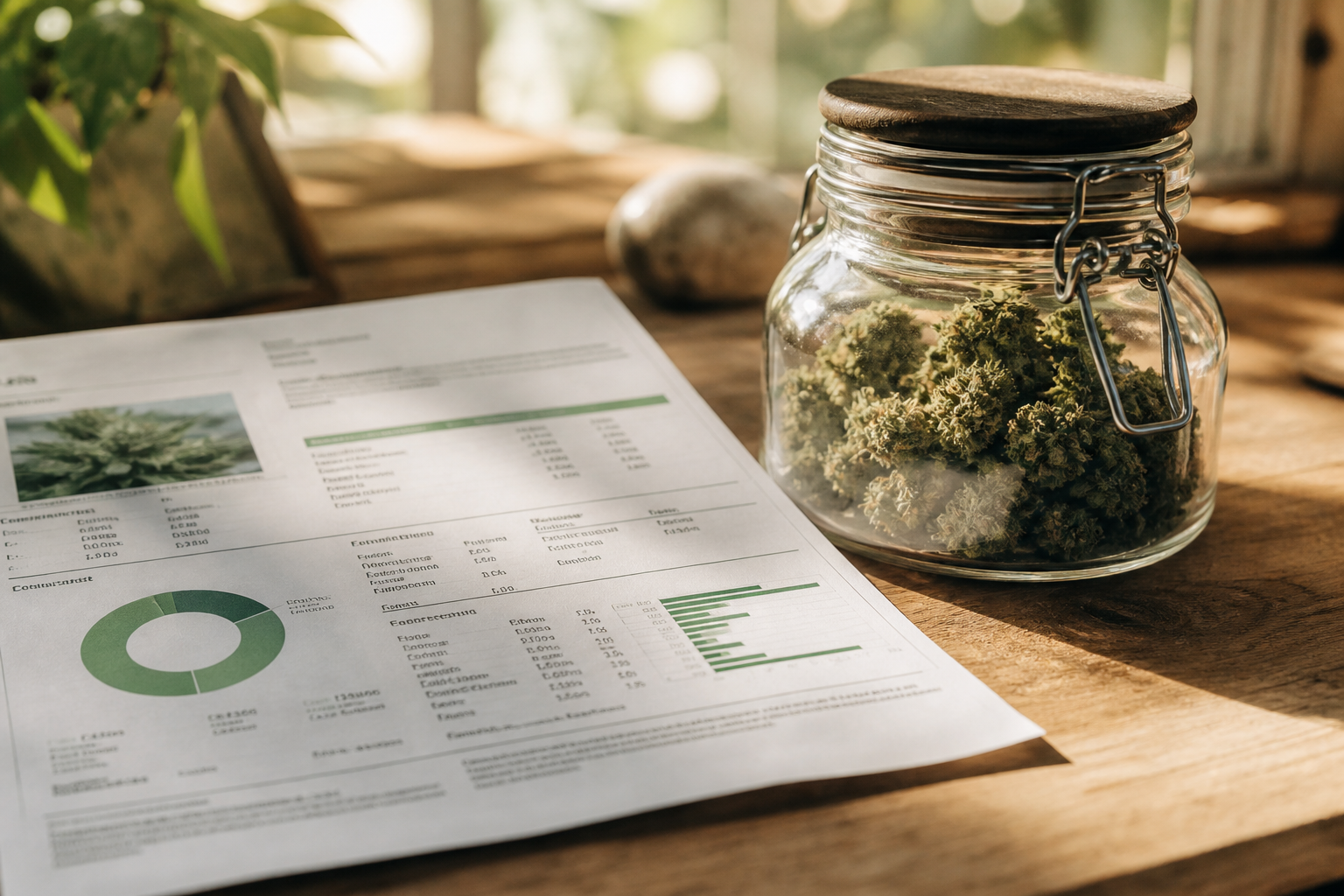
A terpene panel is the lab list of individual terpenes — usually shown as percentages — measured in a specific cannabis batch. It sits on (or with) the Certificate of Analysis, also called a COA: the lab report tied to that lot after testing.
Think of the COA like a nutrition label for plant chemistry. Cannabinoids (THC, CBD, and minors) tell you potency direction. The terpene panel tells you aroma direction and, for many people, the "shape" of the experience. Michigan safety testing is about pass/fail compliance; terpene lists are extra detail many labs still report. The Michigan Cannabis Regulatory Agency (CRA) Sampling and Testing Technical Guidance even notes that Metrc and COA results should match for required tests, "aside from… testing not required by the agency (i.e., terpenes)."
For the wider "what lab tested means" picture in Michigan, read what lab-tested means for Michigan cannabis.
Dominant vs supporting terpenes #
- Dominant terpene: the single highest percentage on the panel. This is your first shopping filter.
- Supporting terpenes: usually the next two to five compounds. They add depth — citrus under pine, spice under earth, floral under mango.
- Trace terpenes: tiny amounts that may still matter for aroma but rarely drive your first buying decision.
Example of how to read a panel out loud: "Myrcene-forward with caryophyllene and limonene support." That sentence is more useful than "Purple something Kush."
Total terpenes in plain English #
Total terpenes is the sum of measured terpenes, often shown as a percent by weight. Consumer guides commonly treat flower around 1%–2% as moderate aroma and above about 2% as richer and louder — with excellent lots sometimes landing in the 3%–4%+ range depending on cultivar and lab method. Treat those bands as shopping heuristics, not hard law.
| Total terpenes (flower, rough guide) | What it often means at the counter |
|---|---|
| Under ~1% | Flatter smell; chemistry may feel thin |
| ~1%–2% | Solid everyday aroma |
| Above ~2% | Noticeably louder and more layered |
| ~3%–4%+ | Very expressive lots (when real and fresh) |
Numbers alone are not enough. A 3% total panel that is stale in a hot car will still disappoint. Pair the panel with freshness and storage habits — see how to store your weed.
What Do Michigan Cannabis Labels Require — and What About Terpenes? #
Michigan law requires THC, CBD, lab identity, strain name (if applicable), and other safety/ID fields on the sealed package — but it does not require a terpene panel on the label. That is the most important shopping fact for Michigan consumers in 2026: terpene literacy means asking for the COA, not assuming the jar sticker has everything.
Per Mich. Admin. Code R. 420.504, before a product is sold or transferred at a sales location, the sealed container must carry a long list of required information. The Michigan CRA Combined Best Practices bulletin walks licensees through the same cultivator/producer-to-sales labeling checklist.
What must be on the sealed package #
Here is the consumer-facing short list from R 420.504:
| Required on MI package label | Why shoppers care |
|---|---|
| Cultivator/producer name + license + Metrc package tag | Traceability and who grew/made it |
| Packager name + license (if different) | Who put it in the final pack |
| Harvest date (if applicable) | Freshness clue |
| Strain name (if applicable) | Nickname only — not chemistry |
| Net weight | How much you are buying |
| THC and CBD + 10% variance statement | Potency range, not a guarantee |
| Activation time | Especially useful for edibles/infused |
| Lab name + test analysis date | Who tested it and when |
| Universal marijuana symbol | Legal product marker |
| Required warnings (drive, poison control, age/patient, pregnancy) | Safety and legal notices |
Notice what is missing: myrcene, limonene, pinene, linalool, caryophyllene. Those live on the optional terpene section of many COAs, not on the mandatory label checklist.
Why you often have to ask for the COA #
In Michigan stores from Detroit to Grand Rapids, some menus and jars show terpene highlights. Many do not. Your job as a shopper is polite and direct:
- Ask for the batch COA or terpene profile for the exact package tag.
- Confirm the test date is recent and matches the lot.
- Write down the top three terpenes and total terpenes if listed.
- Use the strain name only as a search handle after you like a panel.
The CRA's testing guidance makes the regulatory split clear: required safety results are compliance-critical; terpenes are called out as testing not required by the agency. So when a budtender says "we don't print terps on the box," they may be following the rulebook. That does not stop you from shopping smarter with the lab PDF.
Also remember Michigan CRA rules bar deceptive medical claims in marketing under the broader sales framework — another reason to trust measured panels over miracle strain stories.
How Do You Read Dominant and Supporting Terpenes? #
Read a terpene panel top-down: total terpenes first, then the dominant terpene, then the next two supports — and only then look at THC. That order keeps you from buying a loud THC number with a flat aroma stack.
You are building a short "recipe card," not memorizing the whole lab PDF. Three names and three percentages will take you farther than twenty strain nicknames.
A simple panel-reading checklist #
Use this at any licensed Michigan counter:
- Match the batch. Confirm the COA lot/package info lines up with the jar in your hand.
- Note the test date. Older reports can still be valid for compliance, but aroma chemistry can fade with heat, air, and time.
- Circle total terpenes if listed.
- Star the #1 terpene (dominant).
- Underline #2 and #3 (supports).
- Write a one-line story: "Earthy-sleepy myrcene with peppery caryophyllene and soft linalool."
- Compare two options with similar THC. Prefer the panel that matches your goal and smells alive.
| Panel pattern | Plain-English story | First question to ask yourself |
|---|---|---|
| Myrcene-dominant | Earthy, musky, often heavier body feel | Do I want evening wind-down? |
| Limonene-dominant | Citrus, brighter mood tone | Do I want daytime lift? |
| Pinene-dominant | Pine, resin, clearer head for many people | Do I want alertness over couch? |
| Linalool-forward support | Floral/lavender calm | Do I want soft edges on anxiety or sleep? |
| β-Caryophyllene-forward | Pepper/spice, body-comfort reputation | Do I want grounded body ease? |
Deep dives on two of those molecules live here: linalool lavender terpene guide and beta-caryophyllene CB2 guide.
When percentages look thin or stale #
Red flags while shopping in Michigan:
- No terpene data at all and no way to pull a COA — you are buying blind on aroma chemistry.
- Trace-only totals with a big THC brag — potency without character.
- Panel does not match the nose on flower you can smell — possible age, storage, or just a weak lot.
- You loved a name last month, hate this jar — check whether the dominant terpene flipped.
A panel is a snapshot of one batch. It is not a forever passport for that strain name.
Which Terpenes Match Common Goals? #
Match goals to dominant terpenes as shopping heuristics — not medical guarantees. Early research and traditional use map common terpenes to broad feel directions, but your dose, tolerance, method, and biology still run the show.
A Molecules review (PMC8489319) summarizes widely discussed associations: myrcene with more sedating chemotypes in literature (including the often-cited ~0.5% myrcene threshold in that review's consumer-facing discussion), β-caryophyllene as a CB2-active sesquiterpene, and limonene/linalool/pinene with calming, mood, or alertness themes drawn from broader terpene pharmacology. Treat that as a map, not a prescription.
| Goal | Terpenes to prioritize on the panel | Aroma clues | Honest hedge |
|---|---|---|---|
| Evening rest / heavier body | Myrcene, linalool, β-caryophyllene | Earth, musk, lavender, pepper | Sleep also depends on THC dose and timing |
| Soft calm / less jagged | Linalool, β-caryophyllene, modest limonene | Floral, spice, light citrus | Anxiety responses vary a lot person to person |
| Daytime mood lift | Limonene, pinene (watch myrcene load) | Citrus, pine | High THC can still overwhelm "bright" terps |
| Clearer head / focus vibe | Pinene, limonene | Pine, lemon, resin | Not a stimulant replacement |
| Body comfort / grounded feel | β-Caryophyllene, myrcene, humulene | Pepper, clove, hops/earth | Evidence is stronger mechanistically for caryophyllene than for many others |
β-Caryophyllene is special in the literature because it can engage CB2 receptors — immune-system receptors in the endocannabinoid system — as discussed in PMC9568608. That is one reason peppery panels show up so often in "body" shopping talk.
Sleep and evening wind-down #
For night, many Michigan shoppers start with myrcene-forward flower, then check whether linalool or β-caryophyllene support the stack. The PMC8489319 review notes that higher-myrcene chemotypes are commonly described as more sedating in cannabis culture and preclinical discussion. Keep THC honest: a "sleepy terp stack" with a huge THC hit can still feel racy for some people.
Practical evening script: "Show me myrcene-dominant lots with linalool or caryophyllene in the top three."
Daytime calm, mood, and focus #
For daytime, look for limonene and pinene near the top, with myrcene not steamrolling the panel. Citrus-forward and pine-forward jars are the usual nose match. If you need soft edges without a nap, a linalool support line under limonene can be a sweet spot for some people — again, personal testing beats folklore.
Save the panels that work after a real-world trial (workday, weekend chore day, quiet night). Your notes beat any budtender's favorite nickname.
Why Indica and Sativa Labels Are Weak Shopping Tools #
Indica, sativa, and hybrid stickers are weak predictors of how a Michigan jar will feel — chemotype (cannabinoids + terpenes) is the better shopping frame. Use plant labels as rough morphology slang if you want. Do not treat them as a lab result.
We unpack this fully in indica vs sativa vs hybrid: what actually matters. Here is the shopping version.
What research says about the labels #
A 2021 Nature Plants study found that cannabis labeling tracked only a small number of terpenes linked to terpene-synthase gene variation — not a clean genetic split that proves "indica = sleepy" and "sativa = energetic." A PMC review (PMC8517044) likewise notes that strong empirical proof for effect differences by these plant-species labels is lacking.
In plain English: the sticker on the shelf is often more marketing shelf language than pharmacology.
Observational work such as PubMed 36648357 has explored how terpene profiles and cultivar labels relate to subjective effects in real users. That kind of research supports shopping by measured chemistry more than by folklore categories — without proving that any one terpene "determines" your high every time.
Chemotype beats plant nickname #
Chemotype means the measured chemical pattern of a batch: THC/CBD ratio, minor cannabinoids when listed, and the terpene panel.
| Shopping shortcut | Reliability for predicting feel | Better move |
|---|---|---|
| "Indica" sticker | Low | Ask for myrcene/linalool/caryophyllene stack |
| "Sativa" sticker | Low | Ask for limonene/pinene stack |
| Strain name alone | Low–medium | Save the panel from batches you liked |
| THC % alone | Medium for intensity, poor for vibe | Pair THC with terpene panel |
| Batch terpene panel + THC | Highest practical signal | Rebuy matching chemistry |
The so-called entourage effect — the idea that cannabinoids and terpenes work better together — is a useful shopping story, but science is still mixed. A 2023 scoping review (PMC10452568) described the evidence as contradictory and inconclusive, and later commentary continues to treat strong synergy claims as unproven. For the whole-plant framing we use at Divine Toke, see the entourage effect guide. Shop the measured mix. Do not pay a premium for the buzzword alone.
Step-by-Step: How to Shop by Terpenes at a Michigan Dispensary #
Walk in with a goal, ask for the batch terpene panel, pick by the top three terpenes, then confirm with nose and THC — in that order. This works in Detroit dispensaries and anywhere else under Michigan CRA rules.
Michigan adult-use shoppers are buying inside a regulated label system that prioritizes potency and safety ID, not terpene storytelling. Your workflow fills that gap.
Questions to ask the budtender #
Use this script. Short. Clear. No jargon wall.
- "I'm shopping by terpene panel, not strain name. Can I see the COA for this batch?"
- "What are the top three terpenes and their percentages?"
- "What is total terpenes, if it's listed?"
- "When was this tested, and is this the same package tag?"
- "Do you have another lot with a similar panel — even under a different name?"
Then run the floor workflow:
| Step | Action | Pass / fail cue |
|---|---|---|
| 1 | Name your goal (sleep, calm, daytime, body ease) | You can say it in one sentence |
| 2 | Pull COA / terpene panel | Batch matches the jar |
| 3 | Rank top 3 terpenes | You can say the stack out loud |
| 4 | Compare 2–3 options at similar THC | Panel, not nickname, decides |
| 5 | Smell if the store allows | Aroma roughly matches the panel story |
| 6 | Check harvest/test dates | Not ancient, not cooked in a hot case |
| 7 | Buy the smaller amount first if new | Test before you commit to an ounce habit |
| 8 | Photograph or note the panel | Future you can rebuy chemistry |
Michigan sealed packaging can limit smell access. If jars are closed, lean harder on the COA and ask staff which lots customers rebuy for the same terp stack. Nose-shopping still helps when flower is available to smell — pair both methods with our nose-shopping guide.
How to rebuy a winner later #
After a good night or a good workday, log:
- Date and store (city is enough — Detroit, Ann Arbor, Lansing, etc.)
- Strain name (search handle only)
- Package/test date if you have it
- Top three terpenes + percentages
- Total terpenes
- THC %
- Dose and method
- One sentence on how it felt
Next visit, shop the panel pattern first. If the beloved name is gone, ask for "something myrcene-dominant with caryophyllene and linalool support" (or whatever your winning stack was). That sentence is the whole skill.
Sun-grown, carefully cured flower often shows louder terpene character when the grow and post-harvest are done well — which is why Divine Toke talks chemistry first. Still, never invent a farm story from a nickname. Trust the batch report in your hand.
Common Mistakes When Buying by Terpene Panel #
The biggest mistakes are treating terpenes like magic, ignoring THC dose, trusting names over batch data, and shopping stale flower with a pretty old PDF. Avoid those and panel shopping gets simple fast.
| Mistake | Why it bites | Better habit |
|---|---|---|
| Buying the name that worked last time | Chemistry drifted | Rebuy the terpene stack |
| Chasing the highest THC | Intensity ≠ vibe | Match THC band + panel |
| Treating indica/sativa as science | Labels are weak predictors | Shop chemotype |
| Ignoring total terpenes | Flat lots hide behind big names | Prefer richer, fresher panels |
| Assuming every MI label lists terps | CRA does not require terpene labels | Ask for the COA |
| Over-trusting "entourage" marketing | Evidence is mixed | Pay for measured composition |
| Skipping your own notes | Memory lies | Keep a tiny panel journal |
| Smoking a new panel right before a work shift | Impairment is real | Test timing on off hours |
A few Michigan-specific notes:
- Sealed packaging can block the smell check. That makes the COA more important, not less.
- Hot cars and humid summers around southeast Michigan punish terpenes. Get flower home cool and sealed. Storage habits matter as much as the purchase — again, how to store your weed.
- Budtender favorites are useful as leads. They are not a substitute for the panel on your batch.
- Medical claims on a menu should make you slow down. Michigan's sales rules and CRA consumer-protection framing are why measured lab data beats miracle language.
If a product cannot show batch-linked chemistry, you are guessing. Guessing is how people waste money on nicknames.
Frequently Asked Questions #
Do Michigan cannabis labels have to list terpenes? #
No. Michigan's required package label fields do not include a terpene panel. Under Mich. Admin. Code R. 420.504, labels must show things like THC/CBD, lab name, strain name if applicable, and warnings — not myrcene or limonene percentages. Ask for the batch COA when you want terpene detail.
What is the difference between a COA and the package label? #
The label is the sticker on the sealed pack; the COA is the lab report for that batch. Michigan labels must carry required ID and potency fields. The COA documents testing results and may include optional terpene data the CRA testing guidance notes is not agency-required. Shoppers use both: label for legal basics, COA for chemistry depth.
Is shopping by terpenes better than indica or sativa? #
For predicting feel, a terpene panel is usually a better tool than indica/sativa stickers. A Nature Plants 2021 study and PMC8517044 both undercut the idea that those plant labels cleanly predict effects. Many people still use indica/sativa as casual shorthand — just do not let the sticker overrule the chemotype.
What total terpene percentage is good in flower? #
Many consumer guides treat about 1%–2% as moderate and above ~2% as richer, with standout lots higher — but freshness matters as much as the number. There is no official Michigan "good terpene" cutoff. Compare totals across options at similar THC, then trust your nose and your notes after you try the batch.
Can two jars with the same strain name have different terpene panels? #
Yes. Same name, different batch, different chemistry is common. Grow conditions, harvest timing, cure, and storage all move volatile terpenes. That is exactly why Divine Toke teaches strain by terpene panel, not by name.
Do terpenes get you high by themselves? #
Not in the THC sense. THC drives intoxication; terpenes mainly shape aroma and may modulate the experience. Reviews such as PMC8489319 discuss terpene pharmacology widely, but terpenes are not a substitute for cannabinoid dose. Shop them as the seasoning, not the whole meal.
Which terpenes should I look for for sleep or calm? #
Start with myrcene- and linalool-forward panels, often with β-caryophyllene support — then test carefully with your own dose. The PMC8489319 review associates higher-myrcene chemotypes with more sedating descriptions in the literature, and linalool carries a long calming/aromatherapy story. Results still vary by person, THC level, and timing.
What should I ask a Michigan budtender about terpenes? #
Ask for the batch COA, the top three terpenes with percentages, total terpenes if listed, and whether another lot matches that panel under a different name. Add the test date and package-tag match. That five-question script turns a Michigan counter stop into chemotype shopping instead of nickname shopping.
Why doesn't the smell always match the panel? #
Age, heat, air, humidity, and packaging can mute aroma even when an older COA still looks decent on paper. Southeast Michigan summer heat and winter dry air both punish flower if storage is sloppy. If smell and panel disagree hard, believe the jar in front of you and skip the tired lot.
Should I ignore THC percentage completely? #
No. Use THC for intensity and the terpene panel for vibe. A bright limonene panel with very high THC can still feel heavy or edgy. A modest THC lot with a rich panel can feel more satisfying than a loud, flat 30% jar. Read both.
How fresh does a terpene COA need to be? #
Prefer recent test dates and harvest dates when aroma is your priority. Compliance testing proves the batch passed required checks at test time; it does not freeze terpenes forever. If the jar has been cooked under lights for weeks, the PDF will not save the experience.
Can I shop this way if jars are sealed and I can't smell the flower? #
Yes — lean harder on the COA and your written panel notes. Sealed Michigan packaging is normal. Ask staff for batch terpene data, compare top-three stacks, buy a small amount first, and log what actually worked. Nose-shopping is a bonus when available, not a requirement.
Closing Thoughts: Buy the Chemistry, Not the Nickname #
If you remember one Divine Toke rule at the Michigan dispensary, make it this: buy the terpene panel, not the strain name. The nickname gets you to the shelf. The panel tells you what you are actually taking home.
At Divine Toke, we care about sun-grown, whole-plant character — the kind of flower where aroma chemistry is part of the point, not an afterthought. If you are curious to try flower chosen for real terpene expression rather than hype labels, start with whatever current lots match the panel pattern you already know you like. Keep notes. Rebuy chemistry. Ignore the myth that a name is a promise.
Keep learning in the cluster:
- What are terpenes?
- How to nose-shop for cannabis
- Indica vs sativa vs hybrid: what actually matters
- What "lab tested" means in Michigan
- Linalool guide
- Beta-caryophyllene and CB2
This article is for educational purposes only and is not medical advice. Always consult your healthcare provider before starting any new wellness routine.
Grown in Detroit. Shipped to your door.
Small-batch, sun-grown cannabis cultivated in living soil. Mail-order shipping to all 50 states.