Beta-Caryophyllene: The Spicy Terpene That Binds Your CB2 Receptors

Jamie
Head Cultivator
Beta-caryophyllene is the peppery terpene in cannabis that can bind your CB2 receptors — the same family of locks your body uses for swelling and immune balance. That is why scientists call it a dietary cannabinoid. This guide shows what that means for everyday Michigan shoppers.
What Is Beta-Caryophyllene? #
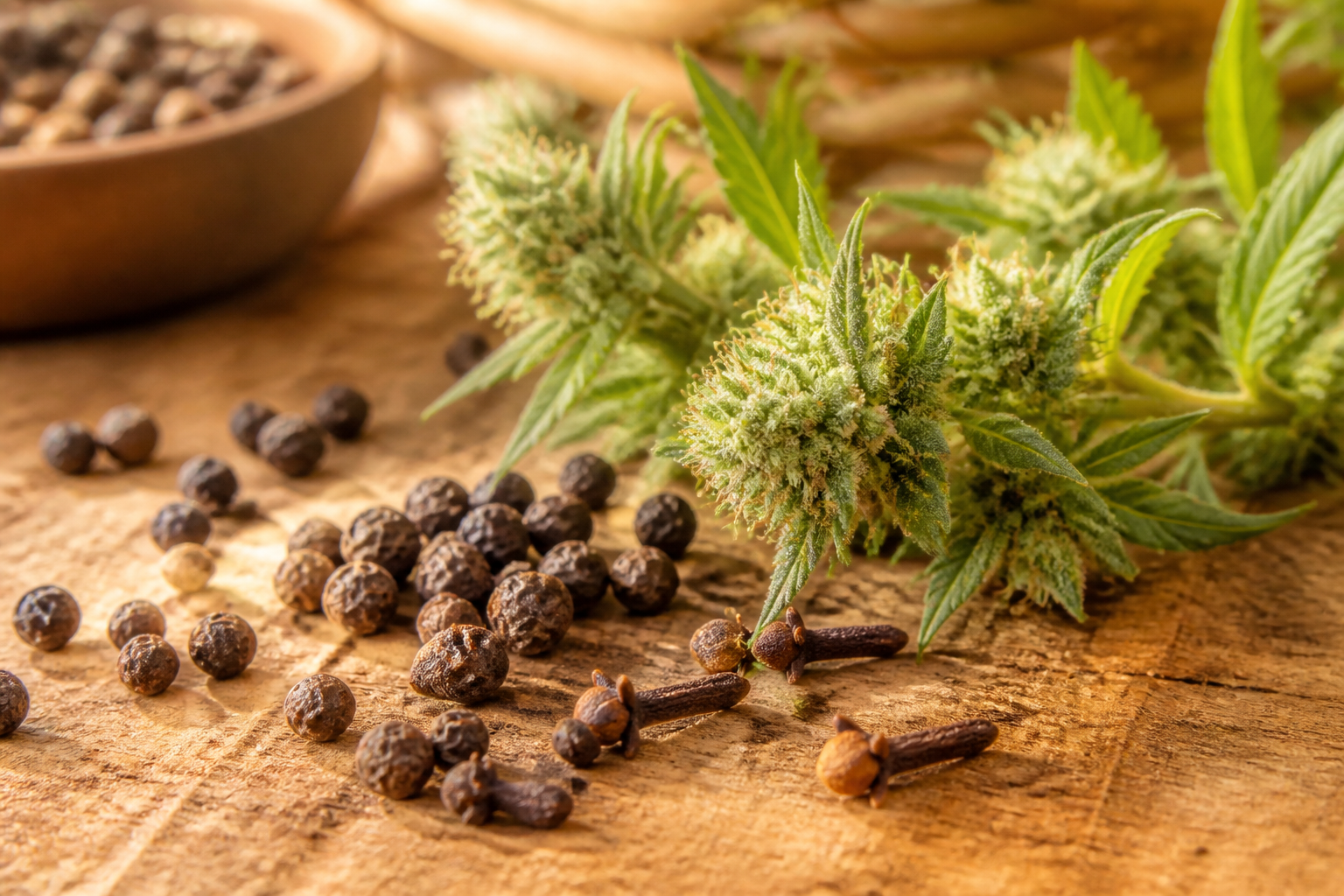
Beta-caryophyllene (also written β-caryophyllene or BCP) is a spicy, peppery plant oil molecule — a terpene — found in cannabis, black pepper, cloves, and hops. It is the only common cannabis terpene shown to bind directly to your body's CB2 receptors, which is why researchers call it a dietary cannabinoid.
If you already read our what are terpenes guide, think of terpenes as the spices in the plant's recipe. Most terpenes shape smell, taste, and mood of the experience. Beta-caryophyllene goes one step further: it can talk to part of your endocannabinoid system — the internal signaling network that helps keep swelling, mood, and gut comfort in balance.
A few plain facts to lock in:
- Chemical family: It is a sesquiterpene — a heavier, oilier terpene than sharp citrus notes like limonene.
- Smell cue: Black pepper, clove, warm wood, and a little earth.
- Cannabis role: Often shows up mid-to-high on flower terpene panels when the jar smells spicy.
- Big difference: It can activate CB2 receptors without the intoxicating CB1 path that THC uses.
You do not need a chemistry degree to use this. If a jar smells like cracked pepper and warm spice, beta-caryophyllene is a good bet on the lab sheet.
How Beta-Caryophyllene Smells and Tastes #
On the nose, beta-caryophyllene reads as pepper, clove, and woody spice — not sweet fruit or pure pine. That is why seasoned shoppers call BCP-forward flower "peppery" or "spicy."
Use these kitchen analogies when you shop:
- Black pepper crack — sharp, dry heat without chili burn
- Whole cloves — warm, slightly sweet spice cabinet note
- Hoppy beer bitterness — woody, herbal backbone (hops also carry BCP)
- Oregano / Italian herbs — earthy kitchen spice, not candy
Smell is a clue, not a lab test. Two batches can smell similar and still list different terpene percentages. Pair your nose with the COA — more on that below, and in our nose-shopping terpene guide.
Where Else Nature Puts This Terpene #
Beta-caryophyllene shows up across the spice rack and the hop field, not only in cannabis. That food presence is part of why scientists labeled it a dietary cannabinoid after it was shown to activate CB2.
According to a National Toxicology Program chemical background summary on β-caryophyllene, compiled food-chemistry data put cloves and black pepper near the top of the list:
| Source | What the data suggests | Kitchen takeaway |
|---|---|---|
| Cloves | About 10,300–16,000 ppm in surveyed food data | One of the richest everyday spice sources |
| Black pepper | About 2,300–10,000 ppm | The classic "peppery" reference smell |
| Oregano / hops / cinnamon / basil | Common essential-oil constituents (often listed in reviews as major or notable fractions) | Same spicy-herbal family as BCP-forward cannabis |
Those ppm numbers describe concentrated plant chemistry surveys — not the dose you get from one sprinkle of pepper at dinner. Still, they explain the smell match: when cannabis leans peppery, your brain is recognizing a spice note you already know.
Why Does Beta-Caryophyllene Act Like a Cannabinoid? #
Beta-caryophyllene acts like a cannabinoid because it can bind and turn on CB2 receptors — the same receptor family your body's own calming signals use — without meaningfully activating CB1, the main "high" receptor. In plain English: it fits a lock that usually belongs to cannabis-related chemistry, even though BCP itself is a terpene from the spice world.
The landmark paper is Gertsch et al., 2008 in PNAS. That team showed β-caryophyllene is a selective CB2 agonist — a molecule that prefers CB2 and activates it. Later reviews, including a 2021 focused review of CB2-selective BCP pharmacology (PMC8163236), summarize the same core idea: BCP behaves as a full, selective CB2 agonist with little CB1 affinity.
Here is the thermostat analogy that sticks:
- Your endocannabinoid system is like a house thermostat for comfort signals.
- CB1 is more like the dial tied to brain buzz and intoxication (THC's main door).
- CB2 is more like the dial on immune cells and peripheral tissue — swelling, recovery, gut immune noise.
- Beta-caryophyllene can twist the CB2 dial. It does not slam the CB1 dial the way THC does.
That is the whole "terpene that acts like a cannabinoid" story — mechanism first, marketing second. For a fuller map of both receptors, see our CB1 and CB2 receptors explained guide.
CB2 vs CB1 — Why You Do Not Get High From BCP Alone #
You do not get high from beta-caryophyllene alone because it targets CB2, not the CB1 path that drives intoxication. THC is the main player for the high. BCP is a supporting character with a different job.
| Feature | CB1 (think: brain buzz) | CB2 (think: body calm signals) |
|---|---|---|
| Main vibe | Intoxication, appetite, mood intensity | Immune tone, swelling signals, peripheral comfort |
| Classic plant key | THC | Beta-caryophyllene (dietary cannabinoid) |
| Does BCP bind here? | Little / not meaningful in the key studies | Yes — selective agonist |
| Will BCP alone get you high? | N/A | No |
A 2024 therapeutic-potential review of β-caryophyllene (PMC10970213) keeps repeating the useful consumer line: BCP's CB2 selectivity helps explain anti-inflammatory and analgesic interest without THC-like psychoactivity. That does not mean a spicy flower will not get you high — flower still has THC. It means the peppery terpene itself is not the intoxicating piece.
What “Dietary Cannabinoid” Actually Means #
“Dietary cannabinoid” means a food-plant compound that can engage cannabinoid receptors — not that dinner pepper is a substitute for medical cannabis. The phrase comes from science writing after the 2008 PNAS work, not from a snack-food marketing team.
Break the label into two honest parts:
- Dietary — BCP is common in edible plants and spices (pepper, cloves, hops, oregano). Food regulators have long treated caryophyllene-type flavor compounds as ordinary flavor chemistry; reviews note GRAS / food-additive status for related uses (PMC7599522, PMC9104399).
- Cannabinoid-like action — Unlike most kitchen terpenes, BCP can activate CB2 in receptor assays and animal models.
So when you hear "dietary cannabinoid," translate it as: a spice-rack terpene that can talk to CB2. It is not a promise that black pepper tea will replace a carefully chosen cannabis product. Dose, delivery, and the rest of the plant (THC, CBD, other terpenes) still matter — which is why the entourage effect still earns its keep.
How Beta-Caryophyllene May Support Comfort and Calm Swelling #
Early research suggests beta-caryophyllene may help calm swelling signals and support physical comfort through CB2-linked pathways — with strong animal data and only early, limited human trials so far. Treat this as science-informed hope, not a cure claim.
Reviews such as PMC7692661 and PMC10970213 describe BCP reducing pro-inflammatory messengers in preclinical models — including signals people hear about in plain talk as "swelling chemicals" (TNF-α, IL-1β, IL-6, and NF-κB pathways). A Frontiers in Pharmacology review (2021) also frames BCP's CB2 activity as a reason it keeps showing up in gut and inflammation research.
Evidence strength at a glance:
| Area | What we know as of 2026 | Honesty check |
|---|---|---|
| Biology / mechanism | CB2 agonist; anti-inflammatory signaling in many lab models | Strongest part of the story |
| Animal pain / swelling models | Repeated benefit signals across reviews | Promising, not human proof |
| Human pain trials | Small / narrow studies (e.g., exercise soreness); limited neuropathy reports in reviews | Early — not guideline-level care |
| Gut comfort | Mostly preclinical; plausible CB2 gut-immune angle | Interesting, still preliminary |
If you are shopping for comfort first, also read our cannabis for pain natural relief guide. Terpenes are one layer. Dose, method, and how your body responds still lead.
What Early Research Suggests About Pain #
Human pain evidence for beta-caryophyllene is promising but narrow — not a green light to drop prescribed care. The best-known controlled human example is a randomized, double-blind, placebo-controlled crossover study of a liposomal BCP product for delayed-onset muscle soreness (DOMS), published in ACS Omega. That study reported less DOMS pain and better recovery markers without side effects in that short exercise model.
What that means for a Detroiter with a sore back after a double shift:
- It supports the idea that oral BCP formulations can be studied in people and may feel relevant to muscle recovery.
- It does not prove BCP treats arthritis, nerve pain, or chronic back pain on its own.
- Reviews that mention neuropathic pain signals (summarized in PMC10970213) are encouraging, but the clinical base is still small.
Practical consumer translation:
- Prefer whole-plant products with a real terpene panel — not a mystery cart with no COA.
- Look for beta-caryophyllene near the top of the terpene list if spicy comfort is your goal.
- Start low with THC if intoxication is a concern — BCP will not cancel a heavy THC dose.
- Track how you feel for a week. Your body is the final lab.
The Gut Angle — Calm Signals in the Belly #
Beta-caryophyllene is one of the terpenes people watch for gut comfort because CB2 receptors sit on immune cells in and around the digestive tract — but most gut evidence is still preclinical. In other words: the biology makes sense; the big human trials are not there yet.
Reviews covering BCP and digestive inflammation — including the Frontiers Pharmacology 2021 overview — describe potential interest for gastritis, ulcer models, barrier stress, and inflammatory bowel patterns in animals. That lines up with why spicy-herbal terpene mixes show up in our best terpene profiles for digestive comfort guide.
Gut-side checklist for shoppers:
- Smell: pepper + herb, not pure candy fruit
- COA: BCP listed (ideally with humulene or limonene as supporting notes)
- Format: some people prefer flower or tinctures over heavy fried edibles when the belly is already loud
- Expectations: look for "may ease" comfort, not "cures Crohn's"
Always talk with your clinician if you have IBD, ulcers, or complex gut disease. Plant chemistry is not a substitute for medical care.
Beta-Caryophyllene vs Other Cannabis Terpenes #
Beta-caryophyllene is unique among common cannabis terpenes because it is a direct CB2 agonist; myrcene, limonene, and linalool shape aroma and experience mostly through other paths. That is the cleanest way to compare them without hype.
Reviews that treat BCP as an atypical / dietary cannabinoid — including PMC8163236 and PMC10970213 — put the spotlight on receptor binding. Myrcene and limonene matter a lot for smell and how a session feels, but they are not established CB2 agonists in the same Gertsch-style sense.
| Terpene | Smell cue | Cannabinoid-receptor claim | Common shopper goal |
|---|---|---|---|
| Beta-caryophyllene | Pepper, clove, woody spice | Direct CB2 agonist (dietary cannabinoid) | Comfort, swelling calm, spicy profiles |
| Myrcene | Mango, earth, hops | Not a CB2 agonist like BCP | Couchy / sleepy sessions for many people |
| Limonene | Citrus peel | Not a CB2 agonist like BCP | Bright mood / daytime lift for many people |
| Linalool | Lavender, floral | Not a CB2 agonist like BCP | Soft calm / wind-down aroma |
How to use the table in a Michigan dispensary:
- Want spicy comfort chemistry → scan for BCP first.
- Want sleepy earth → myrcene may lead, with BCP as support.
- Want citrus daytime → limonene may lead; BCP can still sit in the mix.
- Want whole-plant synergy → do not chase one terpene in isolation; the entourage effect is the team sport.
No single terpene "is" the strain. Batch chemistry moves. Read the panel every time.
How to Spot Beta-Caryophyllene on a Cannabis COA #
To find beta-caryophyllene on a COA, open the terpene (or terpenoid) panel and look for “beta-caryophyllene,” “β-caryophyllene,” or sometimes just “caryophyllene,” then read the percentage or mg amount next to it. That one line is your proof — not the strain nickname on the jar.
Consumer COA explainers — including the New Jersey Cannabis Control Commission’s “How to Read a COA” guide — put terpenes in their own section beside cannabinoids and safety tests. Michigan shoppers should do the same: ignore the marketing sticker first, then read the sheet. For the bigger Michigan testing picture, see what “lab tested” means in Michigan.
Step-by-step:
- Ask for the batch COA (QR code, budtender printout, or brand site).
- Find the terpene panel — not the THC% banner.
- Scan names for beta-caryophyllene / β-caryophyllene / caryophyllene.
- Note the number — usually a % of the sample; sometimes mg/g or mg per serving.
- Rank it against other terpenes on the same sheet (is it #1, #2, or a trace?).
- Confirm the batch ID matches the product in your hand.
In Michigan, licensed labs may run terpene analysis with an agency-approved method under Michigan Administrative Code R 420.305. Michigan CRA sampling and testing technical guidance also explains how terpenoid results should be reported on the certificate when that testing is performed (including percentage and mg/serving style reporting). Safety panels are still the non-negotiable pass/fail layer — terpenes are the flavor-and-feel layer.
Names You Will See on Lab Reports #
Labs do not always spell this terpene the same way — train your eye for three common labels.
| Label on COA | Same compound? | Notes |
|---|---|---|
| beta-caryophyllene | Yes | Most common full English spelling |
| β-caryophyllene | Yes | Greek beta (β) — identical meaning |
| caryophyllene | Usually yes in cannabis panels | Short form; confirm it is not a different isomer if the lab lists several |
| trans-caryophyllene | Closely related naming | Sometimes used interchangeably in consumer talk; check the lab's glossary if unsure |
If the sheet lists a long terpene menu and BCP is missing entirely, either the lab did not quantify it or levels were below reporting limits. Ask. A blank is not the same as "zero forever."
What Counts as a Strong Showing? #
A “strong” beta-caryophyllene showing means it ranks high on that batch’s own terpene list — not that it hits a magic universal percentage. Percentages swing with genetics, harvest, cure, and lab method. Directional reading beats fake precision.
Use this shopper scale:
- Dominant / leading — BCP is #1 or clearly near the top of the terpene stack; jar often smells peppery.
- Strong support — BCP is in the top three behind myrcene or limonene; spice is still noticeable.
- Moderate — Mid-list; may add warmth without owning the nose.
- Trace / not reported — Do not market the batch as a BCP product.
Avoid quoting a single “ideal %” for every strain. That is how blogs invent numbers. Compare within the COA in your hand, then smell the flower. If the numbers and the nose disagree wildly, trust the nose and ask about storage age — terpenes fade when jars are abused.
Practical Shopping Tips for Michigan Consumers #
Shop for beta-caryophyllene with three tools: your nose, the terpene panel, and a clean Michigan COA — then buy whole-plant flower you can actually verify. Do not chase a strain nickname that “always has BCP.” Batches lie; lab sheets do not (when they are real).
Michigan-ready checklist:
- Smell first — cracked pepper, clove, warm wood.
- Confirm on the COA — beta-caryophyllene near the top of the terpene list.
- Check safety passes — pesticides, heavy metals, microbes, and the rest of the required panels (Michigan CRA testing guidance).
- Match batch IDs — sticker, receipt, and COA should agree.
- Prefer transparent growers — sun-grown organic programs that publish full panels beat mystery indoor with only a THC boast.
- Start with a small amount if the THC is high — spicy does not mean gentle.
At Divine Toke, we grow sun-grown organic flower in Michigan with the same obsession: real plant chemistry you can smell and verify. We will not invent a strain name here. Ask for the current batch sheet and let BCP (and the rest of the terpene stack) speak for itself.
Pair Your Nose With the Lab Sheet #
Nose shopping finds candidates; the COA confirms them. Use both or you are guessing.
A simple loop:
- Walk the jar → note pepper / spice / wood
- Pull the QR / COA → find β-caryophyllene
- Compare rank → is it leading or riding shotgun?
- Check date → fresher cure usually means louder terpenes
- Buy small first → confirm the experience matches the sheet
Deepen the smell skill with our terpenes nose-shopping guide, and keep the compliance basics handy in what lab tested means in Michigan.
Storage Mistakes That Kill Spicy Terpenes #
Heat, air, light, and grinding early will flatten beta-caryophyllene’s pepper note faster than you think. Protect the oil, protect the experience.
Do this:
- Store in an airtight glass jar, not a loose plastic bag
- Keep it cool and dark — not on a sunny dashboard
- Avoid constant open-and-sniff sessions that vent aroma
- Grind right before you use it, not days ahead
- Skip wet produce drawers and hot glove boxes
Terpenes are volatile. That pepper snap is fragile chemistry, not a permanent tattoo on the flower.
Is Beta-Caryophyllene Safe? #
At food-flavor and studied oral doses, beta-caryophyllene has a generally favorable safety picture; inhaled cannabis use is common but has thinner BCP-specific human safety data than oral/food exposure. Plain version: kitchen-level and studied oral BCP look calm; smoking or vaping whole flower is a different exposure path and should be treated with normal cannabis caution.
What the literature supports:
- A 2022 human oral BCP formulation study (PMC9104399) reported products were well tolerated, with no treatment-related serious adverse events in that trial and no clinically concerning vital-sign or blood-parameter signals that raised safety alarms for the authors.
- Reviews note BCP’s long use as a flavoring / food additive and GRAS-style framing for dietary exposure (PMC7599522, PMC9104399).
- Animal toxicology summaries in those same papers describe high oral NOAEL-style margins relative to food use — useful context, not a free pass for megadosing supplements.
- Inhalation-specific human data for isolated BCP are more limited; a review discussion in PMC10970213 notes bioavailability and tolerability signals, but the evidence base is smaller than oral/food chemistry.
Safety habits that still matter for cannabis products:
| Habit | Why it matters |
|---|---|
| Read the full COA | Contaminants hurt more than terpenes help |
| Respect THC dose | BCP will not cancel impairment |
| Go slow with new batches | Your response is personal |
| Talk to your clinician | Especially with gut disease, immune drugs, or pregnancy questions |
| Do not replace prescribed care | Educational plant chemistry ≠ medical treatment |
If you are drug-tested at work, remember: spicy terpenes do not hide THC. Plan accordingly.
Frequently Asked Questions #
What is beta-caryophyllene in cannabis? #
Beta-caryophyllene is a peppery terpene in cannabis that can bind CB2 receptors. It shows up in many spicy or woody flower profiles and is the same compound found in black pepper and cloves. Scientists also call it a dietary cannabinoid because of that CB2 activity, as first highlighted in Gertsch et al., 2008 (PNAS).
Does beta-caryophyllene get you high? #
No — beta-caryophyllene alone does not get you high. It prefers CB2 over the CB1 path associated with intoxication, according to primary CB2-agonist work and later reviews like PMC8163236. Flower that smells peppery can still get you high if it contains THC.
Is beta-caryophyllene a cannabinoid or a terpene? #
It is a terpene that can act like a dietary cannabinoid. Chemically it is a sesquiterpene; functionally it is a selective CB2 agonist. That dual label is why you will see both words in science writing (PMC10970213).
Why does beta-caryophyllene bind CB2 receptors? #
Its shape fits the CB2 binding pocket and activates the receptor as a selective agonist. The landmark demonstration is the 2008 PNAS study, with binding-mode and signaling details summarized in PMC8163236. Think of a key that opens the immune-side door, not the main brain buzz door.
Can beta-caryophyllene help with pain or swelling? #
Early research suggests it may support comfort and calmer swelling signals, but human proof is still limited. Preclinical reviews (PMC7692661) look strong; human data include narrow models such as the ACS Omega DOMS study. Use it as one shopping clue, not a medical treatment plan.
Does beta-caryophyllene help with gut comfort? #
It may — the CB2 gut-immune angle is biologically plausible, but most gut evidence is preclinical. Reviews such as the Frontiers Pharmacology 2021 BCP overview discuss digestive inflammation models. Pair spicy terpene panels with clinician advice if you have IBD or ulcers.
What foods contain beta-caryophyllene? #
Black pepper, cloves, oregano, hops, cinnamon, and basil are classic sources. A National Toxicology Program summary lists cloves around 10,300–16,000 ppm and black pepper around 2,300–10,000 ppm in surveyed food data. Dinner spice is not the same dose as a cannabis terpene panel.
How do I find beta-caryophyllene on a COA? #
Open the terpene panel and look for beta-caryophyllene, β-caryophyllene, or caryophyllene. Read the % or mg value and note its rank among other terpenes. Michigan guidance on reporting terpenoid results when tested appears in CRA sampling and testing materials; general COA literacy tips are also laid out in guides like NJ’s How to Read a COA.
What does a beta-caryophyllene-forward flower smell like? #
It usually smells like cracked black pepper, clove, and warm wood. If the jar is pure candy citrus with no spice, BCP may be lower on that batch. Always confirm with the COA — smell is a clue, not a certificate.
Is beta-caryophyllene safe to consume? #
Food-level and studied oral BCP generally look well tolerated; treat inhaled cannabis with normal caution. A 2022 oral human study (PMC9104399) reported good tolerability for the formulations tested, and reviews note flavoring/GRAS context (PMC7599522). Contaminated products are still unsafe no matter the terpene story.
How is beta-caryophyllene different from myrcene? #
BCP is a CB2-binding dietary cannabinoid; myrcene is a common earthy terpene without that same CB2-agonist claim. Myrcene often tracks with heavier, sleepier sessions for many people, while BCP tracks with spicy comfort chemistry (PMC10970213). Many great batches carry both.
Can black pepper replace cannabis for CB2 effects? #
No — black pepper contains beta-caryophyllene, but it is not a one-for-one replacement for cannabis products. Food ppm numbers from the NTP summary explain the smell overlap, not equivalent dosing or the full plant matrix of cannabinoids and terpenes. Enjoy pepper at dinner; shop cannabis with a COA when wellness is the goal.
Closing Thoughts #
Beta-caryophyllene is the rare terpene with a cannabinoid-style handshake: it can bind CB2, smell like the spice rack, and show up clearly on a good Michigan lab sheet. That is the whole practical takeaway — peppery nose, CB2 story, verify on the COA.
If you are curious to try sun-grown organic flower with real terpene panels you can actually read, start with a spicy batch at Divine Toke in Michigan and ask for the current certificate. Let your nose and the numbers agree before you commit to a big jar.
Want more context around this spoke?
- What are terpenes?
- CB1 and CB2 receptors explained
- Why whole-plant beats isolates
- How to nose-shop for cannabis
- What lab tested means in Michigan
- Cannabis for pain: natural relief guide
- Best terpene profiles for digestive comfort
This article is for educational purposes only and is not medical advice. Always consult your healthcare provider before starting any new wellness routine.
Grown in Detroit. Shipped to your door.
Small-batch, sun-grown cannabis cultivated in living soil. Mail-order shipping to all 50 states.