Topicals Deep Dive: Balms, Salves, and Patches for Targeted Relief
Balm, salve, cream, or patch? How cannabis topicals work on skin receptors for localized pain — what the research says, and how to pick the right form.

Head Cultivator
On this page
Sore knee after a shift. Stiff thumb from tools. Lower back that acts up when you sit too long. You do not always want a head-change — you want relief right where it hurts. That is what cannabis topicals are for.
The short answer: CBD and THC topicals (balms, salves, creams, and true patches) work mostly on skin and local tissue receptors, not like smoking or edibles. Early human trials show real promise for joint and nerve pain. Pick the form that matches how long you need it to stick and how deep the ache sits.
How Do Cannabis Topicals Work on Skin Pain Receptors? #
Cannabis topicals work by talking to cannabinoid receptors already sitting in your skin, nerves, and immune cells — so relief can stay local instead of flooding your whole body. Think of it as turning down a loud speaker in one room, not muting the whole house.
Your skin is not just a wrapper. It has its own mini endocannabinoid system — the same balancing network that helps regulate pain, swelling, and nerve chatter elsewhere in the body. For the big-picture pain map, see our cannabis pain relief guide. For receptor basics, see CB1 and CB2 receptors explained.
What Is the Skin Endocannabinoid System? #
Your skin has CB1 and CB2 receptors on nerve endings, skin cells, and immune cells — and plant cannabinoids can nudge those same switches. A 2023 review of cutaneous cannabinoid signaling (PMC10386449) maps how these receptors show up across the outer skin layers, hair follicles, and immune cells that drive swelling.
Here is the plain-English split:
| Receptor | Where it sits in skin | What it tends to do for pain |
|---|---|---|
| CB1 | Pain-sensing nerve endings | Turns down nerve "firing" so sharp signals travel less |
| CB2 | Immune cells and skin cells | Calms the chemical soup that causes swelling and heat |
| TRPV1 (and related channels) | Nerve endings that sense heat/irritation | CBD can interact here too — part of why some topicals feel soothing |
CBD does not act like a simple on/off switch for one receptor. A detailed pharmacology review (PMC7700528) shows CBD also touches serotonin-related pathways, TRP channels, and inflammatory signaling — which is why researchers keep studying it for nerve and joint pain, not just "relaxation."
Everyday analogy: Menthol cream distracts your nerves with cold. A cannabis topical is closer to asking the local thermostat (your skin ECS) to stop overreacting.
Why Topicals Usually Do Not Get You High #
Most rub-on balms and creams stay in the skin and nearby tissue, so they rarely send enough THC to the brain to cause a high. Reviews of topical cannabinoids for joint and nerve pain note that local receptor action is the point — not intoxication (PMC12472909).
A few caveats keep you honest:
- Standard cream/balm/salve: Built for local effect. Trace blood levels are possible but usually tiny.
- True transdermal patch: Built to push cannabinoids through skin into blood for steadier, longer effects. That is a different product class.
- THC-heavy lotions with strong permeation enhancers: Still unlikely to feel like smoking — but "unlikely" is not "impossible" for every person and every formula.
If your goal is clear-headed work, driving, or a job that tests urine, start with a well-labeled CBD-forward topical and read the drug-test section below before you commit.
Balm vs Salve vs Cream vs Lotion: What Is the Difference? #
The main difference is the base — how much water, oil, and wax the product uses — which changes how fast it sinks in, how greasy it feels, and how long it stays on the sore spot. Cannabinoid content matters, but texture decides whether the jar works for a daytime knee wrap or an overnight elbow.
| Form | Base | Feel | Absorbs | Best for |
|---|---|---|---|---|
| Lotion | High water | Light, thin | Fast | Large areas (back, quads), under clothes |
| Cream | Water + oil emulsion | Medium, spreads easy | Fairly fast | Daily joints, post-work rubs |
| Salve | Oil + lower wax | Buttery, melts in | Medium | Targeted joints, massage-friendly |
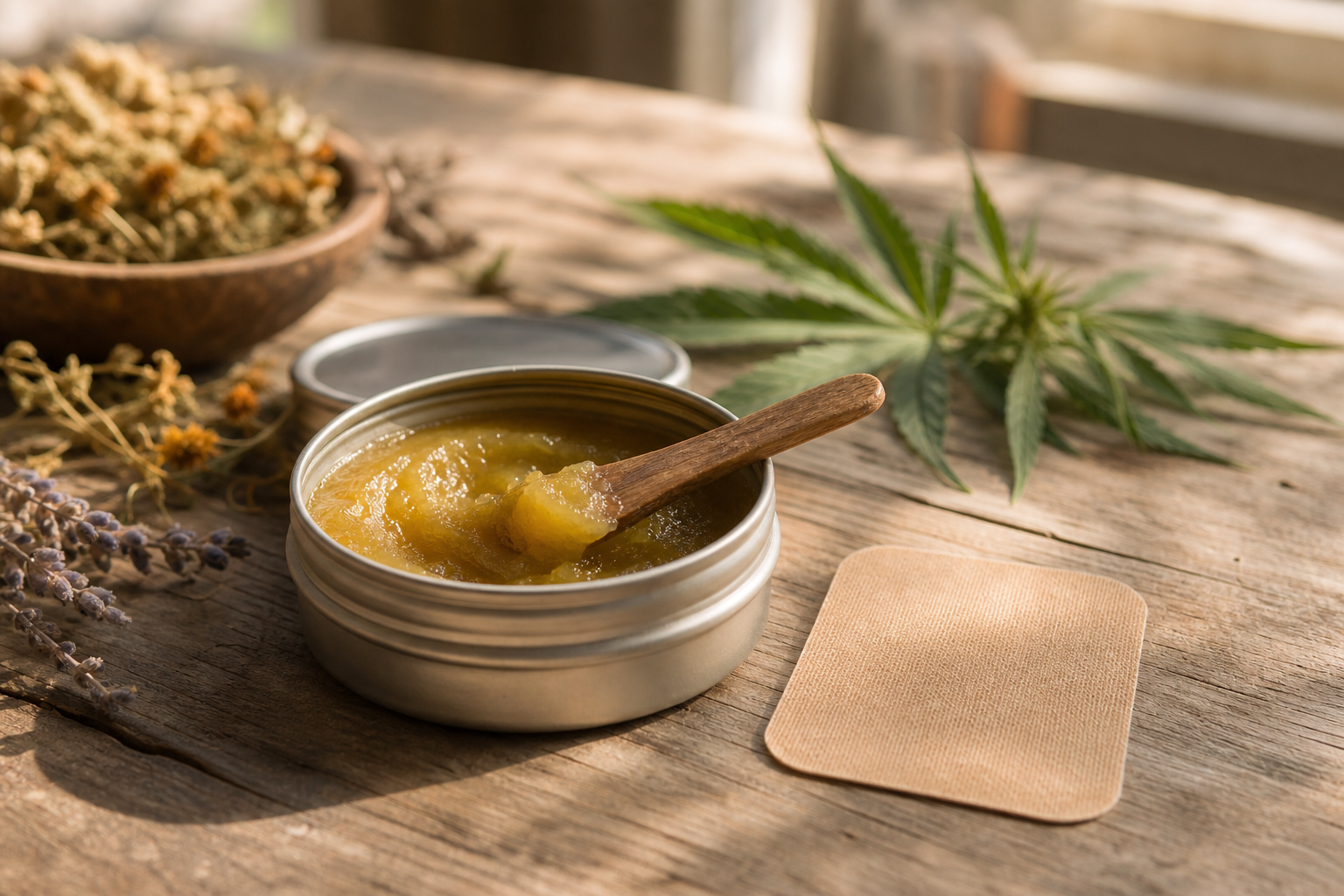
| Balm | Oil + higher wax (often beeswax) | Thick, waxy barrier | Slower | Overnight, stays put on knees/elbows |
| Patch | Adhesive + solvents/enhancers | Hands-free | Slow, steady | Longer coverage without re-rubbing |
Industry guides (and dispensary menus) use these labels loosely — always check the ingredients. A "balm" with lots of water is basically a cream with marketing. A "salve" with heavy wax behaves like a balm.
When to Choose a Thick Balm #
Pick a balm when you need the product to stay put for hours — overnight joints, one stubborn spot, or skin that dries out. The wax layer acts like a lid: it slows evaporation and keeps oils (and cannabinoids) in contact with the skin longer.
Good balm moments:
- Knees, elbows, thumbs after a long day of kneeling or gripping tools
- Bedtime when you can massage it in and leave it alone
- Dry winter skin that needs a moisture barrier plus cannabinoids
Trade-off: balms can feel greasy under gloves or on a steering wheel. Wipe excess, or use a thinner cream for daytime.
When a Salve or Cream Makes More Sense #
Choose a salve or cream when you want targeted relief that still spreads and sinks without a heavy wax coat. Salves melt with body heat and work well for massage. Creams cover bigger zones without soaking through a shirt.
Quick picks:
- Salve: One joint or muscle knot; you want to knead it in
- Cream: Shoulders, lower back, or both knees after a shift
- Lotion: Full back or legs; you need something light before work
If menthol, camphor, or arnica is in the jar, you may feel cool or warm in seconds. That sensation is not the same as cannabinoid relief — it is a bonus (or a distraction), covered later in the FAQ.
How Do Cannabis Patches Differ From Rub-On Topicals? #
A true cannabis patch is built for slow, steady delivery through the skin — often aiming for bloodstream levels — while a balm or cream is built for local skin and tissue contact. Same plant compounds. Different delivery job.
| Factor | Rub-on (balm / salve / cream) | Transdermal-style patch |
|---|---|---|
| Main goal | Local relief at the sore spot | Longer, steadier dosing |
| Bloodstream | Usually minimal | Designed to enter circulation more |
| Onset | Often 15–45 minutes locally | Often slower build (can take hours) |
| Duration | A few hours; reapply as needed | Marketed for ~8–48 hours depending on product |
| Hands-free | No — you rub it in | Yes — stick and leave |
| Evidence depth | Growing human data for gels/oils | Still thinner human trial data overall |
A 2023 review of transdermal CBD systems (PMC11104392) and related work on nanocarrier patches (PMC10100468) explain why patches use permeation enhancers and special carriers: plain cannabinoids do not cross the outer skin barrier well on their own.
Practical takeaways for Divine Toke readers in Detroit and across Michigan:
- Spot pain (thumb, knee, elbow): Start with a balm, salve, or cream you can massage into the joint.
- Want all-day coverage without reapplying: Ask your budtender for a true transdermal patch — and confirm it is meant for systemic delivery, not just a sticker with CBD printed on the box.
- Workplace testing concerns: Patches that push cannabinoids into blood deserve more caution than a simple CBD balm (see drug-test section).
Do not assume every "patch" on a shelf is pharmaceutical-grade. Read the label for CBD/THC milligrams, wear time, and lab results.
What "Transdermal" Actually Means on a Label #
"Transdermal" should mean the formula is designed to push active ingredients past the outer skin barrier into deeper tissue or blood — not just "sticks to skin." Marketing blurs that word. Some stickers are comfort products with CBD in the adhesive; others use solvents, oils, or nanocarriers studied in papers like PMC10100468.
Ask three questions at the counter:
- How many hours is this meant to stay on?
- Is it intended for systemic absorption or local comfort only?
- Where is the COA for this batch?
If the budtender cannot answer, treat it as a novelty sticker until you get documentation.
What Does the Research Say About Topicals for Pain? #
Early human trials suggest topical CBD can cut localized joint and nerve pain for some people — but it is not a miracle for every ache, and results depend on the formula and the kind of pain. Frame expectations like a tool in the box, not a cure-all. For chronic pain context beyond topicals, see our chronic pain cannabis guide.
Arthritis and Joint Pain Evidence #
The strongest consumer-facing human trial for a CBD gel is still the 2022 thumb basal-joint (CMC) osteoarthritis study. In that randomized, double-blind, placebo-controlled crossover trial, adults with symptomatic thumb arthritis used a topical CBD gel twice daily for two weeks. Pain scores dropped more on CBD than on placebo, and hand function scores improved, with no serious side effects reported (PubMed 35637038; summarized in PMC12472909).
Key numbers from that trial (small sample — treat as promising, not final proof):
- About 18 patients completed the crossover design
- Average pain (VAS) fell roughly from 5.0 to 2.2 with CBD vs a smaller drop on placebo
- Function scores (DASH) improved on CBD more than placebo
The Arthritis Foundation notes CBD interest is high among people with arthritis, while urging medical guidance and realistic expectations. Harvard Health likewise describes promising early signals with limited high-quality trials.
Preclinical work also supports a joint story: a 2016 study of transdermal CBD gel in arthritic rats (PMC4851925) found reduced joint swelling and pain behaviors — useful for mechanism, not a human dose chart.
Nerve Pain and Neuropathy Evidence #
Topical CBD oil has shown statistically significant relief for some kinds of peripheral nerve pain in a placebo-controlled human study. In adults with symptomatic peripheral neuropathy of the lower extremities, topical CBD reduced intense pain, sharp pain, itch, and cold sensations versus placebo (PubMed 31793418).
That matters for people dealing with tingling feet, burning calves, or nerve weirdness after injury or metabolic disease. It does not mean every neuropathy will respond — nerve pain is stubborn and personal.
Where the Evidence Is Still Thin #
Be honest about misses. A 2024 study on delayed-onset muscle soreness (PMC10824304) found a high-strength topical CBD ointment did not clearly beat control for post-workout soreness and inflammation markers. If your main complaint is gym DOMS, a topical may feel nice (especially with menthol) without being a proven recovery drug.
Broader chronic-pain reviews of oral / systemic pharmaceutical CBD are mixed — some analyses find little advantage over placebo for many chronic pain setups. That debate is about pills and oils you swallow, not every jar you rub on a thumb. Still, it is a reminder: hedge claims, track your own results, and keep your doctor in the loop.
CBD Alone vs CBD + THC Topicals #
Some people prefer CBD-only jars for daytime clarity; others prefer a CBD/THC mix because THC also hits CB1 receptors on peripheral nerves. Reviews of cannabinoid medicines for chronic pain often find the strongest clinical signals in combined THC/CBD preparations for certain conditions, while CBD-alone evidence is more mixed depending on route and dose (PMC9294022).
For topicals specifically:
| Goal | Often try first | Why |
|---|---|---|
| Stay clear-headed at work | CBD-forward cream/balm | Lower intoxication risk |
| Stubborn local ache that CBD alone did not touch | Licensed THC-containing topical | Local CB1 activity |
| High-stakes drug testing | Verified THC-free isolate topical | Lowest THC exposure |
Michigan licensed products list THC clearly when it is present — use that label. Do not assume "hemp" equals "zero THC," and do not assume "dispensary" equals "will get you high" when the product is a topical.
How to Apply CBD or THC Topicals for Better Results #
Clean skin, a pea-to-fingertip amount, firm massage for 30–60 seconds, and consistent reapplication beat dumping half the jar once. Technique will not invent a miracle — but it does help the product contact the tissue you care about.
How Much Should You Use? #
Start small, then scale to cover the sore zone in a thin, even layer. There is no universal milligram chart for topicals the way there is for edibles.
| Pain level / area | Starting amount | Frequency many people try |
|---|---|---|
| Small joint (thumb, wrist) | Pea-sized | 2× daily |
| Knee or elbow | Fingertip | 2–3× daily |
| Lower back / large muscle | 1–2 fingertips | 2–3× daily or as relief fades |
Tips:
- Patch-test a tiny amount on the inner forearm for 30 minutes the first time — especially if you have sensitive skin.
- Do not apply on open cuts, rashes, or infected skin.
- Give it a fair trial — many people judge topicals after several days of regular use, not one swipe.
- Read the label for CBD/THC milligrams per container so you can compare jars fairly.
The Arthritis Foundation's CBD guidance stresses talking with your clinician and treating CBD as one part of a broader plan — exercise, sleep, and prescribed care still matter.
Tips That Actually Help Absorption #
Warm skin and massage help oils and creams move past the outer dead-skin layer better than cold, dry slap-and-go. Cannabinoids are fat-loving molecules; they do not love dry, scaly barriers.
Try this routine:
- After a warm shower or after washing the area — pores open, dead skin loosened
- Pat dry — leave skin slightly warm
- Massage in circles for 30–60 seconds until the product looks absorbed (or until balm softens)
- Optional: a warm (not scorching) pack for 10 minutes after application
- Optional for overnight balms: a clean wrap or soft sleeve so clothes do not wipe it off
For knees: work around the kneecap and joint line. For lower back: along the muscles beside the spine, not digging into the spine itself. For thumbs: the base of the thumb (CMC joint) — the exact zone studied in the Heineman gel trial.
Will a CBD Cream Make You Fail a Drug Test? #
Standard CBD topicals are low risk for failing a urine drug test — a 2024 human study found no urine positives under federal workplace cutoffs after days of use — but risk is not zero if the product contains THC, you use a true transdermal patch, or oral fluid testing catches hand-to-mouth transfer. If your job or probation tests you, read labels and still treat "low risk" as a decision you own with HR and your lawyer, not a guarantee from a blog.
The key study: researchers enrolled 46 healthy adults, assigned commercial hemp-derived high-CBD / low-THC topicals (cream, lotion, patch, balm, or gel) or placebo, and measured blood, urine, and oral fluid over 10 days of use (Journal of Analytical Toxicology, 2024).
What they found:
- Blood: Δ9-THC and its metabolites stayed below the limit of detection for the products studied
- Urine: No samples screened positive under common federal workplace criteria (immunoassay 50 ng/mL with confirmatory cutoff 15 ng/mL)
- CBD: Some products showed measurable CBD absorption — lotion with more CBD and a permeation enhancer absorbed more
- Oral fluid: A subset of participants hit ≥2 ng/mL Δ9-THC in oral fluid (often linked to lotion use) — likely hand-to-mouth transfer after rubbing product in, not a full "stoned" blood level
- Feel: Products did not produce clear intoxicating effects vs placebo
Earlier tiny work on topical THC salves also found no blood/urine positives (PubMed 28122323).
Practical rules for trades, union halls, and anyone who gets tested:
- Prefer clearly labeled products with a recent Certificate of Analysis (COA)
- If testing is high-stakes, lean CBD isolate / THC-free topicals — and verify the COA
- Wash hands after applying before you eat, smoke, or touch your mouth
- Treat transdermal patches as higher systemic-risk than a simple balm
- Remember: Michigan's Cannabis Regulatory Agency (CRA) regulates licensed product testing and labeling — it does not give you a workplace drug-test exemption
Mislabeling still exists in the wider hemp market. A Johns Hopkins–linked study summarized by Hopkins Medicine found CBD product labels often fail accuracy checks — another reason to buy from licensed, lab-tested channels when you can.
Who Are Cannabis Topicals Best For? #
Topicals shine for people who want localized relief without a head-change — trades workers with joint ache, seniors with arthritis, parents who need to stay sharp, and anyone who already uses cannabis but wants a spot treatment. They are a weak fit if you need full-body sedation, appetite, or sleep from the same product.
Strong fits:
- Knees, hands, elbows, lower back that hurt in one zone
- Daytime use when impairment is a hard no
- Seniors exploring smoke-free options (pair with our cannabis for seniors starter guide)
- People stacking methods — a topical for the joint plus a separate low-dose edible or flower plan for systemic needs
Proceed carefully if:
- You have open wounds, severe eczema flares, or known allergies to beeswax, menthol, or essential oils
- You take blood thinners or complex meds — CBD can interact with liver enzymes when absorbed; tell your pharmacist even for topicals
- Your workplace uses oral fluid testing and you apply greasy products with bare hands
- You expect one jar to replace opioids, injections, or physical therapy — that is not what the evidence shows
Divine Toke is a Detroit-area sun-grown organic cannabis farm. We talk about topicals the same way we talk about flower: clean inputs, honest expectations, and education first — not miracle claims.
How to Choose a Quality Topical in Michigan #
Buy lab-tested products with a readable label — CBD and THC milligrams, batch/COA access, and ingredients you recognize — preferably from Michigan's licensed market when you want CRA-level oversight. Fancy packaging means nothing if the jar is under-dosed or mislabeled.
Checklist for the counter:
| Check | Why it matters |
|---|---|
| COA / lab results | Confirms cannabinoids and screens for contaminants |
| CBD mg + THC mg listed | Lets you compare strength across jars |
| Form matches your use | Balm for overnight; cream for daytime; patch for long wear |
| Ingredient list | Spot menthol, allergens, or mystery "proprietary blends" |
| License / CRA channel | Michigan adult-use and medical products fall under CRA rules for testing and labeling |
| Scent vs effect | Strong menthol feels "strong" even if CBD dose is low |
About add-ins:
- Menthol / camphor: Cooling distraction — useful, but not proof of cannabinoid dose
- Arnica: Traditional herbal add-on; evidence for the combo is mostly anecdote
- Beeswax: Helps balms stay put; not a painkiller by itself
- Essential oils: Can irritate sensitive skin
At Divine Toke we care about clean, sun-grown plant inputs. When you shop topicals anywhere in Michigan, apply the same standard: know what is in the jar, prefer transparent labs, and skip anything that promises to "cure" arthritis overnight.
Common Mistakes With Cannabis Topicals #
The biggest mistakes are expecting edible-level effects, judging a product after one rushed swipe, and ignoring the label. Fix those three and most people get a clearer read on whether topicals help them.
Watch for these traps:
- Waiting for a "high" as proof it works — local topicals are not supposed to intoxicate
- One-and-done testing — arthritis trials dosed for weeks; give regular use a few days to a couple weeks
- Greasing broken skin — raises irritation risk and can change absorption
- Trusting the tingle — menthol can mask a weak cannabinoid dose
- Comparing mg without jar size — 500 mg in a tiny tin is stronger per swipe than 500 mg in a huge tub
- Skipping hand washing — matters for oral-fluid workplace tests
- Using topicals as your only plan for whole-body chronic pain — see the pain pillar for multi-method strategy
- Ignoring meds — tell your clinician if you stack CBD products of any kind
A simple success loop: pick one form → apply the same way twice daily for 7–14 days → note pain scores morning and night → adjust form or strength with a budtender or clinician.
A Simple Two-Week Trial Plan #
Treat your first jar like a short experiment with a notebook — not a forever commitment. You will learn more in 14 honest days than in three random applications.
| Day | Action | What to write down |
|---|---|---|
| 1 | Patch-test forearm; apply to target joint once | Any redness? Initial pain 0–10 |
| 2–3 | Twice daily after warm wash | Morning / evening pain; stiffness |
| 4–7 | Keep same product and amount | Best time of day; how long relief lasts |
| 8–14 | Adjust amount slightly if needed | Function (stairs, grip, sleep) |
| End | Decide: keep, switch form, or stop | Compare Day 1 vs Day 14 scores |
If nothing budges after two weeks of solid use, switch form (balm ↔ cream ↔ patch) or talk with a clinician about whether a different route — tincture, edible, or flower — fits your pain better. That is not failure. That is data.
Pain that moves around the body, wakes you at night, or comes with numbness and weakness deserves a medical workup — a topical is a comfort tool, not a diagnostic. When in doubt, get checked.
Frequently Asked Questions #
These are the questions people ask most about CBD and THC topicals for targeted pain — short answers first, then the details.
Do CBD topicals get you high? #
No — CBD itself is non-intoxicating, and most rub-on topicals do not deliver enough THC to the brain to cause a high. Full-spectrum products may contain trace THC, but standard creams and balms are built for local skin action, not intoxication (PMC12472909). If a product ever makes you feel altered, stop and check the label and lab results.
How long do CBD balms and creams take to work? #
Many people notice local comfort within about 15–45 minutes; cooling menthol can tingle in seconds, which is a different effect. Full judgment often takes days of consistent use — the thumb arthritis gel trial dosed twice daily for two weeks before measuring outcomes (PubMed 35637038). Reapply as directed rather than expecting a single swipe to last all day.
What is the difference between a CBD balm and a CBD salve? #
Balms are usually thicker (more wax) and sit on the skin as a barrier; salves are oilier with less wax and melt in faster for massage. Both are typically water-free compared with creams and lotions. Pick balm for overnight "stays put" use and salve when you want to knead a joint without a heavy coat.
Are cannabis patches better than rub-on creams? #
Not better — different. Patches can offer hands-free, longer wear and may push more cannabinoid into circulation when truly transdermal (PMC11104392). Creams and balms win for massaging a specific knee or thumb. Match the tool to the job.
Can I use a topical and still pass a urine drug test? #
In a 2024 study of commercial hemp CBD topicals, no participants failed urine testing under federal workplace cutoffs after up to 10 days of use (JAT 2024). Blood THC stayed undetectable in that study. Oral fluid positives still happened for some people — wash your hands. This is not a legal guarantee; high-stakes testing deserves caution and THC-free, verified products.
How often should I reapply a cannabis balm? #
Twice daily is a common starting pattern (morning and night); bump to three times if relief fades and your skin tolerates it. Cover the sore area thinly — more product does not always mean more benefit past a certain point. Stop if you get a rash.
Do topicals help arthritis in knees and hands? #
Early evidence is encouraging for some hand/joint pain — especially the 2022 topical CBD gel trial in thumb CMC osteoarthritis — but results vary and larger trials are still needed (PubMed 35637038; Arthritis Foundation). Knees are a frequent real-world use case; treat them as "worth a careful trial," not proven for every arthritis type.
Can seniors use cannabis topicals safely? #
Often yes — topicals are one of the gentlest entry points because they usually avoid a head-change — but seniors should still patch-test, check for skin sensitivity, and tell their doctor about CBD use alongside other meds. See our seniors starter guide for dosing and drug-interaction basics. Start with a simple CBD cream or balm before stacking multiple products.
Does menthol mean the CBD is working? #
No. Menthol creates a cool (or sometimes warm) distraction on nerve endings; cannabinoids work through different pathways. Menthol can make a weak jar feel strong. Check the CBD milligrams and COA, not just the tingle.
Can I combine topicals with flower or edibles? #
Yes — many people use a topical for the sore joint and a separate inhaled or oral product for sleep, stress, or whole-body pain. Keep doses intentional so you know which product did what. Review the multi-method approach in our cannabis for pain guide and talk to a clinician if you take prescription pain meds.
Trying Topicals the Smart Way #
If you are curious to try a cannabis topical, start with a lab-tested balm or cream aimed at one stubborn joint, apply it the same way for a week, and judge results by pain and function — not by whether you felt high. Keep expectations grounded: early trials back localized relief for some arthritis and nerve pain, while workout soreness and whole-body chronic pain need a wider plan.
At Divine Toke — a Detroit-area sun-grown organic cannabis farm — we care about clean plants and clear education. Shop licensed Michigan products with readable COAs, ask your budtender to explain balm vs cream vs patch in plain English, and pair topicals with the rest of your wellness toolkit.
Keep reading:
- Cannabis for Pain: A Complete Guide to Natural Relief
- CB1 and CB2 Receptors Explained
- Cannabis Chronic Pain Guide
- Cannabis for Seniors: A Gentle, Practical Starter Guide
This article is for educational purposes only and is not medical advice. Always consult your healthcare provider before starting any new wellness routine.
Grown in Detroit. Shipped to your door.
Small-batch, sun-grown cannabis cultivated in living soil. Mail-order shipping to all 50 states.