Composting at Scale: How We Feed Our Soil Without Chemicals

Jamie
Head Cultivator
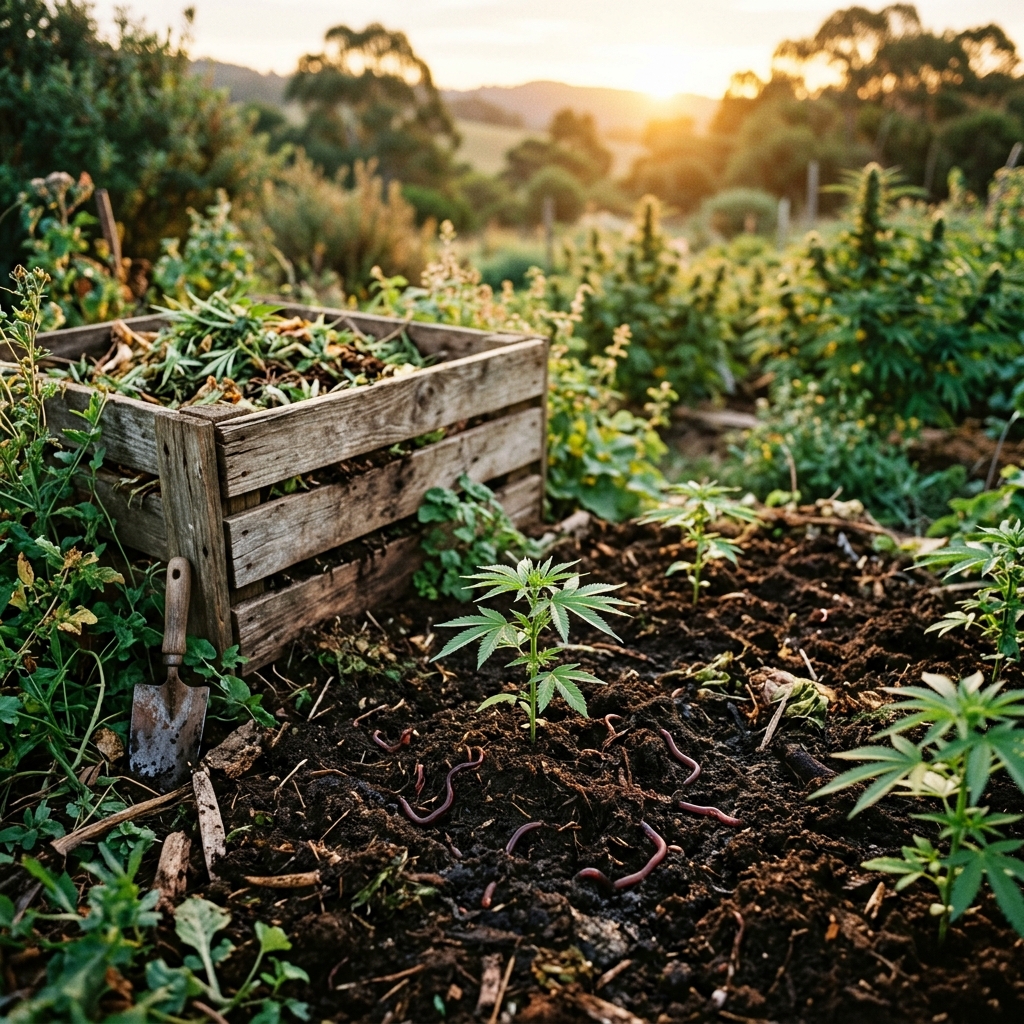
Composting at scale feeds cannabis soil by turning dead plant matter into slow-release nutrients through heat, oxygen, and billions of microbes — no synthetic fertilizer required. The pile does the work. Microbes break down organic material. Heat kills pathogens. Finished compost returns carbon, nitrogen, and living biology back to the root zone.
At Divine Toke — a Detroit-area Michigan sun-grown farm — compost is how we feed living soil through a short southeast Michigan season without synthetic salt bottles. Great Lakes humidity and freeze-thaw winters make organic matter and water-holding structure matter as much as the nitrogen number on a bag.
What Is Compost, Really? #
Compost is finished organic matter — dark, crumbly, earthy-smelling soil food made when microbes break down dead plants, leaves, and food scraps. It is not dirt. It is recycled life. You take waste that would rot in a landfill and turn it into the stuff roots crave.
Think of compost like a slow-cooked stew for your soil. You throw in ingredients. Heat and microbes do the cooking. What comes out feeds the next crop.
The Simple Recipe Behind Every Pile #
Every compost pile — backyard bin or farm windrow — runs on the same basic idea:
- Collect organic waste — leaves, straw, plant trimmings, food scraps, old stalks
- Mix carbon and nitrogen — "browns" (dry, woody stuff) plus "greens" (fresh, wet stuff)
- Add water and air — damp like a wrung-out sponge, turned so oxygen reaches the center
- Let microbes work — bacteria and fungi eat the material and release heat
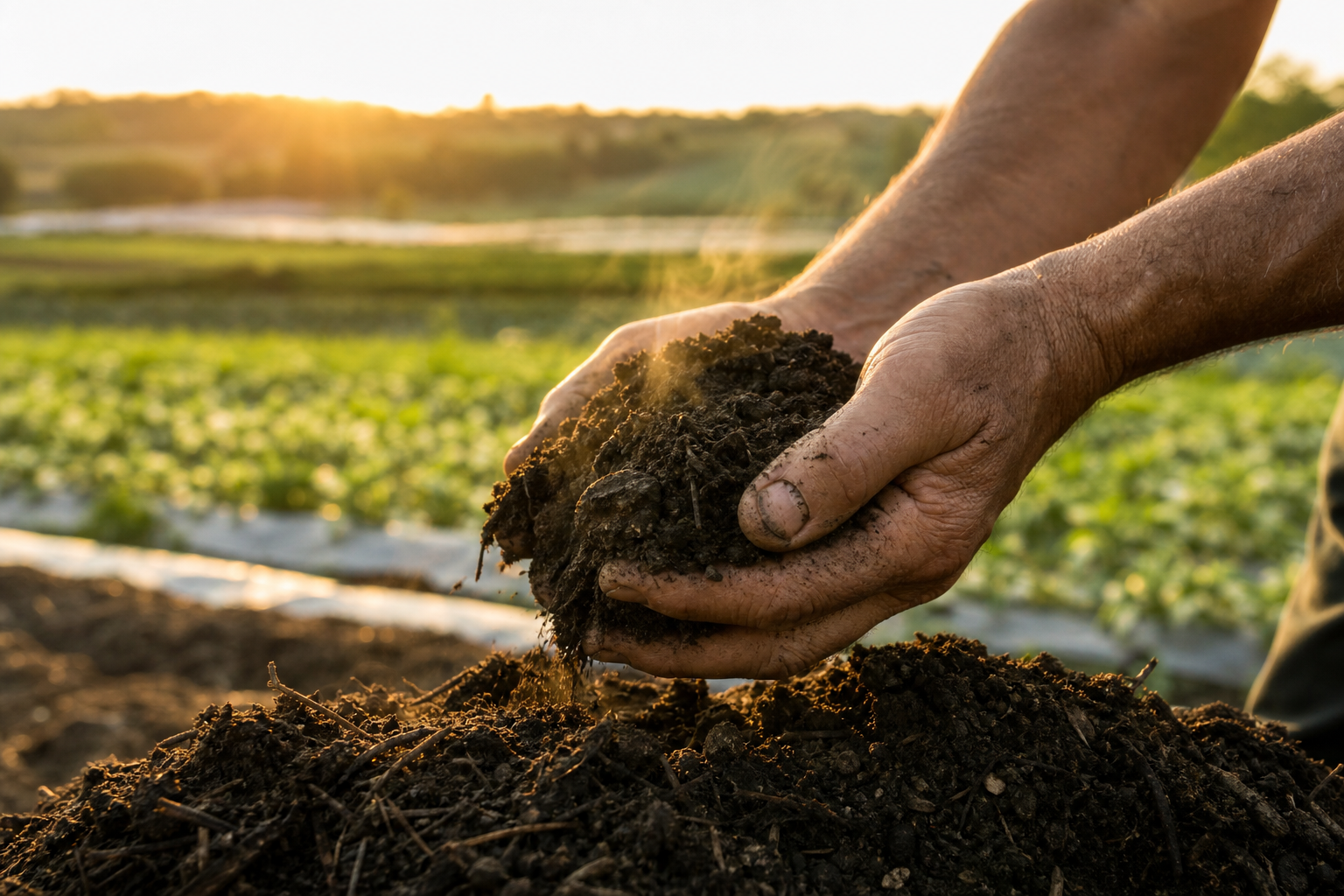
- Harvest finished compost — dark, crumbly, smells like a forest floor
The EPA's composting guide describes this as controlled decomposition. You are not letting stuff rot randomly. You are managing the conditions so the right microbes win.
What Finished Compost Looks and Feels Like #
Good compost has telltale signs. Learn these and you will never confuse unfinished pile with finished product:
| Sign | Finished Compost | Still Cooking |
|---|---|---|
| Color | Dark brown to black | Mixed tan/green patches |
| Texture | Crumbly, falls apart in your hand | Clumpy, recognizable chunks |
| Smell | Earthy, like forest soil | Sour, ammonia, or rotten |
| Temperature | Cool — same as air | Hot in the center |
| Original materials | Not visible | Stalks, leaves still clear |
When compost is done, the carbon-to-nitrogen ratio drops to about 10:1 to 15:1 — down from the 25:1 to 30:1 you started with. The Cornell Composting program explains that microbes burn off roughly two-thirds of the carbon as carbon dioxide during the process. What remains is stable organic matter your plants can use.
Compost Is a Soil Builder, Not a Magic Fertilizer Bottle #
This matters for cannabis growers: compost does not dump a big hit of nitrogen the way a synthetic bottle does. It builds the soil food web — the network of bacteria, fungi, worms, and root helpers that release nutrients slowly over time.
According to Oregon State University Extension, compost feeds plants indirectly. Microbes break down organic matter. Roots trade sugars with those microbes. Nutrients move when the plant needs them — not all at once in a salt rush.
That slow release is exactly why sun-grown farms lean on compost instead of chemical salts. The soil gets stronger every season instead of weaker.
In southeast Michigan, that seasonal math is tight. MSU Extension's Lower Peninsula garden calendar puts average last spring frost around May 1–May 15 in USDA zone 6a (and April 15–April 30 in warmer 6b pockets), with first fall frost often landing in October. Compost-built beds hold moisture through humid Great Lakes summers and keep biology alive when Michigan winters slam the ground with freeze-thaw cycles — the same climate clock outdoor cannabis has to respect around Detroit.
Why Compost Instead of Synthetic Fertilizer? #
Compost feeds soil biology and releases nutrients slowly; synthetic fertilizer feeds the plant directly and often hurts soil life over time. Bottled nutrients work fast. They also leave salt behind, kill helpful fungi, and push you to buy more bottles every season.
Synthetic fertilizer is like giving a kid candy for energy. It works right now. Compost is like cooking real meals. It takes longer, but the body — or in this case, the soil — stays healthy.
What Synthetic Fertilizer Actually Does #
Most bottled cannabis nutrients are mineral salts dissolved in water. You pour them on. Roots absorb them. Plants grow fast. That is the appeal.
The problem shows up over years, not days:
- Salt buildup — excess minerals accumulate in soil and can burn roots
- Dead biology — repeated high-nitrogen synthetic use shifts soil bacteria toward less diverse communities, per organic farming research from OFRF
- Runoff risk — fast-release nitrogen washes into waterways instead of staying in soil
- Flush cycles — many growers must flush synthetic salts before harvest
Synthetic nutrients bypass the soil food web. They go straight to the plant. The microbes that would normally cycle nutrients get sidelined.
What Compost Does Differently #
Compost works with soil life, not around it. The EPA lists key benefits of using compost:
- Improves soil structure so roots spread easily
- Increases water holding — less drought stress
- Adds organic matter that stores carbon long-term
- Supports diverse microbial communities
- Reduces erosion and runoff
| Factor | Synthetic Fertilizer | Compost-Based Feeding |
|---|---|---|
| Speed | Fast — days | Slow — weeks to months |
| Soil biology | Often suppressed over time | Strengthened |
| Salt buildup | Common — needs flushing | None |
| Runoff pollution | High risk | Low — nutrients bound in organic matter |
| Long-term soil health | Degrades without more bottles | Builds year after year |
| Flower flavor | Can taste harsh if over-fed | Cleaner when soil is balanced |
Why This Matters for Cannabis Quality #
Cannabis is a bioaccumulator — it pulls up what is in the soil. Clean inputs mean cleaner flower. Synthetic salt buildup can affect taste and smoothness. Living soil fed with compost tends to produce richer terpene profiles because the plant gets complex signals from a diverse root zone, not just a nitrogen spike.
Research on soil health consistently shows that compost-amended soils hold more organic matter and support more microbial activity than synthetically managed soils over multi-year trials. You are not just feeding a plant. You are building a system that feeds itself.
That is the whole point of regenerative cannabis farming. Stop extracting. Start rebuilding.
The Carbon-to-Nitrogen Balance (Browns and Greens) #
Hot compost needs a carbon-to-nitrogen ratio of about 25:1 to 30:1 — roughly two to three parts dry "browns" for every one part fresh "greens." Get this balance wrong and your pile either rots and stinks or sits cold and does nothing.
Carbon is fuel. Nitrogen is protein. Microbes need both to multiply, generate heat, and break material down fast.
Why the Ratio Matters #
Microbes consume carbon for energy and nitrogen to build cell tissue. They naturally eat at a ratio of about 30 parts carbon to 1 part nitrogen. Match your pile to that range and decomposition takes off.
According to the Cornell Composting chemistry guide:
- 25:1 to 30:1 — ideal for fast, hot compost
- Above 35:1 — too much carbon; pile stays cold and slow
- Below 25:1 — too much nitrogen; ammonia smell, nitrogen lost to the air
South Dakota State University Extension notes that finished compost should land around 10:1 to 15:1 before you apply it to soil. Below 25:1 in the finished product, nitrogen becomes plant-available.
What Counts as Browns? #
Browns are dry, carbon-rich materials — the stuff that looks dead and crunchy:
| Material | Role | Notes |
|---|---|---|
| Dried leaves | High carbon | Shred for faster breakdown — metro Detroit fall leaf drops are a classic Michigan brown |
| Straw or hay | High carbon | Great bulk for large piles |
| Shredded cardboard | High carbon | Remove tape and labels |
| Wood chips | Very high carbon | Break down slowly — use sparingly |
| Corn stalks | High carbon | Common on farms after harvest |
| Shredded paper | High carbon | Avoid glossy or colored ink |
Browns give the pile structure and air pockets. They also prevent the wet greens from turning into a slimy, airless mess.
What Counts as Greens? #
Greens are fresh, nitrogen-rich materials — the wet, living-or-recently-living stuff:
| Material | Role | Notes |
|---|---|---|
| Fresh grass clippings | High nitrogen | Use thin layers — they mat down |
| Kitchen scraps | High nitrogen | No meat, dairy, or oily foods |
| Coffee grounds | Moderate nitrogen | C:N around 20:1 |
| Plant trimmings | High nitrogen | Cannabis fan leaves and soft stalks work |
| Manure (herbivore) | High nitrogen | Must compost fully — never apply raw |
| Cover crop residue | Mixed | Chop before adding |
A simple volume rule from extension guides: mix 2 to 3 parts browns with 1 part greens. You do not need a lab test every time. If the pile smells like ammonia, add browns. If it sits cold for weeks, add greens.
The Ballpark Mix for a Hot Pile #
For a farm-scale or large garden pile:
- Layer browns first — 6 to 12 inches of straw or leaves
- Add greens — 2 to 4 inches of trimmings or food scraps
- Sprinkle finished compost or garden soil — inoculates microbes
- Repeat layers until the pile is at least 3 feet tall and wide
- Water as you build — damp, not dripping
- Turn every 7 to 10 days once heat builds
The pile should hit 130°F to 160°F (55°C to 71°C) within a few days if the mix is right. That heat means the thermophilic microbes — the heat lovers — have taken over. That is when composting at scale really starts to cook.
How Heat Kills Pathogens and Weed Seeds #
A compost pile must reach at least 131°F (55°C) in the core and hold that heat for several days to kill harmful bacteria, pathogens, and weed seeds. This is the thermophilic phase — the hot stage where heat-loving microbes do the heavy work.
If your pile never gets hot, you are cold composting. That can still work over a long timeline, but it will not reliably kill pathogens or seeds.
The Three Temperature Phases #
Composting moves through distinct microbial phases:
| Phase | Temperature Range | Who Is Working | What Happens |
|---|---|---|---|
| Mesophilic | 68°F to 113°F (20°C to 45°C) | Moderate-temp bacteria | Initial breakdown starts, pile warms |
| Thermophilic | 113°F to 160°F (45°C to 71°C) | Heat-loving bacteria | Rapid decomposition, pathogens die |
| Curing | Below 104°F (40°C) | Fungi, actinomycetes | Pile cools, humus stabilizes |
The EPA composting guide notes that sustained temperatures above 131°F (55°C) are needed to destroy most human pathogens and weed seeds. Many farm windrow systems target 130°F to 150°F (54°C to 66°C) and maintain it through regular turning.
Why Heat Matters for Cannabis Farms #
Cannabis farms generate a lot of plant waste — fan leaves, stalks, root balls, failed plants. You want that material back in the soil. But you do not want to spread living pathogens or viable weed seeds into your beds.
Hot composting solves both problems:
- Pathogen kill — bacteria like E. coli and Salmonella die above 131°F when held long enough
- Seed kill — most weed seeds break down above 140°F (60°C)
- Faster breakdown — thermophilic bacteria chew through tough fibers like cellulose much faster than cold microbes
A PubMed study on thermophilic decomposition found that low carbon-to-nitrogen ratios allow 40% to 80% fiber degradation, while high C:N piles only break down 10% to 20% of fibers. Heat and the right ratio work together.
How to Keep a Pile Hot #
Heat is not magic. It comes from microbe metabolism. Keep them fed and breathing:
- Size matters — piles under 3 feet cubed lose heat too fast; farm windrows are often 4 to 6 feet tall and wide
- Turn regularly — every 7 to 10 days brings fresh food and oxygen to the center
- Monitor moisture — 40% to 60% moisture; dry piles cool off, soggy piles go anaerobic
- Check temperature — use a compost thermometer probe in the core; if it drops below 110°F, turn and adjust the mix
- Do not over-turn — turning too often drops temps before thermophilic work finishes; 3 to 5 turns over 4 to 8 weeks is typical for hot compost
When the pile stops heating after turning and the material looks dark and crumbly, move it to a curing pile. Let it sit 2 to 4 more weeks. Fungi and actinomycetes — the thread-like microbes that give compost its earthy smell — finish the job.
The Microbe Army That Feeds Your Roots #
Finished compost is packed with bacteria, fungi, actinomycetes, and other soil life that break down organic matter and trade nutrients with plant roots. You are not just adding nitrogen and phosphorus. You are adding the workers that make those nutrients available.
Healthy soil is a living city. Compost is how you recruit more citizens.
Who Lives in Good Compost? #
A single teaspoon of healthy compost can hold billions of bacteria and miles of fungal threads. The main players:
- Bacteria — first responders; break down simple sugars and proteins fast
- Fungi — break down tough lignin and cellulose; form networks that transport water and nutrients
- Actinomycetes — thread-like bacteria that give compost its earthy smell
- Protozoa and nematodes — eat bacteria and fungi, releasing nitrogen in plant-ready form
- Mycorrhizal fungi — partner with roots, extending the root zone by up to 100 times
The U.S. Composting Council notes that compost improves plant growth through better nutrient availability, disease suppression, and improved soil structure — all driven by this biology.
How the Soil Food Web Feeds Cannabis #
Here is the cycle in plain terms:
- Plant makes sugar through photosynthesis
- Root exudes sugar — up to 40% of what the plant produces can leak into the soil as root exudates
- Microbes eat the sugar and multiply
- Microbes break down compost into plant-available nutrients
- Plant absorbs nutrients through root hairs and fungal partners
- Cycle repeats — stronger plant, stronger soil
This is why living soil is not just dirt. Dirt is dead mineral particles. Living soil is a working ecosystem where plants and microbes feed each other.
Disease Suppression Without Chemicals #
Compost-rich soil also fights disease naturally. Beneficial microbes outcompete harmful pathogens for space and food on root surfaces. Some fungi in compost produce antibiotics that suppress root rot organisms.
Research summarized by the EPA on compost benefits shows that compost-amended soils have lower plant disease rates compared to untreated soils — without any synthetic fungicide.
For cannabis, where root health directly affects yield and terpene production, this biological defense matters. A strong root zone means a stronger plant above ground.
Building Microbial Diversity Over Time #
One compost application helps. Years of compost building transforms soil:
| Year | What You Typically See |
|---|---|
| Year 1 | Better water retention, initial microbe boost |
| Year 2 | Noticeable structure improvement, fewer input needs |
| Year 3+ | Self-sustaining biology, reduced external inputs |
Organic farming research shows that gardens with 5 or more years of compost amendment need fewer inputs of any kind. The soil starts doing the work for you. That is the long game — and it is why composting at scale is worth the upfront labor.
Compost Tea: Liquid Biology for the Root Zone #
Compost tea is water brewed with finished compost and aeration, used to deliver live microbes directly to the root zone or soil surface. Think of it as a probiotic drink for your soil — not plant food in a bottle, but a biology boost.
Solid compost builds long-term soil health. Compost tea gives a quick shot of active microbes when soil needs a jump-start.
Aerated vs. Non-Aerated Tea #
There are two main types:
| Type | How It Is Made | Best For |
|---|---|---|
| Aerated compost tea (ACT) | Compost in a mesh bag, bubbled with an air pump for 24 to 48 hours | Root zone biology, soil drenches |
| Non-aerated "stew" | Compost soaked in water without bubbling | Less reliable microbe mix; use quickly |
The Rutgers Organic Landcare program recommends aerated brewing. Oxygen keeps beneficial aerobic bacteria alive. Without air, anaerobic microbes take over and the tea can smell bad or harm roots.
Basic Brew Recipe #
You do not need fancy gear. A bucket, an aquarium air pump, and good compost will do:
- Fill a 5-gallon bucket with dechlorinated water (let tap water sit 24 hours or use rainwater)
- Place 1 to 2 cups finished compost in a mesh bag or old pillowcase
- Submerge the bag and add a tablespoon of unsulfured molasses (microbe food)
- Bubble with an air pump for 24 to 36 hours — keep it cool, out of direct sun
- Use within 4 hours of stopping the pump — microbes die off fast once aeration stops
- Apply as a soil drench — pour around the base of plants, not as a foliar spray unless you know your compost is pathogen-free
What Compost Tea Does (and Does Not Do) #
Compost tea does:
- Introduce beneficial bacteria and fungi to depleted soil
- Help cycle nutrients already in the soil and compost
- Support root zone disease resistance
- Improve water penetration in compacted areas
Compost tea does not:
- Replace solid compost applications — you still need organic matter in the soil
- Provide a full N-P-K fertilizer hit — nutrient levels are low
- Fix a badly imbalanced pile — garbage in, garbage out
For cannabis in living soil beds, compost tea works best as a maintenance tool between top-dressings of finished compost. It keeps the biology active during heavy flowering when root demand peaks.
We covered the basics of tea brewing in our earlier composting for cannabis guide. This post goes deeper on why the biology matters at farm scale.
Windrow Composting: How Farms Do It at Scale #
Windrow composting is the standard method for large-scale compost production — long rows of piled organic material, turned with a tractor-mounted turner to maintain heat and oxygen. When you need tons of compost, not buckets, windrows are how it gets done.
A backyard bin handles kitchen scraps. A farm windrow handles entire harvests.
How a Windrow Works #
Picture a row of material 4 to 6 feet tall, 8 to 14 feet wide, and as long as the field allows. That is a windrow. The process:
- Build the row with a loader — layer browns and greens as you go
- Monitor core temperature daily during the first two weeks
- Turn with a windrow turner — a tractor attachment that flips and aerates the row
- Repeat turns every 7 to 14 days until the pile stops reheating
- Cure in place or move to a stockpile for 4 to 8 weeks
- Screen if needed — remove oversized chunks before spreading on beds
Windrows typically reach 120°F to 140°F (49°C to 60°C) within hours of formation. With proper turning, they hold thermophilic temps for 3 to 15 days per cycle — enough to meet pathogen reduction standards used by many municipal and agricultural compost programs.
Why Farms Choose Windrows Over Bins #
| Method | Best Scale | Pros | Cons |
|---|---|---|---|
| Backyard bin | Under 1 cubic yard | Cheap, simple | Too small for crop waste |
| Static pile | 1 to 10 cubic yards | Low equipment need | Slow, uneven breakdown |
| Windrow | 10+ cubic yards | High throughput, reliable heat | Needs space and equipment |
| In-vessel | Any volume | Fast, controlled, enclosed | Expensive, energy use |
For sun-grown cannabis farms that generate stalks, leaves, and cover crop residue every season, windrows turn waste into fertility on-site. No hauling. No buying bagged amendments. No dependency on synthetic bottles.
Space, Water, and Timing #
Windrow composting needs planning:
- Space — each windrow needs room for turning equipment on both sides
- Drainage — rows sit on a slight pad or hard-packed surface so water does not pool
- Water access — piles dry out in summer; a hose or irrigation pass during turning keeps moisture in range
- Season — many farms build windrows in fall after harvest, when browns (leaves, stalks) are abundant
- Time — plan 8 to 16 weeks from pile build to finished compost, plus curing
You do not need to invent a custom recipe. The same C:N rules apply at 10 cubic yards or 100. Scale changes the equipment. The biology stays the same.
Regulatory Note #
Some states classify cannabis plant waste as regulated material. Check your local rules before composting crop waste on-site. In many jurisdictions, fully composted material that meets time-temperature standards can return to soil. When in doubt, ask your state agriculture extension office.
How Compost Connects to Living Soil #
Compost is the primary fuel for living soil — it adds organic matter, microbes, and slow-release nutrients that keep the underground ecosystem running year after year. Without regular organic inputs, living soil slowly starves. With compost, it gets stronger every season.
Living soil and compost are not separate ideas. Compost is how you feed living soil.
The Living Soil Loop #
A regenerative cannabis farm runs a closed loop:
- Grow plants in biologically active beds
- Harvest flower and generate trim, stalks, and root waste
- Compost the waste with browns from cover crops and local carbon sources
- Return finished compost to the same beds as top-dress or mix-in
- Plant cover crops between cycles to fix nitrogen and add more biomass
- Repeat — each cycle adds organic matter and deepens the soil food web
This connects directly to cover crops and companion planting, which supply both living roots and post-harvest residue for the compost pile. Legume cover crops like clover and vetch fix nitrogen from the air. That nitrogen ends up in the greens you compost.
What Compost Adds to Living Soil Beds #
| Input from Compost | Effect on Living Soil |
|---|---|
| Organic matter | Holds water, stores carbon, feeds microbes |
| Beneficial bacteria | Jump-starts nutrient cycling |
| Fungal spores | Builds mycelial networks around roots |
| Humic substances | Helps roots absorb minerals |
| Stable carbon | Long-term soil structure improvement |
OFRF research on synthetic fertilizers and soil health shows that soils managed with organic amendments like compost accrue more organic matter and sustain higher microbial activity than synthetic-only systems over crop rotations.
Top-Dressing vs. Mixing In #
Two main ways to apply finished compost to living soil beds:
Top-dressing — spread 1 to 2 inches on the soil surface around existing plants. Worms and rain pull it down. Low disturbance. Good during the growing season.
Mixing in — incorporate 2 to 4 inches into the top 6 to 8 inches of soil between cycles. Better for new beds or full replants. Disturbs soil structure less if done once per season, not repeatedly.
Most sun-grown farms top-dress at flip (when plants switch to flower) and mix in during bed renovation between seasons. The goal is steady organic matter input — not one big dump and done.
Compost and No-Till Living Soil #
Many organic cannabis growers use no-till beds — they do not churn the soil every season. Instead, they layer compost, cover crop residue, and mulch on top. Soil structure improves because fungal networks and aggregate stability stay intact.
Compost is the main amendment in no-till systems because it feeds from the surface down. Worms, microbes, and water do the mixing for you. Less tractor time. More biology. That is the model behind regenerative sun-grown flower — and it starts with what you put on the pile.
Common Composting Mistakes (and How to Fix Them) #
Most compost failures come from bad C:N balance, wrong moisture, or not enough air — all fixable without starting over. A stinky pile, a cold pile, or a pile that never breaks down usually tells you exactly what it needs.
Composting is forgiving. Pay attention to the signs and adjust.
Problem: Pile Smells Like Rotten Eggs or Ammonia #
| Symptom | Likely Cause | Fix |
|---|---|---|
| Rotten egg smell | Too wet, not enough air (anaerobic) | Turn pile, add dry browns, loosen |
| Ammonia smell | Too much nitrogen (greens) | Add browns — straw, leaves, cardboard |
| Vinegar smell | Anaerobic pockets | Turn more often, improve drainage |
| No smell, no heat | Too dry or too much carbon | Add greens and water while turning |
Anaerobic compost — compost without oxygen — produces methane and hydrogen sulfide. Those smells mean harmful anaerobic bacteria are winning. Turn the pile, add structure with browns, and get air back into the center.
Problem: Pile Never Heats Up #
Check these in order:
- Too small — piles under 3 feet cubed cannot hold heat; combine with other material
- Too dry — squeeze a handful; it should feel like a damp sponge, not dust
- Too much carbon — add fresh greens (grass clippings, kitchen scraps, plant trim)
- Not enough nitrogen — same fix; boost the greens side of the mix
- Recently turned — wait 24 to 48 hours after building or turning before checking temp
The Cornell Composting program emphasizes that C:N ratio is the number one reason piles fail to reach thermophilic temps.
Problem: Pile Is Taking Forever #
Slow compost is usually cold compost. Speed it up by:
- Shredding materials — smaller pieces = faster microbe access
- Turning more often — every 5 to 7 days during the hot phase
- Balancing the mix — target 25:1 to 30:1 C:N
- Maintaining moisture — water lightly each time you turn
Cold composting over 6 to 12 months still works. It just will not kill seeds and pathogens reliably. For farm-scale cannabis waste, hot composting is the safer choice.
Problem: Finished Compost Still Has Chunks #
Chunky compost means it needed more time or more turning. Options:
- Screen it — pass through half-inch hardware cloth; return chunks to the next pile
- Cure longer — let the pile sit 4 to 8 weeks after the last heat cycle
- Use as mulch — coarse compost still adds organic matter on bed surfaces; fine compost goes in root zone
Problem: Attracting Pests #
Keep meat, dairy, and oily foods out of the pile. Bury fresh kitchen scraps under 6 inches of browns. If rodents are an issue, use enclosed bins for food scraps and keep the farm windrow to plant material only.
Good compost management is unglamorous work. Turning piles in the heat. Checking temps. Adding water. Fixing smells. But this is the craft that makes great flower possible without a shelf full of chemical bottles.
Frequently Asked Questions #
What is compost in plain English? #
Compost is broken-down organic waste turned into dark, crumbly soil food by heat, water, air, and microbes. Leaves, food scraps, and plant trimmings decompose into a stable material that feeds soil life and releases nutrients slowly. The EPA calls it controlled decomposition — managed rot that helps instead of harms.
What is the best carbon-to-nitrogen ratio for hot compost? #
Aim for 25:1 to 30:1 carbon to nitrogen for fast, hot compost. In volume terms, that is about 2 to 3 parts browns (dry leaves, straw) to 1 part greens (fresh trimmings, food scraps). The Cornell Composting chemistry guide sets this as the target range for thermophilic decomposition.
How hot does a compost pile need to get to kill pathogens? #
The pile core must reach at least 131°F (55°C) and hold that heat for several days. Many farm windrows target 130°F to 150°F (54°C to 66°C). The EPA composting guide notes that sustained thermophilic temps destroy most human pathogens and weed seeds when the pile is managed correctly.
Can you put cannabis plant waste in compost? #
Yes — fan leaves, soft stalks, and root balls are excellent green material for compost. Woody stalks should be chipped or shredded first. Always hot-compost crop waste to kill any pathogens and seeds. On a licensed Michigan farm, follow Michigan Cannabis Regulatory Agency waste-handling rules before you assume plant trim can go straight on the pile — state compliance beats backyard habits.
What is compost tea and does it actually work? #
Compost tea is aerated water brewed with finished compost to deliver live microbes to soil. It works as a biology boost for depleted root zones, not as a full fertilizer replacement. The Rutgers Organic Landcare guide recommends aerated brewing and using the tea within hours of stopping the pump.
Why is compost better than synthetic fertilizer for cannabis? #
Compost builds soil biology and releases nutrients slowly; synthetic fertilizer feeds plants fast but degrades soil life over time. Compost-amended soils hold more organic matter, support more microbes, and produce less runoff, per the EPA's compost benefits summary. For a bioaccumulator crop like cannabis, cleaner soil inputs mean cleaner flower.
How long does it take to make finished compost? #
Hot compost takes 8 to 16 weeks from pile build to finished product, plus 2 to 4 weeks of curing. Cold compost can take 6 to 12 months. Farm windrows with regular turning typically finish in 3 to 4 months total. Speed depends on C:N ratio, moisture, pile size, and turn frequency.
What are browns and greens in composting? #
Browns are dry, carbon-rich materials like leaves, straw, and cardboard. Greens are fresh, nitrogen-rich materials like grass clippings, kitchen scraps, and plant trimmings. You need both. South Dakota State University Extension explains that microbes use carbon for energy and nitrogen to grow — the balance between browns and greens controls how fast the pile works.
Does compost replace all fertilizer needs? #
Compost builds soil and provides slow-release nutrients, but most gardens still benefit from supplemental nitrogen during peak growth. Finished compost often contains less than 1% nitrogen by weight. Oregon State Extension notes that compost is a soil builder first — not a complete replacement for all fertility inputs, especially in heavy-feeding crops.
What is windrow composting? #
Windrow composting is long rows of piled organic material, turned with farm equipment to maintain heat and oxygen at large scale. Rows are typically 4 to 6 feet tall and 8 to 14 feet wide. It is the standard method for producing tons of compost from crop waste, leaves, and other farm biomass.
How does compost help living soil? #
Compost adds organic matter, microbes, and stable carbon that keep the soil food web alive and cycling nutrients. It connects directly to living soil ecosystems where roots, fungi, and bacteria trade sugars and minerals. Without regular compost input, living soil slowly loses the biology that makes it work.
What should I do if my compost pile smells bad? #
Bad smells mean something is off — usually too wet, too much nitrogen, or not enough air. Add dry browns and turn the pile to fix ammonia smells. For rotten-egg smells, the pile has gone anaerobic — turn it immediately, loosen it, and improve drainage. A healthy hot pile smells earthy, not like a dumpster.
The Bottom Line #
Composting at scale is not glamorous. Nobody posts Instagram stories of turning a windrow at 6 AM. But this is the work that makes sun-grown, chemical-free cannabis possible. You take waste. You manage heat, air, and moisture. Microbes do the rest. What comes back is living soil that gets stronger every year — not weaker.
At Divine Toke, we believe the best flower starts underground. Compost is how a Detroit-area Michigan sun-grown farm feeds that world without synthetic salts or bottled nutrients. If you want to understand the full picture of how we grow, start with our regenerative cannabis process overview, then dig into living soil and cover crops to see how the whole system connects.
If you are curious to try sun-grown flower raised on living soil and farm-built compost — the kind southeast Michigan shoppers look for when they want biology over bottles — explore what is on the shelf at Divine Toke. The difference is in the dirt — and the patience it takes to feed it right.
This article is for educational purposes only and is not medical advice. Always consult your healthcare provider before starting any new wellness routine.
Grown in Detroit. Shipped to your door.
Small-batch, sun-grown cannabis cultivated in living soil. Mail-order shipping to all 50 states.