Humulene and the Hoppy Profile: Earthy Flower for Daytime
Humulene is the hoppy, earthy cannabis terpene Detroit shoppers chase for daytime. Learn the hops link, early research, and how to shop a Michigan panel.

Head Cultivator
On this page
Humulene is the earthy, hoppy cannabis terpene that smells like crushed hop cones — and that hoppy, earthy panel is a fair daytime shopping signal for Detroit-area adults who want grounded flower without a mango-couch night. It does not get you high by itself, and the honest job is pairing that beer-garden nose with a Michigan terpene rank.
What Is Humulene and How Does It Smell? #
Humulene (α-humulene) is a common plant oil molecule — a terpene — that smells earthy, woody, and hoppy, which is why cannabis shoppers call it the beer-garden spice. It does not get you high by itself. It helps shape how a batch smells and is the terpene people hunt when they want a dry, herbal day jar instead of candy citrus or heavy mango musk.
If you already read our what are terpenes guide, think of terpenes as the spices in the plant’s recipe. THC and CBD are the main meal. Humulene is more like the crushed-hop, dry-wood finish that makes the dish feel grounded.
A few plain facts to lock in:
- Chemical family: It is a sesquiterpene — a heavier oil molecule built from three isoprene units. PubChem lists α-humulene as C15H24 (about 204.35 g/mol), also called alpha-caryophyllene.
- Smell cue: Fresh hop cones, dry garden wood, herbal spice, a little earth — not lemon candy, not lavender soap, not cracked pepper alone.
- Cannabis role: Often shows up as Strong or Moderate on hoppy, earthy flower panels, and it frequently rides next to beta-caryophyllene.
- Honesty check: Consumer guides love the “anti-munchies / daytime” nicknames. Those stories are partly beer-smell lore and partly early lab work — not a promise that humulene is a weight-loss drug or a coffee replacement.
You do not need a chemistry degree to use this. If a jar smells like a hop bine and dry wood more than mango earth or pine needles, humulene is a fair bet on the Michigan lab sheet.
How Humulene Smells and Tastes #
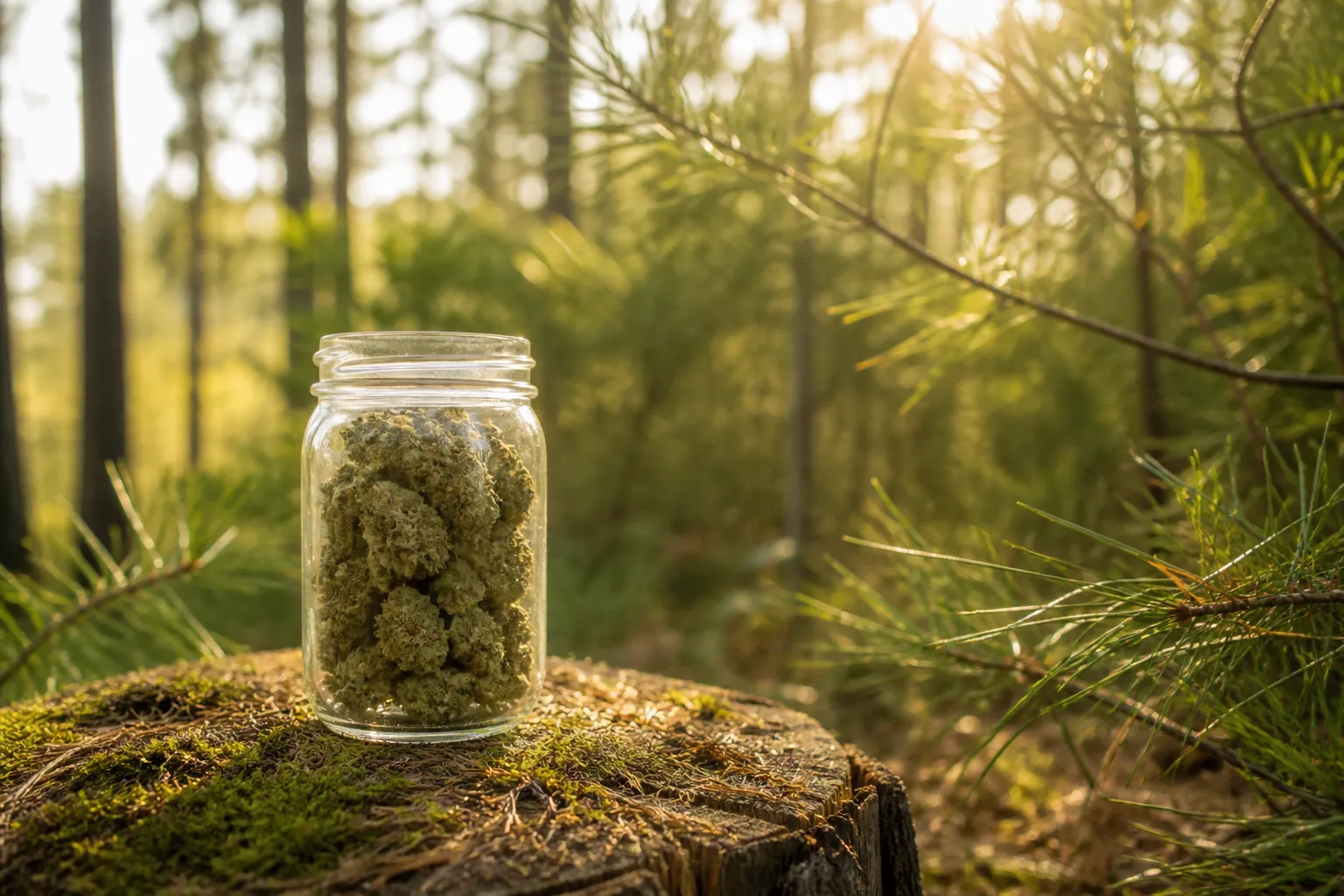
On the nose, humulene reads as hoppy earth and dry wood — not mango-sweet, not lemon-zest, not Christmas-tree pine. Seasoned Michigan shoppers call it “IPA weed,” “hop yard,” or “earthy beer flower.”
Use these kitchen and garden analogies when you shop:
- Crushed hop cones — papery green, herbal, the note people remember first
- Dry wood / cedar chest — warm, not sweet
- Sage or ginseng tea — bitter-herbal, earthy
- Noble-hop lager — spicy wood more than tropical fruit
Smell is a clue, not a lab test. Two batches can smell hoppy for different reasons — humulene, myrcene (also famous in hops), or a spicy caryophyllene backbone. Pair your nose with the COA. More on that below, and in our nose-shopping terpene guide.
Where Else Nature Puts Humulene #
Humulene shows up across the hop yard, the spice rack, and the herbal tea aisle, not only in cannabis. Hops are the famous namesake source. Sage, ginseng, basil, clove, and some fir oils carry it too.
A 2018 review of cannabis and hop terpenes in the European Journal of Medicinal Chemistry (PubMed 30096653) notes that both Cannabis sativa and Humulus lupulus can pack a lot of aroma oil in the female flower — often discussed as a few percent of dry mass — and that humulene is a regular player in that mix.
| Source | Typical humulene story | Kitchen takeaway |
|---|---|---|
| Hops / beer | Major hop-oil note; woody, spicy, “noble hop” character | Why some weed smells like a pale ale |
| Sage / ginseng / basil | Common herbal-oil sources in reviews | Same earthy-bitter family |
| Clove / fir oils | Supporting woody-spice note | Not the pepper-only story |
| Cannabis flower | Often Strong or Moderate next to caryophyllene | Shop by panel rank, not strain name |
Those oil stories describe concentrated plant oils — not a pint of beer, and not a dosing plan. Still, they explain the smell match: when cannabis leans hop-earth, your brain is recognizing a note you already know from the brewery and the herb garden.
Alpha-Humulene vs Beta-Caryophyllene #
Alpha-humulene and beta-caryophyllene are close cousins — they share the same formula, but they fold into different shapes, so they smell and act a little different. Labs often list both. Humulene is the hop-wood note. Caryophyllene is the cracked-pepper note, and it is the one with the settled CB2 story.
| Form | How it usually smells | What shoppers should know |
|---|---|---|
| α-Humulene (alpha-humulene) | Hop cone, dry wood, herbal earth | Also written α-caryophyllene; the hoppy flag |
| β-Caryophyllene (beta-caryophyllene) | Black pepper, clove, warm spice | Can bind CB2; see the caryophyllene guide |
| “Humulene” on a menu | Hop / earth shorthand | Ask whether the COA lists it next to caryophyllene |
PubChem treats alpha-caryophyllene as a synonym for humulene. The 2018 hops-and-cannabis terpene review (PubMed 30096653) is blunt: humulene does not contain the cyclobutane ring that β-caryophyllene has, and it has not been characterized as a CB2 ligand the way caryophyllene has. Do not invent a story that humulene “is the same cannabinoid as pepper terpene.” Same family. Different job.
Humulene Is Not a Cannabinoid #
Humulene is a terpene (aroma oil), not a cannabinoid like THC, CBD, or CBN. That distinction matters when a menu talks like humulene is “the anti-munchies cannabinoid.”
Quick entity check:
- Cannabinoids — plant compounds that mainly talk to your endocannabinoid system (THC → intoxication; CBD → different, milder pathways)
- Terpenes — smell-and-spice molecules that shape aroma and may nudge how the session feels
- Whole-plant mix — the idea that the blend matters more than any single number
So if someone says “just take humulene for daytime,” ask what they mean. Isolated hop oil is not the same as Michigan flower with Strong humulene next to real THC. Whole-plant shopping still wins for most Divine Toke readers.
Why Does Cannabis Humulene Smell Like Hops? #
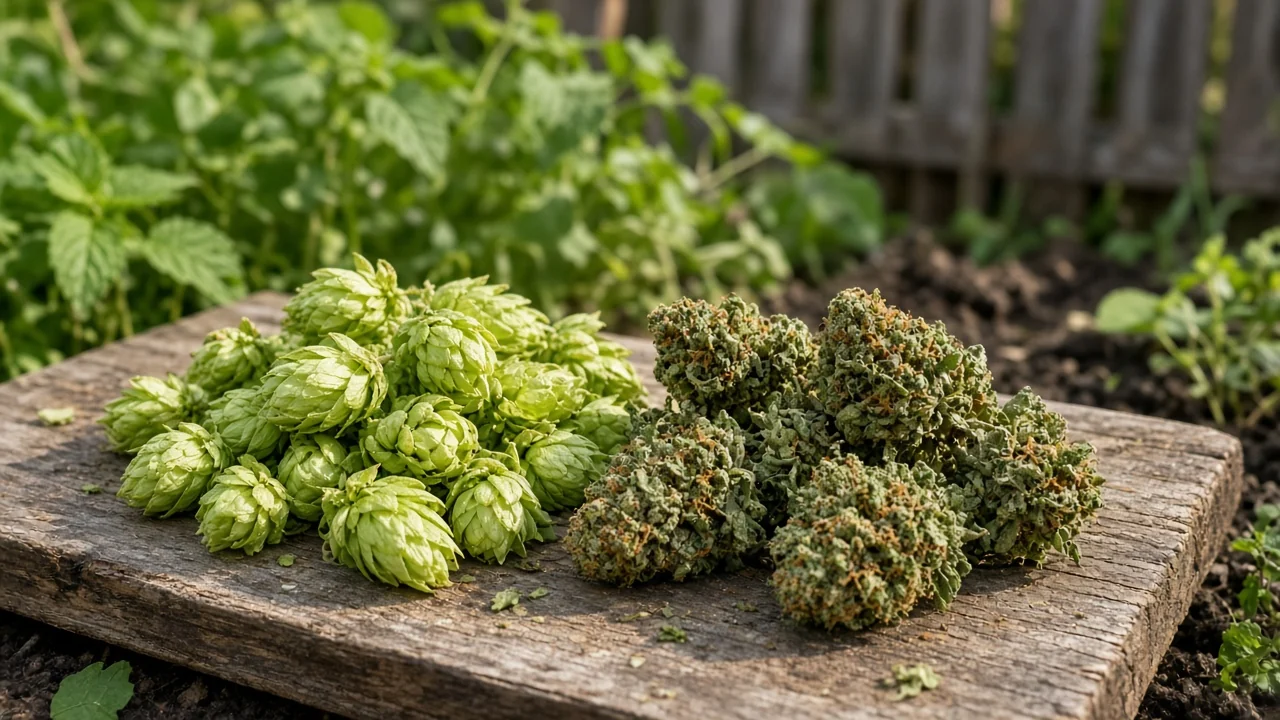
It smells like hops because it is a hop oil — the molecule is named after Humulus lupulus, and cannabis is a close botanical cousin in the same plant family. Your nose is not making that up. A hop cone and a hoppy jar share some of the same spices.
Here is the family-tree version in plain English:
- The USDA PLANTS database places Cannabis sativa in Cannabaceae, the hemp family.
- A 2018 systematics review in Cannabis and Cannabinoid Research (PMC6225593) treats Cannabis and Humulus as sister genera. The same paper’s molecular-clock work puts their split around 27.8 million years ago.
- That is why a Detroit beer drinker can open a cannabis jar and think “wait — that’s my IPA.” You already trained the smell.
Hops do not smell like one molecule. Brewers talk about a whole oil. A hop-genetics paper in BMC Plant Biology (PMC3927220) notes that hop essential oil is typically terpenoid-heavy and often dominated by myrcene, humulene, caryophyllene, and farnesene. Cannabis flower recycles that same spice rack.
The Hop Oil Trio You Already Know From Beer #
Myrcene, humulene, and caryophyllene are the three hop oils that show up again and again — and they are the same three names you will see on many Michigan cannabis COAs. A hoppy jar is often a mix, not a single-note solo.
| Hop / cannabis oil | Beer-world cue | Cannabis shopping cue |
|---|---|---|
| Myrcene | Green, resinous, “fresh hop” | Can also read mango-earth and sleepy — see the myrcene guide |
| α-Humulene | Woody, spicy, “noble hop” | Dry earth / hop-yard daytime flag |
| β-Caryophyllene | Peppery, woody spice | Body-comfort / pepper flag |
The USDA hop cultivar sheet for Tettnanger (accession 21015) is a useful kitchen example: that noble-aroma hop’s oil listed about 20.4% humulene, 6.2% caryophyllene, 40.6% myrcene, and 11.3% farnesene, with a humulene-to-caryophyllene ratio of 3.39. A USDA Mt. Hood sheet likewise flags high humulene (26–36%) as part of the “noble aroma” story.
A 2024 Foods hop-extract study (PMC11311985) describes α-humulene’s sensory tags as woody, spicy, and earthy. That is the same language Detroit budtenders use when a jar smells like a hop yard instead of a fruit stand.
Practical translation: if you love a woody lager more than a mango smoothie, you already know how to start shopping. Still check whether myrcene is also on top. Hops taught your nose both spices.
Michigan Hops as the Teaching Tool #
If you have walked a Michigan hop yard — or even a backyard bine on a garage trellis — you already have the teaching smell. You do not need a lab coat. Crush a papery cone. That dry green spice is the humulene family talking.
Michigan State University Extension keeps a live hops program for Great Lakes growers, including the 2026 Michigan Hop Management Guide published in April 2026. MSU’s Michigan Fresh hops page reminds gardeners that brewers use the female cones of Humulus lupulus for acids and essential oils. That is botany class, not a beer endorsement.
A Detroit dispensary jar will not match a Traverse City hop bine ounce-for-ounce. It just gives your brain a home-field name for the spice. Sun-grown flower can lean into that woody-sesquiterpene side: a 2023 Molecules comparison of outdoor living-soil vs indoor cannabis (PMC9861703) found outdoor samples carried a greater share of sesquiterpenes including α-humulene and β-caryophyllene versus genetically identical indoor lots. That is one reason Divine Toke talks about living soil and daylight — not because we invent a house “humulene strain.”
Is a Hoppy Humulene Profile Better for Daytime? #
A hoppy, earthy humulene panel is a reasonable daytime shopping signal for many people — but it is not a proven “daytime drug,” and a hoppy nose can still glue you to the couch if myrcene and THC are loud. Treat hop-earth as a feel map, not a clock stamp on the jar.
Here is what we can defend as of August 2026:
- Shoppers often describe hoppy-earthy jars as grounded, dry, and less candy-bright than limonene citrus or pinene forest.
- That “less heavy than mango night” story is a pattern, not a law. Hops themselves are myrcene-rich. A hoppy jar can still be myrcene-Dominant.
- Humulene does not cancel THC. Impairment is still impairment on the Lodge or I-75.
- Early lab work on humulene is mostly inflammation and high-dose mouse behavior, not a shift-worker focus trial.
| Claim you hear | What evidence supports | Better wording |
|---|---|---|
| “Humulene is the daytime terpene” | Consumer pattern + dry hop aroma (not candy, not couch-musk) | Often associated with a grounded day jar |
| “Hoppy weed will not make you sleepy” | Weak — hops also carry myrcene | Check the rest of the panel |
| “Humulene is like coffee” | No human stimulant trial | Not a proven pick-me-up |
| “Humulene cancels the munchies so you stay functional” | Appetite claim is unproven in people (see below) | Do not bank your lunch on it |
For metro Detroit trades, hospital, and plant workers who want a Saturday jar that does not erase Sunday, a hoppy panel is a fair shopping start. It is not a hall pass for “I can still drive because it smelled like beer.”
Why “Daytime” Is a Shopping Heuristic, Not a Clock #
If a hoppy session feels more usable in daylight, humulene may be one reason — but dose, sleep, coffee, and expectation still run the show. “Daytime” on a menu usually means “less heavy / less dessert-sweet,” not “clinically alert.”
Common reasons a humulene-forward jar feels more daytime:
- Less candy-citrus hype — the nose reads garden, not soda
- Less mango-musk weight — many hop-earth jars are not myrcene-Dominant (when they are, expect a heavier body)
- Pepper-wood support — caryophyllene often rides along and feels more body-grounded than racy
- Aroma expectancy — beer-garden smells “afternoon porch” to many brains before the first hit
- How you dose — people often sip earthy jars instead of stacking night flower
A 2021 cannabis-terpene survey (PMC8489319) still maps consumer “energetic vs couch-lock” language mainly onto myrcene talk, not onto a proven humulene switch. Use that as a map of how people talk, not as a prescription.
Why a Hoppy Nose Can Still Be a Night Jar #
Hops taught your nose two spices at once: green myrcene and woody humulene. If the batch is myrcene-Dominant with only Moderate humulene, you may have bought “IPA smell” and received “couch body.”
Watch for these mismatches:
- Hoppy name, mango-earth rank — the menu said hops; the COA said myrcene #1
- High THC, “daytime” sticker — the spice cannot outrun a huge inhale
- Stale hop jar — sesquiterpenes hang around longer than citrus, but a cardboard nose still means the party left
- Edible or drink format — slower onset can feel heavier even with the same terp story
Simple rule for Detroit shoppers: hoppy smell gets you in the conversation. The top three terpenes decide the shift.
Does Humulene Suppress Appetite? #
No solid human trial shows that humulene in cannabis flower turns off the munchies — treat the “anti-appetite terpene” line as folklore until someone runs that study. THC still tends to raise hunger for many people. A hoppy panel is not a diet plan.
Here is the honest stack:
- Dispensary blogs repeat “humulene = anorectic” so often it sounds settled. As of August 2026, I have not found a controlled human humulene-alone appetite trial that backs a shop-floor promise.
- A 2021 Molecules cannabis-terpene review (PMC8489319) even says α-humulene “acts as an appetite suppressant,” but the papers it points to for that line are Rogerio 2009 (PMC2785529) and Fernandes 2007 (PubMed 17559833) — inflammation studies, not lunch studies. That is a citation leak. Do not copy it.
- A 2024 Planta Medica scoping review of 340 α-humulene papers (doi:10.1055/a-2307-8183) catalogs anti-inflammatory, antimicrobial, antiproliferative, antiallergic, gastroprotective, and cannabimimetic work. Appetite is not in that headline list. The authors also flag a paucity of clinical translation.
- Bitter hop extracts can reduce hunger in fasting studies — but that is a different product. A 2019 Nutrients trial (PMC6893682) gave men a GI-targeted bitter hops extract (not isolated humulene) during a 24-hour water fast and saw hunger ratings drop. Those capsules are hop bitters, not a Detroit eighth.
| Claim you hear | What the record shows | Better wording |
|---|---|---|
| “Humulene kills the munchies” | No good human flower trial | Unproven in people at cannabis doses |
| “Hoppy strains are diet weed” | Marketing + citation recycling | Smell is not a calorie plan |
| “Hops reduce hunger, so humulene must too” | Bitter hop-acid extracts ≠ terpene | Different chemistry |
If your goal is less snack-raiding, start with dose, sleep, and what else is on the panel — not a humulene decimal. THC still runs appetite for a lot of bodies.
What Those Bitter-Hop Studies Actually Measured #
The hop appetite papers measured bitter extracts during a planned fast — not smoked flower, and not α-humulene milligrams. That matters when a budtender collapses “hops” into one word.
Plain-English takeaways from PMC6893682:
- Thirty adult men fasted 24 hours on repeat weeks.
- They took placebo or 100 mg or 250 mg of a bitter hops-based extract twice late in the fast.
- Both doses cut hunger more than 10% versus placebo in the last stretch.
- The researchers framed the story as bitter compounds talking to the gut — not as a terpene panel.
So when someone says “hops suppress appetite, and weed has hops terpenes,” you can nod at the family tree and still say: that study did not test this joint.
Does Humulene Calm Swelling? #
Early animal research suggests α-humulene can lower swelling signals in paws and allergic airways — but it is not a proven human anti-inflammatory medicine, and hoppy flower is not a replacement for a prescribed treatment. The shop-floor translation is “earthy comfort association,” not “steroid in a jar.”
Here is the evidence stack people actually cite:
- Fernandes et al., 2007, European Journal of Pharmacology (PubMed 17559833) gave mice and rats oral α-humulene and trans-caryophyllene from Cordia verbenacea oil. Both cut several kinds of paw swelling. Only humulene clearly cut histamine-driven swelling. Humulene lowered both TNF-α and IL-1β; caryophyllene mainly lowered TNF-α. Both reduced PGE2, iNOS, and COX-2. The authors said the effects looked comparable to dexamethasone in those animal models.
- Rogerio et al., 2009, British Journal of Pharmacology (PMC2785529) used a mouse asthma-style model (ovalbumin). Oral humulene at 50 mg/kg or an aerosol cut eosinophils in lung wash. Trans-caryophyllene did not match that. Humulene also lowered IL-5, CCL11, and LTB4 and quieted NF-κB and AP-1.
- The 2024 scoping review (doi:10.1055/a-2307-8183) repeats that rodent oral 50 mg/kg story and then says the hard part out loud: these findings have not been translated into clinical populations with the matching disease.
| Claim you hear | What the animal data show | Better wording |
|---|---|---|
| “Humulene is anti-inflammatory” | Strong preclinical signal in paw and airway models | May calm swelling signals in labs |
| “Humulene equals a steroid” | Dexamethasone was the control in rodent tests | Not a human steroid substitute |
| “Humulene treats asthma” | One mouse airway model | Not a treatment |
Those milligram-per-kilogram mouse doses are not a joint on a Detroit porch. Useful science. Wrong serving size for a menu sticker.
Why Hoppy Flower Is Not an Arthritis or Asthma Treatment #
Humulene-forward cannabis is not a medicine for arthritis, asthma, IBS, or “inflammation culture” as a diagnosis. Smoking or vaping anything can irritate airways. A hop smell does not cancel that.
Hard stops for Detroit-area shoppers:
- Do not replace a prescribed inhaler, NSAID, or biologic with a hoppy jar.
- Do not treat a CRA label as a swelling-drug claim. Michigan’s Cannabis Regulatory Agency regulates tested adult-use and medical products; it does not license terpenes as arthritis drugs.
- Do not chase concentrated hop essential oil as a homemade treatment. Flower-level terpenes and industrial oils are different risks.
If swelling is the job, see a clinician. If the job is “I like hop-earth and I do not want a mango nap,” shop the panel. Keep those two jobs apart.
Does Humulene Act Like a Cannabinoid? #
At very high lab doses in mice, α-humulene can mimic some cannabinoid-style behaviors — but it is not a dietary cannabinoid like beta-caryophyllene, and it will not get you high by itself in a normal flower session. Treat “cannabimimetic” as a research word, not a menu promise.
The load-bearing paper is LaVigne et al., 2021, Scientific Reports (PMC8050080):
- Researchers injected mice with 50–200 mg/kg of several cannabis terpenes, including α-humulene.
- Humulene helped produce the classic cannabinoid tetrad: pain-response change, less movement, catalepsy (stiff stillness), and lower body temperature.
- Some effects looked CB1-linked in a dish or after a blocker; others pointed at adenosine A2a receptors.
- Effects were selectively additive with a synthetic cannabinoid (WIN55,212-2).
- The authors framed this as conceptual support for an entourage story — terpenes can do something — not as a human dosing chart.
The 2024 scoping review restates that i.p. 50–200 mg/kg range and again notes the missing human leap.
| Research phrase | Shop-floor translation |
|---|---|
| Cannabimimetic | “Behaved a little like a cannabinoid in mice at high injected doses” |
| Tetrad | Four lab tests scientists use for CB1-like drugs — not a tasting flight |
| Additive with WIN55,212-2 | Mixed with a lab cannabinoid, some effects stacked |
| Flower session | Milligrams in an eighth are not 200 mg/kg in a mouse |
Compare that with beta-caryophyllene, which has a cleaner CB2 binding story at more realistic “dietary cannabinoid” language. Humulene is the hoppy isomer, not the pepper key.
How Do You Spot Humulene on a Michigan COA? #
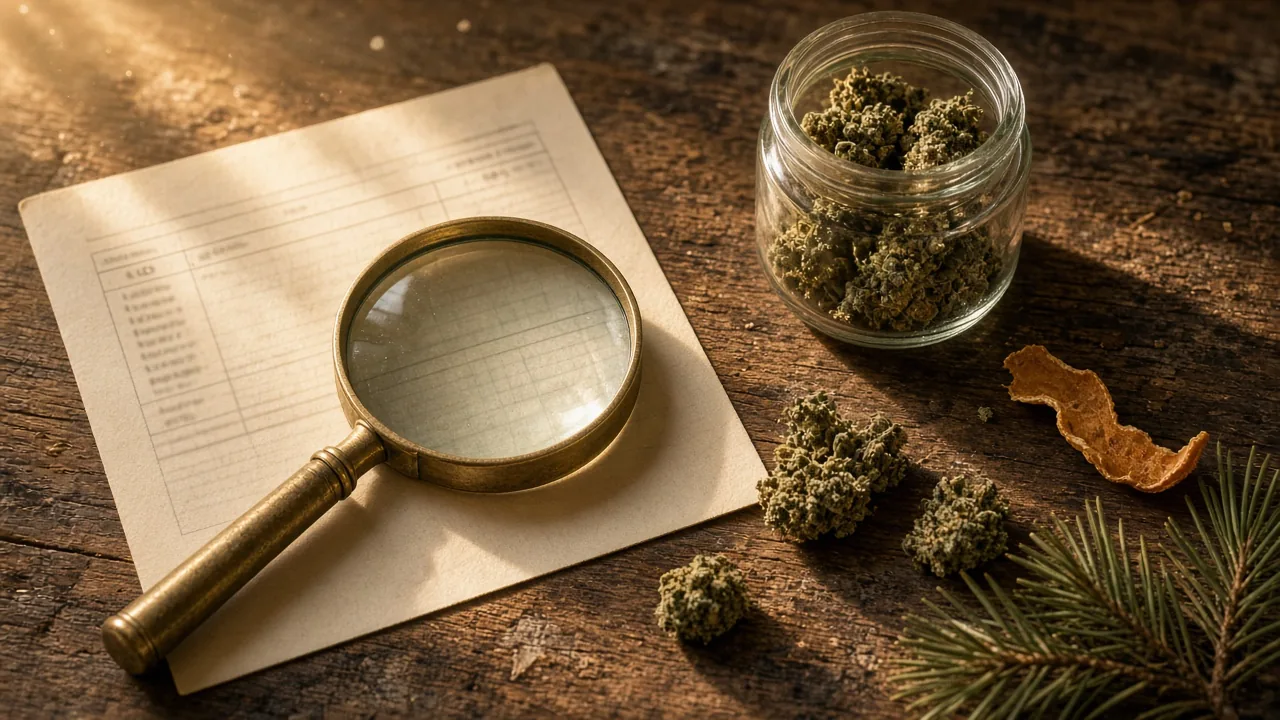
Ask for the batch Certificate of Analysis (COA), find the terpene panel, and look for “humulene,” “α-humulene,” “alpha-humulene,” or “α-caryophyllene” near the top of the list. On Michigan products regulated by the Michigan Cannabis Regulatory Agency (CRA), potency and safety testing are the compliance backbone; terpene panels are the shopper’s effect cheat sheet when the lab includes them.
Michigan-specific shopping notes, as of August 2026:
- The CRA publishes Sampling and Testing Technical Guidance for marijuana products. Use it as the reminder that lab paperwork is batch-specific — you want the sheet for this jar, not last month’s cousin. Terpenes are still the bonus sheet more often than the required safety panel.
- Mich. Admin. Code R. 420.504 lists what must sit on the sealed package: THC and CBD, lab name, test date, strain name if applicable, harvest date if applicable, warnings, and more. Humulene is not a required label field.
- Labels and menus can summarize. The PDF or QR COA is where humulene rank actually lives.
- Compare the top three terpenes, not humulene in a vacuum. Strong humulene next to caryophyllene is a different day than Strong humulene under Dominant myrcene.
One-minute Michigan COA checklist:
- Match the batch / package ID on the label to the COA
- Find the terpene table (sometimes called “terpenoids”)
- Locate humulene / α-humulene / α-caryophyllene
- Note its rank — #1 Dominant, high on the list Strong, mid-pack Moderate, bottom Trace
- Smell the jar — hop cone + dry wood should roughly agree with a high humulene rank
- Ignore strain-name nostalgia if the panel disagrees
For more panel literacy beyond humulene alone, keep our shop-by-terpene-panel Michigan dispensary guide open in the dispensary line.
Dominant, Strong, Moderate, Trace — Skip the Strain-Name Numbers #
Do not memorize a magic humulene percentage for a famous name. Batches swing. Grow, cure, storage, and lab method all move the number. Use directional ranks instead.
| Rank word | What it means on a COA | Shopper translation |
|---|---|---|
| Dominant | Humulene is #1 on the terpene panel | Strongest hop-earth signal; uncommon, treat as a prize if the nose agrees |
| Strong | Near the top, clearly a lead supporting note | Likely to shape the hop-yard feel people report |
| Moderate | Mid-list presence | Part of the blend, not the boss |
| Trace | Low on the list or barely reported | Smell/effect contribution is small |
You will still see internet lists that pin a decimal to a famous name. Those lists go stale the next harvest. For Detroit-area buyers, Dominant / Strong / Moderate / Trace beats chasing a decimal.
Freshness warning: Michigan summers are humid and winters are dry furnace air. Humulene is oilier than lemon terpenes, so it can linger a little longer, but a hoppy COA from a poorly stored jar can still smell flat. Buy fresh, store cool and dark, and re-check the nose every time.
What If the COA Has No Terpene Panel? #
If the batch paperwork skips terpenes, treat the product as incomplete information — not automatically bad, just harder to shop for a hoppy day. Michigan compliance testing centers on safety and cannabinoid potency under the CRA. Terpene panels are the bonus sheet smart shops and careful brands still provide.
What to do when terpenes are missing:
- Ask out loud — “Do you have a terpene COA for this batch?”
- Lean harder on the nose — hop cone and dry wood are still useful clues
- Prefer a different jar that publishes the full panel if hop-earth daytime is the mission
- Do not invent numbers from out-of-state menus or old harvests
Divine Toke’s education bias is simple: Detroit-area shoppers deserve the same transparency on aroma oils that they already expect on THC %. A hoppy nickname without a panel is just a story.
Humulene vs Myrcene vs Caryophyllene vs Pinene #
For cannabis shopping, humulene is the hop / earthy-day flag, myrcene is the heavy body flag, beta-caryophyllene is the pepper / CB2 comfort flag, and pinene is the pine / clearer-head flag. Many good jars carry more than one — that is a feature, not a bug.
| Terpene | Smell cue | Day / night job | Best when… | Sibling deep-dive |
|---|---|---|---|---|
| Humulene | Hop cone, dry wood, herbal earth | Grounded daytime association; appetite folklore | You want beer-garden aroma without chasing citrus | This guide |
| Myrcene | Mango earth, green hops, musk | Heavy body / sleepy association | You want physical melt after a hard shift | Myrcene guide |
| Beta-caryophyllene | Black pepper, clove | CB2-linked comfort; less “focus” talk | Aches steal the day | Caryophyllene guide |
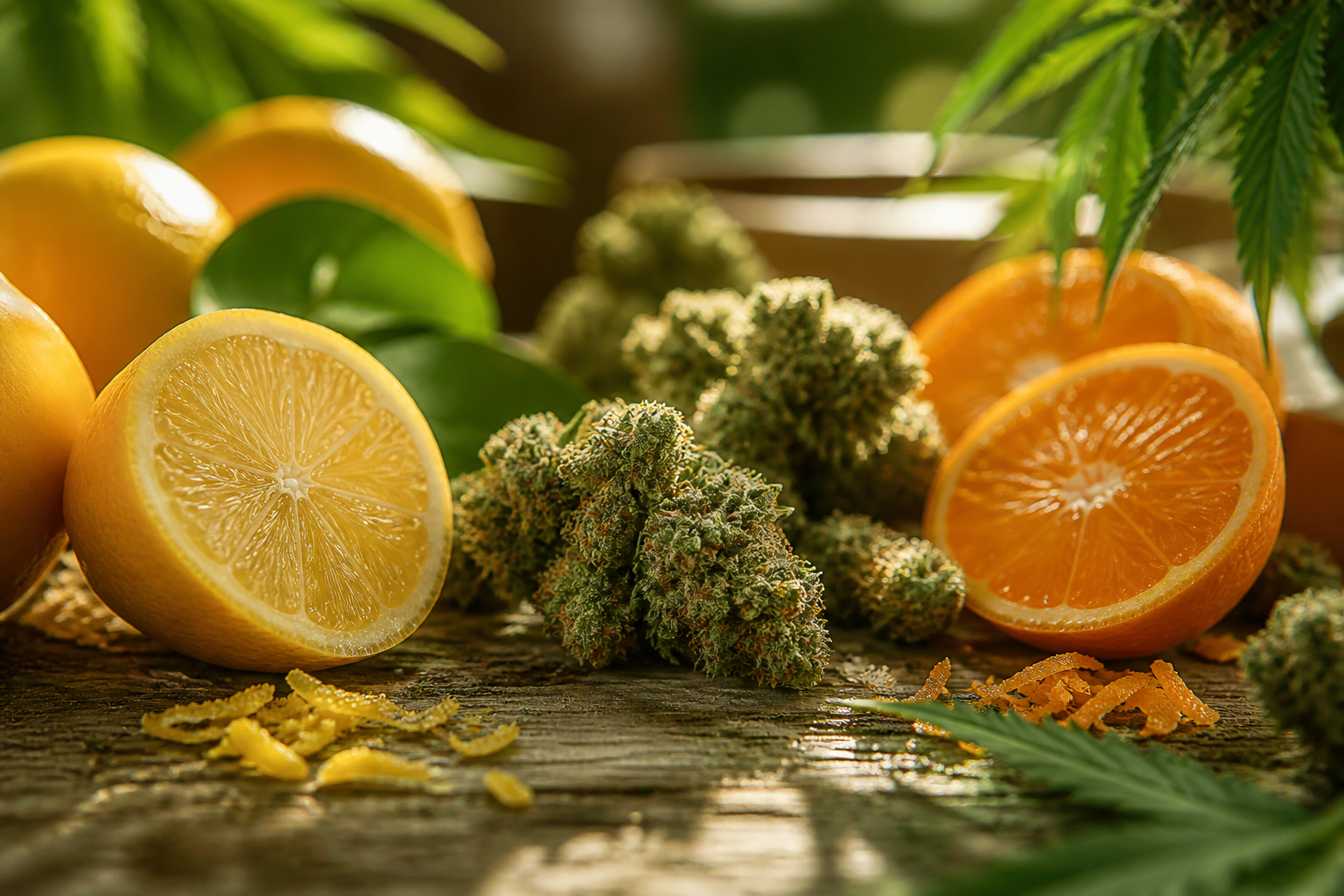
| Pinene | Pine needle, rosemary, resin | Clearer-head association; anti-couch folklore | You want forest aroma and a less heavy day | Pinene guide |
Evidence honesty in one breath:
- Humulene’s swelling story is preclinical animal work (PubMed 17559833, PMC2785529). Appetite is unproven in people.
- Myrcene’s sleep reputation is mostly preclinical + consumer pattern matching — details live in the myrcene spoke, not here.
- Caryophyllene is special because it can engage CB2 pathways tied to immune calm — not because it smells like a hop bine.
- Pinene’s memory story is lab enzyme work + a 2025 human vapor test that did not rescue THC fog.
Simple Michigan day stack:
- Want hop-earth / grounded day → prioritize Strong (or Dominant) humulene and check that myrcene is not also on top
- Want pine / less couch → look for pinene, not just a “sativa” sticker
- Want citrus brightness → look for limonene
- Mind spinning → look for linalool in the top tier
- Aches stealing the afternoon → want caryophyllene present with whichever head terpene you prefer
Divine Toke’s lane — Detroit-area Michigan sun-grown organic cannabis — is about preserving those oils so the panel you smell matches the panel you read. The molecules only help if they survive the jar.
How to Shop a Hoppy, Earthy Panel in Detroit #
Shop humulene with your nose first, the Michigan batch COA second, and the strain name last. That order protects you from menus that recycle “hoppy” folklore while the actual panel changed.
We will not invent Divine Toke cultivar names here. There is no house “humulene-forward” list to memorize. The batch still wins.
Step-by-step for metro Detroit and statewide adult-use stores:
- Tell the budtender the job: “I want a hoppy, earthy daytime jar — dry wood and hops, not mango couch, not lemon candy.”
- Smell two or three jars — hunt crushed hop cone, sage, dry wood. Skip jars that only scream ripe mango if a heavy night is what you are trying to avoid.
- Ask for each batch COA under Michigan CRA rules of the road — match package ID to paperwork. Terpenes may be optional; still ask.
- Check humulene rank — Strong (or Dominant) for a hop-forward day; Moderate if you only want a nudge.
- Read the supporting cast — caryophyllene for pepper-body; myrcene if the jar might still put you on the couch; pinene or limonene if you want a brighter edge; linalool if nerves are the main issue.
- Start low on dose — especially before a drive, a job site, or parenting duty. Adult-use possession and purchase limits still apply under CRA rules.
- Journal one line the next day — “Strong humulene + Moderate caryophyllene = porch / still snacky / too heavy.” Patterns beat strain myths.
Quick decision table:
| What you notice | Likely humulene story | Move |
|---|---|---|
| Hop-wood nose + humulene near the top of the COA | Strong / Dominant | Good grounded-day candidate |
| Soft beer note, humulene mid-list | Moderate | Fine if you want a lighter hop accent |
| Loud mango-earth, humulene Trace | Trace | Probably not your hoppy-day jar |
| Famous “hoppy” name, flat smell, no terp panel | Unknown | Pass or demand the COA |
| Hoppy nose + myrcene #1 | Mixed | Expect more body than the beer smell promised |
Common hop-forward names you may see on Michigan menus — “hop,” “ale,” earthy nicknames — are clues, not guarantees. For a fuller panel-shopping walkthrough, use shop by terpene panel Michigan dispensary.
Metro Detroit reality: shift workers from plants, hospitals, and logistics often want an afternoon jar that does not glue them to the couch before dinner. Humulene shopping is a method for that job. It is not a hall pass for driving impaired.
Who Should Look for Humulene — and Who Should Skip It? #
Look for Strong or Dominant humulene when you want a hoppy, earthy, less candy-sweet day; skip leaning on it when you need lights-out body melt, when hoppy jars make you feel dry or dull, or when you hoped it would kill your appetite. The molecule is a preference flag, not a personality test — and not a diet drug.
Good fit for a hoppy, earthy panel:
- Metro Detroit trades, hospital, logistics, and plant workers who want a grounded daytime reset
- Shoppers who like beer-garden, sage, and dry-wood aromas and dislike heavy mango-earth nights
- People building a day stack with pinene or limonene while keeping THC honest
- Anyone who already knows myrcene-Dominant jars glue them to the couch and wants the other end of the hop spice rack
Think twice, or keep humulene Moderate/Trace, when:
- You need lights-out body melt — prioritize myrcene instead
- Hop-earth jars make you feel flat, dry, or uninterested in food in a way you do not want
- You are new to THC and still finding a low dose that does not overshoot
- Your main goal is calm nerves — linalool may be the better flag
- You hoped hops would “treat inflammation” or “replace lunch” — that is not what the evidence supports
Michigan adult-use reality check: impairment is impairment whether the jar smells like a hop bine or lavender. Plan tomorrow’s drive and workplace testing rules before you chase “daytime” tonight.
| Goal | Humulene target | Pair with |
|---|---|---|
| Hop-earth grounded day | Strong / Dominant | Watch myrcene rank; modest THC you already tolerate |
| Soft beer accent only | Moderate | Whatever base panel fits your night/day |
| Pepper + hops body | Strong humulene | Strong/Moderate caryophyllene |
| Pine + hops clarity | Strong humulene | Strong/Moderate pinene |
| Deep sleep / body melt | Trace / low | Myrcene + linalool-forward panels |
Common Humulene Mistakes to Avoid #
The biggest humulene mistakes are treating it like a diet pill, treating a hoppy smell as automatic daytime energy, trusting beer nicknames over COAs, and ignoring myrcene because “hops mean functional.” Avoid those and you are already ahead of most menu marketing.
Mistakes to cut out:
- Chasing a strain name without a panel — “hoppy” genetics can still test Dominant myrcene after a different grow or cure.
- Assuming hop smell = Dominant humulene — myrcene and caryophyllene can fake a beer note; confirm on the COA.
- Calling humulene an appetite drug — the 2024 scoping review does not give you a human munchies trial, and PMC8489319 recycled inflammation papers for that claim.
- Calling humulene a steroid — Fernandes 2007 used dexamethasone as a control in animals.
- Calling humulene a cannabinoid — it is a terpene; LaVigne 2021 used injected mouse doses you will not smoke.
- Memorizing precise percentages for named strains — use Dominant / Strong / Moderate / Trace instead.
- Buying stale hoppy flower — a cardboard nose means the spice left the jar.
- Overdosing because it “smells like afternoon beer” — aroma does not cancel THC impairment for driving or work.
- Skipping the rest of the panel — Strong humulene + Dominant myrcene can still feel heavier than you expect.
- Inventing a house cultivar — we will not, and you should not. Batches move.
Quick myth table:
| Myth | Reality |
|---|---|
| “Hoppy strain = daytime cure” | Panel + dose decide more than the name |
| “Humulene is caffeine” | Not a proven stimulant |
| “Humulene cancels munchies” | Not shown in people at flower doses |
| “Humulene treats swelling” | Animal data only so far |
| “Humulene is the same as caryophyllene” | Same formula family; different shape and job |
| “No COA needed if it smells like an IPA” | Nose helps; paperwork confirms |
If you only remember one line: smell + Michigan COA rank > nickname + beer lore.
FAQ: Humulene and Hoppy Flower #
These are the humulene questions Detroit-area shoppers ask most — short answers first, then the useful detail.
What is humulene in cannabis? #
Humulene is a common cannabis terpene with an earthy, woody, hop-cone smell. It is a sesquiterpene, also called α-caryophyllene. PubChem CID 5281520 lists the formula as C15H24. It helps shape aroma and the “hoppy day” reputation; it is not THC.
Why does cannabis smell like hops? #
Because cannabis and hops are family, and they share some of the same oils — including humulene, myrcene, and caryophyllene. PMC6225593 treats Cannabis and Humulus as sister genera in Cannabaceae. Crush a hop cone from a Michigan hop yard and you have the teaching tool.
What does humulene smell like? #
It usually smells like crushed hop cones, dry wood, and herbal earth — woody and spicy more than sweet. A 2024 hop-extract sensory paper (PMC11311985) tags α-humulene as woody, spicy, and earthy. Confirm with the COA; aroma is a clue, not a lab result.
Is humulene the same as beta-caryophyllene? #
No. They are isomers — same formula, different shape. Caryophyllene is the peppery CB2-active terpene. Humulene is the hop-wood terpene and has not been characterized as a CB2 ligand in the 2018 hops-and-cannabis review (PubMed 30096653). Shop both rows if the lab splits them.
Does humulene suppress appetite? #
Not based on solid human evidence — do not treat a hoppy panel as diet weed. A 2024 scoping review of 340 papers does not headline an appetite proof, and bitter-hop fasting studies such as PMC6893682 tested bitter extracts, not flower humulene. THC can still raise hunger.
Does humulene reduce inflammation? #
It reduced swelling markers in animal models — it is not a proven human anti-inflammatory drug. Fernandes 2007 and Rogerio 2009 (PMC2785529) are the load-bearing papers. Those doses were lab milligrams per kilogram, not a Michigan pre-roll.
Does humulene get you high by itself? #
No. Humulene does not get you high by itself at normal flower levels. The intoxicating high from cannabis comes mainly from THC. LaVigne 2021 (PMC8050080) saw cannabimimetic mouse behaviors at 50–200 mg/kg injected — a research dose, not a porch session.
Is a hoppy humulene profile better for daytime? #
It is a fair shopping signal for a grounded day — not a guarantee, and not better than pinene or limonene for every person. Check that myrcene is not also Dominant. Dose still decides whether you stay upright.
How do I find humulene on a Michigan COA? #
Open the batch Certificate of Analysis, go to the terpene panel, and look for humulene, α-humulene, or α-caryophyllene. Match the package ID to paperwork from a Michigan CRA–regulated product, then note whether it is Dominant, Strong, Moderate, or Trace. R 420.504 does not require terpenes on the sealed label, so you often have to ask. Full walkthrough: shop by terpene panel.
Humulene or myrcene — which should I pick for daytime? #
Pick humulene for hop-earth grounded day; pick myrcene for heavier body wind-down. Many hoppy jars have both — read the top three terpenes. Deep dives: this guide and the myrcene mango sleepy guide.
Does a hoppy strain name guarantee high humulene? #
No. Strain names are marketing shorthand; batches change. A “hop” or “ale-style” menu name can still show Moderate or Trace humulene after a different grow, cure, or storage run. Always match the batch COA under Michigan CRA testing reality.
Does Divine Toke grow a humulene-forward strain? #
Divine Toke grows sun-grown organic cannabis in the Detroit / Michigan lane and teaches shoppers to read terpene panels batch by batch — we do not invent permanent house “humulene strains” in this guide. Ask for the current COA, smell for hop cone and dry wood, and shop Strong or Dominant humulene when that job is the job. Panels change with harvest and cure.
Closing Thoughts #
Humulene is the hop-cone terpene Michigan shoppers reach for when they want a grounded, earthy day — a useful shopping signal, not an appetite pill, a steroid, or a guaranteed couch-lock undo. The research says the swelling reputation is plausible and preclinical. The appetite reputation is mostly folklore. Skip the strain-name decimals, read the batch COA, and let Strong or Dominant humulene guide you alongside caryophyllene, myrcene rank, and a sane THC dose.
Primary question this guide answers: what is humulene in cannabis, why does it smell like hops, and is that profile better for daytime? Smell for crushed hop cones and dry wood, confirm the rank on the panel, and ignore beer lore that will be wrong next harvest.
Keep it practical: one jar, one batch COA, one honest dose. That beats a nickname and a myth every time.
If you're curious to try sun-grown organic flower chosen for aroma and terpene character — not just a giant THC number — explore what Divine Toke offers as a Detroit-area Michigan farm, starting at the shop. Pair this spoke with our what are terpenes guide, reading a Michigan COA terpene panel, shop by terpene panel at a Michigan dispensary, and the sibling terpene deep-dives on myrcene, pinene, limonene, linalool, and beta-caryophyllene. The nose-shopping terpene guide is the pocket version for the counter.
This article is for educational purposes only and is not medical advice. Always consult your healthcare provider before starting any new wellness routine.
Grown in Detroit. Shipped to your door.
Small-batch, sun-grown cannabis cultivated in living soil. Mail-order shipping to all 50 states.