Reading a Michigan COA: Terpene Panels for Everyday Shoppers
Learn how everyday Michigan shoppers read a generic cannabis COA terpene panel: names, percent vs mg/g, batch matching, and what the numbers do not prove.

Head Cultivator
On this page
An everyday Michigan shopper reads a COA terpene panel by matching the batch to the jar, then noting units (% or mg/g), total terpenes if listed, and the top three named compounds. Those numbers describe that lot's aroma chemistry — not a safety pass, and not a required field on Michigan's sealed package label.
I am Jamie, writing from the Divine Toke side of Detroit-area flower talk. This is a reading lesson. It is not a tour of any one farm's lab file. As of August 2026, a terpene list is extra chemistry on a generic Certificate of Analysis. Learn the names. Learn the units. Then ask a licensed budtender for the panel that belongs to the package in your hand.
What Is a Terpene Panel on a Michigan Cannabis COA? #
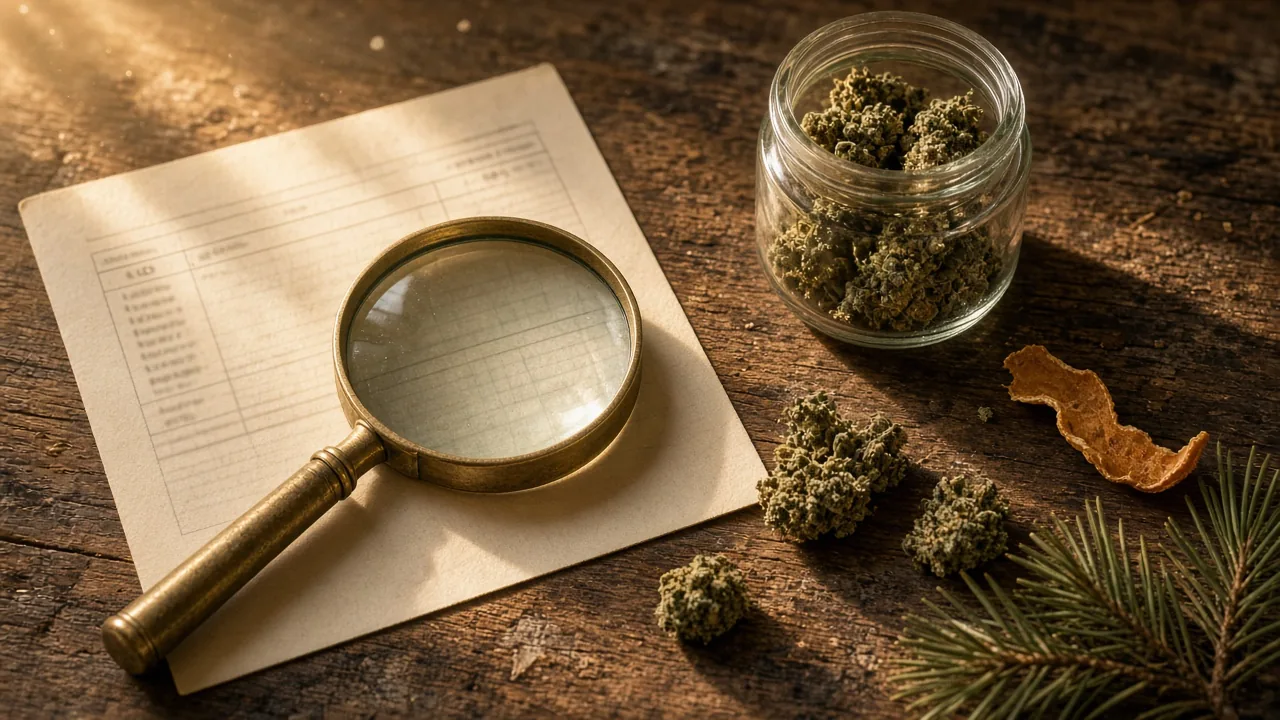
A terpene panel is the optional lab list of aroma compounds measured in one sampled batch — usually names plus a percent or an mg/g amount. It sits on a Certificate of Analysis (COA). Think of it as a smell-chemistry table, not a pass/fail safety stamp.
A COA is the lab's written report for a specific lot. The Michigan Cannabis Regulatory Agency (CRA) Scientific Section oversees the licensed safety compliance facilities that test products sold in Michigan's legal market. Those labs issue COAs. Shoppers in Detroit, Ann Arbor, Grand Rapids, and smaller towns all run into the same paper (or PDF) shape.
Terpenes are the volatile oils that make cannabis smell like mango, lemon peel, pine, pepper, or lavender. A 2021 Molecules review (PMC8489319) surveys the common cannabis terpenes and the pharmacology stories attached to them. You do not need that paper at the counter. You need the top few names and what the number next to each name is trying to say.
For the plant-level primer, start with our what are terpenes guide. For buying by chemistry instead of a nickname, see shop by terpene panel. This post is the middle skill: how to read the panel itself.
The four blocks most generic COAs share #
Most licensed-lab reports, as of August 2026, stack the same kinds of blocks. Layouts differ. The jobs of the blocks do not.
| COA block | What it is | Shopper job |
|---|---|---|
| Header | Lab name, sample ID, dates, product type, tracking ID | Match this lot to the jar |
| Cannabinoids | THC, THCA, CBD, and sometimes minors | Intensity clue — not the terpene story |
| Required safety tests | Pass/fail categories the agency asks for | Read separately from terpenes |
| Terpene panel | Optional list of aroma compounds | Read top-down for smell chemistry |
The CRA Sampling and Testing Technical Guidance tells labs that Metrc results and the COA should match for required tests, "aside from… testing not required by the agency (i.e., terpenes)." That sentence is the whole regulatory plot: terpenes can show up on the PDF and still not be a Metrc compliance field.
If you want the wider "what lab tested means" picture — potency inflation, missing safety pages, and why a stamp is not a promise — read what lab-tested means in Michigan. This article stays on the terpene table.
Does Michigan Require a Terpene Panel on Every COA? #
No. As of August 2026, Michigan lets a licensed lab run terpene analysis. It does not treat that list as a required safety test. If a COA has no terpene page, that does not by itself mean the batch skipped the agency's required checks — and if a COA has a terpene page, that does not mean the safety page is complete.
Mich. Admin. Code R. 420.305 lists required safety tests in subrule (3): potency, foreign matter, microbial screening, chemical residue, heavy metals, residual solvents where the rule applies, water activity, and mycotoxin or target-analyte tests when the agency asks. Subrule (18) is the terpene line: a laboratory may perform terpene analysis by an agency-approved method, and that method must be accredited on the same schedule as required safety tests.
Plain English:
- Required tests are the compliance lane. Labs enter pass or fail in Metrc, Michigan's seed-to-sale system, and on the COA.
- Terpene analysis is extra chemistry. The CRA technical guidance even uses terpenes as the example of results that may appear on a COA but not in Metrc.
- I am not listing numeric pass/fail limits here. Those live in agency tables and change. Inventing them would be a bad shopper habit.
Proposed is not the same as required #
The CRA's proposed-rules summary has floated standard terpene profile testing of flower, noting that many labs already run it and that it would improve consumer knowledge. A draft rules guide likewise discusses moving more of the scientific guide into rule, including flower terpene testing and COA uploads into the statewide system.
As of August 2026, treat that as proposed direction, not a promise that every jar on a Detroit shelf already has a terpene table. Ask. Do not assume.
Why this matters at the counter #
If a budtender says "we don't print terps on the box," they may be describing R. 420.504 correctly. If they say "there is no COA," that is a different problem. If they say "here is the terpene page" and nothing else, you still have not read a full safety report. Keep those three sentences straight.
How Do You Match a Terpene Panel to the Jar in Your Hand? #
Match the tracking ID, product name, and test date on the COA header to the sealed package before you trust a single terpene number. A pretty panel for the wrong lot is just a story about someone else's flower.
Metrc is the statewide monitoring system the CRA Scientific Section describes: serialized tags on plants and labels on wholesale packages so inventory can be followed from grow through sale. The CRA sampling guidance says lab chain of custody must include the complete Metrc identification number, plus product name, type, container count, and weights.
Your matching checklist:
- Package tag / Metrc ID on the jar or bag versus the same ID on the COA header.
- Product type — flower, pre-roll, concentrate, vape, edible. A terpene table for live resin is not a table for the eighth next to it.
- Strain name if listed — a search handle only. Names drift. IDs should not.
- Lab name — R. 420.504 already requires the lab that performed passing compliance testing, plus a test analysis date, on the sealed package.
- Test date and harvest date — freshness clues for aroma, not magic expiration math.
QR codes help only when they open the right file #
Some Michigan packages carry a QR code. MJBizDaily's reporting on Metrc Retail ID notes that the feature is available in Michigan and can point adult-use shoppers to a COA plus cannabinoid and terpene content. The same piece is honest about the gap: many QR codes around the country still open little more than a unique package ID.
If the code opens a menu, a brand homepage, or a different lot, stop. Ask staff to pull the report for this tag.
A made-up header, so you know what "match" looks like #
Here is a generic, invented header — not a real farm, not a Divine Toke file, not a lab result you should quote at anyone:
- Product: "Example Flower — Batch Demo"
- Metrc package:
000000000000000000000000(fake) - Lab: "Example Safety Compliance Facility"
- Analyzed: 2026-07-12
- Matrix: dried flower
If the jar in your hand does not share that ID and type, you put the PDF down. That is the whole first skill.
What Do Percent and mg/g Mean on a Terpene Panel? #
Percent (%) and milligrams per gram (mg/g) are two ways to write the same weight-to-weight amount. On flower, 1.0% of a terpene is 10 mg of that terpene in each gram of flower. Convert before you compare two jars.
Michigan already trains your eye on both unit families for potency. R. 420.305 says total THC and total CBD for marihuana and concentrates are reported in percentages, while infused products report milligrams per gram. Terpene tables borrow the same two languages. Labs pick one. Some print both.
The conversion you can do in your head #
One gram of flower is 1,000 milligrams. One percent of that gram is 10 milligrams.
| Panel number | Same amount in the other unit | Plain English |
|---|---|---|
| 0.10% | 1 mg/g | Trace line — often just a whisper |
| 0.25% | 2.5 mg/g | Supporting note |
| 0.50% | 5 mg/g | A real presence on many flower panels |
| 1.00% | 10 mg/g | A loud single-compound line for flower |
| 2.00% | 20 mg/g | Very high for one terpene on dried flower |
If Jar A lists myrcene at 0.60% and Jar B lists myrcene at 6.0 mg/g, they are the same amount. People lose money by treating 6.0 as "ten times louder" than 0.60 because they skipped the unit.
What the number is not #
- It is not a dose in milligrams you swallow, the way an edible label talks about THC per piece.
- It is not a Michigan pass/fail. The CRA guidance treats terpenes as testing the agency does not require.
- It is not the smell in the room after a hot car ride. Volatile oils fade. The NIST cannabis laboratory quality program exists in part because cannabis numbers are hard to compare across methods and labs. Treat any one decimal as a snapshot.
Concentrates can show much larger terpene totals than flower. Compare flower to flower and oil to oil. Do not crown a vape cart "more terpy" than an eighth because the cart's mg/g line is huge — the matrix is different.
What Do Common Terpene Names and Numbers Mean in Plain English? #
Each line is usually one compound name plus how much of it the lab measured in that sample. Read the name as a smell family. Read the number as "how much of that smell-family oil showed up," not as a medical dose.
A Molecules terpene review (PMC8489319) and Sommano and colleagues' 2020 Molecules review are the science backdrop: these oils drive a lot of cannabis aroma, and the literature maps them to plants you already know. Shopping still starts with your nose and your notes.
Use this table as a decoder, not a prescription. Percent bands are typical flower talk, not CRA cutoffs.
| Name you may see | Everyday smell | What a mid-range flower number often means | Deeper Divine Toke read |
|---|---|---|---|
| Myrcene (β-myrcene) | Earth, musk, ripe mango, hops | Often the tallest line; many people read it as heavier body | Myrcene / mango guide |
| Limonene (d-limonene) | Lemon rind, orange peel | Citrus-forward stack; mood-lift reputation in culture and some lab work | Limonene guide |
| β-Caryophyllene | Black pepper, clove, spice | The unusual one: it can bind CB2 receptors | Caryophyllene / CB2 guide |
| α-Pinene / β-pinene | Pine needles, rosemary, resin | Sharp green top note; "clearer head" talk | Pinene-forward guide |
| Linalool | Lavender, floral soap | Soft floral support; calm/sleep folklore | Linalool guide |
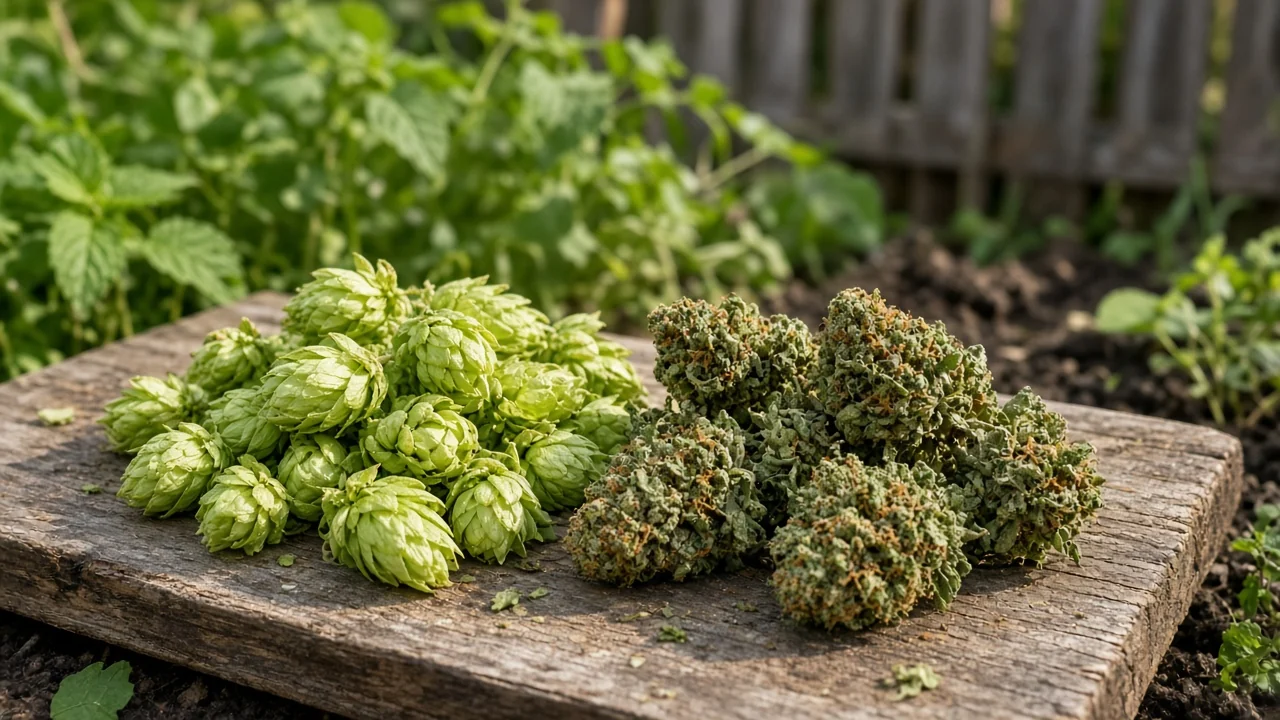
| Humulene (α-caryophyllene) | Hops, wood, earth | Often rides with caryophyllene | Smell: dry hops |
| Terpinolene | Fresh, herbal, sometimes sweet-pine | Less common as #1; when it leads, the jar often smells "bright-herbal" | Write it down — do not force an indica/sativa story |
| Ocimene | Sweet, tropical, green | Usually a support, not the whole panel | Secondary citrus-green |
| Bisabolol (α-bisabolol) | Soft floral, chamomile | Often a small line | Gentle floral edge |
| Nerolidol | Wood, bark, tea tree | Usually trace-to-support | Not a first filter |
Gertsch and colleagues in PNAS (2008) showed that β-caryophyllene selectively activates human CB2 receptors and does not act like a CB1 high. That is why the pepper line is more than a kitchen smell. It is still not a pain-medicine claim for the jar in your hand.
A 2024 Johns Hopkins–led human lab study found vaporized d-limonene could lower anxious/paranoid ratings when paired with THC in a controlled setting (Spindle et al., Drug and Alcohol Dependence). That is a careful experiment, not a promise that a 0.2% limonene line on a Michigan eighth will feel the same.
A made-up flower panel you can practice on #
This is invented so you can rehearse the voice. It is not a real lot and not a Divine Toke result.
| Compound | Result | Unit |
|---|---|---|
| Myrcene | 0.58 | % |
| β-Caryophyllene | 0.31 | % |
| Limonene | 0.22 | % |
| α-Pinene | 0.09 | % |
| Linalool | 0.07 | % |
| Humulene | 0.06 | % |
| Others / ND | — | — |
| Total terpenes | 1.45 | % |
How I would say that out loud at a Detroit counter: "Myrcene-forward, about one and a half percent total, with pepper and citrus support." That sentence is more useful than "it's an indica."
A 2021 Nature Plants study by Watts and colleagues found that sativa/indica labels tracked only a small set of terpenes and did not split the plants cleanly on the whole genome. The sticker is weak. The panel is the better shopping object — when you have it.
How Do You Read Dominant and Supporting Terpenes? #
Read top-down: total (if listed), then the single highest name, then the next two supports. That three-name stack is the panel in everyday language.
Labs sort tables two ways:
- By abundance — biggest number first. Easiest for shoppers.
- Alphabetical or method order — you have to hunt. Circle the top three yourself.
Dominant, support, trace #
- Dominant: the highest individual result. This is your first filter.
- Supporting: usually #2 and #3, sometimes #4 and #5 if they are close.
- Trace / ND: tiny or not detected. Useful for completeness. Rarely your buying reason.
If myrcene is 0.70% and everything else is 0.05%, you have a one-note stack. If myrcene is 0.40%, caryophyllene 0.35%, and limonene 0.30%, you have a more even trio. Neither pattern is "better." They smell different. Sommano et al. (Molecules) describe how terpene mixes — not one molecule — shape chemovar aroma.
A one-line story you can write on your phone #
Use this fill-in:
"[Dominant] -forward, with [support 1] and [support 2]. Total about [X]% / [Y] mg/g. Tested [month]."
Examples of the voice, still generic:
- "Pinene-forward with limonene and a little myrcene. Total about 2%."
- "Caryophyllene and humulene spice, myrcene underneath. Total about 1.2%."
- "Linalool is only third, but it is sitting under loud myrcene."
That is the same habit we teach in the nose-shopping guide: name the chemistry, then check whether the jar actually smells like the story.
When two lines look "tied" #
Do not overfit a 0.01% gap. Methods and rounding move that last digit. The NIST CannaQAP write-up is a reminder that labs do not all measure the same way. If two terpenes are close, call them co-dominant and move on.
What Does "Total Terpenes" Tell You? #
Total terpenes is the sum of the measured lines — a rough loudness score for that snapshot, not a quality trophy and not a Michigan legal cutoff. Use it to compare two similar products tested in similar units. Then still smell, if you can, and still watch the date.
There is no official CRA "good terpene percent." R. 420.305 does not publish a consumer terpene action limit, because terpenes are not in the required safety list.
Shopping heuristics many Michigan counters already use for dried flower:
| Total terpenes (flower, rough) | Everyday reading |
|---|---|
| Under ~0.5% | Flat or faded on the page |
| ~0.5%–1% | Quiet but usable if the top names fit you |
| ~1%–2% | Common "solid jar" band |
| Above ~2% | Noticeably louder on paper |
| ~3%+ | Unusual richness — still check freshness |
Sommano et al. note that breeding and chemovar work have pushed some flowers well above the old ~1% folklore. Treat high totals as a reason to get interested, not a reason to skip the rest of the report.
Totals lie when the sample is old #
Heat, air, and time strip the same oils the lab counted. A March total of 2.4% does not freeze the August eighth. Southeast Michigan summer cars are rough on this. If the panel is loud and the jar is mute, believe the jar.
Totals also lie across product types #
A live resin with 8% total terpenes is not "four times better" than a 2% flower. Different starting material. Different process. Compare like with like.
What Is a Terpene Panel Not Telling You? #
A terpene panel does not prove a product is clean, complete, or safe — and it does not replace the required safety section of a COA. This is the line I will not blur. Divine Toke's job in this post is shopper literacy, not a lab-claim.
Hold these limits in your head:
- Not a pesticide result. Chemical-residue testing is a different required category under R. 420.305.
- Not a mold result. Microbial screening is its own line.
- Not a metals result. Heavy metals are their own line.
- Not a solvent result. Residual solvents apply to the product types the rule names.
- Not a guarantee the safety page exists. A potency-plus-terpene PDF can look busy and still omit categories you care about.
- Not "the whole plant." Labs quantify the compounds they validate. Other volatiles can sit below the limit of quantitation.
- Not your high. THC still drives intoxication. Terpenes season the experience. A mouse-and-receptor paper (PMC8050080) is interesting mechanism talk. It is not a dispensary promise.
MLive reported in June 2026 that Michigan has spent millions on a state reference lab that still lacked legal authority to test commercial product, while the CRA had cited a large share of active private labs since 2024. Senate Bill 704 is the vehicle to let the agency operate that reference lab. As of August 2026, shoppers still live in a private-lab world. Read the panel. Do not worship it.
MJBizDaily has also documented how potency numbers can get stretched in several state markets, including Michigan data in industry analyses. If the THC line can wobble, the terpene line can wobble too. Use both as clues.
For how Michigan's required testing system is supposed to work — without turning this post into a Divine Toke lab brochure — stay with what lab-tested means.
Why Don't Michigan Package Labels List Terpenes? #
Because the sealed-package rulebook asks for identity, potency, the lab's name, dates, and warnings — not myrcene or limonene. As of August 2026, terpene literacy means asking for the COA (or a menu field the store chose to add), not staring at the sticker until a terp appears.
Mich. Admin. Code R. 420.504 is the consumer-facing list. The CRA Combined Best Practices bulletin walks licensees through the same cultivator-to-sales labeling checklist.
What the sealed pack must show (short shopper version) #
| Required on the MI package | Why you care when you also want terpenes |
|---|---|
| Cultivator/producer name, license, Metrc package tag | Your match key to the COA |
| Packager name and license if different | Who finished the pack |
| Harvest date if applicable | Age of the plant material |
| Strain name if applicable | Nickname only |
| Net weight | How much you are buying |
| THC and CBD + 10% variance statement | Potency range, not a terp list |
| Activation time | More useful for edibles |
| Lab name + test analysis date | Who tested, when |
| Universal symbol + warnings | Legal product markers |
Notice the missing row: no required terpene names, percents, or mg/g. Stores may print a highlight anyway. Many do not. That is allowed.
Strain name is not a panel #
The jar may say a famous nickname. Watts et al. in Nature Plants already told us those folk labels are a thin terpene story, not a genome. Two lots can share a name and flip their dominant line. Write the panel. Keep the name as a search handle.
How Do You Ask a Michigan Budtender for the Terpene Panel? #
Ask for the batch COA that matches the package tag, then ask them to read the terpene table out loud: units, total, top three names, and the test date. Short questions. No chemistry lecture.
I have watched this work in Detroit shops and in smaller Michigan rooms. Staff are faster when you are specific.
The five-question script #
- "Can I see the COA for this package tag?"
- "Is there a terpene panel on it, and is it percent or mg/g?"
- "What is total terpenes, if they printed one?"
- "What are the top three names and numbers?"
- "What is the test date, and is this the same lot as the jar?"
Optional extras, if the first five land:
- "Do you have another lot with a similar stack under a different name?"
- "If the QR only shows a Metrc ID, can you open the PDF?"
MJBizDaily is useful context for that last line: some QR tools now carry COA and terpene fields; plenty still do not.
What "I don't have terpenes" can mean #
| What they say | What it might mean | Your next move |
|---|---|---|
| "Not on the label" | True under R. 420.504 | Ask for the COA |
| "Lab didn't run terps" | Allowed under R. 420.305(18) | Shop the nose, or pick another lot |
| "I can only see potency" | Partial screen in their POS | Ask for the full PDF |
| "Here's last month's batch" | Wrong lot | Stop. Match the tag. |
| "We don't share COAs" | A service problem | Note it. Buy elsewhere if you need the data. |
Be polite. You are not accusing anyone. You are reading a table.
If you want the shopping workflow that comes after this reading lesson — goal, stack, rebuy — use shop by terpene panel.
What Do ND, LOQ, and Missing Terpene Lines Mean? #
ND means the lab did not measure that compound above its detection setup; LOQ is the smallest amount they will put a number on; a missing terpene page means that extra test was not reported — not that the plant had "zero terpenes" in nature. These footnotes keep you from inventing chemistry the PDF never claimed.
The CRA technical guidance already uses LOQ language for required analytes: when something sits below the method's limit of quantitation, labs are told to include the numerical LOQ and note "<LOQ" in Metrc. Terpene tables often reuse the same flags even though terpenes are not the required lane.
A tiny glossary #
- ND (not detected): nothing seen above the lab's detection floor for that method.
- LOD (limit of detection): the "we can tell it is there" floor. Often lower than LOQ.
- LOQ (limit of quantitation): the "we will print a number" floor.
- <LOQ: seen, but too small to quantify the way the method is validated.
- FIO / informational: some labs mark extra tests as information-only. That matches the CRA idea that terpenes are not the agency-required Metrc field.
The Michigan Cannabis Industry Association's testing-lab page summarizes the same split shoppers feel: licensed labs report pass/fail into Metrc and onto the COA within a few business days, and the two records should match except for tests the CRA does not require.
Why two labs can disagree on a "small" terpene #
Different columns, different standards, different lists. One lab may report 20 terpenes. Another reports 10. A compound that is ND on a short list might have been off-menu, not absent in the plant. NIST built CannaQAP because comparability is the hard part. Do not fight a friend over 0.03% ocimene from two different labs.
If a line you expected is blank, ask: "Is that ND, below LOQ, or not in this method?" Three different answers.
How Should You Use the Panel With Your Nose and Your Notes? #
Use the panel to name the chemistry, the nose to check that the jar is still alive, and a two-line note to rebuy the stack later. Paper first when packages are sealed. Nose first when the store lets you smell. Notes always.
Michigan sealed packaging often blocks a full sniff. That makes the COA more important, not less. When you can smell, pair the methods with our nose-shopping guide.
A Sunday counter rhythm #
- Goal in one phrase: evening quiet, daytime lift, body ease.
- Pull the matching COA.
- Convert units if needed.
- Write dominant + two supports + total.
- Smell if allowed. If the paper says citrus and the jar says hay, skip it.
- Buy a small amount if the stack is new to you.
- Next day, add one sentence: too heavy, too racy, just right.
What to write down (keep it tiny) #
- Store and city (Detroit is enough)
- Date
- Package tag or test date
- Top three terpenes + numbers + unit
- Total terpenes
- THC % from the label (range, not gospel)
- One feel sentence
That notebook is how you stop chasing nicknames. It is also how you notice when a beloved name flipped from pinene-forward to myrcene-forward.
When paper and nose disagree #
Believe the living flower. The COA is a past sample. Storage after the test date is not on the PDF. A faded jar with a beautiful old panel is still a faded jar.
FAQ: Reading a Michigan COA Terpene Panel #
Read the matching lot's terpene table as aroma chemistry — names, units, total, top three — and never treat that table as a Michigan safety pass. The questions below repeat the counter skills in short form.
How does an everyday Michigan shopper read a COA terpene panel? #
Match the batch ID to the jar, note the unit (% or mg/g), then read total terpenes if listed and the top three named compounds. Say the stack out loud. Treat the numbers as aroma chemistry for that lot, not as a safety badge. As of August 2026, that extra table is allowed under R. 420.305(18) and is called out as non-required in the CRA sampling guidance.
Is a terpene panel required on Michigan cannabis labels? #
No. R. 420.504 requires THC/CBD, lab identity, the Metrc package tag, warnings, and other ID fields — not terpene names or percents. Ask for the COA or a store menu field if you want the list. The CRA best-practices bulletin follows the same labeling checklist for licensees.
Does a terpene panel mean the product passed every safety test? #
No. Terpenes are optional extra chemistry, not a stand-in for pesticides, microbes, metals, or solvents. R. 420.305 keeps those jobs in separate required tests. A busy terpene table can sit on a report that is incomplete elsewhere. Do not read "loud terps" as "clean."
What is the difference between % and mg/g on the panel? #
They measure the same weight ratio: 1.0% equals 10 mg/g. Michigan already uses both families for potency in R. 420.305(9). Convert before you compare two jars. A 6 mg/g line is not automatically "more" than a 0.6% line.
What does total terpenes mean? #
It is the sum of the terpenes the lab reported — a loudness clue for that snapshot, not an official Michigan grade. There is no CRA consumer cutoff. Compare flower to flower, check the date, and remember oils fade after the test.
What should I ask a budtender? #
Ask for the COA that matches this package tag, the unit, total terpenes, the top three names and numbers, and the test date. If the QR only shows a Metrc ID, ask them to open the PDF. MJBizDaily notes some Retail ID labels now carry COA and terpene fields; many codes still do not.
Why does the COA list terpenes if Metrc might not? #
Because the CRA technical guidance says Metrc and the COA should match for required tests, aside from non-required tests such as terpenes. The PDF can be richer than the state tracking fields. That is expected, not a glitch you need to "catch" the store on.
Will Michigan require flower terpene testing? #
It has been proposed; as of August 2026 it is not the same as the current "may perform" rule. See the CRA proposed-rules summary and the draft rules guide. Until a final rule is in force, keep asking lot by lot.
Do terpenes get you high by themselves? #
Not in the THC sense. THC drives the intoxicating high; terpenes mainly shape aroma and may nudge how a dose feels. Reviews such as PMC8489319 discuss pharmacology widely. β-caryophyllene's CB2 work in PNAS is real mechanism research. None of that turns a terpene line into a substitute for knowing your THC dose.
What does ND or <LOQ mean on a terpene line? #
ND means not detected above the method's floor; <LOQ means the lab saw something too small to quantify under its rules. The CRA guidance uses the same LOQ idea on required tests. A missing name can also mean the lab's panel simply did not include that compound.
Can two jars with the same strain name show different terpene panels? #
Yes. Same nickname, different batch, different chemistry is common. Grow, harvest, cure, storage, and lab method all move volatile oils. Watts et al. already weakened the indica/sativa shortcut. Rebuy the stack, not the word on the lid.
Should I ignore THC and only read terpenes? #
No. Read THC for intensity and the terpene panel for the aroma shape. A bright limonene stack with a very high THC line can still feel edgy. A modest THC lot with a rich panel can feel more satisfying. Use both. And remember MJBizDaily's potency-inflation reporting: the THC digit is a range story, too.
Closing Thoughts: Read the List, Then Ask for the Right Lot #
If you remember one Divine Toke habit at a Michigan counter, make it this: read the terpene list on the batch COA like a short recipe — units, total, top three — and never confuse that recipe with a cleanliness seal. The nickname gets you to the shelf. The panel, when it exists, tells you what that lot smelled like on test day.
At Divine Toke we care about sun-grown, whole-plant character — the kind of flower where aroma is part of the point. If you are curious to try sun-grown organic flower chosen with that bias, start from the chemistry you already know you like and see what is on the shop. Keep notes. Rebuy stacks. Leave the myth that a PDF makes a product "clean" at the door.
Keep learning in this cluster:
- What are terpenes?
- Shop by terpene panel at a Michigan dispensary
- What "lab tested" means in Michigan
- Nose-shopping guide
- Humulene and the hoppy profile
- Myrcene · Limonene · Pinene · Linalool · Beta-caryophyllene
This article is for educational purposes only and is not medical advice. Always consult your healthcare provider before starting any new wellness routine.
Grown in Detroit. Shipped to your door.
Small-batch, sun-grown cannabis cultivated in living soil. Mail-order shipping to all 50 states.