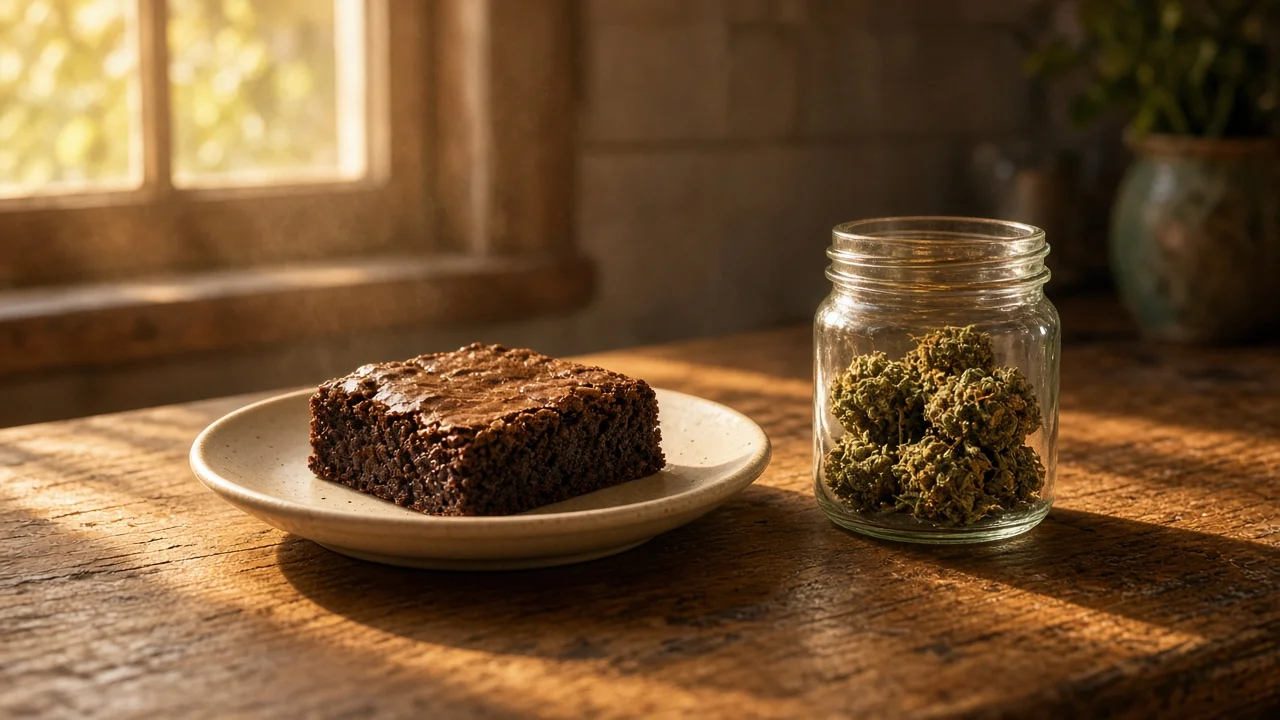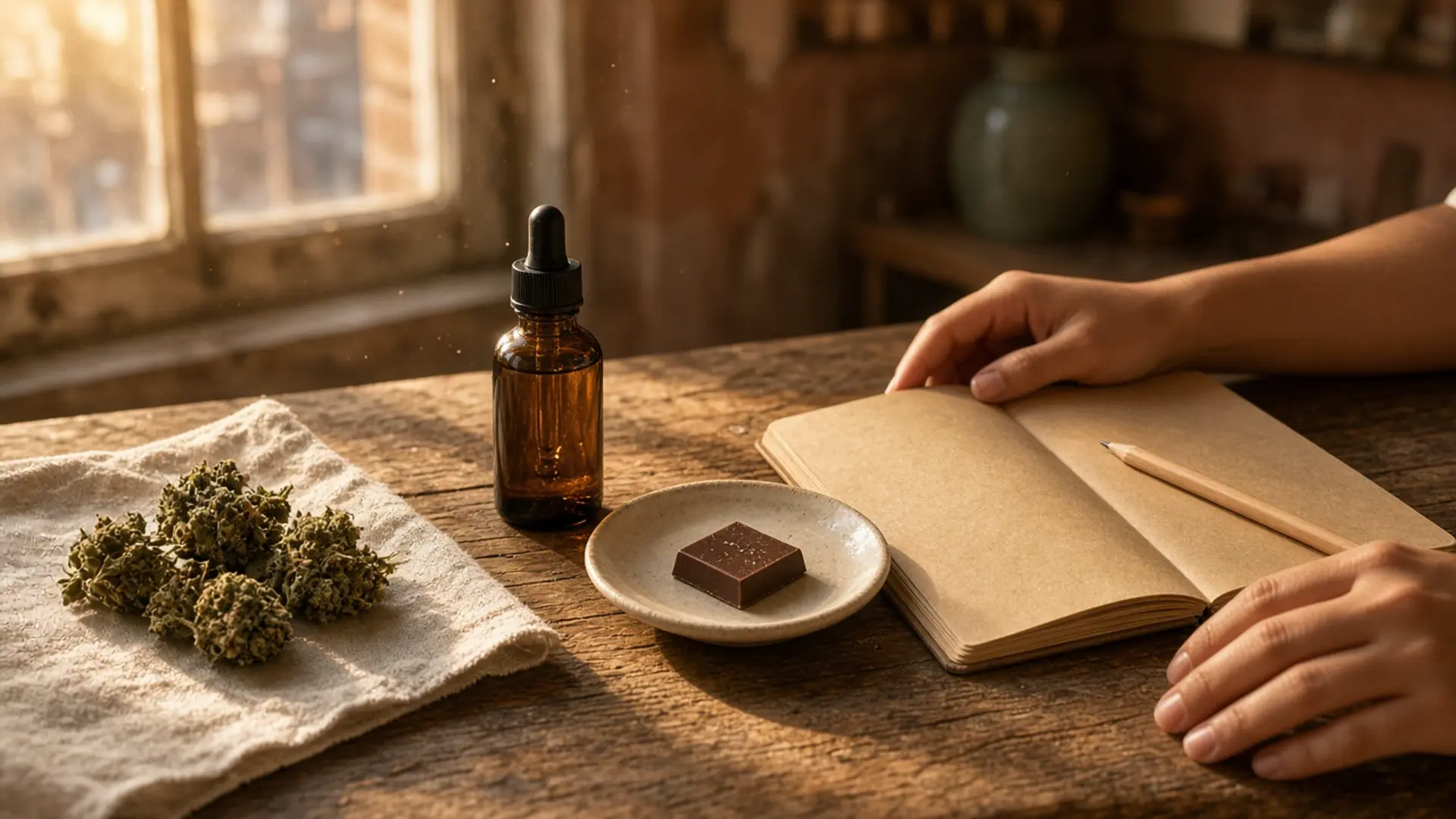
The High Isn't One Thing: Cannabinoids, Terpenes, Dose, Method, and You
The high isn't one feeling. Cannabinoids, terpenes, dose, method, and your body each change the ride. Here's the five-factor map for Detroit shoppers.

Head Cultivator
On this page
The high isn't one feeling because cannabinoids, terpenes, dose, method, and your body each change the ride. Two Detroit friends can share the same Michigan-tested jar and still walk away with two different nights — one warm and slow, one loud and racy — even when the label numbers match.
This pillar answers one question: why isn't "the high" one feeling, and which five factors actually change it? As of August 2026, that is the map we use at Divine Toke when a Metro Detroit shopper asks why last week's flower felt like a porch chair and this week's edible felt like a long hallway.
Why Isn't "The High" One Feeling? #
"The high" is not a single mood. It is a stack: plant chemistry, how many milligrams actually reach you, the path those milligrams take, and the nervous system they land on. People talk as if cannabis has one switch. The plant has many keys. Your body has many locks. The room you are in still has a vote.
The National Institute on Drug Abuse says THC is the main intoxicating — mind-changing — compound, and that products now vary a lot in how much THC they hold and how people take them. That is already more than one thing. The CDC cannabis FAQ adds the rest of the consumer stack: how much you use, how often, how you take it, your biology (including sex), and whether alcohol or other drugs are in the mix.
Think of coffee, not a cartoon. A small cup after breakfast is not a triple shot on no sleep. Same plant family. Different night.
Lu and Mackie (PMC4789136) describe the endocannabinoid system as a widespread dimmer: receptors, the body's own cannabis-like chemicals (anandamide and 2-AG), and the enzymes that build and break those chemicals. Plant THC walks into a system that was already running. That is why two people can share a joint and not share a baseline. One person's dimmer is already halfway down from a hard week. The other person's is sitting at idle.
A 2023 review in Molecules (PMC10058560) put the science in one blunt line: the exact same dose and prep can help one person and feel toxic to another. The authors split the reasons into exposure (route, frequency, food, other pills), individual (age, sex), and susceptibility (genes for receptors and breakdown enzymes). That is not a vibe. It is why "how did that hit you?" is a real question on a Detroit porch.
What people usually mean by "the high":
- A change in mood or body weight — loose, floaty, heavy, giggly, quiet
- Time stretching or shrinking
- Hunger, dry mouth, red eyes
- Softer pain or louder thoughts
- Sleepiness, or the opposite: a racing mind
Those are not one chemical event. THC docking on CB1 receptors — the main brain "locks" for the intoxicating part — is the loudest click. StatPearls (NBK430801) notes that CB1 receptors in the central nervous system can change the release of several brain chemicals, while CB2 receptors sit more in immune tissue. That split is why a head high and a body ease are not the same lock. The CDC health-effects page also lists faster heart rate, blood-pressure change, and smoked-lung strain — body facts that sit next to the mood story, not under it.
If you want the body-system map this pillar sits on, start with our endocannabinoid system deep dive. This page stays on the five levers that change the felt ride.
Divine Toke grows sun-grown organic flower in that Michigan legal frame. We do not sell a single "house high." We sell the honest story: the jar is an input. You are the other half.
What Five Factors Actually Change a Cannabis High? #
Five factors change the high in a way you can actually shop and journal: cannabinoids, terpenes, dose, method, and you. Strain nicknames and indica/sativa stickers are marketing shortcuts. They are not the engine.
Here is the factor matrix we will walk through. Keep it. It is the whole article in one table.
| Factor | Plain English | What it usually changes | What it does not do |
|---|---|---|---|
| Cannabinoids | THC, CBD, and the smaller plant keys (CBG, CBN, THCV, and others) | Whether you get intoxicated, and some of the shape | Promise a personality or a medical cure |
| Terpenes | The smell-and-oil compounds (myrcene, limonene, beta-caryophyllene, pinene, linalool) | Aroma, and sometimes the edge of the ride | Reliably "make you sleepy" from a menu word alone |
| Dose | Milligrams that actually get into you, not just the big % on the jar | Intensity, anxiety risk, how long you are in it | Climb in a perfect straight line with the label |
| Method | Lungs, tongue, gut/liver, or skin | Onset, peak, duration, and how much 11-OH-THC the liver makes | Make two routes equal just because the milligrams match |
| You | Receptors, liver enzymes, tolerance, meds, sleep, set and setting | Why your friend is fine and you are not | Get solved by a spit kit or a zodiac strain |
The CDC already lists most of that stack for the public. This pillar names the plant half (cannabinoids and terpenes) and the delivery half (dose and method) with the same weight as the body half.
A Saturday in Detroit makes the matrix real:
- Friend A smokes two small hits of flower on a full stomach, on the porch, after a regular week.
- Friend B eats a 10 mg square on an empty stomach after a double shift, then waits twenty minutes and eats another because "nothing happened."
Same plant family. Friend B is running a different cannabinoid path (gut and liver), a higher delivered dose, a slower clock, and a louder set. The CDC's edible-poisoning page is written for that second story: 30 minutes to two hours before the peak, a long tail, and a real risk of taking more too soon.
Add a third friend and the matrix gets even clearer:
| Person | Cannabinoids / terpenes | Dose | Method | You / set | Likely night |
|---|---|---|---|---|---|
| A | Same eighth, pepper-loud nose | Two small puffs | Flower | Fed, slept, porch | Fast, adjustable, done in a few hours |
| B | Same plant family, 10 mg then 10 mg more | ~20 mg swallowed | Edible | Empty stomach, post-shift | Late, heavy, long — the "nothing happened" trap |
| C | High-THC vape cart, almost no terpene story | Unknown dabs | Lungs, concentrate | Beer in hand, loud bar | Fast, stacked, hard to reverse (CDC MMWR on routes) |
None of those people "had a bad strain." They ran different stacks. That is the whole thesis.
You do not need a lab coat to use the five factors. You need to stop asking one question — "is this a strong strain?" — and start asking five.
The rest of this guide is one factor at a time, then how they stack. For the chemistry nouns, keep our cannabinoids guide and terpenes guide open in another tab. This is the umbrella, not a redo of those dictionaries.
How Do Cannabinoids Like THC and CBD Shape the Ride? #
THC is the main intoxicating cannabinoid. CBD is not intoxicating on its own. The smaller cannabinoids can nudge the ride, but they do not replace the five-factor stack. Cannabinoids are the plant keys. Your endocannabinoid system is the building full of locks.
The CDC says the cannabis plant holds more than 100 cannabinoids. THC is impairing — it changes thinking, attention, and timing. CBD is not impairing. That one sentence already kills the idea that "cannabis" is one drug.
NIDA uses the same split: THC is the mind-altering piece. Product menus in 2026 also sell drinks, oils, and concentrates with very different THC loads. The chemical class is shared. The dose and the path are not.
What THC actually does #
THC (delta-9-tetrahydrocannabinol) is a partial key for CB1 receptors in the brain and nerves. That is the main reason a joint can change mood, memory, hunger, and coordination. StatPearls on the NCBI Bookshelf notes that CB1 receptors sit in the central nervous system and can change the release of several brain chemicals, including dopamine, serotonin, norepinephrine, and GABA. CB2 receptors sit more in immune tissue and do not run the head high the way CB1 does.
A one-line recap, then we move: CB1 = brain and the intoxicating click. CB2 = body/immune more than "stoned." Full map: CB1 and CB2 receptors explained.
THC is also fat-loving. It spreads into tissues. The liver turns some of it into 11-hydroxy-THC (11-OH-THC), an active metabolite, then into 11-COOH-THC, which is not the high. A 2025 review of cannabis–drug pharmacokinetics (PMC11945156) says 11-OH-THC is active, a bit more potent than parent THC in the usual telling, and crosses into the brain more readily. Oral routes make more of that first-pass metabolite than a lung hit. That is chemistry, not a scare story. We will come back to it under method.
What CBD actually does — and does not do #
CBD does not get you high by itself. People still stack it with THC and hope it will "cancel" a racy jar. Human data on that hope is mixed. Some lab sessions show CBD softening THC's edge. Some show CBD making THC effects stronger or last longer, depending on dose, timing, and route. Some show almost no change.
As of August 2026, the honest line is: CBD is a different key, not an antidote sticker. It can matter for the whole-plant feel. It is not a guarantee that a 1:1 gummy will feel gentle for you. If the label is almost all THC and a dusting of CBD, shop it as a THC product.
The smaller keys #
The plant also makes CBG, CBN, CBC, THCV, and others. They show up on some Michigan labels. They are real chemicals. They are not secret personality settings.
| Cannabinoid | What we can say without overselling | What we should not say |
|---|---|---|
| THC | Main intoxicating CB1 key | "Higher % is always a harder night" |
| CBD | Not intoxicating alone (CDC) | "It erases anxiety for everyone" |
| CBG | Early research; often sold as "daytime" | Proven focus drug |
| CBN | Oxidation cousin of THC; sleep marketing is ahead of the human data | A guaranteed knockout |
| THCV | Different enough that people sell it as "less munchies" | A diet plan |
Treat minor cannabinoids as seasoning, not the meal — unless you bought an isolate on purpose. Whole-plant flower still leads with THC for most adult-use jars in Michigan.
A distillate cart can be almost only THC. Sun-grown flower is a mix: THC, a little CBD or none, minors, and terpenes. Russo (PMC3165946) argued that mix can change the therapeutic index — the gap between "this helps" and "this is too much." Piomelli (PMC6760171) said we should keep testing that idea instead of treating it as finished law. As of August 2026, that is still the right posture: whole plant is a different product than an isolate. It is not a magic shield.
For the noun list and label reading, stay with what cannabinoids are. For why the mix can beat a single isolated chemical, see the entourage effect. This section's only job is to put cannabinoids in slot one of the five.
How Do Terpenes Change the Feel Without Being the High? #
Terpenes are the smell-and-oil compounds that make one jar pine and another citrus. They can nudge the feel. They are not a second THC. If cannabinoids are the keys, terpenes are the room tone — real, useful, and easy to oversell.
Russo's 2011 review "Taming THC" (PMC3165946) is the paper people mean when they say entourage effect: cannabinoids and terpenes may work as a band, not a solo. That idea is older than Michigan adult-use stores. It is still only partly proven in humans.
Piomelli's 2019 comment "Waiting for the Entourage" (PMC6760171) is the honest hedge. The phrase is useful. The human proof is incomplete. Some terpenes have real pharmacology of their own. That does not mean a budtender can read your Tuesday off a three-letter terpene code.
What we can say about common terpenes #
Keep the claims small. Keep the nose honest.
| Terpene | Common smell | What the better evidence actually supports | Hedge |
|---|---|---|---|
| Myrcene | Earth, mango, hops | A very common cannabis terpene; sleepy marketing is mostly folk + animal hints | Not a couch-lock law |
| Limonene | Citrus peel | A 2024 Johns Hopkins–led human study found vaporized d-limonene lowered THC-related anxious/paranoid ratings in a dose-orderly way, without changing most other THC effects | The high limonene:THC ratio in that lab is not what every Detroit eighth contains |
| Beta-caryophyllene | Black pepper, clove | Gertsch et al., 2008 (PMC2449371) showed (E)-beta-caryophyllene is a selective CB2 agonist (Ki about 155 nM) and is not a CB1 head-high | Body/immune lock, not a stoned switch |
| Pinene | Pine forest | Smell is real; "pinene saves your memory" is not a finished human finding | Do not buy it as Adderall |
| Linalool | Lavender | Calming story comes from aromatherapy and preclinical work | Not a prescription for panic |
The limonene trial is worth a plain-English retell because it is one of the few controlled human terpene × THC tests. Adults inhaled THC alone (15 mg or 30 mg) or THC plus d-limonene. Limonene alone felt like placebo. Anxiety-like ratings fell as limonene rose. Other THC effects — the general high, the heart-rate bump — stayed in the same ballpark. The journal paper is early, not a shopping rule. It is still the right kind of evidence: one terpene, one outcome, hedged.
Mouse work can go further and still not be your jar. A 2021 paper (PMC8050080) found some cannabis terpenes can act a bit like cannabinoids and can boost cannabinoid activity in animals. That is a lab door, not a Michigan menu promise.
How to use a terpene panel in a Detroit store #
Smell first. Then read the panel if the shop prints one. Then write down what you felt.
- If it smells like pepper and wood, you may be in beta-caryophyllene country
- If it smells like lemon cleaner, you may be in limonene country
- If it smells like a mango and a couch, people will say myrcene — believe the nose more than the bedtime slogan
Terpenes fade with heat, air, and a messy stash jar. A loud panel on a stale eighth is a ghost. For the full noun lesson, use what terpenes are. For why the band can beat a single isolate, stay with entourage vs isolates. This pillar's job is simpler: terpenes are factor two. They color the high. They are not the high.
Does a Higher THC Percentage Mean a Stronger High? #
No. A higher THC percent is real lab math. It is not a reliable strength grade for how hard the first session will feel. Blood can climb. The "I am high" score often does not climb in a straight line with the sticker.
In a 2020 University of Colorado Boulder study in JAMA Psychiatry (PMC7287943), 121 regular users took legal-market flower around 16% or 24% THC or concentrates around 70% or 90% THC the way they actually use them. Concentrate users had much higher plasma THC and 11-OH-THC. Self-reported intoxication and the short-term hits to memory and balance did not split cleanly by that potency gap.
Lead author Cinnamon Bidwell's public line matches the paper: potency did not track intoxication the way people expect. Regular users also self-titrate — they take smaller hits from a louder product. Receptors can saturate. The label never sees either of those.
| What the THC % can tell you | What it cannot tell you |
|---|---|
| How the lab calculated Total THC in that dried sample | How hard the first session will feel |
| A rough intensity direction (low vs high) | The mood or body-load of the ride |
| Whether two jars are in the same ballpark | Whether you will inhale the same milligrams as your friend |
| How much THCA could become THC when you heat it | Freshness, terpene panel, or your CB1 baseline |
The CDC still warns that higher-THC products can raise the risk of overdoing it and of cannabis use disorder, especially if you start young or use often. Those are population risks. They are not the same sentence as "30% flower will feel twice as strong as 15% tonight."
This is the myth we already took apart in the THC potency myth. The pillar point is narrower: percentage is a cannabinoid number. Dose is what you actually take. Method is how it arrives. You are who it lands on. A 18% sun-grown jar with a loud nose can out-feel a 28% jar that you barely sip — or the reverse, if you take four huge hits of the 28%.
Divine Toke does not hide from high-THC flower. We hide from the shortcut. Shop the number as one column. Read the rest of the report card.
How Does Dose Change the High — and Why Aren't Milligrams the Whole Story? #
Dose is the biggest volume knob most people still turn by accident. Too little and you write the batch off. Too much and you decide "this strain is anxiety" when you just overshot. The milligrams on a Michigan label are the starting estimate, not the milligrams in your blood.
Huestis's human pharmacokinetics review (PMC2689518) is the old, load-bearing paper: dose, route, vehicle (the oil or food around the THC), and your own absorption and clearance all change the concentration in circulation. Two people can swallow the "same" 10 mg and not share a blood curve.
A 2018 clinical PK/PD review (PMC6177698) adds the puff problem: inhaled THC bioavailability is often cited around 10% to 35%, and a lot of that spread is how you inhale — number of puffs, how long you hold, how deep, the device, where the particles land. Sharing a joint is not splitting milligrams. It is sharing a stick and guessing.
Dose is not one number #
There are at least three "doses" in play:
- Label dose — milligrams or percent printed under Michigan CRA rules
- Delivered dose — what you actually inhale, hold under the tongue, or swallow
- Body dose — what survives first-pass liver work, fat storage, and your enzymes
Edibles make that gap famous. The CDC says food and drink cannabis can take 30 minutes to 2 hours to feel, can last longer than people expect, and is easier to overshoot because the first serving is still invisible. Empty stomach, other meds, and alcohol all change the same clock.
A practical dose ladder for adults 21+ who are not being told what to take by a clinician — this is education, not a prescription:
| Experience picture | Flower (very rough) | Edible / swallowed | Why people blow it |
|---|---|---|---|
| New or anxious | One small puff, then wait | 1–2.5 mg, then wait at least 2 hours | "I feel nothing" at minute 20 |
| Occasional | Two small puffs, journal | 2.5–5 mg | Matching a daily friend's 10 mg |
| Regular flower | Your usual, then less if the method changes | Start lower than your smoked "feel" | Treating 10 mg edible as "one hit" |
| Daily heavy | Tolerance is not immunity | Do not "make up for it" with a 50 mg square | Chasing a percent instead of a pause |
Those edible milligram bands match common legal-market serving talk, including the old Colorado single-serving story the CDC MMWR used when it described delayed edible peaks and stacked servings. Michigan packages still print milligrams. They still cannot see your liver.
Biphasic is the ten-dollar word for a simple fact: a little THC can feel like ease; a lot can feel like a panic. That is one reason the same cultivar is "perfect" at two puffs and "never again" at six.
Dose also interacts with you. A December 2025 pharmacogenetics review (PMC12732823) notes that people with slower CYP2C9 spellings can show about three times the THC exposure after oral THC in a typical volunteer experiment, with more sedation. You will not see that on a dispensary sticker. You will feel it if a 5 mg gummy lands like someone else's 15.
Start low. Go slow. Stay low until the clock is done. That line is in the Molecules individuality review (PMC10058560) for a reason. It is also how you stop blaming the plant for a math error.
Food, fat, and the "empty stomach" edible #
Food in the stomach changes an oral dose more than it changes a lung hit. THC is fat-loving. Huestis (PMC2689518) showed that the oily vehicle around oral THC — sesame oil vs a dry cookie vs an empty gut — changes how much gets into blood and how jumpy that curve is. The CDC edible page lists empty stomach as one reason a food product can last longer or hit harder than you planned.
A Coney Island after a plant shift is not a controlled lab breakfast. It still matters:
- Empty stomach, swallowed THC: often faster, sometimes sharper, easier to overshoot
- Fatty meal, swallowed THC: often slower, sometimes bigger total exposure, longer wait
- Flower after the same meal: the lung clock barely cares about the fries
Do not use "I ate" as a reason to double the gummy. Use it as a reason to wait the full two hours.
For edible-specific timing and serving math, our edibles dosing guide is the how-to. This pillar only needs you to treat dose as factor three, not as a personality test.
Why Does Method — Flower, Tincture, or Edible — Change the High? #
Method changes the clock and the chemistry. Lungs are a light switch. A held tincture is a dimmer. A swallowed edible is a delayed freight train because the liver remakes part of the THC. Same milligrams on two labels are not the same experiment.
Huestis (PMC2689518) compared smoking, swallowing, and injection decades ago: smoked and IV THC rose fast; oral THC was low, late, and messy. In that classic cookie comparison, systemic availability was about 18% ± 6% after smoking and about 6% ± 3% after an oral 20 mg cookie. Effects after oral THC also showed up at lower plasma levels and lasted longer.
A Permanente Journal pharmacokinetics review gives the consumer clocks most clinicians still quote: inhaled THC often peaks in about 6 to 10 minutes, with bioavailability often cited at 10% to 35%; swallowed THC bioavailability is often cited at 4% to 12%, with a slower climb and a longer stay. The liver's CYP enzymes — especially CYP2C9 and CYP3A4 — turn THC into 11-OH-THC (still active) and then 11-COOH-THC (not the high).
The 2018 PK/PD review (PMC6177698) is the clean method table in sentence form:
- Inhaled: peak about 3 to 10 minutes; higher peak than oral; first-pass mostly skipped
- Oromucosal / under the tongue: faster than a swallow, slower and lower than a lung hit; less first-pass than a full gulp
- Oral / edible: poor, variable absorption; first-pass is the point; peak often around ~2 hours; useful when you want a long window, risky when you want a short one
A 2025 Pharmaceutics review (PMC11945156) puts oral Tmax in a 1 to 5 hour band and says effects can start around 30 minutes and last about 6 hours — and that is an average story, not your Tuesday.
Method comparison (the table to screenshot) #
| Factor | Flower (smoke / vape) | Tincture held under the tongue | Swallowed edible / gulped tincture | Topical on skin |
|---|---|---|---|---|
| Typical onset | Seconds to a few minutes | About 15–45 minutes (up to ~60) | About 30–90+ minutes; CDC cites up to 2 hours | Local; not a head high |
| Peak | Sharp; often ~15–30 minutes | Gentler; often ~45–120 minutes | Delayed; often ~2–3 hours | Slow, local |
| Duration | Roughly 2–4 hours | Roughly 2–6 hours | Roughly 4–12 hours | Hours on the spot |
| Liver first-pass / 11-OH-THC | Low on the first pass | Mix: some mouth, some swallow | High — this is the edible difference | Skips the gut if it stays on skin |
| Dose control | Puff-by-puff; easy to stop | Dropper marks; wait to redose | Fixed mg; hard to take back | Rub-on; do not eat it |
| Lung exposure | Yes | No | No | No |
| Main fail | Over-puffing because it is easy | Swallowing the whole dropper and calling it "sublingual" | Redosing at minute 25 | Expecting a couch-lock from a balm |
Those timing bands line up with the PK reviews above and with the clocks we already published in tincture high vs flower high. If you are choosing what to buy, use tincture vs flower vs edible. This pillar is why the rides differ.
Minute-by-minute: same person, three methods #
Same adult. Same Saturday. Three different clocks. These are typical bands from the PK papers, not a promise.
| Clock | Flower night | Held-tincture night | Swallowed edible night |
|---|---|---|---|
| 0:00 | First small puff | Drops under the tongue, then spit or swallow leftover | Square goes down with water |
| 0:05 | Already shifting for many people | Still waiting | Still waiting |
| 0:15 | Near peak for a lot of inhaled sessions | Maybe a soft edge | Still waiting — this is where people fail |
| 0:45 | Coming down or on a plateau | Climb often underway | Maybe a first hint |
| 2:00 | Often mostly done | Mid-ride for many | Peak window for a lot of oral THC (Permanente PK) |
| 4:00 | Usually residual | Fading or still on | Still very much in it |
| 8:00 | Sleep is about sleep | Mostly over | Tail can still be on, especially after a second serving |
The lesson is ugly and useful: if you judge an edible on the flower clock, you will take more. The CDC wrote a whole poisoning page so we would stop doing that.
Why the edible ride is a different chemical, not just a slower joint #
When you swallow THC, a chunk of it hits the liver before the rest of you. That first-pass step makes more 11-OH-THC than a lung hit does. PMC11945156 calls that metabolite active and a little more potent, with an easier path into the brain. That is a big reason a 10 mg square can feel heavier and longer than 10 mg worth of flower puffs — and a big reason you should not "match" them milligram-for-milligram on a work night.
You do not need a new chemical name to use this. You need the rule: lungs = fast parent THC. Gut = slower mix with more liver product. Food in the stomach, the oil the THC is dissolved in, and your CYP2C9 speed all shove that curve around (Huestis, PMC2689518).
CDC's 2025 MMWR on routes of use is the public-health half: smoking is still common; eating and vaping are up; each route carries a different risk — lung injury questions for some vapes, overconsumption for edibles, very high THC for dabs. Method is not a lifestyle brand. It is a medical-adjacent choice.
Topicals stay in their lane. A transdermal cannabinoid review (PMC8876728) notes skin is a poor, slow door for THC compared with lungs or gut, and CBD tends to move through skin better than THC. A balm on a knee is not a substitute for a tincture in the head. Do not lick it to "make it work."
After a Detroit shift, the method question is practical:
- Need to feel it before the bus, and stop if it is too much? Flower, one small puff at a time
- Need a quieter climb without smoke? Held tincture, then wait
- Need a long evening and you can stay home? A low-milligram edible, then do not take a second until the two-hour mark is dead
Same plant. Three clocks.
How Does Your Body Change the Same Michigan Jar? #
Your copy of the endocannabinoid system is not your friend's — receptors, liver enzymes, hormones, meds, and last week's tolerance all change the same label. This is factor five. It is why a shared joint is a poor experiment.
The Molecules 2023 review (PMC10058560) is the umbrella: exposure, individual, susceptibility. NIDA lists amount, potency, route, other substances, age, sex, and genes at the consumer level. We already wrote the deep genetic version in why everybody's high is different. Here is the pillar-length recap — enough to shop, not enough to mail spit to a startup.
Receptors and tolerance #
CB1 receptors are the main brain locks. Heavy daily use can take some of those locks offline. A break can bring them back. Hirvonen and colleagues (PMC3223558) used PET scans in 30 men who smoked cannabis daily and 28 controls. CB1 availability was about 20% lower in thinking and emotion cortex at baseline, and moved back toward normal after about four weeks of monitored abstinence. That 20% is one study's average, not your personal lab result.
A later scan study found receptor differences were already hard to see after about two days off in heavy users (D'Souza et al., PMC4742341) — an early bounce, not a finished reset.
What that feels like in a Detroit week:
- Your "usual two puffs" do less
- You reach for a third without thinking
- A weekend off makes "your usual" feel loud again
That last one scares people. It is often seats coming back online. It is not proof the new batch is spiked. Compare package IDs if you want to rule out a real chemistry change. Then look at your calendar. If you want the pause how-to, that lives in tolerance-break science. This pillar will not rebuild that calendar.
Liver genes, without the spit-kit sales pitch #
THC and CBD are handled largely by CYP2C9, CYP3A4, and CYP2C19. The 2025 personalization review (PMC12732823) flags **CYP2C9 2 and 3: slower THC clearance, higher exposure, especially after oral products. In one typical volunteer design, *CYP2C93/3* raised THC AUC about threefold and came with more sedation.
FAAH is the enzyme that breaks down anandamide, your body's own cannabis-like chemical. A slower FAAH spelling can change baseline mood and reward wiring a bit. It does not mean a DNA result can tell you how a joint will feel. COMT is the enzyme that breaks down dopamine in the front of the brain. Older papers blamed it for THC anxiety. A meta-analysis summarized in that same 2025 review found the COMT × cannabis interaction unconvincing for routine testing.
| Body lever | Plain English | Shop move |
|---|---|---|
| CB1 density / tolerance | Daily use can quiet some brain locks | Do not chase percent; change frequency |
| CYP2C9 speed | Slow liver = more oral THC hanging around | Treat edibles as a different drug |
| FAAH baseline | Your idle anandamide setting can differ | Start lower if you already run anxious |
| COMT / other SNPs | Mixed, oversold | Skip the "cannabis genotype" upsell |
| Age and sex | CDC notes women may get more dizziness; older adults often clear drugs slower | One friend's dose is not a courtesy |
Meds, gut, and the week you are having #
A 2024 clinical drug-interaction review (PMC10824494) says cannabis can be a "victim" (other drugs raise cannabinoid levels) or a "perpetrator" (cannabinoids raise other drug levels). Their research-average caution: clinically noticeable enzyme fights are more likely when oral THC is above about 30 mg/day or CBD is above about 300 mg/day. That is not a personal green light. Liver disease, genetics, and your other pills can move the line.
The full safety chart is cannabis and medication interactions. Never change a prescription because of a blog post. Tell the clinician who manages a blood thinner, a seizure drug, or a heart pill the truth.
Gut talk is earlier than the internet wants. Bugs and the endocannabinoid system do speak. As of August 2026 there is no good human proof that a stool test predicts a joint. Food in the stomach still matters more than a $200 microbiome kit.
Age and sex belong in the same pile, with a hedge. The CDC FAQ notes that women may get more dizziness after cannabis than men. Older adults often clear many drugs slower, and Metro Detroit has a lot of people on more than one daily pill. None of that is a home diagnosis. It is a reason not to copy a 24-year-old roommate's milligrams if you are 64 and on a blood pressure script.
Two Detroit friends, same eighth, different bodies: one slept, ate dinner, smokes twice a week, takes no daily meds. The other came off a double, skipped food, smokes most nights, started a new antibiotic, and has church with the kids at 8 a.m. The CRA milligrams did not change. The stack did.
What Are Set and Setting, and How Much Do They Matter? #
Set is the mind and body you bring. Setting is the room. Both can change the report you give — and expectancy can produce "THC-like" feelings even when the cigarette is placebo. This is still factor five. It is the half you can change tonight without buying a new jar.
Set means sleep, stress, empty stomach, what you believe will happen, and whether you still have to drive a kid across 8 Mile. Setting means porch vs loud bar, light vs dark, friends vs strangers, phone buzzing vs phone in the other room.
A balanced-placebo marijuana study (PMC3829473) split people into told-THC vs told-no-THC, and real 2.8% THC vs placebo. Expecting THC produced more THC-like subjective effects. Pharmacology still mattered. The story in your head mattered too.
A sister paper on mood after smoking (PMC3852154) found THC raised arousal and confusion. The direction of anxiety depended on the instructional set: anxiety rose after THC for people told they got placebo, and fell among others. People who expected more impairment got more anxious. Frequent users were less anxious after smoking than less-frequent users.
That is the science under "I only get weird at parties." The drug is real. The prediction is also real.
Hedge the furniture. Hollister's 1975 Archives of General Psychiatry paper on marihuana and setting found a strong effect of person and drug, and little effect of a "favorable" vs "neutral" room in that design. So we do not claim a candle fixes a 30 mg edible. We claim this:
- A night-shift nurse and a Saturday porch are not the same experiment
- If you already expect to panic, a high-THC concentrate in a crowded bar is a mean test
- Sleep debt is a dose multiplier in real life, even when the paper did not measure your overtime
Practical set/setting checks before you change the cultivar:
- Have I eaten.
- Have I slept.
- Do I still need to drive, lift, or parent in two hours.
- Is this room loud, new, or full of people I perform for.
- Am I stacking a beer "just because."
If three of those are bad, the plant is not the first problem. The stack is.
Why Don't Indica and Sativa Labels Predict the High? #
Indica and sativa on a Michigan menu are leftover plant-shape words. They do not reliably tell you whether you will sleep or clean the kitchen. Chemistry and you do. The sticker is a habit.
People still say indica = body, sativa = head, hybrid = both. Breeders crossed those lines for decades. Two jars with the same nickname can have different THC, different CBD, and different terpene panels. Two jars with different nicknames can smell like cousins.
What actually tracks better, in the order this pillar already used:
- THC and the rest of the cannabinoid panel
- Terpenes you can smell and, when printed, read
- Dose you will really take
- Method
- Your last two weeks
That is why we already told shoppers to retire the binary in indica vs sativa vs hybrid: what actually matters. The pillar version is shorter: if the five factors are the engine, indica/sativa is the paint.
A Detroit-counter translation:
| What the menu says | What to ask instead |
|---|---|
| "That's an indica, you'll sleep" | What's the THC/CBD, what's the loud terpene, and how are you taking it? |
| "That's a sativa, you'll get stuff done" | Is this high-THC flower you plan to smoke before a work call? |
| "Hybrid, best of both" | Hybrid of what chemistry? Can I smell it? |
| "This one is 31%, so it's stronger" | Stronger than what dose, in what method, in whose body? |
Sun-grown organic flower from a living-soil farm can still be labeled indica or sativa because the market talks that way. Smell the jar. Read the numbers. Journal the night. Let the plant tell you after, not the folklore before.
How Do Alcohol, Medications, and Stacking Change the Experiment? #
Alcohol, other drugs, and many prescriptions turn a known five-factor stack into a new experiment — often a harder one. Cross-fading is not a third cannabinoid. It is two depressant-style intoxicants on the same clock.
The CDC FAQ says using cannabis with alcohol or other drugs can raise the risk of harm, including unknown drug-to-drug fights. That is the public line. The lab line is more specific.
A vaporized-cannabis-with-and-without-alcohol study (PMC4749481) found alcohol could stretch how long cannabis subjective effects lasted, and that high-THC cannabis plus alcohol produced a higher blood THC peak in that sample — possibly from faster absorption or sloppier self-titration while drinking. A co-use review (PMC7363401) walks through the older Lukas work: alcohol first can raise plasma THC; some dose pairs increase the number and duration of "good" effects; impairment still stacks.
That is why we keep cross-fading explained in this cluster. The pillar rule is one sentence: if you need to get home across Detroit after a wedding, do not run the stacked condition.
Medication stacking is quieter and just as real. PMC10824494 and PMC11945156 both put THC and CBD on the same CYP highways as a long list of pills. Strong CYP3A4 inhibitors can raise THC and 11-OH-THC. CBD at high oral doses can bother CYP2C19 and CYP3A — the classic teaching example is clobazam. Blood thinners and other narrow-index drugs are a clinician conversation, not a budtender one.
| Stack | Why the ride changes | What to do |
|---|---|---|
| Beer + joint | Alcohol can raise THC exposure and stack impairment (PMC7363401) | Pick one if you still have to drive |
| Edible + second edible at minute 20 | First dose has not peaked (CDC) | Wait a full 2 hours |
| New antifungal / antibiotic + usual edible | Liver enzymes can slow THC/CBD clearance | Call the pharmacist; do not "dose through it" |
| Daily flower + "just a 50 mg square" | Tolerance is route-specific; liver still sees the swallow | Treat oral as new |
| Caffeine + high-THC vape before a meeting | Two stimulatory stories on one heart | Bad test of a new batch |
Divine Toke is a Detroit-area sun-grown farm brand. A lot of our readers work trades, hospitals, and auto shifts. The wellness move is boring: one variable at a time. If you change method, do not also change dose, drink, and bedtime in the same hour.
How Should Detroit Shoppers Read a Michigan Label Without Treating It as the Whole High? #
A Michigan CRA label is a chemistry receipt. It is not a feeling forecast. Use it to know what you bought. Use a journal to know what it did.
Michigan's Cannabis Regulatory Agency is the state body that sets adult-use and medical rules, including testing and packaging frames. Licensed flower, tinctures, and edibles you buy in a legal shop should carry cannabinoid numbers under those rules. That is useful. It is also incomplete.
As of August 2026, a typical adult-use label can help you with:
- Package ID and harvest or test date (freshness is a terpene story)
- Total THC / delta-9 and THCA, depending on how that lab prints it
- CBD if it is there in a real amount
- Sometimes a terpene panel
- Serving milligrams on edibles and tinctures
- Activation-time language on some non-inhaled products
It cannot tell you:
- How hard you will inhale
- Whether you will swallow the tincture
- Your CB1 density this week
- Your CYP2C9 spelling
- Whether you slept
- Whether you will stack a High Life at the after-party
| Label field | Use it for | Do not use it for |
|---|---|---|
| THC % or mg | Ballpark intensity direction; serving math | "This is twice as strong as 15%" |
| CBD mg | Spotting a real CBD ratio vs a dusting | Assuming it will cancel anxiety |
| Terpene panel | Matching a smell you already liked | A sleep prescription |
| Indica / sativa | Conversation starter | Effect prediction |
| Activation time | Planning the clock | Skipping the wait because you "know your body" |
Shop like a cook, not like a trophy hunter:
- Smell the flower if you can
- Read THC and CBD as a pair
- Read terpenes if they are printed
- Decide method before you decide dose
- Buy less of a new method than your ego wants
- Write the night down
A worked checkout line in Midtown or Hamtramck looks like this:
- You want something for a quiet porch, not a concert. That is set/setting first.
- You pick flower because you want a short, stoppable clock. That is method.
- You skip the 32% jar and take a mid-teens or low-20s number with a nose you like. That is dose direction plus terpenes, not a trophy.
- You check CBD. If it is a dusting, you treat it as a THC product. That is cannabinoids.
- You plan two small puffs and a glass of water, not a beer. That is you.
If any of those five is "I don't know," buy less. The CRA receipt will still be there tomorrow. Your Sunday will thank you.
If you want sun-grown organic flower from a Detroit-rooted farm brand, start at /shop and still run that list. We will not invent a Divine Toke SKU that "always feels like X." Living soil and full sun change the plant. They do not delete your liver.
For the percent myth in full, stay with higher percentage isn't always stronger. For receptor and gene detail, stay with why everybody's high is different. The label is the bridge between those two posts and the cash register.
How Can You Track Your Own Five-Factor Stack? #
A short journal beats a new strain every Friday. You are not trying to become a scientist. You are trying to stop running five variables at once and then blaming the nickname on the jar.
Our cannabis journaling guide is the full template. The pillar version fits on a note in your phone.
Write these eight lines after a session you want to learn from:
- Product — package name, THC, CBD, terpenes if listed
- Method — flower / held tincture / swallowed / other
- Dose — puffs or milligrams, not "a little"
- Clock — when you took it, when you first felt it, when it peaked, when it ended
- Body going in — food, sleep, meds, alcohol, stress (one word each)
- Setting — porch, couch, bar, work-adjacent
- Feel — three words, plus a 0–10 body and 0–10 mind score
- Would I repeat this stack? — yes / lower / different method / no
Do that for two weeks and patterns show up:
- "Edibles after 8 p.m. steal tomorrow"
- "Limonene-loud flower is fine; high-THC vape before family dinner is not"
- "My usual flower puffs are not a 10 mg square"
That is personalized medicine without a spit kit. The 2025 genetics review (PMC12732823) is clear that routine COMT or FAAH testing is not ready to run a dispensary trip. Your notes are.
A simple decision tree when a night goes sideways:
- Too fast, too loud, you can still taste smoke — method and dose (you over-puffed)
- Fine at 20 minutes, wrecked at 2 hours — method (you swallowed; the liver clock showed up)
- Fine last month, muted now, same jar style — you (tolerance)
- Fine on the porch, awful at the concert — set/setting
- Fine for your roommate, awful for you, same puffs — you (and maybe how hard you each inhaled)
Change one factor next time. If you change the cultivar, the milligrams, and the method together, you learned nothing.
Common five-factor mistakes #
These are the errors we hear on a Detroit counter. They are calendar errors and clock errors, not moral ones.
| Mistake | Which factor you skipped | Better frame |
|---|---|---|
| "This 31% jar will be stronger than last week's 19%" | Dose + you + terpenes | Percent is a direction, not a grade (PMC7287943) |
| "It's an indica, I'll sleep" | Cannabinoids + terpenes | Smell it. Read THC/CBD. Ignore the folklore. |
| Matching a daily friend's edible milligrams | You + method | Their CB1 seats and liver are not yours |
| Redosing a gummy at minute 20 | Method + dose | Oral peak is often hours, not minutes |
| Calling a gulped tincture "sublingual" | Method | If it went down the hatch, it is an edible |
| Chasing a louder cart after daily flower stopped working | You (tolerance) | Frequency, not percent |
| Testing a new batch at a packed bar after two beers | Set/setting + alcohol | Bad experiment (PMC7363401) |
| Buying a spit kit to "know my strain" | You | Journal first; PMC12732823 is not a merch table |
If you only fix one habit: change one lever at a time, and let the oral clock finish before you touch the dropper again.
FAQ: Why the High Isn't One Thing #
Why isn't the cannabis high one feeling? #
Because the high is a stack of cannabinoids, terpenes, dose, method, and your body — not a single switch. NIDA and the CDC both describe THC as the main intoxicating compound and then immediately list route, amount, biology, and other substances as reasons two sessions differ. A 2023 review (PMC10058560) says the same dose can help one person and feel toxic to another.
What five factors actually change a high? #
Cannabinoids, terpenes, dose, method, and you. Cannabinoids decide whether you get intoxicated and some of the shape. Terpenes color smell and sometimes the edge. Dose is the volume knob. Method is the clock and the liver path. You are receptors, enzymes, tolerance, meds, and set/setting. Indica/sativa is not on that list.
Does a higher THC percentage mean a stronger high? #
Not automatically. In the CU Boulder JAMA Psychiatry study (PMC7287943), concentrate users had much higher blood THC than flower users, but self-reported intoxication did not climb in a straight line with product potency. Regular users also self-titrate. Read the potency myth for the label math.
Do terpenes get you high? #
No. THC gets you high. Terpenes change smell and may nudge the feel. Russo (PMC3165946) proposed a real band effect. Piomelli (PMC6760171) said we are still waiting on a lot of the human proof. The 2024 limonene + THC lab study is one careful exception: limonene lowered some THC anxiety ratings and did not feel like a high on its own.
Why does an edible feel different from smoking flower? #
Because swallowing sends THC through the gut and liver, which is slower and makes more active 11-OH-THC than a lung hit. Huestis (PMC2689518) and the Permanente PK review put inhaled peaks in minutes and oral peaks in hours, with oral bioavailability often in the mid-single to low-teens percent. The CDC warns that the wait is how people poison themselves with a second serving. See tincture high vs flower high for the middle path.
Why does the same joint hit two people differently? #
They did not actually take the same dose, and they did not bring the same receptors, liver, meds, or night. Sharing a joint is not splitting milligrams (PMC6177698). Daily use can lower CB1 availability by about 20% in some brain regions (PMC3223558). Slow CYP2C9 can triple oral THC exposure in a typical genetics experiment (PMC12732823). Full walkthrough: why everybody's high is different.
What is set and setting for cannabis? #
Set is your mind and body going in. Setting is the room. Expectancy can change how high you say you feel. Balanced-placebo work (PMC3829473) showed that being told you got THC produces more THC-like subjective effects. Mood work (PMC3852154) showed anxiety can flip with the story you were told. A quiet Detroit porch and a packed bar are not the same test.
Do indica and sativa labels matter? #
Not as effect predictors. They are old plant-shape words. THC, terpenes, dose, method, and your body matter more. Use indica vs sativa vs hybrid if you want the chemistry argument in full. On the sales floor, smell the jar and read the numbers.
Can I take a DNA test to know how cannabis will hit me? #
Not in a way that should run your shopping as of August 2026. PMC12732823 treats CYP2C9 as a real oral-THC exposure modifier and treats COMT testing as not ready. FAAH and other spellings are research knobs. A two-week journal will teach you more than a spit kit sold next to merch.
Is it safe to mix cannabis and alcohol? #
It is a worse impairment stack, and alcohol can raise THC exposure. PMC4749481 and PMC7363401 describe higher or longer cannabis effects when alcohol is in the mix. The CDC flags the combo as extra harm risk. If you have to drive in Michigan, do not run that experiment. Read cross-fading explained.
How should a beginner in Detroit start? #
Pick one method. Pick a low dose. Change nothing else. Write it down. Flower: one small puff, wait. Tincture: a marked low dose, held, wait. Edible: 1–2.5 mg, wait at least two hours (CDC). Tell your pharmacist if you take daily meds (PMC10824494). Buy licensed product with a CRA label. Do not copy a daily friend's milligrams.
Why did last week's jar feel different from this week's edible? #
You changed method, clock, and liver chemistry — not just "the strain." Swallowing makes more 11-OH-THC and peaks later than a lung hit (Huestis, PMC2689518; Permanente PK review). Read 11-hydroxy-THC explained for the metabolite, then come back to this pillar for the other four factors.
The High Is a Stack, Not a Type #
The high isn't one thing because it was never one chemical in one body in one room. Cannabinoids write the keys. Terpenes color the air. Dose sets the volume. Method sets the clock and the liver's share. You bring the locks, the enzymes, and the night you are having.
If you are curious to try sun-grown organic flower from a Detroit-rooted farm brand, start smaller than the menu dares you to. Smell the jar. Read the THC next to the CBD. Ask how you will take it before you ask how strong it is. Let living soil and full sun do what they do — then let your notes, not a nickname, decide the reorder.
For the system under the stack, read the endocannabinoid system deep dive and CB1 and CB2 explained. For the plant nouns, use cannabinoids and terpenes. For the edible clock, see 11-hydroxy-THC explained. For reading a generic Michigan terpene table, see reading a Michigan COA and humulene. For the band vs a single isolate, see the entourage effect. For the two biggest shopping myths, see the THC potency myth and indica vs sativa. For clocks, see tincture vs flower vs edible and tincture high vs flower high. For the body half, see why everybody's high is different. For the stacked night, see cross-fading. For driving, see blood THC vs impairment. For the notebook, see cannabis journaling.
This article is for educational purposes only and is not medical advice. Always consult your healthcare provider before starting any new wellness routine.
Grown in Detroit. Shipped to your door.
Small-batch, sun-grown cannabis cultivated in living soil. Mail-order shipping to all 50 states.