Tincture vs. Flower vs. Edible: Choosing Your Delivery Method

Jamie
Head Cultivator
Not sure whether to grab a pre-roll, a tincture bottle, or a bag of gummies? You're not alone. Each delivery method works differently inside your body — different speed, different strength, different staying power. This guide breaks it down in plain language so you can match the method to what you actually need.
The Big Three: What Are You Even Comparing? #
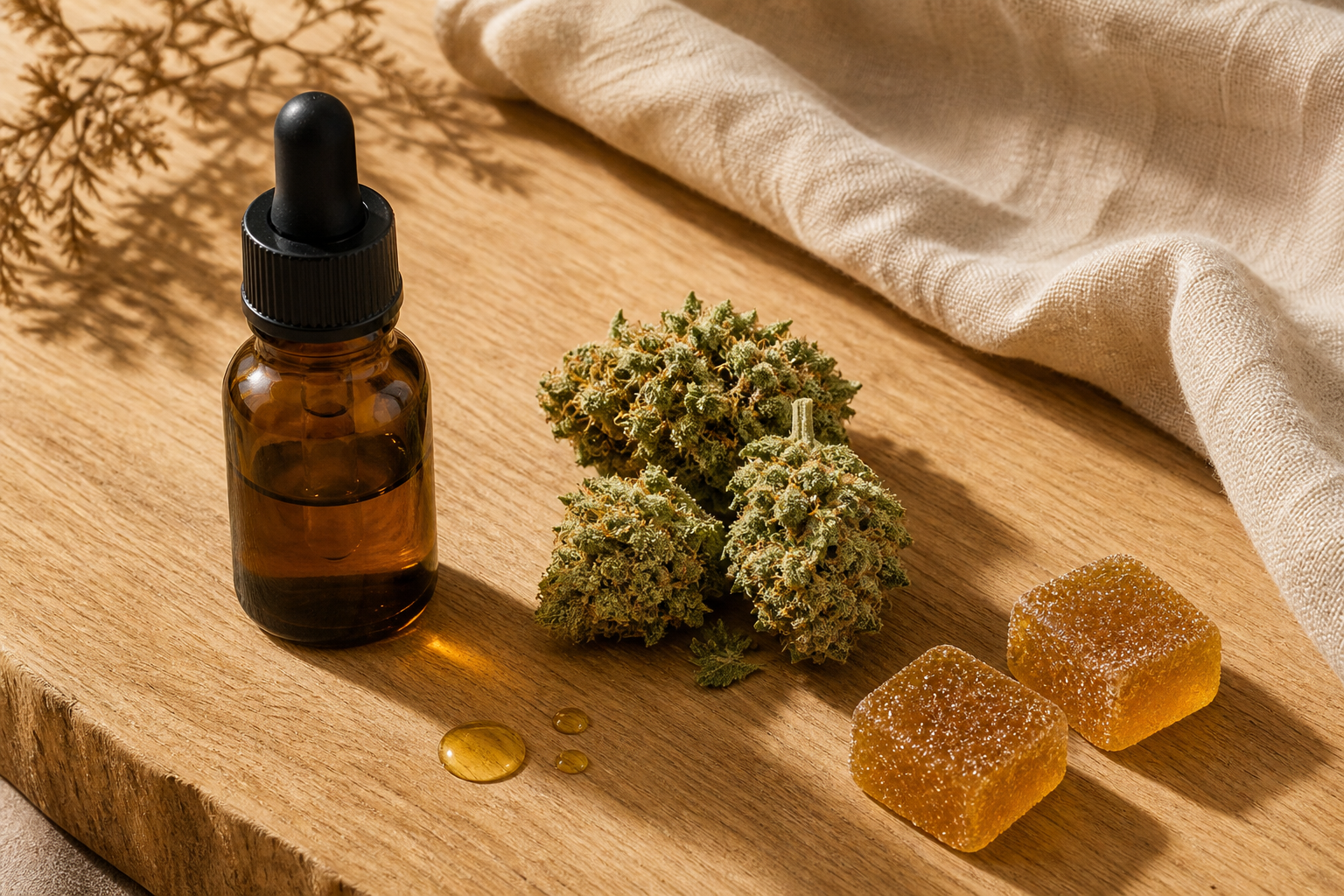
Flower, tinctures, and edibles are three completely different ways to get cannabinoids into your bloodstream — and your body handles each one differently.
Here's the short version before we go deep:
| Method | How You Take It | How It Enters Your Body |
|---|---|---|
| Flower (smoking or vaping) | Inhale through lungs | Directly into bloodstream via lungs |
| Tincture | Drops under your tongue | Absorbed through mouth tissue, then digested |
| Edible | Chew and swallow | Digested and processed by liver |
The route matters because it changes everything: how fast you feel it, how strong it gets, and how long it lasts.
How Fast Does Each One Kick In? #
Inhaled flower is the fastest — effects in minutes. Edibles are the slowest — sometimes over an hour. Tinctures fall in between.
This is the chart most people need on a napkin before they pick a product:
| Method | Onset | Peak Effects | How Long It Lasts |
|---|---|---|---|
| Flower (smoked/vaped) | 0–10 minutes | 15–30 minutes | 2–4 hours |
| Tincture (under tongue) | 15–60 minutes | 45–90 minutes | 4–6 hours |
| Edible (swallowed) | 30 min–3 hours | 2–4 hours | 6–12 hours |
Why Does Flower Work So Fast? #
When you inhale cannabis, THC goes straight from your lungs into your bloodstream. No pit stop in the stomach, no detour through the liver. That's why you feel it in minutes.
Why Do Edibles Take So Long? #
Edibles have to travel the long road — stomach, then small intestine, then liver — before THC gets to your brain. That process takes time and changes the molecule along the way (more on that below). A 2024 clinical review in The Permanente Journal notes that oral THC products can delay effects up to several hours depending on food in the stomach and individual metabolism.
Why Do Tinctures Land in the Middle? #
When you hold tincture drops under your tongue for 60–90 seconds, the tissue there absorbs cannabinoids directly into tiny blood vessels. This skips most of the stomach. It's not as fast as smoking, but it's faster than a gummy — usually 15–60 minutes.
The Edible Effect: Why Edibles Feel Stronger #
Edibles feel stronger than the same amount of THC in flower because your liver converts THC into a more potent molecule called 11-hydroxy-THC.
Here's the deal: when you eat THC, your liver processes it before it ever reaches your brain. During that process, it transforms regular THC into 11-hydroxy-THC — a metabolite that crosses into the brain more easily and tends to hit harder and last longer than the original compound.
This is called first-pass metabolism. Think of it like the liver acting as a bouncer who changes your outfit before letting you into the party — and the new outfit is somehow even flashier than the original.
After you inhale, your liver barely sees the THC at all. The ratio of 11-hydroxy-THC to regular THC after oral ingestion can exceed 1:1, while after inhalation it's closer to 1:20, according to the same Permanente Journal clinical review. That's why a 10 mg edible can floor someone who handles a puff of flower just fine.
Dosing Control: Which Method Is Easiest to Manage? #
Tinctures give the most control for most people. Flower is fast but hard to measure. Edibles are precise on the label but punishing if you redose too early.
Flower: Fast but Fuzzy #
You feel flower almost immediately, which actually helps with control — you can stop when you've had enough. But potency varies from batch to batch, and technique matters (how deep you inhale, how long you hold it). There's no milligram count on a joint.
Tinctures: Drop by Drop #
A dropper lets you measure 2.5 mg increments. You feel effects in under an hour, which means you're not sitting in the dark wondering if it's working. Consensus dosing guidelines from a 2021 clinical study recommend starting with 2.5–5 mg THC and going up in small steps every few days — tinctures make that easy.
Edibles: Precise Label, Risky Timing #
Edibles are labeled exactly — 5 mg, 10 mg, 25 mg — so you know what you're taking. The problem is that delayed onset. Many people eat 10 mg, feel nothing at 45 minutes, eat another 10 mg, and then both doses hit at once two hours later. That's a recipe for a rough night. The CDC recommends waiting at least two hours before considering a second dose of any edible.
The golden rule for edibles: start at 2.5–5 mg and wait. The whole wait. No sneaking a second piece.
For a deeper breakdown on edible dosing, check out our edibles dosing guide.
What About Lung Health? The Honest Answer #
Smoking cannabis does carry real respiratory risks. Vaping flower reduces some of those risks but isn't risk-free. Tinctures and edibles are the safest options for your lungs because there's nothing to inhale.
This isn't fearmongering — it's what the data says.
The CDC states directly that smoked cannabis "can harm lung tissues and cause scarring and damage to small blood vessels." The American Lung Association puts it plainly: smoking marijuana causes chronic bronchitis and injures the cell linings of the large airways.
A 2023 review published in PubMed (PMID 38056532) confirmed that cannabis smoke irritates the bronchial tree and is strongly linked to chronic bronchitis symptoms. A separate PMC study (PMC5072387) found chronic cannabis smokers show increased incidence of chronic cough, phlegm, and shortness of breath.
What About Vaping Flower? #
Vaporizing cannabis flower — using a dry herb vaporizer, not an oil cart — does reduce combustion byproducts compared to smoking. A controlled PMC study (PMC6676961) found vaporization to be a more efficient delivery method than smoking, with higher blood cannabinoid concentrations at the same dose. But "less harmful than smoking" is not the same as "safe for the lungs."
If you have asthma, COPD, or any existing breathing issue, tinctures and edibles are the smarter bet. No smoke, no vapor, no question.
Which Method Is Best for Sleep? #
Edibles are generally the best fit for sleep because they last 6–12 hours, covering most of the night. Tinctures work if you want faster onset without inhaling.
The Sleep Foundation notes that cannabis may help with sleep, particularly when pain, PTSD, or restless legs are keeping someone up. The long duration of edibles matches a full night's sleep window in a way that two-to-four-hour flower effects don't.
If you have trouble falling asleep: a tincture taken 30–45 minutes before bed can work well. You feel it before your head hits the pillow.
If you wake up in the middle of the night: an edible taken one hour before bed may be the better call. The delayed onset means effects are peaking around the 2–3 hour mark and carrying you through.
If you hate the waiting game entirely: a puff of flower before bed delivers fast sedation, especially with high-myrcene strains. Just know it'll likely wear off before morning.
Which Method Is Best for Pain? #
Inhaled flower works best for breakthrough pain that needs immediate relief. Edibles and tinctures work better for sustained, long-duration pain management.
Pain that hits hard and fast — a migraine, a muscle spasm, an acute flare — calls for a fast method. Flower gives you relief in minutes.
Chronic pain that grinds on all day (back pain, joint inflammation, neuropathy) is a different story. The longer window of edibles means you're not dosing every two hours. A 2021 PMC clinical consensus (PMC8252988) recommends oral formulations for patients seeking consistent chronic pain relief, starting at low doses and titrating slowly.
One important note: a 2022 PMC study (PMC9622393) comparing sublingual CBD-rich extract to inhaled THC-rich therapy for low back pain found that inhaled THC outperformed the sublingual CBD extract. Method matters — but so does whether your product is THC-forward or CBD-forward.
| Pain Type | Best Method | Why |
|---|---|---|
| Breakthrough / acute | Flower (inhaled) | Fast onset, immediate relief |
| Chronic / all-day | Edibles or tincture | Longer duration, consistent relief |
| During work hours | Tincture (low dose) | Discreet, no smoke, controllable |
| Lung concerns | Edible | No inhalation at all |
Who Should Choose What? #
Quick guide by lifestyle:
| You Are... | Best Method |
|---|---|
| A beginner who's nervous about overdoing it | Tincture — measured drops, predictable timing |
| Someone with lung or breathing issues | Edible or tincture — no smoke or vapor |
| Needing fast relief right now | Flower (smoked or vaped) |
| Using it for overnight sleep | Edible — covers the full night |
| Wanting discretion at work or in public | Tincture or edible — no smell, no smoke |
| Managing chronic pain through the day | Edible or tincture |
| Experienced and enjoy the ritual | Flower — ritual, community, full sensory experience |
For first-timers navigating all of this for the first time, our complete first-timer's guide walks through every step.
A Word on Bioavailability (Without the Textbook) #
Bioavailability means how much of what you consume actually reaches your bloodstream. Inhalation is highest. Oral edibles are lowest — and most variable.
Think of it like this: if you take 10 mg of THC in an edible, maybe 6–20% of that actually does anything. The rest gets broken down before it reaches your brain. With inhalation, that range jumps to roughly 10–35% — and it gets there faster.
| Method | Approximate Bioavailability |
|---|---|
| Inhaled (smoked) | ~10–35% |
| Inhaled (vaporized) | Similar to smoked, sometimes higher |
| Sublingual tincture | ~13% (variable) |
| Oral edible | ~6–20% |
This doesn't mean edibles are "wasteful." It means you account for it in your dose — and why edible packaging often shows higher milligrams than a tincture to achieve a similar effect. It also means the 11-hydroxy-THC conversion more than compensates, making edibles feel potent even with lower bioavailability.
FAQ #
How long do cannabis edibles take to kick in? #
Most people feel edibles within 30 minutes to 2 hours, but onset can take up to 3 hours depending on your metabolism and what you last ate. The variation is real — a full stomach slows absorption, while an empty stomach speeds it up. Always wait at least two hours before considering a second dose. Impatience is the number-one reason people accidentally consume too much.
Is it better to take a tincture under the tongue or just swallow it? #
Holding it under your tongue for 60–90 seconds before swallowing produces faster effects than just swallowing. When cannabinoids are absorbed through the tissue under your tongue, they bypass some first-pass liver metabolism. Clinical research puts sublingual onset at 15–60 minutes vs. the longer digestive route. You won't always feel a dramatic difference, but the technique matters — especially for time-sensitive relief.
Do edibles make you higher than smoking the same amount of THC? #
Yes, many people report edibles feel stronger even at the same milligram dose. That's because your liver converts oral THC into 11-hydroxy-THC — a metabolite that crosses into the brain more readily than regular THC. The same 10 mg from a gummy and 10 mg from a joint do not produce the same experience for most people.
Is smoking cannabis bad for your lungs? #
Yes. The research is consistent. The CDC and American Lung Association both confirm that smoking cannabis damages lung tissue and is associated with chronic bronchitis symptoms. If lung health is a concern, edibles or tinctures are the better option. Vaporizing dry flower reduces combustion byproducts but is not risk-free.
What's the safest cannabis delivery method for a first-timer? #
A tincture is usually the safest starting point for most beginners. You can dose precisely with a dropper (start at 2.5–5 mg), effects arrive in under an hour so you're not left wondering, and you can stop after one dose if it's enough. Clinical dosing guidance recommends starting at 2.5 mg THC and increasing by 2.5 mg every few days until you find your level.
How long does a cannabis tincture last? #
Tinctures typically last 4–6 hours when taken sublingually. That's longer than inhaled flower (2–4 hours) but shorter than most edibles (6–12 hours). The duration can stretch if a portion of the tincture gets swallowed rather than absorbed under the tongue, effectively adding some edible-style duration to the mix.
Can I use an edible for sleep? #
Yes, edibles are one of the most popular choices for sleep specifically because they last longer than other methods. The 6–12 hour window covers most people's sleep cycle. The Sleep Foundation reports cannabis may improve sleep for people dealing with pain, PTSD, or restless legs. Take your edible about 1–2 hours before you want to fall asleep so the peak effect lines up with bedtime.
What if I feel nothing from an edible? #
Wait. The most common mistake is assuming the edible didn't work and taking more. Onset can take up to two to three hours depending on your digestive system and metabolism. If you've waited at least two full hours and feel nothing, you can try a slightly higher dose next time — but not the same night. Stacking doses is how people end up in uncomfortable territory they didn't plan for. For more detail, our edible buying guide covers what to look for on labels.
Is a tincture or an edible better for chronic pain? #
Both work, but the best choice depends on your schedule. Tinctures offer faster onset (15–60 min) with a 4–6 hour window, which is useful if you need relief during work hours and don't want effects lasting all evening. Edibles offer longer coverage (6–12 hours) which can be ideal for overnight pain or all-day management when you don't need to dose repeatedly. PMC consensus guidelines (PMC8252988) recommend low, controlled oral dosing for chronic pain, noting that patients should titrate slowly over days.
Does cannabis quality matter for delivery method? #
Yes, especially with flower. What's in the plant determines what you inhale — and clean, sun-grown organic flower means no pesticide residue in your lungs. At Divine Toke, our sun-grown cannabis is grown without synthetic pesticides or fertilizers, which matters most when you're inhaling. For edibles and tinctures, the quality of the base extract still affects the final product, but the delivery method adds another layer of processing. Always buy from a licensed dispensary with lab-verified products.
Ready to Pick Your Method? #
There's no wrong answer here — it all depends on what you're after.
Want fast relief? Flower. Want to sleep through the night? Edible. Want measured, no-smoke control? Tincture. Want to try all three before committing? That's exactly what exploring is for.
If you're looking to explore Divine Toke's lineup, our organic sun-grown flower is a great place to start for anyone who wants the full sensory experience. For a smoke-free life, check out what tinctures and edibles we carry in the shop.
More guides to help you choose:
- First-Timer's Guide: What Nobody Tells You About Cannabis
- The Complete Edibles Dosing Guide
- How to Shop for Edibles: What to Look For
This article is for educational purposes only and is not medical advice. Always consult your healthcare provider before starting any new wellness routine.
Grown in Detroit. Shipped to your door.
Small-batch, sun-grown cannabis cultivated in living soil. Mail-order shipping to all 50 states.