Cross-Fading Explained: Why Weed and Alcohol Hit Harder Together

Jamie
Head Cultivator
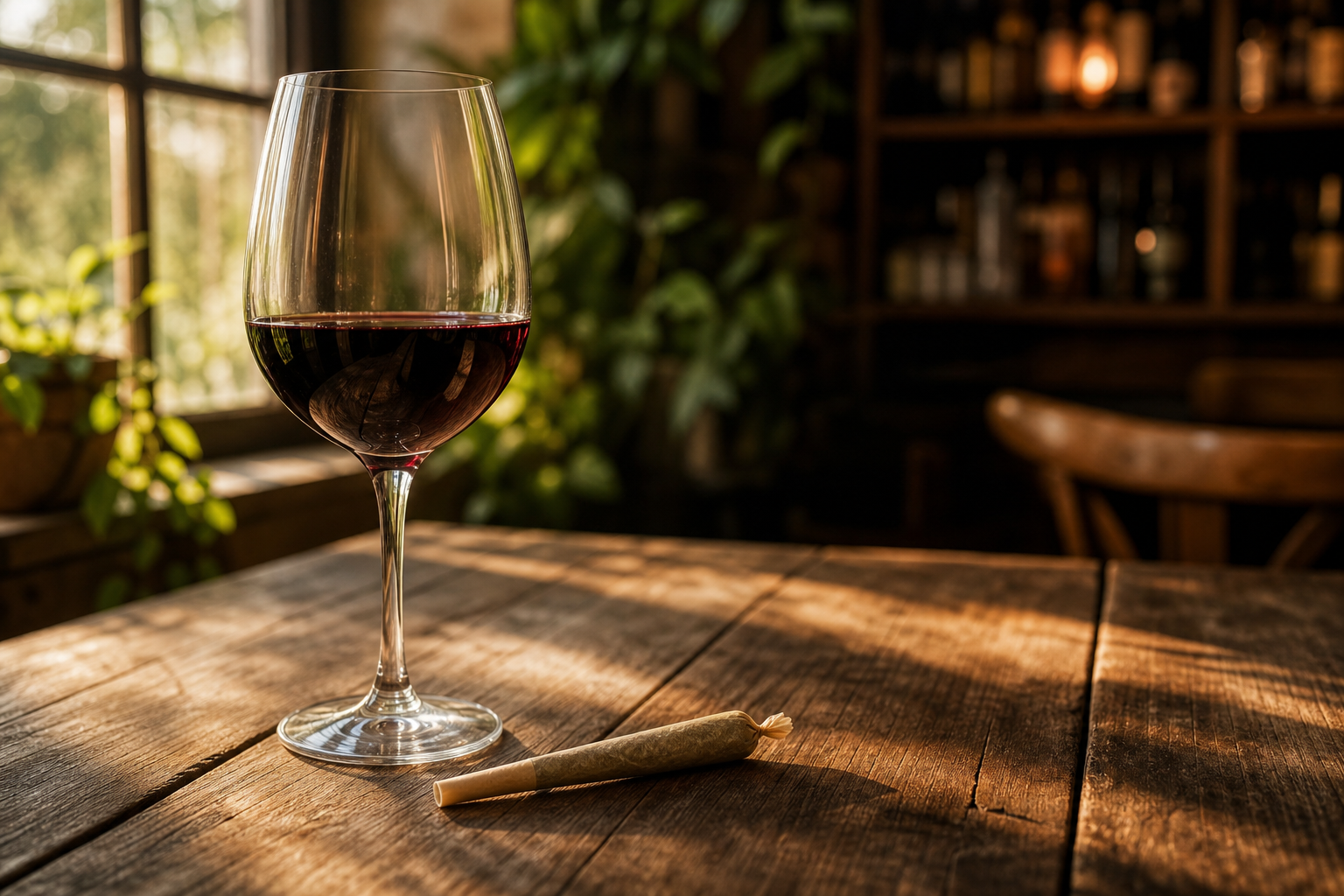
Cross-fading means using cannabis and alcohol in the same window. It hits harder than either alone — and that matters if you still need to get home after a shift, a wedding, or a Detroit weekend out.
Cross-fading is the street name for stacking weed and alcohol so both are active in your body at once. Alcohol can raise blood THC levels, and both drugs slow reaction time and judgment. That combo is a bad plan for driving, operating tools, or picking up kids after a metro Detroit night out.
What Is Cross-Fading? #
Cross-fading means using cannabis and alcohol close enough in time that both are still working on your brain. People call it “cross-faded,” “crossed,” or “drunk and high.” It is not a special product. It is two depressant-style intoxicants stacked on the same night.
Divine Toke is a Detroit-area Michigan sun-grown organic cannabis farm. We talk about this because Michigan adults can buy legal flower and still walk into a bar after — and many of our readers work construction, hospital nights, or auto shifts where getting home safe is the whole job.
Common reasons people cross-fade:
- A beer or two at a wedding, then a joint in the parking lot
- A cannabis edible earlier, then drinks at a Detroit bar
- Habit from college or “that’s just how the weekend goes”
- Thinking weed will “cancel out” alcohol (it does not)
What it often feels like:
- The high comes on faster or harder than usual
- Spinning room, heavy body, or sudden nausea
- Worse balance and slower thinking than either substance alone
- Anxiety or paranoia after what started as a “chill” night
Cross-Fading vs. Using One Substance Alone #
| Factor | Alcohol alone | Cannabis alone | Cross-faded (both) |
|---|---|---|---|
| Main target | GABA system (brain calm / slow) | CB1 receptors (THC) | Both systems at once |
| Typical feel | Loose, talkative, then sleepy | High, floaty, time stretch | Harder hit, more spin / nausea |
| Impairment focus | Reaction time, judgment | Attention, coordination | Stacked deficits |
| Morning after | Hangover common | Often milder | Often rough — head + gut |
| Drive home? | Illegal over limit / if impaired | Illegal if impaired | Highest risk combo |
If you are choosing one substance for the night, that is a clearer call than stacking. For a broader look at swapping drinks for cannabis over time, see our cannabis vs. alcohol guide.
Why Does Alcohol Make Weed Hit Harder? #
Alcohol can raise how much THC gets into your blood after you smoke or vape — so the same joint can feel stronger after drinks. That is the main pharmacokinetic (how the body moves a drug) story behind cross-fading.
In a controlled human study published in Drug and Alcohol Dependence, researchers found that when volunteers drank ethanol and then smoked cannabis, they often had higher plasma THC levels, felt effects sooner, and reported more euphoria than with placebo alcohol. The authors concluded that ethanol may increase THC absorption — see the Lukas and Orozco 2001 PubMed abstract.
A later controlled vaporizer study summarized in clinical chemistry literature also reported that alcohol increased blood and plasma THC peak levels (Cmax) under some conditions — see Huestis and colleagues in Clinical Chemistry (2015). Reviews collecting human data make the same point: ethanol can boost plasma THC and subjective effects of smoked cannabis — see PMC6177698.
Plain-English takeaways:
- More THC in blood can mean a harder, faster high from the same flower dose
- Timing matters — drinking before cannabis is the pattern most linked to a hotter THC ride
- Not every study agrees on size — heavy daily users and different doses can change the curve
- Feeling “more high” is not the same as “more fun” — more THC also means more chance of nausea, panic, or blacking out
Think of alcohol like opening the highway on-ramp for THC. More cars get through. Your brain still has to drive with all of them.
Important caveats (so we do not oversell the science):
- Not every pharmacokinetic study finds the same boost. Some work in heavy cannabis users found little change in THC curves with ethanol — see Toennes et al. on PubMed.
- Dose, timing, smoking vs. vaping vs. edibles, and your personal tolerance all change the ride.
- A “stronger high” can mean more pleasure or more panic. The body does not promise a good time.
- Michigan dispensary THC percentages on a jar do not predict how hard a cross-fade will hit once alcohol is in the mix.
For people who already struggle with tolerance climbing from daily use, stacking alcohol is a messy way to “feel it again.” A cleaner reset is a planned break — see our cannabis tolerance break science guide.
Drink First vs. Smoke First #
| Order | What often happens | Risk note |
|---|---|---|
| Drink → then cannabis | Higher chance alcohol boosts THC absorption | Hotter high; easier to green out |
| Cannabis → then drink | THC may already be peaking; alcohol adds CNS slowdown | Still impairing; pacing feels “fine” until it isn’t |
| Both at once / edibles + drinks | Unpredictable onset windows | Hardest to dose; longest night |
Reviews and consumer-facing summaries of the primary literature repeatedly note that drinking before cannabis tends to amplify THC more than the reverse — but neither order is “safe for driving.” Both still stack impairment in the brain even if blood levels do not spike the same way. For how THC lands on CB1 receptors in the first place, see our CB1 and CB2 receptors explainer.
What Happens in Your Brain When You Mix Them? #
Alcohol slows the brain through GABA (a calm-down chemical), while THC hits CB1 receptors — and those two systems stacked make coordination and judgment fall off faster. Cross-fading is not magic. It is two different brakes pressed at the same time.
THC (delta-9-tetrahydrocannabinol — the main intoxicating compound in cannabis) binds to CB1 receptors in the brain. Those receptors help manage memory, coordination, appetite, and how intense experiences feel. Our endocannabinoid system deep dive covers that thermostat in more detail.
Alcohol boosts GABA signaling — GABA is the brain’s main “slow down” messenger — and dampens some excitatory signaling. That is why drinks make people loose, then clumsy, then sleepy.
When both are active:
- Absorption layer — alcohol can raise THC blood levels after smoking (Lukas and Orozco, 2001)
- Brain layer — CB1 effects + GABA slowdown hit attention, balance, and decision-making together
- Gut layer — both can upset the stomach; stacking raises odds of nausea and vomiting
- Judgment layer — you are worse at judging how impaired you already are
A 2024 peer-reviewed synthesis on cannabis and alcohol co-use notes overlapping impairment pathways and the real-world risk of heavier combined effects — see PMC11238947. Another review of simultaneous use patterns and harms is available at PMC7363401.
Everyday analogy: alcohol turns down the lights. THC rearranges the furniture. Doing both means you are navigating a dim room where the chairs moved — and you still think you can drive I-75.
Common Cross-Fade Effects #
| Effect | Why it shows up | What it feels like |
|---|---|---|
| Spinning / dizziness | Vestibular + blood pressure + intoxication | Room moves; hard to stand |
| Nausea / vomiting | Gut + stronger THC pulse | “Green out” with drinks |
| Anxiety / paranoia | High THC + loss of control | Heart race, bad thoughts |
| Slow reaction time | CNS depression stack | Late braking, missed steps |
| Memory gaps | Alcohol blackout risk + THC | Missing chunks of the night |
| Heavy sedation | GABA + CB1 | Couch-lock that feels unsafe |
Michigan nights can make this worse. Cold parking lots after a Detroit bar, late Ubers, and “I’ll just drive — it’s only 20 minutes” are classic setups for a bad decision. If your body already runs low on its own cannabinoids from stress or sleep debt, see endocannabinoid deficiency explained — stacking alcohol is still not a fix.
How Much Worse Is Impairment When You Stack Weed and Alcohol? #
Lab and driving-performance research find that cannabis plus alcohol usually impairs driving skills more than either alone — even when crash-risk math is debated. For getting home after a Michigan night, treat the combo as worse than “just buzzed.”
What the evidence supports:
- Alcohol is a clear crash-risk driver. In the NHTSA Drug and Alcohol Crash Risk case-control study, adjusted crash risk at a BrAC of .08 was about 3.93 times that of drivers with no alcohol.
- Cannabis alone shows mixed crash-risk findings after researchers adjust for age, gender, and alcohol — the same NHTSA report found adjusted THC odds near 1.0 (no clear increase after adjustment), while still warning that presence in blood is not the same as “safe to drive.”
- Combined use is repeatedly linked to worse lane-keeping, slower reactions, and greater performance deficits than either drug alone in experimental and review literature — see PMC6771478 and the addiction-science review at Addiction (Wiley).
- Some epidemiologic reviews argue the joint crash effect is often additive rather than proven “multiplicative” — still more dangerous than one substance, just not always a magic “times two” on paper (Sage review on co-use and crash risk).
Practical translation for Detroit-area drivers:
- You do not need a perfect synergistic formula to be unsafe
- Stacked impairment shows up in lane weave, late braking, and bad judgment
- Edibles plus alcohol are especially messy because edible onset is delayed
- “I drive this route every day” does not restore reaction time
The NTSB’s impaired-driving safety study keeps pressure on alcohol and drug-impaired driving as a national safety problem — Michigan roads are not exempt.
Reaction Time, Balance, and Judgment #
| Skill you need to get home | Alcohol | Cannabis | Stacked |
|---|---|---|---|
| Hard brake for a deer / car | Slower | Distracted / delayed | Worst |
| Stay in lane on Lodge / I-94 | Wobbly at higher BAC | Lane variability rises | Worse variability |
| Decide “I’m fine to drive” | Overconfident | Often overconfident | Highest false confidence |
| Walk stairs / parking garage | Stumble risk | Balance off | Fall / green-out risk |
| Watch kids or tools | Impaired | Impaired | Do not stack |
If you only remember one line: cross-fading is an impairment multiplier in real life even when scientists argue about the exact crash-risk math. Plan the ride before the first drink or first hit.
Edibles Plus Alcohol — A Special Warning #
Edibles plus drinks are one of the easiest ways to overshoot. You drink, feel “fine,” take a gummy, drink more while waiting, then both peak together.
Why this combo bites Michigan consumers:
- Michigan adult-use infused edibles are capped at 10 mg THC per dose and 200 mg per container under the CRA R 420.404 THC limits bulletin — but legal limits are not a personal safe-dose guarantee when alcohol is involved
- Edible onset often takes 30–120 minutes; alcohol makes waiting feel optional
- Liver processing of edible THC (into 11-hydroxy-THC) already makes many people feel a longer, heavier high
- A wedding open bar + a shared gummy is a classic Detroit-area overshoot story
- Medical Michigan servings can be higher on the label (up to 50 mg per dose in that same CRA bulletin) — that is still not a green light to mix with drinks
Rules if someone still chooses this path (not a recommendation — damage control):
- Eat food first
- Cap alcohol hard (or skip it)
- Take a low edible dose and set a phone timer for two hours
- Do not redose because “nothing happened yet”
- Keys stay with a sober person the whole night
For edible buying basics without the alcohol stack, see our edible buying guide and edibles dosing guide. First night with flower instead? Start with the first-timer’s guide.
Michigan Driving Rules for Alcohol, Cannabis, and Both #
In Michigan, alcohol has a clear per se BAC line, and cannabis cases turn on impairment — stacking both puts you in the highest-risk legal and safety box. This is not legal advice. It is the plain read of state impaired-driving materials.
According to the Michigan State Police impaired driving law page:
- It is a crime to drive with a BAC of .08 or greater if you are over 21 (.02 if under 21)
- Michigan also has a high-BAC path with tougher penalties at .17 and above
- Officers can still arrest at any BAC if you show impairment
- Drivers with any amount of a Schedule 1 controlled substance and/or cocaine face the same fines and penalties as drunk drivers even without signs of impairment, with a key exception: a person with a valid medical marijuana card who has marijuana in their system — the officer must show impairment due to that marijuana
The MSP Cannabis and Driving brochure reinforces a simple consumer rule: do not drive high. Legal adult-use purchase in Michigan does not equal a free pass behind the wheel.
What that means for cross-fading:
| Situation | Practical Michigan takeaway |
|---|---|
| Alcohol over .08 | Per se OWI risk even if you “feel okay” |
| Cannabis only | Impairment / observation still matters; medical-card nuance exists for some per se drug rules |
| Alcohol + cannabis | Alcohol alone can put you over the line; cannabis adds impairment evidence |
| “Just to the next exit” | Still operating a vehicle under Michigan law |
Adult-use shoppers still buy through Michigan’s licensed market overseen by the Michigan Cannabis Regulatory Agency. Legal product does not make impaired driving legal.
Cost reality if alcohol puts you over the line (first offense examples from MSP materials — penalties vary by case):
- Fines, possible jail, community service, and license suspension
- High-BAC path (.17+) adds tougher penalties and treatment requirements
- Ignition interlock costs after certain suspensions
- Multi-year driver-responsibility style costs called out on the state page
Those numbers are why a $30 rideshare from a Detroit bar is cheap insurance compared with an OWI. Cross-fading just makes the “I’ll risk it” voice louder when your judgment is already compromised.
Why “I Feel Fine” Is Not a Legal Defense #
Feeling fine is a symptom of impairment, not proof you are safe. Alcohol and THC both warp that self-check.
Roadside reality in Michigan:
- Officers look at driving pattern, speech, eyes, balance, and field tests
- A breath test can nail alcohol numbers quickly
- THC blood presence is messier than BAC — chronic users can test positive when not currently high — but observed impairment still matters
- Refusing a breath test carries its own license suspensions under MSP materials (first refusal: up to one year suspension)
Metro Detroit weekends pack bars, stadium traffic, and late shifts onto the same roads. If you stacked weed and alcohol, the safest legal move is the same as the safest human move: do not drive. Call a ride, a sober friend, or sleep it out.
Why Cross-Fading Is Especially Risky for Getting Home Safe #
Stacking weed and alcohol is a bad idea when you still need to drive, operate tools, watch kids, or show up sharp for a Michigan shift. The science of a hotter high matters less than the logistics of getting home alive and employed.
Metro Detroit reality check:
- Union and trade work — construction, plants, logistics, and hospital nights punish impaired judgment. One bad drive or one dropped tool is a career problem.
- Parenting handoffs — school pickup and midnight daycare runs do not mix with a cross-fade.
- Bar-to-freeway pattern — Corktown to I-75, downtown to the suburbs, casino nights — short trips still kill people when reaction time is gone.
- Winter and late shifts — Michigan cold, dark roads, and fatigue already cut performance. Adding two intoxicants on top is stacking mistakes.
Safer night plan (pick one intoxicant lane):
- Decide before you leave — drinks night or cannabis night, not both
- Book the ride early — Uber/Lyft/friend before the second round
- Leave keys with someone sober
- Eat real food if you drink; do not chase shots with a strong edible
- Give yourself hours before any safety-sensitive task
Divine Toke’s Detroit-area readers ask about wellness, sleep, and pain — not about blacking out in a parking structure. Cross-fading works against those goals.
Drug Tests, Jobs, and Stacking Substances #
Michigan employers can still enforce drug and alcohol policies, and workplace impairment is not protected just because cannabis is legal off the clock. Alcohol is often easier to prove in the moment (breath). Cannabis is messier on tests that detect past use, not current impairment.
Key points for shift workers:
- Legal adult-use status does not force your employer to ignore a positive test or observed impairment
- Safety-sensitive roles (DOT-adjacent, tools, vehicles, patient care) are the strictest
- Union contracts (CBAs) may set procedure — they rarely erase safety rules
- Stacking alcohol and cannabis raises the odds someone looks impaired even if you planned “just a little”
For the employment side in plain Michigan English, read Can You Get Fired for Legal Weed in Michigan?. For meds that also interact with cannabis, see our cannabis medication interactions safety guide.
Bottom line for the job: if tomorrow’s shift uses heavy equipment, a forklift, or a patient chart, do not cross-fade tonight.
A Simple Decision Tree for Michigan Nights #
Use this before the first pour or first hit:
| Question | If yes… | If no… |
|---|---|---|
| Do I need to drive within 6–8 hours? | Skip alcohol and intoxicating THC, or arrange a ride now | Still plan a ride if plans change |
| Is tomorrow a safety-sensitive shift? | One substance max, early cutoff, or dry night | Keep doses modest anyway |
| Am I with people who will push “just one more”? | State your plan out loud; give keys away | Still set a hard stop time |
| Am I already tired from a Detroit-area double? | Fatigue counts as impairment — skip the stack | Food + water before anything |
| Am I combining with prescriptions? | Talk to a clinician; read our medication interactions guide | Still avoid surprise mixes |
Cross-fading fails most of these gates. That is the point of the tree — catch the night before the parking garage.
Parents and caregivers in southeast Michigan often get hit with the “unexpected pickup” problem: a friend cancels, a kid gets sick, a second shift opens up. If you already stacked substances, you cannot invent sobriety on demand. Build the sober backup into the plan before the first drink or hit — same as packing a lunch for a long plant shift.
Harm Reduction If You Already Mixed Them #
The safest choice is not to mix — if you already did, stop using more, sit somewhere safe, hydrate slowly, and do not drive. Harm reduction is not a green light. It is damage control.
Immediate checklist:
- Stop — no more drinks, hits, dabs, or edibles
- Sit or lie down — cool, quiet room; feet up if dizzy
- Sip water — small sips, not chugging
- Eat a little if you can keep food down (crackers, bread)
- Tell a sober person where you are and how you feel
- Hand over the keys — rideshare, cab, friend, or sleep there
- Watch the clock on edibles — they can keep climbing for hours
Call 911 (or local emergency services) if someone:
- Cannot be woken up
- Has slow or irregular breathing
- Seizes
- Vomits and cannot protect their airway
- Has chest pain, severe confusion, or symptoms that keep getting worse
Reviews of simultaneous cannabis–alcohol use underline higher acute harm potential than either alone — see PMC7363401 and PMC11238947. Public health framing from campus and clinical harm-reduction pages is consistent: lower dose, slower pace, no driving — and skipping the mix is still best.
Michigan-specific add-on: if you are far from home after a Detroit event, staying put is cheaper than an OWI. MSP materials list fines, jail exposure, license suspension, and ignition-interlock costs for alcohol convictions — see the Michigan impaired driving law page.
What Helps a Green-Out Cross-Fade #
| Symptom | Do this | Skip this |
|---|---|---|
| Spinning room | Sit/lie still; eyes on a fixed point | Standing showers, sudden standing |
| Nausea | Cool air; small water sips; empty stomach rest | More alcohol “to settle it” |
| Panic | Dim lights; slow breathing; sober friend | Crowds, more THC “to calm down” |
| Too high from edible | Wait it out in a safe place — peak can still rise | Redosing because “it’s not working yet” |
| Friend passed out | Check breathing; recovery position if trained; call 911 if unsure | Leaving them alone “to sleep it off” |
Cold showers, viral “pepper trick” hacks, and stacking caffeine are not medical care. Time and safety are the real tools. If this keeps happening, treat it as a pattern problem — not a bad luck night.
Frequently Asked Questions #
Q: What does cross-faded mean? #
Cross-faded means cannabis and alcohol are both active in your system at the same time. People also say “crossed” or “drunk and high.” It is a state of stacked intoxication, not a strain name or a product type.
Q: Why does alcohol make weed stronger? #
Alcohol can increase THC absorption and raise blood THC levels after smoking, which can intensify the high. A controlled human study by Lukas and Orozco (2001) linked ethanol with higher plasma THC and stronger subjective effects. Brain impairment also stacks even when blood levels are not the whole story.
Q: Is it safer to smoke first or drink first? #
Neither order makes driving or heavy impairment “safe,” but drinking first is more often linked to a hotter THC spike. Cannabis-first still adds alcohol’s GABA slowdown on top of an active high. If you insist on any mix, keep both doses tiny and leave a long pause — skipping the mix is still better.
Q: How long does a cross-fade last? #
Most mild cross-fades last a few hours; edibles plus alcohol can run much longer. Inhaled cannabis peaks faster. Edibles can climb for two hours or more and linger into the next morning. Dose, tolerance, food, and body weight all change the window.
Q: Can mixing weed and alcohol make you throw up? #
Yes — nausea and vomiting are among the most common acute cross-fade problems. Higher THC pulses after drinking, plus alcohol’s gut effects, raise the odds of a “green out.” Stop using more, sit still, sip water, and get help if breathing slows or the person cannot wake up.
Q: Is cross-fading illegal in Michigan? #
Using legal adult-use cannabis and alcohol as an adult is not automatically a crime — driving impaired is. Michigan sets a .08 BAC per se alcohol line and treats drug-impaired driving under MSP impaired-driving rules — see the Michigan State Police impaired driving law page. Cross-fading raises the chance you hit one of those lines.
Q: Can I drive if I only had a little of both? #
No — even “a little” of both can impair reaction time and judgment more than either alone. Alcohol crash risk rises sharply near the legal limit in the NHTSA crash-risk study, and combination use worsens driving performance in experimental reviews. Plan a ride instead.
Q: Does CBD change the alcohol + THC combo? #
CBD is not a reliable “antidote” for a cross-fade. Some people use CBD products for daytime calm, but CBD will not sober you up for a Michigan drive or cancel alcohol’s effects. If a product also contains THC, it can still impair you. Read labels and Michigan CRA packaging carefully.
Q: Will a drug test show alcohol and cannabis differently? #
Yes — alcohol clears relatively fast; cannabis metabolites can linger for days or weeks depending on use. Breath or saliva can catch recent alcohol. Urine THC tests often reflect past use more than current impairment. Employers can still act on policy and observed impairment — details in our Michigan workplace drug-testing guide.
Q: What should I do if a friend greens out while cross-faded? #
Get them seated or lying down in a safe place, stop more substances, keep them cool, and call 911 if they cannot wake up or breathing looks wrong. Stay with them. Do not put them in a car as the driver. A sober watcher beats a viral home remedy every time.
The Bottom Line on Cross-Fading #
Weed and alcohol hit harder together because alcohol can raise THC blood levels and both drugs stack brain impairment — so cross-fading is a bad plan for getting home safe. If you want cannabis as a wellness tool in Michigan, keep the night simple: one lane, low dose, and a sober ride when you need one.
If you are curious to try clean, intentional flower instead of stacking drinks, explore sun-grown options from Divine Toke — a Detroit-area Michigan sun-grown organic cannabis farm — and shop what fits your goals without the bar-tab spiral. Start with clear labels, modest amounts, and no mixing.
Related reads:
- Cannabis vs. Alcohol: The Great Swap
- Can You Get Fired for Legal Weed in Michigan?
- Endocannabinoid System Deep Dive
- First-Timer’s Guide to Cannabis
This article is for educational purposes only and is not medical advice or legal advice. Always consult your healthcare provider before starting any new wellness routine. Do not drive impaired.
Stay safe out there — Michigan nights are better when everyone gets home.
Grown in Detroit. Shipped to your door.
Small-batch, sun-grown cannabis cultivated in living soil. Mail-order shipping to all 50 states.