Sun+Earth vs. Clean Green vs. USDA Organic: What Cannabis Certifications Mean
What Sun+Earth, Clean Green, and USDA Organic cannabis seals actually audit — and how a Detroit shopper tells a farm seal from a Michigan CRA lab test.

Head Cultivator
On this page
A Detroit budtender can tell you three different "organic" stories before the jar is even in your hand. One points at a farm seal. One points at a lab test. One just says the grower "does it organic." Those are not the same thing. This post compares what Sun+Earth, Clean Green, and USDA Organic actually audit — and why a Michigan CRA label is not a farm certification.
What Is the Difference Between a Farm Seal and a Michigan Lab Test? #
A farm seal audits how a crop was grown. A Michigan lab test audits one finished batch. They answer different questions. Mixing them up is how a Detroit shopper gets sold three "organic" stories that do not match.
In Michigan, licensed flower cannot hit a sales floor until a safety-compliance lab samples the batch and logs the results. The Michigan Cannabis Regulatory Agency runs that system. The CRA Scientific Section oversees the labs. The state's sampling and testing technical guidance is about pass/fail on that lot — potency, pesticides, metals, microbes, and the rest — not about whether the farm used living soil last spring.
The jar label is also a state document, not a farm resume. Michigan Admin Code R 420.504 requires the cultivator license, package tag, harvest date, strain name, net weight, lab THC and CBD (with a 10% variance note), the lab that ran passing tests, and the legal warnings. It does not require a Sun+Earth, Clean Green, or USDA Organic field.
| Check | What it answers | What it does not answer |
|---|---|---|
| Michigan CRA COA / label | Did this batch pass state safety and potency tests? | How the farm treats soil, light, workers, or neighbors |
| Sun+Earth / Clean Green seal | Did a private program inspect the farm's methods? | Whether this exact jar passed Michigan testing |
| USDA Organic seal | Did a USDA-accredited certifier approve an eligible crop? | Whether state-legal marijuana flower can even use the seal |
The sampling rule makes the gap even clearer. Michigan Admin Code R 420.304 says the lab — not the farm — must physically collect the sample. The harvest batch cannot be bigger than 50 pounds. The sample must be at least 0.5% of that batch by weight. A farm employee may watch. They may not touch the flower or the tools. The lot sits in quarantine until passing results land in the statewide monitoring system. The lab has three business days after testing to enter those results.
That is a chain-of-custody ritual for one lot. It does not ask whether last year's soil test showed living microbes. It does not ask whether the trim crew was paid a living wage. It does not ask whether the plant saw Michigan sun or a warehouse lamp.
Think of it like a truck inspection versus a farm inspection. The sticker on the windshield says the vehicle passed today's safety check. It does not say the farm that grew the cargo paid a living wage or skipped synthetic spray. For the batch side of that story, see what "lab tested" means in Michigan. For the numbers on the terpene panel, see how to read a Michigan COA.
A third-party farm seal is optional. The CRA test is not. If someone at the counter treats them as the same stamp, ask which question they think they answered.
What Does Sun+Earth Certified Actually Audit? #
Sun+Earth Certified is a private nonprofit cannabis program that audits sun-grown, soil-grown, chemical-free farming plus how workers are treated. It is not a USDA seal. It is not a Michigan CRA test. It is a third-party farm standard built for this plant.
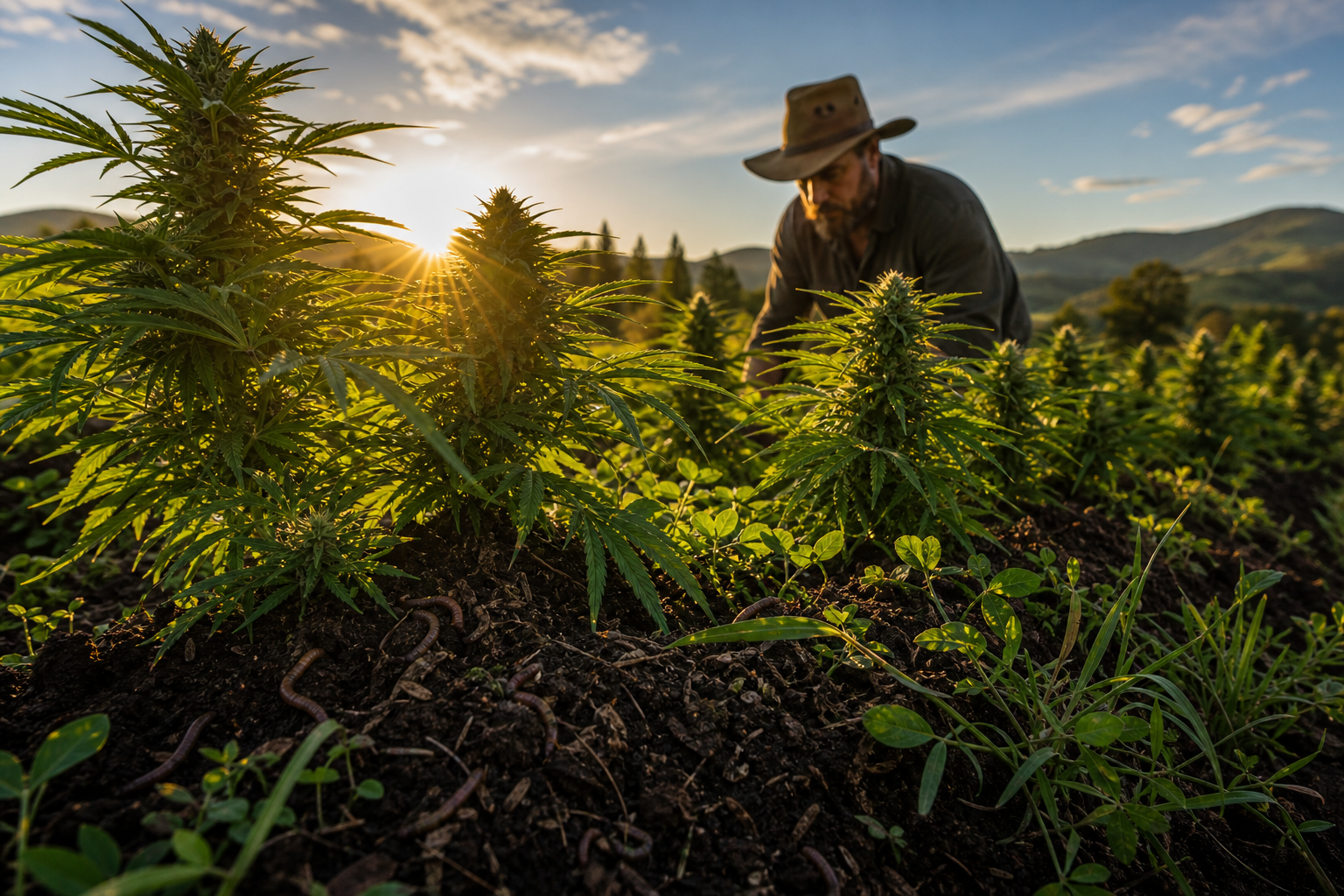
The program says so in plain language. The Sun+Earth FAQ states that it certifies cannabis "grown under the sun, in the soil of mother earth, without chemicals by fairly-paid farmers." The Sun+Earth standards page repeats the same three grow rules: living soil, natural sun, and no toxic pesticides, herbicides, or synthetic fertilizers.
That sun rule is the hard filter. Indoor rooms that run only on lamps do not fit the story this seal tells. Greenhouse or outdoor plants that live on daylight do. If you want the "why sun changes the plant" side of that argument, our older Sun+Earth farming explainer covers the grow philosophy. This post stays on what the seal checks.
The same standards page lists what inspectors look for beyond the plant:
- Soil health and fertility — they say they analyze soil for beneficial microbes and harmful contaminants, not just a "no spray" checkbox
- Water conservation — water-wise practices, not unlimited irrigation
- Energy use — smaller carbon footprint, renewable energy, less waste
- Social responsibility — fair wages, safe working conditions, and fair treatment
The Sun+Earth certification page publishes the paperwork: Guidance Assessment Criteria, Certification Standards, a Quality Manual, documentation forms, and a grower application. Farms apply, get evaluated, and take an on-site inspection. That is a farm audit. It is not a substitute for the Michigan COA on the jar.
Sun+Earth also runs two add-on lanes that confuse shoppers. The Made With program lets manufacturers use certified flower in other products. The dispensary program lets shops join the network. Neither lane turns a processor or a Detroit retailer into a sun-grown farm. If the seal is on a gummy or a vape, ask whether the flower inside is listed on the farm directory, or whether you are only looking at a "made with" claim.
Living soil is the other load-bearing rule. Sun+Earth does not treat dirt as a dead potting mix you refill with bottled feed. The standards page says farmers build soil that is "teeming with life." That is the same idea we walk through in the living soil cannabis guide: microbes and fungi feed the plant. A lamp room on coco and salt nutrients can still pass a Michigan pesticide test. It cannot tell this particular seal's soil story.
| Sun+Earth checks | Sun+Earth does not replace |
|---|---|
| Sun-grown production in living soil | A passing CRA pesticide panel |
| Chemical-input rules and soil tests | USDA Organic eligibility for marijuana |
| Labor and community claims | A Michigan license by itself |
Divine Toke grows sun-grown organic flower in Michigan. That is a farming style, not a claim that our farm sits on the Sun+Earth certified-farms directory. If a brand says it is Sun+Earth, the directory is the proof — not a story at the counter.
What Does Clean Green Certified Actually Audit? #
Clean Green Certified is a private cannabis program, running since 2004, that reviews inputs, checks the state license, inspects the site, and can lab-test samples for residues. It sells itself as the stand-in for USDA Organic on a plant USDA will not certify. That framing is the program's own, not a federal title.
The Clean Green homepage says the program started because legal cannabis products were calling themselves "organic." The Clean Green organic-certifications page is blunt: under USDA National Organic Program rules, cannabis is not eligible, and U.S. cannabis "may not be represented as, or labeled as, organic, or certified organic." Clean Green then offers an "organically managed" track it calls the closest thing in this industry.
That is useful. It is also easy to oversell. Clean Green is not USDA. It is one company's audit, based on organic and regenerative ideas, with more than one badge.
The same official page lists four tracks:
| Clean Green track | What the program says it allows |
|---|---|
| Organically Managed | The original "closest to organic" crop/product seal |
| Best Practices | Limited synthetic fertilizer if the crop needs it; pest and disease control still "organically managed" |
| Regenerative | Add-on for farms already in one of the tracks above; soil, watershed, and habitat rebuild; "very few farms qualify" |
| Vegan | No animal by-products in fertility or processing |
Ask which track is on the jar. "Clean Green" on a sticker is not enough if Best Practices allowed a synthetic feed the shopper thought was banned.
The Clean Green FAQ walks through the audit steps:
- Materials review — fertilizers, pest products, and soil amendments, using national and international organic programs as the lead
- License check — the company must be licensed in its state
- On-site inspection — methods on paper must match methods in the room; records get reviewed; they run mock recall and trace-back drills
- Lab work — the FAQ says they use a federally licensed agricultural lab, not a state cannabis lab tied to the certifier
- Certificate — one year, plus a unique number and a digital "verified" logo on a directory page
That one-year clock matters. A Clean Green claim from 2022 on a 2026 Michigan jar is a souvenir. Ask for the current certificate date. The FAQ also says Clean Green is not affiliated with random online shops or delivery services that borrowed the words "Clean Green." If a Metro Detroit menu uses the phrase and the farm is missing from the directory, you are looking at a nickname, not a member.
Indoor rooms are not written out of the program. Official pages list crop producers, processors, handlers, and retail outlets. If a Detroit shopper wants sun-grown only, Clean Green is the wrong filter by itself. Pair the seal with how the farm actually grew the plant — and with why pesticide-free farming matters when you inhale the crop.
The Clean Green "how it works" page is the most specific audit list they publish. The application asks about water and power sources, soil-erosion protection, border plants, and pest or disease control. The inspector then checks that the written methods match the site, reviews fertilizers, sprays, and potting soils, and walks the plants for excess mold, mildew, pests, wind-blown dust, dirt, and manure. Samples go to a lab for pesticide residues. The growing area is checked for erosion and for border habitat that can host beneficial insects. They also look at the processing room, because the program says contamination often happens there when a whole crop gets packed into a smaller space.
That is a farm walk-through. It is still not the CRA's 0.5% harvest-batch sample under R 420.304. Two different people, two different clipboards.
Clean Green also says it does not sell, ship, or broker cannabis. The FAQ warns that other businesses use the words "Clean Green" without being in the program. Verification is the official member directory, not a font on a menu board.
Can Cannabis Be USDA Organic — and What Does That Seal Audit? #
Hemp can be USDA Organic. State-legal marijuana flower sold in a Michigan shop cannot wear that federal seal. USDA Organic is a real farm-and-handling audit — for crops the federal program is allowed to touch.
The USDA Agricultural Marketing Service hemp FAQ draws the plant line first. Hemp is Cannabis sativa L. at or under 0.3% total THC. Above that, it is marijuana. You cannot grow medical or adult-use marijuana on a hemp license. Then the same FAQ answers the organic question: hemp grown in the U.S. under the Domestic Hemp Production Program may be certified organic under USDA organic rules.
That is the whole door. Marijuana flower sitting in a Detroit dispensary is not walking through it.
What USDA Organic actually inspects on an eligible crop #
USDA Organic is not a vibe. It is a production-and-handling system. A certifier reviews the Organic System Plan, walks the land or facility, and checks inputs against the National List. That is closer to Clean Green's paperwork-plus-visit model than it is to a Michigan COA. The difference is legal power. USDA can take the word "organic" off a grocery shelf. Sun+Earth and Clean Green can take their own logos off a member.
If a crop is eligible, the USDA organic labeling rules are strict:
- A USDA-accredited certifier must oversee the operation
- No genetic engineering, ionizing radiation, or sewage sludge
- Only substances on the National List are allowed when a synthetic is used at all
- Production must build soil and water quality, cycle resources, and limit synthetic inputs
- If you are not certified, you must not put "organic" on the front of the package or use the USDA seal anywhere
USDA Organic is not a sun-grown rule. A greenhouse hemp crop can qualify if it meets NOP soil and input rules. A lamp-only indoor hemp room can also chase certification if the certifier accepts the system. That is the opposite of Sun+Earth's daylight mandate.
| USDA Organic fact | What it means at a Michigan counter |
|---|---|
| Hemp ≤0.3% THC can apply | A USDA Organic hemp CBD tin can be real |
| Marijuana flower is outside the hemp program | A high-THC eighth should not show the USDA seal |
| Uncertified "organic" on the front panel is a federal labeling problem | Treat that word as marketing until you see a certifier and a listing |
USDA also splits labels into four buckets that hemp products can use if they are certified:
| Label on an eligible product | What it means |
|---|---|
| 100 percent organic | All ingredients organic (salt and water do not count) |
| Organic | At least 95% organic ingredients |
| Made with organic ___ | At least 70% organic ingredients; no USDA seal on the pack |
| Ingredient list only | Under 70% organic; no "organic" on the front |
A Michigan hemp tincture can sit in one of those buckets. A Michigan marijuana eighth cannot borrow the first two just because the shop also sells hemp. Verify a real USDA claim in the Organic Integrity Database. Ask for the operation name and the certifying agent. If the shop cannot produce either, the seal — or the story — is not doing the job. For the soil science behind "organic" growing, even without a federal seal, see our living soil cannabis guide.
How Do the Three Certifications Compare Side by Side? #
Sun+Earth audits sun-grown regenerative cannabis farms. Clean Green audits cannabis operations against private organic-style tracks. USDA Organic audits eligible hemp — not Michigan marijuana flower. Same plant family. Three different jobs.
Use this table when a Detroit shopper hears all three names in one sentence. Every row is a program fact, not a taste ranking.
| Question | Sun+Earth Certified | Clean Green Certified | USDA Organic |
|---|---|---|---|
| Who runs it? | Private nonprofit cannabis program (sunandearth.org) | Private cannabis program since 2004 (cleangreencertified.com) | Federal National Organic Program |
| What crop can wear the seal? | Cannabis that meets their sun-and-soil standard | Licensed cannabis farms, processors, and some retail members | Hemp under the U.S. hemp program; not state-legal marijuana flower |
| Indoor lamp rooms? | No — "powered by the sun," not artificial lights | Not banned on official pages | Allowed if the eligible crop meets NOP rules |
| Soil / media | Living soil required | Soil and amendments reviewed; Best Practices can allow limited synthetic fertilizer | Soil-building NOP crop rules; National List inputs |
| Pesticides | No toxic pesticides, herbicides, or synthetic fertilizers | Input review plus residue testing at a federally licensed ag lab | Synthetic pesticides banned unless the National List allows them |
| Labor / community | Fair wages and safe conditions are part of the published standard | Not a headline pillar on the official program pages | NOP is an agricultural production standard, not a labor-union seal |
| How you verify | Certified farms list and dispensary finder | Member directory and verified badge | Organic Integrity Database plus certifier name |
| Replaces a Michigan CRA test? | No | No | No |
A few rows need extra honesty.
"Organic" is a legal word for USDA, and a marketing word everywhere else. Clean Green says cannabis cannot be labeled USDA organic. Sun+Earth uses "organic and regenerative" as program language, not as a federal claim. A Michigan licensee who slaps "USDA Organic" on high-THC flower is not following the USDA labeling page.
Labor is not a tie. Sun+Earth publishes worker pay and safety as part of the seal. Clean Green and USDA Organic can still be serious about inputs. They are not the same social audit.
Indoor is not a tie. If the shopper's real question is "did this plant see the Michigan sun," only Sun+Earth makes daylight a must. Clean Green and USDA (on hemp) can follow a crop into a warehouse.
Price is not a quality score. A certified farm spent time and fees on inspections. That can raise the tag. It does not prove the high will feel better. Pair the seal with the COA and with how you actually like the flower.
This table is the whole post in one glance. The next sections unpack eligibility, how to check a claim in a Michigan shop, and when the word "organic" is just paint.
Indoor vs Outdoor: Which Seals Can an Indoor Room Even Earn? #
An indoor-only room can chase Clean Green. It cannot chase Sun+Earth. USDA Organic is a hemp question, not a lighting question. Eligibility is the part most "organic" pitches skip.
Sun+Earth's published standard is daylight. The standards page says certified cannabis is "powered by the sun" and tells growers to forget artificial lights. The FAQ repeats "grown under the sun, in the soil." A sealed Detroit warehouse with no sun is out. A Michigan outdoor field or a sun-lit greenhouse can apply if the rest of the standard holds. That matches how short-season Great Lakes farms actually finish a crop — sunlight first, hoop houses as weather gear, not as a lamp barn.
Clean Green does not publish an indoor ban. The homepage process is inputs, state license, inspection, certificate. Crop producers can be indoor, outdoor, or mixed. Processors and retail outlets can join too. If a shopper wants "no warehouses," they have to ask the grower, not just scan the sticker.
USDA Organic follows the crop, not the light bulb. A hemp hoop house or an indoor hemp room can both sit in front of a certifier. The blocker for a Michigan adult-use eighth is the plant definition, not the fixture.
| Grow style | Sun+Earth | Clean Green | USDA Organic on that jar |
|---|---|---|---|
| Michigan outdoor / sun greenhouse | Eligible if the farm meets the standard | Eligible if the farm is in the program | Not for marijuana flower |
| Indoor lamp room | Not eligible | Eligible if they pass the audit | Not for marijuana flower |
| Hemp field or hemp indoor | Not this program's job | Not this program's job | Possible if NOP-certified |
Ask one follow-up after the seal name: "Was this lot sun-grown in soil, or grown under lights?" Then look at the CRA harvest date on the label. Late-summer Michigan outdoor lots cluster in a real season. Indoor lots can land any month. Neither fact proves quality. Together they keep the story honest.
Southeast Michigan outdoor flower lives on a short clock. First frost and September rain push harvest into a tight window. A hoop house can save a crop from weather. It still uses the sun. A sealed indoor room in Detroit can flower in January. That is legal. It is just a different eligibility map.
Carbon and soil are a separate conversation. Sun-grown regenerative farming can store carbon and skip warehouse power. That is the regenerative farming case, not a reason to fake a seal.
What this comparison is not #
This is not a remake of our Sun+Earth explainer. That post is about one program's philosophy. This post is about three seals, a Michigan lab test, and the stories shops sell when they blur them. We are not ranking taste. We are not assigning Divine Toke a certificate we cannot show on a public registry. We are giving a Detroit shopper a way to keep the nouns straight.
How Can a Michigan Shopper Verify a Seal at the Counter? #
Match the name on the jar to the program's public list. If the farm is not on the list, the seal is a sticker. A Detroit counter can show you a logo in thirty seconds. Verification takes one more step.
Do this in order:
- Read the Michigan label first. R 420.504 already gives you the cultivator, license number, package tag, harvest date, lab name, and THC/CBD. Write those down. A farm seal that cannot be tied to a licensed cultivator is noise.
- Ask which program, which year, and which farm. "We're organic" is not an answer. "Sun+Earth, 2026, farm name X" is an answer. "Clean Green Organically Managed, not Best Practices" is an answer.
- Open the official directory on your phone.
- Sun+Earth: certified farms and the dispensary finder
- Clean Green: member directory — the FAQ also tells you to look for the verified member badge
- USDA Organic (hemp products only): Organic Integrity Database
- Ask to see the current certificate. Clean Green says certificates last one year. Sun+Earth farms should be able to show current status. USDA listings show the certifier and the operation.
- Keep the COA in the same conversation. A seal without a passing Michigan test is not legal retail flower. A passing test without a seal is still legal retail flower.
| If they say… | You do this |
|---|---|
| "It's Sun+Earth" | Search the farm on sunandearth.org |
| "It's Clean Green" | Search the directory; ask which track |
| "It's USDA Organic" | Confirm it is hemp, then search Integrity |
| "The lab said it's clean" | That is a COA, not a farm cert — ask for the lab name on the CRA label |
| "We grow organic, no sticker" | Treat it as a method claim. Ask about inputs. Do not treat it as a third-party audit |
What to photograph before you leave the counter #
Michigan labels already give you a paper trail. Use it.
- Package tag — the statewide monitoring number from R 420.504
- Cultivator name and license — this is the farm you will search in a directory
- Lab name — the safety-compliance lab, not the certifier
- Harvest date — a season check for outdoor claims
- Certificate photo — if they have a Sun+Earth or Clean Green PDF, shoot the farm name and the expiration year
You do not need to post any of that. You need it if the story changes between the jar and the parking lot.
Metro Detroit shops move fast on a Friday. You do not need a speech. You need a farm name and a URL. If the budtender cannot produce either, buy the flower because you like the smell and the COA — not because of the adjective.
When Is "Organic" Just Marketing? #
"Organic" on a Michigan marijuana jar is a story until a real program or a real federal certifier is named. The word is not illegal by itself. Using it in a false or misleading way is.
Michigan Admin Code R 420.507 bars licensees from deceptive, false, or misleading ads and statements on the product, a sign, or a handout. The same rule bars health-benefit claims unless they go through an FDA path almost no cannabis brand has. The CRA does not publish a special "organic" definition. The general honesty rule is the hook.
Federal organic law is tighter on the USDA word. The USDA labeling page says an uncertified product must not put an organic claim on the principal display panel or use the USDA seal. Clean Green's own certifications page tells cannabis operators they may not represent U.S. cannabis as organic or certified organic under NOP.
So a Michigan shopper hears three common pitches:
- "Lab tested organic" — usually a CRA pesticide pass plus a vibe word. The lab did not certify the farm.
- "We grow organic, no cert" — possible. Plenty of small farms skip fees and still skip synthetic spray. You are trusting the grower, not an inspector.
- "Certified organic" — ask which certifier. If they mean USDA on marijuana flower, the claim does not match USDA's published hemp rule. If they mean Sun+Earth or Clean Green, make them say the program name.
| Phrase | Honest translation |
|---|---|
| "CRA tested" | Batch passed Michigan safety/potency rules |
| "Pesticide-free" | Ask for the COA panel, not a slogan |
| "Living soil / sun-grown" | A method. Can be true with no seal |
| "Clean Green" | Private audit — check the directory and the track |
| "Sun+Earth" | Private sun-and-soil audit — check the farm list |
| "USDA Organic" | Federal seal — hemp products only unless USDA publishes a new pathway |
None of this is a smear of honest growers. A farm can do the work and skip the sticker. A farm can buy a sticker and still ship a boring jar. The defect is the swap: selling a method, a lab pass, or a logo as if they were the same receipt.
Three "organic" stories a Detroit shopper actually hears #
Story one: "It's organic, look at the lab." The budtender flips to a passing pesticide line on a COA. That line is real. It is also a batch result. It does not say living soil. It does not say sun. Thank them, read the rest of the panel, and do not call it a farm cert.
Story two: "It's Clean Green, that's like USDA." Clean Green is older than most Michigan shops. It is still not USDA. Ask which track. Open the directory. If the farm is listed, you have a private audit. If it is not, you have a compliment.
Story three: "It's Sun+Earth, so it's USDA Organic outdoor." Sun+Earth is sun-grown by design. USDA Organic is a hemp program by design. Those two facts can both be true and still not make a Michigan eighth a federal organic product. Keep the nouns in their lanes.
Union-shift shoppers in Metro Detroit do not have time for a seminar. They have time for one corrected sentence. Use it.
Which Cannabis Certification Should a Detroit Shopper Trust? #
Trust the seal that answers the question you actually asked — and always keep the Michigan COA underneath it. There is no single "best" badge. There is a best match.
Use this as a counter card:
- You want daylight, living soil, and a labor story. Look for Sun+Earth, then confirm the farm on the official list. That is the only one of the three that makes sun a must.
- You want a private organic-style audit that can include indoor. Look for Clean Green, then ask which track and confirm the directory. Organically Managed is not Best Practices.
- You want the federal organic program. Look at hemp products and search the Integrity Database. Do not expect that seal on a Michigan marijuana eighth.
- You want to know this batch is legal and tested. Ignore the adjectives until you read the CRA label and the COA. That is the only check the state requires.
Divine Toke is a Detroit-area Michigan brand that grows sun-grown organic flower. We talk about soil and sun because that is how the plant is raised, not because a federal seal sits on adult-use marijuana. If a shop tries to sell you our kind of flower as "USDA Organic weed," they are mixing programs. If they try to sell a lab pass as a farm cert, they are mixing documents.
A fair shop will not be offended by the extra minute. They will pull the directory or the COA. That is what trust looks like on a Saturday in Detroit: not a bigger logo, a checkable name.
Five mistakes that waste a good question #
- Treating THC % as a cleanliness score. Potency is not a farm audit. The CRA label even warns the printed THC can vary by 10%.
- Calling every outdoor farm Sun+Earth. Sun-grown is a method. Sun+Earth is a member list.
- Calling every private seal USDA. USDA publishes the hemp-only organic door. Private programs cannot widen it.
- Skipping the Clean Green track name. Best Practices is not Organically Managed.
- Stopping at a logo photo. Directories exist because logos get copied. Use them.
If you want a short script, use this:
- "Is this a farm seal or the CRA lab result?"
- "Which program — Sun+Earth, Clean Green, or USDA — and which farm name?"
- "Can we open the directory together?"
- "Can I see the COA for this package tag?"
Four questions. No speech. You walk out with either proof or a cheaper adjective.
FAQ: Cannabis Certifications for Michigan Shoppers #
Q: What is the difference between Sun+Earth, Clean Green, and USDA Organic cannabis certifications? #
Sun+Earth is a sun-grown cannabis farm seal, Clean Green is a private organic-style cannabis seal, and USDA Organic is a federal seal that applies to hemp — not to Michigan marijuana flower. Sun+Earth's standards page requires living soil, daylight, and no toxic chemical inputs. Clean Green's own certifications page says cannabis cannot be USDA organic, so it offers an "organically managed" audit instead. USDA's hemp FAQ only opens organic certification to hemp under the federal hemp program.
Q: Can a Michigan marijuana jar legally carry a USDA Organic seal? #
No — not under USDA's published hemp and organic labeling rules. The USDA hemp FAQ says hemp at or under 0.3% THC may be certified organic. Marijuana is the same genus above that THC line. The USDA labeling page also says uncertified products must not use the USDA seal or put "organic" on the front panel. If a Detroit eighth shows that seal, ask for the Integrity listing before you pay.
Q: Is Clean Green the same as USDA Organic? #
No. Clean Green is a private cannabis program. USDA Organic is a federal program run through accredited certifiers. Clean Green says so itself: cannabis is not eligible for the National Organic Program, and the Clean Green logo is the stand-in they built in 2004. The founder may have NOP experience — the homepage claims that — but the cannabis certificate is still not a USDA certificate. Verify members on the Clean Green directory.
Q: Does a passing Michigan CRA pesticide test mean the farm is organic? #
No. A passing pesticide panel means that batch stayed under Michigan's residue limits. The CRA sampling and testing guidance is a lot-level safety check. It does not audit a three-year land history, a living-soil program, or worker pay. Indoor flower grown with allowed inputs can pass. Outdoor flower grown with sloppy drying can fail. Read what lab tested means before you treat a COA as a farm biography.
Q: Can indoor cannabis be Sun+Earth Certified? #
No. Sun+Earth's published standard is sun-grown cannabis in soil, not lamp rooms. The standards page says certified flower is powered by the sun and grown without artificial lights. Indoor flower can still be Clean Green, still pass a Michigan CRA test, and still be grown with care. It just cannot wear that particular seal.
Q: How do I verify a Sun+Earth or Clean Green claim at a Detroit dispensary? #
Look up the farm or product on the program's official directory, then match it to the cultivator name on the Michigan label. Sun+Earth publishes a certified-farms list and a dispensary finder. Clean Green publishes a member directory and tells shoppers to check the verified badge. If the names do not match, treat the logo as decoration.
Q: Are third-party farm seals required by the Michigan CRA? #
No. The CRA requires licensed testing and a compliant label. Farm seals are optional. R 420.504 lists cultivator, tag, harvest date, lab name, and potency. It does not list Sun+Earth, Clean Green, or USDA. You can buy legal Michigan flower that has never seen a third-party farm inspector.
Q: What is Clean Green Best Practices versus Organically Managed? #
Organically Managed is Clean Green's original "closest to organic" track. Best Practices allows limited synthetic fertilizer when the farm says the crop needs it. Both are described on the Clean Green certifications page. Pest and disease control stay "organically managed" on the Best Practices track, but the feed can include synthetics. Ask which logo is on the certificate. They are not the same promise.
Q: If a brand says "organic" with no seal, what does that mean? #
It is a method claim, not a third-party audit. The grower may skip synthetic spray and still skip the inspection fee. R 420.507 still bars false or misleading statements, so a wild claim can be a compliance problem. You are allowed to ask what they use in the soil and to read the COA. You are not required to treat the adjective as a certificate.
Q: Which certification should a Michigan shopper trust? #
Trust the one that matches your question, and never drop the CRA COA. Want sun and soil? Sun+Earth, if the farm is on the list. Want a private organic-style audit that can include indoor? Clean Green, if you know the track. Want the federal organic program? Hemp products in the Integrity Database. Want "is this legal and tested?" The Michigan label. Divine Toke shoppers who care about sun-grown organic flower should shop the method and the lab sheet, not a borrowed USDA logo.
Q: Can hemp CBD be USDA Organic while flower in the same shop is not? #
Yes. Those are two different legal plants. USDA says hemp under the Domestic Hemp Production Program may be certified organic. The marijuana flower next to it is over the 0.3% THC line and is not in that program. A shop can sell both. The seals should not pretend they are the same crop.
Q: Does a farm seal replace reading the COA? #
No. A farm seal is about how the crop was grown. The COA is about this batch. Michigan still requires passing compliance testing before sale. A certified farm can fail a mold or metals test. An uncertified farm can pass. Read the terpene and residue panels the way we walk through in how to read a Michigan COA, then decide if the seal is extra information you care about.
If You Want Flower Grown in Michigan Sun and Soil #
Shop the method and the lab sheet. Treat every logo as a claim you can look up. Divine Toke grows sun-grown organic flower for Detroit and Michigan adults who want the plant raised in soil, under daylight, without a chemistry set. That is our farming style. It is not a substitute for a Sun+Earth listing, a Clean Green number, or a USDA hemp certificate we do not put on marijuana jars.
If you are curious to try that kind of flower, browse the current selection. If you want more of the farming side, start with what Sun+Earth certification covers, why we skip pesticides, and how regenerative farming ties carbon to the plant. For the paperwork in your hand at the counter, keep Michigan lab testing and the COA terpene-panel walkthrough bookmarked.
This article is for educational purposes only. It is not legal advice and it is not a claim that any named farm, including Divine Toke, currently holds a specific third-party seal. Check the official directories before you trust a logo.
Programs change their PDFs. State rules get amended. If a shop's certificate is newer than this August 30, 2026 post, believe the certificate and the Michigan CRA label in your hand — then come back and see if the nouns still match.
The goal is not more stickers. The goal is a Detroit adult who can hear "organic" three ways and still know which document they were just shown.
If you remember nothing else: lab test ≠ farm cert, and USDA Organic ≠ a Michigan marijuana jar.
Grown in Detroit. Shipped to your door.
Small-batch, sun-grown cannabis cultivated in living soil. Mail-order shipping to all 50 states.