Drying Cannabis Flower: The Step Between Harvest and Cure That Saves Terpenes
Drying is the hang step after harvest. Learn dry-room temp, humidity, wet vs dry trim, and how Michigan humidity decides whether terpenes survive.

Head Cultivator
On this page
Last August a Detroit tradesperson opened a bag of outdoor flower and got hay, not pine. The harvest was not the whole story. The hang was.
This guide answers one question: what is the difference between drying and curing cannabis, and how do you dry flower so terpenes survive?
What Is the Difference Between Drying and Curing Cannabis? #
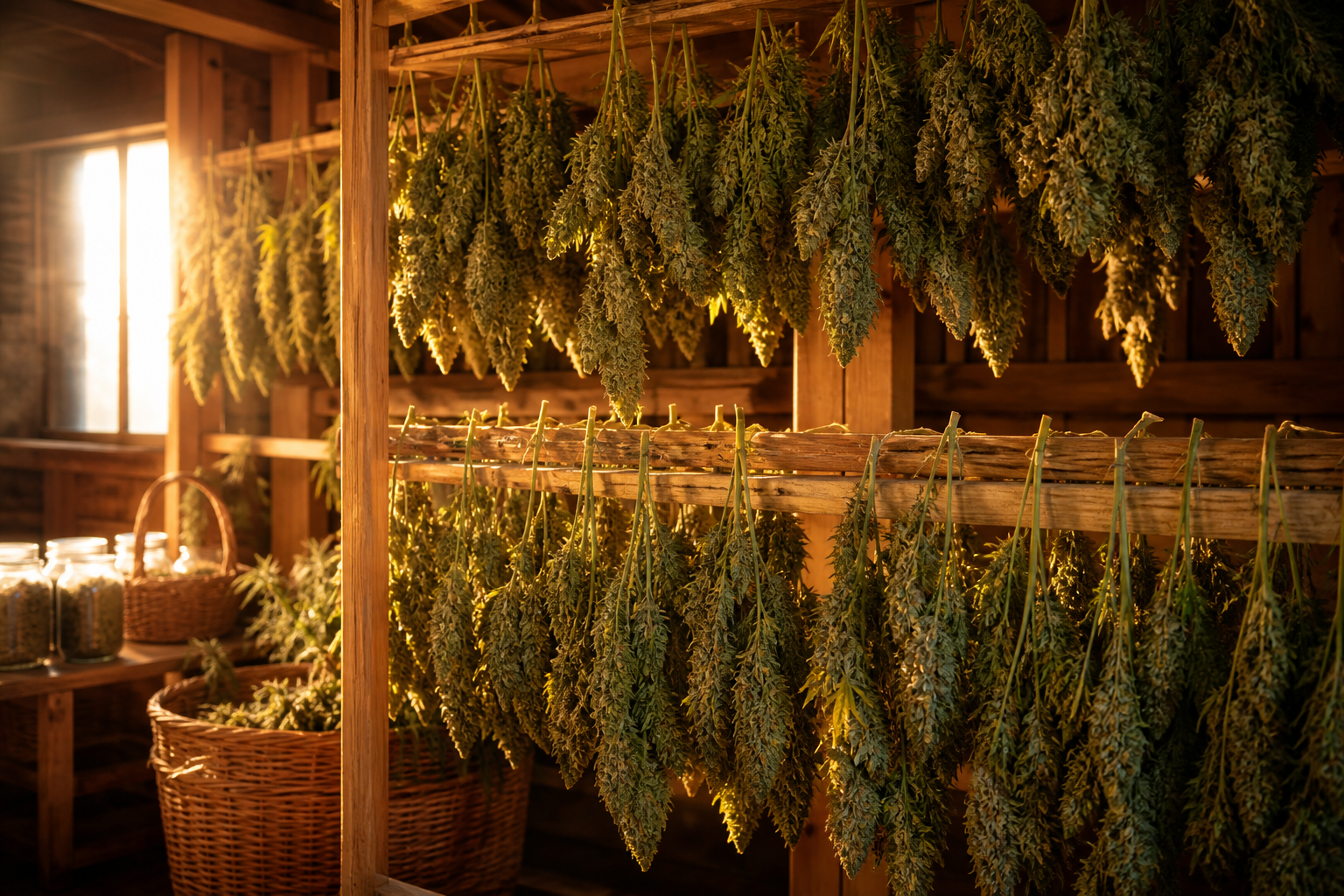
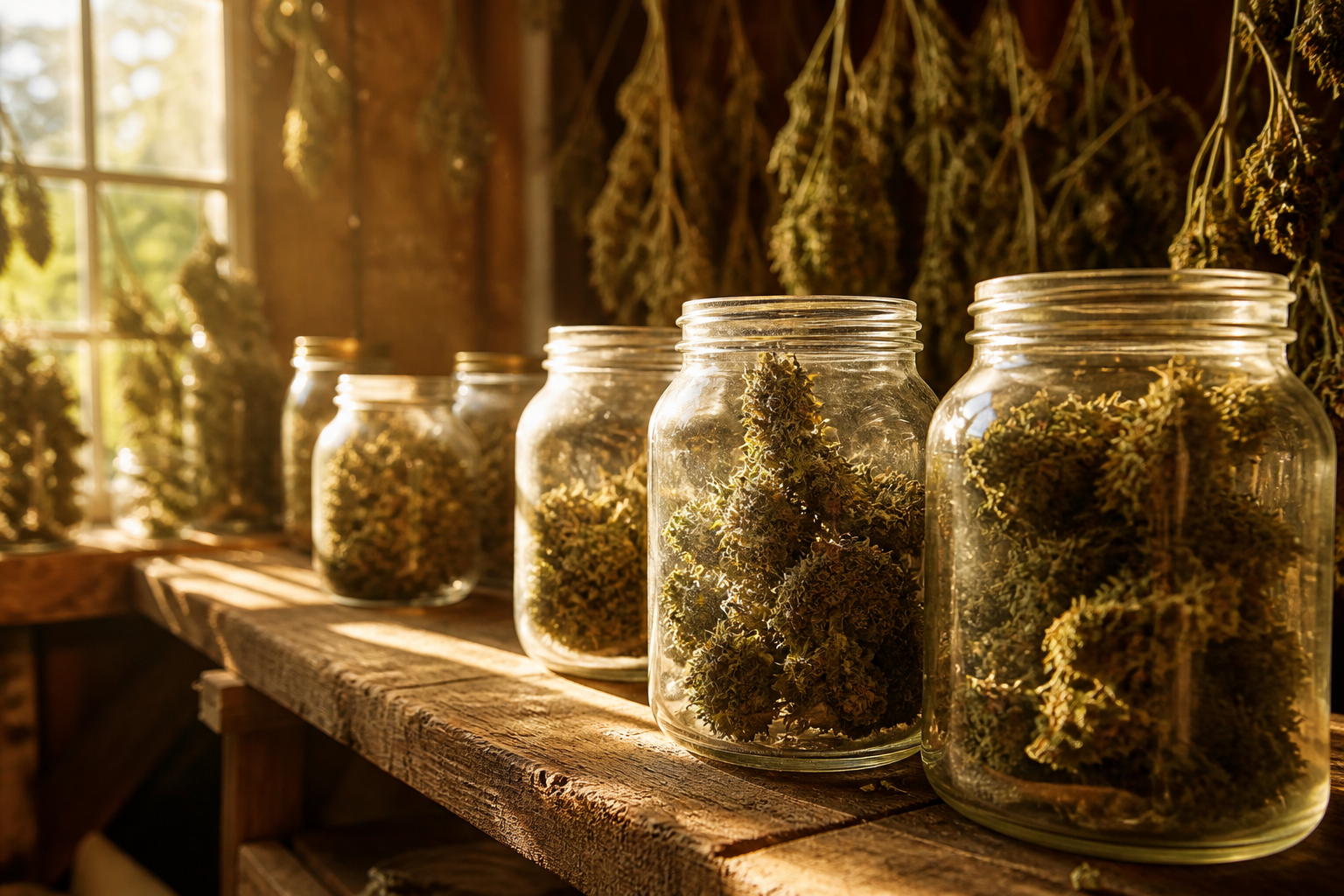
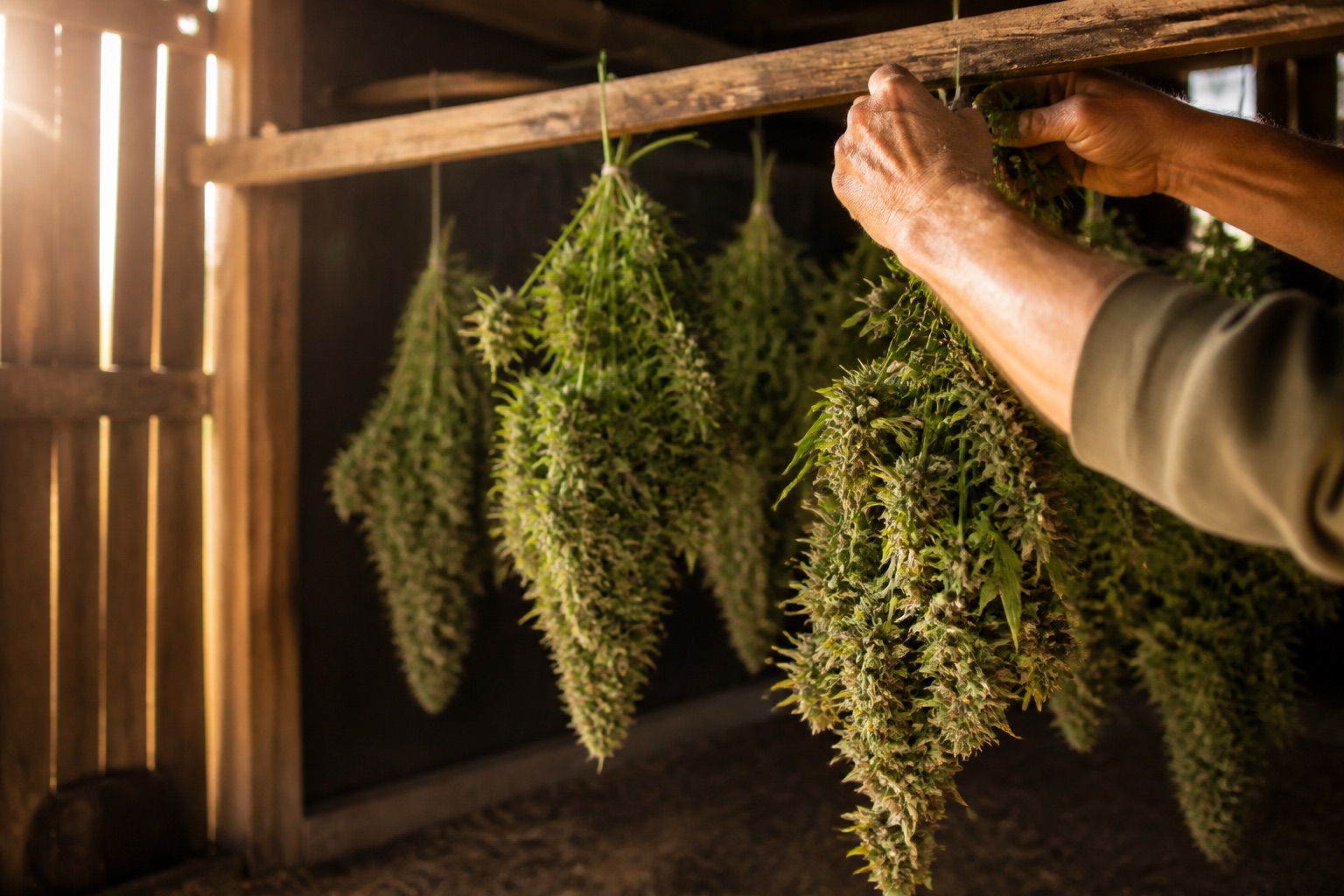
Drying is the open hang that pulls most of the water out of freshly cut flower. Curing is the sealed jar stage that starts only after that hang is done. People mash the two words together. They are neighbors, not twins.
Think of a wet towel on a line, then a loaf of bread in a bread box. The line is the dry. The box is the cure. Skip the line and the box gets soggy. Rush the line with a space heater and the towel gets crispy on the outside while the middle is still damp.
A 2022 University of Saskatchewan postharvest review in PMC9404914 puts it in farm language: fresh cannabis flower is about 78 to 80% water. That water has to leave before the flower is safe to store. The same review treats curing as the start of storage — the moment you stop driving water out and start holding a steady leftover moisture.
| Step | What it is | Typical setting | Typical time | Main job |
|---|---|---|---|---|
| Harvest | Cut ripe plants | Field or hoop house | One window | Catch ripe resin |
| Drying | Hang or rack in moving air | Dark, cool room | About 5–14 days | Drop bulk water without cooking aroma |
| Curing | Seal in jars or bins | Airtight, stable humidity | Weeks | Even out leftover moisture; soften harsh green notes |
| Store | Hold finished flower | Cool, dark, steady | Months | Keep what you saved |
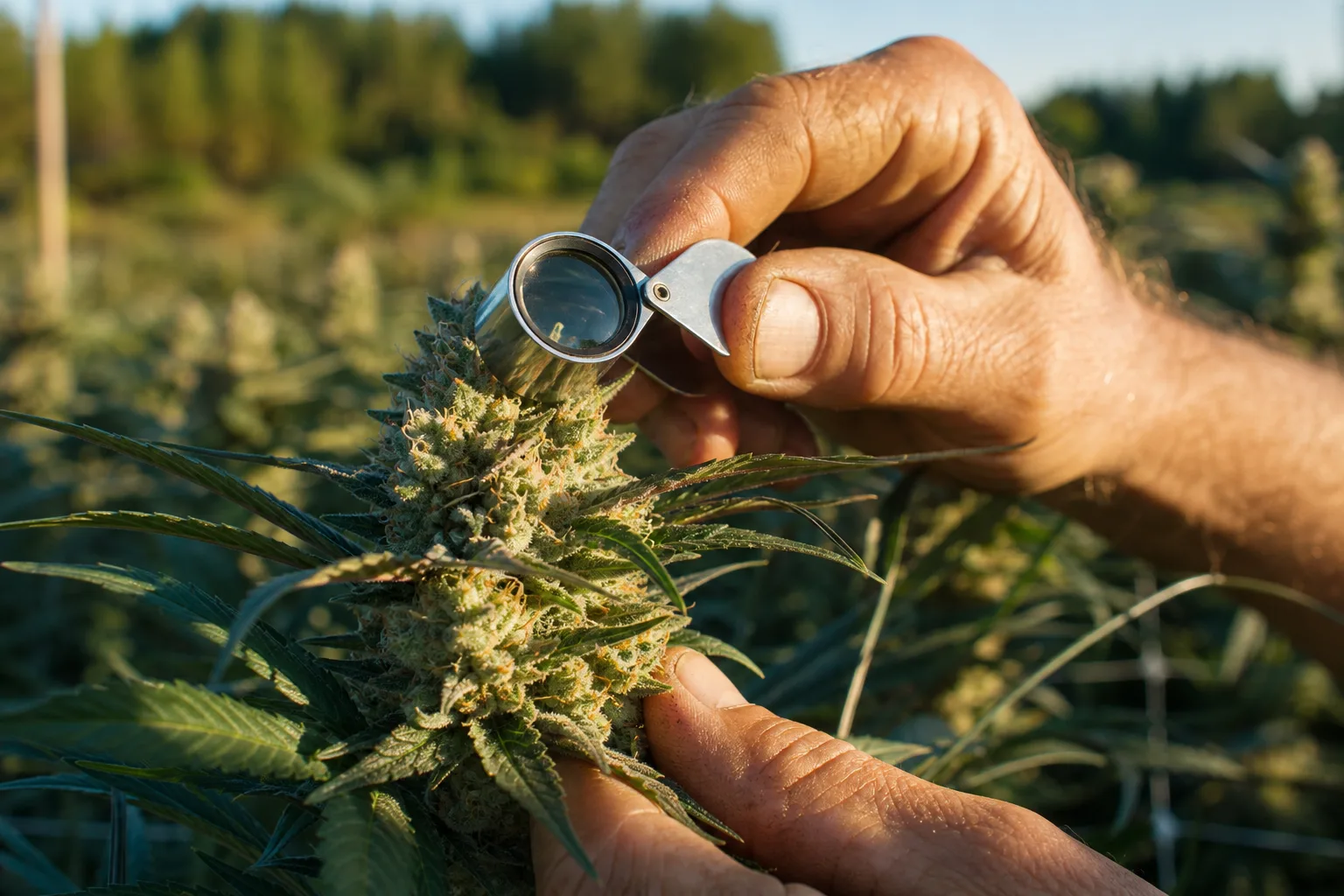
That harvest window is a different article. For when sun-grown plants are actually ready to cut, see when sun-grown cannabis is ready. For the jar weeks after this hang, see curing cannabis: the art of patience. This post stays in the middle: the dry room.
What drying does that curing cannot #
- Drying moves free water from wet plant tissue into room air.
- Curing cannot safely start if that free water is still high. A wet jar is a mold jar, not a cure.
- Drying is where the lightest smells leave first if the room is hot or too dry.
- Curing can round leftover green notes. It cannot put evaporated terpenes back in the bud.
Terpenes are the small aroma molecules that smell like pine, citrus, gas, or spice. They sit in the same sticky heads — trichomes — that hold cannabinoids. They leave with heat and moving air faster than THC does.
A 2024 drying study in PMC11013261 reported traditional hang-drying can last 2 to 3 weeks and drop about 75% of the fresh weight as water leaves. Controlled rooms can go faster. A barn that just “feels dry” can go slower — and dirtier.
The one-sentence handoff #
Drying ends when the outside of the bud is dry, small stems snap instead of folding, and leftover water is low enough that a sealed jar will not sweat. Curing begins at that snap. Not before. Not two days after the flower has turned to dust.
If last year’s Michigan outdoor bag smelled like a hay bale, the miss often happened here — in the days after the cut — not in the soil and not in the jar.
Why Does the Dry Room Decide Whether Terpenes Survive? #
The dry room decides terpene survival because the lightest aroma molecules leave with water vapor the first time the flower gets hot, blasted with air, or dried too fast. The plant already made the smell in the field. The hang either keeps it or spends it.
PMC9404914 is blunt about why temperature matters: the glands that hold cannabinoids and terpenes are heat-sensitive. The review cites work where drying above 40 °C (104 °F) cut terpene levels hard, while cannabinoids like CBD held up better. That is hotter than a careful dry room. It is not hotter than a closed Michigan garage in late August.
The same review cites Chen and colleagues on hemp flower: as dry temperature climbed from room air toward 90 °C, terpene retention fell from about 82.1% down to 29.9%. Sequential infrared-plus-hot-air drying lost as much as 72.3% of the terpene load. You do not need a lab oven to lose a smaller share. A hot shed does the same job more slowly.
Light terpenes leave first #
Monoterpenes are the smaller, more volatile smells — myrcene (mango, sleepy), limonene (citrus), pinene (pine). Sesquiterpenes are heavier — caryophyllene (pepper), humulene (hops). In PMC11013261, β-myrcene dropped under open-air drying more than under controlled-atmosphere rooms. Heavier smells held or even looked higher as a share once the light ones left. That “increase” is often a leftover mix, not new perfume being born.
| What leaves first | Everyday smell | What makes it leave |
|---|---|---|
| Light monoterpenes | Citrus, pine, mango, floral | Heat, dry air, fans on buds, sunlight |
| Heavier sesquiterpenes | Pepper, wood, hops | Still leave, but slower |
| Water | Weight, “wet plant” feel | Any dry that works |
| Green / grass notes | Fresh-cut lawn | Need time at a gentle moisture, not a blast of heat |
Controlled air vs a lucky barn #
The 2024 PMC11013261 team dried two medicinal chemovars in sealed chambers with set gases and compared them to open-air drying. Controlled rooms finished in 6 days. Open-air lots were still wet after 14 days — one chemovar still held about 45% of the water the chamber-dried flower had already lost. About 80% of the high-THC open-air samples grew heavy Alternaria mold. Some showed Botrytis (the same family as bud rot). Chamber lots showed no visible mold.
That is not a sales pitch for fancy gas rooms. It is a receipt: uncontrolled air is slow and risky, and slow-plus-wet is how outdoor Michigan harvests lose a room. Divine Toke, a Detroit, Michigan sun-grown organic cannabis farm, treats the hang as part of the same living-soil story as the field. The living soil cannabis guide is about how the plant is fed. This page is about how that work is not wasted on a clothesline in a humid barn.
What “survive” actually means #
Terpenes do not “cook in” during the dry. They stay if you do not drive them off. A good dry:
- Drops water steadily so mold cannot set up
- Keeps the room cool enough that light aromas do not flash
- Moves air around the plants, not onto the flowers
- Stops before the bud is bone-dry sawdust
A bad dry does the opposite. Then the jar inherits a problem it cannot fix. How curing protects terpenes covers the sealed weeks. The smell you hope to protect has to still be in the flower when the lid closes.
What Temperature, Humidity, and Airflow Should a Cannabis Dry Room Use? #
A careful cannabis dry room stays cool, a little humid, dark, and gently moving — roughly 60 °F and about 60% relative humidity, with no fan pointed at the buds. Growers call that the 60/60 rule. It is a starting mark, not a law of physics.
PMC9404914 reports a common slow-dry band of 18–21 °C (about 64–70 °F) and 50–55% relative humidity, often for 5–6 days when the room is honest. Craft teachers such as Ed Rosenthal’s 2026 drying and curing note land in the same neighborhood: cool, dark, and patient beats hot and fast. Whole-plant hangs and dense outdoor colas often need 7–14 days.
Relative humidity (RH) is how “full” the air already is with water. If the air is already full, water cannot leave the flower. If the air is empty, water leaves too fast and takes smell with it.
The numbers that actually matter #
| Setting | Practical target | Why it matters | What goes wrong |
|---|---|---|---|
| Temperature | About 60–68 °F (15–20 °C) | Cool air slows aroma loss | Above ~70 °F, terps leave faster; a late-August Detroit garage can sit hotter than that |
| Relative humidity | About 55–60%, some rooms run 50–55% the first days | Gives water a path out without toasting the skin | Below ~50% with moving air: crispy outsides. Above ~65%: mold window stays open |
| Airflow | Gentle, indirect, continuous | Stops dead pockets of wet air | A fan on the cola case-hardens the shell |
| Light | Dark or near-dark | Light plus heat ages resin | A sunny barn “dry” is a terpene tax |
| Spacing | Branches and buds not touching | Outdoor flower carries dew, rain, and extra leaf | Touching colas stay wet in the middle |
The 2024 controlled-atmosphere paper (PMC11013261) dried at a cool 15 °C (59 °F) in sealed chambers. That is the science version of “keep it cool.” You do not need their gas mix to steal the lesson: stable and cool beats swinging and warm.
Airflow in plain English #
Move the room. Do not sandblast the flower.
- Point a small fan at a wall or across an aisle, not at hanging plants.
- Leave space so wet air can leave the canopy.
- Use a dehumidifier when Great Lakes air is already at 70%+ RH — which late summer around Detroit often is.
- Do not “help” the dry with a space heater. Heat is how you buy hay.
Vapor pressure deficit (VPD) is a grower term for how thirsty the air is. Most dry-room talk still uses temperature and RH because those are the two dials you can read on a $20 sensor. The 60/60 setup is a moderate thirst: enough to dry, not enough to strip.
Darkness is not mood lighting #
Resin heads sit on the surface. Light plus heat ages them. PMC9404914 lists light as a physical factor that speeds breakdown of plant compounds after harvest. A dry room should feel like a closet, not a sun porch.
For Detroit-area outdoor lots, the room has to fight the weather the field just lived through. NWS Detroit/Pontiac 1991–2020 normals put August highs near 81.4 °F. That is a fine harvest afternoon. It is a bad dry-room setpoint. Bring the plants inside. Do not hang them in the same air that grew them.
Wet Trim vs Dry Trim: Which Path Protects Aroma? #
Dry trim — hanging first, then cutting sugar leaves after the hang — usually keeps more aroma. Wet trim — cutting those leaves off while the plant is still fresh — usually dries faster and can cut mold risk in a humid room. Neither path skips the dry. Neither path is a cure.
PMC9404914 defines the two jobs in one paragraph: wet trim happens before the long dry; dry trim happens after. Both are just leaf removal. The timing changes how fast water can leave.
A 2024 trim-timing study in PMC11249524 put that folklore on a lab bench. Researchers used one hybrid medicinal chemovar and three cuts:
- Mild wet trim (MWT): stems off, sugar leaves only half-cut, then dry
- Aggressive wet trim (AWT): stems and sugar leaves fully off, then dry
- Dry trim (DT): hang intact, then trim after a 6-day dry
They dried at 15 °C in controlled chambers. Final water landed near 10%. Mild wet trim raised total cannabinoids a few percent versus the other cuts. For more than 80% of the mono- and sesquiterpenes they measured — including β-caryophyllene, pinene, and humulene — only dry trim significantly raised those aroma levels. The authors said growers may have to pick: a small cannabinoid bump from a gentle wet trim, or a louder nose from leaving the leaf on during the dry.
That is one chemovar in a lab chamber. It is not a Divine Toke farm SOP. It is still the strongest peer-reviewed receipt we have that leaf left on during the hang protects smell.
| Path | What you do | Dry speed | Terpenes | Mold in a humid room | Best when |
|---|---|---|---|---|---|
| Wet trim | Cut sugar leaves while wet, then rack buds | Faster | Higher risk of flash-off if the room is already dry | Often safer — less wet mass | Great Lakes humidity is winning; colas are dense and rain-soaked |
| Dry trim / whole-plant hang | Hang branches or plants, trim after | Slower | Better protected if the room is stable | Longer wet window if RH stays high | You can hold ~55–60% RH and keep air moving around, not on, the hang |
| Mild wet trim | Half the leaf stays on | In between | Mixed; myrcene favored MWT in that one study | In between | You want a little less leaf without stripping the bud naked |
How to choose without farm-bro theology #
Use the room, not a forum argument.
- If Southeast Michigan air is sticky and the dehumidifier is already gasping, wet trim or a lighter hang shortens the mold window. MSU Extension’s hemp production note says Michigan’s damp, wet stretches make dry-down hard even for stalks — flower is worse.
- If you can hold a real 60/60 room, dry trim is the aroma bet, matching PMC11249524.
- Whole-plant hangs dry slowest because stems and fans hold water. That is a gift in a controlled room and a problem in a wet barn.
- Machine trim is a separate bruise risk. Fresh trichomes snap less than dry ones — which is why some crews wet-trim for speed, not for smell.
The late-summer harvest guide for Detroit consumers is about when outdoor flower shows up on a shelf. This choice is why two lots cut the same week can smell like two different plants.
How Do You Know When Drying Is Done and Curing Can Start? #
Drying is done when small stems snap instead of folding, the outside of the bud feels dry but not dusty, and leftover water is low enough that a closed jar will not rain on the inside. That is the handoff. Curing starts there. It does not start because a calendar said “day seven.”
PMC9404914 is honest: the industry still treats the dry endpoint as more art than a single lab number. Farms hang until water activity lands in a safe band. Home growers bend a stem. Both are trying to answer the same question: is free water gone?
The stem-snap check (field, not lab) #
- Wait until day 3 or 4 before you obsess. Early stems always bend.
- Take a small stem near a bud, not the main trunk.
- Bend it. Snap or sharp crack = closer to jar time. Rubber fold = more hang.
- Squeeze a bud gently. The shell should feel dry. The core should not feel like a wet sponge.
- If the bud is already crispy and the stem still folds, you may have case hardening — dry skin, wet heart. Slow the room down. Do not jar yet.
Stem snap is a heuristic. It is not a microbial test. PMC11013261 showed open-air flower can still hold a lot of water after two weeks even when a crew thinks the hang is “done.”
Water activity vs “feels dry” #
Water activity (aw) is how much water is available for mold and chemistry, not just how heavy the bud is. The FDA water-activity technical guide defines it as the vapor pressure of the food divided by the vapor pressure of pure water. PMC9404914 writes the grower version: aw = equilibrium RH / 100. A jar that settles at 60% RH is sitting near 0.60 aw.
Trade labs and Cannabis Science and Technology’s water-activity explainer treat about 0.65 aw as the line where mold risk climbs. A practical jar-in band many quality rooms use is 0.55–0.65 aw, with ~0.60 as a middle aim. Moisture content — often discussed around 10–14% — tells you weight of water, not mold risk. Two buds can share a moisture number and not share an aw.
| Check | What it tells you | Limit |
|---|---|---|
| Stem snap | Handling dryness | Can lie if the shell dried too fast |
| Bud feel | Surface dryness | Misses a wet core |
| Jar RH after 12–24 hours | Rough aw proxy | If the hygrometer jumps above ~65%, hang longer |
| Metered aw | Microbial safety | Best control; not what most home hangs have |
| Smell | Process quality | Hay now often means the dry already failed |
The 24-hour jar test anyone can run #
This is not a full cure. It is a dryness check.
- Fill a clean glass jar about three-quarters with flower that seems dry.
- Close it. Leave it at room temp, out of sun, for 12–24 hours.
- Open it. If the lid smells swampy, or the buds feel wetter, or a cheap hygrometer reads above ~65%, they were not done. Back to the hang or a paper bag overnight — then recheck.
- If RH sits near 58–62% and the nose is clean, you can start the actual cure described in curing cannabis: the art of patience.
Do not confuse that overnight test with “we cured it.” Curing is weeks. This test only asks: is the dry finished?
Why Does Rushed Drying Smell Like Hay? #
Rushed drying smells like hay because the light terpenes flash off while the green, grassy notes never get time to fade — and a dry shell can trap a wet core that never finishes. That lawn-bag nose is not a mystery “hay strain.” It is a hang that went too hot, too fast, or both.
Chlorophyll is the green pigment in leaves and fresh flower. Fresh-cut cannabis smells like a mowed ditch for a reason. A slow, cool dry lets those green notes drop while the cultivar’s real smell — pine, gas, fruit, spice — stays put. A blast of heat does the opposite: perfume leaves, grass stays.
The curing twins on this site cover hay as an unfinished jar. Fair. A short cure can leave grass in the bag too. This section is the earlier miss: the dry room already spent the terpenes before anyone reached for a lid. How curing protects terpenes is the chemistry of the sealed weeks. Here the damage is evaporation.
Case hardening in kitchen language #
Bake a loaf too hot and you get a hard crust with dough in the middle. That is case hardening. In a dry room it looks like this:
- Temperature too high
- RH too low
- Fan pointed at colas
- Wet-trimmed buds on a rack in desert-dry air
The outside seals. Water inside cannot leave on schedule. Green chemistry in the core never finishes. You jar a dry-looking bud that still wants to sweat. Then you get hay, harsh smoke, or worse — mold you cannot see until you break the cola.
PMC9404914 ties the same physics to heat: above 40 °C, terpene concentration dropped in the hemp-drying work it reviews. You do not need 40 °C on a probe. A closed van, a south-facing shed, or an attic hang after an 81 °F Detroit afternoon will do a smaller version of that theft.
| Smell | Likely dry-room story | What a buyer can do |
|---|---|---|
| Fresh hay / cut grass | Too fast, too warm, or hang stopped early | Pass. A jar week will not rebuild flashed terps |
| Almost no smell | Overdried, heat-baked, or old | Expect flat smoke |
| Musty basement | Stayed wet too long; possible mold | Put it down |
| Loud and layered | Slow, cool, dark hang | This is the bag |
Two hay stories, one bag #
- Hay from a rushed dry: bright smells gone, grass locked in, buds may feel crispy outside.
- Hay from a skipped cure: dry was decent, but nobody gave the leftover green notes time in a jar.
A Detroit shopper who bought outdoor flower in late August last year and got hay should not assume the farm “harvested wrong.” Harvest timing is a loupe question. Hay is often a dehumidifier and a fan question.
You cannot put myrcene back once it has left with the water. You can refuse the next bag that smells like a straw bale.
How Michigan Late-Summer Humidity Fights the Dry #
Great Lakes late-summer air is often warmer and wetter than a dry room wants, so Michigan outdoor flower can sit in the mold zone unless someone dehumidifies on purpose. The field does not stop at the barn door. The humidity walks in with the plants.
NWS Detroit/Pontiac’s 1991–2020 climate normals put Detroit’s August average high at 81.4 °F and September’s at 74.4 °F. August rain averages 3.26 inches. September still brings 3.22 inches. That is not a desert finish. It is a wet shoulder season right when outdoor colas are densest.
The NWS Detroit/Pontiac monthly normals page is the same dataset growers should bookmark in harvest week. Late-summer outdoor air around Detroit is often already wetter than a 55–60% hang wants. NCICS’s Michigan climate summary and GLISA’s Michigan climatology frame that as humid continental weather with lake influence — warm, moist, and slow to dry. Outdoor air is not a dry room. It is the thing a dry room has to beat.
Why “hang it in the barn” fails here #
Drying only works if room air can still take water. When ambient RH is already ~70%, the air is half full. Water leaves the flower slowly. Slow-plus-warm-plus-still is how Botrytis (bud rot) and Alternaria get a week they should not have.
PMC11013261 watched that happen in open-air drying: long hangs, leftover water, then mold on most of one chemovar. Michigan does not need a lab to copy that result. It only needs a humid September and no dehumidifier.
MSU Extension’s industrial hemp bulletin says Michigan’s damp, wet weather makes it hard even to dry stalks to a safe moisture. It also flags gray mold (Botrytis cinerea) as more common with high humidity and free moisture — rain, dew, or irrigation. MSU’s Botrytis note on grapes is the same physics: frequent rain and high humidity feed the rot. Cannabis colas are just denser fruit.
| Michigan fact | Number | Why a dry room cares |
|---|---|---|
| Detroit August high (normals) | 81.4 °F (NWS DTX) | Too warm to hang in unconditioned air if you want terpenes |
| Detroit September rain | 3.22" (NWS normals) | Wet plants enter the room; first 48 hours decide mold |
| Detroit October close | Growing season ends in October (NWS first-freeze maps) | Harvest rush tempts a fast, hot dry |
| Lake-moderated climate | Humid continental, lake influence (NCICS Michigan summary; GLISA) | Nights cool, RH rises, barns sweat |
The harvest rush is a dry-room rush #
Farming on Michigan time is about frost dates and hoop houses. This is the next problem: once you cut to beat rain or a freeze, you still have to dry. A rushed cut plus a rushed hang is how last year’s hay bag gets made.
Southeast Michigan usually gets a longer finish than the north. MSU Extension frost-free dates and the NWS Detroit/Pontiac freeze page still put a hard stop in the fall. Crews who wait for “one more sunny week” can walk wet plants into a room that is already losing to lake air.
What a controlled hang needs in this climate:
- A space that is not the same RH as the yard
- A dehumidifier sized for wet outdoor plants, not a closet
- Cool nights that do not become 80% RH still air around hanging colas
- Extra spacing after rain-soaked harvests
- A first-48-hour watch for wet pockets and smell
Divine Toke grows sun-grown organic cannabis in Michigan for Detroit-area shoppers. The lakes give the flower a regional nose. They also give the dry room a fight. Pretending otherwise is how outdoor lots smell like straw by Halloween.
Common Cannabis Drying Mistakes That Kill Terpenes #
The mistakes that kill terpenes are heat, direct fans, light, jarring too soon, and hanging until the flower is dust. Mold is the other failure, and it comes from the opposite error: leaving flower wet in still, humid air.
Cannabis Business Times has called commercial drying one of the industry’s unsolved rooms — too much art, not enough control. Home hangs make the same mistakes with cheaper tools.
| Mistake | What you think it does | What it actually does |
|---|---|---|
| Fan pointed at buds | “Speeds the dry” | Case-hardens the shell; strips light terps |
| Space heater / hot garage | “Gets ahead of mold” | Recreates the >40 °C terpene drop problem at a smaller scale (PMC9404914) |
| Sun-drying on a porch | “Free heat” | Light + heat ages resin in public |
| Crowded hang, touching colas | “Fits the harvest” | Wet pockets; Botrytis loves that (MSU) |
| Jar on day 3 because it “feels dry” | “Start the cure” | Traps free water; mold risk above ~0.65 aw |
| Hang until stems are powder | “Be safe” | Permanent aroma loss; cure has nothing to equalize |
| Same RH as the Michigan yard | “Barn is fine” | Open-air hangs in PMC11013261 stayed wet and grew Alternaria |
A short “don’t” list #
- Do not dry in sunlight. Darkness is a quality control step, not a vibe.
- Do not aim airflow at flowers. Aim it at a wall. Let the room turn over.
- Do not use oven, microwave, or car-dashboard “finishes.” Those are terpene disposal methods.
- Do not skip the first two-day inspection after a rainy outdoor cut. Pull anything with rot before it seeds the room.
- Do not treat paper-bag overnight as a full dry. It can equalize a slightly wet batch. It cannot replace a week in a real room.
- Do not confuse trim speed with quality. Wet trim is a humidity tool. It is not a flavor upgrade by itself.
Whole-plant hang vs bucked buds #
Bucked buds are flowers cut off the branch before the hang. They dry faster. Whole plants dry slower. Faster is safer when Detroit’s September RH is winning. Slower is kinder to terpenes when you can hold 60/60. Pick from the weather, not from a brand story.
Ed Rosenthal’s 2026 post-harvest note keeps repeating the same three words: slow, cool, dark. The mistakes above are just ways to violate one of those three.
What Detroit Shoppers Should Ask About the Dry #
You do not need a dry-room keycard. You need a nose, a pinch, and four questions that separate a patient hang from a rush job. Most people reading this will never hang a branch. You still pay for the hang every time you open a jar.
Divine Toke is a Detroit, Michigan sun-grown organic cannabis farm. We cannot invent a secret cultivar list for you. We can tell you what “dried well” looks like on a counter in late August, when last year’s outdoor bag is the ghost in the room.
A 60-second counter check #
- Smell first. You want layered plant smell — pine, citrus, gas, spice, earth. Hay and cardboard are the dry talking.
- Pinch second. The bud should spring a little. Dust means overdried. A wet sponge means the hang was not done — or storage failed after.
- Look at the stem. A tiny stem that snaps is a good sign. A fat wet wick in the middle of a “dry” cola is not.
- Ask when it was harvested, then when it was ready. Late-summer harvest for Detroit consumers explains why cut week and shelf week are not the same week. A lot cut last Tuesday should not already be “cured” unless someone cooked it.
Questions that actually help #
| Ask | Good answer sounds like | Bad answer sounds like |
|---|---|---|
| Was this hung slow or rushed with heat? | Cool, dark, days-not-hours | “We flash-dry so it’s on the shelf faster” |
| Wet trim or dry trim? | A reason tied to humidity, not a flex | “Doesn’t matter” |
| How long from cut to jar? | A range in days, then weeks of cure | A shrug |
| Can I smell it? | Lid opens. Nose makes sense. | Sealed until you pay |
You will not get a lab aw printout at every Detroit counter. You do not need one if the flower smells like itself and burns clean. If it smells like a hayloft, believe it.
How this fits a normal Detroit week #
Shift work does not leave time for a lecture. Remember one line: harvest is the cut, drying is the hang, curing is the jar. If a budtender skips the middle word, last year’s bag can happen again.
For the soil that grew the resin, read the living soil cannabis guide. For the frost clock that rushed the cut, read farming on Michigan time. For the weeks after this hang, stay with the curing twins. The dry is the save in between.
Frequently Asked Questions #
What is the difference between drying and curing cannabis? #
Drying is the open hang that removes most of the water. Curing is the sealed stage that starts after that hang is finished. Fresh flower is about 78–80% water per PMC9404914. The dry drops that bulk water. The cure equalizes what is left and softens harsh green notes. Jar wet flower and you are not curing. You are incubating.
How long does cannabis take to dry? #
Most careful hangs take about 5 to 14 days, depending on room, cultivar, and whether you hung whole plants or racks. PMC9404914 cites a common slow-dry of 5–6 days at 18–21 °C and 50–55% RH. PMC11013261 saw traditional hangs run 2–3 weeks, with open-air lots still wet at day 14. Dense Michigan outdoor colas after a rainy week sit on the long end.
What is the 60/60 rule for drying cannabis? #
The 60/60 rule means about 60 °F and 60% relative humidity in a dark room with gentle, indirect airflow. It is a craft target, not a statute. Ed Rosenthal’s 2026 drying note and the PMC9404914 slow-dry band both live in that cool, mid-humidity neighborhood. If your room cannot hold it, fix the room. Do not invent heat.
Is wet trim or dry trim better for terpenes? #
Dry trim won on most terpenes in the best peer-reviewed head-to-head we have. In PMC11249524, post-dry trimming raised more than 80% of the mono- and sesquiterpenes measured. A mild wet trim raised cannabinoids a few percent instead. If Great Lakes humidity is winning, wet trim can still be the safer mold choice. Smell and safety are different bets.
How do you know cannabis is dry enough to jar? #
Small stems snap, buds feel dry outside but not dusty, and a test jar does not climb past about 65% RH overnight. Labs use water activity; Cannabis Science and Technology and the FDA aw definition treat ~0.65 aw as the mold-risk line. Stem snap is the field version. It can lie if the shell dried too fast.
Why does dried cannabis smell like hay? #
Hay usually means the dry was too hot or too fast, so grassy notes stayed and light terpenes left. Chlorophyll-related “cut grass” smell is normal on day one. It should fade during a slow hang. PMC9404914 reviews drying above 40 °C cutting terpene levels. A skipped cure can leave hay too — that is the jar story. If the bag already smells like straw when you buy it, the hang already spent the perfume.
Can cannabis get mold in the dry room? #
Yes. A slow, wet, still hang is a mold room. PMC11013261 found about 80% of one open-air chemovar heavily infested with Alternaria, plus some Botrytis, by day 12. MSU Extension ties Botrytis to humidity and free moisture. If you smell basement, throw it out. Do not “cure” rot.
Should a fan blow directly on hanging buds? #
No. Blow the room, not the flowers. Direct air dries the skin first and leaves the core wet. That is case hardening, and it is how terpenes leave while mold still has a home inside the cola. Point the fan at a wall. Keep air exchanging. If RH is above ~65%, use a dehumidifier before you turn the fan into a leaf blower.
Why is drying harder after a Michigan outdoor harvest? #
Because late-summer Great Lakes air is already humid, and harvest often lands in a rain-and-frost rush. NWS Detroit/Pontiac normals give Detroit 3.22 inches of September rain and August highs near 81.4 °F. NCICS and GLISA describe that lake-moderated moisture. The plants come in wet. The barn is not automatically a dry room.
What happens if you overdry cannabis before the cure? #
The flower goes brittle, the nose goes flat, and the cure has no leftover moisture to even out. Curing needs a little water left to move from core to shell. Once terpenes have evaporated, weeks in a jar will not rebuild them. Aim to stop at snap, not at dust. A hygrometer that reads under ~50% in a full jar is a warning, not a trophy.
Can you dry cannabis in a garage or barn? #
Only if that space can hold cool, mid-50s-to-60% RH, darkness, and indirect air. Most Michigan garages in August cannot. An unconditioned barn tracks outdoor humidity. NWS Detroit first-freeze guidance already tells you the season is closing. Do not add a hot-box dry on top of that rush. A basement with a dehumidifier often beats a “picturesque” rafter hang.
Does drying increase THC? #
No. Drying does not mint new THC. Heat can convert a little THCA toward THC, and it can also waste aroma. PMC9404914 walks through decarboxylation: heat knocks a carboxyl group off acidic cannabinoids. That is why low dry temperatures are the habit. Chase potency with a heater and you buy hay. Shop the nose, not a story about the dry “activating” the flower.
Closing: The Hang Is the Save #
Great sun-grown flower is not finished when the scissors close. The hang decides whether the terpenes you paid for in living soil and Michigan light are still in the jar.
If last August’s outdoor bag smelled like hay, do not only blame the calendar. Ask whether the dry room lost to Great Lakes humidity — or whether someone tried to beat mold with heat. Harvest timing is a loupe. Curing is a lid. Drying is the week in between that nobody photographs.
If you are curious to try sun-grown organic flower from Divine Toke, a Detroit-rooted Michigan farm brand, trust your nose first. Ask how it was hung. Pair that with how it was grown — the living soil cannabis guide — and with the season clock in farming on Michigan time. For when the plant was ready to cut, see harvest timing. For the jar weeks after this hang, stay with how curing protects terpenes.
This article is for educational purposes only and is not medical advice. Always consult your healthcare provider before starting any new wellness routine.
Grown in Detroit. Shipped to your door.
Small-batch, sun-grown cannabis cultivated in living soil. Mail-order shipping to all 50 states.