Contact High Myths and Secondhand Smoke: What the Science Actually Says
Can you get a contact high from secondhand cannabis smoke? Johns Hopkins, the CDC, kids, pets, and Michigan indoor rules — without the folklore. For roommates.

Head Cultivator
On this page
A contact high is real in a sealed, smoky room. It is folklore if you just walked past a joint on a Detroit sidewalk. This post is for the roommate, the parent, and the person who is tired of stories.
Contact high means a non-smoker takes in enough THC — the main mind-changing chemical in cannabis — from someone else's smoke or vapor to feel a drug effect. Smell is not the same thing. Smell means particles hit your nose. A high means enough THC reaches the receptors in your brain. Those are two different doses.
Divine Toke is a Detroit-area Michigan sun-grown organic cannabis farm. We write this because legal flower did not cancel courtesy. Metro Detroit duplexes, Hamtramck two-flats, and Ferndale porches still share air. Your high is not supposed to be your neighbor's homework.
If you want the map of why a smoked high itself is not one feeling, that lives in the high isn't one thing. This article is narrower: what happens to the person who did not light it.
Can You Actually Get a Contact High From Secondhand Cannabis Smoke? #
Yes — but only when the room is small, the smoke is thick, and the air is not moving. A brief walk past a joint does not do that job. The CDC page on cannabis and secondhand smoke says exposed people can feel psychoactive effects, such as feeling high. That sentence is true. It is not a claim that every hallway smell is a high.
THC rides on smoke particles. When you inhale those particles, some THC can enter your blood. In a Johns Hopkins sealed-chamber series, nonsmokers who sat for a full hour with six people smoking 11.3% THC cannabis did pick up measurable THC — and some mild drug effects — when the room had no ventilation. When the same room ran 11 air exchanges per hour, those sedative effects and urine-screen positives went away. That contrast is the whole story. See Herrmann et al. 2015 (PubMed 25957157) and Cone et al. 2015 III (PMC4627404).
Think of a campfire, not a cartoon. Standing upwind of a small fire is not the same as sitting in a closed garage with six people feeding it for an hour.
| Situation | Likely contact high? | Why |
|---|---|---|
| Walk past a joint on Woodward or a Detroit porch | No | Seconds of dilute outdoor air. Dose is tiny. |
| Shared living room, window cracked, one joint | Unlikely to feel high | Some particles, not a sealed chamber. Still rude if kids or a sober roommate are there. |
| Unventilated car or tiny bathroom, several joints, an hour | Possible, usually mild | Matches the Hopkins “extreme” setup more than a sidewalk. |
| Hotboxed sealed room, heavy smoke, no fan | Yes, mild to moderate | Blood/urine THC and subjective effects showed up in the chamber studies. |
| Smell on a jacket after someone else smoked outside | No high | Odor is not a milligram count. Thirdhand residue is a research gap, not a high. |
A contact high is also not “everyone feels the same.” Two sober roommates can sit in the same smoky kitchen and only one notices a heavy head. That is the same biology we cover in why everybody's high is different — receptor density, past use, and how fast you clear THC. The smoke dose still has to be large enough to matter.
What a contact high is not:
- Proof you “used” cannabis on purpose
- A reliable way to get high (the smoker still gets far more)
- The same as eating an edible — your liver is not turning this into 11-hydroxy-THC the way it does with a gummy. That path is 11-hydroxy-THC explained
- A reason to treat a hallway smell like a crime scene
What Did the Johns Hopkins Chamber Studies Find? #
They found that a contact high can happen — in a lab box built to be worse than a normal house — and that a working exhaust fan almost erases it. This is not a bar story. It is a three-paper series from the Johns Hopkins Behavioral Pharmacology Research Unit, done with SAMHSA scientists on the author list.
What “extreme exposure” looked like #
Researchers built a Plexiglas chamber about 10 feet by 13 feet with a 7-foot ceiling. Six experienced smokers and six drug-free nonsmokers sat around a table in alternating seats. Each session lasted one hour. Smokers used cannabis ad libitum — as much as they wanted. Session 1 used 5.3% THC cigarettes with no ventilation. Sessions 2 and 3 used 11.3% THC. Session 3 added ventilation. Those numbers come from Cone et al. 2015 I (PMC4342697) and the methods recap in Cone et al. 2015 III (PMC4627404).
That is a small room, six burning joints (or cigarettes), and an hour. It is closer to a sealed basement session than to a Hamtramck porch with a breeze.
After they left, everyone washed up and moved to a clean room so leftover smoke on clothes would not fake the lab results. That detail matters. Early oral-fluid studies got “positives” that were really smoke sitting on the collection swab. This series tried to stop that mistake.
What ventilation changed #
Herrmann et al. 2015 (PMC4747424) compared the unventilated 11.3% THC hour with the same setup at 11 air exchanges per hour.
| Measure in nonsmokers | Unventilated hour | Ventilated hour (11 air changes) |
|---|---|---|
| THC in blood / urine | Detectable | Much lower |
| Heart rate | Small rise | No meaningful sedative package |
| How they said they felt | Mild to moderate sedative / drug effects | No sedative drug effects |
| DSST (a timed symbol task) | Impaired | No impairment |
| Urine immunoassay | One specimen + at 50 ng/mL; several + at 20 ng/mL | No screen positives |
Cone I (PMC4342697) adds the urine cutoffs across sessions:
- Zero presumptive positives at 100 or 75 ng/mL
- One positive at the common 50 ng/mL workplace screen
- Several at a sensitive 20 ng/mL cutoff
- Confirmed THCCOOH in nonsmokers ranged about 1.3 to 57.5 ng/mL
- Authors' own line: positives are likely rare, limited to the hours right after, and only when the exposure is obvious
Cone III (PMC4627404) tracked oral fluid and blood. Nonsmokers could show THC in those fluids for up to about three hours. Subjective ratings tracked how thick the exposure was. Extreme secondhand smoke mimicked active smoking, but to a lesser extent. The smoker still absorbed far more.
The Johns Hopkins news write-up is the plain-English version of the same work. Use the PMC papers when you want the numbers.
What the studies do not say:
- That every apartment smell equals a high
- That a fan makes smoke “safe” for kids (it only dropped adult drug effects in that box)
- That 2015 flower is the same as every 2026 jar — many Michigan labels now read higher than 11.3% THC, so a sealed room could be worse, not better. The ventilation lesson still stands.
Is Walking Past a Joint the Same as Sitting in a Closed Room? #
No. Dose, time, and moving air decide this — not the fact that you smelled it. A sidewalk pass is seconds of outdoor dilution. The Hopkins box was an hour of shared indoor air with six smokers. Those are not cousins. They are different jobs.
Three knobs set the dose:
- How much smoke is in the air — one joint vs a table of them
- How long you breathe it — ten seconds vs sixty minutes
- How fast the air turns over — open porch vs sealed bathroom
Herrmann 2015 is the clean proof for knob three: the same 11.3% THC hour, same chamber, and 11 air exchanges per hour wiped out the sedative effects and the urine-screen positives. A Detroit porch in August already has more air movement than that sealed box. A parked car with the windows up does not.
| Place | Air | Typical time | Contact-high risk |
|---|---|---|---|
| Open porch / backyard | High | Minutes | Very low for a bystander a few chairs away |
| Apartment hallway | Medium, shared | Seconds to a minute | Smell, not a high |
| Living room, one window cracked | Low–medium | A session | Unlikely to intoxicate a sober adult; still loads the room |
| Car on I-75, windows up | Very low | A ride | Real enclosed-space risk; also illegal to smoke in the passenger area on a public way — MCL 333.27954 |
| Sealed bedroom / bathroom “hotbox” | Almost none | Long | This is the chamber study, just without the lab coats |
Smell is a bad meter. Your nose can scream at a tiny amount of terpenes — the aroma chemicals — while the THC dose stays small. The reverse is also true: a “weed-proof” spray does not delete particles. It covers odor. Kids and pets still breathe the room.
If alcohol is in the mix the same night, that is a different stack. Impairment adds. Do not treat a smoky after-party as “just secondhand.” Read cross-fading explained if the plan includes both.
Courtesy still wins when the science says you will not get high. Your sober roommate in a Ferndale two-bedroom did not sign up to be the ventilation system.
Is Secondhand Cannabis Smoke Harmful Even If You Don't Feel High? #
Yes, it can still be dirty air — even when nobody in the room feels high. A contact high is a THC question. Lung and heart irritation is a smoke question. Those can split. You can breathe combustion junk and never catch a buzz.
The CDC is blunt: secondhand cannabis smoke contains many of the same toxic and cancer-causing chemicals found in tobacco smoke, and some in higher amounts. That comparison comes from Moir et al. 2008 in Chemical Research in Toxicology, which the CDC cites. Cannabis smoke also carries THC. Tobacco secondhand smoke does not.
The known harms of secondhand tobacco smoke — heart and lung risk — are why public-health agencies ask the next question about cannabis smoke. The U.S. EPA indoor-air page on secondhand marijuana smoke repeats that caution: tobacco science raises concern; cannabis-specific long-term bystander studies are still thinner. Hedge that. Do not invent a cancer rate the papers do not give.
A 2016 Journal of the American Heart Association study (Wang et al.) found secondhand marijuana smoke impaired blood-vessel function in lab animals as much as, or more than, tobacco smoke in that model, and the effect lasted longer. That is one animal paper, not a Detroit clinic trial. Treat it as a reason to keep smoke out of shared air, not as a diagnosis.
What we can say without stretching:
- Combustion makes irritants. Burning plant material makes fine particles. Your roommate's asthma does not care that the plant is legal in Michigan.
- THC is extra cargo. Tobacco secondhand smoke does not deliver a CB1-active drug. Cannabis smoke can.
- “I don't feel it” is not a clearance. Hopkins nonsmokers in the ventilated hour did not report a high. They still sat in a room that had just been smoked in.
- Vapor is not magic clean air. Indoor vaping can still dump a lot of particles in a small room. The 2025 aerosol papers measure haze, not a proven contact high. Do not treat a vape cloud as outdoor air.
The CDC cannabis lung-health page is the sibling warning for people who smoke themselves. This section is for the person on the other chair.
If you share a Detroit apartment with a night-shift nurse or a kid with a cough, the kind move is outside, downwind, and done. Feeling sober does not make the air clean.
Can Kids and Pets Absorb THC From Someone Else's Smoke? #
Yes. Children can pick up measurable THC from household smoke, and pets can be poisoned by cannabis — mostly by eating it, but smoke in a closed room is still a bad plan. This is not the same question as “will the sober adult on the porch get high?” Kids have smaller lungs, more floor time, and no choice about the air.
The CDC says THC can pass to infants and children through secondhand smoke, and that children exposed to THC are potentially at risk for negative health effects. It also says more research is still needed. That hedge stays. You do not need a finished 20-year study to take the joint off the couch.
A 2017 Pediatric Research paper (Wilson et al., PMC5701510) was one of the first to show marijuana metabolites in young children after secondhand exposure. A 2025 JAMA Network Open study of 275 children found 27.3% had detectable urinary cannabinoids. In-home cannabis smoking raised the odds of detectable THC-equivalent metabolites about five times (OR 5.0; 95% CI 2.4–10.4). Odds rose as daily smoking events rose. That is a biomarker study — it shows exposure, not a full map of later illness.
Holitzki et al. 2017 (PMC5741419) looked for thirdhand marijuana smoke science — residue on couches and walls — and found almost none. Surfaces are a plausible leftover. Direct pediatric proof is still thin. Do not scare people with a residue fairy tale. Do keep smoke out of the playroom.
The American Academy of Pediatrics tells caregivers to keep products locked and smoke away from children. For Michigan house rules — locked storage, no school-property possession, no driving kids high — use our back-to-school cannabis etiquette post. This section is the science of shared air, not a second parenting manual.
| Who | What the science supports | What to do |
|---|---|---|
| Infants / kids in the home | Detectable urine THC when adults smoke indoors | Smoke outside, away from windows. Never in the car with kids. |
| Teens in the next room | Developing brains + smoke exposure is a bad combo (CDC teen pages) | Same outdoor rule. Do not treat “they can't see it” as clean air. |
| Dogs and cats | ASPCA lists cannabis as toxic (THC). Eating flower or edibles is the main emergency. VCA also flags secondhand smoke. | Do not hotbox with pets. Lock edibles. If they wobble, vomit, or look “drunk,” call your vet or ASPCA Poison Control at 888-426-4435. |
Pets do not get a cute contact high. They get intoxication or irritated lungs. A Detroit studio with a cat and a closed window is a small chamber. Take it to the porch.
Does Michigan Law Treat Cannabis Smoke Like Cigarette Smoke Indoors? #
Not under the state's tobacco smoke-free law — but Michigan still bans public cannabis use, lets landlords ban smoking, and treats apartment common areas as smoke-free. Three rules overlap. People mash them into one myth. Pull them apart.
1. The Dr. Ron Davis Smoke-Free Air Law is a tobacco law. MCL 333.12601 defines “smoking” as burning a cigar, cigarette, pipe, or any other matter that contains a tobacco product. A joint with no tobacco is not automatically that statute's problem. Bars, offices, and many indoor public places already banned tobacco. Cannabis did not sneak into that definition.
2. The adult-use act still bans public consumption. MCL 333.27954 does not authorize consuming marihuana in a public place, or smoking it where the owner, occupier, or manager says no. It also bans smoking marihuana in the passenger area of a vehicle on a public way, and consuming while you operate a vehicle. The Michigan CRA MRTMA summary matches that picture: legal to possess as an adult, not legal to treat the sidewalk like a lounge.
3. Housing is a lease and a hallway, not a free-for-all. MDHHS smoke-free housing guidance for property managers says Michigan's indoor smoke-free air law is generally read to cover indoor common areas of apartments and condos. Living units are not covered by that state law. Owners may still adopt a building-wide smoke-free policy. MDHHS model policies include cannabis and vapes, not just cigarettes.
MCL 333.27954(4) adds a tenant wrinkle: a lease may not ban a tenant from lawfully possessing and consuming marihuana by means other than smoking. Translation: your Detroit landlord can say no joints in the unit. They cannot, under that subsection, ban a legal edible the same way.
| Space | Tobacco smoke-free law | MRTMA / other rule |
|---|---|---|
| Restaurant, office, indoor public place | Tobacco smoking banned | Cannabis public use also not authorized |
| Apartment hallway / lobby | Generally treated as smoke-free common area (MDHHS) | Owner can prohibit cannabis smoking too |
| Your leased bedroom | Not auto-covered by the tobacco statute | Lease may ban smoking; other legal consumption has extra protection |
| Private single-family house | Your house, your rules among adults | Still no public use; still no smoking in a car on a public road |
| Porch facing the street | Not a cigarette-bar rule | “Public place” and neighbor courtesy both matter; don't make it a show |
This is not legal advice. It is the statute split so a Ferndale roommate argument can use real citations instead of folklore. If your building posted a no-smoking addendum, that paper wins inside the unit even when the tobacco statute does not.
Can Secondhand Smoke Make You Fail a Workplace Drug Test? #
Walking past a joint will not. Sitting for an hour in a sealed, heavily smoked room has produced a rare screening positive in a lab. Those are different facts. A workplace test is also a different question from “did I get high?” Detectable leftover THC is not the same as being impaired on the job. Michigan drivers get that gap in blood THC vs impairment. This section stays on passive smoke and urine screens.
Most federal-style urine programs use a two-step setup described in the Hopkins urine paper and in SAMHSA workplace testing material: an immunoassay screen often set at 50 ng/mL, then a confirmation test (commonly 15 ng/mL for the leftover metabolite THC-COOH) if the screen fires. A confirmed positive is not a faint smell on a coat.
Cone I (PMC4342697) put six nonsmokers in that extreme chamber. Results:
- No screen positives at 100 or 75 ng/mL
- One positive at 50 ng/mL
- Several at a more sensitive 20 ng/mL cutoff
- Authors: positives are likely rare, soon after, and only when the smoke exposure is obvious
Herrmann 2015 found no urine screen positives when the same room had 11 air exchanges per hour.
| Exposure | Realistic screen risk at 50 ng/mL |
|---|---|
| Sidewalk / open porch, seconds | Effectively none from that pass |
| Normal living room, some airflow, one session | Very unlikely; not the Hopkins box |
| Unventilated hotbox, hour, several smokers | Rare but documented in the chamber |
| You smoked yesterday | That is not secondhand. Do not dress it up as a contact high. |
Michigan law does not make an employer ignore a workplace policy because the plant is legal. MCL 333.27954(3) says the act does not require an employer to permit on-the-job use, and does not stop discipline for a workplace drug-policy violation. Metro Detroit auto plants, hospitals, and union shops still run tests. That is a job rule, not a chemistry myth.
What this post will not do:
- List ways to “flush,” time, or beat a test
- Coach you on what to tell a medical review officer
- Pretend a sealed-room lab hour is your commute past Corktown
If you need a clean test, do not sit in obvious heavy smoke on purpose. If you only walked past a joint, the science does not support a panic story. Those two sentences are the honest middle. Everything else is someone selling you a workaround.
How Do You Keep Smoke Off Roommates and Neighbors in Metro Detroit? #
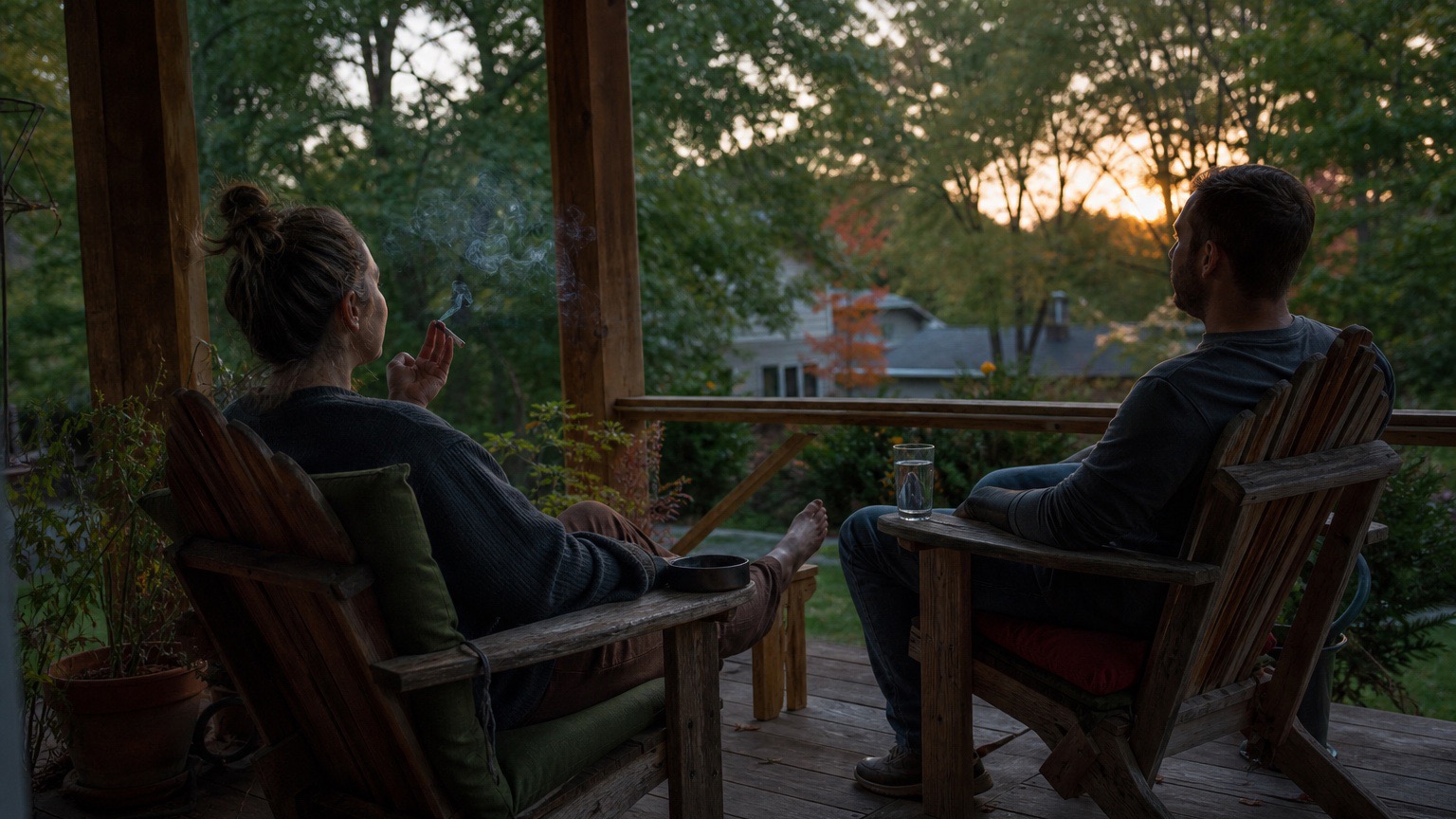
Take it outside, stand downwind of windows, and treat shared air like a shared sink — you don't leave it dirty for the next person. The science says a contact high is unlikely on an open porch. Courtesy says your neighbor's baby, cat, and sober roommate still live here.
Metro Detroit housing is close. Duplexes share walls. Two-flats share stairwells. A January night pushes people indoors. An August evening gives you a porch. Use the porch. If you only have a balcony over a play lot, walk to the alley or the backyard, not the kids' table.
A simple house rule beats a fight:
- No indoor combustion when kids, pets, or a sober roommate are in the unit. Vapor still clouds a small room. Treat it like smoke unless you live alone and the lease allows it.
- Smoke outside, not in the hallway. Hallways are common areas. MDHHS already treats many of those as smoke-free.
- Stay off the building HVAC return. A bathroom fan is not a license to hotbox. You are feeding the duct.
- Cars are not lounges. MCL 333.27954 already bans smoking marihuana in the passenger area on a public way. Kids in the back seat make it worse.
- Ask before you light in someone else's yard. Owner, occupier, or manager can say no. That is the statute, not a vibe.
- Put the jar away when you come back in. Smell on a hoodie is not a high. A gummy on the coffee table is how pets and kids get hurt — ASPCA.
| If you live… | Default move |
|---|---|
| Detroit / Hamtramck two-flat | Backyard or porch, not the shared stair |
| Ferndale / Royal Oak apartment | Check the lease; common areas are not your lounge |
| Single-family house in the suburbs | Downwind of the play set and the neighbor's windows |
| With a night-shift roommate | Their sleep air is not your session |
If you are shopping flower so you can take a smaller, cleaner session outside instead of filling the living room, that is the whole product point. Divine Toke sells sun-grown organic flower and pre-rolls to adults 21 and over. We do not sell a “stealth indoor” kit. Go outside. Keep it short. Come back human.
School-year parents: the longer checklist is back-to-school etiquette. This page is the science so the conversation does not start with a myth.
Frequently Asked Questions #
Can you get high just from smelling weed? #
No. Smell is not a milligram of THC in your blood. Terpenes — the aroma chemicals — hit your nose at tiny doses. A contact high needs enough THC on inhaled particles to reach your brain. The CDC says people can feel high from secondhand smoke, but that is about breathing a smoky room, not catching a whiff on a jacket.
Can walking past a joint give you a contact high? #
No. A sidewalk pass is seconds of outdoor air. The Hopkins chamber needed an hour, six smokers, and almost no ventilation before nonsmokers reported mild drug effects — Herrmann 2015. Walking past a joint on a Detroit porch is not that experiment.
Can secondhand cannabis smoke make you fail a workplace urine test? #
Not from ordinary exposure. A sealed, heavy, hour-long session has produced a rare 50 ng/mL screen positive in the lab. Cone I (PMC4342697) found one such screen and said positives are likely rare, short-lived, and obvious. Ventilated rooms did not screen positive in Herrmann 2015. This is not advice on how to pass a test.
Is secondhand cannabis smoke worse than cigarette smoke? #
It shares many of the same toxic chemicals, and the CDC says some show up in higher amounts. That comparison is Moir 2008, cited on the CDC secondhand page. Cannabis smoke also carries THC. Long-term bystander cancer numbers for cannabis smoke are still thinner than the tobacco file. Treat both as dirty indoor air.
Can kids get THC in their system from someone else's smoke? #
Yes. Studies have found cannabis metabolites in children's urine when adults smoke in the home. Wilson 2017 (PMC5701510) showed it early. The 2025 JAMA Network Open study found about five times the odds of detectable THC equivalents with in-home cannabis smoking. Keep smoke outside. House rules: back-to-school etiquette.
Can dogs or cats get high from secondhand weed smoke? #
They can get sick. That is intoxication, not a cute high. The ASPCA lists cannabis as toxic to dogs, cats, and horses because of THC. Eating edibles or flower is the bigger emergency. VCA also lists secondhand smoke as an exposure route. Closed rooms plus pets is a bad plan.
Is vaping safer for the people in the room than smoking flower? #
Probably lower contact-high risk than a thick joint session, but it is not clean air. The Hopkins contact-high data is about combusted smoke. Indoor vape clouds can still fill a room with particles. The CDC warning is written for smoke. Do not hotbox a vape in a nursery and call it wellness.
Is it legal to smoke cannabis on a Michigan porch or apartment balcony? #
It depends whose property it is, whether the space is “public,” and what the lease says. MCL 333.27954 bans public consumption and lets an owner or manager prohibit smoking. MDHHS says common areas are generally smoke-free; units follow the lease. A street-facing balcony can still bother neighbors and management. This is not a courtroom script.
Does cracking a window stop a contact high? #
It helps a lot for adult drug effects. It does not make indoor smoke kid-safe. Herrmann 2015 used 11 air exchanges per hour and wiped out sedative effects and urine-screen positives. One cracked window in January is not that fan. Kids and pets still should not sit in the plume.
Can you get a contact high in a car? #
Yes, a closed car is a small chamber. Time plus no airflow is how the Hopkins setup worked. Michigan also bans smoking marihuana in the passenger area of a vehicle on a public way — MCL 333.27954. Never do it with kids in the car.
How long does cannabis smoke linger in a room? #
Particles and odor can hang after the joint is out. A true contact high tracks the thick session, not last night's smell. Hopkins nonsmokers' blood/oral-fluid THC faded over a few hours after they left the chamber — Cone III (PMC4627404). Thirdhand residue on couches is still an evidence gap per Holitzki 2017 (PMC5741419). Open the windows. Do not trust a spray.
What's the difference between a contact high and just smelling it? #
A contact high is a drug effect from absorbed THC. Smell is your nose noticing terpenes. You can smell cannabis and stay sober. You can also sit in a sealed smoky room, feel a little heavy, and show THC in blood — the Hopkins papers. If you only smelled it on the next block, you got odor, not a high.
Where This Leaves Detroit Roommates and Parents #
A contact high is a sealed-room problem. Secondhand smoke is still a courtesy problem even when nobody gets high. Johns Hopkins showed mild drug effects in a box built to be unfair. The CDC still tells you the smoke carries toxins and THC. Michigan law splits tobacco indoor bans from cannabis public-use bans. Your lease may be stricter than both.
If you want flower that belongs on a porch chair — not in a child's bedroom air — start with Divine Toke sun-grown organic flower or a pre-roll, then take it outside. Shop adults-only at the shop. We do not invent strain theater here. We sell clean plant material. You handle the air.
Keep reading in this cluster:
- The high isn't one thing — why a smoked high itself is a stack, not a single switch
- Why everybody's high is different — why one roommate feels a smoky room and another doesn't
- Back-to-school cannabis etiquette — locked storage, school property, and pickup-line rules
- Blood THC vs impairment — leftover THC in a test is not the same as being high behind the wheel
- Cross-fading explained — do not stack smoke and drinks and call it “just secondhand”
This article is for educational purposes only and is not medical advice. Always consult your healthcare provider before starting any new wellness routine. It is not legal advice and it is not a guide for passing a drug test.
Grown in Detroit. Shipped to your door.
Small-batch, sun-grown cannabis cultivated in living soil. Mail-order shipping to all 50 states.