Cannabis and Fitness: How Athletes Are Using Weed for Recovery

Jamie
Head Cultivator
More athletes — from marathon runners to weekend gym-goers to hard-working tradespeople — are reaching for cannabis after a tough workout. The questions on everyone's mind: does it actually help? And is it safe to use if your job or sport tests for it?
What the Science Actually Says About Cannabis and Recovery #
Early research suggests cannabis — especially CBD — may help with the feeling of recovery, but the hard clinical proof is still catching up to the hype. That's the honest answer, and it matters if you're making real decisions about your body.
Most of what we know comes from surveys and small studies, not big clinical trials. A 2023 study of trained athletes found that 93% of habitual CBD users and 87% of habitual THC users felt cannabis helped their recovery. But feeling better and measuring better are two different things. When researchers look at actual recovery markers — like how fast muscles repair or how much inflammation drops — the evidence is thinner and more mixed.
Here's what the research does support:
| What Cannabis Might Help With | Evidence Level | Notes |
|---|---|---|
| Pain perception (soreness) | Moderate | CBD may dull pain signals |
| Sleep quality | Moderate | Both CBD and THC show some effect |
| Anxiety and tension after hard training | Moderate | CBD's best-documented benefit |
| Actual tissue repair speed | Weak | Not well-supported by clinical trials yet |
| Reducing inflammation markers | Early/Mixed | Promising in lab, limited human data |
Reviews from GSSI (Gatorade Sports Science Institute) describe CBD's recovery potential as "promising but not conclusive." So what does that mean for you? It means cannabis might genuinely help you feel better after a hard day — but you shouldn't count on it as a substitute for good nutrition, real rest, or working with a doctor on injuries.
The Runner's High Connection: Your Body Already Makes Its Own Cannabinoids #
Your body produces its own cannabis-like chemicals during exercise — and that's a big part of why a good run can feel like a natural high. The compound responsible is called anandamide (pronounced ah-NAN-duh-mide), and it's your body's version of THC.
Here's the basic idea: you have something called the endocannabinoid system (ECS) — a network of receptors spread throughout your brain, muscles, and immune system. Think of the ECS like a thermostat that keeps things in balance: pain, mood, sleep, inflammation, and more. For a deeper dive into how this whole system works, check out our post on how your body makes its own cannabinoids.
When you exercise hard, your body pumps out anandamide. A PMC study on the endocannabinoid system and aerobic exercise found that acute aerobic exercise consistently raises anandamide levels in the blood. Another research review published in PMC (PMC4620874) showed that the anxiolytic (anxiety-reducing) and pain-dulling effects of running depended on functioning cannabinoid receptors — not just endorphins, like we used to think.
So where does cannabis come in? THC and CBD from the cannabis plant interact with the same receptors — CB1 and CB2 — that your own anandamide uses. Cannabis doesn't create the runner's high, but it acts on the same biological pathway. Think of it like pressing the same button your body already presses during a good workout.
- Anandamide = your body's natural endocannabinoid ("the bliss molecule")
- CB1 receptors = found mainly in the brain; linked to euphoria, pain relief, mood
- CB2 receptors = found mainly in immune tissue and muscles; linked to inflammation
- THC = plant compound that activates CB1 (and some CB2) receptors directly
- CBD = plant compound that modulates the ECS more indirectly, without the high
How CBD Works Differently from THC for Recovery #
CBD and THC are not the same thing, and they don't do the same thing for recovery. Knowing the difference matters — especially if you have a drug test on the horizon.
CBD (cannabidiol) does not get you high. It works more like a system-wide calming agent. Early research suggests it may reduce pain signals, calm muscle tension, and help the body wind down after exertion. The World Anti-Doping Agency (WADA) removed CBD from its Prohibited List in 2018, making it the only cannabinoid that's safe for competing athletes to use.
THC (tetrahydrocannabinol) is the compound that produces the high. It directly activates CB1 receptors in the brain. Some athletes use low-dose THC in the evening for deep relaxation and sleep. But THC carries anti-doping risk, affects coordination, and raises heart rate — all covered below.
| Feature | CBD | THC |
|---|---|---|
| Gets you high | No | Yes |
| Allowed in competition (WADA) | Yes | No |
| Drug test risk | Low (if product is pure) | High |
| Best for | Pain, anxiety, sleep quality | Deep relaxation, sleep |
| Heart rate effect | Minimal | Can raise significantly |
| Workplace test risk | Low | High (detectable for days–weeks) |
A 2025 Frontiers in Nutrition study on elite Canadian athletes found that the most commonly reported reasons athletes use CBD were improved sleep, relaxation, pain from training, and perceived recovery. For most people using cannabis for recovery, CBD-forward products make more sense than THC-heavy ones — especially if any kind of drug test is possible.
The Real Ways Athletes Are Using Cannabis Post-Workout #
Most athletes using cannabis for recovery are reaching for it after the workout, not before — and they're choosing topicals or low-dose CBD over full THC sessions. Here's how the three main methods work.
Topicals for Sore Spots #
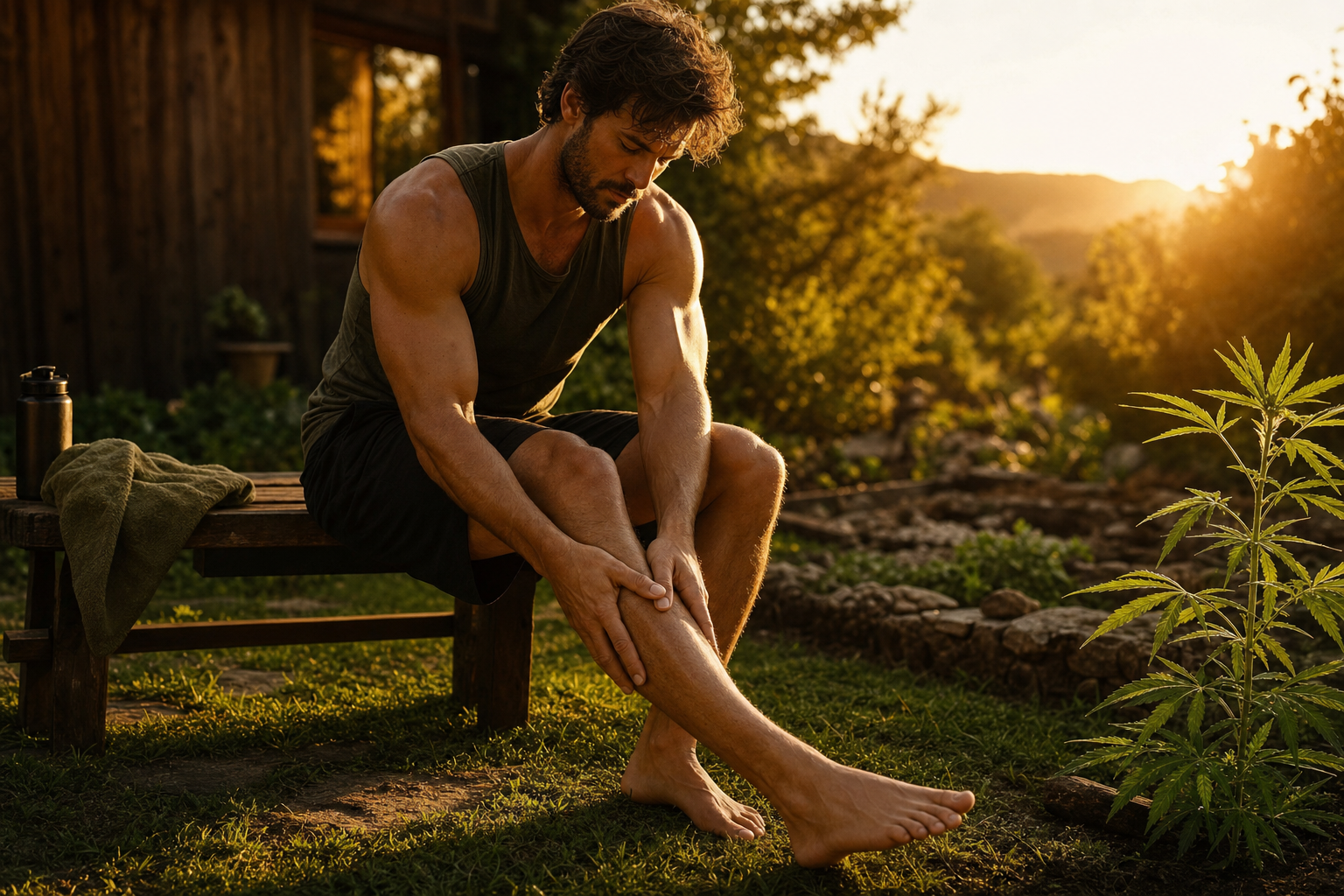
CBD-infused balms, creams, salves, and lotions are the most common way athletes use cannabis for localized soreness. You rub it directly on a sore knee, tight shoulder, or aching calves.
The appeal is that topicals work locally — the CBD doesn't reach your bloodstream in any significant amount, so there's no high and minimal drug-test risk. The Realm of Caring Foundation's review on cannabis for workout recovery notes topicals as one of the most practical options for athletes who want to target soreness without systemic effects.
Good for: Localized joint or muscle soreness, post-game aches, stiff spots from repetitive work.
Not great for: Full-body recovery, sleep, or anything that needs a systemic effect.
Low-Dose CBD for Sleep and Wind-Down #
Oral CBD — tinctures, capsules, or gummies — is the other big method. The idea is to take it 30–60 minutes before bed to help your body settle down and get into deeper, more restorative sleep.
Sleep is where recovery actually happens. Growth hormone surges during deep sleep. Muscles repair. The nervous system resets. If cannabis genuinely helps you sleep better, the indirect recovery benefit could be real — even if the direct anti-inflammatory effect is still uncertain.
Survey data from the 2025 Frontiers in Nutrition elite athlete study puts sleep improvement as one of the top reported benefits of CBD use among competitive athletes.
Good for: Winding down, falling asleep faster, staying asleep.
Start with: 10–25mg CBD as a starting point; work up slowly over several nights.
Timing It Right: When to Use vs. When to Skip #
The general principle across all reviewed sources: recovery use = post-workout, not pre-workout.
- Pre-workout THC: Not recommended. Raises heart rate, can impair reaction time and coordination, adds cardiovascular stress during already-demanding exercise.
- Post-workout CBD: Generally fine for most people. Target the soreness or help with sleep.
- Post-workout low-dose THC (evening only): Some athletes do this for deeper sleep. Know your drug-test risk before trying.
| Timing | CBD | THC |
|---|---|---|
| Before workout | Generally fine, but minimal recovery benefit | Not recommended — impairs performance and safety |
| Right after workout | Topical for localized soreness | Skip — let heart rate normalize first |
| 1–2 hours post-workout | Oral CBD for relaxation | Low dose if no drug test concerns |
| 30–60 min before bed | Best window for sleep support | Low dose — watch for next-day grogginess |
Does Cannabis Help with Inflammation and DOMS (Delayed Onset Muscle Soreness)? #
Cannabis may help with how sore you feel, but it likely isn't fast-tracking actual tissue repair. That's a meaningful distinction worth understanding before you skip ice baths and foam rolling in favor of a CBD gummy.
DOMS — delayed onset muscle soreness — is the deep, achy feeling that usually peaks 24–48 hours after a hard workout. It's caused by microscopic tears in muscle fibers and the inflammation that follows as your body repairs them. Some of that inflammation is actually necessary for getting stronger. Too much of it for too long just makes you miserable.
Here's what the research shows, honestly:
- CBD may reduce pain perception from DOMS — meaning you might feel less sore, even if the actual muscle damage is the same. A PMC review on CBD and athletic recovery (PMC8369499) notes CBD's potential analgesic and anti-inflammatory properties, but flags that human evidence specific to DOMS is still limited.
- The anti-inflammatory effect in humans is unproven at typical doses. Most anti-inflammatory data comes from cell cultures or animal studies. That doesn't mean it won't translate — it means we don't have the clinical trial yet.
- The pain relief effect is real for many people. Whether it's placebo or pharmacology, athletes consistently report feeling less beat up when using cannabis for recovery.
For our readers who are on their feet all day — construction, warehousing, delivery, trades — this distinction matters. If you come home with sore knees and a throbbing lower back, cannabis might genuinely take the edge off that. Whether it's doing something biological or just calming the signal from your pain receptors is, for most people, a secondary question. Learn more about how cannabis interacts with pain in our full guide to cannabis for natural pain relief.
The Sleep Factor: Why Rest Is the Biggest Recovery Tool #
If cannabis helps you sleep better, that might be the single biggest recovery benefit it offers — and sleep is the part of recovery most people underestimate.
Here's a simple truth about how your body fixes itself after exercise: most of it happens while you're asleep. During deep, slow-wave sleep, your body releases human growth hormone, which drives muscle repair. Your immune system clears out cellular debris from the workout. Your nervous system — taxed from an intense training session or a long hard shift — gets to actually rest.
If you're not sleeping well, you're not recovering well. Period.
Cannabis and sleep have a complicated relationship. THC can help you fall asleep faster, but regular high-dose THC use may reduce the amount of REM sleep you get — and REM is important for mental recovery, memory, and mood. CBD, on the other hand, seems to support sleep without disrupting sleep stages as much, at least at moderate doses.
A 2025 Frontiers in Nutrition study of elite Canadian athletes using CBD found improved sleep was one of the most consistently reported benefits. That tracks with what many everyday people report too — CBD helping them quiet the mental chatter after a tough day and fall asleep faster.
For a deeper look at how cannabis affects your sleep cycles and what dosing actually looks like at bedtime, read our cannabis and sleep complete guide.
Quick sleep-recovery tips if you're using cannabis:
- Use CBD in the evening rather than THC, especially on nights before early training or work
- Keep doses moderate — more isn't always better for sleep quality
- Avoid using within 1 hour of going to bed if you're trying an edible (digestion takes time)
- Don't rely on cannabis as your only sleep tool — good wind-down habits still matter
The Honest Risk Section: What You Need to Know Before You Try #
Cannabis carries real risks for athletes and workers, and ignoring them doesn't make them go away. Here's the straight talk.
Heart Rate and Cardiovascular Effects #
This is the one most people don't think about. Smoking or vaping cannabis — especially THC — can raise your heart rate by anywhere from 20% to 100% for two to three hours after use. That's according to a PMC cardiovascular review (PMC5542986) that looked at cannabis and the heart. The same review notes it can cause blood pressure swings and, in some people, orthostatic hypotension — that dizzy, lightheaded feeling when you stand up too fast.
Combine that with strenuous exercise too soon after using THC, and you're adding cardiovascular stress on top of cardiovascular stress. The American Heart Association reported that cannabis use is linked to increased heart attack and stroke risk, based on population-level data — though that evidence is mostly observational and strongest for heavy, smoked cannabis.
Practical rule: Don't use THC and then jump into a hard workout. Save it for the end of the day.
Drug Testing — Athletes, Tradespeople, and Workplace Policies #
This is the part that could cost you your job or your career, so read carefully.
For competing athletes: THC is banned in competition under WADA's Prohibited List. CBD was removed from the list in 2018 and is allowed. But here's the catch — CBD products can contain trace THC, and some research suggests certain CBD products can even convert to detectable THC levels under the acidic conditions of digestion. A positive test is a positive test, even if you were using something labeled "CBD only."
For tradespeople and workers in safety-sensitive industries: Employer drug tests usually don't distinguish between last week's recreational use and today's impairment. THC is detectable in urine for:
| Use Pattern | Approximate Detection Window |
|---|---|
| Single use | 3–4 days |
| Occasional use (a few times/week) | Up to 10–14 days |
| Daily use | Up to 30+ days |
| Heavy daily use | 45–90 days in some cases |
The CDC is clear that cannabis impairs reaction time and coordination — effects that matter on a job site, behind the wheel, or anywhere that precision matters. Even if you feel fine the next morning, residual effects on reaction time can linger.
If your employer tests, or if you're in a WADA-regulated sport, be honest with yourself about the risk. CBD topicals carry the lowest risk. Oral CBD from a tested, certified product is next. THC products carry meaningful risk for anyone subject to testing.
What Athletes Who've Spoken Publicly Are Actually Saying #
A growing number of professional athletes have gone on record about using cannabis for recovery — and their accounts track closely with what the research suggests. Nate Diaz smoked a CBD vape pen at a post-fight press conference in 2016. Rob Gronkowski has been a spokesperson for CBD recovery products. NFL linebacker Derrick Morgan helped push for the league to reconsider its cannabis policies. These aren't fringe cases anymore.
What most of these athletes describe is not cannabis as a performance enhancer during competition — it's cannabis as a recovery tool, sleep aid, and pain management alternative to the prescription medication and over-the-counter painkillers that sports medicine has long relied on.
The shift in professional sports policies reflects this reality. The NFL reduced its cannabis penalties in 2020. The MLB removed cannabis from its restricted substances list in 2019. The NBA changed its testing protocols in 2020. The trend is clear: leagues are increasingly treating cannabis the way they treat alcohol — something athletes may use in their personal time, with appropriate limits around safety and performance.
But the drug-testing picture for working athletes is still complicated. WADA still bans THC in competition. Olympic athletes operate under much stricter rules than NFL players. And workplace testing for tradespeople and people in safety-sensitive jobs follows employment law, not sports policy — which can be more variable and less forgiving.
Key takeaway: The conversation has changed, but the rules still vary enormously by governing body, league, employer, and jurisdiction. Knowing your specific situation is step one.
Common Mistakes People Make When Using Cannabis for Recovery #
The biggest mistake is treating cannabis like a supplement with a standard dose — it doesn't work that way. Here are the pitfalls worth knowing about.
Using too much THC. More isn't better for recovery. High doses of THC can interfere with sleep quality, raise anxiety (the opposite of what you want), and impair next-day performance. The sweet spot for recovery is usually a much lower dose than people expect.
Ignoring the product label. Not all CBD products are created equal. Unregulated products may contain more THC than listed, or less CBD than advertised. Research published in JAMA found that 69% of CBD products tested online were mislabeled, with some containing significantly more THC than disclosed. Buy from brands that publish third-party lab results.
Skipping recovery basics. Cannabis doesn't replace protein, sleep, hydration, or progressive training. Using a CBD balm on a sore knee doesn't mean you can skip mobility work.
Using before a workout when the goal is recovery. Cannabis is a post-workout tool. Using THC before training can impair coordination and push your heart rate in directions that aren't productive during exercise.
Expecting immediate results. Cannabis for recovery works best as a consistent habit, not a one-time fix. Give any new approach at least a week of consistent use before deciding it does or doesn't work for you.
How to Start: Practical Tips for Recovery-Focused Use #
If you want to try cannabis for recovery, start low, stay post-workout, and pick the right format for your goal. Here's a simple starting framework:
Know your drug-test situation first. If you're subject to any testing — athletic, employer, or federal — figure out where you stand before trying anything with THC. CBD topicals are your safest option in any testing environment.
Match the format to the goal:
- Sore knee or shoulder → CBD topical (balm, cream, roll-on)
- General post-workout tension → 15–25mg oral CBD, 30–60 min before bed
- Trouble falling asleep → oral CBD or low-dose THC (evening, if no test risk)
Start with the lowest dose. Cannabis affects people differently. Body weight, metabolism, how recently you ate, and your personal endocannabinoid system all matter. What works for your training partner might not work for you.
Give it at least a week. Single-use results are often unpredictable. Consistent low-dose use over 5–7 days gives you a clearer picture.
Track it like you track your training. If you're logging workouts, log how you feel after adding cannabis to your recovery routine. Soreness level on a scale of 1–10, sleep quality, morning readiness — it's the same discipline.
Use clean products. Especially if you're concerned about drug tests or general purity, look for cannabis products with a Certificate of Analysis (COA) from a third-party lab. At Divine Toke, we believe in transparency — and you should expect the same from any brand you're trusting with your body.
The honest bottom line: cannabis isn't a magic recovery potion, but for many people it's a genuinely useful part of a recovery routine — especially for the sleep and soreness end of things. The key is being realistic about what it does and doesn't do, and being smart about the risks specific to your situation.
Frequently Asked Questions #
Does CBD actually help with muscle soreness after a workout? #
CBD may reduce how sore you feel, but it probably doesn't speed up the actual muscle repair process. The distinction matters. A PMC review of CBD and athletic recovery (PMC8369499) found CBD shows promising analgesic properties, but clinical evidence specific to DOMS (delayed onset muscle soreness) in humans is still limited. What many people experience is a real reduction in discomfort — which has genuine quality-of-life value even if it isn't accelerating the cellular repair timeline.
Is it safe to use cannabis before exercising? #
Avoid THC before intense exercise — it raises heart rate and impairs coordination. A PMC cardiovascular review (PMC5542986) found cannabis can raise heart rate by 20–100% for 2–3 hours after use. Pairing that with strenuous exercise adds unnecessary cardiovascular stress. CBD before a workout is generally lower risk, but most of the recovery value comes post-workout, not before. Save cannabis for your cool-down, not your warm-up.
Will using CBD make me fail a drug test? #
Pure CBD won't, but contaminated or mislabeled CBD products might. WADA removed CBD from its Prohibited List in 2018, but all other cannabinoids — including THC — remain banned. The real risk is that many CBD products on the market contain trace amounts of THC, which can accumulate or be detected in testing. Some research even suggests CBD can convert to detectable THC levels in the acidic environment of the gut. If you're tested by an employer or sports governing body, use only third-party lab-certified CBD products with a Certificate of Analysis showing non-detectable THC.
What's the difference between CBD and THC for workout recovery? #
CBD is non-intoxicating and focuses on pain, inflammation, and sleep; THC is intoxicating and better for deep relaxation and sleep, but carries impairment and drug-test risk. The 2025 Frontiers study on elite Canadian athletes found athletes use CBD most often for pain relief, sleep, and relaxation — the same goals you'd use THC for, but without the high or the anti-doping risk. For anyone subject to testing, CBD is the safer choice by a wide margin.
How do professional athletes use cannabis for recovery? #
Most report using it after training, not before, and typically in CBD form for sleep and soreness. A 2023 athlete survey (PMC10403841) found that among athletes who used cannabis, the most common reasons were muscle soreness relief, sleep support, and relaxation. Post-workout and evening timing was more common than pre-workout use. Topical application for localized soreness was popular among those avoiding systemic effects.
What's the best form of cannabis for post-workout recovery? #
It depends on your goal: topicals for localized soreness, oral CBD for sleep and full-body relaxation. Topicals (balms, creams, salves) don't enter the bloodstream significantly, so they're the lowest-risk option for anyone who might be tested. Oral CBD tinctures or capsules work better when the goal is sleep quality or whole-body calming. Start with one format, give it a week, and track how you feel before adding more.
Does cannabis actually improve sleep for athletes? #
Many athletes report better sleep with cannabis, especially CBD, and sleep is where most physical recovery actually happens. The 2025 Frontiers in Nutrition elite athlete study identified improved sleep as one of the top self-reported benefits of CBD use among competitors. Growth hormone — critical for muscle repair — is primarily released during deep sleep. Better sleep means better recovery, so if cannabis genuinely improves your sleep quality, the downstream benefits are real even if the direct anti-inflammatory effect is still uncertain.
Can a topical CBD cream or balm relieve sore muscles? #
Yes — for localized soreness, topicals are one of the most practical and lowest-risk options. CBD topicals work by binding to CB2 receptors in the skin and local tissue, potentially reducing localized pain and inflammation without reaching the bloodstream. They won't give you a drug-test issue and they won't get you high. The key is applying enough — most people under-dose topicals. Rub it in well and give it 15–30 minutes to take effect. Reapply if needed.
What is anandamide and how does it connect to the runner's high? #
Anandamide is your body's own natural cannabinoid — often called "the bliss molecule" — and it's a major reason why a hard run can feel euphoric. A PMC study (PMC4620874) showed that the anxiolytic (anxiety-reducing) and pain-dulling effects of running in mice required functioning cannabinoid receptors, not just opioid receptors. Anandamide rises during aerobic exercise and binds to the same CB1 and CB2 receptors that THC binds to. Cannabis and the runner's high both ride the same biological rails — which is part of why people who already feel good from exercise sometimes notice cannabis working differently than those who don't.
Is cannabis banned in professional sports? #
THC is banned in competition under WADA rules, but CBD is legal for athletes. WADA updated its Prohibited List in 2018 to remove CBD while keeping all other cannabinoids — including THC — on the banned list. Individual sports leagues have their own policies. The NFL, NBA, and MLB have each modified their cannabis testing policies in recent years, generally reducing penalties for off-field use, but active athletes should check their specific governing body's current rules before using any cannabis product.
Getting Started at Divine Toke #
If you're curious to try cannabis as part of your recovery routine, we'd suggest starting with what has the most straightforward evidence: a quality topical for sore spots, or a clean CBD product for evening wind-down. At Divine Toke, our sun-grown organic flower and cannabis products are grown without pesticides, giving you a cleaner baseline for any wellness routine.
For more on how cannabis supports your body's recovery systems, explore these related posts:
- Your Body Makes Its Own Weed: Understanding Anandamide
- Cannabis and Sleep: A Complete Guide
- Cannabis for Natural Pain Relief
This article is for educational purposes only and is not medical advice. Always consult your healthcare provider before starting any new wellness routine. If you are subject to drug testing by an employer or sports governing body, consult those policies before using any cannabis product.
Grown in Detroit. Shipped to your door.
Small-batch, sun-grown cannabis cultivated in living soil. Mail-order shipping to all 50 states.