Banking and Cannabis: Why Your Dispensary Is Still Cash-Only

Jamie
Head Cultivator
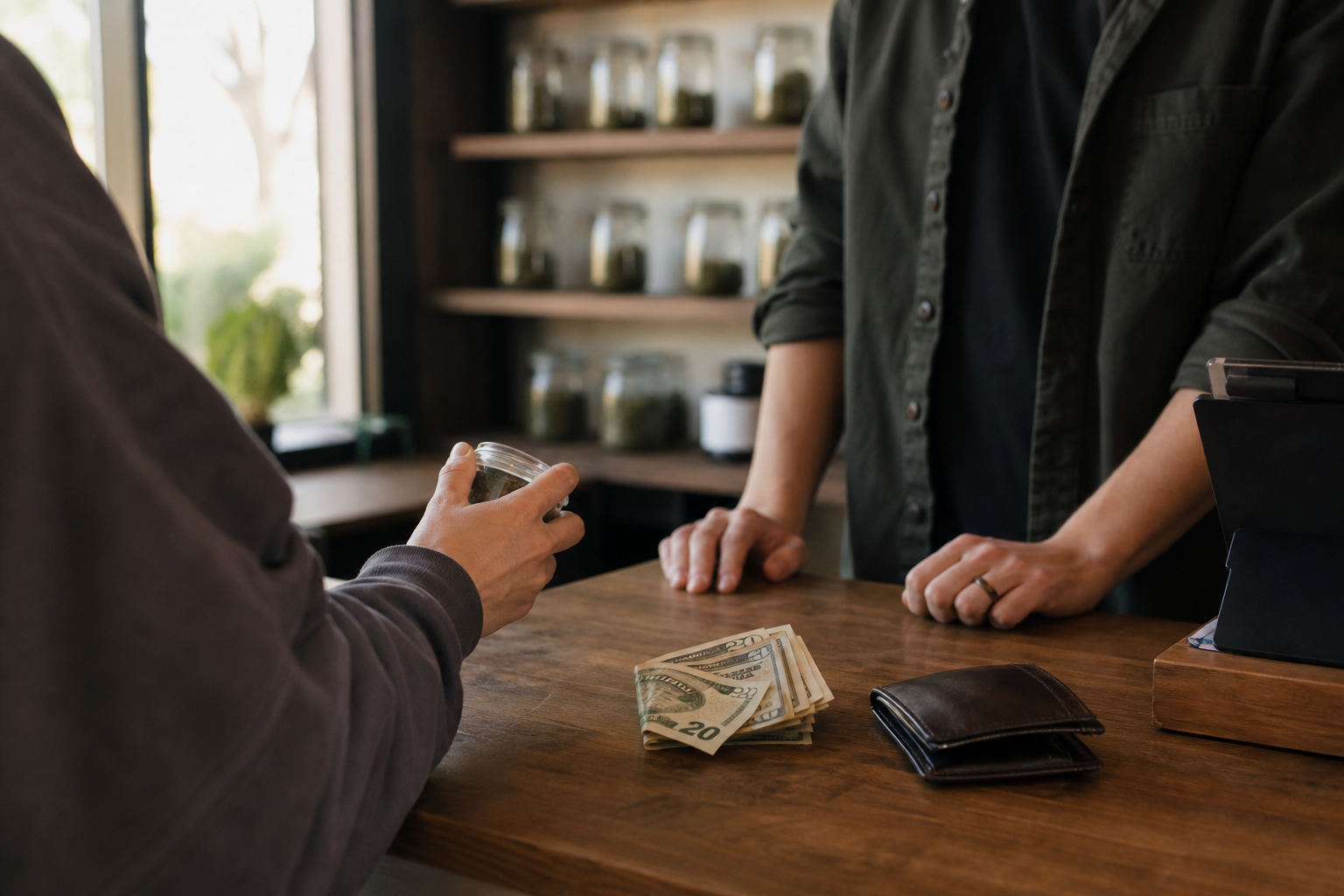
You walked into a Michigan dispensary, grabbed your flower, stepped to the register, and then heard it: "Cash or debit only." Maybe there's an ATM in the corner. Maybe you're already paying a $3.50 fee just to buy your own weed.
This isn't an accident, and it's not the dispensary's fault. It's a federal problem that is costing Michigan shoppers real money every single visit — and as of June 2026, it still hasn't been fixed. Here's the plain-English version of why.
Already read our banking basics explainer? This post picks up where Cannabis Banking: Why Your Dispensary Is Cash-Only left off, with a consumer-first lens: what it costs you, how safe it is, and what's actually changing in 2026.
Why Banks Won't Touch Cannabis Money #
Banks are federally regulated, and cannabis is still federally illegal — so any bank that handles cannabis money risks being charged with federal money laundering. That one sentence explains almost everything.
Here's the chain of events that leads to you standing at an ATM inside a dispensary:
- Cannabis is legal under Michigan state law.
- But the bank you use is insured by the FDIC — a federal agency. Federal rules, not state rules, govern how it operates.
- Under federal law, cannabis money is technically the proceeds of a controlled substance. Moving that money through a bank could count as money laundering under the Bank Secrecy Act.
- So most banks say no. Not because they want to. Because the legal risk isn't worth it.
The FinCEN — the federal agency that watches for money laundering — put out guidance back in 2014 telling banks how to serve cannabis businesses if they chose to. But it never made it legal or safe. It just said: here's the paperwork trail you need to file. Banks looked at that paperwork trail and mostly said, no thanks.
How Many Banks Actually Serve Cannabis? #
Out of roughly 10,000 FDIC-insured banks in the United States, only about 816 total financial institutions — banks, credit unions, and specialty lenders combined — were actively reporting cannabis-related accounts as of Q4 2024, according to CRB Monitor's analysis of FinCEN data. A June 2026 Credit Union Times report confirmed that number remains "just over 800" heading into mid-2026.
That 816 breaks down like this:
| Institution Type | Active Cannabis Accounts (Q4 2024) |
|---|---|
| Banks | 507 |
| Credit unions | 182 |
| Non-depository institutions | 127 |
| Total | 816 |
That's less than 10% of all U.S. banks. The other 90%+ have decided the federal risk isn't worth it.
The ones that do step up tend to be smaller, state-chartered credit unions willing to take on the compliance burden — and they charge a lot more for it. In Michigan, Dart Bank is one of the few confirmed financial institutions actively offering deposit and cash management services to cannabis operators.
Why the Compliance Burden Is So High #
When a bank does choose to serve a cannabis business, it doesn't just open an account and move on. Under FinCEN's 2014 cannabis banking guidance, the bank must:
- File a Suspicious Activity Report (SAR) when it first opens the account
- File an ongoing SAR for every month the account remains active — even if nothing suspicious happens
- Conduct enhanced due diligence on the business, its owners, its licenses, and its operations
- Monitor transactions for any sign that the business is operating outside state law
A normal business's bank account requires none of this. One cannabis account can require dozens of SARs per year. Multiply that across hundreds of accounts, and you have a compliance operation that requires dedicated staff, legal counsel, and ongoing regulatory review. For community banks and credit unions, that cost can be prohibitive.
That compliance architecture — built around treating cannabis money as inherently suspicious — is the core problem. And it doesn't go away with Schedule III. It goes away when Congress passes a law that explicitly says: cannabis banking is legal and banks are protected.
That law hasn't passed yet.
The ATM-Fee Tax: What Cash-Only Actually Costs You #
Every time you use a dispensary ATM, you're paying a hidden tax that goes straight to the banking system's refusal to deal with cannabis. Most dispensary ATMs charge $3–5 per transaction. That's on top of whatever your own bank charges for out-of-network withdrawals — another $2–3 on average.
So on a $40 purchase, you might pay $6–8 just to get the cash to complete the transaction. That's a 15–20% fee added before you even walk out the door.
What the Cash Problem Actually Costs per Store #
The math gets uglier when you look at the business side — because those costs get passed to you. A 2026 cannabis banking guide for California operators estimates that cash-intensive dispensaries pay $40,000 to $90,000 per year in banking-related costs: armored transport, cash counting services, on-site ATM fees, compliance audits, and extra insurance.
None of that would exist if a dispensary could just run a normal point-of-sale system and deposit its cash like any other business.
| Hidden Cash Cost | Who Pays It Ultimately |
|---|---|
| Out-of-network ATM fee ($2–5) | You, directly |
| Bank-fee surcharge on ATM machine ($2–3) | You, directly |
| Armored transport + vault services ($20K–40K/yr) | Built into product prices |
| Compliance and SAR filing costs | Built into operating overhead |
| Robbery losses and extra security | Built into product prices |
| Higher banking fees (specialty accounts) | Built into operating overhead |
That last column matters. When a dispensary's costs go up, prices go up. Cash-only isn't just an inconvenience — it's a line item on your receipt, hidden in the sticker price of every product you buy.
What About the "Cashless ATM" Workaround? #
Some dispensaries use what's called a cashless ATM — a system where you run your debit card as if you were withdrawing cash, and the dispensary gets the money. Sounds better, right?
Not really. These systems still charge fees (usually $3–5), they technically violate Visa and Mastercard's terms of service, and they've been shut down repeatedly by card networks. They also don't protect you the way a real debit card transaction would. They're a workaround, not a solution — and they could disappear from any dispensary at any time.
Is It Safe to Carry Cash to a Dispensary? #
Most dispensary visits are safe — licensed stores invest heavily in security — but the cash-only system creates real robbery risk that doesn't exist at any other retail store. Knowing this helps you make smarter choices on your visit.
Because dispensaries can't use banks, they sit on a lot of cash. Criminals know this. According to ASIS International's 2024 analysis of cannabis crime trends, dispensary robberies happen frequently enough that industry security professionals say "hardly a day goes by" without one being reported nationwide.
Dispensaries respond to this risk with real infrastructure: armed guards, cameras, controlled entry, vaults, and armored pickups. You'll notice this the moment you walk into most Michigan shops. That security is real — and so is its cost (which, as noted above, gets folded into prices).
What Makes Dispensaries a Target #
The Sapphire Risk 2022 report on cannabis business crime identified the cash problem as the core driver of the crime wave: dispensaries hold large amounts of physical currency because they have nowhere else to put it. Criminals know this. The pattern tends to be quick, targeted, and focused on the moments when cash is most exposed — during opening, closing, and transport.
For consumers, the direct risk is lower than for the business itself. Most robberies target the dispensary's cash vault or employees during transit, not individual shoppers at the counter. But the general environment still calls for common sense.
Smart Tips for Michigan Shoppers #
None of these tips mean you should be scared to visit a dispensary. But they're worth keeping in mind:
- Go during daylight or busy hours. The parking lot before and after your visit is the riskiest part. More people around means lower risk.
- Keep cash out of sight. Don't count it in your car or at the register. Put it away fast.
- Use the dispensary's on-site ATM instead of arriving with a wallet full of cash. You'll pay the fee, but you'll also carry less exposed.
- Choose stores with visible security. Cameras, a guard at the door, and a controlled entry are all signals of a well-run operation.
- Trust your gut. If something feels off in the parking lot, leave. Come back another time.
- Don't loiter outside. Make your purchase and go. Extended time in the parking lot increases exposure in cash-heavy environments.
Licensed Michigan dispensaries are regulated by the Michigan Cannabis Regulatory Agency and are required to maintain security plans. The risk you're managing isn't the store itself — it's the general vulnerability that comes from any cash-heavy environment.
The fix isn't better locks on the door. It's the SAFER Banking Act — which would let dispensaries function like normal businesses that deposit their cash daily and don't need armed guards in the parking lot.
Why Schedule III Didn't Fix the Banking Problem #
Rescheduling cannabis to Schedule III helped in some ways — but it did not fix cannabis banking, and dispensaries are still operating in the same cash-heavy environment. Here's why.
On April 28, 2026, Acting Attorney General Todd Blanche signed the final DEA/DOJ rule moving state-licensed medical cannabis from Schedule I to Schedule III under federal law. That was a meaningful step. It opened some doors for medical cannabis research, reduced certain federal penalties, and gave some banks a bit more comfort about serving medical cannabis businesses.
But here's what it didn't do:
- It did not rewrite the Bank Secrecy Act.
- It did not remove the requirement for banks to file Suspicious Activity Reports (SARs) on cannabis transactions.
- It did not change how the FDIC or federal regulators assess risk for banks serving cannabis clients.
- It did not change anything for adult-use recreational cannabis, which is most of what Michigan dispensaries sell.
Think of it this way: if you get a speeding ticket reduced from reckless driving to just speeding, your insurance still knows you were in trouble. The banks' insurance is federal oversight. Scheduling is one part of the risk equation. The Bank Secrecy Act compliance burden is another. Until both change, most banks will keep saying no.
Moritz Law's Drug Enforcement and Policy Center puts it plainly: the banking problem needs more than a scheduling change — it needs a clear federal rule on when cannabis proceeds are lawful and when banks are protected from consequences for handling them.
The SAFER Banking Act in 2026: Still Stalled #
The SAFER Banking Act — the bill designed to fix all of this — has not passed as of June 2026, and there's little sign it's moving soon. It's the most important piece of legislation for cannabis shoppers in the country, and it's been stuck for years.
Here's the timeline:
| Year | What Happened |
|---|---|
| 2019–2022 | House passed SAFE Banking Act multiple times |
| 2023 | Senate Banking Committee passed upgraded SAFER Banking Act 14–9 |
| 2024 | Never got Senate floor vote; died at end of 118th Congress |
| 2025 | Reintroduced; bipartisan support remains, progress remains slow |
| June 2026 | Still not law. Cannabis Business Times reports the act is "nowhere to be found" despite the Schedule III rescheduling |
The SAFER Banking Act (full name: Secure and Fair Enforcement Regulation Banking Act) would give banks a clear federal safe harbor for serving state-legal cannabis businesses. It would let them open accounts, process debit card transactions, offer loans, and handle payroll — all the normal stuff — without federal penalty. The National Cannabis Industry Association has tracked this legislation as its top federal priority for years.
Why is it stalled? Politics. Some members of Congress don't want to pass anything that looks like cannabis normalization without broader reform. Others want banking tied to other reforms, like expungement. The result is a bill with real bipartisan support that keeps failing to reach a floor vote.
What the SAFER Banking Act Would Actually Do #
If it passed, here's what changes overnight for Michigan shoppers:
| What Changes | Consumer Impact |
|---|---|
| Dispensaries can open real bank accounts | Cash handling costs drop; prices follow |
| Debit/credit card processing becomes possible | No more ATM fees |
| Business loans become accessible | Better products, lower operational overhead |
| Payroll processed normally | Stable workforce; lower turnover costs |
| Robbery incentive drops | Dispensaries stop being cash vaults |
The National Cannabis Industry Association has called cannabis banking access the single most important federal issue for the industry — not because it's good for dispensary owners, but because its absence actively harms consumers and communities.
For a deeper look at the structural banking problem — including the full business side of the cash equation — see our primer Cannabis Banking: Why Your Dispensary Is Cash-Only.
Digital Payments Are Coming — But Slowly #
Some Michigan dispensaries are starting to accept digital payments — but it's patchwork, not universal, and none of it works like a normal debit or credit card transaction. Here's what's actually available.
The fastest-growing alternative isn't a credit card. It's ACH payments — bank-to-bank transfers, similar to Venmo but built for cannabis. You link your bank account through a secure platform, and the money transfers directly to the dispensary. ArentFox Schiff's 2026 industry report calls ACH "rapidly becoming the preferred alternative to cash and credit cards" for cannabis merchants.
The numbers back that up. TSG Payments projects that ACH and real-time bank payment rails could handle 42% of cannabis transaction volume in 2026, up from about 28% in 2025.
What's Actually Available at Michigan Dispensaries #
| Payment Option | How It Works | Fee to Consumer | Availability |
|---|---|---|---|
| Cash | Standard | Just the ATM fee | Everywhere |
| Cashless ATM | Debit card runs as "cash withdrawal" | $3–5 surcharge | Some stores |
| ACH / bank transfer | Links your bank account | Usually $0 or $1 | Growing |
| CanPay | Cannabis-specific payment app | Low/no fee | Participating stores |
| Dutchie Pay | Built into Dutchie POS | Varies | Dutchie-integrated stores |
| Debit/credit card | Normal swipe/tap | N/A | Not available |
The platforms to know are CanPay and Dutchie Pay. CanPay is a payment app designed specifically for cannabis — you download it, link your bank account, and pay with your phone where accepted. Dutchie Pay is similar but integrated into Dutchie's dispensary software platform. Neither works everywhere, but adoption is growing in Michigan.
Ask your dispensary which options they offer. Some post it on their website. Others, you only find out at the register — which is a frustrating but honest summary of where cannabis payments stand in 2026.
Why Card Networks Still Won't Budge #
Even as ACH grows, Visa and Mastercard haven't moved. Their position is simple: cannabis is federally illegal, and they aren't going to put their brand on transactions that could expose them to federal liability. That's not about moral opposition — it's about the same risk calculation every bank makes.
The only way to change that is to change federal law. Which brings us back to the SAFER Banking Act, and why it matters more than any single payment app.
According to a 2026 ArentFox Schiff industry analysis, ACH is the most viable near-term path because it bypasses card networks entirely — it's a direct bank-to-bank transfer that doesn't require Visa or Mastercard's approval. It's not as fast or seamless as tapping your card, but it works, and it's growing. This is where Michigan dispensaries are likely to land before the SAFER Banking Act ever makes it to a Senate floor vote.
How Cash-Only Drives Up Your Total Bill (The Double-Hit) #
Cannabis is already expensive to buy legally, and the cash-only banking ban is a big reason why. It's not just the ATM fee. It's the way cash-only combines with another federal rule — called 280E — to inflate every price tag on the shelf.
Here's how the double-hit works:
Hit #1: Cash handling costs money. When a dispensary can't use a bank, it pays for armored transport, vaults, cash counting, extra insurance, and security guards. These are real operating costs — running $40,000–90,000 per year per location in states like California.
Hit #2: 280E won't let them deduct it. Under Section 280E of the Internal Revenue Code, cannabis businesses can't deduct normal operating expenses from their taxes. Rent, payroll, security — none of it. They can only deduct the cost of goods sold. According to tax compliance firm Wiss & Company, this can push a cannabis business's effective federal tax rate to 70–80% or higher.
So the dispensary pays $60,000 in cash handling costs. It can't write that off. It has to earn that $60,000 in revenue and then pay tax on top of it. That cost flows into the price of your eighth.
What 280E could mean for consumer prices: Industry analysts estimate that removing 280E alone could save the cannabis industry $2.3 billion annually. That's money that would flow back to operators — and could flow back to consumers through lower prices. As of mid-2026, 280E still applies because cannabis is Schedule I or II for non-medical uses. Our full 280E explainer breaks down exactly how it works and what legislative changes could end it.
The Michigan 24% wholesale excise tax adds another layer on top. Read that full breakdown here.
Michigan's Cannabis Market vs. the Banking Wall #
Michigan runs one of the largest adult-use cannabis markets in the country, and cash-only banking creates friction throughout the whole system. Understanding where Michigan sits in this national picture helps explain why the problem is so visible here.
Michigan legalized adult-use cannabis in November 2018 and opened its first recreational dispensaries in December 2019. By 2026, the Michigan Cannabis Regulatory Agency (CRA) licenses hundreds of active dispensaries across the state — all of them operating in a cash-heavy environment that every other licensed industry left behind decades ago.
What's Different About Michigan #
Michigan has its own state-level complications on top of the federal banking ban:
- The 24% wholesale excise tax — the highest wholesale cannabis tax in the Midwest — makes margins tighter and makes every extra cost (like cash handling) hurt more. See our full Michigan 24% tax breakdown.
- Social equity licensing — Michigan has a social equity program meant to bring in operators from communities most affected by cannabis prohibition. But equity operators, who are often under-resourced, are hit hardest by cash-only banking costs and the inability to access business loans.
- Detroit's urban market — In Detroit, where many dispensaries serve working-class neighborhoods, the ATM-fee burden falls disproportionately on shoppers who are already managing tight budgets. A $5 ATM fee on a $35 purchase is a 14% surcharge.
What Lab-Tested Michigan Cannabis Has to Do With Banking #
Here's a connection most shoppers don't make: when a dispensary can't get a business loan because of the banking ban, it may struggle to invest in better quality inputs, lab testing infrastructure, or supply chain upgrades. Lab-tested cannabis is non-negotiable from a consumer safety standpoint — but the system that makes clean, tested product more accessible is the same system being choked off by the banking ban.
The bottom line: Michigan's cannabis consumers are paying a banking tax that no other state's retail shoppers pay, and it's layered on top of an already high tax burden.
What Michigan Shoppers Can Do Right Now #
You can't fix federal banking law, but you can stop paying the ATM-fee tax on every single visit. Here's a practical guide for Michigan shoppers.
Before You Go #
- Check the dispensary's website for payment options. Many now list whether they accept ACH, CanPay, or other digital methods.
- Set up CanPay or Dutchie Pay if your dispensary supports it. Both apps are free to download and link directly to your checking account.
- Bring the right amount of cash so you skip the ATM fee. If you know you're spending $60, bring $65 — don't use the machine.
At the Store #
- Use on-site ATMs if you have to — but only withdraw what you need. Most on-site ATMs charge $3–5. Withdrawing $20 and $40 in two trips doubles the fee.
- Ask if digital options are available. Even if it's not on the website, some budtenders know about newer payment options not yet advertised.
- Keep your wallet secured after paying. Don't count bills at the register.
The Bigger Picture #
The cash-only problem isn't going away this week. But it is slowly getting better:
- More credit unions are entering the market.
- ACH payment platforms are growing.
- If the SAFER Banking Act ever passes, most of this goes away overnight.
Until then, knowing the system is the best defense. You didn't choose to deal with this. The federal government created it. But understanding it means you don't have to pay $6 in ATM fees every time you need an eighth.
| Quick Action | Saves You |
|---|---|
| Download CanPay or Dutchie Pay | $3–5 per visit |
| Bring exact cash | $3–5 per visit |
| Ask about ACH payments | $3–5 per visit |
| Avoid double ATM trips | $6–10 per visit |
How to Check Before You Go #
A five-minute check before you leave the house can save you the ATM fee every time:
- Search "[dispensary name] payment methods" — many post this on their Google Business listing.
- Check the dispensary's own website — look for an FAQ or "How to Order" page.
- Call ahead — a 30-second call to the front desk will tell you exactly what they take.
- Check the CanPay app — it has a store finder that shows which Michigan dispensaries accept it.
It shouldn't be this complicated. But until federal law catches up, a little prep prevents a lot of ATM frustration.
Frequently Asked Questions #
Q: Why can't I use my debit or credit card at a cannabis dispensary? #
Because Visa, Mastercard, and other major payment networks prohibit cannabis transactions on their platforms. Cannabis is still federally illegal for recreational use, and payment networks operate under federal rules. Any merchant caught processing cannabis sales through a standard card network risks immediate account termination. This is separate from, but connected to, the banking ban — even if a dispensary had a full bank account, they still couldn't take Visa without the card networks changing their policies, which requires federal law to change first.
Q: How much extra does cash-only cost me as a shopper? #
Directly, $3–8 per visit in ATM fees alone — and indirectly, more through higher product prices. The on-site ATM typically charges $3–5 as an out-of-network surcharge. Your own bank may charge another $2–3 on top of that. Over the course of a year, a weekly shopper paying $5 per ATM visit pays $260 extra per year just to access their own money. Beyond the ATM fee, the dispensary's cash handling costs — estimated at $40,000–90,000 per store annually in comparable markets — are built into the sticker prices you see on the shelf.
Q: Is it safe to carry cash to a dispensary? #
Yes, generally — but the cash-only environment creates real security risk that a normal store doesn't have. Licensed Michigan dispensaries are regulated by the Michigan Cannabis Regulatory Agency and must maintain security plans. Most stores have guards, cameras, controlled entry, and vaults. The risk isn't the store itself — it's the general vulnerability of any cash-heavy environment. Keep cash discreet, use the on-site ATM instead of arriving with a visible wallet, and stay aware in the parking lot. According to ASIS International's 2024 cannabis crime report, dispensary-targeted crime is a persistent national pattern — so standard situational awareness applies.
Q: What is the SAFER Banking Act, and did it pass in 2026? #
The SAFER Banking Act would protect banks from federal penalties for serving state-legal cannabis businesses — but it has not passed as of June 2026. The Senate Banking Committee approved it 14–9 back in September 2023, but it never got a full Senate floor vote and died at the end of the 118th Congress. As Cannabis Business Times reported on May 26, 2026, the bill remains "nowhere to be found" even after Schedule III rescheduling. It's been reintroduced with bipartisan support, but there is no clear path to a floor vote at this time.
Q: Why didn't Schedule III fix the banking problem? #
Because the banking problem isn't mainly about cannabis scheduling — it's about the Bank Secrecy Act, FDIC regulations, and payment network rules, none of which were changed by rescheduling. The DEA/DOJ final rule signed April 28, 2026 moved state-licensed medical cannabis to Schedule III, which helped in some narrow ways. But it didn't rewrite how banks file Suspicious Activity Reports, how the FDIC evaluates risk, or how Visa and Mastercard make their rules. Adult-use recreational cannabis — which is most of what Michigan dispensaries sell — also remains outside the Schedule III carve-out. According to a May 2026 Buchalter Law analysis, banking and insolvency risk for cannabis operators remains largely unchanged by the rescheduling order.
Q: Are any Michigan dispensaries accepting digital payments yet? #
Some are, through ACH bank transfers or cannabis-specific apps like CanPay — but it's not universal. As of 2026, industry projections from TSG Payments suggest ACH and real-time bank payments could handle 42% of cannabis transactions nationally this year, up from 28% in 2025. In Michigan, Dart Bank is one of the few financial institutions confirmed to offer cannabis banking services. Check your dispensary's website or ask at the counter — some offer CanPay or Dutchie Pay without advertising it prominently.
Q: What is a cashless ATM and why does it cost extra? #
A cashless ATM is a workaround where you run your debit card as if you were withdrawing cash at the register — and it almost always comes with a $3–5 surcharge. These systems technically violate Visa and Mastercard's terms of service because they process cannabis transactions on networks that prohibit them. Card networks have shut them down repeatedly. They offer no real consumer protections, no fraud dispute process, and they can disappear from a store without warning. They're a duct-tape fix, not a real payment solution.
Q: What should I do if there's no ATM at a dispensary? #
Bring cash. Most Michigan dispensaries have on-site ATMs, but if yours doesn't, your best move is to stop at your own bank's ATM before you go — that way you avoid the out-of-network surcharge entirely. If you're a regular at a particular store, it's worth calling ahead or checking their website to see what payment options they offer. Some dispensaries accept ACH transfers or CanPay, which means you don't need cash at all — just your phone and a linked bank account.
Q: Why do dispensary prices seem higher than they should be? #
Because legal cannabis carries costs that no other retail category carries — and most of them come from bad federal policy. You're paying Michigan's 24% wholesale excise tax (see our Michigan 24% tax breakdown), plus the costs of 280E — the federal tax rule that prevents dispensaries from deducting normal business expenses, pushing effective tax rates to 70–80%. Add in cash handling costs that can't be offset by normal banking, security overhead, and compliance requirements, and the price of an eighth reflects a lot more than just flower. Our 280E explainer breaks down exactly how much of your purchase price goes to federal and state tax rather than the product.
Q: When will I finally be able to swipe my card at a dispensary? #
Probably when the SAFER Banking Act passes or cannabis is fully descheduled at the federal level — and neither has a clear timeline right now. Some industry observers hope for progress in 2026–2027, but Congress has failed to act on cannabis banking for years despite broad bipartisan support. The most realistic near-term path is continued growth in ACH and bank-transfer platforms that let you pay digitally without a card network. Full Visa/Mastercard acceptance requires those networks to change their rules, which requires federal law to change first.
Q: What is FinCEN and why does it matter? #
FinCEN is the Financial Crimes Enforcement Network — the federal agency that tracks money laundering and requires banks to report suspicious financial activity. It published guidance in 2014 telling banks how to serve cannabis clients, but it didn't make it safe or legal — just less ambiguous. Banks that serve cannabis must file ongoing Suspicious Activity Reports (SARs) on every cannabis-related transaction, which is expensive and puts them under constant scrutiny. That compliance burden is one of the key reasons most banks still refuse to do it.
Q: How does 280E make the cash problem worse for consumers? #
280E is the federal tax rule that prevents cannabis businesses from deducting normal expenses — including their enormous cash-handling costs. A regular business can write off security costs, banking fees, and armored transport. A cannabis dispensary can only deduct cost of goods sold under Section 280E of the Internal Revenue Code. So every dollar spent on cash management because of the banking ban is a non-deductible cost that shows up directly in the retail price. The Marijuana Policy Project estimates that removing 280E could save the industry $2.3 billion annually — money that would reduce prices for everyone. For the full picture on Schedule III's relationship to the banking problem, see our cannabis rescheduling guide.
The Bottom Line for Michigan Shoppers #
The cash-only dispensary isn't a quirk or an oversight. It's the result of a federal system that has not caught up to the fact that cannabis is legal in Michigan and 33+ other states.
As of June 2026:
- The SAFER Banking Act is still not law
- Schedule III helped, but didn't fix banking
- About 816 banks and credit unions serve cannabis — less than 10% of U.S. banks
- ACH payments are growing and may reach 42% of transactions by end of 2026
- The ATM-fee tax is real, and it costs regular shoppers hundreds of dollars per year
You can reduce what you pay by using ACH apps like CanPay where available, bringing the right amount of cash, and stopping at your own bank's ATM instead of the in-store machine.
At Divine Toke, we use our platform to keep you informed about the policy issues that affect what you pay and how you shop. Michigan consumers deserve access to clean, sun-grown cannabis without jumping through cash hoops. Until federal law catches up, knowing the system is the best tool you have.
The dispensary that asks for cash isn't being difficult. They're navigating a federal system that treats a legal Michigan business like a criminal enterprise. Every ATM fee you pay is a tax on that dysfunction — and the remedy is sitting in Congress, waiting for the Senate to schedule a vote.
We'll keep tracking it. When the SAFER Banking Act moves, you'll hear about it here first.
Cannabis Banking Basics → · 280E Tax Explained → · Michigan's 24% Wholesale Tax → · Schedule III Guide →
Grown in Detroit. Shipped to your door.
Small-batch, sun-grown cannabis cultivated in living soil. Mail-order shipping to all 50 states.