Cannabis and Cooking: Infused Recipes for Summer Gatherings
Learn how to safely make and dose cannabis-infused recipes for summer cookouts — decarboxylation, butter and oil, guest labeling, and starter doses.

Head Cultivator
On this page
Summer cookouts and cannabis go together — but infused food plays by different rules than a joint. This guide walks through safe cannabis cooking for gatherings: how to activate flower, make butter or oil, dose servings, and host without surprise highs.
Why Cannabis Cooking Hits Differently Than Smoking #
Edibles feel stronger and last longer than smoking because your liver turns THC into 11-hydroxy-THC — a metabolite that hits harder and sticks around longer. A joint peaks in minutes. A brownie can take 30 to 120 minutes to land, then ride for hours.
When you smoke or vape, THC moves from lungs into blood fast. A PMC review of cannabis metabolism (PMC8803256) notes inhaled THC can reach peak blood levels in about 6 to 10 minutes, with inhaled bioavailability often cited around 10% to 35%.
Swallow the same plant in food, and the path changes:
- Food leaves the stomach and moves through the gut
- THC heads to the liver first (first-pass metabolism)
- Liver enzymes convert THC into 11-OH-THC (also psychoactive), then into inactive forms
- Only a fraction reaches the blood — oral bioavailability is roughly 4% to 12% per that same PMC8803256 review
Less of the dose reaches your bloodstream — but the metabolite that does can feel stronger per milligram than smoked THC. That is why "I ate one more because I felt nothing" is the classic cookout mistake.
| Factor | Smoking / vaping | Edible / infused food |
|---|---|---|
| Onset | Minutes | Often 30–120 minutes |
| Peak feel | Earlier, sharper | Later, deeper |
| Duration | Shorter for most people | Often several hours |
| Easy to overdo? | Easier to stop mid-session | Easy to redose too soon |
| Host risk | Shared joint is obvious | Food looks like normal food |
At Divine Toke in Detroit, we talk about this every summer: infused food is wellness-friendly and social — and it demands patience. If you want the full dosing deep dive, read our edibles dosing guide. For how edibles compare to flower and tinctures, see tincture vs flower vs edible.
What Is Decarboxylation and Why Do You Need It? #
Decarboxylation is the heat step that turns THCA (the raw acid in flower) into THC — the form that gets you high in edibles. Skip it, and most of your butter tastes like weed and barely works. Overdo the heat, and you burn off aroma and start degrading the good stuff.
Raw flower is packed with THCA, not active THC. Heat knocks off a carboxyl group (a small chemical piece) and leaves THC. Peer-reviewed work on cannabinoid acid conversion — including a 2021 PMC study on thermo-chemical decarboxylation (PMC8408919) — shows conversion depends on temperature and time, and that heat can also cause evaporation and degradation of cannabinoids if you push too hard. That study found different cannabinoids prefer different conversion temperatures in a pressurized water system (THC-related conversion peaked near 120°C / 248°F in their setup). Home cooks do not need lab gear — but the takeaway is the same: gentle, controlled heat wins.
Consumer kitchen guides commonly land around 220–245°F (about 104–118°C) for 30–40 minutes in a regular oven. That range is widely taught by cooking outlets like Bon Appétit's cannabutter primer and Food52's cannabutter method. Treat those as kitchen practice, not a medical prescription — and always start with less flower than you think you need.
Oven Decarboxylation Steps #
- Preheat the oven to about 240°F (115°C). Use an oven thermometer if yours runs hot.
- Break up flower into small pieces — not powder. Spread in a thin layer on parchment on a baking sheet.
- Bake 30–40 minutes, stirring once halfway so the heat hits evenly.
- Cool fully before mixing into butter or oil. Hot flower on cold fat can seize and smell harsh.
- Smell check: finished flower smells toasted and earthy, not burnt.
Heat Mistakes That Waste Your Weed #
| Mistake | What happens | Better move |
|---|---|---|
| Oven too hot (over ~300°F) | Faster degradation; harsh taste | Stay near 220–245°F |
| Decarb skipped | Weak edibles | Always decarb first for THC edibles |
| Open flame / direct grill heat on infusion | Burns fat; destroys aroma | Brush or dollop after food leaves the heat |
| Microwaving "to activate" unevenly | Hot spots; burnt edges | Use oven or low, even heat |
| Leaving the tray in forever "just to be sure" | More loss, more CBN-type dullness | Stick to ~30–40 minutes |
Terpenes — the aroma compounds that smell like citrus, pine, or pepper — are more fragile than many people expect. High heat drives them off. That is why summer recipes that use cold dressings and compound butter after cooking often taste better than recipes that boil the infusion for hours. For a plain-English terpene primer, see our what are terpenes guide.
How to Make Cannabutter and Infused Oils #
Cannabinoids dissolve in fat, not water — so butter, coconut oil, and olive oil are the real carriers for summer infused recipes. Water alone will not pull THC into your food. Decarb first, then gently warm the flower in fat, strain, and dose by the spoonful.
THC is lipophilic — it likes fat. The same PMC8803256 metabolism review notes THC's high fat solubility and how it stores in fatty tissue. In the kitchen, that chemistry is your friend: fat holds the dose so you can spread it across servings.
| Fat | Best summer uses | Notes |
|---|---|---|
| Butter | Corn, garlic bread, brownies, compound butter on steak | Classic; add water during simmer to reduce burning |
| Coconut oil | Frostings, chocolate, vegan baking, some dressings | High saturated fat; solid when cool |
| Olive oil | Salad dressings, grilled veg brush (off-heat), pasta | Best for savory cold or warm — not deep frying |
Classic Cannabutter Method #
Kitchen media like Bon Appétit and Food52 walk similar steps. Here is the backyard-cook version:
- Decarb your flower (see above).
- Melt 1 cup (2 sticks) unsalted butter with 1 cup water in a saucepan on low. Water helps keep the butter from scorching.
- Add decarboxylated flower. A common home ratio is roughly 7–10 grams flower per cup of butter — but potency depends on your label % THC. Start lighter for parties.
- Simmer low for 2–3 hours. Do not boil. Keep it at a lazy bubble, lid slightly ajar.
- Strain through cheesecloth into a jar. Squeeze gently. Compost the plant matter.
- Chill. Discard the watery layer if it separates. Label the jar with date and estimated mg per teaspoon.
Smell will linger. Open a window. Do this on a day you are not hosting — cook ahead, not mid-party.
Infused Olive or Coconut Oil for Summer Dishes #
For cookouts, infused oil often beats butter:
- Brush grilled vegetables after they leave the grill
- Whisk into vinaigrette for fruit or green salads
- Stir into mayo for potato salad (label clearly)
- Melt coconut oil into chocolate-dipped strawberries, then chill
Low-and-slow infusion: warm oil with decarbed flower at roughly 160–190°F for 2–4 hours (double boiler or slow cooker on low). Strain. Store cool and dark.
Never deep-fry in infused oil. High fryer heat wastes cannabinoids and can make the kitchen smell like a burnt joint. Save the infusion for finishing, dressings, and baking.
How to Calculate THC per Serving From Flower #
Estimate total milligrams of THC in your flower, assume you will not capture every milligram in the butter, then divide by the number of servings — and aim low for guests. Homemade infusions are estimates, not lab results. Treat every number as a ceiling you might accidentally beat.
Rough math:
- Find the THC % on the jar label (example: 20%).
- Convert: 1 gram of 20% flower ≈ 200 mg THC (because 20% of 1,000 mg = 200 mg).
- Multiply by grams used: 7 g × 200 mg = 1,400 mg theoretical THC in the jar.
- Decarb and infusion are never 100% efficient. Many home cooks mentally cut that total by 20–40% for loss — so maybe ~900–1,100 mg ends up in the butter. This is still a guess.
- Divide by servings: if you make 100 teaspoons of butter, that is roughly 9–11 mg per teaspoon.
Starter doses for gatherings:
| Guest type | Target per serving | Wait before more |
|---|---|---|
| New or low-tolerance | 2.5–5 mg THC | At least 2 hours |
| Occasional user | 5–10 mg | At least 2 hours |
| Experienced | 10 mg and stop | Still wait — stack later if needed |
Michigan licensed adult-use edibles are capped by the Michigan Cannabis Regulatory Agency under infused-product rules. A CRA technical bulletin on maximum THC for marijuana-infused products (Aug. 5, 2022) publishes package maxima (for example, an adult-use gummy container max of 200 mg THC under that bulletin's example) and notes sales locations must follow agency limits within a stated variance. That is the retail world — clear labels, tested servings. Your backyard butter is not lab-tested. Err softer than a 10 mg store gummy when you are feeding mixed company.
Health Canada's lower-your-risks guidance and the CCSA "Knowing Your Limits" guide both push the same vibe: start low, go slow, know your limit. For party math, write the estimated mg on a sticky note stuck to the serving dish.
If the math makes your head spin, buy tested products instead of guessing — our edible buying guide and edibles dosing guide cover store-bought servings without the kitchen variables.
Worked Example: One Stick of Party Butter #
Say you used 3.5 grams of flower labeled 18% THC.
- Theoretical THC in flower: 3.5 × 180 = 630 mg
- Assume you keep about 70% after decarb and strain: ~440 mg in the finished butter
- You end up with 16 tablespoons of butter (one cup)
- Each tablespoon ≈ 27 mg — too strong for most guests as a single smear
- Dilute: mix 1 tablespoon infused butter into 3 tablespoons plain butter → about 7 mg per tablespoon of the blend
- Use half a tablespoon of that blend on an ear of corn → about 3.5 mg — a friendly cookout dose
Write the blend ratio on painter's tape stuck to the jar. Future-you will thank present-you.
Summer Infused Recipe Ideas for Gatherings #
The best summer cannabis recipes use a measured spoon of infused fat as a finish — not a mystery marinade dumped on the grill. Keep the infusion off open flame, label every dish, and offer a non-infused twin so nobody gets surprised.
These are framework recipes. Swap in your own butter or oil potency after you do the math above. Pair citrus-forward flower aromas with fruit and fish; peppery, earthy notes with grilled meat — the same logic we cover in our terpenes guide. For smoke-side cookout strain vibes (not food), see the 4th of July cookout strains guide.
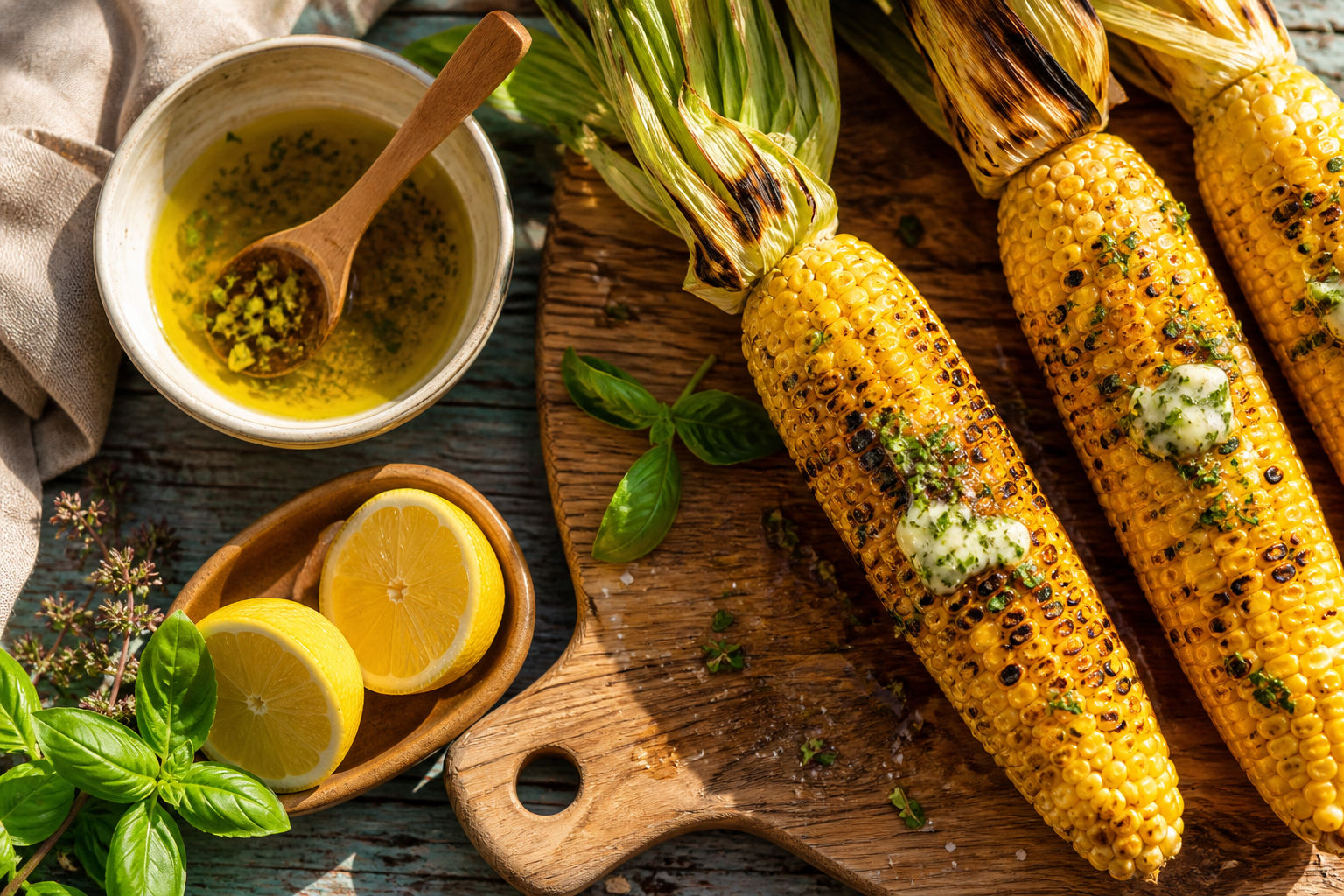
Grilled Corn With Compound Cannabutter #
- Soften regular butter and mix in a measured amount of cannabutter (example: enough for ~5 mg THC per ear).
- Add salt, smoked paprika, lime zest, and a pinch of chili.
- Grill corn as usual over high heat — no infused butter on the grate.
- As soon as corn comes off the fire, roll it in the compound butter.
- Plate with a card: "Infused — ~5 mg THC per ear."
Citrus Salad Dressing With Infused Olive Oil #
- Whisk 3 parts regular olive oil + 1 part infused olive oil (adjust to hit your mg target for the whole bowl).
- Add lemon juice, Dijon, honey, salt, and pepper.
- Toss with greens, berries, and goat cheese right before serving.
- Cold prep keeps more aroma than a long simmer. Limonene-leaning citrus notes play well here.
Simple Infused Honey or Syrup for Drinks #
- Warm honey or simple syrup on very low heat — do not boil hard.
- Stir in a small, measured amount of infused coconut oil or a cannabis tincture if you prefer measured drops (tinctures are easier to dose — see tincture vs flower vs edible).
- Cool. Use one teaspoon per drink max for low-dose parties.
- Offer THC drinks as a separate station from regular lemonade. For ready-made drinkables, our THC beverages guide covers what to look for in store products.
More easy summer finishes:
- Infused mayo for potato salad (stir cold)
- Garlic-herb compound butter on toast after the grill
- Chocolate-dipped fruit with a thin infused coconut shell
- Caprese with a light infused olive oil drizzle
| Recipe style | Heat exposure | Dose control | Guest-friendliness |
|---|---|---|---|
| Compound butter finish | Low (after cook) | High if pre-portioned | Excellent |
| Cold dressing | None | High | Excellent |
| Baked dessert tray | Medium oven | Medium (cut evenly) | Good with labels |
| Marinade on open flame | High | Poor | Avoid |
Rule of thumb: cook the food hot, dose the food cool.
Portioning Trays So Nobody Overdoes It #
Big trays of brownies are how cookouts go sideways. Pre-cut and pre-dose instead.
- Bake or assemble the dish with a known total of infused fat mixed in.
- Cut into even squares before guests arrive — do not let people carve freehand.
- Put one square per napkin or small plate for the first round.
- Hold a second labeled plate behind the kitchen counter for experienced guests who ask for more after two hours.
- Keep a notepad with the batch math taped inside a cabinet so you remember what you made.
| Tray size | Total estimated THC | Pieces | mg each (if even) |
|---|---|---|---|
| Small | 50 mg | 10 | 5 mg |
| Medium | 100 mg | 20 | 5 mg |
| Large party | 100 mg | 40 | 2.5 mg |
When in doubt, cut more pieces. Soft servings beat heroic ones.
How to Host Infused Food Without Accidents #
Label every infused dish, keep a non-infused twin on the table, and tell guests to wait two hours before taking more — because edibles poison risk is higher when food looks normal. The CDC cannabis health effects page warns that edibles carry a greater risk of poisoning than smoked cannabis, especially when packaging or presentation looks like regular snacks. Kids who eat THC products can get very sick. Lock leftovers. Call Poison Control at 1-800-222-1222 if someone — especially a child — eats an unknown amount.
Divine Toke is a Detroit sun-grown organic cannabis farm. We care about community cookouts as much as flower quality. Hosting well is part of that culture.
Host checklist:
- Write the dose on the dish — "Contains cannabis — ~5 mg THC per serving."
- Put infused food on a separate table or tray with a bright card.
- Serve non-infused twins of the same food so kids, drivers, and sober guests can eat freely.
- Announce the rules once when people arrive: onset delay, no redosing for two hours, no driving after dosing.
- Watch the kids and pets — edibles look like dessert. Use locked storage after the meal.
- No "secret" dosing. Surprising someone with THC is not hospitality — and it can be dangerous.
- Offer water, snacks, and a quiet seat if someone gets too high.
- Respect work and drug tests. Plenty of Detroit guests have early shifts or random testing. Do not pressure anyone.
| Situation | Do this |
|---|---|
| Mixed ages at the party | Separate table + locked leftovers |
| Someone feels nothing at 45 minutes | Wait — do not stack |
| Guest drove | Offer non-infused only to that person |
| Leftover brownies | Childproof container, labeled, fridge or freezer |
| Someone ate way too much | Stay calm, hydrate, quiet room; poison control / 911 if severe |
For smoke-side hosting ideas that do not involve food dosing, the 4th of July cookout strains guide keeps the vibe social without the edible delay trap.
A Simple Timing Plan for a 4-Hour Cookout #
Assume food is ready at 4:00 p.m. and people hang until dusk.
| Clock | Move |
|---|---|
| 3:30 | Set out non-infused snacks and water |
| 4:00 | Serve infused dishes with labels; announce the 2-hour rule once |
| 4:00–6:00 | No second servings of infused food — hang out, grill, play cards |
| 6:00 | Optional second round for people who still want it and feel fine |
| End of night | Lock leftovers; make sure drivers are sober or have a ride |
This schedule respects liver timing. It also stops the "I feel nothing, give me another" spiral that ruins Sundays. If someone has an early Monday shift or a job that drug-tests, steer them to the non-infused table without a speech — just make the safe option easy.
Butter vs Store-Bought Edibles: When to Cook, When to Buy #
Cook when you want flavor control and a communal kitchen project; buy when you need exact milligrams, mixed-tolerance guests, or zero guesswork. Homemade cannabutter tastes great on corn. Lab-tested gummies and drinks win for precision.
| Need | Homemade infusion | Dispensary edible |
|---|---|---|
| Exact mg per bite | Estimate only | Labeled, tested |
| Flavor with real food | Excellent | Limited to product form |
| Michigan retail serving rules | Do not apply the same way | CRA package/serving limits |
| Time and smell | Hours + kitchen odor | Open the package |
| Guest liability comfort | Higher risk if mislabeled | Clearer expectations |
| Cost per mg | Often lower | Often higher |
Michigan adults can possess and consume legal cannabis within state limits, and many people make personal edibles at home. Selling homemade infused food is a different legal world — do not run a backyard bakery. For licensed product rules and serving context, lean on the Michigan CRA materials such as the infused-product THC maximums bulletin.
Practical split for summer:
- Cook compound butter and dressings for a small, knowing group
- Buy portioned edibles or THC drinks for larger mixed crowds
- Mix both: store gummies for precise dosing, homemade oil for one labeled specialty dish
Deep dives: edible buying guide, edibles dosing guide, and THC beverages.
Common Cannabis Cooking Mistakes #
Most bad edible nights come from skipping the wait, guessing the dose, or blasting the infusion with grill heat — not from "weak weed." Fix the process and summer gatherings stay fun.
- Redosing at the 30-minute mark — Oral onset is slow. Wait at least two hours.
- No labels — Guests assume brownies are regular brownies. The CDC flags edible poisoning risk for that reason.
- Decarb too hot or too long — You lose potency and flavor. Stay near 220–245°F for ~30–40 minutes.
- Putting cannabutter on open flame — Burns fat, kills aroma, wastes THC. Finish after cooking.
- Using trim of unknown strength — Without a % THC label, your math is fiction. Use lab-tested flower.
- Making one mega-potent batch "for everyone" — Build a low-dose base. Offer a second measured boost for experienced guests only.
- Leaving leftovers unlocked — Kids and pets do not read sticky notes. Lock it up.
- Pressuring coworkers or family who have drug tests — Respect the no. Always.
| Mistake | Result | Fix |
|---|---|---|
| Stack servings early | Anxiety, nausea, ruined night | 2-hour rule |
| Unlabeled tray | Accidental dosing | Big clear card |
| Boiling the butter | Harsh taste, loss | Low simmer with water |
| Mystery flower | Wild dose swings | Use labeled, tested flower |
Clean flower matters in food the same way it matters in a joint. At Divine Toke we grow sun-grown organic flower in Michigan because what goes in your body should be simple and clean — especially when you are eating it.
How Long Does Cannabutter Keep? #
Fridge butter lasts about two weeks; freezer butter keeps for months if labeled and sealed. Smell is your friend — if it turns rancid, toss it. Water left in the jar shortens fridge life, so separate the watery layer after chilling.
| Storage | Typical window | Tip |
|---|---|---|
| Counter | Not recommended | Melts, spoils, invites mix-ups |
| Fridge | ~1–2 weeks | Opaque jar, clear label |
| Freezer | 2–6 months | Portion into ice-cube trays first |
Frozen cubes make summer dosing easy: thaw one cube, weigh or measure, and blend into plain butter for the night's batch. Never leave a mystery jar unmarked in a shared fridge — roommates and kids do not share your batch notes.
Frequently Asked Questions #
How long should I decarboxylate cannabis for cooking? #
Most home cooks use about 30–40 minutes at roughly 220–245°F (104–118°C). That kitchen range shows up across guides like Bon Appétit and Food52. Lab work such as PMC8408919 shows conversion depends on temperature and time, and that too much heat causes loss — so do not crank the oven to "make sure."
How do I calculate milligrams of THC per serving? #
Multiply grams of flower by the THC percent (as milligrams), then divide by servings — and treat it as an estimate. Example: 5 g of 20% flower ≈ 1,000 mg theoretical THC before loss. After decarb and strain losses, you might keep less. Divide what you think landed in the butter by the number of spoons or slices. For party guests, aim 2.5–5 mg to start. Details live in our edibles dosing guide.
Why do cannabis edibles feel stronger than smoking? #
Your liver converts oral THC into 11-hydroxy-THC, a psychoactive metabolite that can feel stronger and last longer. PMC8803256 explains first-pass metabolism and notes oral THC bioavailability around 4–12%, versus faster lung uptake when smoked. Less total THC may enter blood — but the ride can still feel heavier.
Can I put cannabis butter directly on the grill? #
No — add infused butter after the food leaves the heat. Open flame scorches fat, ruins flavor, and wastes cannabinoids. Grill the corn or steak first. Then finish with a measured compound butter.
What is a safe starter dose for guests at a cookout? #
Start most guests at about 2.5–5 mg THC per serving and wait two hours before offering more. Experienced friends can choose 5–10 mg. Lower-risk guidance from Health Canada and CCSA emphasizes knowing your limits and going slow — that advice fits a backyard table perfectly.
How long do homemade edibles take to kick in — and how long do they last? #
Many people feel edibles in 30–120 minutes, with effects lasting several hours. Smoking can peak in minutes (PMC8803256 notes inhaled peaks around 6–10 minutes). Food, metabolism, and dose all change the clock. Plan the party around the delay.
Is homemade cannabutter legal for personal use in Michigan? #
Adults can generally make personal cannabis edibles in Michigan under adult-use personal possession and home-processing norms — but selling them is not a backyard side hustle. Licensed retail edibles must follow Michigan CRA infused-product THC limits such as those in the August 2022 technical bulletin. Homemade food is not lab-certified. When in doubt, buy tested products.
How do I keep kids and pets away from infused food? #
Use clear labels, a separate serving table, and locked childproof storage for leftovers. The CDC warns edibles raise poisoning risk because they look like regular food. If a child eats an unknown amount, call Poison Control at 1-800-222-1222 or 911 for emergencies.
Butter, coconut oil, or olive oil — which is best for summer recipes? #
Use butter for corn and baking, coconut oil for chocolate and vegan sweets, and olive oil for dressings and post-grill finishes. All three work because cannabinoids are fat-soluble. Match the fat to the dish, not to a myth about which one is "strongest."
Do terpenes survive cooking heat? #
Some do, many do not — high heat drives off aroma compounds fast. That is why cold dressings and compound butters added after cooking taste brighter. For how terpenes shape flavor and feel, read our terpenes guide.
Should I cook with flower or just buy dispensary edibles? #
Cook for flavor and ritual; buy for exact milligrams and big mixed crowds. Store products carry tested labels under CRA rules. Homemade infusions taste great but stay estimates. Many hosts do both — see the edible buying guide.
What should I do if someone eats too much? #
Keep them calm, hydrated, and in a quiet space — and get medical help if symptoms are severe. Anxiety, racing heart, and nausea are common when people stack servings too soon. Do not leave them alone if they are distressed. For kids or extreme reactions, call poison control or emergency services as the CDC advises.
Closing Thoughts #
Safe cannabis cooking for summer gatherings comes down to five habits: decarb gently, bind to fat, dose low, label loud, and wait two hours. The grill is for heat. The infusion is for the finish. Your guests will remember the food — and they will remember whether they felt safe.
If you are curious to try clean Michigan flower for the kitchen, start with lab-tested sun-grown organic flower from Divine Toke and keep your first batch soft. Pair this guide with our edibles dosing guide, edible buying guide, and 4th of July cookout strains guide for a full summer hosting kit.
This article is for educational purposes only and is not medical advice. Always consult your healthcare provider before starting any new wellness routine. Cannabis laws vary; follow Michigan rules for adult-use possession and never drive impaired.
Grown in Detroit. Shipped to your door.
Small-batch, sun-grown cannabis cultivated in living soil. Mail-order shipping to all 50 states.