Does Flushing Cannabis Before Harvest Change the Smoke?
Does plain-water flushing before harvest make cannabis smoother or cleaner? Here is what studies, ash color, and safety tests actually show.
Questions this article answers
- Does flushing cannabis with plain water before harvest change the smoke?
- Does flushing make cannabis smoother?
- Does white ash prove cannabis was flushed?
- Can flushing remove nutrients from cannabis buds?
- How can shoppers tell if flower is safe?

Head Cultivator
On this page
You tap a joint and the ash comes out white.
Somebody at the table says that means the grower flushed it.
White ash can’t prove a plant got a plain-water finish, and Michigan shoppers deserve a better answer than a pile of ash. I’m Jamie. The research doesn’t show that flushing before harvest reliably makes flower smoother, safer, or easier on the throat. It can change plant nutrition under some conditions, and that’s a different claim.
Does Flushing Cannabis Before Harvest Change the Smoke? #
Plain-water flushing has not been shown to reliably make cannabis smoke smoother, safer, tastier, or whiter-ashing. It can change plant nutrition under some conditions, which is a narrower question than how a joint feels.
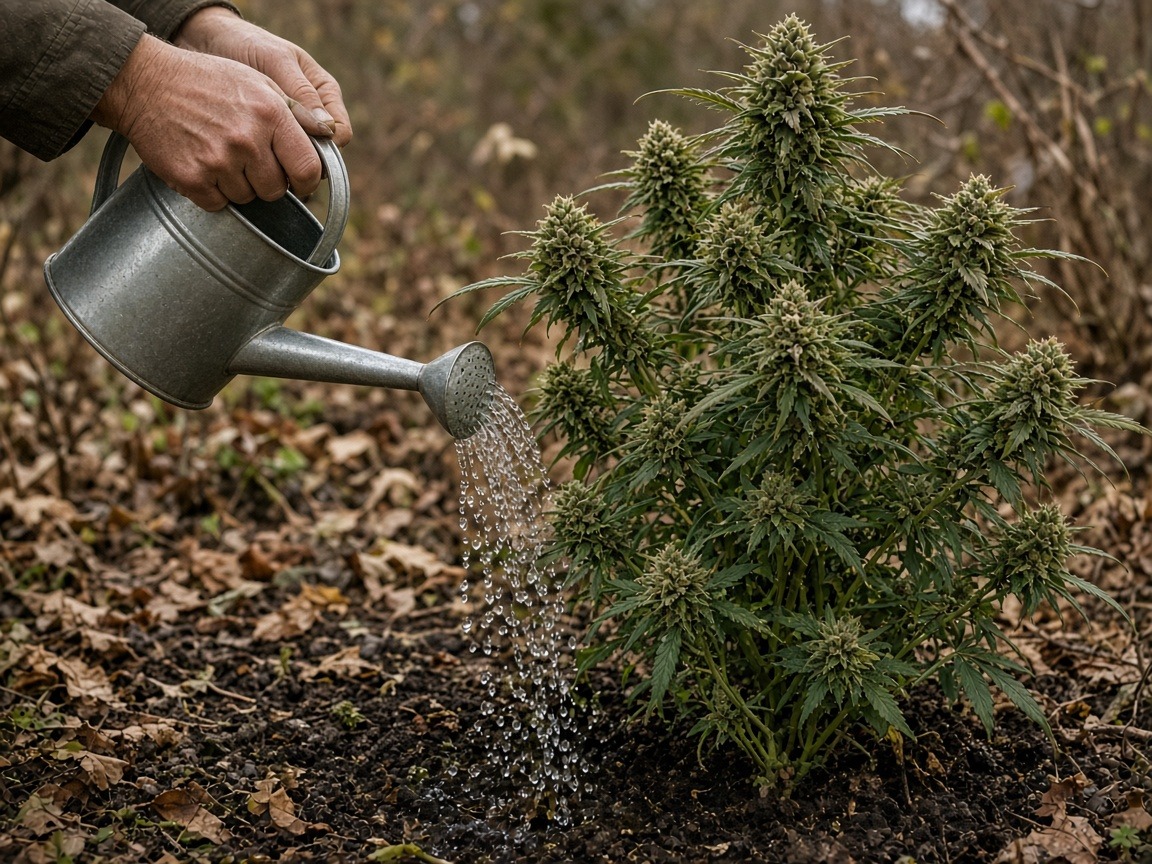
A flush is when a grower stops fertilizer near harvest and waters with plain water. The promise you hear is that the feed disappears, the smoke gets clean, and the ash turns white. The research doesn’t back all of that.
The best direct paper is a multi-cultivar cannabis experiment by Saloner, Sade, and Bernstein. It compared continued nutrition with a distilled-water finish during late flower and measured growth, nutrient uptake, cannabinoids, and terpenoids. It can’t promise the same smoke-quality result for every crop, cultivar, or grow room.
Researchers can measure minerals, THC, and terpenes in dried flower. They have far less controlled evidence for “this one felt cleaner in the throat.” The old grower belief is a lot bigger than the pile of studies.
| Claim people hear | What the evidence can support |
|---|---|
| “A flush makes every joint smoother.” | Controlled cannabis research has not established that result. |
| “A flush removes all nutrients from buds.” | Plant tissue holds nutrients and can keep receiving them from internal stores. |
| “White ash proves the job was done.” | Ash color depends on combustion and has no validated flush signature. |
| “No flush means unsafe flower.” | Safety depends on regulated testing, handling, and many other steps. |
If you shop in Detroit, “flushed” tells you something about farming. It doesn’t tell you the flower is safe. Michigan’s Cannabis Regulatory Agency testing rules require licensed labs to check microbial screening, heavy metals, chemical residues, foreign material, and water activity before a harvest batch moves through the market.
Those rules don’t ask a grower to put “flushed” on the label. Late-season rain and the trip from field to package can matter more to outdoor flower than a feeding decision nobody labels.
What Did Cannabis Flushing Studies Actually Test? #
Cannabis flushing studies test plant chemistry, weight, and tissue nutrients far more often than they test the lived experience of smoking. The strongest work compares groups under the same conditions, then measures what changed at harvest.
That setup matters because one plant can’t separate plain water from weather, genetics, harvest timing, or handling.
The 2024 paper in Industrial Crops and Products studied five medical-cannabis cultivars. The researchers tracked plant physiology, biomass, nutrient uptake, cannabinoids, and terpenoids after a late reproductive-stage water treatment. Five cultivars beats one clone, but it’s still a controlled setup.
A later HortScience controlled-environment study reported that nitrogen, phosphorus, and potassium concentrations declined as flush duration increased in its two tested cultivars. A longer fertilizer break can move the tissue-mineral numbers. That doesn’t prove any set number of days makes better smoke.
| Evidence track | What it measured | What it can answer | What it cannot answer |
|---|---|---|---|
| 2024 five-cultivar paper | Growth, nutrients, cannabinoids, terpenoids | Whether late water treatment changed measured plant outcomes | Whether every smoker prefers the result |
| 2025 controlled-environment paper | Dry mass, cannabinoid yield, mineral nutrients | Whether longer restriction changed tissue concentrations | A universal farm schedule |
| RX Green trial report | Yield, cannabinoids, terpenes, minerals, panel observations | A limited Cherry Diesel comparison | A peer-reviewed answer for all cannabis |
| Consumer ash test | Appearance after a burn | What happened in that burn | The plant’s feeding history |
The RX Green Technologies trial report is the source most often attached to flush talk online. It compared Cherry Diesel plants with 0, 7, 10, and 14 days of water-only treatment and reported no meaningful difference in mineral, THC, terpene, flavor, smoothness, or ash-color results.
It came from a nutrient company and was not peer reviewed. Count it as helpful but limited. Studies differ in growing medium, starting nutrient load, cultivar, treatment length, harvest point, and outcome. One can see lower mineral concentration after a longer break from feeding while another sees little after a shorter water-only period.
So duration, cultivar, and production system all matter. A regulated harvest batch still needs to meet the CRA’s testing-point rules before transfer or sale. Use the flush research for the farming question. Use batch testing for the safety question.
Does Plain Water Remove Nutrients Already Inside the Flower? #
Plain water can lower what reaches the roots over time, yet it cannot instantly pull nutrients back out of finished cannabis flower. A plant has roots, growing media, stems, leaves, and flower tissue holding different nutrient pools.
Think of a plant as a jobsite with materials stashed in several rooms. Turning off one delivery truck doesn’t empty the building. Nutrients can stay around the roots, cling to the medium, come from organic breakdown, or already sit inside leaves, stems, and flowers.
The plant can also shift certain nutrients from older tissue toward developing flowers. Researchers call that remobilization. Nitrogen, phosphorus, and potassium can move more easily than calcium, so a yellowing leaf can’t prove a flower has been “cleared out.”
Cannabis nutrition research in Frontiers in Plant Science shows that flower yield and chemistry respond to nutrient supply during flowering. What the plant gets all through flower matters, and the last watering is only one piece of it.
| Where a mineral can be during late flower | Why plain water does not create an instant blank slate |
|---|---|
| Irrigation lines and root zone | Residual ions can remain after fertilizer input stops. |
| Growing medium | Some nutrients stay attached to media or arrive from organic breakdown. |
| Roots and stems | The plant can draw on tissue it built earlier. |
| Leaves | Mobile nutrients can move as leaves age. |
| Inflorescences | Already formed tissue contains minerals as part of its structure. |
The five-cultivar 2024 flushing study examined nutrient uptake alongside cannabinoids and terpenoids. It treats flushing as a plant-nutrition step. Finished buds don’t get a chemical rinse.
The 2025 HortScience experiment found lower nitrogen, phosphorus, and potassium concentrations as its flush duration increased. Its cultivars and controlled conditions can’t tell a buyer what happened in every field or greenhouse.
| A lab result can tell you | A lab result cannot tell you |
|---|---|
| The concentration of elements in the submitted sample | The exact number of water-only days before harvest |
| Whether a regulated safety panel passed | Whether leaves yellowed in the final week |
| The tested batch’s cannabinoid or terpene result | The grower’s full feeding history |
| A snapshot of one lot | A universal smoke-quality score |
A single dried-flower panel has too many moving parts for flush detective work. Cultivar, maturity, sample position, medium, water, nutrient formula, and starting level all matter.
Lower tissue nutrients don’t mean pesticide residues, metals, mold, or other safety hazards went away. Plain water is no cleanup method for a contaminated harvest. The CRA technical guidance handles those categories with required methods and action limits.
Can Flushing Make Cannabis Smoke Smoother or Less Harsh? #
No controlled cannabis study has established a dependable path from plain-water flushing to smoother smoke. Harshness and flavor come from many parts of the crop’s life, so one late feeding choice cannot explain every draw.
“Smooth” is real when you’re the one smoking, and it’s hard to measure cleanly. One person means less throat irritation, another means less grassy flavor, and someone else means an even burn. Those are related, but a lab can’t measure them as one thing.
The old explanation says leftover fertilizer makes smoke harsh. The controlled evidence hasn’t shown that simple chain. The commercial RX Green trial reported no meaningful flush-duration difference in flavor or smoothness. It has limits. It’s still the closest direct test of the claim people keep repeating.
The peer-reviewed 2024 multi-cultivar study measured plant and chemical outcomes. Its design didn’t establish a universal smoke-smoothness advantage.
| What someone notices | Several plausible contributors | Can a flush claim diagnose it? |
|---|---|---|
| Scratchy smoke | Combustion heat, plant material, storage changes, individual sensitivity | No |
| Grass or hay notes | Green plant compounds, lost aroma, postharvest handling | No |
| A joint that runs | Packing, particle size, moisture distribution, airflow | No |
| A muted aroma | Age, heat, light, oxygen, handling, terpene loss | No |
| A musty smell | Moisture or microbial trouble | No |
Postharvest science is why there’s no one clean answer. A 2022 review in Molecules describes quality effects on terpene retention, cannabinoid chemistry, physical condition, and microbial control. A postharvest review in Plants treats water activity and moisture behavior as important quality and safety variables.
Some buyers see a “sun-grown” label and figure one farm move made the final taste. Wet fall air, handling, storage, package age, and the roll itself can all sit between a field choice and the smoke. Flushing may be part of a crop-management plan. It doesn’t make cannabis smoke harmless.
Smoke is combustion, and it can irritate lungs no matter how the last watering went. If smoking regularly bothers your chest or throat, take a break and talk with a clinician. A batch should smell clean, match its paperwork, and come from a licensed source.
Does White Ash Prove Cannabis Was Flushed? #
No. White or pale gray ash cannot prove a cannabis plant was flushed before harvest. Dark ash cannot prove that fertilizer stayed in the flower either.
Ash is what’s left after a burn. It doesn’t carry a farm record. Plant material starts with carbon-rich tissue and a smaller mineral fraction. During combustion, some material burns into gases, some stays as mineral residue, and some carbon can stay behind as dark char.
The RX Green Technologies report compared 0, 7, 10, and 14 days of water-only treatment. It found no meaningful ash-color pattern tied to duration. One commercial report can’t settle this forever, but it goes straight at the strongest white-ash story.
| Ash-color claim | What evidence supports |
|---|---|
| “White ash proves a flush.” | No validated evidence supports this diagnostic. |
| “Black ash proves fertilizer residue.” | No validated evidence supports this diagnostic. |
| “Ash contains minerals.” | Yes. Plant ash retains inorganic compounds after combustion. |
| “Ash appearance depends only on plant nutrients.” | No. Burn conditions matter too. |
Biomass researchers measure ash after controlled burning because temperature and oxygen change what remains. The University of California biomass-ash reference describes silicates, oxides, phosphates, carbonates, potassium, calcium, and magnesium compounds.
That’s lab ash. A joint adds paper, packing, airflow, moisture, and how you light it. Even a steady hand pulls differently from the person next to them.
| What can shift ash appearance | Why it matters |
|---|---|
| Oxygen and draw rate | More complete combustion can leave less dark char. |
| Moisture distribution | Wet spots can cool a burn and change combustion. |
| Packing and grind | Uneven airflow can create uneven burning. |
| Paper and wrap | The wrapper adds its own burn behavior. |
| Mineral composition | Plants retain minerals for many reasons beyond a final flush. |
“White ash” caught on because you can see it, and you can’t see a feeding schedule. It’s a weak answer. Ash can tell you something happened during one burn. It can’t name the final-week treatment.
State cannabis law doesn’t treat ash as a product-safety test. Licensed flower gets judged through laboratory testing and required records, and a lighter at home doesn’t count.
What Can Ash Color Tell You at All? #
Ash can hint that a particular burn ran hot, cool, complete, or uneven. It cannot grade the whole crop, verify a feeding schedule, or replace a lab result.
Very dark ash can show up when more carbon stays behind in a less complete burn. Tight airflow, uneven moisture, and dense packing can all push that way. None of it reaches back down the supply chain and names the cause.
The same flower can burn differently in a cone, a pipe, or a loose hand roll. The same joint can burn differently after a windy walk from the car. Ash belongs at the end of a short list.
| If you notice this | A reasonable next thought | A claim to avoid |
|---|---|---|
| Pale gray ash | This burn may have had enough heat and oxygen for light residue. | “The grower definitely flushed.” |
| Dark ash | This burn may have left more char or burned unevenly. | “The flower has fertilizer in it.” |
| A joint that keeps going out | Airflow, packing, or moisture may be uneven. | “The plant was badly grown.” |
| Harsh smoke | Several product and combustion factors could be involved. | “A water-only finish would have fixed it.” |
| A musty or moldy odor | Stop using it and seek batch information. | “Ash color will answer the safety question.” |
People turn ash into a pride test: white becomes “clean,” black becomes “chemicals.” Plant minerals are normal, and calcium, potassium, magnesium, phosphorus, and silica can stay in ash. The biomass-combustion literature shows composition changes with feedstock and combustion conditions.
Watch for the real red flags. Must, a chemical smell, visible mold, a package tag that doesn’t match, or missing test info should worry you more than a gray ashtray. The CRA guidance uses methods, action limits, and documented pass or fail results. Ash has none of those.
What Do Required Tests Check That Ash Cannot? #
Michigan’s required testing checks real safety categories with laboratory methods. Ash color cannot tell you whether a batch passed those checks, and it cannot tell you whether a grower flushed.
In Michigan, the Cannabis Regulatory Agency hands the lab a checklist. The lab tests the regulated harvest batch before licensed flower moves to sale. The state testing rule, R 420.305, lists required categories for marijuana products, and the agency’s technical guidance sets the testing details and action limits.
That tells you more about risk than a gray ashtray does.
| What a licensed lab can check | Why it matters | What ash cannot reveal |
|---|---|---|
| Microbial screening | Helps identify microbial hazards in the tested batch | Whether a dark ash came from microbes |
| Heavy metals | Checks listed elements against action limits | A farm’s full nutrient schedule |
| Chemical residues | Checks required safety categories | Whether plain water was used late in flower |
| Foreign material | Looks for physical contamination | A smoke-quality score |
| Water activity | Checks water available for microbial growth | The exact moisture story inside a single joint |
| Cannabinoid content | Reports the measured tested sample | The reader’s exact experience |
Water activity is the amount of water available for microbes to use. It has nothing to do with a white-ash test. The technical guidance includes water activity for harvest batches, so the state works from a measured threshold instead of guessing from a flame.
Heavy metals are another clear example. The guidance names lead, inorganic arsenic, mercury, cadmium, total chromium, and nickel for flower. Plain water near harvest doesn’t replace those tests, so when a seller says “we flush,” you should still ask about the paperwork.
The label does a different job. State labeling rules require identifiers and product information, including harvest date when it applies. R 420.504 doesn’t make a “flushed” field part of the required flower label. That gap tells you something: the state doesn’t use a preharvest water-only claim as a consumer safety standard.
| A buyer can ask for | Why it is useful |
|---|---|
| The package tag | Connects the container to the regulated batch. |
| The harvest date | Gives a real point on the product timeline. |
| The test result or batch information | Points to documented safety categories. |
| A licensed source | Keeps the purchase inside the state’s testing system. |
| A clear answer about freshness | Helps assess what the buyer is actually getting. |
At a busy counter, the jargon gets thick fast. “Flushed,” “living soil,” “organic,” and “white ash” all sound like safety claims, and they’re different kinds of statements. Living soil describes a farming approach. Flushing describes a late nutrition choice. The package tag identifies the regulated product. Testing speaks to required safety categories.
Of those, testing has the strongest paper trail. The rest can be useful context, but none of it should outweigh the record that comes with the batch.
How Should a Detroit Shopper Judge Flower Without the Flush Myth? #
Start with the legal batch record, the package details, the aroma, and the condition of the flower. Treat a flush claim as extra farm context unless it comes with a specific, supportable explanation.
Most people don’t need to grill a grower about their feeding schedule. They need a quick way to tell a real product signal from a story. The list below works at a Detroit counter, in a delivery order, or when a friend hands you a sealed jar.
- Match the package to the batch. A package tag gives you a real reference point.
- Ask for the safety record. Start with the lab-testing guide if the abbreviations look like alphabet soup.
- Check the harvest date. It tells you more than ash color about the product timeline.
- Use your nose before a slogan. Musty or off odors deserve caution.
- Look at the flower. Visible mold, odd residue, or broken-down material are stronger concerns than a gray ash.
- Ask a plain question. “What can you tell me about this batch?” can reveal more than “Was it flushed?”
| Shopping signal | What it can help you judge | What it cannot prove |
|---|---|---|
| Package tag | Whether you can connect the product to its batch | A farm’s private feeding schedule |
| Harvest date | Product timeline | How it was handled every day afterward |
| Lab record | Required safety categories and measured results | Your personal reaction |
| Aroma | Freshness and obvious off-notes | A pesticide or metals pass |
| Ash | How one smoke burned | Whether the crop was flushed |
Be careful with the word “clean.” It can mean a lot of things in cannabis marketing. When a seller says clean, look for documented testing and flower that looks and smells right for use. One late watering step can’t fix every possible risk.
If a seller says “white ash means quality,” ask for the batch record. If they say “flushed means safe,” ask the same thing. A farming phrase isn’t a safety claim by itself.
Legal flower has regulated testing for a reason. The law gives you a stronger starting point than the old lighter ritual. Farming choices still matter, though. The plant’s nutrition, season, and handling can shape what ends up in the package.
Our regenerative cannabis process guide covers the bigger farm system. That system doesn’t hand you one automatic smoke outcome. For a nearby postharvest question, wet trim versus dry trim explains why two harvest lots can look and smell different after the scissors move. That page is about when you trim. This one is about the flush claim. They meet in one spot: finished flower has several inputs, and no single visual signal tells the whole story.
One more stop sign. Don’t use flower that smells moldy, looks contaminated, or makes you feel unwell. Save the packaging when you can. That gives a retailer or regulator a way to identify the batch if something seems wrong.
Nobody knows everything about a crop from a lighter. Leave room for what you don’t know, and use the records that shrink it.
Frequently Asked Questions #
Does flushing cannabis make the smoke smoother? #
Research has not shown a dependable smoother-smoke result from flushing cannabis with plain water. The RX Green trial compared 0, 7, 10, and 14 days and reported no meaningful smoothness difference. That commercial study has limits, but it’s closer to this consumer claim than ash folklore is.
Does flushing cannabis make ash white? #
No controlled evidence shows that a plain-water finish reliably turns cannabis ash white. The same 0/7/10/14-day trial report found no useful ash-color pattern by treatment. White and gray ash can both appear under different burn conditions.
Can plain water remove nutrients from cannabis buds? #
Plain water can change nutrient supply over time, though it cannot instantly empty nutrients from formed flower tissue. A 2025 controlled-environment study found nitrogen, phosphorus, and potassium declined as its flush duration increased. Roots, media, leaves, stems, and flowers can each hold nutrients during the late flowering period.
Does flushing remove pesticides or heavy metals? #
Flushing is not a validated way to remove pesticides, heavy metals, microbes, or other safety hazards from finished flower. Michigan requires laboratory testing for heavy metals and other safety categories under R 420.305. Those tests run on specified methods and action limits. An irrigation claim has neither.
Can a lab test prove cannabis was flushed? #
A dried-flower lab result usually cannot prove the exact number of flush days. The 2024 five-cultivar flushing study shows why research needs matched treatments and multiple measurements. One commercial sample also reflects cultivar, media, maturity, nutrient history, and sampling choices.
Does Michigan require growers to flush cannabis before harvest? #
Michigan’s published cannabis rules do not require a “flushed” label field or a preharvest water-only claim. R 420.504 requires specific label information, including harvest date when it applies. The state cares that the product is identifiable and tested. It has no universal nutrient-finish rule.
What does dark or black cannabis ash mean? #
Dark ash can mean more char remained after that burn, yet it does not identify one farming mistake. The biomass ash reference describes carbon and mineral compounds remaining after combustion. Airflow, moisture, packing, paper, and burn temperature can all change the result.
Should I avoid cannabis that was not flushed? #
A no-flush label by itself is not a reason to reject a legal, tested batch. The CRA’s testing-point bulletin requires harvest-batch safety testing before transfer or sale. Use the package and batch record before a farming slogan.
Does flushing change THC or terpene levels? #
Flushing can affect measured plant chemistry in some conditions, and the direction is not universal. The peer-reviewed 2024 multi-cultivar paper measured cannabinoids and terpenoids across five medical-cannabis cultivars. A higher percentage on a label also does not automatically mean more total cannabinoid yield.
What should I check instead of ash color? #
Check the package tag, harvest information, batch testing, aroma, and visible condition before reading meaning into ash. The technical guidance includes water activity, microbial screening, and listed heavy metals. That is a stronger evidence trail than any color left in an ashtray.
Closing: What White Ash Can Show #
Flushing can change plant nutrition under some conditions. It is not a reliable promise of smoother smoke, white ash, or safer cannabis. A lighter tells you about one burn. A regulated batch record tells you much more about the product in front of you.
The plain-water finish is a real farming practice. The big claims around it outran the evidence. The strongest research asks what changed in the plant, and the answer can include nutrient concentrations, biomass, cannabinoids, and terpenoids. It can’t turn an ashtray into a lab.
You’ve got better tools than a color test. Use the package tag, the harvest information, and the state testing trail. Use your nose for obvious freshness or must. Then treat the flush claim as farm context and nothing more.
If you want more of the paperwork side, read what “lab tested” means in Michigan. If you want the wider farm-system question, read the regenerative cannabis process guide. Both pages add context, but neither one gives you a shortcut around the evidence here.
Divine Toke is a mail-order shop at divinetoke.org. The catalog includes flower, 1g pre-rolls, a 20-pack of 20 × 1g pre-rolls at $120, Honey Bananas rosin, and Sundog Bio Hash. This article doesn’t claim any flush schedule for those products.
Ask about the batch. Read the records. The ash is just ash.
Try Honey Bananas — sun-grown in Detroit
Small-batch, living-soil flower cultivated in our Detroit sun-houses. Ships to all 50 states.