Guaiol / Piney-Wood Flower on a Michigan COA
You popped a Detroit lid that smelled like a wood shop, not candy. Guaiol is the piney-wood line on a Michigan COA. Usually supporting, never a house SKU.
Questions this article answers
- what is guaiol on a Michigan cannabis COA
- what does piney-wood flower feel like
- is guaiol the same as pinene
- how do I find guaiol on a cannabis lab test
- does guaiol make you high

Head Cultivator
On this page
You cracked a lid after a Detroit shift. Next jar smelled like candy. This one smelled like the wood shop on the walk home.
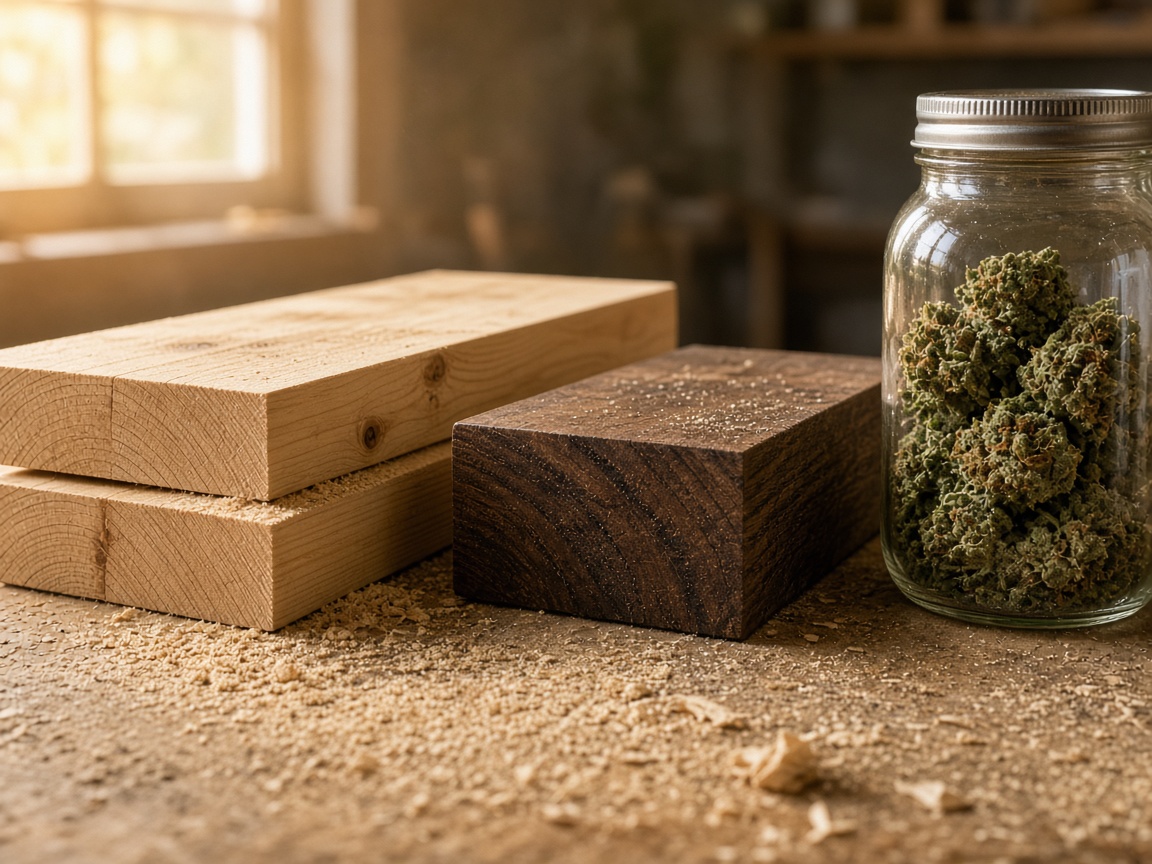
Dry pine board. Sawdust. Not lemon gummies.
That leftover wood is often guaiol on a Michigan Certificate of Analysis (COA). Think dry board, not the bright needle people chase for focus. We don't sell a house strain named for it. If you already read our what are terpenes guide, treat terpenes as spices. THC is still the meal. I'm only covering the wood-shop line here.
For percent vs mg/g, ND, and matching the Metrc tag, use reading a Michigan COA terpene panel. For buying by the table instead of a nickname, use shop by terpene panel.
I'm Jamie. I grow sun-grown flower for Divine Toke on the Detroit-area Michigan side. I'm not selling you a wood-shop high I can't source.
What Is Guaiol on a Michigan Cannabis COA? #
Guaiol is a heavier plant oil, a sesquiterpene alcohol, that can print on a cannabis terpene panel as a piney, dry-wood note. It won't get you high by itself. You'll see it next to THC, CBD, and CBN as its own named line on a good Michigan lab sheet, never as a cultivar on the lid.
A sesquiterpene is a bigger, slower-to-flash oil than light citrus or fresh pine. PubChem lists guaiol as C15H26O, CID 227829. NIST WebBook files the same molecule under CAS 489-86-1 and older names like champacol and guaiac alcohol. That extra carbon weight is why the wood can hang after candy terps blow off.
A few plain facts:
- Chemical family: Sesquiterpene alcohol. Same broad weight class as nerolidol, not the lighter C10 pine needle oils.
- Smell cue: Dry pine board, wood shop, guaiac wood. A little balsam or soft floral is possible. Not mango. Not lemon candy.
- Cannabis role: Usually Trace, Moderate, or a supporting Strong. Dominant batches are uncommon.
- Honesty check: Menus love “woody terpene” and “calming wood.” Those are shopping nicknames. They aren't a sleep pill, and one line won't run your night.
You don't need a chemistry class to use this. If a sealed Michigan jar still smells like sawdust and old pine board after the sweet top note dies, guaiol is a fair bet. Confirm the paper. Don't trust the nickname alone.
Hanuš and Hod (PMC8489319) put terpenes and terpenoids on the cannabis map as a family of plant oils, not as one spice. Guaiol is one named member of that family, not the whole jar.
Guaiol vs the word next to it on a sloppy menu #
Guaiol is not guaiacol. The names sit close on a phone screen. The molecules don't.
PubChem lists guaiacol as C7H8O2, CID 460. That's a small phenol. People meet it in smoke and some flavor talk. It isn't the wood-shop terpene on a Michigan flower COA.
If a Detroit menu or a Discord screenshot says “guaiacol terp,” ask for the PDF. Search guaiol. If the lab printed guaiacol, that's a different chemical class. Don't shop a typo.
| Word on the page | What it is | Shop move |
|---|---|---|
| Guaiol | C15 wood-shop terpene alcohol | Rank the line. Smell for dry board. |
| Guaiacol | C7 phenol, not this terpene | Don't treat it as the same oil. |
| α-Pinene / pinene | C10 bright pine needle | Different spoke. See pinene-forward flower. |
| Nerolidol | C15 woody floral / tea tree | Different spoke. See nerolidol. |
What Does Piney-Wood Flower Feel Like? #
Piney-wood flower usually feels like a familiar wood-shop nose with an ordinary THC high, not a separate “guaiol high.” The leftover smell is the part you can name. The body ride still belongs to dose, sleep, and the louder oils next to it.
People who like this jar more than candy terps tend to report the same three things. None of that's a clinic result:
- The room smells like a shop, not a candy aisle. After the first two pulls, the sweet is gone and the board is left.
- The night doesn't announce itself as “wood.” You still feel like you smoked cannabis. You don't feel like you swallowed furniture oil.
- The head can stay ordinary. This oil isn't a proven focus terp, and it isn't a proven knockout. If the night went racy or heavy, look at THC, myrcene, pinene, and how little you ate.
What piney-wood isn't:
| You hoped | Honest answer |
|---|---|
| A unique body buzz only this terp makes | No human trial isolates that. |
| Couch lock from “wood” | Wood on the nose isn't sedative proof. |
| Clear-headed pine | That hope sits with pinene, and even that hope is hedged. |
| Candy fruit with a wood nickname | You wanted a different jar. |
If you work a trades night in metro Detroit, you already know the smell. You walked past a shop. You can tell board from solvent. If the jar smells like the shop, write that. If it smells like a gas station air freshener, you've left this spoke.
The wood lives in the nose. The high is still the stack.
Why Does Guaiol Smell Like a Wood Shop, Not a Pine Needle? #
Guaiol smells like dry wood and pine board because it is a heavier oil that hangs as a base note, not a sharp needle flash. Your nose is reading weight and warmth, not a forest poster.
Walk a Great Lakes pine stand after rain. That bright, clean needle smell is closer to pinene. Walk a metro Detroit wood shop. Dry pine board. Sawdust on the floor. A little varnish memory. That leftover wood is closer to guaiol. Same state. Two different oils. Our terpenes-beyond-cannabis guide uses Michigan pine as a teaching smell for pinene. I'm staying on the board, not the living tree.
NIST also files older names like guaiac alcohol and champacol. Perfume and wood-oil people have used that dry, balsamic wood for a long time. That's a smell cousin. It doesn't mean your jar is furniture oil, and Divine Toke doesn't distill guaiac wood.
How to use your nose:
- Crack the lid. Wait ten seconds. Candy and lemon flash first. Wood shows up after.
- Name the leftover. Board, sawdust, tea tree, mango, or soap. One word.
- Don't crown the leftover. A wood nose without a panel is a hint. Confirm the named line on the paper.
- Mind Michigan humidity. A hot car and a wet September week both flatten top notes. The board smell can look louder when citrus is already gone. That's storage talking, not a new cultivar.
If the leftover is wet bark and tea tree, you drifted into nerolidol. If the first hit is bright Christmas-tree pine and a clear head is what you came for, go back to pinene-forward flower. Stay here if the jar smells like the shop, not the stand.
Leftover-smell cheat sheet for a Michigan lid:
| Leftover after ten seconds | Fair first guess | Next move |
|---|---|---|
| Dry pine board, sawdust | Guaiol | Search guaiol on the matching COA |
| Bright needle, turpentine | Pinene | Leave this page |
| Wet bark, tea tree | Nerolidol | Leave this page |
| Mango, earth | Myrcene | Different encyclopedia |
| Lemon candy, peel | Limonene | Different encyclopedia |
| Flat hay, no wood | Dead terps or a bad cure | Don't invent a wood line |
September in Michigan can fool you. Great Lakes humidity and a sealed bag in a hot car both knock the light oils down first. A jar can smell “more wood” on Sunday than it did on Friday because the candy flashed off, not because guaiol grew in the bag. Write the date you opened it. Compare lots, not moods.
How Is Guaiol Different From Pinene, Nerolidol, and Guaiacol? #
Guaiol is a C15 wood-shop alcohol. Pinene is a C10 needle hydrocarbon. Nerolidol is a C15 woody floral alcohol. Guaiacol is a different chemical class entirely. Same “wood” or “pine” word on a menu doesn't make them one spice.
PubChem's guaiol record is the identity lock for this page. Hanuš and Hod (PMC8489319) treat cannabis terpenes as a list of separate oils, not a mood sticker. Shop them that way.
| Oil | Carbon class | Everyday smell | What people hope it does | Typical COA rank |
|---|---|---|---|---|
| Guaiol | C15 alcohol | Dry pine board, wood shop | “Woody calm” on menus. Papers are preclinical. | Trace to supporting |
| α-Pinene | C10 hydrocarbon | Fresh pine needle | Focus / memory talk. Different spoke. | Often louder than guaiol when present |
| Nerolidol | C15 alcohol | Bark, tea tree, soft floral | “Slow the ride” talk. Different spoke. | Trace to supporting |
| Guaiacol | C7 phenol | Smoke / medicinal phenol | Not a cannabis terpene line | Shouldn't be shopped as guaiol |
Practical split for a Michigan counter:
- Needle first, then fade: think pinene. Ask for α-pinene or pinene on the panel.
- Board after the sweet dies: think guaiol. Search the exact spelling.
- Bark and tea tree: think nerolidol. Leave this page.
- Someone typed guaiacol: ask for the PDF. Don't smoke a typo.
Don't stack these into one “forest terp.” A Great Lakes weekend can smell like all of them in different rooms. The jar still has one table. Read the table.
What Does Research Actually Say Guaiol Does? #
Early lab papers show isolated (−)-guaiol can change cells in a dish. There is no good human cannabis trial that says this line will calm you, put you to sleep, or treat a disease. THC still writes the high. Dose, sleep, and the rest of the panel still run the night.
Russo and Marcu, 2017 (PMID 28826544) treat cannabis pharmacology as a stack: cannabinoids plus other plant oils plus you. They don't hand you a guaiol dose.
What the papers actually measured:
- Zeng et al., 2022 (PMC9336205) used network mapping, docking, and lab assays on (−)-guaiol and lung adenocarcinoma cells. Title on the record: they were investigating a mechanism in a model. They weren't writing a Detroit treatment.
- 2023 Molecular and Cellular Biochemistry (PMC10209243) reported that (−)-guaiol triggered immunogenic cell death and slowed tumor growth in non-small cell lung cancer models. Again, cells and animal-style tumor work, not a joint and not a Michigan label claim.
- Sedation / “chill wood”: I didn't find a human trial that isolates guaiol as a sleep drug. Menu copy that says it will tuck you in is advertising.
How to hold the papers:
| Claim you will hear | Honest grade | What to do at the counter |
|---|---|---|
| “Anti-inflammatory terpene” | Preclinical / in vitro at best | Smell and rank. Don't drop a pill. |
| “Antimicrobial terpene” | Lab-dish story | Don't treat a jar like soap. |
| “Fights cancer” | Cell and model papers only | Don't shop flower as oncology. |
| “Calming / sedating” | Marketing nickname | Journal the night. Don't buy a promise. |
| “Gets you high” | False | THC does that. This oil doesn't. |
Plant-as-medicine talk is fine as education. A specific SKU as a protocol isn't. If you take other medicines, talk to a clinician who knows cannabis. I'm not telling you to change a prescription.
Divine Toke is a Detroit-area Michigan sun-grown organic cannabis brand. A supporting wood line isn't a clinic result, and we don't dress it up as one.
Method still changes the night more than this one oil:
- Flower or a 1g pre-roll: you get the nose. That's why you shop wood in the first place.
- A 20-pack: same gram size, more nights to compare lots. You're not getting a stronger guaiol dose.
- Edibles: the liver makes a different THC chemical. The wood-shop smell is gone. Don't test this terp on a brownie night and call it data.
Papers on isolated (−)-guaiol are not a Michigan jar study. The jar is a mix. Write the leftover smell anyway.
How Much Guaiol Shows Up on a Typical Flower Panel? #
Guaiol is usually a supporting or trace line, not the loudest spice on the sheet. Dominant lots happen. They aren't the everyday Michigan print. Treat every number as this lot, this lab, this week.
Chacon, Raup-Konsavage, and colleagues (PMC9775512) reviewed secondary cannabis terpenes and compiled published ranges in mg/g. In that Table 1, guaiol showed up across chemotypes in a low band: chemotype I listed as trace to 1.09 mg/g, chemotype II about 0.27 to 0.87 mg/g, chemotype III about 0.010 to 1.21 mg/g. Those are mixed-study ranges, not a Divine Toke COA, and not a promise your Detroit jar will land there.
Translate that into shop language:
- 1 mg/g is about 0.1% by weight. A supporting line can still be real at a fraction of that.
- Trace / ND means the lab didn't print a usable number. Missing isn't a fail.
- Rank beats a lonely percent. Dominant myrcene with a whisper of guaiol is still a myrcene night.
| Rank word | What it usually means on a flower panel | What it does not mean |
|---|---|---|
| Missing / ND | Not on this lab’s list, or under the floor | The jar “failed” wood |
| Trace | You can see the name. It's quiet | A wood-shop guarantee |
| Moderate / supporting | Loud enough to notice next to neighbors | It will run the high |
| Strong / Dominant | Rare for this oil | A house “guaiol cultivar” |
Don't chase a “high guaiol strain” list from a blog. Strain names drift. Michigan lots change. Shop the batch in your hand. There's no honest cutoff, so don't invent one.
How Do You Find Guaiol on a Michigan CRA COA? #
Match the Metrc package tag to the PDF, open the terpene table, and search the exact word guaiol. Then rank it against the other named oils. If there's no terpene table, you can't shop this line by number. Michigan doesn't owe you that page.
The Michigan Cannabis Regulatory Agency (CRA) Scientific Section oversees the licensed safety compliance labs that issue COAs in this state. Those labs must run the safety panel. They may add aroma chemistry. They don't have to.
Mich. Admin. Code R. 420.305 lists required safety tests: potency, foreign matter, microbial screening, chemical residue, heavy metals, residual solvents on the infused and edible batches the rule names, water activity, and mycotoxin screening. Guaiol isn't on that list. Terpenes as a class aren't on that list.
What the sealed Michigan pack will not tell you #
The sticker on a sealed adult-use pack is a potency-and-warning label, not a terpene menu. Mich. Admin. Code R. 420.504 is the must-list: producer and packager, statewide monitoring package tag, harvest date if it applies, strain name if it applies, net weight, THC and CBD with a statement that the real value may vary by 10%, activation time, lab name and test date, the universal symbol, and the required warnings. Terpene names aren't on that list.
So a Detroit budtender can hand you a legal jar with no guaiol printed on the bag. That's the rule doing its job, not a farm hiding the wood.
How to ask at the counter:
- Show the tag. Last six characters is enough if the full string is ugly.
- Ask for the COA that matches that tag. A “similar strain” PDF is a different lot.
- Find the terpene block. Names plus % or mg/g.
- Search guaiol. Not guaiacol. Not “wood terps.”
- Write the rank. Dominant / Strong / Moderate / Trace / missing. Leave the lonely percent in the PDF.
If the shop won't pull the file, walk. The CRA consumer hub is the agency, not a brand page. Ask for the paper.
Units recap, then stop:
| You see | Treat it as | Don't do this |
|---|---|---|
| 0.08% guaiol | A quiet supporting line (about 0.8 mg/g) | Call it dominant |
| 0.8 mg/g guaiol | Same neighborhood as 0.08% | Invent a “strong” cutoff |
| ND or blank | No usable number | Assume the jar has none, or assume it is hiding |
| Total terpenes only | A pile, not this spice | Shop the pile as wood |
For the longer reading lesson (mg/g vs %, matching dates, what ND means), stay on reading a Michigan COA terpene panel. This spoke only teaches you to find one name.
Here's a fake table so you can see the ranks. Not a Divine Toke lot. Not a real Metrc tag:
| Line on a generic terpene table | Amount | Rank word you write |
|---|---|---|
| β-Myrcene | 4.2 mg/g | Dominant |
| Limonene | 2.1 mg/g | Strong |
| β-Caryophyllene | 1.4 mg/g | Strong |
| α-Pinene | 0.6 mg/g | Moderate |
| Guaiol | 0.4 mg/g | Moderate / supporting |
| Nerolidol | ND | Missing |
How to read that row:
- The night is still a myrcene-and-citrus jar if those two are loud.
- Guaiol at 0.4 mg/g is real and supporting. It can explain leftover board after the lemon dies.
- It can't outvote 4.2 mg/g myrcene if the body went heavy.
- ND nerolidol means you don't get to borrow the slow-ride story from the other spoke.
If your Detroit shop only shows a top-three sticker and guaiol is fourth, ask for the full PDF. A top-three card is a highlight reel. You still need the table.
Who Is Piney-Wood Flower For, and Who Should Skip It? #
Piney-wood flower is for the shopper who already likes a wood shop and dry pine more than candy terps, and who will read a supporting line without turning it into a medical plan. Skip it if you're hunting a knockout or you only chase 30% THC.
Good fit:
- You crack a lid and want board and sawdust, not lemon gummies.
- You work with your hands in metro Detroit and that smell already means “done for the day,” not “party.”
- You'll write the lot tag and the rank. You won't invent a house SKU.
- You can hold two facts: the wood can shape the nose, and THC still writes the high.
Skip or slow down:
- You wanted bright needle pine and a clear head. That's pinene, and even that page hedges the focus story.
- You wanted wet bark and a slower ride. That's nerolidol.
- You wanted mango-sleep. You left this encyclopedia.
- You wanted a cancer headline from a cell paper. Stop. Talk to your clinician.
Menu lines you can ignore:
- “Guaiol strain.” We don't sell one. Other menus that print the word are still guessing unless the PDF matches the tag.
- “Wood means indica.” Stickers leak. Chemistry doesn't owe the sticker.
- “This percent will calm you.” Rank and the rest of the panel matter more than a lonely number.
- “Guaiacol terps.” Typo or a different molecule. Ask for guaiol.
If a Detroit menu reads like a clinic, treat it as ads, then ask for the PDF. R. 420.507 is the Michigan rule behind dressing a product up as a treatment.
How to ask a Detroit budtender without a speech #
Ask for the matching COA and the word guaiol. Then stop talking. You don't need a lecture. They don't need your life story.
A script that works on a Friday:
- “Can I see the COA for this tag?”
- “Does this panel list guaiol?”
- “What is loud next to it?”
- “I’ll take flower or a 1g if the leftover smell is wood, not candy.”
If they start naming house terp stories, smile and keep your eyes on the PDF. If they have no PDF, you're shopping a nickname. Shop by terpene panel is the longer buying lesson. You just need the spelling.
Allowed names on this site, if you need a jar to start from, stay Blueberry Mojito, Honey Bananas, and L.A. Sunshine. Even those aren't “guaiol cultivars.” Read the COA that matches the tag. Shop sun-grown flower or 1g pre-rolls lot by lot. A 20-pack is 20 × 1g at $120.
How Do You Test One Wood-Shop Night? #
You test one night by writing four facts: the lot tag, the guaiol rank, the loud neighbors, and whether the nose stayed wood-shop or flipped to candy. Write it like a grocery list. Leave the clinic language at the shop.
Keep it ugly and short. Phone notes are fine.
- Lot. Metrc tag or the last six characters. If you can't write a tag, you can't compare two Fridays.
- Rank. Dominant / Strong / Moderate / Trace / missing. No invented percent.
- Neighbors. What else was loud? Pinene, myrcene, limonene, nerolidol, nothing listed.
- The nose and the ride. Board, needle, candy, or “same as always.” Then one word for the body: heavy, clear, racy, or ordinary.
- Dose and clock. How much, what time, smoked or eaten. Edibles are a different chemical. Don't mix those nights in one line.
Example rows. Generic. Not Divine Toke lots. Not real COA numbers:
| Night | Tag (fake) | Guaiol rank | Loud neighbor | Nose / ride |
|---|---|---|---|---|
| Fri after shift | 1A4… | Moderate | Limonene Strong | Board after the sweet; ordinary body |
| Sat porch | 1A4… | Trace | Pinene Strong | Needle first; clearer head |
| Sun afternoon | no panel | missing | Nose said sawdust | Could not tell |
If Friday and Saturday share a tag, you learned your dose, not a new terpene. If the rank changes and the leftover smell changes, you've got a hint. Two nights isn't a trial. Ten nights with the same method is how you actually learn a panel in Detroit.
Don't turn this into a sleep log. If the note says “knocked out,” you left this spoke. Come back when you wanted the shop smell, not a blackout.
Frequently Asked Questions About Guaiol #
What is guaiol on a Michigan cannabis COA? #
Guaiol is a piney-wood sesquiterpene alcohol that may print as a named line on a terpene panel. PubChem CID 227829 is C15H26O. It isn't THC, and it isn't a strain name. On most Michigan sheets it's supporting or quiet, not the loudest spice.
What does piney-wood flower feel like? #
It often smells like dry pine board and a wood shop after candy terps fade. The high is still mostly THC, dose, and the rest of the panel. There's no honest human trial that isolates this oil as a “feel.” Journal the leftover nose. Don't buy a mood sticker.
Is guaiol the same as pinene? #
No. Pinene is a lighter C10 pine-needle oil. Guaiol is a heavier C15 wood-shop alcohol. Bright Great Lakes needle smell is the pinene cousin. Dry board in a Detroit shop is the guaiol cousin. Use pinene-forward flower if you wanted the needle and the focus talk.
Is guaiol the same as guaiacol? #
No. Guaiacol is a small phenol, C7H8O2, PubChem CID 460. People mix the words on phones. A Michigan flower COA that you can shop for wood should say guaiol. Ask for the PDF if the menu typed the other word.
Does guaiol get you high? #
No. Guaiol isn't intoxicating the way THC is. Russo and Marcu, 2017 (PMID 28826544) still put cannabinoids at the center of the high. This oil, if you can feel it at all, is a supporting spice. THC is still the engine.
Does guaiol make you sleepy or calm? #
No good human cannabis trial proves guaiol by itself puts you to sleep or takes your edge off. Cell papers on (−)-guaiol, including Zeng 2022 (PMC9336205) and PMC10209243, are disease-model work. They aren't a night plan. If a menu says “calming wood,” treat it as ads.
Does Michigan require terpene testing? #
No. For ordinary adult-use flower, terpene testing is allowed, not required. R. 420.305 names the safety tests. R. 420.504 names the sealed-pack must-list. Terpene names are on neither. The CRA Scientific Section still oversees the labs. Ask for the extra page.
How do I find guaiol on a Michigan lab sheet? #
Match the Metrc tag, open the terpene table, and search guaiol. Then write the rank. Use reading a Michigan COA terpene panel if the units confuse you. No table means you can't shop this oil by number.
Why is guaiol missing from some COAs? #
Either the lab didn't run terpenes, the amount sat under the reporting floor, or this lot isn't a wood-shop supporting batch. Missing isn't a fail. It's a missing spice list. Michigan never required that list on the bag.
How much guaiol is a lot? #
There's no honest consumer cutoff. PMC9775512 compiled published flower ranges in mg/g that sit in a low supporting band, often listed as trace up to about 1 mg/g depending on chemotype. That's mixed-study paper, not your jar. Rank the line. Don't invent a “high guaiol” number.
Can I buy a Divine Toke guaiol strain? #
No. We don't sell a house SKU named for this terpene, and I'm not inventing one. Shop sun-grown flower or 1g pre-rolls lot by lot. A 20-pack is 20 × 1g at $120. Allowed strain names on this site stay Blueberry Mojito, Honey Bananas, and L.A. Sunshine, and even those aren't “guaiol cultivars.” Read the COA that matches the tag.
Does a walk in Great Lakes pine mean the jar has guaiol? #
No. A living pine stand is a pinene teaching smell, not a guaiol test. The dry board in a wood shop is the better smell cousin for this page. Confirm the named line on the COA. Trees don't print Metrc tags.
Closing Thoughts #
You wanted wood-shop and pine, not candy. Guaiol is the piney-wood name for that leftover board-and-sawdust note. Usually a supporting line on a Michigan COA. Not a sleep pill. Not a house cultivar.
If you want to try sun-grown organic flower or 1g pre-rolls chosen for aroma and terpene character instead of a giant THC number, start at the shop. A 20-pack, when you want one, is 20 × 1g at $120. Pair this spoke with our what are terpenes guide, reading a Michigan COA terpene panel, and shop by terpene panel at a Michigan dispensary. For the bright needle, see pinene-forward flower. For shared smells in hops, citrus, and pine, see terpenes beyond cannabis. For bark and tea tree instead of dry board, see nerolidol.
This article is for educational purposes only and is not medical advice. Always consult your healthcare provider before starting any new wellness routine.
Try Blueberry Mojito — sun-grown in Detroit
Small-batch, living-soil flower cultivated in our Detroit sun-houses. Ships to all 50 states.