Juneteenth and Cannabis Justice: The War on Drugs' Unfinished Business

Jamie
Head Cultivator
Juneteenth celebrates freedom that arrived late — and for many Black Michiganders, cannabis justice is still late too. Legal weed did not erase decades of arrests, prison time, and locked-out business ownership. This post lays out what the data says, what has changed, and what is still unfinished.
As of June 2026, 24 states plus D.C. have legal adult-use cannabis, per MPP's legalization tracker. Michigan has been among them since 2018. The question this Juneteenth is not whether the plant is legal — it is whether the people hurt most by making it illegal get a fair shot now that it is not.
What Is Juneteenth — and Why Does It Connect to Cannabis Justice? #
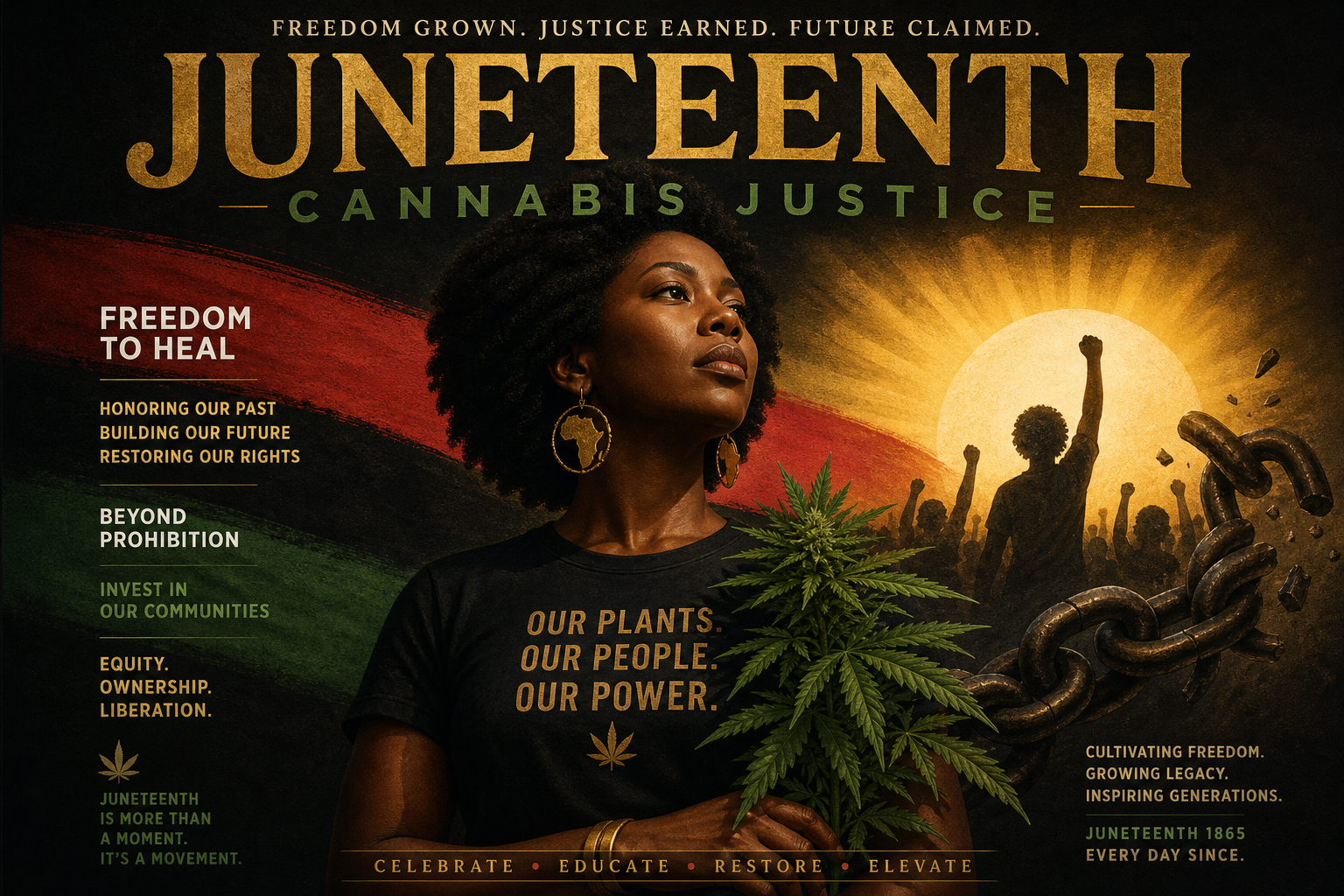
Juneteenth marks June 19, 1865 — the day enslaved people in Texas finally learned they were free, more than two years after the Emancipation Proclamation. It became a federal holiday in 2021. For cannabis justice, the parallel is hard to miss: freedom on paper arrived long before freedom in practice — and many Black Americans are still waiting on the second half of that story when it comes to weed.
The National Park Service explains that on June 19, 1865, Major General Gordon Granger arrived in Galveston, Texas, and issued General Order No. 3. That order enforced the Emancipation Proclamation for more than 250,000 people still held in bondage. President Joe Biden signed the Juneteenth National Independence Day Act on June 17, 2021, making it the first new federal holiday since Martin Luther King Jr. Day in 1983.
| Juneteenth Fact | Detail |
|---|---|
| Official name | Juneteenth National Independence Day |
| Date | June 19 every year |
| What it marks | End of slavery in Texas — and by extension, the U.S. |
| Federal holiday since | 2021 |
| Name origin | Blend of "June" and "nineteenth" |
The Smithsonian National Museum of African American History and Culture notes that celebrations started in Texas in 1866 and spread across the country over generations. Activist Opal Lee — often called the "Grandmother of Juneteenth" — spent years pushing for federal recognition.
So what does this have to do with cannabis? Juneteenth is about delayed freedom. Cannabis legalization in Michigan and 23 other states created a legal market worth billions. But the people who bore the heaviest cost of prohibition — disproportionately Black communities — still face arrest gaps, criminal records, and near-total exclusion from ownership. Legal weed without repair is another kind of delayed justice.
That is not a partisan take. It is what the arrest data, expungement counts, and ownership numbers show. The sections below walk through each piece.
How Did the War on Drugs Target Cannabis — and Black Communities? #
The War on Drugs was never just about stopping drug use — it was built to disrupt Black political power and the antiwar movement by criminalizing the substances each group was associated with. President Richard Nixon declared the War on Drugs in 1971. Cannabis enforcement became one of its sharpest tools.
The NAACP Legal Defense Fund documents how Nixon aide John Ehrlichman later confirmed the strategy: associate heroin with Black communities and marijuana with antiwar "hippies," then arrest and disrupt both groups. Ehrlichman's quote has been widely reported in policy analysis, including by the Vera Institute of Justice.
Nixon, Ehrlichman, and the 1971 Declaration #
Nixon's 1971 declaration launched a federal campaign that would send millions of Americans — disproportionately Black and Latinx — through the criminal justice system. The Brookings Institution notes that the War on Drugs fueled mass incarceration over five decades. Cannabis was a primary target even though usage rates between Black and white Americans have long been similar.
Key timeline:
- Early 1900s — State laws targeted Mexican immigrants and cannabis smoking, framing the plant as dangerous
- 1937 — The Marihuana Tax Act effectively banned cannabis at the federal level
- 1970 — The Controlled Substances Act placed cannabis in Schedule I (same category as heroin)
- 1971 — Nixon declared the War on Drugs
- 1980s–1990s — Mandatory minimums and "three strikes" laws piled on top
From the Marihuana Tax Act to Schedule I #
Cannabis prohibition started decades before Nixon — but Nixon turned it into a weapon of mass punishment. The NAACP LDF traces early marijuana laws to xenophobia against Mexican immigrants who introduced cannabis smoking to the U.S. The 1937 Marihuana Tax Act made possession and sale effectively illegal nationwide.
When Nixon signed the Controlled Substances Act in 1970, cannabis landed in Schedule I — defined as having "no currently accepted medical use" and "high potential for abuse." That classification justified decades of raids, arrests, and prison sentences. Federal rescheduling to Schedule III has been ordered for FDA-approved medical marijuana products, but recreational cannabis remains federally illegal as of mid-2026.
| Era | Policy | Impact on Black Communities |
|---|---|---|
| 1937 | Marihuana Tax Act | Federal ban; enforcement targeted Mexican-American communities |
| 1970 | Controlled Substances Act | Cannabis classified Schedule I |
| 1971 | War on Drugs declared | Mass arrests, mandatory minimums, militarized policing |
| 1980s–90s | "Tough on crime" era | Prison populations exploded; Black men incarcerated at rates far exceeding white men |
| 2010s–2020s | State legalization wave | Arrests dropped in legal states — but racial gaps persisted |
The National Association of Criminal Defense Lawyers summarizes the result: Black and Latinx people carry a disproportionate share of drug arrests, convictions, and collateral consequences — lost jobs, housing denials, and stripped voting rights in some states — even when usage rates are comparable.
Are Black People Still Arrested More for Marijuana After Legalization? #
Yes — in every state the ACLU studied, Black people were still arrested at higher rates for marijuana even after legalization reduced overall arrest numbers. Legal weed cut total arrests. It did not close the racial gap.
The ACLU's "A Tale of Two Countries" report found that from 2010 to 2018, Black people were 3.64 times more likely than white people to be arrested for marijuana possession — despite similar usage rates. Law enforcement made 6.1 million marijuana-related arrests during that period, and the vast majority were for simple possession.
What the ACLU Data Shows (2010–2018) #
The national ratio is 3.64x — but in some states, the gap is far worse. The ACLU report PDF breaks down state-level extremes:
| State | Black-to-White Arrest Ratio (Marijuana) |
|---|---|
| Montana | 9.62x |
| Kentucky | 9.36x |
| Illinois | 7.51x |
| National average | 3.64x |
| Minnesota | 5.4x (down from 7.8x in 2010) |
| Georgia | 3.0x |
Other findings from the ACLU:
- Racial disparities exist in every state studied
- Disparities appear in over 96% of counties examined
- In states that legalized marijuana, total arrest rates fell — but racial gaps did not disappear
- Disparities persist whether possession is legal, decriminalized, or still criminal
Important note on data freshness: As of mid-2026, the ACLU's most comprehensive national report still covers 2010–2018. No newer national ACLU benchmark has replaced it in public reporting. State-level data may vary, but the 3.64x national ratio remains the best-documented figure for talking about this issue responsibly.
What Happens in Legal States Like Michigan #
Michigan legalized adult-use cannabis in 2018, and arrest numbers dropped — but communities that were over-policed during prohibition still carry the heaviest records. The ACLU has tracked marijuana enforcement nationally since its landmark 2013 report. Michigan's adult-use market launched in December 2019 under the Michigan Cannabis Regulatory Agency.
What changed after legalization:
- Fewer total possession arrests in Michigan and other legal states
- Existing criminal records from pre-legalization arrests still show up on background checks
- Disproportionately impacted communities — defined by the CRA as areas with higher marijuana conviction rates and poverty — still qualify for social equity support because the harm did not vanish when sales went legal
If you know someone who caught a charge for the same plant now sold at dispensaries, you are not imagining the injustice. The data backs up what Detroit neighborhoods have lived through for decades.
Public arrest data tools: The ACLU's Marijuana Arrest Report interactive map lets you look up county-level arrest rates and racial disparities. Plug in Wayne County and compare it to statewide numbers. The picture is rarely flattering — but it is always worth seeing for yourself rather than guessing.
Who Is Still in Prison for Cannabis Convictions? #
Hundreds of people still serve federal prison time for marijuana convictions — even as new federal prosecutions hit record lows. State-level numbers add thousands more, though exact counts vary by state and offense type.
According to Marijuana Moment's analysis of 2025 federal sentencing data, federal cannabis trafficking cases dropped to just 383 in 2025 — a 62% decline from 2021. Only 400 people received federal sentences for marijuana in 2025, down from 5,554 in 2015.
But "record lows" for new cases does not mean empty prisons:
| Metric | 2025 Federal Data |
|---|---|
| New federal marijuana sentences | 400 |
| Federal trafficking cases filed | 383 |
| Average federal sentence length | 44 months (up from 36 months in 2024) |
| 2015 comparison (sentences) | 5,554 |
A 2023 U.S. Sentencing Commission report cited by Marijuana Moment noted that hundreds of individuals received serious federal prison sentences in prior years for possession convictions in states that have since reformed their laws.
Federal vs. state: Most cannabis prisoners serve state sentences, not federal ones. MPP's federal policy page notes that possessing or selling marijuana remains a federal crime. Federal enforcement has largely avoided state-licensed businesses since 2013 guidance, but individuals with older convictions still carry the weight.
Veterans and cannabis: Many veterans carry both service-related trauma and cannabis convictions from eras when VA policy and state law did not align. Our post on veterans and cannabis beyond the VA system covers how federal status still affects people who served — another layer of unfinished business.
What about commutation? A coalition of Democratic lawmakers has pushed for sentence commutations for people still serving federal time for marijuana, per Marijuana Moment's 2025 reporting. Outcomes under the current administration remain uncertain as of June 2026.
The bottom line: legalization stopped most new prosecutions. It did not automatically free people already serving time.
How Many Cannabis Records Have Been Expunged — and How Many Haven't? #
State courts have expunged or sealed more than 2.3 million marijuana-related cases since 2018 — but there is no nationwide automatic clearing, and millions of eligible records remain stuck in backlog. Expungement means hiding or removing a conviction from public view so it stops blocking jobs, housing, and licenses.
NORL's updated expungement report tracks over 2.3 million marijuana-related cases acted on by state courts since 2018. A 2025 PMC review (PMC12502637) confirms that expungement programs exist in 36 of 39 states (plus D.C.) that legalized or decriminalized cannabis. Four states still prohibit expungement of existing convictions, per the Marijuana Policy Project.
State-by-State Progress #
Progress is real but uneven — some states cleared tens of thousands while others barely started. Here is a snapshot:
| State | Records Cleared or In Process | Notes |
|---|---|---|
| Nationwide (total) | 2.3+ million cases | State courts since 2018 |
| Minnesota | 57,000 expunged; 110,000 under review | Automatic process began June 2025 |
| Illinois | 2.2 million eligible; ~10% petitioned | Full automatic sealing for 1.7M adults starts 2029 |
| Delaware | 159,000+ drug records cleared | Mostly cannabis under 2021 Clean Slate law |
| Connecticut | 43,000 sealed | Automatic erasures for 2000–2015 possession |
| New Mexico | 14,000+ expunged | Tens of thousands still waiting for review |
Capitol News Illinois reported in 2025 that even in a legal state, clearing old records remains a slow, confusing process for many residents.
Michigan context: Michigan allows expungement of certain marijuana offenses, but the process requires individual action in many cases — it is not fully automatic for every conviction. Check the Michigan CRA resources and consult a legal aid clinic for case-specific guidance.
How expungement helps in daily life: A cleared record can mean the difference between getting a commercial driver's license back, passing a landlord background check, or qualifying for a trade apprenticeship. Those are not abstract policy wins. They are rent paid and shifts picked up.
The Federal Gap #
There is no federal mechanism to seal cannabis convictions from your record — Biden's pardons do not erase them. The proposed Clean Slate Act of 2025 would create the first federal record-sealing system, but it had not passed as of mid-2026.
What this means in plain terms:
- State expungement can hide a conviction from landlords and employers
- Federal records may still exist for the same conduct
- "Expunged" does not always mean "deleted" — Minnesota's Department of Public Safety notes records are hidden from public view but remain accessible to the subject
Millions cleared. Millions still waiting. That gap is the unfinished business.
What Did Biden's Marijuana Pardons Actually Do? #
President Biden pardoned thousands of people convicted of federal simple marijuana possession in October 2022 — but a pardon is not the same as expungement, and most cannabis prisoners serve state sentences Biden could not reach. The pardon covered U.S. citizens and lawful permanent residents convicted of simple possession, attempted possession, or use under federal law (21 U.S.C. § 844) before October 6, 2022.
The NASADAD FAQ on Biden's marijuana proclamation explains what the pardon did and did not do:
| What the Pardon Did | What It Did Not Do |
|---|---|
| Forgave federal simple possession convictions before Oct. 6, 2022 | Remove the conviction from your criminal record |
| Applied to U.S. citizens and lawful permanent residents | Cover non-citizens not lawfully present at time of offense |
| Aimed to reduce barriers to jobs, housing, and school | Free people currently serving prison time for marijuana |
| Was step one of a three-part reform plan | Pardon state-level convictions (governors must act) |
The U.S. Department of Justice pardon records list all clemency actions during Biden's term. AP News reported that Biden also urged governors to pardon state-level offenses and called for rescheduling review.
Why this matters for Juneteenth and cannabis justice: A pardon acknowledges the harm was wrong. It does not rebuild a life already disrupted by a record, a lost job, or years in prison. Biden's action was historic for federal possession cases. It left the bulk of War on Drugs damage — state convictions, ongoing incarceration, and ownership exclusion — largely untouched.
For more on where federal policy is headed, see our guide on cannabis rescheduling and Schedule III.
Do Social Equity Programs Work — Promise vs. Reality? #
Social equity programs promise fee breaks, grants, and priority licensing for communities hit hardest by prohibition — but national ownership numbers show most of the money still flows to white-owned companies. Programs work in pockets. They have not yet reshaped the industry nationwide.
The Marijuana Policy Project tracks how each legal state handles expungement and equity. Results vary wildly by state, funding level, and how programs are designed.
Michigan's CRA Social Equity Program #
Michigan defines "disproportionately impacted communities" and offers fee reductions up to 75% for qualifying applicants. The Michigan CRA Social Equity Program page explains eligibility:
- Residency in a disproportionately impacted community for at least five cumulative years between 2008 and 2018
- A marijuana-related conviction (with exceptions for distribution to minors or violence)
- Registered as a caregiver for at least two years between 2008 and 2018
After a 2020 expansion, 184 communities now qualify statewide, per the CRA.
2025 grant outcomes: The CRA Social Equity Grant Program awarded $1 million split among 103 eligible licensees in January 2025 — roughly $9,708.73 each. Grant funds must go toward employee education, business compliance, or community investment. The application window for the 2025–2026 cycle ran November 1–30, 2025.
For a deeper look at who benefits in Detroit specifically, read our post on Detroit cannabis equity.
| Michigan Equity Tool | What It Offers |
|---|---|
| Fee reductions | Up to 75% off licensing fees |
| Disproportionately impacted communities | 184 communities statewide |
| Social Equity Grant Program | $1M to 103 licensees (Jan. 2025) |
| Social Equity All-Star Program | Certification required for grant eligibility |
Who Owns Cannabis Businesses Today? #
Nationally, Black people own less than 2% of cannabis businesses — while Illinois social equity programs pushed majority-Black ownership to 30–31%. The contrast tells you design matters.
National data from the Congressional Black Caucus Foundation "Road to 2030" report puts Black cannabis business ownership at 1.2% to 1.7% nationally. Plant-touching license holders who are Black entrepreneurs: roughly 2.7%. Over 80% of cannabis business owners are white.
State-level contrast from the Illinois CROO 2025 demographics report:
| Scope | Black Ownership |
|---|---|
| National (all businesses) | 1.2% – 1.7% |
| National (dispensaries) | ~4% |
| Illinois (majority owners) | 30% – 31% (2024) |
| Illinois (new equity licenses) | ~66% Black/Latino-owned |
| Maryland (total ownership, African American) | 4.9% (2025 report) |
Illinois went from 0% majority-Black ownership in 2020 to 30–31% by 2024 after aggressive social equity licensing. Nationally, the needle barely moved. Michigan sits somewhere in between — programs exist, but ownership diversity has not reached Illinois levels.
Equity is not charity. It is an attempt to put people who were punished for the plant into positions to benefit from its legalization. The data says some states are doing that better than others.
What critics and supporters both agree on: Fee discounts alone do not fund a grow operation. Grants of roughly $9,700 help with compliance training — but startup capital for cultivation, retail buildout, and working inventory runs into six or seven figures. Michigan Cannabis Industry Association coverage of the grant program noted the intent to boost businesses, employees, and community reinvestment — the scale of the dollars remains a debate in Lansing and in Detroit grow rooms alike.
How Can Cannabis Consumers Support Justice? #
You vote with your wallet, your voice, and your time — and all three matter for cannabis justice. Legalization created a market. Where you spend and who you amplify determines whether that market repairs old harm or repeats it.
1. Buy from social equity licensees and Black-owned operators when you can.
Look for dispensaries and brands that carry a Michigan CRA social equity designation. Ask budtenders who owns the grow. Our post on women in Michigan cannabis covers how ownership diversity is shifting — and where gaps remain.
2. Support expungement clinics and legal aid.
Organizations like Code for America's criminal justice programs help people navigate record-clearing. Local legal aid societies in Detroit run expungement fairs. Volunteering or donating keeps those services running.
3. Learn the policy — and talk about it plainly.
Know the difference between a pardon (forgiveness without record removal) and expungement (hiding the conviction from public view). Know that the ACLU's 3.64x arrest disparity figure is real, sourced, and still the best national benchmark. Share facts, not hot takes.
4. Push for automatic expungement in Michigan.
Illinois will not finish automatic sealing for 1.7 million adults until 2029, per Capitol News Illinois. Michigan's process still requires individual action in many cases. Contact your state rep. Support Clean Slate legislation.
5. Show up on Juneteenth — and beyond.
Juneteenth is one day. Cannabis justice is every day you walk into a dispensary. Celebrate freedom. Then ask who is still waiting for theirs.
| Action | Impact |
|---|---|
| Shop equity-owned businesses | Direct revenue to communities harmed by prohibition |
| Donate to expungement clinics | Helps people clear records blocking jobs and housing |
| Contact legislators | Pushes for automatic expungement and sentencing reform |
| Share sourced data | Counters myths with facts from ACLU, CRA, and NORML |
| Learn federal vs. state law | Understand why a state license does not erase a federal record |
What's Left Undone — the Unfinished Business #
Legal weed fixed the sales problem. It has not fixed the justice problem. Juneteenth reminds us that proclamations on paper mean little until the people they were written for actually experience freedom. Cannabis is in the same place.
Here is an honest scorecard as of June 2026:
| Issue | Status |
|---|---|
| Racial arrest disparities | Still present nationally (3.64x ACLU ratio, 2010–2018 data) |
| Expungement | 2.3M+ cases cleared at state level; millions still eligible; no federal sealing law |
| Incarceration | Hundreds still in federal prison; state numbers add more |
| Biden pardons | Covered federal simple possession pre-Oct. 2022; did not erase records |
| Black business ownership | Under 2% nationally; 30–31% in Illinois with strong equity programs |
| Michigan equity grants | $1M to 103 licensees in 2025 — helpful but modest relative to market size |
| Federal legalization | Still illegal for recreational use; Schedule III shift applies to medical products only |
What would "finished business" look like? Reasonable people disagree on the details, but the data points toward a few shared goals:
- Automatic expungement for all non-violent cannabis convictions in every legal state
- Sentence commutations for people still serving time
- Equity licensing with real capital — not just fee discounts and $9,700 grants
- Arrest disparity tracking with public reporting in every legal state, updated annually
- Ownership transparency so consumers know who profits from the plant
The Leadership Conference on Civil and Human Rights argues that federal marijuana policy still carries the War on Drugs' racial footprint. State legalization was a start. Juneteenth asks us to remember how long "starts" can take — and to keep pushing until the finish line is real.
A note on reading the data fairly: No single statistic tells the whole story. The ACLU's 3.64x ratio covers 2010–2018 — before Michigan's adult-use market fully matured. Newer state-level reports may show improvement in some counties and none in others. The honest approach is to cite the best available national benchmark, track state updates as they publish, and let the numbers speak without spinning them toward any party line.
At Divine Toke, we grow sun-grown organic cannabis in Michigan because we believe the plant should heal communities, not just generate revenue for the same people who always had access. We will keep writing about the policy side — not because it is trendy, but because our neighbors lived it.
Frequently Asked Questions #
How does cannabis legalization connect to racial justice? #
Legalization stopped most new arrests but did not repair decades of disproportionate enforcement. The ACLU found Black people were 3.64 times more likely to be arrested for marijuana from 2010–2018. Legal markets opened. Records, prison sentences, and ownership gaps remained.
What is Juneteenth and why does it matter for cannabis policy? #
Juneteenth (June 19) marks the day enslaved Texans learned they were free in 1865 — more than two years after the Emancipation Proclamation. The National Park Service documents General Order No. 3 in Galveston. Cannabis justice echoes that theme: freedom announced on paper, delayed in practice.
Are Black people still arrested more for marijuana after legalization? #
Yes — the ACLU found racial disparities in every state studied, even where marijuana is legal. Total arrests dropped after legalization, but Black people were still arrested at 3.64 times the rate of white people nationally (2010–2018 data). Gaps persist in over 96% of counties examined.
How many cannabis records have been expunged nationwide? #
State courts have cleared or sealed more than 2.3 million marijuana-related cases since 2018, per NORML's updated report. Millions more remain eligible. Four states still prohibit expungement of existing convictions.
Who is still in prison for marijuana convictions? #
Hundreds of people still serve federal time, and thousands more serve state sentences. Marijuana Moment reported only 400 new federal marijuana sentences in 2025 — but people sentenced in prior years remain incarcerated.
What did Biden do about marijuana pardons? #
Biden pardoned federal simple marijuana possession convictions before October 6, 2022. The NASADAD FAQ confirms the pardon forgives the offense but does not remove it from your criminal record. State convictions require governor action.
Do social equity programs actually work? #
Results depend on the state — Illinois reached 30–31% majority-Black ownership; nationally Black ownership stays under 2%. The Illinois CROO demographics report shows what strong equity licensing can do. The CBCF Road to 2030 report shows how far the national industry still has to go.
How can I support cannabis justice as a consumer? #
Shop social equity and Black-owned businesses, donate to expungement clinics, and push for automatic record clearing. Ask who owns the brand before you buy. Contact your state rep about Clean Slate legislation. Share sourced data from the ACLU and CRA — not unsourced social media posts.
What is the War on Drugs and how did it target cannabis? #
Nixon declared the War on Drugs in 1971 and used cannabis enforcement to disrupt Black communities and the antiwar movement. The NAACP LDF documents how Ehrlichman later confirmed the political strategy. Cannabis landed in Schedule I in 1970, fueling decades of arrests.
Does Michigan have a social equity program for cannabis? #
Yes — the Michigan CRA runs a Social Equity Program with fee reductions up to 75% and grant funding. The CRA program page lists 184 disproportionately impacted communities. The 2025 grant cycle awarded $1 million to 103 licensees.
Why are expungement programs still incomplete? #
Most states require people to petition individually, and backlogs stretch into the millions. Capitol News Illinois reported Illinois will not finish automatic sealing for 1.7 million adults until 2029. There is still no federal expungement mechanism.
What percentage of cannabis businesses are Black-owned? #
Nationally, Black people own roughly 1.2% to 1.7% of cannabis businesses — under 2%. The CBCF Road to 2030 report puts plant-touching Black ownership at 2.7%. Illinois reached 30–31% majority-Black ownership after equity licensing reforms.
Closing Thoughts #
Juneteenth is a day to celebrate freedom — and to remember how long freedom can take to arrive. Cannabis legalization in Michigan gave us legal dispensaries, lab-tested products, and a growing industry. It did not automatically give justice to the communities that paid the highest price during prohibition.
If you want to learn more about how equity plays out on the ground in Detroit, start with our deep dive on Detroit cannabis equity. For the federal policy side — including Schedule III and what it means for medical cannabis — read our cannabis rescheduling guide. And if you want to see how ownership diversity is shifting beyond the headline numbers, check out women in Michigan cannabis.
At Divine Toke, we believe buying clean, sun-grown organic flower should go hand in hand with knowing where your dollar lands. Shop equity operators when you can. Ask questions. Share the data. Freedom delayed is still freedom denied — whether the calendar says June 19 or any other day of the year.
If you are curious to try cannabis from a Michigan farm that cares about community as much as cultivation, explore what we grow. The plant belongs to everyone. The profits should too.
Grown in Detroit. Shipped to your door.
Small-batch, sun-grown cannabis cultivated in living soil. Mail-order shipping to all 50 states.