Two Strains in One Jar: Do the Smells Actually Mix?
Two strains in one jar never have to touch to swap smells. Moisture moves too. Here is what labs have shown, and the one-strain rule that holds up.
Questions this article answers
- do terpenes transfer when storing cannabis strains together in a jar
- can I store two different strains in the same jar
- will weed smells mix if I combine strains
- does mixing strains in one jar change the high
- cannabis jar humidity mold Michigan

Head Cultivator
On this page
Two strains in one jar never have to touch to swap smells. Tip the last of a citrus bag onto pine flower and you can end up with a third smell nobody grew.
I'm Jamie. I grow sun-grown flower for Divine Toke, a Detroit-rooted, living-soil brand that sells by mail at divinetoke.org. No storefront, no street address, no local delivery. This page stays on one mistake: two strains sharing a lid. Heat, light, and humidity packs have their own guide, how to store your weed.
Do two strains in one jar swap smell? #
Yes. The light smell oils can leave one bud, drift through the shared air, and land on the other bud. No published lab test has put two retail strains in one jar and timed that swap.
Terpenes are the smell oils in the flower: pine, citrus, mango, pepper. They're why two jars with the same THC number can smell like different plants. A 2020 review in Molecules calls terpenes the main parts of the plant's essential oil, and the source of its aroma. Sommano and coauthors, 2020
So do those oils move from one strain to the other when they share a lid? Here is what labs have shown, and what is still a guess.
| What you want to know | What a lab has actually shown | What is still a guess |
|---|---|---|
| Can flower take smell oils out of the air in a closed jar? | Yes. A 2020 test stored flower in airtight jars with extra terpene oil in the same jar. The flower ended higher in terpenes than the jars with no added oil. | That oil was added on purpose. Nobody tipped in a second eighth from a shop. |
| Do the light oils leave the bud at room temperature? | Yes. A 2023 review ties the loss to vapor pressure, how hard an oil pushes itself into the air. The lighter oils go first, starting at drying and curing temperatures. | The review did not time two strains in a mason jar. |
| Will two bags become one smell? | Flower can absorb airborne terpenes. Expect a blend. | Nobody has published the hour-by-hour blend of two retail strains. |
| Will the high flip because the jars touched? | The smell oils move much more easily than cannabinoids. | No shared-jar study measured how the flower feels. |
The uptake paper is Bueno and coauthors, 2020, in the Journal of Cannabis Research. They put flower in airtight jars. Some jars also held terpene oil, in a small vial or on a sponge. Control jars did not. Every sample stored with that outside oil finished with more terpenes than its control. The smallest amount that held the starting terpene level for six weeks was 1.18% of the flower's weight.
Keep the setup in mind. The team added oil. Nobody dropped a pine eighth onto a citrus eighth. In one arm they opened the jars twice a week, the way a real kitchen jar gets used. The authors worked at a cannabis company and hold a patent on the method. Still, the kitchen takeaway holds: cannabis flower can pull terpene vapor out of the air in a closed jar.
The physics paper is Eyal and coauthors, 2023, in Cannabis and Cannabinoid Research. Oils start evaporating well below boiling. Drying and curing are warm enough for the light ones to leave. The light oils are monoterpenes. The heavier pepper and wood oils are sesquiterpenes. Monoterpenes go first.
The air under the lid holds whatever oils have left the buds, and the other bud can take some of them back. You get a blend. The name on the bag stays the same.
Which smell oils leave a bud first? #
The mango, citrus, and pine oils leave first. The pepper and wood oils stay longer. Plain room air is enough to start the exit.
Vapor pressure is how hard a liquid pushes itself into the air. More push means a faster exit, and you don't need a hot plate to get it. Eyal and coauthors, 2023 measured that push for the oils people actually smell.
| Oil | What it smells like | Which family | What the 2023 review reported |
|---|---|---|---|
| Myrcene | Mango, damp earth | Lighter oil (monoterpene) | Pushes into the air about 80 times harder than caryophyllene at room temperature |
| Pinene | Pine needles | Lighter oil (monoterpene) | Evaporates about three times faster than limonene at 20°C (68°F) |
| Limonene | Citrus peel | Lighter oil (monoterpene) | Still a light oil, slower out the door than pinene |
| Caryophyllene | Black pepper | Heavier oil (sesquiterpene) | Much lower push, so it lingers |
A monoterpene is a small smell oil. Myrcene, pinene, and limonene sit in that group. A sesquiterpene is a heavier smell oil, and caryophyllene, the pepper one, is in that group.
A 2024 storage study saw the same split over months. The heavier sesquiterpenes broke down less than the lighter monoterpenes across a long hold. Birenboim and coauthors, 2024 That paper covers shelf life after harvest, including a vacuum hold, so no two-strain jar was involved. It still shows which notes fade first when a jar sits.
Milay and coauthors, 2020 tracked whole buds, ground buds, and extracts in the dark for up to a year. Terpene levels fell fast at every temperature they tried, including the fridge. Whole buds were the better compromise, stored at 4°C (about 39°F). Grinding the flower, and temperatures lower than -20°C, were the worst setups for the terpenes. Their 25°C hold (about 77°F) made the biggest changes in the natural cannabinoids.
What that means when two strains share a lid:
- Citrus and pine blur first. Those are the light oils.
- Pepper hangs on longer. A mixed jar can smell "loud" and still lose the note you bought.
- Ground flower gives the oils more open surface. Grinding two strains together and parking the mix in one jar speeds up the loss Milay measured.
- The freezer is a bad plan for saving terpenes. Cold below -20°C was among the worst conditions in that year-long test.
If you want the mango jar to stay a mango jar, give it its own glass. Same for the pepper jar. To pick those smells in the first place, see the nose-shopping guide.
How does the smell move if the buds never touch? #
The buds do not have to touch. The oils turn into vapor, fill the empty air, and can stick back onto the other flower.
Think of the jar as a small room that both strains share. Here is the path, step by step:
- The smell oils sit in the resin on the bud. Terpenes are those oils.
- At room temperature, some of that oil becomes vapor. Eyal and coauthors, 2023 call this evaporation. It already happens during drying and curing, before the jar ever reaches your kitchen.
- In a closed jar the vapor builds in the headspace. That is the empty air above the flower.
- That air touches both strains. There is one atmosphere under the lid.
- Flower can absorb terpene vapor. Bueno and coauthors, 2020 showed it with added oil in airtight jars. Their flower finished higher in terpenes than the controls.
- Open the lid and you dump that air into the room. The next air that goes in is your kitchen's. In a Detroit apartment that might be pasta steam, or January furnace air.
Does a full jar mix less? #
A fuller jar has less empty air, so less oil has to leave the bud before that air is loaded with smell. A half-empty jar has more room for vapor.
That follows from vapor pressure. An oil keeps evaporating until the air above it holds as much vapor as its push can support. More air means more oil has to leave to get there. I don't have a published fill-line test on two strains. The careful kitchen rule is still to fill the jar and leave a little room so the lid seats. A gram in a quart jar is a lot of empty air.
Glass or plastic? #
In one 2024 lab comparison, a glass bottle kept the starting smell profile better than a closed hard-plastic box.
Spadafora and coauthors, 2024 dried cannabis, then stored it three ways: a glass bottle, an open tray, or a closed HDPE box. HDPE is a common hard plastic, the stuff of many tubs. The glass bottle held the original smell mix better than the open tray and better than the closed plastic box.
Same paper, second finding: the glass bottle also let more of the acid cannabinoids, like THCA, turn into neutral forms like THC. So glass won on smell, but it didn't freeze everything in place. Use glass for the smell, and keep the jar cool and dark so heat isn't doing the rest. Heat and light are covered in how to store your weed.
Your nose can check plastic, too. If a washed tub still smells like the last strain, the plastic likely held onto the oil. Don't put a new strain in that tub. Pick a glass jar with a lid that actually seals.
| Container | What happened in the 2024 storage test | Kitchen read |
|---|---|---|
| Glass bottle | Kept the starting smell mix better | Best of the three for smell |
| Closed HDPE box | Held less of the starting smell mix than glass | Hard plastic is a weaker bet than glass |
| Open tray | Open to room air, and held less than glass | An open jar lets the oils out into the kitchen |
Does a shared jar change the taste or how the flower works? #
Taste and smell can change, because those are the oils that move. The THC number does not hop to the other bud the same way. No study has measured whether a shared jar changes how the flower feels.
Smell and taste ride the same oils once they hit your nose. If the light oils have traded places, the jar tastes like the blend when you break a bud up.
Cannabinoids, THC among them, are heavier compounds. Eyal and coauthors, 2023 put the vapor pressures for terpenes and cannabinoids on one figure. The light terpene oils push into the air much harder than the heavier ones, and far harder than the cannabinoids. So a shared jar swaps smell long before it swaps potency. The percent on last month's label doesn't crawl onto the other bud.
Your nose and a terpene printout can disagree. Isaacson and coauthors, 2025 built a 25-word aroma list and had people smell 91 cannabis samples. The terpene list alone did a poor job of predicting the words the panel used. Terpinolene was the exception, and it kept company with citrus and chemical notes. The paper came out October 21, 2025.
After two strains share a jar, the old label is a worse map than your nose. Open the jar. If it smells like neither bag, the air already did its work. The lab sheet from packing day can't see that.
How the flower feels after a blend is a different question, and there isn't enough research yet to answer it. Nobody can tell you a mixed jar will feel like strain A, strain B, or something new. I won't use a storage paper to tell you your own experience is wrong. My tolerance isn't a typical tolerance. I'm a bad witness for how a mixed jar hits somebody who smokes less than I do. I notice the nose first.
Here's what I will say, since the vapor-pressure work backs it up:
- You can lose the mango, the pine, or the pepper you paid for.
- Don't expect the THC number to average itself across the two buds.
- If you bought a jar for one smell, mixing is how you lose it.
Does moisture move from a wet bud to a dry bud? #
In a sealed jar, water vapor moves from the wetter flower toward the drier flower until they share one humidity. The dry bud takes moisture on. The wet bud gives it off.
This is the part people miss when they only ask about smell. A dry bud and a damp bud in one jar share water along with aroma.
Water activity is the lab number for how much water vapor the flower will push into the air around it. Michigan uses it before flower can pass testing. The Cannabis Regulatory Agency's sampling and testing guide is version 5.2, revised September 23, 2024. It says a marijuana sample passes if water activity does not exceed 0.65. The guide points labs to ASTM D8196 for the measurement method.
| Product in the CRA guide | Water activity pass line | Total yeast and mold on bud, shake, trim, and kief |
|---|---|---|
| Marijuana flower sample | 0.65 or under | Medical: 10,000 CFU/g. Adult-use: 100,000 CFU/g |
| Edible marijuana-infused product | 0.85 or under | 10,000 CFU/g in that guide's infused-product column |
| Non-edible infused product | Not subject to water-activity testing in this guide | 10,000 CFU/g in that guide's infused-product column |
CFU/g means colony-forming units per gram, a count of yeast and mold a lab will flag. Those limits are in Table 3 of the same CRA guide. Flower gets the stricter water line. Edibles are allowed to be wetter.
Your kitchen jar never goes back to the lab. Set a damp bag on a dry bag and close the lid, and the air between them evens out. The drier flower drinks some of that vapor. The wetter flower dries a little. If they meet above 0.65 water activity, both strains sit on the wrong side of Michigan's pass line.
The room is a separate number. The EPA's mold guide tells homeowners to keep indoor humidity below 60 percent, and ideally between 30 and 50 percent. A sealed jar can run wetter than the room, because the flower supplies the vapor from inside.
What a humidity pack can and cannot do #
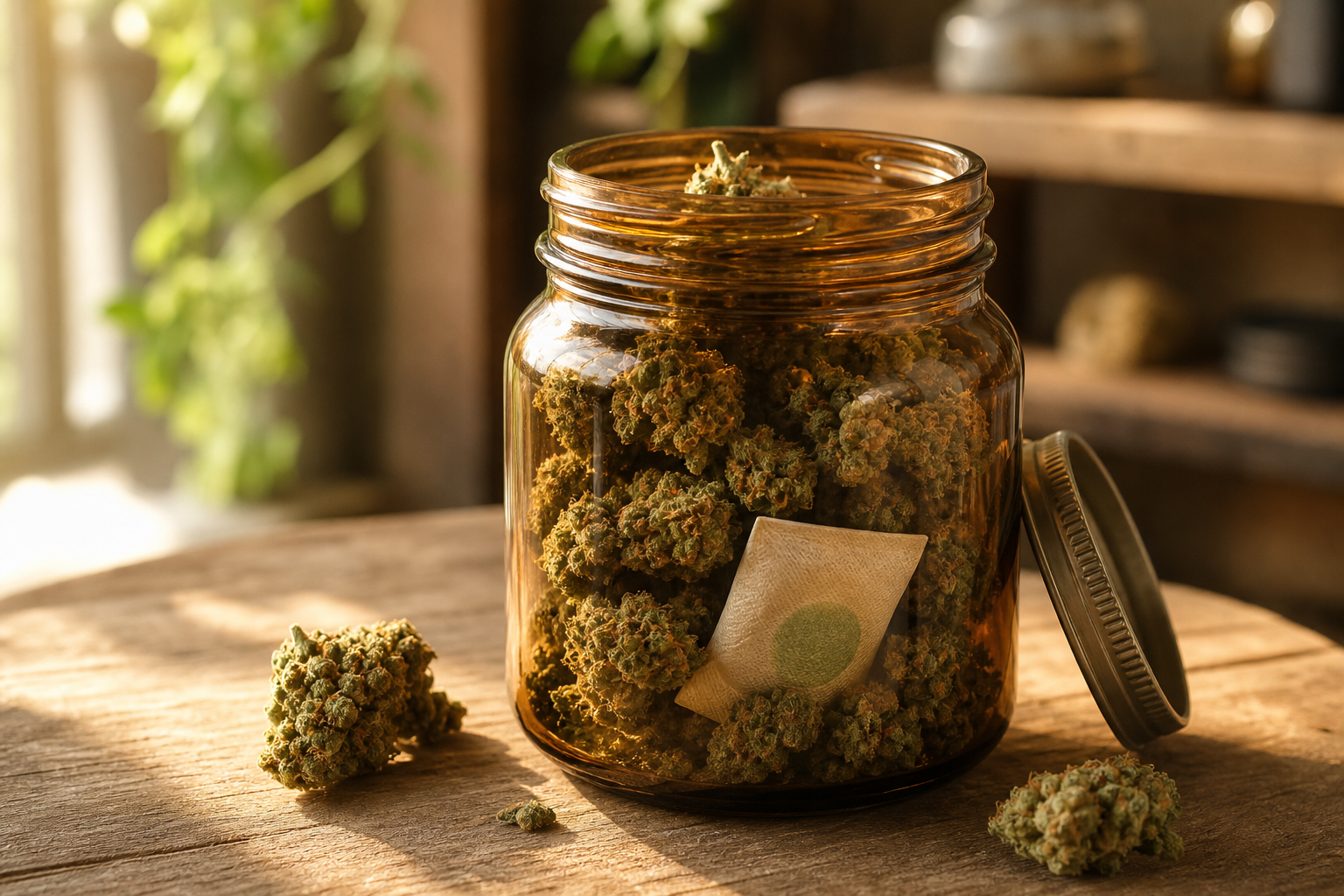
A two-way humidity pack tugs the jar's air toward one moisture level. It does not stop smell oils from sharing that air.
A pack is for one jar with one problem: a little too dry or a little too damp. It's no wall between two strains. If one batch is wet, soft, or cold in the middle, split it out. Don't ask a pack to protect the dry strain beside it. Which pack to buy, and the everyday humidity range, are in how to store your weed.
Three common setups:
- Dry, crispy flower in with damp flower: the dry flower gains moisture. That can rescue the dry bud and put the whole jar at risk if the damp bud was too wet.
- Two properly dried bags: the moisture swing is smaller. The smell swap still happens.
- One humidity pack tossed on top of two strains: the pack sees one jar of air. Both smells still use that air.
Can hay smell or mold reach the other strain? #
A grassy hay smell can share the jar's air. Mold risk goes up if the wetter batch pulls the whole jar past Michigan's 0.65 water-activity line.
Hay is a different smell from pine, citrus, or pepper. It shows up when the loud oils are gone, or when the dry was rushed. The grassy note comes from other plant compounds that hang around when a cure is off. Spadafora and coauthors, 2024 showed the whole mix of smell compounds changes with the drying method and the storage container. They didn't run a hay-transfer test. Still, anything that can become vapor can sit in the shared air.
A bag that smells like hay the moment you open it is a quality question before it's a jar question. What dirt weed means and how to spot it covers that side.
For a September jar that already smells like a barn, see terpene freshness after harvest. How a slow cure keeps the oils is in how curing protects terpenes. The jar rule here is short: a hay bag lends that note to a clean bag under the same lid.
Stem and sugar leaf are greener and louder in that grassy way. If you jar trim with finished flower, you put the leaf smell in the flower's air. Keep trim in its own container, or out of the jar you plan to smoke from.
When moisture becomes mold #
Fuzzy growth means that jar is finished. Do not smoke it, and do not "save" the other strain by leaving it in there.
Michigan's numbers, again from the CRA testing guide:
- Flower passes water activity at 0.65 or under.
- Adult-use bud, shake, trim, and kief: total yeast and mold action limit 100,000 CFU/g.
- Medical bud, shake, trim, and kief: 10,000 CFU/g.
A home jar never gets that test again, so you're the inspector. Warm plus damp is the combo mold likes. The EPA flags rooms above 60 percent relative humidity. A closed jar with a wet batch can sit above the flower pass line even when the room is fine.
Places this goes wrong around metro Detroit:
- A summer kitchen with the jar open while water boils. July averages 74.1°F at Detroit Metro Airport, per the NOAA 1991–2020 normals.
- A basement that already smells damp.
- A closed car in the afternoon. Milay and coauthors, 2020 found 25°C, about 77°F, was the worst temperature they tested for changes in the natural cannabinoids. A parked car clears that easily.
- A soft, cold center in a bud that got jarred before it was dry. That bud can wet the flower next to it.
If you see fuzz, or the jar smells like a wet basement instead of plant, trash the whole jar. Don't pick the "clean" buds off the top and move them to the good jar. The air they sat in is the problem.
| What you notice | Likely meaning | What to do |
|---|---|---|
| Both bags smell like hay | Grassy compounds shared the air, or both were already tired | Split them. The freshness post covers a dead jar |
| One bag is soft, the other is crisp | Moisture is moving toward the crisp bag | Separate them the same day |
| White fuzz, gray fuzz, or a sour wet smell | Mold | Trash the jar. Do not smoke it |
| Only the citrus note got quieter | Light terpenes left first | Own jar, full, glass, cool, dark |
What jar rules hold up in a Michigan year? #
One strain per jar. Write the name on it. Use glass. Fill it. Michigan's year is a warm, muggy summer and a furnace-dry winter, and the jar feels both.
The temperatures below are monthly normals for 1991–2020 at Detroit Metro Airport, in Wayne County. The data comes from the NOAA climate normals for station USW00094847. They're outdoor air temperatures, not the humidity inside your jar. They show what your house is up against.
| Season around Detroit | Outdoor normal at Detroit Metro | What the jar feels | What to do |
|---|---|---|---|
| Deep winter | January 25.8°F, December 31.3°F | The furnace heats that cold air. Indoor relative humidity falls. The EPA wants rooms at 30 to 50 percent | Close the lid. Every crack lets dry room air in and pulls moisture out of the bud |
| Early spring | March 37.2°F, April 48.9°F | Windows start opening. Rainy weeks swing the house | Keep one strain per jar while the house humidity jumps around |
| Early summer | May 60.3°F, June 69.9°F | Kitchens get wetter. Showers and boiling pots load the air | Don't pop the lid over a steaming sink |
| High summer | July 74.1°F, August 72.3°F | Warm rooms speed evaporation. A parked car is hotter than the 77°F Milay flagged | Cool, dark, closed. No dashboard |
| Fall | September 64.9°F, October 53.0°F | Heat is just coming on. Outdoor air can still be damp. This is leftover-bag season | Don't combine the old jar with the new one |
| Late fall | November 41.2°F | The furnace is on for real | Same winter rule: lid on, jar off the radiator |
Milay and coauthors, 2020 found that 25°C, about 77°F, changed the natural cannabinoids more than the colder holds they tested. Terpenes fell at every temperature. So no season makes a shared jar a good idea. Give each strain its own.
The rules I actually use #
- One strain per jar. The smell oils share whatever air you give them. Give them separate air.
- Write the name and the date you closed it. A week later the nose may not match the memory.
- Glass, with a lid that seals. The 2024 storage test favored glass over a closed HDPE box for smell. Spadafora and coauthors, 2024
- Fill the jar. Less empty air means less room for vapor. Leave enough gap for the lid to seat.
- Cool and dark. Skip the windowsill, the car, and the top of the fridge.
- A humidity pack stays with one strain. It moves moisture and nothing else. The comparison of packs is in how to store your weed.
- A wet bag, a hay bag, or a bag with trim gets its own jar. Keep it off the good flower.
- Skip the freezer as a mixing fix. Temperatures lower than -20°C were among the worst terpene conditions in the Milay year-long test.
If you take a little flower to a job site, give it its own small jar. A lot of metro Detroit works shifts, and a coat pocket is a real storage spot. Don't dump that pocket jar back into the main jar on Friday. It's been warm, opened, and exposed to whatever air was in the car. The main jar stays home, closed, one strain.
What should you do the night the flower gets home? #
Split the strains before the bags spend a night in the same tub. Label each jar. Leave each humidity pack with its own strain.
Do this the night it comes in the door, before you notice any blend.
- Open one bag at a time. Smell it before it shares air with anything else. If it smells like itself, good. If it smells like hay, it still gets its own jar.
- Move it into glass. Use a tight lid and fill the jar.
- Write the strain name and the date on tape. Painter's tape is enough. If your nose drifts later, the label still tells you what you paid for.
- Keep the pack with that strain only. One pack, one jar. Don't lay one pack across two open bags in a shoebox.
- Stash it cool and dark. A cupboard beats a sunny windowsill, which runs hotter than the outdoor July average.
- Leave the second strain in its own jar. If you only have one glass jar tonight, leave the second bag sealed until you get another jar. A sealed bag beats a shared tub.
For flower that still smells like the bag you opened, give each bag its own glass the same night. Start at the shop. Storage basics are in how to store your weed.
FAQ #
Do the smells mix overnight? #
The light oils can already evaporate at room temperature. No published lab test has timed an overnight swap for two retail strains.
Eyal and coauthors, 2023 showed pinene evaporating about three times faster than limonene at 68°F. At room temperature, myrcene (the mango oil) pushes into the air about 80 times harder than caryophyllene (the pepper oil). Bueno and coauthors, 2020 measured uptake over weeks, with added oil, not over a single night with two eighths. If the jar smells blended the next evening, believe your nose. You don't need a study to name the hour.
Will the two strains turn into one strain? #
No. They can share a smell, but each bud stays its own strain.
Flower can absorb airborne terpenes. In Bueno's airtight jars, added oil raised terpene content. It took 1.18% of the flower's weight in oil to hold the starting level for six weeks. A neighboring bud is likely a weaker source than a vial of oil. You get a blend, and the strain name stays on the bag.
Does the THC number move to the other bud? #
The THC number stays put far more than the smell does.
According to Eyal and coauthors, 2023, cannabinoids push into the air far less than the light terpene oils do. A shared jar is an aroma problem first. It won't quietly average two potency labels.
Can a humidity pack stop the smell from mixing? #
No. A pack moves moisture. It does not block terpene vapor.
The pack and both strains still share one headspace, the empty air in the jar. Use a pack inside a single-strain jar if that jar is too dry or a little too damp. Pack brands and the daily setup are in how to store your weed.
Is a plastic tub fine if the lid clicks? #
Glass kept the smell profile better than a closed HDPE box in a 2024 test.
Spadafora and coauthors, 2024 compared a glass bottle, an open tray, and a closed hard-plastic box. Glass held the original smell mix better. The same glass storage also let more acid cannabinoids, like THCA, turn into neutral ones, like THC. That was one kind of closed HDPE box, so it leans toward glass without ruling out every tub.
Does a full jar mix less than a half-empty jar? #
Less empty air means less room for vapor, so a full jar gives the oils less space to move into.
That's vapor-pressure reasoning from the same 2023 review. No published fill-line trial covers mixed strains. Fill the jar, and leave enough room for the lid to seal. A gram in a giant jar gives the oils the most room to roam.
Can I keep two strains together for a week? #
You can, but the smells will be mixing the whole time.
In Bueno's study, jars opened twice a week still gained terpenes from the added oil at two, four, and six weeks. Nobody has timed a shared jar of two retail strains. I'd still expect the light oils to be sharing air well before a week is up. If you care which bag is which, split them the first night.
Is mixing strains in a jar illegal in Michigan? #
Michigan's lab testing guide says nothing about how you store flower at home.
The September 23, 2024 CRA guide is written for licensed labs. It sets the 0.65 water-activity pass line and the yeast and mold counts. It doesn't tell a shopper how to arrange jars at home. One strain per jar is a freshness habit, a way to keep what you bought.
Will a Detroit basement make a mixed jar mold? #
A damp basement can, if the jar's humidity sits too high. The mix makes that easier when one bag is wetter.
Basements run damper than the furnace-dried upstairs in winter. Flower fails Michigan water-activity testing above 0.65, per the CRA guide. If the basement jar smells wet, or you see fuzz, trash it.
Should stem and leaf go in the flower jar? #
Keep trim out of the jar you plan to smoke.
Stem and sugar leaf carry more of the grassy plant smell. Those compounds use the same shared air as the terpenes. A hay note spreads the way a citrus note does. The cure and the dry are covered in curing and harvest freshness.
Does the freezer stop the swap? #
No. Very cold storage was one of the worst terpene setups in a year-long study.
Milay and coauthors, 2020 found temperatures lower than -20°C, and grinding, least favorable for terpenes. A frozen jar can also sweat when it hits warm room air. Split the strains. Then keep the jars cool and dark, not frozen.
How do I label a jar so I still know what I bought? #
Write the strain name and the date you jarred it, on the outside, the night you open the bag.
Once the light oils move, the tape is a better witness than your nose. Isaacson and coauthors, 2025 found a terpene printout is a poor predictor of smell words. After a blend, the printout fits even less. Put the record on the jar.
If the jar should still smell like one strain #
Give each strain its own glass the night it gets home. Write the name, fill the jar, and leave the humidity pack with that strain only.
Michigan swings from a 74.1°F July average at Detroit Metro to a 25.8°F January average. The lid is the part you control.
Divine Toke is Detroit-rooted, sun-grown, living-soil flower, sold only by mail. No storefront, no street address, no local delivery. Pre-rolls are 1 gram each, and the 20-pack is 20 of those 1-gram joints for $120. See what's in stock on the shop.
More on the jar, the cure, and the nose:
- How to store your weed
- Terpene freshness after harvest, and Michigan humidity
- How curing protects terpenes
- Nose-shopping cannabis
- What dirt weed means and how to spot it
This article is for educational purposes only and is not medical advice. Always consult your healthcare provider before starting any new wellness routine.
Grown in Detroit. Shipped to your door.
Small-batch, sun-grown cannabis cultivated in living soil. Mail-order shipping to all 50 states.