Terpene Freshness After Harvest: Michigan Humidity vs a Dead Jar
A September jar can smell like hay the night you crack it. How Michigan humidity kills terpenes after harvest, and how Detroit shoppers keep flower alive.
Questions this article answers
- How do you keep September harvest flower from going terpene-dead in Michigan humidity?
- why does my September jar smell like hay
- can a humidity pack restore dead cannabis aroma
- does Michigan humidity ruin flower
- how to tell if cannabis is terpene-dead
- best humidity for storing cannabis in Detroit

Head Cultivator
On this page
I cracked a September jar last week and it smelled like a barn. The sticker said this month. The flower was already dead.
I am Jamie, Divine Toke's head cultivator. This is a Detroit kitchen lesson, not a dry-room how-to. The hang lives in drying cannabis so terpenes survive. The jar weeks live in how curing protects terpenes. Year-round storage 101 lives in how to store your weed. Here we stay on harvest-season freshness versus Michigan humidity, when the oils have already left.
Why does a September Michigan jar already smell like hay? #
Hay in a September jar means the loud oils are gone, or they never made it through the hang. The harvest date can still say this month.
That is the trick of cut week in Michigan. Outdoor energy hits metro Detroit menus. People buy like the plant just came down. Then they open the lid at the kitchen table and get dried grass, not pine. A Michigan harvest date tells you when scissors hit. It does not tell you whether the oils survived the next two weeks, or the ride home, or the steam from the pasta pot.
Hay is leftover plant smell. Terpenes (the oils that smell like pine, citrus, pepper, or mango) are the first things to leave. Once they evaporate or oxidize, you smell the dry plant underneath. That can be a rushed hang. It can also be a jar that sat warm, wet, or open. This post is the second case: flower that already made it to a Detroit counter and still died.
| What you smell | Plain meaning | What to do |
|---|---|---|
| Pine, citrus, pepper, mango | Oils are still there | Buy it. Close the lid. Get it out of the kitchen. |
| Hay or dried grass, no punch | Loud oils are gone or never finished the hang | Do not stockpile. Do not "fix" it with a humidity pack. |
| Cardboard or dust | Old storage, not a fresh cut | Walk. A new sticker does not change that. |
| Musty basement, wet socks, ammonia | Moisture problem. Possible mold. | Do not smoke it. Do not save it. |
A hay jar and a moldy jar are not twins. Hay is a dead nose. Mold is a safety problem. If you also see fuzz, or the bud feels damp and spongy, treat it as trash. MSU Extension's hemp notes are blunt about Great Lakes weather: damp air plus free moisture is how Botrytis and other rot get a foothold. That is farm language. In a Detroit apartment it still means the same thing. Wet flower in a closed bag is not a cure. It is a bet.
September harvest on a Woodward menu is a different clock. Cut week is not jar week. That story is in September harvest on a Detroit menu. On this jar, hay is the night you lived. The rest of this post is how Michigan humidity finishes the job after you pay.
What hay is not #
- It is not a strain name.
- It is not "indica earthiness."
- It is not proof the grower used living soil.
- It is not something a 62% pack will perfume back in.
If the hang failed, you cannot re-hang retail flower on your counter. If the oils already left, you cannot will them back. You can only stop the next jar from dying the same way.
Three September nights in metro Detroit #
Same humidity. Three different ways people lose the jar.
| Night | What happens | What the flower needed |
|---|---|---|
| Shift off, pasta on | Eighth sits open next to the pot while you eat | Lid. Then a room that is not making steam. |
| Friends on the porch | Bowl stays out "for the next round" in 70° air | Close between rounds. Porch air is still September air. |
| 20-pack on the counter | You open three tubes to "see which one slaps" | Open one. The other 19 are still sealed for a reason. |
None of those nights need a grower lecture. They need a lid. Michigan harvest energy makes people treat every jar like a trophy. Humidity treats every open jar like a sponge.
What does terpene-dead flower actually mean? #
Terpene-dead flower can still show a high THC number. The volatile oils that make it smell like itself are gone. THC is heavier and slower to leave. The smell leaves first. That is why a dead jar can still get you high and still taste like cardboard.
Terpenes sit in sticky resin glands called trichomes (the frost on the bud). They evaporate. They oxidize. They rearrange when heat, light, air, or bad moisture hits them. A 2020 storage study in PMC7593247 followed whole and ground flower in the dark at several temperatures. Terpenoid concentrations dropped fast under every condition they tested. Room temperature, 25°C (77°F), also made the biggest cannabinoid shifts. Whole flower held at 4°C (39°F) kept the original mix best in that lab setup. A Detroit fridge is not that lab. More on that later.
The light oils leave first. Those are monoterpenes, the smaller smell molecules like myrcene (mango, hops), limonene (citrus), and pinene (pine). Heavier sesquiterpenes like beta-caryophyllene (black pepper) hang on longer. A 2024 canning study in PMC11660729 stored dried flower 18 to 74 days. Total terpene weight did not move much. Individual oils did. β-myrcene dropped 33% in regular air. Nitrogen-flushed cans held myrcene better. You do not have a nitrogen line in a Ferndale kitchen. You have a lid.
That same paper cites Bueno et al. 2020 (PMC7819294): volatile terpenes can fall as much as 50% in the first month after harvest. Treat that as a warning, not a promise every jar dies on day 30. Storage decides the slope. A sealed, cool, dark jar dies slower. An open bag on a warm fridge dies faster.
| Class | Everyday examples | What happens first |
|---|---|---|
| Monoterpenes | Myrcene, limonene, pinene | Leave or oxidize sooner. The nose goes flat. |
| Sesquiterpenes | Beta-caryophyllene, humulene | Stick around longer. Pepper can outlast mango. |
| Cannabinoids | THC, THCA, CBD | Change slower than smell. A dead jar can still test "strong." |
A 2024–2025 Phytochemical Analysis paper (PMC11742972) showed cannabis terpenes break in their own patterns under UV and heat. Sun baking through a windshield is chemistry, not a vibe. Michigan September still puts 70s on the dashboard, and that is plenty of heat to cook a jar.
Dead is a nose word, not a CRA word. The Michigan Cannabis Regulatory Agency does not print "terpene-dead" on a label. The lab sheet may still list oils from the day they tested. That sheet is a snapshot. It is not a promise the jar still smells like the PDF. How to read the terpene page is in reading a Michigan COA. How those oils work in the first place is in what terpenes are. This post stays on whether they are still in the jar you are about to smoke.
What "dead" does not mean #
The THC is still in there, full weight and all. Nobody shorted you on the scale, and a dead jar is not automatically a moldy one. A humidity pack will not bring the smell back either. More on that later in this post.
If it smells like itself, it is alive. If it smells like a hay bale, the night already happened without you.
Why the THC number lags the nose #
Labs measure cannabinoids and terpenes on a grind-and-extract day. That day is not tonight. R 420.504 even writes a 10% swing into the THC line. The smell line has no swing printed, because there is no smell line.
Oxygen is the quiet one. PMC11660729 compared regular air cans to nitrogen-flushed cans. Total terpene weight barely moved. Myrcene, the loud mango/hops oil, still fell 33% in regular air. You will not nitrogen-flush a mason jar in Warren. You will decide how often that lid comes off. Every open is a fresh gulp of Michigan air.
Heat stacks on that. Turek and Florian 2013, cited inside the Meiri storage paper, is the old rule of thumb: many aroma oils degrade about twice as fast for every 10°C you add. A jar that baked in a Civic on I-75 is not the same jar you smelled at the counter. September sun is enough. You do not need July.
So "dead" is not on you, and the lab did not screw up either. The oils are doing what volatile oils do once air, heat, light, and wet-dry swings get a vote. The sticker can stay legal the whole time.
How does Michigan humidity kill terpenes after you bring the jar home? #
Michigan September air is wet. A kitchen after pasta water is wetter. An open bag drinks that air, then either swells toward mold or swings dry when the AC kicks on. The oils hate both swings. They also hate the extra air you let in every time you leave the lid off "for a minute."
This is not the dry-room fight. Growers already hung the plant, or they did not. You are in a Detroit apartment in harvest season. NWS Detroit/Pontiac climate normals and the 1991–2020 local climate packet put Detroit September around 74.4°F days / 55.5°F nights and about 3.22 inches of rain. August is still hotter: 81.4 / 63.2°F, 3.26 inches. NWS DTW September records sit on top of that. Daily climate reports out of Detroit routinely show relative humidity in the 60–90%+ band, high in the morning, lower in the afternoon. Great Lakes air does not take September off.
Relative humidity (RH) is how full the air is with water, as a percent. Water activity (aw) is how much free water is sitting in the flower itself, ready to feed mold or dry the bud brittle. ASTM D8196 is the practice for measuring that free water. ASTM D8197 says keep dry flower between 0.55 and 0.65 aw. Above 0.65, mold gets a vote. Below 0.55, buds snap and quality drops. The same ASTM write-up notes that below about 0.50 aw, terpenes dry out and the smell flattens. In a sealed jar, aw tracks the air right above the flower. That is why people talk about 55–65% RH in the jar, not in the hallway.
Room RH is not jar RH. A Hamtramck kitchen at 75% after you boil noodles is not the same number as a closed mason jar. The jar only copies the room if you leave it open.
PMC9404914 puts the simple math in farm language: aw equals equilibrium RH divided by 100. Fresh-cut flower starts around 78–80% water. That water is supposed to leave in the hang, not in your Tupperware on the stove. Once the flower is finished, you are trying to hold a thin leftover moisture band. Michigan humidity tries to shove more water back in. A blast of heat from a south window or a hot car tries to drive oils out.
| Setup | What Michigan September does | What happens to the oils |
|---|---|---|
| Open bag on the counter | Drinks kitchen steam, then dries when the AC runs | Fastest death. Air plus swings. |
| Lid cracked "to breathe" | Same air, slower | You are curing a room, not a jar. |
| Sealed glass, no pack | Holds whatever moisture you sealed in | Fine if the flower was already in range. |
| Sealed glass plus 58–62% pack | Buffers the headspace | Slows a live jar. Does not revive a dead one. |
| Plastic bag in a warm car | Heat plus thin walls | Oils leave. Smell cooks. |
| Closet on an exterior wall | Cooler than the kitchen, still humid | Better than the stove. Still needs a real lid. |
Two failures, one month:
- Too wet. The bag softens. The bud feels cool or spongy. Musty smell shows up. That is the mold side of Great Lakes air.
- Too dry, then wet, then dry. Trichomes get brittle. Oils evaporate. You grind dust. A later humid night cannot put the mango back.
PMC7593247 stored flower in the dark and the terpenes still fell. Light and heat make it worse. PMC11742972 is the UV-and-heat paper. So the Detroit version is simple: do not store harvest-week flower where you cook, where the sun hits, or where the bag can gulp September air.
If you want the year-round container list, that is how to store your weed. This section is the September-specific part: humidity here is a season, not a theory.
Kitchen, car, porch, closet #
Metro Detroit storage is not one room.
- Kitchen. Worst default in September. Stove, dishwasher, kettle. You already have NWS Detroit humidity. Cooking adds a spike the jar does not need.
- Car. A closed Civic on Gratiot after work is an oven with windows. PMC11742972 is the heat-and-UV paper. Bring the bag inside. Do not "leave it for tomorrow."
- Porch table. Feels like the season. It is also open air plus evening damp. Smoke, then cap it, then go in.
- Bathroom cabinet. Steam cousin of the kitchen. Skip it.
- Interior closet or drawer. Boring. Dark. Away from the pot. That is the win.
- Garage fridge or shed. Temperature swings and sometimes worse humidity than the house. Do not store flower like paint.
A cheap $8 hygrometer in the jar is more honest than guessing. If it reads 70% after a night in the kitchen, you do not need a lecture. You need a better lid and a different shelf. If it reads 40%, the flower is going toward dust. Either way, the hallway RH on a Detroit September morning is not the number that matters. The number inside the closed jar is.
How can you tell a dead jar from a live one before you pay? #
Smell it if the shop will let you. Read the harvest date. Ignore a pretty pack date. A live jar smells like a plant you can name. A dead jar smells like a barn or like nothing. THC percent will not settle the fight.
Michigan already printed the useful clock. Mich. Admin. Code R. 420.504 requires date of harvest, if applicable, plus the grower, the package tag, the lab name, and the test analysis date. It does not require a pack date or a best-by on flower. The long version of those two dates is harvest date vs pack date on a September jar. Here, the date is only half the test. The nose is the other half.
A same-week harvest and pack can still smell like hay if the hang was rushed. A harvest date from July can still smell loud if someone stored it dark and cool. Age is a clue. Smell is the verdict.
Counter checklist #
- Ask to smell. If they say no, ask them to smell it and describe it in plain words. "Loud" is not a word. Pine, lemon, gas, or pepper is.
- Read harvest date first. That is the cut. A September date is not a freshness trophy. It is a calendar.
- Read test date second. That is when the lab finished, not when the plant came down.
- Treat pack date as extra. New lid, old plant is a real pattern.
- Match the package tag to the COA. The CRA tracks licensed packages through Metrc. A PDF for a different tag is a different lot.
- Look at the flower if you can. Dry dust and no spring is tired. Damp and spongy is a walk-away.
- Skip the "just dropped" font. New ink is not new oil.
| Signal | Live jar | Dead jar |
|---|---|---|
| Nose | You can name the smell | Hay, dust, or silence |
| Harvest date | You can explain the gap | You ignore it for a newer stamp |
| Test date | Near the hang, or at least honest | Fresh test on a winter cut, no smell |
| Feel | Breaks with a little give | Powder, or wet and cool |
| Shop line | They can describe the nose | They only recite THC |
If two eighths sit at the same percent, take the one that still smells like itself. The THC potency myth is the longer argument. This version is shorter: a dead 28% smells worse than a live 18%.
Pre-rolls count. A 1g joint and a 20-pack of those 1g joints still carry harvest date when the product is flower. Smell the tube if you can. A paper wrap hides the nose better than a glass jar. That is a reason to buy flower when you care about oils, and to keep the tube closed once you do.
What should you do the night you bring harvest-week flower home in Detroit? #
Close the lid before you take your shoes off. Get the jar out of the kitchen. Put it in glass, in the dark, away from the stove and the window. That is the whole September move. The rest is habit.
You already paid. Michigan humidity starts working the minute the bag is open. Cooking steam is extra water. A sunny sill is extra heat. A "I'll just leave it out so I can see it" bowl is extra air. All three kill the same oils PMC7593247 watched fall in the dark.
The first hour #
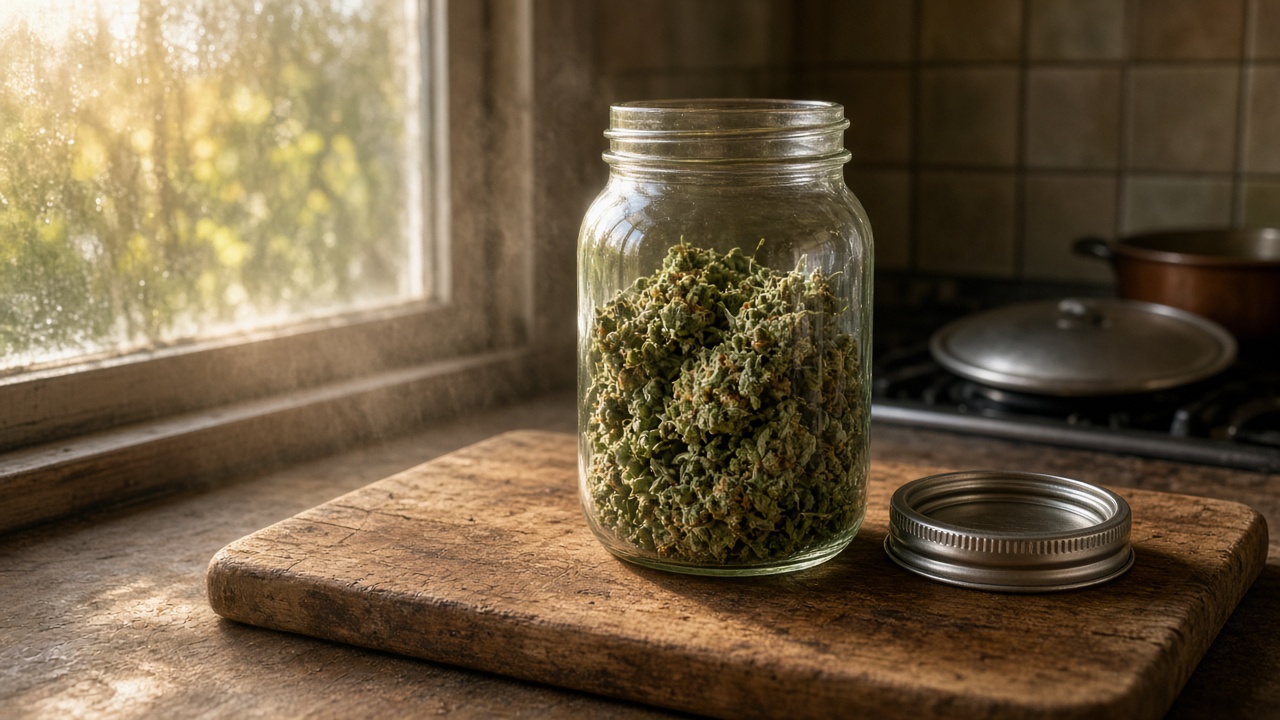
- Transfer out of a thin retail bag if that is what you got. Glass with a real lid. If it is a mason jar, use the silver two-piece lid and actually screw it down. A decorative open jar is a vase.
- Do not grind the eighth. Ground flower has more surface area. PMC7593247 found grinding was one of the least friendly conditions for terpenes. Grind the night you smoke.
- Leave the kitchen. Pasta water, dishwasher steam, and a boiling kettle spike RH. The jar does not need to watch you cook.
- Pick a dark, cool spot. A closet shelf beats a window. A drawer beats the top of the fridge. The fridge itself is a later question.
- If you use a humidity pack, drop in one 58% or 62% pack and close it. That holds a live jar. It does not perfume a hay jar.
- Open to smoke, then close. Do not "burp" a finished retail jar in September like you are still curing it. Curing is a grower step. You are storing.
| Do tonight | Do not do tonight |
|---|---|
| Seal glass | Leave the lid on the table |
| Dark closet or drawer | South window, car dash, stove |
| Grind one night | Grind the whole eighth "to save time" |
| One small jar per eighth | Dump three eighths into one bowl |
| 58–62% pack in a live jar | Soak a hay jar and hope |
Flower, a 1g pre-roll, or a 20-pack tube. The first-night routine does not change: lid on, kitchen off-limits, dark shelf. If you bought the 20-pack, do not open every tube to admire them. Open what you will smoke.
The long container-and-temperature list is still how to store your weed. Tonight is narrower. September in metro Detroit is a humidity season. Treat the jar like leftovers you actually want tomorrow.
Pre-rolls are not exempt #
Paper hides the nose. It does not hide the physics. A 1g joint still dries out, picks up kitchen smell, and goes hay-flat if you leave it on the cutting board. A 20-pack only helps if nineteen tubes stay shut. Do not decant the whole pack into a decorative bowl for the weekend. That bowl is an open bag with nicer lighting.
If you roll your own, roll what you will smoke. A tray of packed cones overnight in a humid kitchen is how you wake up to floppy paper and a quiet nose. Roll, smoke, lid. Same order as flower.
Can a humidity pack save a dead jar? #
No. A humidity pack can keep a live jar from going brittle. It cannot put evaporated oils back. If the lid already smelled like hay, the pack will make the hay softer. That is not a comeback.
A pack is a salt-and-water sachet that buffers the air in a sealed container. ASTM's cannabis water-activity write-up says those sachets can pull stored flower into the 0.55–0.65 aw band, which is mold margin and snap margin, not a terpene factory.
Think of a dried orange peel. You can make it less crumbly with a damp paper towel in a box. You cannot make it smell like a fresh peel again. The oils already left. Flower works the same way.
| What you hoped | What the pack actually does |
|---|---|
| Bring mango back | Softens dry flower so it does not powder |
| Fix a hay hang | Leaves the hay. Adds moisture. |
| Replace a lid | Does nothing if the jar stays open |
| Survive a wet kitchen | Helps only after you seal the glass |
| Save a musty bag | Do not try. Musty is a discard. |
Use 58% if your Detroit spot runs warm or you open the jar a lot. Use 62% if the flower is a bit crispy and the room is stable. Stay out of the 65%+ zone. That is the mold side of ASTM D8197. Do not toss a soaked sponge in the jar. Do not use a piece of bread, a citrus rind, or a wet paper towel as a "pack." Those are mold projects.
If the flower is dead and dry, smoke what is left or make it a low-stakes night. Do not build a hydration chamber on the counter in September. Michigan air will help you overshoot. Overshoot is how a tired jar becomes a dangerous one.
A pack is a seatbelt for a live jar. It is not an ambulance.
When should you smoke it now instead of saving it? #
If it still smells like itself, smoke the loudest nights first and keep the rest sealed. If it already smells like hay, do not buy a second eighth "for later." Stockpiling dead flower in a Michigan September just gives humidity more weeks to work.
Bueno et al. 2020 (PMC7819294) is the paper behind the "up to 50% of the volatiles in a month" line. PMC11660729 repeated that warning while showing myrcene can drop 33% in ordinary air over a couple of months. You do not need those exact percents at the counter. You need the direction. Smell now is better than smell in November if the jar is already tired.
| Nose tonight | Move |
|---|---|
| Loud and nameable | Smoke some. Seal the rest. Dark shelf. |
| Quiet but still itself | Do not wait for a holiday. Use it this week. |
| Hay, no punch | One night if you want. Do not hoard. |
| Musty, ammonia, fuzz | None. Trash. |
Smaller units help in humidity season. A 1g pre-roll is one night. You are not opening an eighth every time. A 20-pack (20 × 1g) stays useful if the tubes stay closed. One open mason jar of three eighths is the opposite: more air, more kitchen, more chances to forget the lid.
Buy the size that matches how fast you actually smoke, not the size that looks like a bargain on a dead nose. A single pre-roll forces that discipline. A whole eighth left open all week does not.
Saving flower is fine when the jar is alive and the lid is real. Saving flower is theater when the barn smell already won.
What Michigan labels will not tell you about freshness? #
Michigan prints a harvest date on flower. It does not print a freshness score, a terpene-now number, or a required best-by. The sticker can be legal and the jar can still be dead.
R 420.504 is the sealed-container rule. Harvest date, if applicable. Grower. Packager if different. Package tag. Lab name. Test analysis date. Strain name, if they use one. Net weight. THC and CBD with a 10% variance note. It does not ask for "smells like pine today."
R 420.502 says a licensee may not sell a product after a printed expiration date. Flower jars often have no such date. No date is not forever. It is a gap. Edibles carry extra production and expiration language in R 420.403. Flower does not borrow that clock.
The COA terpene table is the closest thing to a smell list. It is still a lab day, not tonight. Oils move after that day. PMC7593247 watched them fall in storage even in the dark. A loud PDF and a quiet jar can be the same lot a month later.
| On the sticker | What it answers | What it hides |
|---|---|---|
| Harvest date | When it was cut | Whether the hang was honest |
| Test analysis date | When the lab passed it | Whether the oils are still there |
| Pack date (optional) | When this lid went on | Age of the plant |
| THC % | A lab snapshot, ±10% | The night you will actually have |
| Terpene table on the COA | What they measured then | What evaporated since |
The Michigan CRA never wrote a freshness field into the rulebook, which is why a Detroit shopper still has to use a nose. Licensed flower gets tracked and tested for safety. Nobody promised it would still smell loud in week six of a humid fall.
If the harvest date is missing on flower, that is the walk-away. If the harvest date is there and the jar smells like a barn, believe the barn.
What to say at a Detroit counter #
You are not being difficult. Licensed shops already had to print the cut.
- Ask to smell the lot.
- Ask for the harvest date on that tag.
- Ask whether the COA matches this package number.
- Ask when it was tested.
A shrug plus a THC percent means they are selling a number. Walk to a jar they can describe. Ferndale, Warren, Dearborn, and the city proper all run the same CRA label rules. The air outside is the same Great Lakes air. The only variable you control after you pay is the lid.
Do not ask them to promise the flower will stay loud until November. They cannot. PMC7593247 could not keep terpenoids flat even in a dark lab. You are shopping a night, not a warranty.
Freshness mistakes that show up every September #
| Mistake | Why it happens | What to do instead |
|---|---|---|
| Trusting "just dropped" | Harvest energy is loud | Smell. Then read harvest date. |
| Leaving the lid off to "let it breathe" | Sounds like a cure | You are not curing. Close it. |
| Parking the eighth on the stove | Kitchen is where you are | Closet. Drawer. Not the pasta pot. |
| Grinding the whole cut | Faster later | Grind tonight's amount. |
| Hydrating a hay jar | Hope | Smoke it or skip it. Do not soak it. |
| Buying a second dead eighth for later | Bargain brain | Buy a live smaller unit. |
Frequently Asked Questions #
Why does my September jar smell like hay? #
The loud oils left, or they never survived the hang. Harvest date can still say September. Hay is leftover plant smell once terpenes (the pine, citrus, and pepper oils) are gone. A rushed dry does that. So does a warm, wet, or open bag after you buy. The hang version is in drying cannabis. This version is the kitchen.
Can a humidity pack restore dead cannabis aroma? #
No. A pack buffers moisture. It does not rebuild evaporated oils. ASTM's water-activity standards use sachets to hold flower near 0.55–0.65 aw. That fights mold and snap. It does not put myrcene back. If the lid smelled like a barn, the pack will not perfume it.
Is a hay smell the same as mold? #
No. Hay is a dead nose. Mold is a moisture problem you should not smoke. Hay smells like dried grass. Mold smells musty, like a basement, wet socks, or ammonia, and it can show fuzz. MSU Extension flags damp Great Lakes weather as rot weather on the farm. In a jar, musty plus damp is a discard.
Does Michigan require a best-by date on flower? #
No. Michigan requires a harvest date on flower when it applies, but skips the best-by. R 420.504 is the rule. R 420.502 only blocks sale after a date that is actually printed on the package. Skipping that date does not buy the oils extra time.
How long do terpenes last after harvest? #
They start changing as soon as the plant is cut. Storage decides how fast. Bueno et al. 2020 (PMC7819294) reported volatiles can fall up to 50% in a month. PMC11660729 saw β-myrcene drop 33% in ordinary air between day 18 and day 74. PMC7593247 saw terpenoids fall under every storage temperature they tried. There is no CRA "good for X days" number.
Should I put September flower in the fridge? #
Usually no. A Detroit fridge is cold, humid, and full of food smell. PMC7593247 liked 4°C for whole flower in sealed lab bottles. Your fridge opens all day. Condensation hits a warm jar when you pull it out. Onions share the air. A dark closet and a tight lid beat that for most home jars. If you ever fridge flower, it has to be truly sealed, and you have to let it warm closed before you open it.
Is a Detroit kitchen worse than a closet in September? #
Yes, if you cook. Steam is extra water. The stove is extra heat. NWS Detroit September normals already sit in a humid month. Pasta water pushes room RH higher. A closet on an interior wall is boring, which is what you want. Still use a lid. A closet cannot save an open bag.
Does a new pack date mean the terpenes are still loud? #
No. Pack date is the lid. Harvest date is the plant. The nose is the check. R 420.504 does not even require a pack date on flower. A last-week seal on a March cut is a real pattern. Read harvest date vs pack date if you want the sticker lesson. Smell the jar anyway.
Should I grind harvest-week flower ahead of time? #
No. Grind the night you smoke. More surface area means more air on the oils. PMC7593247 treated grinding as one of the least friendly storage states for terpenes. A pre-ground eighth in a Michigan kitchen is a short life.
What humidity should a home jar sit at? #
Aim for about 55–65% RH in the sealed jar, often 58–62% with a pack. That tracks the ASTM D8197 0.55–0.65 aw band. Above 0.65 you court mold. Below 0.55 the bud gets brittle and the smell flattens. Room RH in Detroit September can sit much higher. The jar only copies the room if you leave it open.
Can you still smoke terpene-dead flower? #
You can if it is dry, not musty, and not fuzzy. It will taste like less. THC can still be there. The night will be flatter. If it smells like a basement or looks off, skip it. Dead is a smell word. Unsafe is a mold word. Do not mix them up.
Is a 20-pack safer than one open jar in humidity season? #
Closed units stay fresher than one jar you keep cracking. A 1g tube is one night. A 20-pack is 20 of those, if the other tubes stay shut. One mason jar you open every evening gulps September air 20 times. Buy the size you will actually finish. Shop formats at Divine Toke stay flower, 1g, and the 20-pack.
If the jar still smells like itself #
Close the lid. Leave the kitchen. Believe the nose over the newer date. Michigan humidity will take the rest if you let it. A live September jar is worth that two-minute habit. A hay jar is already a story you cannot rewrite.
If you want the sticker clocks, read harvest date vs pack date. If you want the hang, read drying. If you want the grower jar weeks, read curing. If you want the year-round shelf, read how to store your weed. Menu season versus jar week is September harvest on a Detroit menu. When the frost warning hits, use the first-frost consumer checklist.
If you're curious to try sun-grown flower from Divine Toke, a Detroit-area Michigan farm, start at the shop. We sell flower, 1g pre-rolls, and a 20-pack (20 × 1g at $120). We will not invent a freshness strain. Smell what you buy. Seal what you keep.
Katie packs what you order. Jamie grew it. The humidity in a Michigan September is still your job once the bag is in the kitchen.
Do not leave the lid on the cutting board while you plate dinner. Do not grind Friday's eighth on Wednesday. Do not park the 20-pack next to the kettle. Small habits, same oils.
Crack the lid on the next jar. If it still smells like pine, you did the job. If it smells like a barn, the humidity won this round, not the sticker.
This article is for educational purposes only and is not medical advice. Always consult your healthcare provider before starting any new wellness routine.
Grown in Detroit. Shipped to your door.
Small-batch, sun-grown cannabis cultivated in living soil. Mail-order shipping to all 50 states.