Fenchol Is the New Name on the Sheet. Here's the High That Goes With It.
Fenchol smells like camphor and pine, so people expect a clear, bright high. The studies are mice, worms, and dishes. Michigan labs can name it November 11.
Questions this article answers
- what kind of high follows when fenchol is the smell
- what does fenchol smell like
- is fenchol the same as fenchyl alcohol
- does fenchol show up on a Michigan lab sheet
- is there a human study of a fenchol high

Head Cultivator
On this page
Fenchol is the camphor-and-pine name people file under a clear, bright high.
When that smell is the one you notice, the hope is a bright head. The studies behind the name used mice, worms, and dishes.
By Jamie, grower at Divine Toke. Divine Toke is Sun+Earth Certified.
What kind of high follows a fenchol smell? #
People expect a clear, bright head, because the smell sits with camphor and pine. A fenchol line on a sheet names that smell. The night still depends on the rest of the bag.
The high is still the whole bag. Cannabinoids, the rest of the smell, how you smoke, and the body you walked in with. That stack is the point of the high isn't one thing.
Fenchol is one smell in the bag. Shoppers hear "clear" because camphor and pine already live in that hope. The published tests never handed someone a fenchol joint and asked how the room felt.
What you're actually reacting to:
- A sharp camphor smell, the same family as a chest rub.
- Pine beside it. The focus writeup for a pine-heavy jar already lives on the pinene page.
- A Michigan sheet that can print the word, starting November 11, 2026.
A lot of us have called a jar clear off a camphor smell and still gone quiet. The smell sets the hope. The bag and the night decide the rest.
What does fenchol smell like? #
Camphor first, then pine, with a dry woody edge. Lemon shows up in some flavor notes. The notes don't call the smell basil-lime.
PubChem lists fenchol, also called fenchyl alcohol, and describes a camphoraceous aroma. The same record gives it FEMA number 2480, which is the flavor trade's ID for the material.
The Good Scents Company keeps a 1989 odor note from William Luebke. At full strength he wrote camphor, pine, wood, dry, sweet, and lemon. The odor type on that page is camphoreous.
Other houses on the same page land in the same place:
- Moellhausen: camphoraceous, and conifers, with a fresh pine taste.
- Sigma-Aldrich, as that page quotes it: camphoraceous, woody, pine.
- Takasago: camphor-like, and it blends with lemon-lime notes.
That last line is a blender's note. It says the material sits well next to lemon-lime. It doesn't rename the jar basil-lime. A separate supplier line on the page does say woody, earthy, citrus-lime. That's one house. The line that repeats is camphor and pine.
If you open a jar and get chest rub plus pine needles, fenchol is a fair name for part of it. If the jar smells like sweet basil, the rest of the flower is louder than fenchol.
Which plants make fenchol? #
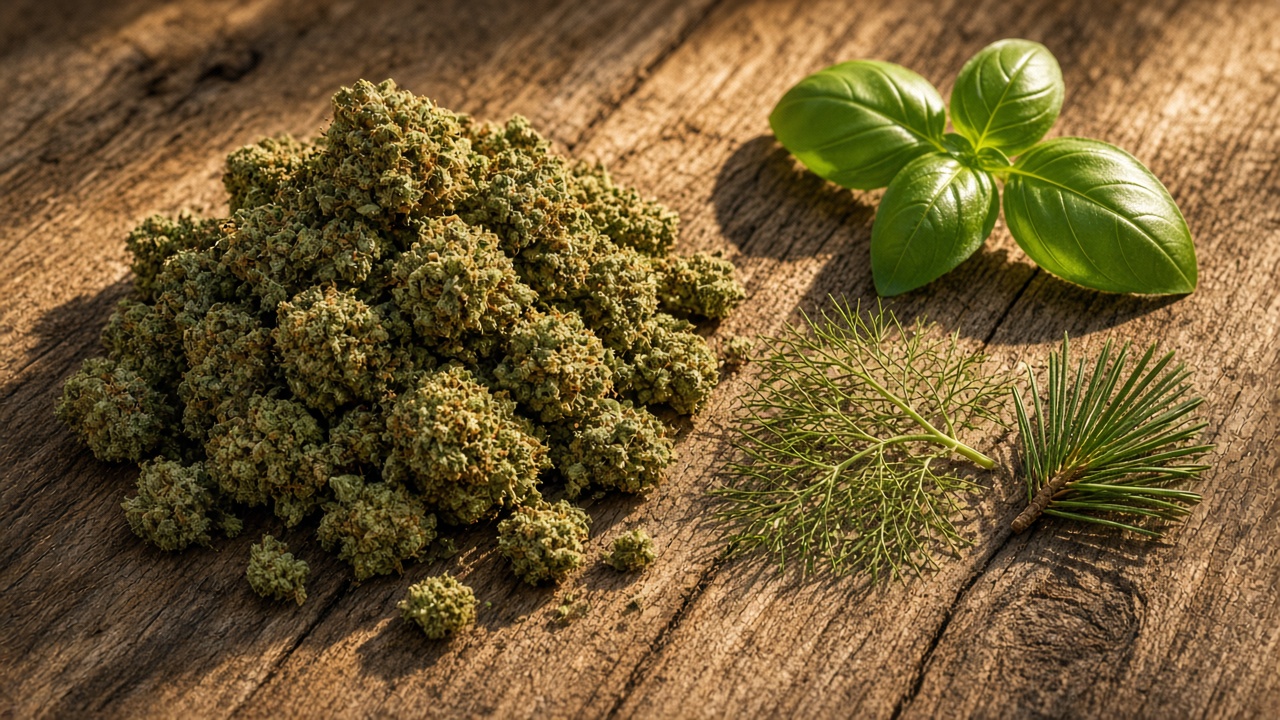
Basil, fennel, and lavender build it, and a pine sap oil carried some. The pure material still smells like camphor and pine, even when the plant is a kitchen herb.
The plant papers and the smell record are two different facts. A plant can make a chemical without that chemical being the smell you notice in the kitchen.
- Razazan and colleagues (2021) call fenchol a natural compound commonly present in basil.
- Sepasi and colleagues (2024) measured a basil gene whose job is building fenchol. Their paper is about basil grown in salty soil. The gene is the part that matters here.
- Croteau, Felton, and Ronald (1980) used a fennel prep that built fenchol and fenchone from the same starting material. Two names, one plant, and they aren't the same chemical. A later Croteau paper (1989) followed the endo form of fenchol in fennel.
- Liu and colleagues (2026) call fenchol a key aromatic compound in lavender oils.
- A 2025 Scientific Reports paper found fenchol among the smaller names in sap oil from Caribbean pine, Pinus caribaea. The big names in that oil were other pine-family smells. The whole oil didn't stop the bacteria they tried in a dish, so this isn't a germ-fighting claim for fenchol.
PubChem also has fenchol reported in magnolia. That's another plant on the NIH record, not a second smell.
So the kitchen version is basil, fennel, and lavender. The jar version is still camphor and pine, unless the rest of the flower shouts louder.
What did the lab animals and the dish actually show? #
The strongest fenchol papers are Alzheimer models in worms, mice, and rats, plus human cells in a dish. None of them is a person smoking flower.
Razazan and colleagues (2021) screened a huge library of plant compounds and landed on fenchol, the one they already tied to basil. In human nerve cells in a dish, it lined up with less damage from amyloid, the sticky protein in that disease model. In worms, a smell-seeking crawl that had gone bad in the disease model eased. In mice bred for Alzheimer-like changes, amyloid buildup came down.
They tie the result to a sensing path your gut microbes already use. That path reads short fats those microbes make. It's a lab finding in disease models. They didn't feed people basil, and they didn't roll a joint.
Ghaliby and Alhasan (2025) worked in rats. They gave the animals aluminum chloride by mouth, a lab way to injure the brain. A separate group then got fenchol by mouth for a month. The fenchol rats kept more of the small packed cells in the brain tissue they checked. The amyloid clumps were lower than in the injured group. IL-6, an inflammation signal in the blood, came down. The comparison drug, memantine, looked stronger on those counts. That's a month of a swallowed chemical in rats. A person smoking flower wasn't in the room.
| What was tested | Who was in it | What moved | What it can't say about a jar |
|---|---|---|---|
| Fenchol in Alzheimer models | Human cells, worms, mice | Less amyloid damage in those models | How a joint feels |
| Fenchol by mouth | Rats with a lab brain injury | Better-looking brain tissue, lower IL-6 | A clear or bright night |
| Flower oils that included exo-fenchol | A dish test of the whole oil | A result for the oil, not for fenchol alone | Which smell ran the high |
| Basil oil, sniffed | People, whole oil | A nicer impression after mental work | That fenchol caused it |
The dish row and the sniff row get their own papers in the next section. The first two rows are the animal and cell work, and they stay there.
Has anyone tested a fenchol high in people? #
No person-test has asked smokers how a fenchol joint feels. The closest human smell study used whole basil oil, and it wasn't a high.
Satoh and Sugawara (2003) had people inhale basil oil and peppermint oil around a bout of mental work. After the work, basil got a more favorable impression than it had before, and fingertip skin ran warmer. Peppermint went the other way on both. They tracked smell ratings, skin temperature, and a forehead signal. They didn't pull fenchol out of the oil, and they didn't hand anyone flower.
Basil oil is a crowd of smells. A warmer fingertip after the whole oil is a smell study. A menu can still print "clear" next to fenchol. This paper didn't test that claim.
Flower oils aren't a person-test either. Odieka and colleagues (2026) distilled oils from the flowers of two cannabis varieties grown in Komga, South Africa. Exo-fenchol showed up in those oils, and it wasn't the lead name. They ran a dish test on the whole oil. Nobody smoked it, and the dish result belongs to the mix.
Plant chemistry isn't a high rating either. Jin, Henry, Shan, and Chen (2021) compared cannabis plants by what they carried. In that set, THC-heavy plants carried more fenchol than CBD-heavy plants. They were sorting plants. They weren't scoring the night.
Why is fenchol on a Michigan lab sheet now? #
Starting November 11, 2026, a Michigan lab can print Fenchol on select Metrc batches. The test stays optional.
Metrc bulletin MI_IB_0119, distributed October 28, 2026, says Metrc and the Cannabis Regulatory Agency are adding the name. Optional, the same way named terpenes already in the system are optional. One of those batches is raw plant material, which is the flower side. The name list and the rules live in which new terpene names can show up on a Michigan lab sheet.
The bulletin doesn't tell you the smell, and it doesn't tell you the high. It tells you the spelling can show up. This page is the smell and the evidence. That page is the reporting change.
How do you read fenchol on a flower sheet? #
Smell the jar first. If Fenchol is printed, the lab chose to name that camphor-pine piece. The line doesn't rank your night.
A Michigan shop sheet can leave terpenes off. When the name is there, read it next to the THC and the rest of the smell. How a panel is laid out is the COA reading post. Shopping from the smell, before one printed word takes over, is shopping by smell.
What to do with the row:
- Open the jar and say the smell in your own words before you read the line.
- Camphor and pine make fenchol a fair guess for part of that smell, and still only a part.
- A blank terpene panel doesn't mean the smell left. The lab didn't report the name.
- Read the THC beside it. A clear-head hope still loses when the bag and the hour go heavy.
Jin and colleagues already showed the split can track the THC-heavy plants in one research set. That's a hint about plants they grew for the paper. It isn't a rule for the eighth in your hand. Odieka's flower oils carried exo-fenchol as a smaller name. A smaller name on a research oil still doesn't tell you the high.
The jar from us #
Divine Toke sells Michigan sun-grown flower by mail, grown in living soil. I grow that flower. The flower is Blueberry Mojito, Honey Bananas, and L.A. Sunshine, plus 1g pre-rolls and the 20-pack of those same joints.
A fenchol story doesn't ride in on the strain name. Smell the jar. If a lab printed Fenchol on that batch, you know they chose to name the camphor-pine piece. The night is still the whole bag.
FAQ #
Is fenchol the same thing as fenchyl alcohol? #
Yes. Fenchyl alcohol is the other name for fenchol. Flavor and fragrance records use both.
PubChem lists fenchol and fenchyl alcohol as the same material, FEMA number 2480. The FDA food-substance record uses fenchyl alcohol and lists fenchol as another name, under CAS 1632-73-1. On a Michigan sheet you'll see Fenchol. In a flavor catalog you'll often see fenchyl alcohol. Same chemical family on those two records.
Is fenchol the same as fenchone? #
No. Fenchone came out of the same fennel prep, and it's a different chemical. Don't shop them as one smell.
Croteau, Felton, and Ronald (1980) showed a fennel enzyme prep could build both fenchol and fenchone. The names sit next to each other because the plant makes both. A sheet that says fenchol isn't saying fenchone. If fennel seed is the smell in your head, you're likely on the other name.
Does fenchol get you high on its own? #
The papers don't treat fenchol as the part that gets you high. They test it as a smell chemical and as a lab compound in disease models.
Razazan and colleagues (2021) put it on cells, worms, and mice and watched amyloid. Satoh and Sugawara (2003) had people sniff whole basil oil. Neither one scored a cannabis high. In the jar, the high still comes with the cannabinoids and the rest of the smell. That stack is the high isn't one thing.
Will a fenchol line feel like a pine jar? #
It can share the pine-and-camphor family, and it still isn't the pine page. Pine already has the focus writeup.
The odor notes on The Good Scents Company put pine next to camphor for fenchol. The focus evidence people want from a pine-heavy jar is on the pinene page. A fenchol row means the lab named this camphor-pine piece. It doesn't copy the pine paper onto your night.
Does Michigan require a fenchol test? #
No. The name is optional on the batches Metrc named. Safety testing didn't change in that bulletin.
MI_IB_0119 says the new names are optionally available, effective November 11, 2026. You can buy flower with no fenchol line and the jar can still smell like camphor and pine. The longer version of the rule is the Michigan lab-sheet post.
If I eat basil, do I get this high? #
Eating basil isn't the experiment, and it isn't a joint. Basil is where several papers found the compound, or the gene that builds it.
Razazan and colleagues call it commonly present in basil, then tested the compound in cells, worms, and mice. Satoh and Sugawara had people inhale the whole basil oil. A plate of the herb doesn't stand in for the clear-head hope on a flower menu.
Does fenchol help Alzheimer's? #
In mice, worms, and rats, the lab models looked less damaged. People with the disease weren't in those papers.
Razazan and colleagues (2021) saw less amyloid trouble in their cell, worm, and mouse models. Ghaliby and Alhasan (2025) saw a similar direction in rats, short of the comparison drug. That's the record. It isn't a reason to change anyone's care, and it isn't a reason to pick a jar.
Is fenchol in every bag of flower? #
No. It showed up in some research plants and some research oils. That isn't every bag in Michigan.
Jin and colleagues (2021) found more of it in the THC-heavy plants in that set than in the CBD-heavy plants. Odieka and colleagues (2026) found exo-fenchol in both flower oils they distilled, as a smaller name. If your sheet is blank, the blank is the lab's choice not to report it. The strain name won't fill that in.
What is exo-fenchol? #
Exo and endo are flipped shapes in the same family. The Michigan line is the single word, Fenchol.
Odieka and colleagues reported fenchol exo- in cannabis flower oils. The 1989 fennel paper followed (-)-endo-fenchol. PubChem treats the common registry entry as the material without pinning one flip. When you shop, read the word the lab printed. Don't split the night into exo and endo unless the sheet already did.
Can I shop fenchol for a focused day? #
The focus hope belongs to the pine jar's page, and the fenchol papers didn't measure a workday.
Camphor and pine are why people put this name with a clear head. The papers measured amyloid models, a basil-oil sniff, and flower oils in a dish. If you want the focus writeup, read the pinene page. If the jar smells like camphor and pine, fenchol can fit that smell. The rest of the bag is still in the session.
Is fenchol safe because it's used as a flavor? #
It's listed as a flavor and as a fragrance material. Those records cover flavor and scent use.
The FDA record lists fenchyl alcohol as a flavor enhancer and a flavoring agent. FEMA's flavor library has the fenchyl alcohol entry. Api and colleagues (2015) published the RIFM fragrance safety assessment. They said fragrance use, under the conditions they reviewed, was supported by the information they had. Smell the jar and read the sheet. The fragrance review covers scent in products. It doesn't cover a smoked bag.
If you want a jar you can smell #
Smell the jar, and read Fenchol if a lab printed the name. The mouse papers are about disease models. The camphor smell is what you check on the jar.
If you're curious to try flower with a real plant smell, Divine Toke ships it by mail. The flower is Michigan sun-grown, in living soil. Blueberry Mojito, Honey Bananas, and L.A. Sunshine are the three. Smell it the way you'd smell a pine branch or a basil stem. Then read the sheet if the lab printed Fenchol.
The camphor hope and the mouse papers can sit in the same week. Your night still starts with the bag you opened. The reporting change is new terpene names on a Michigan lab sheet. The pine page is pinene-forward flower. The stack behind any high is the high isn't one thing.
This article is for educational purposes only and is not medical advice. Always consult your healthcare provider before starting any new wellness routine.
Try Blueberry Mojito — sun-grown in Detroit
Small-batch, living-soil flower cultivated in our Detroit sun-houses. Ships to all 50 states.