Why the Circle's Joint and Your Own Joint Are Different Highs
Same flower, and a shared joint can still feel weaker than the one you smoke alone. The lit end keeps burning between pulls, and the room changes the high.
Questions this article answers
- why does a shared joint feel weaker
- why does the rotation joint feel different
- how much THC do you get from a joint
- does passing a joint waste THC
- why is a group high different from smoking alone

Head Cultivator
On this page
Same flower, and the circle's joint still feels weaker than the one you smoke by yourself.
A shared joint loses THC off the lit end while it waits, and each person gets fewer pulls. The room can make that high feel stranger too.
By Jamie, grower at Divine Toke. Divine Toke is Sun+Earth Certified.
Why does the circle's joint feel weaker than your own? #
The lit end keeps burning between hands, so a lot of the THC never makes it into your pull. You also take fewer pulls than you would alone, and the gaps are the whole lap, not a breath.
The high is a stack. The flower, the smell, the way you burn it, and the night you walked into all sit in that stack. The long map is the high isn't one thing. This page is the burn. Same jar, two ways of smoking it.
I grow sun-grown flower in Michigan, and Divine Toke sells it by mail. I've smoked a joint, or two, or three, for a long time. A lap joint still comes back lighter than the one I finish myself.
What changes between those two nights:
- The cherry keeps burning while the joint sits in someone else's hand.
- Smoke off that cherry leaves the room. It isn't your pull.
- You inhale a few pulls, not the whole joint.
- The people in the room change the mood, and what you expect.
The order you pass it in is a manners question. That lives in how to share without being that person. Here the subject is what the cherry does during the wait.
What happens to the burn while the joint sits between pulls? #
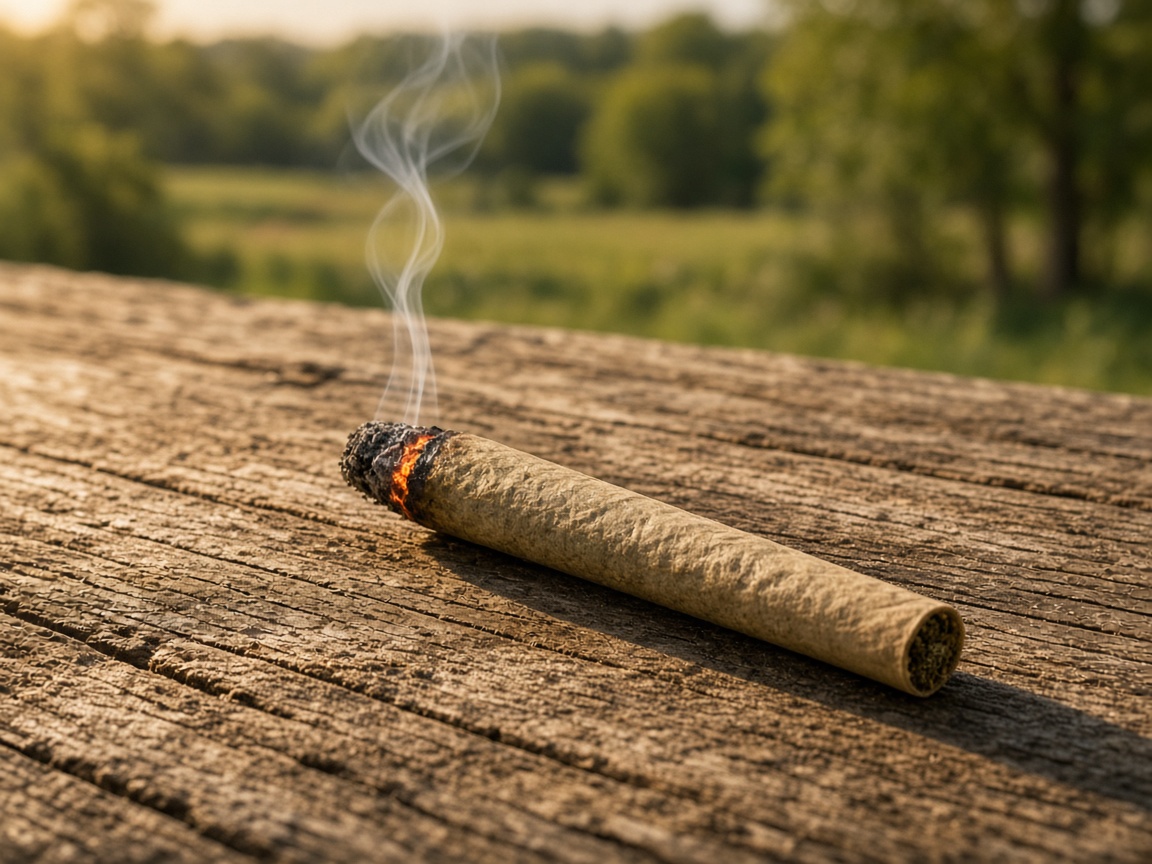
While nobody's pulling, the lit end keeps turning flower into smoke that never enters a pull. That side smoke is the stream off the cherry. Your next inhale is a different stream.
The cherry doesn't pause for the conversation. It keeps eating the joint while somebody finds the lighter.
Gieringer, St. Laurent, and Goodrich (2004) put this on machines. Cigarettes smoked with pauses caught as little as 16% to 19% of the THC. A machine that smoked straight through caught 69%. Those numbers are what the machine trapped in the smoke. They aren't a blood reading.
Their own burn caught 78%. They set it up so the side smoke couldn't drift, and they left no unsmoked end. They say the 78% is high for that reason. Even then, about 22% of the THC was gone, in line with the share the heat destroys. A joint in a hand does the opposite. It idles, it throws smoke off the cherry, and it leaves an end.
In that same paper they pass on an older estimate from Perez-Reyes. About 23% to 30% of the THC is destroyed in the burn. As much as 40% to 50% can leave in the side smoke. That's an estimate they cite, not a measurement of your couch.
Sheehan and colleagues (2018) ran a later machine on real joints. It waited a full minute between pulls. On average, 12.6% of the THC in the flower showed up in the smoke they caught. The middle joint was 10.8%. The spread ran from 7.2% to 28%. A minute is a long pause. A circle isn't that machine. More waiting still means less THC in the pull.
What the idle burn is doing:
- The cherry keeps combusting flower you aren't inhaling.
- Side smoke off that cherry doesn't become the next pull.
- Heat destroys a share of the THC before anyone inhales it.
- Some THC stays in the end nobody finishes.
How much of the THC in a joint actually reaches you? #
Most of the THC in the flower never reaches your blood. The burn, the side smoke, and the unsmoked end take a cut first. Then your lungs keep only part of what you inhaled.
Huestis (2007) puts the share that reaches the blood at about 8% to 24% for smoked THC. It depends on how long that person has been smoking. A wider set of reports runs from 2% to 56%, because people don't pull the same way. That's the share that gets into the blood, after the smoke cut. Catching 69% in a machine's smoke still isn't 69% in a person.
Huestis is plain about where the rest goes. The burn destroys more THC. Side smoke carries more away. The unsmoked end holds more. What's left in the cigarette is already less than the flower started with.
How you pull moves the share that gets in:
- How many pulls you take.
- How long each pull lasts, and the gap before the next one.
- How long you hold the smoke, and how deep you inhale.
Expectation can change the pull itself. Huestis points to Cami and colleagues, who watched people smoke hash cigarettes. When they expected the real thing, they changed how they smoked. Their blood THC went higher than when they expected a blank.
Why do fewer, spaced pulls change the high? #
You inhale less of the joint than you would alone, and the cherry keeps burning for nobody. Fewer pulls mean less smoke in you. Longer gaps mean more flower burned with no one inhaling it.
Four people on one joint is a smaller slice per person. You don't need a lab for that part. The lab is what the gap costs on top of the slice.
Gieringer and his coauthors cite Fehr and Kalant on machine-smoked cigarettes. When the puff length and the draw changed, the THC caught in the smoke ran from 34% to 61%. Rhythm moves the catch before you even split the joint among friends.
Your own joint is pull, a short pause, pull again. In a circle you pull, then the joint goes around the room. That lap is the pause the machine work was already punishing. Sheehan's minute-long wait is the extreme. A lap around the couch is a long version of that same pause.
The smoke hanging in the room is that side stream, not your pull. What room smoke can and can't do is the contact-high piece. This page stays on the joint you're actually hitting.
Does coming back later feel like the same session? #
No. A straight run of pulls piles THC up while you're still smoking. A top-up later starts a new rise.
THC shows up in the blood with the first pull. In the session Huestis charts, the blood level peaked at 9 minutes, before the last pull. Pulls packed that close can still sit on the climb.
He also notes the blood level can start falling before the feeling peaks.
A lap that runs past that climb isn't the same shape. You take a pull, the joint leaves, and your next one lands after the rise has already turned. Coming back later for a few more pulls is a second small rise. It isn't the back half of the first one.
Why can the same flower feel stranger in a group? #
The group changes the mood of the high, and it changes what you expect the joint to do. Less of the THC makes it in, because the cherry wastes flower between pulls. The odd feeling is the people you're with.
Denson and colleagues (2023) tracked mood in daily life. Sour mood was higher when people used cannabis alone, and lower when other people were there. Good mood was up at use times either way. Company doesn't swap the flower. It changes how that high feels with other people there. Who talks and who goes quiet is why some weed makes you talk.
What you believe about the joint moves the report too. Metrik and colleagues (2012) tested 136 regular smokers. Some got real THC and some got a blank cigarette. Separately, some were told it was THC and some were told it wasn't. The real THC raised the felt high. Being told it was THC raised the felt high too, on its own.
An earlier pilot from Metrik and colleagues (2009) used 20 smokers in that same kind of split. What they were told had large effects on how potent the cigarette seemed, and on strength, taste, smell, and satisfaction. It also changed how they smoked. The real THC still showed up in how their bodies felt.
So talk in the circle still counts. If the room has already decided the jar is weird, you hear that before you pull. The lab split was whether they were told the cigarette had THC. It wasn't a test of someone calling the jar weak. What they were told still moved the felt high. The THC still did its own work.
Two people on the same lap still aren't having one high. Bodies differ. That's why everybody's high is different.
How does your own joint compare with the rotation? #
Your joint is a steady burn you finish. The circle's joint idles, gets split into fewer pulls, and sits in a room that's already working on the mood.
| Your own joint | The circle's joint | |
|---|---|---|
| How you pull | Pull, short pause, pull again | One pull, then a lap around the room |
| The cherry | Less time burning alone | Keeps burning in someone's hand |
| THC in the smoke | A steadier catch | More lost to side smoke and the burn |
| How much you inhale | The whole joint | A few pulls |
| The climb | One rise while you keep pulling | A thinner rise, then a gap |
| The mood | The night you walked in with | Other people, and what they say about the jar |
A short personal pause still burns a little flower. A lap burns more, and you inhale less of what's left.
The jar from us #
Divine Toke sells that Michigan sun-grown flower by mail. If the circle wants a joint each, instead of one cherry doing laps, the shop has one-gram pre-rolls. The 20-pack is 20 of those joints, 20 one-gram pre-rolls for $120.
A pre-roll is still flower in paper. The pause still costs THC if you pass one around. You're just not stuck sharing a single cherry. How the roll is built is in why our pre-rolls are different.
The shop also has the flower itself, Honey Bananas solventless rosin, and Sundog bio hash. None of that changes the cherry if you're still passing one joint.
FAQ #
Does the last person on a joint get a stronger pull? #
The unsmoked end still holds THC, so the last bit isn't empty. Gieringer, St. Laurent, and Goodrich saw their high catch, 78%, when the burn left no end at all. That's a lab setup, not a shared roach. The last person still gets whatever the cherry hasn't already thrown off while the joint sat.
Does holding the smoke in make up for a short pull? #
Hold time changes how much gets in. It doesn't put back THC the cherry already lost. Huestis lists hold time with the number of pulls and the gap between them. The side-smoke loss in the Gieringer paper happens before your pull. A longer hold can't refill flower the cherry already burned for the room.
Is a shared pre-roll different from a joint you rolled? #
The burn works the same way. It's flower in paper either way. Sheehan and colleagues ran their minute-long pause on joints, and the catch was still about 12.6% on average. A pause still feeds the cherry. The roll and the flower are a separate question, and that's the pre-roll page.
If the circle goes quiet, is that the flower? #
The room can change the mood, and the flower can too. Denson and colleagues found sour mood higher when people used cannabis alone, and lower with other people there. Quiet in a group is a different night from quiet alone. Which jar makes people talk is why some weed makes you talk.
Does a second joint later match one you smoked straight through? #
No. It's a new rise, not the back half of the first climb. Huestis charts a blood peak at 9 minutes, with the last pull still ahead of it. The feeling can keep building after that blood peak has turned down. A joint much later starts the rise over.
Is the smoke in the room the same as your pull? #
No. Room smoke is the stream off the cherry between pulls. Your pull is the stream you inhale through the joint. What that room smoke can do to someone who isn't hitting it is the contact-high piece.
Does a longtime smoker get more from the same lap? #
The share that reaches the blood depends strongly on experience, and on how you pull. Huestis ties the 8% to 24% estimate to how experienced the smoker is. The wider spread, 2% to 56%, is people not pulling the same way. The body side, past the pull, is why everybody's high is different.
Does passing it slower weaken it if you take the same number of pulls? #
Yes. The gap costs THC even when your pull count stays put. Gieringer, St. Laurent, and Goodrich cite paused machine cigarettes that caught 16% to 19% of the THC. Straight-through smoking caught 69%. Your pulls can match, and the cherry still burns the middle for nobody.
If the jar feels normal alone, is the flower weak in the circle? #
If it's fine when you smoke it steady, the flower didn't change in the circle. The burn and the room did. One person, same jar, pulls with short gaps. If that feels like the jar and the lap feels thin, you're looking at the pause and the group.
Can what people say about the joint change the felt high? #
Yes. Being told a cigarette had THC raised the felt high on its own. Metrik and colleagues (2012) saw that in 136 regular smokers, separate from whether the cigarette actually had THC. The real THC still raised the felt high too. What the room says about the jar still moves the night. It doesn't replace the flower.
When the joint comes back around #
If you're curious, the one-gram pre-rolls are at the shop. Each person can keep their own. The 20-pack is there when a circle wants one each, 20 one-gram joints for $120.
Next time the lap feels thin, watch the cherry while the joint sits. That's the part of the high the circle is smoking without you.
This article is for educational purposes only and is not medical advice. Always consult your healthcare provider before starting any new wellness routine.
Try Honey Bananas — sun-grown in Detroit
Small-batch, living-soil flower cultivated in our Detroit sun-houses. Ships to all 50 states.