Late-September Rain and Bud Rot: What to Refuse Before It Hits a Detroit Jar
Late-September Michigan rain raises bud-rot risk. How Detroit shoppers smell and see mold in a jar — and why the move is refuse it, not cut around it.
Questions this article answers
- How do I spot bud rot or mold in a Detroit jar after late-September Michigan rain — and when should I refuse it?
- what does bud rot smell like
- can I cut mold off cannabis
- Michigan CRA yeast mold Aspergillus limits flower
- trichomes vs mold on weed
- why September rain raises cannabis mold risk Michigan

Head Cultivator
On this page
You crack a Detroit jar after a wet September week. The sticker looks fine. The bud looks loud. Then the lid hits your nose like a wet basement, not like pine or mango.
I'm Jamie. I write for the person who shops flower, not for a grow diary. Bud rot is gray mold, mostly a fungus called Botrytis cinerea, that starts inside dense flower when cool, wet air hangs around too long. Your job as a consumer is simple: smell it, look close, and refuse the jar if it fails. You don't cut around it. You don't "smoke past it."
This post stays on the counter and the jar. Harvest timing lives in when sun-grown cannabis is ready. The hang is in drying cannabis flower. September menu reality is in September harvest on a Detroit menu.
Why Does Late-September Michigan Rain Raise Bud Rot Risk? #
Late-September Michigan air still brings real rain and cool nights, and that combo favors Botrytis on dense outdoor flower. That's the same weather that shows up later as a musty jar if the hang loses the fight. Detroit shoppers meet what's left of that fight at the counter. You don't need a plant count to smell it.
NWS Detroit/Pontiac 1991–2020 climate normals put Detroit September at 74.4 °F / 55.5 °F average high and low, with 3.22 inches of rain. Nobody confuses that with desert harvest weather. It's Great Lakes harvest weather: warm days, cool nights, and enough water to keep dense colas wet inside.
Oregon State University's Pacific Northwest Pest Management Handbook entry on hemp gray mold (updated March 2026) says Botrytis cinerea likes cool temperatures between about 50–80 °F (optimal near 68 °F), high humidity, and free water on plant surfaces. Rainy stretches during bud maturation can trigger big outbreaks. Buds go brown and water-soaked, then may throw a gray-brown fuzzy spore mass.
A 2019 Frontiers in Plant Science review of cannabis pathogens (Punja et al.) treats molds that hit flower quality as a real production and postharvest problem, not a meme. Southeast Michigan outdoor lots sit in that same moisture math. We're a Detroit-area Michigan sun-grown organic cannabis farm, and I'm not going to make up acreage, cultivars, or a claim that our field got rot or never does. The weather does what it does. The jar tells on the week.
| Weather piece | What NWS / extension says | What it means for a jar |
|---|---|---|
| Detroit Sept temps | 74.4 / 55.5 °F normals | Nights cool into the Botrytis comfort zone |
| Detroit Sept rain | 3.22" normal | Free water on dense colas |
| Botrytis sweet spot | ~50–80 °F, wet surfaces | Infection can start inside the bud before you see gray |
| Consumer leftover | Musty nose, soft brown core | Refuse. Don't "fix" it with scissors |
Think of a wet winter coat hung in a closet. The outside looks dry first. The lining stays damp. Dense sun-grown colas work the same way when lake air and rain stack up. September harvest timing for Detroit menus already said cut week isn't jar week. Rain is one reason that gap exists.
What this section is not #
This isn't a spray schedule or a hoop-house tutorial. It's the climate reason a Metro Detroit shopper should treat a weird September jar with less trust and more nose.
What Does Bud Rot Smell and Look Like in a Jar? #
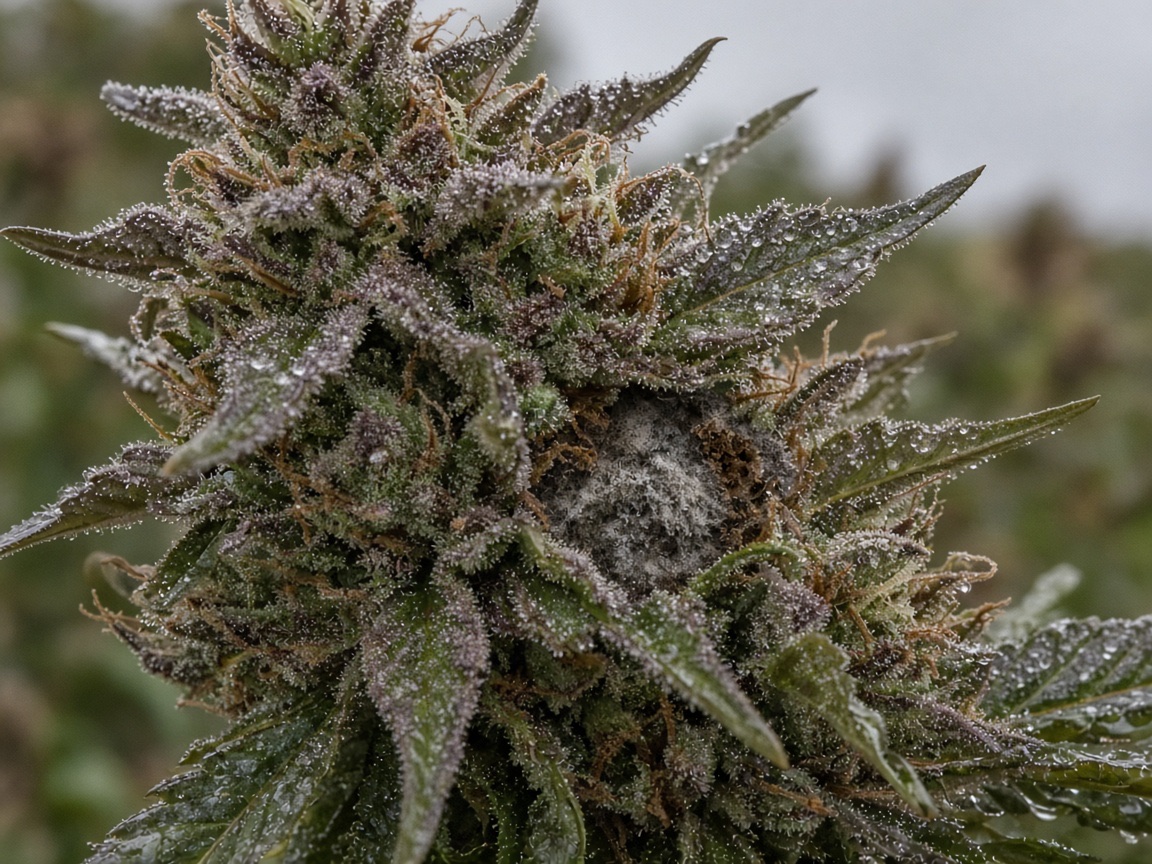
Bud rot and moldy flower usually smell musty, mildewy, or like hay or a wet basement. They often show soft brown, gray, or fuzzy patches deep inside the cola, past the pretty crystals on the outside. Your nose often catches it before your eyes do.
Healthline's moldy-weed guide (updated July 3, 2025) says moldy cannabis often has a grayish-white powdery coating and a musty or mildewy smell, and it may smell like hay. The same piece says if you can see mold, you're better off tossing it. Life's too short for bad bud. That's how Detroit counters should treat an off jar: walk.
The PNW handbook gray-mold photos and symptoms describe brown, water-soaked spots on buds, dead brown tissue, and a fuzzy brownish-gray mass when the fungus is sporulating. In a sealed jar you may see a soft brown pocket inside a cola more than a full gray cloud. Either way, it's not "extra trichomes."
The smell check first #
Healthy Michigan flower should smell like its oils (pine, citrus, pepper, mango, gas), not like a damp laundry pile. Off smells that matter:
- Wet basement / mildew: classic mold flag
- Hay or old grass: can be bad dry, mold, or both. Still a refuse signal if strong
- Ammonia or sour rot: walk away
- No smell at all when it should be loud: not always mold, but not a green light either. Terpene freshness after Michigan humidity covers dead jars
Crack the lid in the store if the shop allows it. If they won't let you smell sealed flower, ask for a sample jar or a fresh crack with a budtender watching. A sticker is not a nose.
The look check second #
| What you see | Likely meaning | Consumer move |
|---|---|---|
| Soft brown or gray pocket inside a dense cola | Classic bud-rot core | Refuse the jar |
| Fuzzy gray-brown "dust" that is not shiny | Spore mass, not resin | Refuse |
| Powdery gray-white coating | Mold / mildew family | Refuse |
| Shiny, glassy, hair-like crystals | Trichomes (resin glands) | Keep looking with your nose |
| Webbing with tiny bugs | Possible mites, not Botrytis | Refuse for a different reason |
Pull buds apart gently if the shop lets you. Bud rot often hides in the middle of a dense cola. The outside can still look market-ready. That's why "it looked fire" isn't a lab result.
Don't confuse a dry brown sugar leaf tip with a soft, wet, collapsing core. Dry leaf tip is normal. Soft collapse plus musty smell is not.
Trichomes vs Mold: How Do You Tell Them Apart? #
Trichomes are the shiny, sticky resin glands that look like tiny crystal hairs. Mold looks powdery, fuzzy, or soft-brown and usually smells wrong. If your eyes are unsure, trust the smell and refuse.
Healthline draws the line clearly: trichomes look like little hairs that almost glitter. Mold has a gray or white powdery look and a distinct musty odor. Trichomes are part of why the jar smells like cannabis. Mold is why the jar smells like a basement.
Here's a plain Detroit-counter checklist:
- Shine test. Real resin looks glassy under light. Mold looks dull and dusty.
- Structure test. Trichomes sit like tiny towers. Mold sits like a film, powder, or soft rot pocket.
- Smell test. Good oils smell like the plant. Mold smells like mildew, hay, or wet concrete.
- Core test. Gently open a cola. Rot often starts inside. Trichomes don't "rot a tunnel" through the bud.
- Feel test. Moldy spots can feel soft or slimy. Healthy cured flower feels springy-dry, not wet-soft.
| Signal | Trichomes | Mold / bud rot |
|---|---|---|
| Look | Clear-to-cloudy shiny hairs | Powdery, fuzzy, or soft brown/gray |
| Smell | Matches the strain's oils | Musty, mildew, hay, basement |
| Location | Surface of flower and sugar leaf | Surface film or inside the cola |
| Feel | Sticky / resinous | Soft, damp, or dusty wrong |
If you're shopping after a rainy Southeast Michigan stretch, spend thirty extra seconds on the core test. Late September is when dense outdoor flower sees the most free water. That's climate, not vibes. See the NWS Detroit normals and the PNW Botrytis entry again.
What Does Michigan CRA Microbial Testing Actually Check? #
Licensed Michigan flower must pass microbial screens that include total yeast and mold counts plus "not detected" limits for four Aspergillus species. A pass is a batch snapshot, not a forever guarantee once the jar sits wrong. Read the sticker and still use your nose.
The Michigan Cannabis Regulatory Agency (CRA) publishes sampling and testing guidance. In the CRA Sampling and Testing Technical Guidance for Marijuana Products, microbial action limits for bud, shake/trim, and kief include:
| Test | Adult-use flower limit | Medical flower limit |
|---|---|---|
| Total yeast & mold (CFU/g) | 100,000 | 10,000 |
| Aspergillus flavus, fumigatus, niger, terreus | Not detected in 1 gram | Not detected in 1 gram |
| Water activity (flower) | Pass if ≤ 0.65 aw | Same rule family |
Those numbers live under the lab-testing framework in Mich. Admin. Code R. 420.305. The agency publishes action limits. A sample above the limit fails.
What that means at a Ferndale or Detroit-area counter:
- A pass means that batch's tested sample cleared the published limits at test time
- A pass does not mean you should ignore a wet-basement smell two months later in a muggy apartment
- Total yeast & mold is a count ceiling, not a promise of "zero fungi forever"
- Aspergillus species on that list must not be detected in 1 gram. That's a hard safety line, not a style choice
Our deeper lab explainer is what lab-tested means in Michigan. Outlier Media's look at Michigan cannabis lab testing is also worth reading if you want the messy human side of potency and mold labels. Trust the system as a floor. Keep your nose as a second check.
A PMC review of cannabis contaminant regulations notes microbial contamination among the common failure reasons in legal markets. Michigan's rules exist because mold is a product-safety problem, not a vibes problem.
What the package will not scream at you #
The CRA label won't print "this cola saw three rain days in late September." It shows potency, lab identity, dates, and the required warnings the sister posts cover. Your job is still sensory. No sticker smells the jar for you.
Adult-use vs medical yeast-and-mold numbers #
Adult-use flower can pass with a higher total yeast-and-mold ceiling (100,000 CFU/g) than medical flower (10,000 CFU/g) under the same CRA technical table. That's a regulatory difference, not a permission slip to ignore a mildew nose. Aspergillus detection rules stay hard for both lanes: not detected in 1 gram for the four named species.
If you carry a Michigan medical card and shop medical SKUs, you're shopping under the tighter yeast-and-mold ceiling. If you shop adult-use, you still get the Aspergillus gate and the water-activity gate. Either way, a musty jar after a wet week isn't a math problem you solve with loyalty points.
Metro Detroit shoppers bounce between adult-use shelves and medical counters all the time. Ask which lane the jar is in before you treat the number like a personality test. The Michigan CRA page is the agency home if you want the official lane, not a forum rumor.
Why Is "Cutting Around" Rot Not the Move? #
If you can see mold or smell rot, refuse the flower. Do not trim the brown pocket and smoke the rest. Spores and soft rot aren't a neat circle you can scissor out.
Healthline says there's not really a way to "remove" the mold, and cutting off the obvious bits is a bad idea. In healthy people, smoking moldy cannabis still isn't recommended. In people with weak immune systems or lung disease, fungi like Aspergillus can cause serious infections. That's educational context, not a diagnosis. Talk to your clinician if you have lung or immune concerns.
Consumer moves that fail:
- "I'll just cut the brown out." Rot often threads inside the cola. The gray you see is late news.
- "I'll bake it / torch it harder." Heat isn't a home microbial lab.
- "It passed testing, so it's fine." Testing was a batch sample at one time. Your jar has its own life after that.
- "It was expensive." Sunk cost isn't a lung plan.
- "My buddy smokes worse." Your buddy isn't your COA.
| Temptation | Why it fails | Better move |
|---|---|---|
| Cut around the rot | Mycelium / spores are not a clean edge | Refuse / return if the shop allows |
| Mix into a joint with "good" flower | You still inhale the bad fraction | Do not dilute the problem |
| Blame the harvest sticker alone | Stickers don't print Botrytis | Use nose + eyes + lab sheet |
| Store it "to dry out" | Wrong RH can feed more mold | Throw it. Fix storage next time |
Divine Toke sells sun-grown flower into Michigan's licensed lane, and we won't show you how to salvage moldy weed. The regenerative process pillar is regenerative cannabis process. This spoke is about refusing a bad jar before it hits your lungs.
What Myths Should Detroit Shoppers Drop About Moldy Flower? #
Drop the myths that mold is "just extra kief," that a high THC number proves safety, or that you can cook mold out at home. None of those protect your lungs. Smell and microbial reality beat folklore.
Common Michigan-counter myths:
| Myth | Reality |
|---|---|
| "Gray dust is just trichomes" | Trichomes glitter. Mold powders and smells musty (Healthline) |
| "It passed CRA so it can't go bad" | Pass is a batch snapshot. Storage and later moisture still matter (CRA guidance) |
| "Outdoor always means mold" | Outdoor raises moisture pressure in September. It doesn't auto-fail every jar (NWS Detroit normals) |
| "Indoor never molds" | Indoor rooms mold too when RH and free water win (PNW Botrytis handbook) |
| "I'll just cut around it" | Spores and soft rot aren't a neat circle. Refuse |
| "Higher THC = safer" | Potency isn't a microbial test. Safety rows are separate on the COA (what lab-tested means) |
Outlier Media's Michigan testing reporting is a reminder that labels and labs are human systems. Your nose is still the best instrument in the parking lot. Use it.
If a friend swears they "always smoke the brown bits," that's their story. It isn't a protocol. The house rule on this blog: refuse moldy flower, especially if you have asthma, COPD, or a weakened immune system. Talk to your clinician about your own risk.
How Should Detroit Shoppers Inspect Before They Buy? #
Smell the jar, look for soft brown or fuzzy gray, ask for the batch COA microbial line if you can, and walk if anything fails. That matters especially after a wet late-September stretch in Southeast Michigan. Thirty seconds of inspection beats a week of regret.
A practical Metro Detroit checklist:
- Read the harvest and pack dates when they are printed. Fresh isn't automatic quality, but old jars in humid apartments need extra nose time. Date literacy lives in harvest date vs pack date.
- Crack and smell. Pine, citrus, fuel, pepper = oils. Basement, mildew, hay-rot = refuse.
- Look under light. Shiny trichomes vs dull powder vs soft brown core.
- Ask for the COA. Confirm microbial / yeast-mold / Aspergillus rows show pass, per the CRA testing guidance.
- Ask how it was stored at the shop. Hot windows and damp back rooms are real.
- Buy less first when you are trying a new late-harvest lot. A gram teaches cheaper than an ounce.
| Step | Pass signal | Fail signal |
|---|---|---|
| Smell | Matches the cultivar story / oils | Wet basement, mildew, ammonia |
| Look | Springy flower, shiny resin | Soft brown core, fuzzy gray |
| Paper | COA microbial pass | Missing COA, vague answers |
| Storage talk | Cool, dark, sealed | Product baking by a sunny door |
Shift workers and weekend shoppers in Detroit, Warren, Dearborn, and the downriver towns all hit the same September weather story. The NWS Detroit September normals don't care which exit you took off I-75. Dense outdoor flower that saw rain still has to survive dry-down. If the hang lost, you meet that loss at the counter.
Scissors timing can change how moisture leaves the plant. That's wet trim vs dry trim. Scissors don't erase a rotten core. You still get to say no.
A short "refuse now" script #
You don't need a speech. You need a sentence.
- "This smells musty. I'm going to pass."
- "Can I see the COA microbial lines for this batch?"
- "The core looks soft and brown. Got another lot."
Budtenders who respect Michigan shoppers will help you pivot. Budtenders who pressure you past a basement smell are telling you something about the shop, not about your manners. Licensed cannabis is a regulated product under the CRA. You're allowed to shop like it matters.
What rain week shopping feels like in Detroit #
After a soggy late-September band, outdoor-leaning menus move fast and uneven. Some jars are loud and clean. Some jars look loud and smell wrong. September harvest on a Detroit menu already framed cut week vs jar week. This post adds the say-no move for the jars that lost the moisture fight.
You might be coming off a shift in Sterling Heights, a hospital night in Midtown, or a Saturday run through Ferndale. Same weather. Same job for your nose. Crack the lid. Trust the basement smell. Buy the clean one.
What Does Rain Season Mean for Harvest Timing and Drying? #
Late rain doesn't automatically ruin every outdoor plant. It raises the mold clock, so harvest timing and a real dry room matter more, and you still judge the finished jar, not the weather app. The grow-side depth lives in the sister posts below.
When sun-grown cannabis is ready covers maturity signals. Drying cannabis flower has the hang numbers. Wet trim vs dry trim handles scissors timing when humidity is sticky. Read those for process depth.
What you need here, as a shopper:
- Rain raises free water on dense colas. Botrytis loves that water, per the PNW gray-mold handbook.
- Detroit September still rains. 3.22 inches is the normal at Detroit per NWS monthly normals.
- A rushed dry can trap moisture in the core. A slow dry in sticky air can feed mold. Both can fail. The jar tells you which week won.
- Cut week ≠ jar week. September harvest on a Detroit menu already said that. Rain is one reason the gap exists.
| Stage | Grower pressure after rain | What you smell later |
|---|---|---|
| Field / finish | Dense wet colas, cool nights | Soft brown cores if rot started |
| Hang / dry | Dehumidifier fight vs lake air | Hay, mildew, or clean oils |
| Cure / jar | Water activity must stay in line | Stable nose vs basement nose |
| Retail shelf | Storage heat and RH | Same jar can go wrong after a pass |
I'm not going to make up Divine Toke harvest dates, plant counts, or a claim that our barns never feel pressure. Michigan outdoor is public weather plus private craft. You buy the craft. You refuse the failure.
Consumer translation of the hang #
You won't see the dry room. You'll smell whether it won.
| Hang outcome | Jar tell | Shopper move |
|---|---|---|
| Cool, steady dry | Oils intact, springy flower | Buy if COA and nose agree |
| Rushed heat dry | Flat nose, harsh smoke feel | Be picky. May still be mold-free but dead |
| Sticky slow dry | Musty, soft core, gray film | Refuse |
| Good dry, bad home storage | Started fine, turned musty later | Toss. Fix storage next time |
The hang science is in drying cannabis flower. Freshness after humidity is in terpene freshness after Michigan humidity. Stay on this page for the say-no decision. You can't audit a dry room from the parking lot anyway.
Which Storage Mistakes Invite Mold After You Get Home? #
A Michigan CRA pass doesn't protect flower you leave damp, warm, or half-sealed in a humid Detroit apartment. Storage mistakes can grow mold after you buy. Keep jars cool, dark, and sealed. Don't fridge-hack the problem.
Healthline's storage notes recommend avoiding fridge and freezer moisture swings, using airtight glass, keeping flower dark and dry, and aiming near 59–63% relative humidity in the container. Too wet invites mold. Too dry kills the nose. Terpene freshness after Michigan humidity and keeping September flower alive in a Detroit apartment go deeper on apartment air. How to store your weed is the longer storage map.
Common fails after a wet September buy:
- Leaving the lid loose "to breathe" in a muggy kitchen
- Parking the jar on a sunny windowsill
- Stuffing a humidity pack that pushes RH too high
- Opening the jar twenty times a night and sealing wet bathroom air inside
- Bagging flower in thin plastic that sweats
| Mistake | What happens | Fix |
|---|---|---|
| Fridge / freezer | Condensation → mold risk | Room-cool dark cabinet |
| Loose lid | Room humidity floods the jar | Airtight glass |
| Hot car / window | Oils cook. Moisture moves | Leave it home |
| Over-wet pack | RH climbs past the safe band | Right-size humidity control |
| Ignoring new musty smell | You smoke a problem | Refuse / toss |
The CRA water-activity pass for flower sits at 0.65 aw or below in the testing guidance. That's a lab gate. Your kitchen isn't a lab. If the jar turns musty at home, don't argue with it.
Frequently Asked Questions #
What does bud rot smell like in a jar? #
It usually smells musty, mildewy, like hay, or like a wet basement, not like pine, mango, or gas. Healthline flags musty, mildewy, and hay-like odors as mold tells. If the lid smells like laundry left in the washer, refuse it.
Can I just cut the brown part off and smoke the rest? #
No. Refuse the jar. Rot often runs deeper than the brown pocket you can see. Healthline says cutting moldy bits off isn't a real fix. There's no home salvage trick worth your lungs.
Does a Michigan CRA pass mean the jar can never grow mold later? #
No. A pass means that batch sample cleared published microbial limits at test time. The CRA sampling guidance sets action limits. It doesn't babysit your apartment humidity. Smell again if storage was rough.
How do I tell trichomes from mold? #
Trichomes look shiny and hair-like. Mold looks powdery, fuzzy, or soft-brown and smells wrong. Healthline uses that glitter-vs-powder contrast. When unsure, trust the musty smell and walk.
Why is late September worse for bud rot in Michigan? #
Cool nights, leftover rain, and dense outdoor flower stack the moisture Botrytis likes. Detroit September normals are 74.4 / 55.5 °F with 3.22 inches of rain per NWS Detroit. The PNW gray-mold handbook ties outbreaks to rainy bud maturation.
What is Aspergillus and why does the CRA ban detecting it in flower? #
Aspergillus is a mold genus. Michigan's guidance requires four species (A. flavus, A. fumigatus, A. niger, and A. terreus) not detected in 1 gram of flower. That line sits in the CRA microbial table. Some Aspergillus species can cause serious lung infections in vulnerable people, which is why Healthline flags immunocompromised risk.
Is a wet-basement smell the same as good earthy weed? #
No. Earthy can mean soil-forward oils. Wet basement means mildew. Good sun-grown flower can smell like forest floor and still be clean. Basement/mildew is a refuse signal, especially after a wet Southeast Michigan week.
Does outdoor rain always mean the jar is rotten? #
No. Rain raises risk. It doesn't auto-fail every lot. Good dry rooms and honest sorting still exist. Your job is the jar in front of you (nose, eyes, COA), not a weather headline alone. Process depth: drying cannabis flower.
Should people with weak immune systems or lung issues be extra careful? #
Yes. Moldy cannabis is a harder no if you have lung disease or a weakened immune system. Healthline notes serious fungal infection risk in those groups. This is education, not medical advice. Ask your healthcare provider about your own risk.
What should I ask a budtender if the jar smells off? #
Ask to smell a fresh crack, see the COA microbial lines, and hear how the jar was stored. Then buy something else if answers are vague. Michigan's licensed lane exists so you can ask. You don't owe the shop your lungs to be polite.
Does Divine Toke claim its own field never gets mold? #
No. We won't claim that, and we won't claim the opposite for clicks either. You get climate, CRA rules, and what to look for in a jar. Farm process talk stays in regenerative cannabis process, without made-up acreage or plant counts.
Where do harvest timing and drying fit if this is a shopping post? #
They explain why late rain shows up in jars. They aren't instructions to grow. Read harvest timing, drying, and September Detroit menus for process. Stay here for the say-no part.
Closing: Refuse the Wet Basement, Keep the Honest Jar #
If a Detroit jar smells like a wet basement or shows a soft brown cola core after late-September Michigan rain, refuse it. That's the whole consumer move. Lab passes matter. Your nose still gets a vote.
Late September in Southeast Michigan is Great Lakes harvest weather, not a desert postcard. NWS Detroit normals and the PNW Botrytis handbook explain why dense flower fights moisture then. The Michigan CRA sets microbial floors. You still crack the lid.
If you want to try clean sun-grown flower from Divine Toke, a Detroit-area Michigan sun-grown organic cannabis farm, shop the current menu. Keep the same refuse rules on every jar, ours included. Honesty travels both ways.
Related reading:
- September harvest on a Detroit menu
- Wet trim vs dry trim at Michigan harvest
- Drying cannabis flower from harvest to cure
- Terpene freshness after Michigan humidity
- What lab-tested means in Michigan
- Regenerative cannabis process
This article is for educational purposes only and is not medical advice. Always consult your healthcare provider before starting any new wellness routine, especially if you have lung disease, mold allergies, or a weakened immune system. Do not inhale moldy cannabis.
Grown in Detroit. Shipped to your door.
Small-batch, sun-grown cannabis cultivated in living soil. Mail-order shipping to all 50 states.
You Might Also Enjoy
Wet Trim vs Dry Trim at Michigan Harvest: Why Scissors Timing Changes the Jar
September 20, 2026 · 32 min read
September Harvest on a Detroit Menu: Why Cut Week Is Not Jar Week
September 3, 2026 · 22 min read
When Is Sun-Grown Cannabis Ready? Reading Trichomes, Pistils, and Late-Summer Weather
August 5, 2026 · 29 min read