No-Till Cannabis: Why We Never Flip Our Soil

Jamie
Head Cultivator
Flipping soil looks busy. It feels like farming. But under that shovel, you're breaking the tiny city that feeds the plant — fungal highways, worm tunnels, and the living crust that holds water when Michigan weather swings hard.
At Divine Toke — a sun-grown organic cannabis farm rooted in Detroit, Michigan — we treat soil more like a forest floor than a plowed field. This post breaks down what no-till cannabis farming is, why it beats tilling for soil and flower, and how the system actually works in plain English.
If you only remember one line: stop flipping the soil if you want the tiny life under it to keep feeding your plant.
What Is No-Till Cannabis Farming? #
No-till cannabis farming means growing plants in soil you never plow, flip, or mix — you plant into an undisturbed bed and feed it from the top with mulch, compost, and cover crops. The goal is simple: keep the soil's living structure intact so fungi, worms, and microbes can keep doing their jobs.
In plain terms, "till" means turning the dirt. A conventional farm might plow, disc, or rototill before every crop. That makes a clean-looking seedbed — and it also snaps fungal threads, collapses worm tunnels, and exposes buried carbon to the air. A USDA Agricultural Research Service summary puts the contrast bluntly: tillage turns the soil, while no-till uses disks to slice a narrow groove and slip seed in — "there is no soil disturbance of substance in no-till."
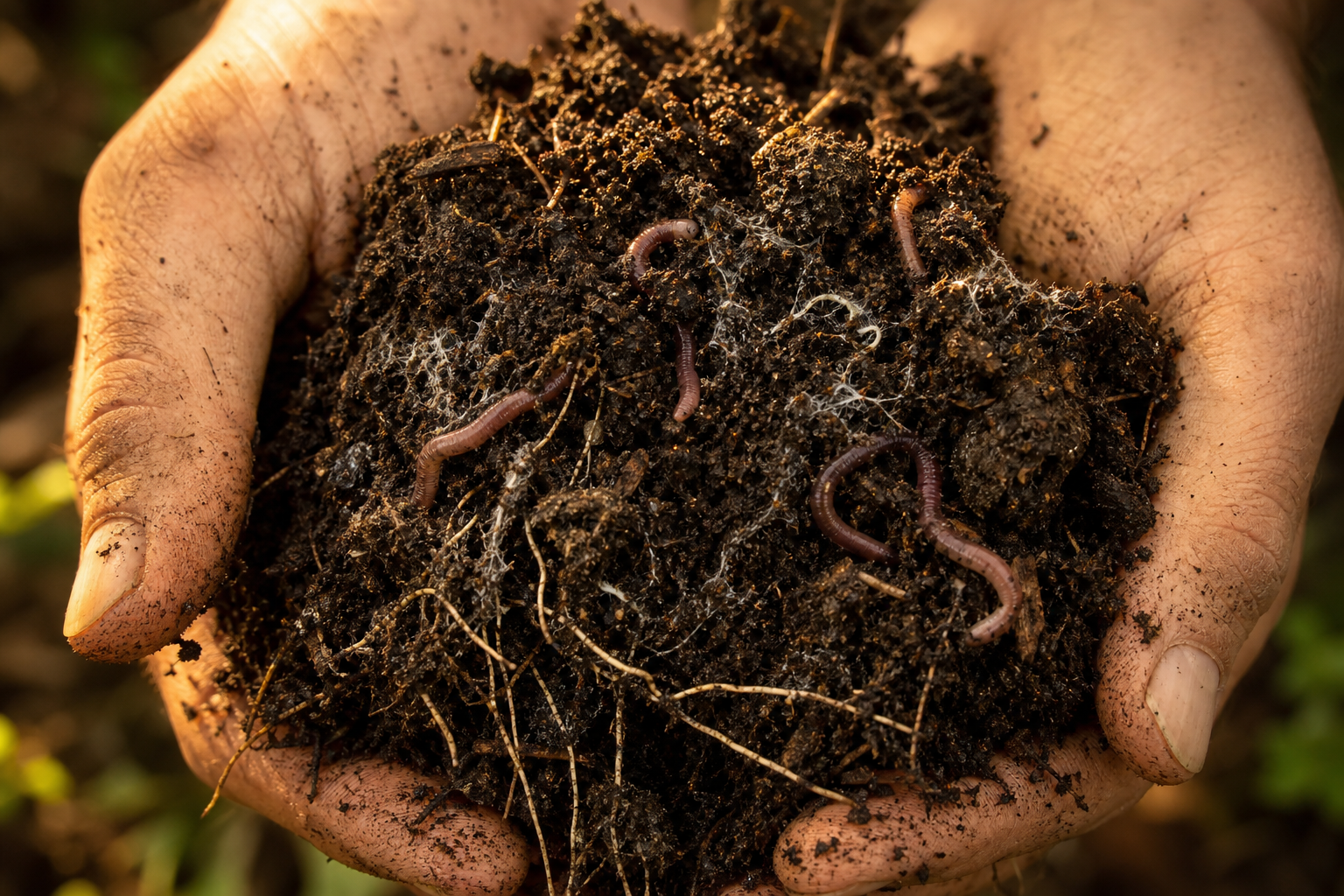
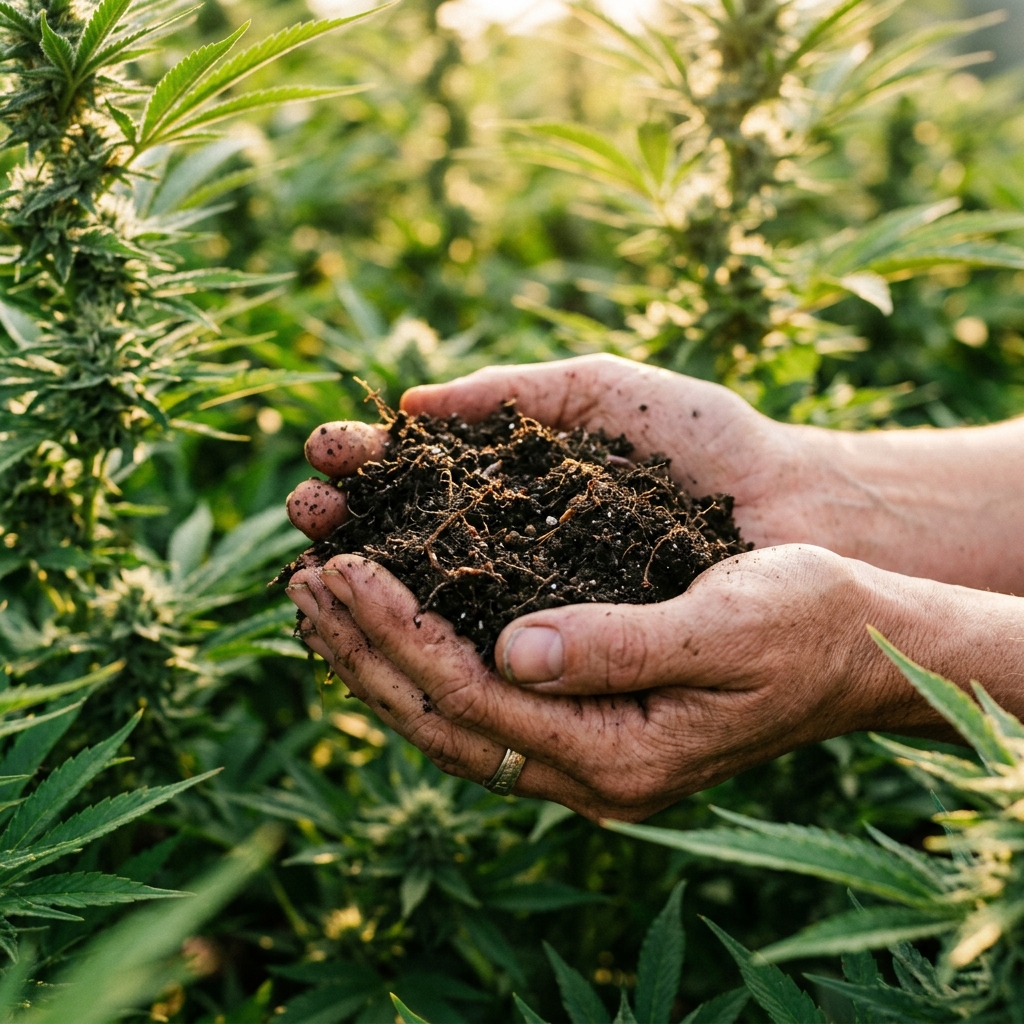
Cannabis growers use the same idea in beds or large containers. After harvest, you cut the plant at soil level. Roots stay. Mulch stays. The next plant goes into a hole, not into a freshly stirred pile. Over cycles, that bed gets richer instead of worn out — the same logic behind the living soil ecosystem we talk about so much at Divine Toke.
How No-Till Differs From Conventional Tilling #
| Factor | No-till cannabis | Conventional tilling |
|---|---|---|
| Soil disturbance | Minimal — plant into a small hole | Heavy — plow, flip, or mix the whole bed |
| Crop residue | Left as mulch on the surface | Buried or hauled away |
| Soil biology | Fungal networks and worm tunnels stay intact | Aggregates break; microbes get disrupted |
| Water behavior | Pore channels stay open for infiltration | Structure collapses; runoff risk rises |
| Fertility approach | Feed from above (compost, mulch, covers) | Mix fertilizers into the profile |
The USDA Economic Research Service defines no-till as a system where crop residue stays on the soil and the ground stays undisturbed from harvest to planting, except for nutrient injection. That federal definition matches what regenerative cannabis growers mean when they say "we don't flip our soil."
The Forest Floor Analogy #
Walk a Michigan woods in October. Nobody plows the leaves. They sit. Fungi lace them. Worms pull them down. Next spring, the soil under that litter is dark, spongy, and full of life.
A tilled field is the opposite move — like raking every leaf into a pile and stirring the forest floor with a blender each year. You get a blank slate. You also reset the biology to zero. No-till cannabis is the forest-floor choice: leave the armor on, feed from the top, and let the underground crew keep working.
That analogy is not poetry for its own sake. It is how natural systems already farm. Forests do not import bottled nitrogen every spring. They recycle. USDA ARS has described no-till as a "quiet revolution" in field agriculture for the same reason: minimal grooves for seed, maximum residue left as cover, and soil life left to assemble structure the way a woods does — slowly, then suddenly all at once when the biology hits its stride.
What you give up with no-till is the visual satisfaction of "clean dirt." What you gain is a bed that remembers last year. Memory, in soil, is structure and biology. Tillage erases both.
Why Does Flipping Soil Kill the Tiny Life That Feeds the Plant? #
Flipping soil kills or scatters the living network — bacteria, fungi, protozoa, nematodes, and worms — that breaks down organic matter and delivers nutrients to cannabis roots. Tillage does not just "aerate." It shreds habitat.
Healthy soil is not a pile of powder. It is glued into crumbs called aggregates — little clumps held together by fungal glue, root hairs, and sticky compounds from microbes. According to the USDA Climate Hubs, minimizing soil disturbance is a core soil-health principle because tillage breaks those aggregates and hurts the living organisms that cycle nutrients.
Michigan State University's long-term work comparing tillage systems makes the same point from the field: tillage changes the soil's chemical, biological, and physical properties and can raise erosion risk while cutting organic matter and biological activity (MSU CANR).
What Happens to Worms, Bacteria, and Aggregates #
When you flip a bed, three things hit at once:
- Aggregates shatter — the crumb structure that holds air and water collapses into dust that crusts or washes away.
- Organic matter "burns" faster — buried carbon gets mixed with oxygen, microbes race to eat it, and more carbon leaves as CO₂ instead of staying in the soil (the USDA notes no-till adoption reduces erosion, raises biological activity, and increases soil organic matter).
- Tunnels collapse — worm holes and old root channels are the soil's plumbing. Stir them shut and water sits on top or runs off instead of soaking in.
Bacteria often bounce back faster than fungi after disturbance. That sounds fine until you remember cannabis in living soil leans on a balanced food web — not a bacteria-only sprint. For the full cast of characters (protozoa, nematodes, the night shift), see our deep dive on living soil as an ecosystem.
Mycorrhizal Fungi: The Plant's Underground Delivery Network #
Arbuscular mycorrhizal fungi (AMF) are thread-like partners that colonize plant roots and extend far into the soil. Think of them as fiber-optic cable for phosphorus, water, and micronutrients — the plant pays in sugars; the fungus pays in reach.
Tillage is brutal to that cable. A Frontiers in Microbiology review of tillage and AMF notes that tillage can strongly undermine underground mycelium, shrinking how far fungi extend, cutting infection rates, and lowering community diversity. A 2024 PMC paper (PMC11034428) likewise reports that conventional tillage can decrease AMF diversity and activity, which weakens the plant–fungus partnership that supports yield and soil quality.
A related PMC study on tillage, rotation, and fungal distribution (PMC8247931) adds another layer: converting from conventional tillage toward no-tillage shifts how fungal groups are arranged in the soil profile, with low-disturbance sites supporting different — often richer — patterns of fungal life than repeatedly stirred ground. You do not need to memorize the taxonomy. You need the takeaway: fungi hate the blender.
In no-till beds, new roots often follow old root channels already lined with fungal life. In tilled soil, that highway gets bulldozed every cycle. Leaving the soil alone is how you keep the delivery network online.
Plain-English checklist for protecting fungi in a cannabis bed:
- Do not rototill or double-dig between cycles
- Leave fine roots in place after harvest
- Keep a mulch layer so the surface does not cook and crack
- Avoid burying the whole profile under fresh "hot" amendments without a rest period
- Prefer top-dress compost over deep mixing
No-Till vs Living Soil: Are They the Same Thing? #
No — living soil describes the biology in the medium; no-till describes the practice of not disturbing that medium. You can have living soil and still ruin it by tilling. You can also leave dead, sterile media "untilled" and still have nothing alive down there. The power move is both: a living food web and a no-till habit that protects it.
Here's the clean split:
| Term | What it means | What it is not |
|---|---|---|
| Living soil | Soil (or a bed mix) rich in microbes, fungi, worms, and organic matter that feed the plant | Just "organic fertilizer mixed into dirt" with no biology |
| No-till | You do not plow, flip, or remix the bed between cycles | A brand of bagged soil |
| Together | Biology stays intact long enough to mature across cycles | Magical soil that never needs feeding from above |
Trade reporting on cannabis cultivation treats the combo as a carbon-and-cost story as much as a flavor story. MJBizDaily notes that growers turn to no-till to limit carbon footprint, maintain soil health, and cut equipment and fertilizer spend across cycles — with healthy systems needing little to no off-site agricultural inputs once established.
Practical rule of thumb many growers use: a bed becomes truly "no-till" when you reuse it for the next run without stirring it. First cycle builds the biology. Second cycle proves you will leave it alone. From there, top-dress, mulch, and cover — don't dig.
If you want the ecosystem cast list, start with living soil isn't dirt. If you want how we feed that system without chemicals, pair this with composting at scale.
How No-Till Improves Water Holding and Cuts Erosion #
No-till helps soil drink rain instead of shedding it — open pore channels, surface mulch, and stable aggregates slow runoff and hold moisture for the plant. That matters for outdoor cannabis in Michigan, where a wet week can follow a dry one without asking permission.
The USDA Natural Resources Conservation Service builds soil health on principles that include soil armor (keep the ground covered) and minimizing soil disturbance. Bare, flipped soil is the opposite of armor. A mulch layer and living cover act like a raincoat and a sponge at the same time.
Field inventory work from NRCS shows how stark the water story can get. In the 2021 Cropping Systems Inventory focused on soil health, diversified systems with practices like no-till and cover crops showed much higher water infiltration rates than conventional tillage comparisons — on the order of several inches per hour versus well under one inch per hour in the conventional example reported there. Exact numbers vary by soil type, but the direction is consistent: structure + cover = water in, not water off.
What that looks like in a cannabis bed:
- Mulch shades the surface so the top inch does not bake hard and shed the next watering.
- Old root channels stay open so water can move down instead of pooling.
- Aggregates hold like tiny sponges so the plant has a reserve between irrigations.
- Less bare dirt means less erosion when a storm hits a slope or a raised bed edge.
| Water / erosion factor | No-till + cover | Conventional till, bare surface |
|---|---|---|
| Infiltration after rain | Higher — pores and channels stay open | Lower — crusts form, water runs |
| Evaporation from surface | Lower under mulch armor | Higher on exposed dirt |
| Soil splash / erosion | Residue and covers shield the surface | Raindrops detach loose particles |
| Plant drought buffer | Aggregates store more plant-available water | Plants stress sooner between waterings |
USDA ARS also flags no-till as excellent at reducing erosion — the trade-off being that tillage can break pest cycles that no-till must manage with other tools (covers, beneficials, sanitation). For cannabis, that usually means pairing no-till with cover crops and a living canopy, not hoping undisturbed soil solves every pest on its own.
Michigan outdoor growers feel this in their bones. A June downpour on flipped soil turns beds into chocolate milk. The same rain on mulched, structured soil sinks, cools the root zone, and leaves the plant standing. That is not theory. That is gravity meeting structure.
Does No-Till Cannabis Farming Help Store Carbon? #
Yes — leaving soil undisturbed helps keep carbon in the ground instead of stirring it into the air, and federal research has put numbers on that shift for U.S. cropland. Cannabis farms that stop flipping beds are riding the same soil-carbon physics as corn and soy no-till systems.
The USDA Economic Research Service (EIB-70) cites Eve et al. (2002): on average, a Corn Belt farmer switching from conventional tillage to reduced tillage would sequester about 0.33 more metric tons of CO₂ per acre per year over 20 years, while switching to the stricter no-till would sequester about 0.64 more metric tons of CO₂ per acre per year. Those are row-crop averages, not cannabis-specific trials — but the mechanism (less disturbance → less carbon oxidized → more organic matter staying put) is the same biology under a flower bed.
USDA also summarizes the broader package: no-till adoption reduces soil erosion, increases soil biological activity, and increases soil organic matter. Pair that with cover crops and compost, and you are stacking practices — which is exactly how regenerative cannabis growers talk about carbon. For the wider climate angle, see our piece on regenerative farming, carbon, and cannabis.
| Practice move | Carbon story (plain English) |
|---|---|
| Stop tilling | Less soil carbon gets "burned" by oxygen each season |
| Keep mulch/residue on top | Armor slows erosion that carries carbon away |
| Grow cover crops | Living roots pump carbon into the soil year-round |
| Add compost from above | Stable organic matter feeds microbes without digging |
One honest caveat from the research world: some global meta-analyses find that no-till alone does not always raise total soil carbon everywhere — depth, climate, and whether you also use covers matter. The durable lesson for a cannabis bed is still clear: disturb less, cover more, feed from the top. That is how carbon and biology win together.
Think of soil carbon like a bank account. Tillage is a fee every time you stir. Cover crops and compost are deposits. No-till stops the monthly fee. That is why regenerative cannabis talk always stacks practices instead of treating "no dig" as a magic spell. For the wider climate and cannabis angle — including how sun-grown systems fit the carbon story — read regenerative farming, carbon, and cannabis.
Consumer translation: when a farm says they never flip their soil, they are telling you they are trying to keep carbon and biology in the ground where they belong — not bragging about being lazy with a shovel.
What Goes On Top Instead of Digging: Mulch, Cover Crops, and Compost #
In a no-till cannabis system, fertility comes from the surface down — mulch, cover crops, and compost feed the soil food web without stirring the bed. You are not starving the plant by refusing to dig. You are changing the delivery route.
The NRCS soil health practices guide frames the playbook: keep soil covered, minimize disturbance, keep a living cover to feed the soil, and diversify with rotations and cover crops. Cannabis beds translate that into mulch layers, companion or cover plantings, and top-dressed compost — the same regenerative stack we use across Divine Toke's sun-grown organic approach.
Mulch as Soil Armor #
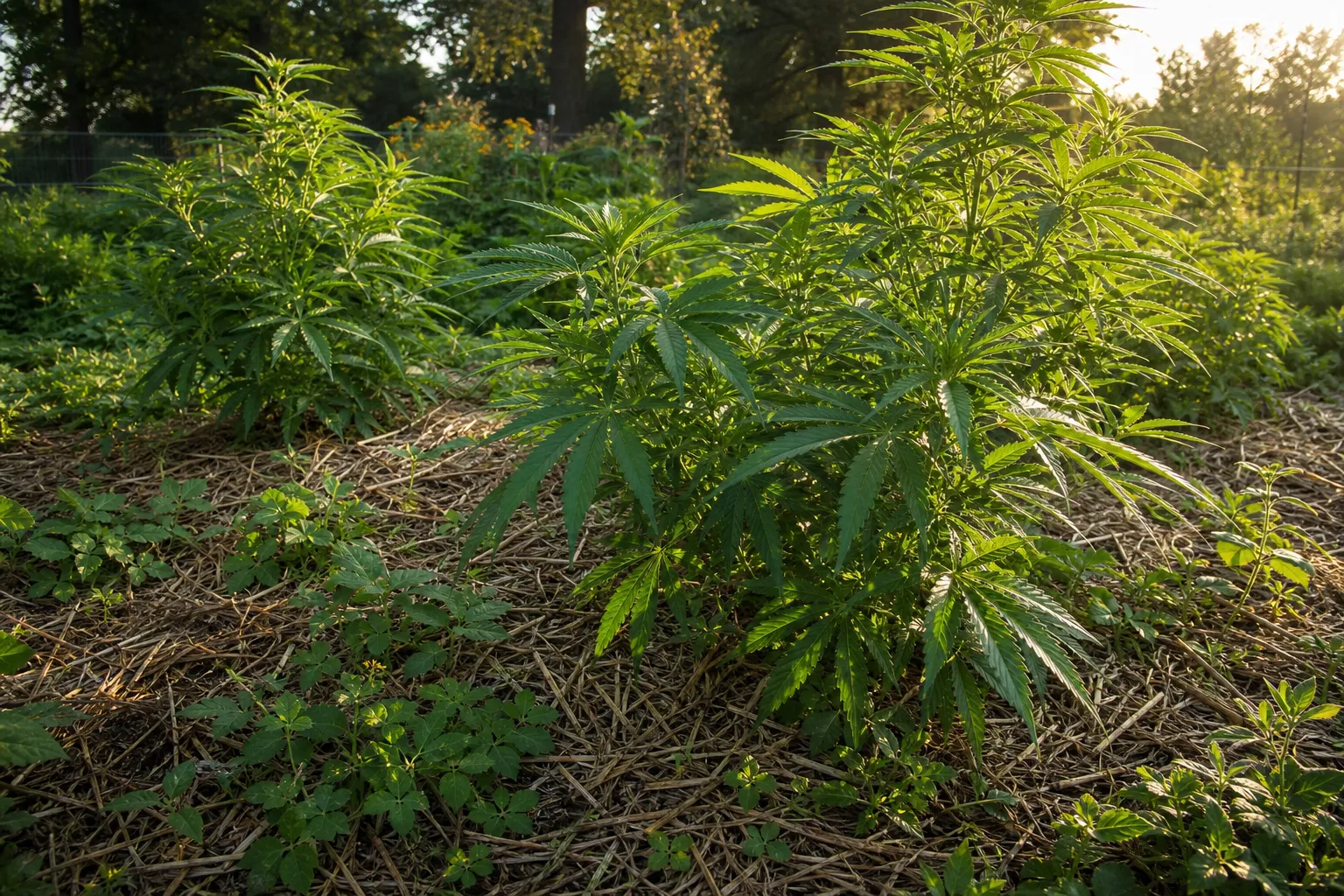
Mulch is the blanket. Straw, leaf litter, shredded plant material, or wood chips (used carefully) shade the surface, slow evaporation, and give worms something to drag underground.
What mulch does in a no-till bed:
- Blocks light that weeds need to germinate
- Cushions raindrops so the surface does not seal into a crust
- Feeds fungi and bacteria as it breaks down
- Keeps the top inch cooler in summer heat
NRCS calls this soil armor for a reason (Soil Health Principles). Bare soil is a wound. Covered soil is a working system.
Cover Crops and Living Roots Year-Round #
Between cannabis cycles — or along bed edges — cover crops keep living roots in the ground. Roots leak sugars that feed microbes. They hold soil when wind and rain hit. Some fix nitrogen. Others punch channels that become next season's plumbing.
That is the continual live plant/root principle in NRCS language, and it is why no-till pairs so well with the practices in our cover crops and companion planting guide. No-till without living cover is half a plan. Covers without leaving the soil alone is the other half. Together they build structure year after year.
Compost and Top-Dressing Without Tilling #
Compost in no-till is a surface feed, not a rototill mix-in. You spread finished compost or a light amendment layer on top and let rain, worms, and microbes pull it down. MJBizDaily describes mature no-till cannabis systems as needing little to no off-site fertilizer once the biology is humming — the soil recycles what you return as mulch and compost.
For how compost scales in a regenerative cannabis operation without becoming a chemical dependency, read composting at scale. The short version: feed the soil life, and the soil life feeds the plant.
Why No-Till Can Mean Better Cannabis Flower #
No-till can support better flower because an undisturbed rhizosphere — the root zone packed with microbes and fungi — helps the plant take up a steadier, more complete diet, which many growers link to richer aroma and a cleaner burn. That is a biological story with strong farm logic. It is not the same as a peer-reviewed cannabis trial that proves "X% more terpenes from no-till alone."
Here is the honest chain:
- Intact mycorrhizae and microbes improve nutrient and water access (supported by tillage/AMF research in Frontiers in Microbiology and PMC11034428).
- Less salt stress and boom-bust feeding than heavy synthetic programs means the plant spends less energy correcting deficiencies.
- Mature living soil cycles nutrients in plant-available forms as the crop asks for them — the same "ecosystem, not dirt" idea in our living soil deep dive.
- Growers and trade press report louder terpene noses and smoother smoke from living-soil / no-till programs; treat those as experienced farmer signals, not lab meta-analyses.
| What people notice | What likely drives it | How to talk about it |
|---|---|---|
| Stronger smell / flavor | Diverse secondary metabolites when plant is not nutrient-stressed | "Many living-soil growers report richer aroma" |
| Smoother burn | Cleaner inputs, fewer residues, better cure still matters | Soil method helps; cure still decides harshness |
| Consistent quality across cycles | Soil that improves instead of depleting | No-till + top-dress builds over seasons |
| Lower input smell of "chem" | Biology replaces bottled salt feeding | Organic living systems, not magic |
MJBizDaily frames the grower case around soil health, carbon, and cost — not a single potency number. That is the right framing for consumers too: no-till is about how the plant was fed, which shapes how the flower presents. Genetics, sun, harvest timing, and cure still do the heavy lifting. Undisturbed living soil gives those factors a healthier stage.
Common Mistakes When Switching to No-Till #
The most common no-till mistake is treating it like a slogan while still digging, leaving soil bare, or starving the biology between cycles. No-till is a habit, not a sticker on a bag of soil.
Watch for these traps:
| Mistake | Why it hurts | Better move |
|---|---|---|
| "Just one till" to fix compaction | Resets fungal networks and aggregates you spent seasons building | Use cover roots, mulch, and time; address compaction with living roots, not a rototiller |
| Leaving the bed bare after harvest | Loses soil armor; weeds and erosion move in | Mulch immediately; plant a cover crop |
| Yanking the entire root ball | Removes organic matter and fungal partners the next plant needs | Cut at the soil line; leave fine roots to decompose |
| No top-dressing for years | Biology runs out of food even if you don't till | Add compost and organic matter from above each cycle |
| Confusing "organic bag" with living no-till | Sterile or one-and-done mixes don't mature across runs | Build and reuse a living bed without flipping it |
| Skipping cover diversity | One plant type feeds a thinner soil food web | Rotate covers and companions (cover crop guide) |
NRCS guidance is blunt that tillage breaks aggregates and can harm the organisms that hold soil together (USDA Climate Hubs). So the "quick till to loosen things" urge is exactly the habit no-till is trying to break.
Patience matters too. MSU's long-term tillage comparisons exist because soil responses play out over years, not one weekend. Expect a no-till cannabis bed to feel more stable after a few full cycles — not after one heroic mulch day.
A Simple "Am I Actually No-Till?" Test #
Ask yourself after harvest:
- Did I leave the fine roots in the bed?
- Is the surface covered with mulch or a living cover within a day or two?
- Did I avoid mixing the whole profile "to fluff it up"?
- Am I planning to plant the next round into this same soil without dumping it?
Three yes answers and you are in the spirit. Four yes answers and you are running the system. Zero yes answers means you bought living-soil language and kept a tillage habit — which is how fungal networks keep losing.
The NRCS soil health practices checklist is built for farms of every size: keep covered, disturb less, feed the soil with living plants, diversify. Cannabis beds are not exempt from physics just because the crop is cannabis.
What Does a No-Till Cannabis Season Look Like? #
A no-till cannabis season is a loop — plant into an undisturbed bed, grow under mulch and living cover, harvest by cutting at soil level, then feed and cover again without flipping. The calendar changes. The shovel habit does not come back.
Here is a plain-English cycle many regenerative cannabis growers follow (yours will vary with greenhouse vs outdoor and your frost dates):
- Bed ready — Mature living soil, damp but not soggy, surface mulched. No rototiller weekend.
- Transplant — Dig only a planting hole. Tuck the root ball in. Pull mulch back around the stem, leaving a small bare ring so the stalk does not stay wet.
- Feed from above — Light compost top-dress if the bed needs it. Water in. Let worms and rain move nutrition down.
- Grow under armor — Keep mulch thick. Spot-pull big weeds by hand. Let companions or cover strips work the edges (cover crops guide).
- Harvest cut — Chop the plant a few inches above the soil. Leave fine roots. Optional: chop-and-drop clean leaf material as mulch if it is disease-free.
- Reset without till — Add compost, refresh mulch, sow a cover crop for the off-season. Do not empty the bed into a wheelbarrow "to start fresh."
| Season moment | No-till move | Tillage temptation to skip |
|---|---|---|
| Spring plant | Hole only | Full bed turn "to warm the soil" |
| Mid-season | Top-dress + mulch | Digging in dry fertilizer |
| Harvest | Cut and leave roots | Yanking whole root balls |
| Off-season | Cover crop + compost | Dumping soil and buying new |
That loop is why trade coverage like MJBizDaily's no-till cannabis feature talks about cost and carbon dropping over cycles. You stop buying a new soil story every round. You invest in one living bed and keep paying it in compost and cover.
If you are used to synthetic salt grows, this will feel slow the first month. The payoff shows up when the second and third cycles need less babysitting — fewer deficiency panic fixes, more "the bed knows what to do." That is the soil food web earning its keep, which we unpack in living soil as an ecosystem.
How Divine Toke Thinks About Undisturbed Soil #
At Divine Toke, undisturbed soil is not a trend — it is how we protect the living system that grows our sun-grown organic flower. We farm with a regenerative mindset: keep the ground covered, feed biology from above, and refuse the habit of flipping beds just because that is what farming "looks like."
We will not invent acre counts, bed sizes, or secret soil recipes here. What we will say plainly:
- Sun-grown organic flower starts with soil that is allowed to stay alive.
- No-till habits protect the fungi and worms that synthetic salt programs try to replace with bottles.
- Cover crops, compost, and mulch are the toolkit — not a rototiller.
- Detroit / Michigan roots keep us honest about weather, seasons, and working with land instead of against it.
If you are building a mental map of our farming cluster, this post sits next to:
- Living soil isn't dirt — it's an ecosystem
- Cover crops and companion planting
- Composting at scale
- Regenerative farming and carbon
- The broader living soil cannabis guide
The through-line is the same: great flower is grown, not manufactured. Leaving the soil alone is how we let the underground crew clock in every night.
Frequently Asked Questions About No-Till Cannabis #
What is no-till cannabis farming? #
No-till cannabis farming grows plants in beds you do not plow or flip between cycles — you plant into undisturbed soil and feed it from the top. Residue and mulch stay on the surface. Roots from the last plant are left to break down. The USDA ERS definition for field crops matches the spirit: soil stays undisturbed from harvest to planting except for limited nutrient injection. Cannabis growers apply that same "leave it alone" rule to living soil beds.
Is no-till the same as living soil? #
No. Living soil is the biology; no-till is the practice that protects it. You want both. Living soil without no-till gets reset every time you dig. No-till without biology is just undisturbed dead medium. MJBizDaily describes healthy no-till cannabis systems as ones that maintain soil health with little off-site fertilizer once established — that only works if the living community is actually there.
Why does tilling hurt mycorrhizal fungi? #
Tilling snaps the thread-like fungal networks (hyphae) that connect roots to a wider soil pantry. Research summarized in Frontiers in Microbiology shows tillage can undermine mycelium, reduce infection rates, and lower AMF diversity. A 2024 PMC review (PMC11034428) likewise links conventional tillage to decreased AMF diversity and activity. Intact fungi = longer nutrient reach for the plant.
Does no-till cannabis taste or smell better? #
Many living-soil growers say yes — richer aroma and a cleaner smoke — but cannabis-specific peer-reviewed proof isolating no-till alone is thin. The plausible mechanism is a healthier root zone and steadier nutrition, which supports secondary metabolites (terpenes) when genetics and cure are also dialed. Treat "louder nose" as a common farmer report, not a guaranteed lab result. Genetics, sunlight, harvest timing, and cure still decide most of what you smell.
How does no-till help with water and drought stress? #
No-till keeps pore channels and surface mulch intact, so water soaks in and evaporates slower. NRCS soil-health principles put soil armor and minimized disturbance at the center of that water story (NRCS Soil Health Principles). Inventory comparisons in the 2021 NRCS cropping systems soil-health report show infiltration rates many times higher in diversified conservation systems than in conventional till examples. Exact inches-per-hour depend on your soil, but directionally, structure holds water.
Does no-till farming store carbon in the soil? #
It can — federal estimates for U.S. cropland show meaningful CO₂ gains when farms switch from conventional tillage to no-till. Eve et al. (2002), cited by USDA ERS EIB-70, put the Corn Belt average near 0.64 metric tons of CO₂ per acre per year for a full conventional-to-no-till switch over a 20-year window. Results vary by climate and whether cover crops join the system. Cannabis beds use the same physics at a smaller scale.
How long does it take for no-till soil to improve? #
Expect noticeable stability after a few full grow cycles, with deeper gains over years — not overnight. Long-term university tillage trials exist because biology and organic matter move on multi-year clocks (MSU CANR). A new bed needs compost, mulch, and patience. A reused no-till bed should feel easier to manage as the food web matures.
Do you still add compost or amendments in a no-till system? #
Yes — you add them on top, not mixed through with a tiller. Top-dress compost, keep mulch thick, and use cover crops to feed microbes. USDA notes no-till systems increase biological activity and soil organic matter when residue and living systems stay in place. Feeding from above is how you replace the "mix fertilizer in" habit without destroying structure. More on that workflow: composting at scale.
Can you practice no-till cannabis indoors? #
Yes — large pots or raised beds can run as no-till living soil if you reuse the medium without dumping and remixing every cycle. Cut plants at the soil line, leave roots, refresh with mulch and compost, and transplant into a hole. Indoor no-till still needs light, airflow, and IPM. The "no flip" rule is the same whether the roof is glass, plastic, or sky.
What's the difference between no-till and regenerative farming? #
No-till is one tool; regenerative farming is the whole toolbox. Regenerative systems usually combine minimized disturbance with cover crops, compost, biodiversity, and often animal or insect partnerships. NRCS lists multiple principles — armor, minimize disturbance, diversity, continual living roots, and livestock integration where it fits (NRCS). No-till alone helps. Regenerative stacks practices. See regenerative farming and carbon.
Does no-till mean you never touch the soil at all? #
No — you still transplant, pull big weeds by hand, and top-dress. You just avoid full-bed flipping and deep mixing. USDA ARS describes field no-till as slicing a narrow groove for seed with no substantial disturbance. Cannabis no-till uses the same spirit: small holes, surface feeds, no blender pass through the whole profile.
Why do some farms still till if no-till is better? #
Tillage is familiar, fast for burying residue, and can interrupt some pest and disease cycles — but it trades those short wins for long-term soil damage. USDA ARS notes no-till excels at erosion control while tillage can help break pest cycles. Farms that stay regenerative answer pests with covers, beneficial insects, and sanitation instead of annual soil destruction. "Better" depends on goals: short-term cleanup versus long-term soil wealth.
Closing: Leave the Soil Alone — Let It Work #
If you take one idea from this post, take this: great cannabis soil works more like a forest floor than a plowed field. Flip it, and you fire the underground crew. Leave it covered, fed, and undisturbed, and that crew clocks in every night — fungi shipping nutrients, worms opening channels, microbes turning last season's roots into this season's dinner.
That is the heart of no-till cannabis farming, and it is why we never treat soil like something to beat into shape. At Divine Toke, our sun-grown organic flower is grown with regenerative habits — living soil, cover, compost, and patience — so what ends up in the jar tastes like a plant that was fed by a living system, not a spreadsheet of bottled salts.
Curious to try flower grown with that care? Start with whatever sun-grown organic Divine Toke offering your local Michigan shop carries, and ask how it was grown. Then keep learning the soil side of the craft:
- Living soil isn't dirt — it's an ecosystem
- Cover crops and companion planting for cannabis
- Regenerative farming, carbon, and cannabis
Farming methods shape flower quality, but this article is educational, not medical advice. Cannabis affects people differently — if you use it for wellness, talk with a healthcare provider who knows your situation.
Grown in Detroit. Shipped to your door.
Small-batch, sun-grown cannabis cultivated in living soil. Mail-order shipping to all 50 states.