Pollinators After Harvest: Michigan IPM When the Crop Is Cut
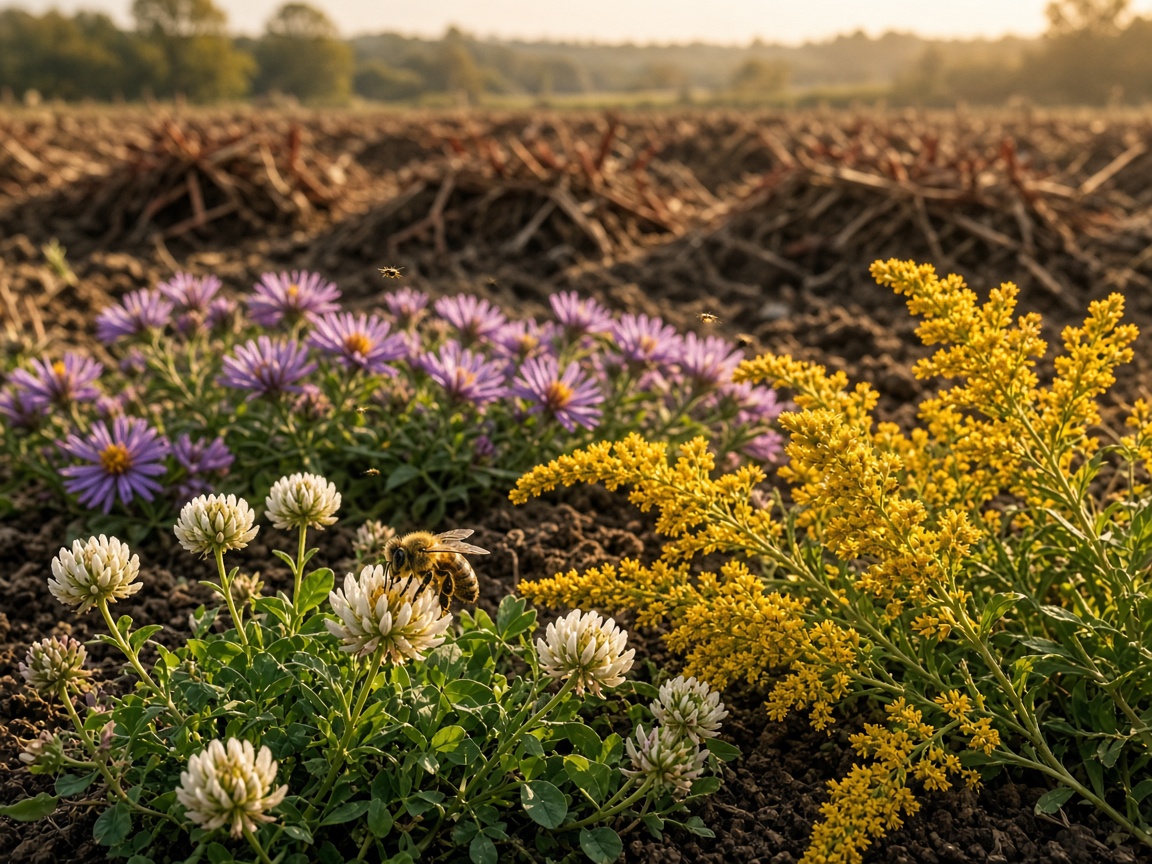
The last stalk is on the hang. Bees are still on the clover. After a Michigan harvest, pollinator habitat is the IPM job that starts when the crop is gone.
Questions this article answers
- What happens to pollinators and IPM on a Michigan cannabis farm after September harvest?
- do bees pollinate cannabis
- should you mow goldenrod after cannabis harvest
- Michigan IPM after harvest pollinators
- does cereal rye feed bees in fall

Head Cultivator
On this page
The last stalk is already on the hang. The bees didn't get the memo.
They're still on the clover strip. Cut week looks empty from the road. From the dirt, it's rush hour for goldenrod.
At Divine Toke, a Detroit-area Michigan sun-grown farm, that's the week people want to mow everything flat and call the season done. The plant left. The bees didn't. MSU Extension frost climatology still puts Detroit's median first 32°F night around October 18. Until that freeze, late bloom is food.
This post answers one question: what happens to pollinators and IPM on a Michigan cannabis farm after September harvest? The crop is gone. Habitat is the job. Skip the cleanup spray. Leave the edges that are still working.
If you want the soil version of this same week, start with fall soil rest after cut week. That piece is rye, roots, and a still bed. This one stays with the bees.
Why Are Bees Still Working After a Michigan Cannabis Harvest? #
Bees were never on the farm to pollinate your colas. Cannabis is wind-pollinated. After cut, they stay because late flowers still feed them, and the seed risk on female flower is already over. That's the whole plot twist. A Detroit shopper hears "pollinators" and pictures hives working a fruit crop. This isn't that.
Cornell entomologists Flicker and Grab treat hemp as wind-pollinated. It doesn't make floral nectar. Bees visit male flowers for pollen. They don't visit female plants for nectar, because there's none to take. A PMC7526430 pollen-capture study calls cannabis anemophilous, which is a long word for "the wind does the breeding." Flower growers spend the season stopping that breeding. Seeded buds are a loss, not a win.
So why are bees in the picture at all?
| Job people imagine | What actually happens |
|---|---|
| Bees pollinate the cannabis so you get bigger buds | Wind moves pollen. You don't want that on female flower. |
| Bees are useless once the crop is cut | They still need nectar and pollen until frost. |
| A cannabis farm "needs" hives like an orchard | No. Habitat is for the surrounding fields and next year's beneficials. |
| After harvest you can spray the field clean | Cleanup chemistry hits the same bees still working the ditch. |
When males are in the field, bees will take the pollen. PMC10455179 counted 1,826 pollinators on four industrial-hemp varieties and found sweat bees made up 84.7% of that bee community. Flicker, Poveda, and Grab's 2020 Environmental Entomology paper (the Cornell field work) recorded 16 bee species on New York hemp during a late-summer forage gap. That's a late-season snack, not a pollination contract.
After a September cut, that snack is gone from the beds. The bees don't vanish. They slide to whatever is still open: clover that didn't get mowed, goldenrod in the fence line, asters that wait for frost. Post-harvest IPM is the choice to leave those groceries out, or to "clean up" and starve the week the farm looks idle.
Divine Toke doesn't publish hive counts, acreage, or a street address. The habit is generic living-soil sun-grown: no invented apiary. If bees are on the cover after cut, the farm didn't clock them out with a mower.
The in-season predator story lives in beneficial insects for cannabis IPM. Ladybugs and predatory mites are a grow-season crew. This post is what you do when that crew's workplace just got harvested.
What Is Michigan's Fall Forage Gap After Cut Week? #
Michigan often hits a late-summer nectar slump, then goldenrod and asters carry bees to frost. After a September cannabis cut, those ditch flowers are the pantry. The empty beds aren't. If you mow the yellow strip because the field "looks done," you pulled the last plate off the table.
MSU's Michigan honey-plant list is blunt on timing. Goldenrod (Solidago spp.) blooms in September and October. Asters bloom mostly after frost. That's not a garden-center slogan. It's the calendar bees actually use around the Great Lakes.
Zachary Huang's MSU goldenrod note walks one Michigan fall in photos. Canadian goldenrod (Solidago canadensis) is the common one. Bees take nectar and pollen. In that 2020 diary, bloom was mostly done by October 7, and the bees moved to New England aster and calico aster if the day was warm enough. Your year will slide a week either way. The order stays: goldenrod first, asters late, then freeze.
MSU showy goldenrod facts add the pest-control bonus. Plants bloomed through September. They pulled high numbers of native bees and honey bees. They also drew three times as many natural enemies as a grass-only control, and ranked seventh among late-season plants for those predators. Goldenrod isn't just "pretty yellow." It's a late diner for the same hunters that ate aphids in August.
Southeast Michigan frost sets the close date. The MSU 1981–2018 freeze table puts Detroit's 50% first 32°F on October 18. NWS Detroit/Pontiac first-freeze climatology is the local weather-office version of the same idea: treat frost as a window, not a holiday. A warm Great Lakes fall can stretch bloom. GLISA's Great Lakes climate trends document a warmer regional baseline. Warmer isn't a promise. One 28°F night still ends the clover.
Monarchs use the same window. MSU's Smart Gardening monarch guide says adults move through Michigan from May through October and take nectar from goldenrods, asters, and a long list of other bloom. The Michigan DNR monarch note is the same story in plainer clothes: they need stopover flowers, not just milkweed for caterpillars.
Here is the after-cut forage map in one glance:
| Still open after a September cut | Who uses it | What kills it |
|---|---|---|
| Goldenrod in edges and waste strips | Honey bees, native bees, late predators | A "cleanup" mow in September |
| Asters, especially after first frost | Bees on warm afternoons | Early edge spraying |
| Clover that was already in the cover | Bees until a hard freeze | Tillage or a tight cut |
| Bare cannabis beds | Almost nobody | Calling the field "finished" |
The USDA 2012 honey-bee health report, the one MDARD cites on its pollinator page, listed poor nutrition from lost forage as a core stressor next to pests and pesticide exposure. Cut week is when a cannabis farm either adds to that forage loss or refuses to.
Why does the gap land on cut week? #
Outdoor cannabis in Michigan comes down in the same weeks the county is already short on flowers. Corn is dented. Many vegetable fields are pulled. Roadside clover is tired. Then the cannabis canopy disappears too. That's a one-two punch: fewer flowers in the county, and a big leafy wall gone from your own ground.
Bees don't keep a farm calendar. They keep a bloom calendar. MSU's honey-plant table is useful here because it's boring. Alfalfa is July and August. Basswood is earlier. Goldenrod is the September-October column. If your "cleanup" lands in that column, you're competing with the only remaining row on the chart.
Great Lakes weather makes the last weeks jumpy. A warm week after a light frost can reopen asters. A wet week can pin bees in the hive. GLISA documents a warmer regional trend. That can stretch bloom. It can also mean weird warm nights and then a hard slam. Plan with the October 18 Detroit median. Adjust with the NWS Detroit/Pontiac forecast that week. Don't mow on a feeling.
What counts as forage on a cannabis farm after cut? #
Three things, in order:
- Edges you already have. Ditch goldenrod. Fence asters. A clover strip that survived the year. This is the cheap pantry.
- Covers that are already flowering. White clover in a living-soil bed can still work until a killing freeze. That's luck you protect, not a new planting.
- New seed that might bloom. Only buckwheat has a straight Michigan timing story for fast fall flower, and only if you're early (MSU 35–40 days).
Everything else is soil work. Fine. Just name it correctly.
Don't confuse this with a soil-cover planting. Cereal rye after harvest is a winter blanket for dirt. We already wrote that in fall soil rest after cut week. Rye doesn't bloom in October. Bees can't eat a plan. They eat flowers that are open now.
What Does Post-Harvest IPM Look Like When the Cannabis Is Already Cut? #
Post-harvest IPM is scout, then leave the living parts alone. Don't spray a field "clean" because the colas are already hanging. The crop is off. The ladder doesn't flip to chemistry. It flips to habitat and next year's beneficials.
Integrated pest management (IPM) is a watch-first system: identify the pest, prevent what you can, then use the gentlest tool that works. The N.C. State Extension IPM handbook is still the plain version of that ladder. In-season cannabis IPM is scouting leaves and releasing predators. We already covered that crew in beneficial insects and the "why we skip sprays" argument in why we don't use pesticides. After cut, the plant you were protecting is in the dry room. A blanket spray now can't save a cola. It can still kill bees on the clover.
Michigan's official pollinator document isn't a cannabis rulebook. MDARD's Managed Pollinator Protection Plan is titled Communication Strategies for Reducing Pesticide Risk for Managed Pollinators in Michigan. It's non-regulatory. It grew out of 2016 listening sessions with beekeepers, growers, applicators, and MSU Extension. The asks are simple: talk before you spray, know if hives are nearby, use practices that cut bee risk. Periodic review is supposed to land at least every three years. A cannabis farm that skips sprays after harvest is doing the MP3 the easy way. There's nothing to notify if you never load the tank.
If someone still reaches for a product, Michigan law is tight. MDARD's cannabis pesticide page says growers may use only state-approved active ingredients, and the label is the law. The CRA Scientific Section still runs safety-compliance testing on flower before it can be sold. A post-cut spray isn't a loophole. Residue can ride tools, media, and next year's plants. The COA on a Detroit counter is about the jar in your hand. The farm habit is about whether next year's jar starts in a field that was nuked in October.
What about leftover pests in the stalks?
MSU bulletin E3436 on hemp insects is the Michigan-specific field note. Corn earworm (Helicoverpa zea) was the late-season threat with the most punch. It doesn't overwinter in Michigan. Moths migrate up from the south, usually in August. In 2019, every bud-feeding caterpillar from hemp that hit MSU Diagnostic Services was earworm. After a September cut, you're not "killing overwintering earworm" with a cleanup spray. Those moths already left the building. Other generalist bugs can sit in residue. That's a scout question, not a fogger question.
| After-cut move | IPM read | Bee read |
|---|---|---|
| Walk the beds and edges once | See what is actually there | You notice what is still blooming |
| Leave healthy residue and flowering edges | Habitat for next year's predators | Food until frost |
| Seed rye for soil (not bloom) | Winter cover, less bare dirt | Neutral for fall forage |
| Spray "just in case" | Skips the ladder | Hits whatever is working the ditch |
| Mow every stem to dirt | Looks tidy | Wipes nests and late bloom |
The farm that already skipped synthetic sprays during flower doesn't get a free pass to "finish the year" with a pesticide. That's the same habit in a different month. MDARD doesn't write a September exception. The CRA bulletins desk doesn't either.
Think of it like locking the shop after close. You turn off the lights. You don't salt the sidewalk with poison because tomorrow's customers are already gone. The bees are still on the walk.
What post-harvest IPM is not #
It's not a second grow. You're not releasing a new wave of ladybugs onto stumps. That in-season story is beneficial insects.
A September cut doesn't hand you a pesticide loophole, either. MDARD doesn't grant a waiver just because it's fall. If a product wasn't approved back in August, cutting the plant doesn't put it on the list now.
This isn't a CRA habitat mandate. The Scientific Section tests product, not your goldenrod. Do the habitat because it keeps the farm alive. Don't do it because you think it's a checkbox on a license.
And it's not "let the field go feral and call it IPM." Scout it. If a residue pile is an actual disease or a real pest hotel, handle that one pile. Don't use a single sick corner as your excuse to spray the whole blooming ditch.
MDARD's MP3 page also repeats the national pollinator-health goals that sat behind state plans: cut winter hive losses, recover monarch numbers, restore millions of acres of forage. A cannabis farm in Michigan is a small piece of that. Leaving October bloom is one of the few pieces you still control after the crop is on the hang.
Should You Mow the Goldenrod and Edges After Harvest? #
No, not while it's still blooming, and not as a ritual cleanup. Leave the yellow and purple strips until frost takes them, then leave the stems. The beds can look cut. The edges should still look like a farm that knows what month it is.
This is the fight people have with neighbors, landlords, and their own itch to "finish." Goldenrod reads as a weed from a car. From a bee's face it's September dinner. MSU's honey-plant table already put Solidago in September and October. MSU showy goldenrod pulled more than five bees per square meter in a 30-second sample, including Andrenid bees, sweat bees, carpenter bees, bumble bees, and honey bees. It also stacked natural enemies: Orius, tiny wasps, lady-beetle relatives. Mow that strip in mid-September and you fired the late shift.
Asters are the overtime crew. MSU says they bloom mostly after frost. Huang's goldenrod diary watched bees move to New England aster and calico aster after goldenrod browned out. A Detroit-area first freeze around October 18 (MSU climatology) doesn't mean you mow on October 19. Warm afternoons still happen. Great Lakes water holds heat. NWS Detroit/Pontiac will tell you when the next shot at 32°F is coming. Until then, purple flowers are still open for business.
Monarchs use those same edges as a gas station. MSU lists goldenrods and asters among adult nectar plants for a May through October Michigan pass. The DNR monarch note says the same: stopover habitat, not just milkweed. You don't need a butterfly program to leave a fence line alone.
When should you cut?
| Timing | What to cut | What to leave |
|---|---|---|
| Right after cannabis cut | Spent cannabis stalks at the soil line (soil story, not this story) | Flowering clover, goldenrod, asters, brushy edges |
| After hard frost, bloom brown | Nothing urgent | Standing dead stems for winter nests |
| Early spring | Dead stalks cut to mixed heights | The stubble. That's next year's nest |
USDA NRCS Conservation Cover (Code 327) is the federal practice that treats permanent flowering cover as wildlife and pollinator habitat, not as a messy ditch. Michigan 327 seed tables even name showy goldenrod, stiff goldenrod, and New England aster. You don't have to be in a Farm Bill contract to copy the idea: keep late bloom on the farm on purpose.
Companion planting during the grow is a different chapter. That's cover crops and companion planting. After harvest, you're not installing a new herb row. You're refusing to erase the one that already clocked in.
One honest limit: if an edge is a disease strip, a noxious weed the county cares about, or a fire hazard against a building, you manage that piece. You don't use that excuse to flatten every yellow acre because Instagram likes bare dirt.
What "leave it" looks like from the road #
People will say the farm looks abandoned. Fine. A September cannabis field after cut already looks empty. Adding a brown-and-yellow ditch doesn't make it a junk lot. It makes it a Michigan farm in week two of fall.
If you need a visual rule for a crew:
- Flowering = stay off. Goldenrod, aster, clover, whatever is open.
- Brown and seedy, still standing = winter housing. Leave it.
- Blocking a lane or a dry-room door = cut that path only. You can have a walkway without a shaved perimeter.
- Invasive or legally listed weeds = handle the plant, not the whole habitat idea.
NRCS 327 even points Michigan planners at MSU's E-2973 on attracting beneficial insects with native flowers for species lists. You don't have to enroll in a contract to steal the plant names: goldenrod, aster, and a mix that blooms late. The after-harvest version is simpler than a new seeding. Keep the plants that already showed up.
Great Lakes wind will lodge some stalks. Rain will flatten a corner. That's not failure. Failure is the mower because a neighbor called goldenrod a weed. Goldenrod isn't ragweed. Different plant. Bees know. Most noses that "blame goldenrod" are blaming the wrong yellow flower.
Which Cover Crops Still Feed Pollinators After a September Cut? #
The clover already in the field can still feed bees until freeze. New cereal rye after a September cut is a soil tool, not a fall flower. Buckwheat only works if you seed it immediately and frost math still holds. That's the split people mash together. Soil rest and bee food are neighbors. They're not the same plant.
We already wrote the dirt version: fall soil rest after cut week. Rye, leftover roots, no till. Read that if your question is "what do I do with the bed." This table is only "what still feeds a bee."
MSU's note on covers after an early vegetable harvest is the closest Michigan timing sheet. Buckwheat can flower in about 35 to 40 days and pulls a crowd of beneficial insects. Seed it the day after an early cut and you might get bloom before Detroit's median October 18 freeze (MSU climatology). Seed it after a late September cannabis cut and you're asking a 5-week plant to beat a 3-week frost window. Sometimes a long fall says yes. Often it says no.
MSU E2884 is the old Michigan cover-crop bulletin people still use. It lists clovers (white, alsike, red, sweetclover) as useful species. Those clovers bloom on their calendar, not on your harvest day. A stand that's already flowering in September is bee food. A bag of red clover thrown on September 20 is mostly a spring story.
Cereal rye is the late hero for soil. It's a green rug, not a nectar bar. NRCS Farm Bill pollinator guidance says a cover crop only feeds pollinators if it's allowed to reach bloom before you kill it. Fall-seeded rye in Michigan doesn't do that before winter. SARE's cover-cropping-for-pollinators guide makes the same point: bloom, then terminate. A rye field in November is doing erosion work. Wave at it. Don't credit it as a bee pasture.
Phacelia shows up in national pollinator mixes. Michigan September is late for a 8-to-9-week bloom. Treat it as a maybe in a weird warm year, not a plan.
| Cover | After a September cannabis cut | Bee food this fall? | Main job |
|---|---|---|---|
| Clover already flowering | Leave it | Yes, until freeze | Nectar now |
| New clover seed | Often too late for fall bloom | Next year, if it takes | Soil / spring |
| Buckwheat, seeded immediately | Tight window before Oct 18 | Maybe | Fast bloom, then frost-kill |
| Cereal rye | Best late soil cover | No | Winter blanket |
| Phacelia | Usually too slow | Unlikely | Cool-season flower in better timing |
| Bare bed | Looks finished | No | Rain and wind get a free shot |
In-season covers and companion rows are the companion-planting post. Carbon and living soil as a planet story sit in regenerative farming and carbon. After cut week, the bee move is conservative: protect what is already blooming. Don't pretend a rye seeding is a pollinator planting.
Divine Toke won't invent a seed mix, a bag count, or a field map. The rule of thumb is enough: if it's flowering, leave it. If you're seeding after cut, say honestly whether that seed is for dirt or for bees. Most late September bags in Michigan are for dirt.
A timing sketch you can argue with #
Use frost math, not vibes.
| Cut date (about) | Days to Detroit median 32°F (Oct 18) | Bee-bloom seed that might work | Honest soil seed |
|---|---|---|---|
| Early Sept (Labor Day week) | ~6 weeks | Buckwheat is in the conversation | Rye still fine |
| Mid Sept | ~4 weeks | Buckwheat is a gamble | Rye is the default |
| Late Sept | ~3 weeks | Don't count on new bloom | Rye or residue |
| First week of Oct | ~2 weeks | New flower seed is a wish | Rye if you still have a window |
Those day counts assume the MSU Detroit median. A warm lakeshore pocket can run later. Inland frost pockets can run earlier. NWS Detroit/Pontiac is the weekly referee.
SARE will happily sell you on flowering covers as beneficial-insect support. Agree. Then look at the calendar. A cannabis cut in Michigan isn't a July vegetable field. Steal the principle. Don't steal a July seeding date.
Why Leave Stems and Leaves Through a Michigan Winter? #
Native bees nest in last year's dead stems. A fall "cleanup" that cuts everything to dirt throws out next spring's apartments. Flowers feed adults. Stems house the kids. IPM after harvest has to hold both.
The Xerces Society's Save the Stems brochure (serial 22-005) is the short public version. Hollow and pithy stalks are nest sites for solitary bees. You leave the dead flower stalks standing through winter. You cut in early spring, not in October because the field looks messy.
The longer Xerces nesting and overwintering fact sheet gives the heights. When you finally prune, cut at mixed lengths about 8 to 24 inches above the ground. That stubble is the doorway. Small carpenter bees (Ceratina) chew nests in pithy stems. Tiny yellow-faced bees (Hylaeus) use smaller hollow centers. Leafcutter bees like bigger stalks. Some beneficial insects also tuck eggs into stems for winter. If you shred every cane in September, those rooms never get built.
Xerces also says leave the leaves where you can. Leaf litter is a blanket for queens, fireflies, and a pile of other wintering insects. A cannabis bed isn't a suburban lawn contest. A Detroit-area freeze-thaw winter already beats uncovered soil. Leaves and standing stems aren't sloppiness. They're the cheap version of habitat.
Four Xerces principles sit under their pollinator pledge, and they map onto post-harvest IPM without extra poetry:
- Grow a mix of pollinator flowers (your edges, not a new branding garden).
- Protect nest sites and host plants (stems, bare patches, leaves).
- Avoid pesticides, especially insecticides.
- Tell someone, so the mower crew gets the memo.
That third line is the farm one. Post-cut insecticide "sanitation" hits the same stems you just asked bees to use. MDARD's MP3 is about reducing pesticide risk to managed hives. Native stem-nesters don't get a text alert. They get whatever you spray.
| Winter habitat | Who uses it | Fall mistake |
|---|---|---|
| Standing dead stalks | Stem-nesting bees, some wasps | Mow to stubble in September |
| Leaf litter | Overwintering queens, beetles, others | Bag every leaf "to look done" |
| Undisturbed ground | Ground-nesting bees (most native bees) | Till the edges "clean" |
| Brush or a snag | Cavity users | Burn the pile because it's ugly |
Most native bees nest in the ground, not in stems. That's why no-till edges matter as much as pretty stalks. The soil-rest post already told you not to flip the bed. Here the same still ground is a nest. Two jobs, one habit.
Spring is when you cut. New growth hides the stubble. Old stems break down. You're not running a museum. You're giving one season of housing. A Michigan March or April cut, after the first warm bee days start, is the Xerces sequence. A September cut-to-dirt is the opposite.
Don't invent a Divine Toke stem-count or a "we never touch the fence line" myth. The teachable move is enough: after harvest, the tidy look is the expensive one.
How this fits a freeze-thaw winter #
Southeast Michigan doesn't put the farm to sleep on October 1. You get rain on bare dirt, a freeze, a thaw, then wind off the lakes. That's the soil story in fall soil rest. The bee story rides the same weather.
Stem-nesters need the stalk to stay up through that mess. If you cut it now, the nest never starts. If you leave it, snow can bend it. That's still better than a chipper. Ground-nesters need the soil still. A rototiller "cleanup" after harvest is a nest wrecker and a soil wrecker in one pass.
Xerces also tells you to rethink mulch and the "perfect lawn." On a farm that means: don't bury every edge in a thick decorative mulch that blocks ground nests, and don't treat the ditch like a golf tee. A little bare, firm ground at the edge is useful. A shiny, scalped perimeter isn't.
Spring cut timing will slide with the year. Watch for the first warm days when you actually see bees checking stems. That's closer to the right week than a date on a coffee mug. Detroit's last-frost odds sit in spring, not now. You have all winter to be patient. You have about three weeks after a mid-September cut to be stupid with a mower.
What Do Detroit Shoppers Get From a Field That Still Feeds Bees? #
You don't get a louder jar this week. You get a farm that didn't poison its own off-season, and a better shot at next year's beneficials and a clean test. Bees on clover after cut won't rewrite the eighth in your bag. They tell you the farm still treats the field as alive.
This week's flower was grown before cut week. Hang, cure, and the CRA Scientific Section test decide what hits a Detroit counter. MDARD already limits what can be sprayed on licensed cannabis. A farm that also refuses a post-harvest "cleanup" spray isn't doing it for a marketing seal. It's keeping chemistry off the same ground that will hold next year's living soil.
What a shopper can actually ask, without sounding like a grant application:
| Question at the counter | What a real answer sounds like | What is fluff |
|---|---|---|
| Is this sun-grown outdoor? | Harvest window, hang talk, weather | A bee cartoon on the bag |
| How do they handle pests? | Scouting, beneficials, no spray | "We love pollinators" with no habit |
| What happens after cut? | Edges left, cover seeded, no fall insecticide | A drone shot of bare dirt |
| Can I see a COA? | Passed pesticide screen for this lot | A generic farm essay |
The why-we-don't-use-pesticides post is the smoke-and-label version. This one is the October version. Same chemistry problem, later calendar.
Divine Toke grows sun-grown organic flower in the Detroit, Michigan orbit. We don't publish a street address, a hive count, or a plant count. What we will say in plain sight: after cut week the bees still have a job, and the farm doesn't clock them out with a tank.
If you want to try the flower that comes off that kind of field, start small. The shop is flower, 1g pre-rolls, and the 20-pack. Smell the jar. Read the date. Let the after-harvest habit be why you come back next season, not a miracle claim on this week's eighth.
Metro Detroit shoppers already know September weather. Great Lakes humidity, a first-frost window in October, and a menu that still has last year's outdoor while the new hang dries. A farm that leaves goldenrod up is doing the unsexy half of sun-grown. The sexy half is the cola photo. Buy the unsexy half if you want the cola photo to keep happening.
For the bigger farming stack behind that habit, the pillar is our regenerative process. Carbon and soil life sit next door in regenerative farming and carbon. Pollinators after harvest are one spoke on that wheel, not the whole farm story.
What Does a Simple After-Harvest Pollinator Checklist Look Like? #
Walk the field once, leave what is blooming, skip the tank, seed soil covers on purpose, and don't mow stems to dirt until spring. That's the whole October list. You can do it in an afternoon. You can also undo it in an hour with a brush hog.
Use this as a cut-week-to-frost card. Times assume a southeast Michigan outdoor cut in September and a Detroit-area first 32°F near October 18 (MSU; NWS Detroit/Pontiac).
| When | Do this | Skip this |
|---|---|---|
| Day of cut | Cut cannabis at the soil line. Leave flowering clover and edges. | "Clean" mow of every yellow strip. |
| Same week | Walk beds and ditches. Note bloom and any real pest leftover. | Spray because the calendar says harvest is over. |
| If frost window is open | Seed rye for soil, not for bees. Say that out loud. | Call rye a pollinator planting. |
| If cut was early | Buckwheat is a maybe (MSU 35–40 day bloom). | Seed buckwheat on September 28 and expect a meadow. |
| Until hard freeze | Leave goldenrod and asters standing (MSU honey plants). | Treat frost date as a mow date. |
| After bloom browns | Leave dead stalks up (Xerces Save the Stems). | Shred every cane for a tidy winter photo. |
| Early spring | Cut stubble at mixed 8–24 inch heights (Xerces fact sheet). | Fall "cleanup" that was really spring housing. |
| Any week a spray is discussed | Check MDARD cannabis pesticide rules and MDARD's MP3. Prefer no spray. | "The crop is gone, so chemistry doesn't count." |
A one-page version you can say out loud:
- Scout. Earworm isn't overwintering in Michigan (MSU E3436). Don't invent a reason to fog the field.
- Feed. Late bloom in the edges is the pantry. Bare beds aren't.
- House. Stems and leaves are winter rooms. Spring is when you cut.
- Talk. If a neighbor or applicator is spraying near remaining forage, the MP3 wants a conversation first.
- Test later. Next year's flower still goes through CRA testing. October habits show up in May dirt, not in this week's label.
Print it. Tape it near the mower key. That's more useful than a pollinator logo on a tote.
Frequently Asked Questions #
Do bees pollinate cannabis? #
No. Cannabis is wind-pollinated. Bees may collect pollen from male flowers. They're not the reason female buds set seed, and flower growers don't want that seed anyway. Cornell's Environmental Entomology paper says hemp makes no floral nectar and bees skip female plants. PMC7526430 calls the plant anemophilous. After harvest, habitat is for bee food and beneficial insects, not for "pollinating the crop."
Why keep pollinator habitat after the cannabis is already cut? #
Because bees still need late flowers, and next year's predators need a place to overwinter. Cut week empties the beds. It doesn't end September. MSU still has goldenrod in bloom in September and October, and asters after frost. Xerces needs those dead stalks left until spring. Habitat after harvest is the off-season half of IPM.
Does Michigan require pollinator habitat on cannabis farms? #
No. There's no CRA rule that says a cannabis farm must plant a pollinator strip. MDARD's MP3 is non-regulatory guidance about pesticide risk and communication. MSU's plan page says the same. Habitat is a farm choice. Licensed flower still has to pass CRA safety testing. Those are different desks.
Can you spray pesticides after cutting cannabis? #
You shouldn't treat post-cut as a free spray day. Michigan still limits what licensed growers may use, and residue can follow the next crop. MDARD allows only approved actives on cannabis, label followed. A cleanup spray also hits bees still on fall bloom, which is the opposite of the MP3. If a pest is actually there, scout it. MSU E3436 says corn earworm doesn't overwinter here.
Why does goldenrod matter in September and October in Michigan? #
It's one of the main late nectar and pollen plants after other bloom fades. MSU's honey-plant list puts Solidago in September and October. MSU showy goldenrod also stacked three times the natural enemies of a grass control. MSU's monarch guide lists goldenrods as adult nectar plants through October. Mowing it in cut week is a food cut.
Should you mow field edges right after harvest? #
Not if they're still flowering. Leave goldenrod, asters, and clover until frost takes them. Huang's MSU goldenrod diary watched bees shift to New England aster and calico aster after goldenrod finished. Detroit's median first 32°F is October 18 on the MSU freeze table. A tidy September edge is a hungry October.
Does cereal rye feed bees in the fall? #
No. Fall-seeded rye in Michigan is a soil cover. It doesn't bloom before winter. NRCS pollinator guidance says a cover crop feeds bees only if you let it flower first. Rye after a September cut is still a good idea for dirt. That story is fall soil rest. Credit it for erosion, not for nectar.
Why leave dead stems standing through a Michigan winter? #
Solitary bees nest in last year's hollow and pithy stalks. Fall shredding throws out spring housing. Xerces Save the Stems says leave stalks up through winter. The nesting fact sheet says cut in early spring at mixed 8 to 24 inch heights. Leaves stay too, where you can leave them. Tidy is optional. Nests aren't.
Do hemp or cannabis insect pests overwinter in Michigan field residue? #
Some generalists can sit in residue. Corn earworm, the late hemp bud pest MSU worries about, doesn't overwinter in Michigan. E3436 says those moths migrate from the south, usually in August, and every 2019 hemp bud caterpillar sent to MSU diagnostics was earworm. Scout what is actually there. Don't spray for a pest that already left the state.
What should a Detroit shopper ask about pollinators and IPM? #
Ask how the farm handles pests, and what they do after cut. Then look at the COA for this lot. A real answer names scouting, beneficials, and no fall cleanup spray. A fake answer is a bee cartoon. CRA testing is about the jar in your hand. October habitat is about next year's field. Both can be true. Neither replaces your nose.
Is this the same as fall soil rest after cut week? #
No. Soil rest is rye, leftover roots, and no till. This post is bees, late bloom, and stems. Read fall soil rest after cut week for the dirt checklist. You can do both in the same week. You can't swap them. Rye doesn't feed a September bee. Goldenrod doesn't stop a January thaw from cutting a bare bed.
Can a Michigan home grower copy these habitat habits? #
The edge habits, yes. A commercial field plan, no. Leave late bloom. Skip cosmetic sprays. Leave some stems until spring. Adults 21+ may grow not more than 12 plants for personal use, with no more than 12 plants on the premises at once (MCL 333.27955), and plants have to follow the enclosed, locked, not-visible rules in MCL 333.27954. This isn't a grow-op manual.
The Crop Left. The Habitat Clocked In. #
After a Michigan September harvest, pollinators and IPM move to the edges. Leave the bloom. Skip the cleanup spray. Let stems stand through winter. The cannabis is on the hang. The bees are still on the clover. That's not a branding problem. That's the week.
For in-season predators, read beneficial insects. For why sprays stay off the plant, read why we don't use pesticides. For the soil half of cut week, read fall soil rest. For the year-round farm stack, start at regenerative process.
If you want to try sun-grown flower from a farm that treats October as part of the grow, start at the shop. We keep it simple: flower, 1g pre-rolls, and the 20-pack. Smell first. Let the bees on the clover be the long story.
This article is farm education. It's not a license, a site plan, or medical advice. Michigan adults who home-grow must stay inside MRTMA plant-count and enclosure rules. Unlicensed commercial cultivation isn't legal.
Grown in Detroit. Shipped to your door.
Small-batch, sun-grown cannabis cultivated in living soil. Mail-order shipping to all 50 states.
You Might Also Enjoy
Fall Soil Rest After Cut Week: Cover Crops and No-Till Winter
September 6, 2026 · 35 min read
Wet Trim vs Dry Trim at Michigan Harvest: Why Scissors Timing Changes the Jar
September 20, 2026 · 32 min read
Michigan Soil Region by Region: Glacial Till, Lakeshore Sand, and Clay
September 13, 2026 · 25 min read