Wet Trim vs Dry Trim at Michigan Harvest: Why Scissors Timing Changes the Jar
Wet trim cuts sugar leaves while the plant is wet. Dry trim waits until after the hang. Why that timing changes a Michigan September jar.
Questions this article answers
- What's the difference between wet trim and dry trim, and why does it matter on a Michigan harvest jar?
- does dry trim keep more terpenes than wet trim
- does wet trim make cannabis smell like hay
- wet trim vs dry trim mold Michigan humidity
- does Michigan cannabis label say wet or dry trim
- how to tell if flower was wet trimmed

Head Cultivator
On this page
You crack two Detroit jars from the same September week. One smells like pine. The other smells like a wet lawn. Same harvest sticker. Different scissors.
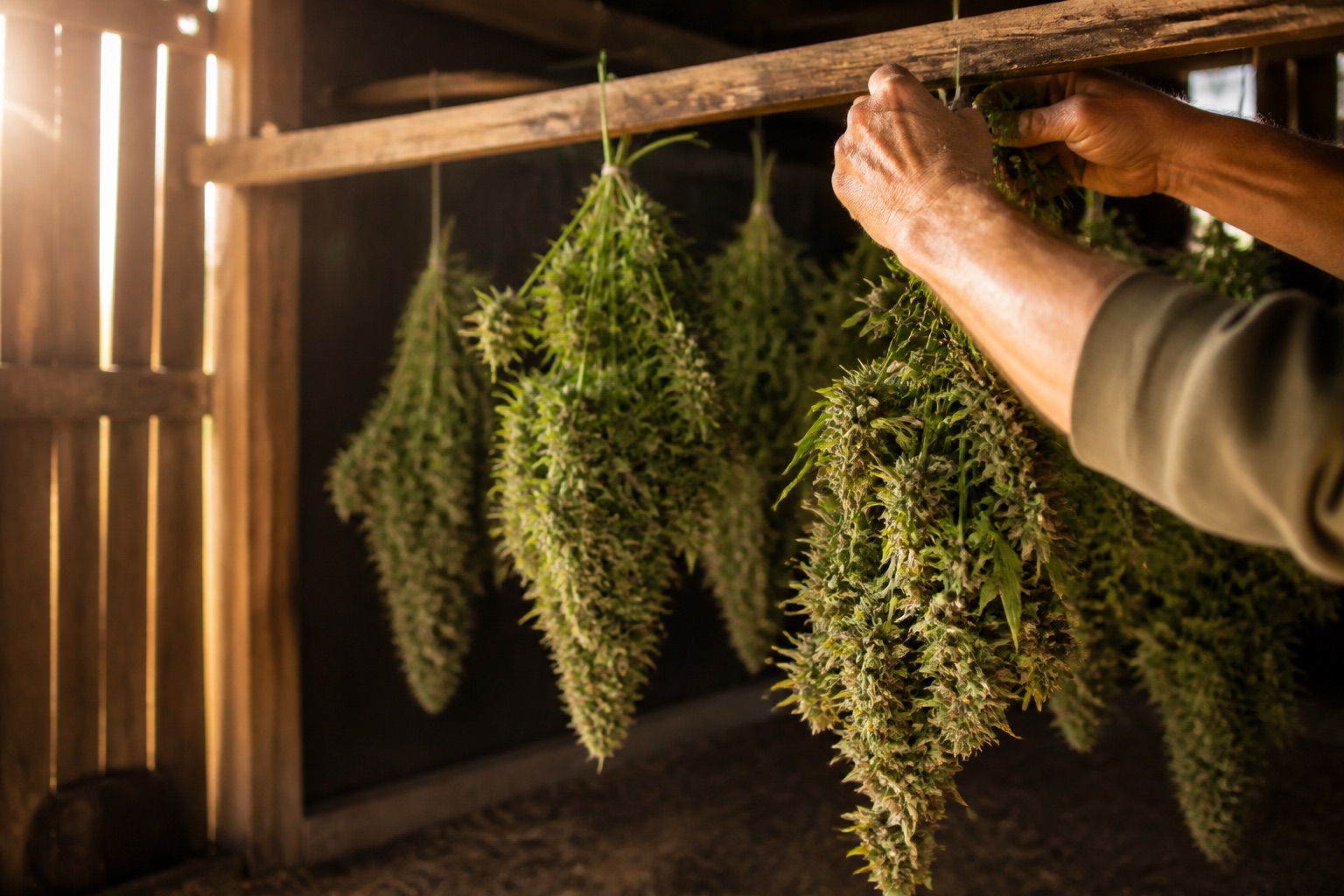
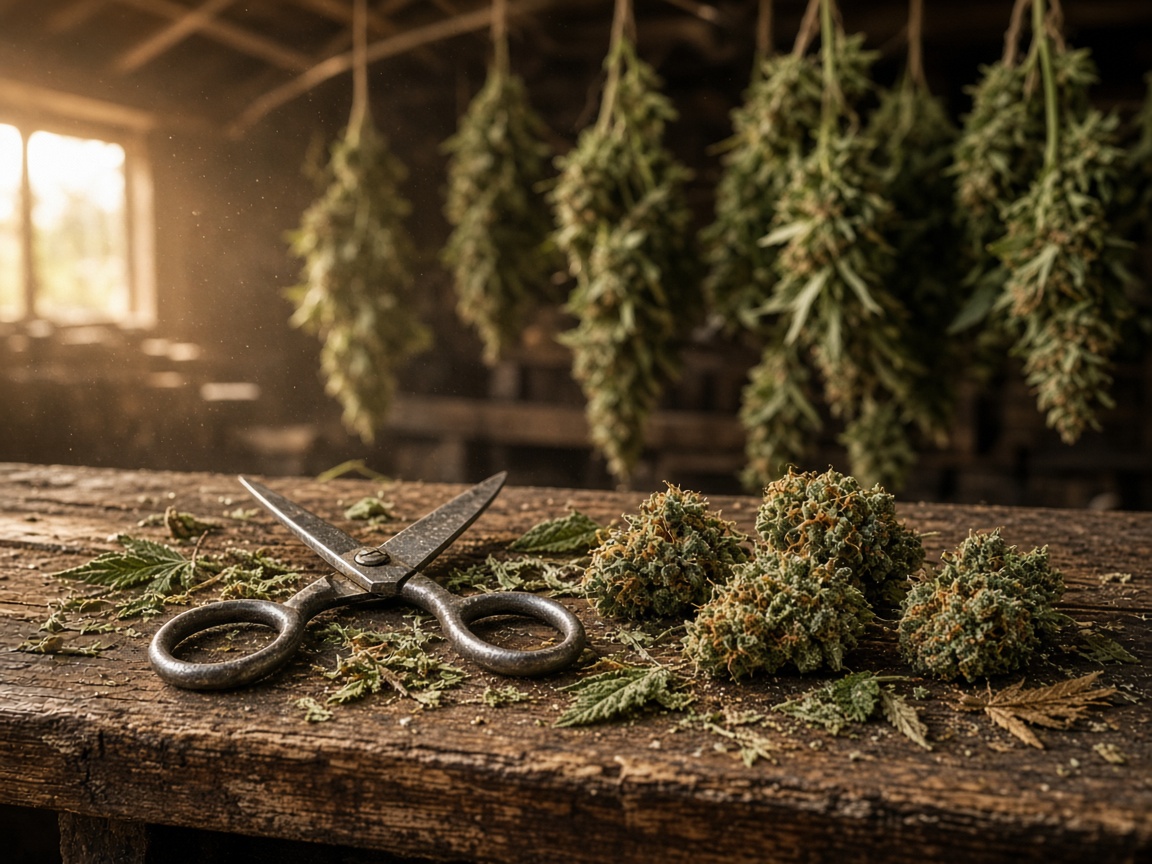
I'm Jamie. I write from the trim table after cut week, not from a lab bench. Wet trim means you cut the small sugar leaves while the plant is still wet. Dry trim means you hang first and cut those leaves after the hang. That's why two Michigan harvest jars can share a week and still not share a nose.
Stay on the scissors. The hang lives in drying cannabis flower. The sealed weeks live in curing and patience.
What Is Wet Trim vs Dry Trim After a Michigan Harvest? #
Wet trim is leaf-off before the dry. Dry trim is leaf-off after the dry. Both still need a real hang. Neither one is a cure. The plant doesn't care what forum you read. It cares when the leaf came off and what the room did next.
Sugar leaves are the small, resin-dusted leaves that hug the bud. They're not the big fan leaves you pull in the field. They hold water. They also hold some of the smell you paid for.
A 2022 University of Saskatchewan postharvest review in PMC9404914 puts the two jobs in one paragraph. Wet trim happens before the long dry. Dry trim happens after. Fresh flower is about 78 to 80% water. That water has to leave. The leaf is either still on the bud while it leaves, or it's already in a bag on the floor.
Think of a wet towel. If you cut the towel into strips first, it dries faster. If you hang the whole towel, it dries slower and the middle stays damp longer. That's speed versus buffer.
A 2022 Molecules post-harvest review (PMC8911901) treats trim as the first postharvest step, then dry, then cure. Michigan outdoor lots don't get to skip any of those. September harvest on a Detroit menu already told you cut week is not jar week. The scissors are one reason that gap exists.
| Path | When the scissors move | What stays on the hang | What you feel in the jar |
|---|---|---|---|
| Wet trim | Right after the cut, while the plant is still wet | Mostly naked buds on racks or strings | Faster dry. Cleaner look sooner. Less leaf as a moisture blanket |
| Dry trim | After the hang, when stems start to snap | Sugar leaf still hugging the cola | Slower dry. Louder nose if the room holds. More leaf to handle later |
| Mild wet trim | Half the sugar leaf comes off while wet | Some leaf left as a thin blanket | In-between dry. One lab study liked this path for cannabinoids |
What wet trim is not #
Wet trim isn't a shortcut around mold math, and it isn't a cure. It also isn't "the indoor way" or "the outdoor way." Indoor rooms wet-trim. Outdoor rooms dry-trim. Plenty of barns do both in the same week when a rain band hits Southeast Michigan.
We grow sun-grown flower in living soil in Michigan. I'm not going to invent a crew size, a trim-room address, or a rule that we "always" pick one path. The room and the week pick the path.
What dry trim is not #
Dry trim isn't a magic terp button. If the hang is hot, bright, or still, dry trim won't save the jar. If the barn is sitting in September lake air and nobody is pulling water, leaf-on just gives mold more time. The drying guide covers the hang. This page stays on the scissors.
Dry trim also isn't "lazy." It's more work later. The leaf gets crispy. Scissors get gummy. Hands get tired. Crews pick it when the room can hold, not because it looks romantic on a story.
The Michigan lock #
NWS Detroit/Pontiac 1991–2020 normals give Detroit September 74.4 °F / 55.5 °F and 3.22 inches of rain. August is still 81.4 / 63.2 with 3.26 inches. Detroit September isn't desert air. It's Great Lakes harvest weather. NWS first-freeze guidance says October ends the Southeast Michigan season. Cut week and first frost can sit in the same calendar stretch. The scissors have to match that air, not a California forum post.
Why Does Scissors Timing Change the Jar? #
The scissors change how fast water leaves the bud, how much leaf sits between the resin and the air, and how long a humid Michigan room has to fight mold. You smell the leftover of that fight, not a slogan.
Pine, mango, pepper, and lawn ride on oils. Those oils evaporate. Heat, moving air, and a naked wet surface make them leave faster. PMC9404914 reviews drying above 40 °C cutting terpene levels, and one cited hemp dry that dropped retention from 82.1% to 29.9% as temperature climbed from ambient to 90 °C. That's hang heat. The trim fork decides how much wet surface the hang gets to work on.
Sugar leaf is a cheap blanket. Leave it on and water has to travel through more plant before it hits the room. Pull it off while the plant is wet and the bud is a smaller, wetter lump with more skin in the air. Faster dry. Shorter mold window. More chance the outside goes crispy while the core is still damp if you add heat. Growers call that case hardening. It's a kitchen problem too. A steak seared too hard still bleeds in the middle.
Three clocks, not one #
A Detroit jar is running three clocks at once:
- Cut clock. When the plant left the field. That's harvest date. R 420.504 makes licensed Michigan flower print that date when it applies. How to read it lives in harvest date vs pack date.
- Scissors clock. When the sugar leaf came off. The sticker doesn't print this.
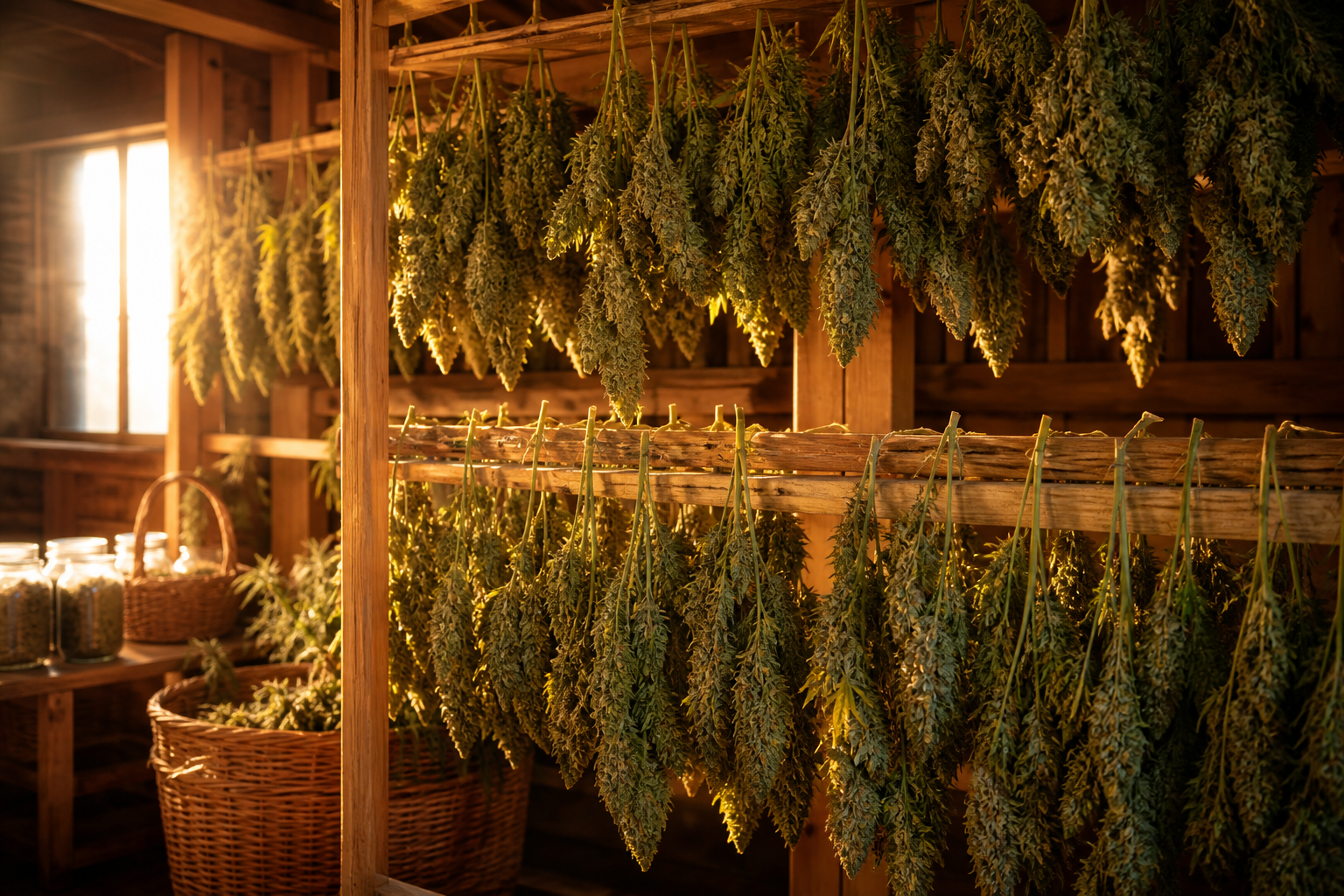
- Hang clock. How long, how cool, how humid the dry room stayed. That's the drying post.
If you only read clock one, you miss why two September eighths from the same week can smoke like two plants.
| What changed | Wet trim | Dry trim |
|---|---|---|
| Wet mass in the room | Lower. Leaf already in the waste bin | Higher. Leaf still on the hang |
| Dry speed | Faster if the room can pull water | Slower. Leaf buffers the bud |
| Mold window in sticky air | Often shorter | Often longer if RH stays high |
| Terpene blanket | Thinner. More oil meets air early | Thicker if the room stays cool and mid-humid |
| Labor | Hard on the day of cut | Hard after the hang, when leaf is crispy |
Why a Michigan jar feels this more than a desert jar #
Southeast Michigan harvest sits in leftover summer rain and lake air. GLISA's Michigan climatology page is the lake-moderated climate story. MSU Extension's hemp production note says damp, wet stretches make dry-down hard even for stalks. Flower is worse. Dense sun-grown colas hold free water in the middle. Botrytis likes that water. MSU's Botrytis note ties the fungus to humidity and rain. Cannabis isn't a grape, but the moisture rule still holds.
The scissors follow the weather, not a style board. Wet trim when the dehumidifier is already gasping. Dry trim when you can hold a real room. If you can't hold the room, the jar will tell on you in Ferndale in October.
What the jar actually reports #
You don't taste "trim method." You taste leftover oils, leftover grass notes, and whether the bud was cooked on the outside. A wet-trim lot that hung cool and slow can still smell loud. A dry-trim lot that sat in a hot garage can smell like straw. Blame the whole week, not one pair of scissors.
The cure posts won't rebuild oils the hang already spent. A lid can't invent pine. It can only keep what the scissors and the room left behind.
Does Dry Trim Keep More Terpenes Than Wet Trim? #
In the best peer-reviewed head-to-head we have, dry trim kept more of the loud terpenes. A gentle wet trim bumped cannabinoids a few percent instead. That's one hybrid in a lab chamber, not a Michigan barn SOP. It's still the receipt that beat the forum story.
PMC11249524 is Brikenstein, Birenboim, Kenigsbuch, and Shimshoni in Medical Cannabis and Cannabinoids, posted June 27, 2024. They used one commercial hybrid, Gen12, thirty tops per path. They compared three cuts:
- Mild wet trim (MWT): stems off, sugar leaves cut halfway, then dry
- Aggressive wet trim (AWT): stems and sugar leaves fully off, then dry
- Dry trim (DT): hang intact, then full trim after a 6-day dry
They dried at 15 °C in controlled-atmosphere chambers. Chamber humidity sat under 10%. Final water landed at 10% ± 1%. Fresh weight dropped about 75%. That's a sealed box with dry gas and silica, not a Southeast Michigan rafter. Keep that in your pocket when someone says "science says always dry-trim."
What the terpenes did #
For over 80% of the mono- and sesquiterpenes they measured, only dry trim significantly raised those levels versus harvest day and the wet paths. The list they name includes β-caryophyllene (pepper), α-pinene and β-pinene (pine), α-humulene (hops), and γ-elemene. The authors write that dry trim made the inflorescence more aromatic.
β-myrcene (the mango-and-sleepy oil) did not follow the pack. It was highest in the mild wet trim, then dry trim. So even inside one paper, one oil can pick the other door.
No notable terpene gap showed between harvest day and the two wet-trim paths for those majority oils. Pulling the leaf early didn't mint extra pine. Leaving the leaf on during the dry did.
What the cannabinoids did #
Mild wet trim raised total cannabinoids about 4% versus dry trim and about 3.5% versus aggressive wet trim. Acidic cannabinoids (THCA, CBDA, CBGA) and some neutrals (THC, CBG) sat higher on that gentle wet path than on dry trim or on harvest day.
The authors float a plant-stress story. Cut some leaf, leave some leaf, and the still-living tissue may keep making cannabinoids while it dries. Strip it naked and you may cut the precursor flow. That's their hypothesis, not a Divine Toke claim, and not a reason to chase a 4% lab bump at a Detroit counter. You won't taste 4%. You'll taste whether the jar still has a nose.
The grower choice the paper actually writes #
They close the paper pretty blunt. You may have to pick louder aroma or a small cannabinoid bump. Doing both at once looks hard. They also say other chemovars may answer differently. One hybrid, one chamber, thirty tops. Treat it as the strongest receipt, not a law.
| Path in PMC11249524 | Cannabinoids | Most terpenes | Myrcene | What it is not |
|---|---|---|---|---|
| Mild wet trim | Highest of the three (+4% vs dry trim) | Not the winner | Highest | Not a Michigan outdoor SOP |
| Aggressive wet trim | Close to dry trim | Not the winner | Not the winner | Not "safer" just because it is wet |
| Dry trim | Lower than mild wet | Winner for >80% of oils measured | Second | Not a guarantee if your barn is hot |
How a Detroit shopper should use this #
Don't ask a budtender for "the PMC trim." Ask whether the lot hung with leaf on, and whether the room stayed cool. If they only recite THC, they're selling the 4% story. If they talk about the hang, they're selling the 80% story.
The drying post already used this paper as one section. This page is the full fork. The hang numbers stay over there. The scissors numbers stay here.
When Does Wet Trim Win in Michigan Humidity? #
Wet trim wins when the room cannot hold, the colas came in rain-soaked, and mold is the nearer risk than a quieter nose. Dry trim wins when you can keep the hang cool and mid-humid. Michigan September often argues for the first door. A good dry room can still take the second.
NWS Detroit/Pontiac normals already gave you the month: 74.4 / 55.5 °F and 3.22 inches of rain. That number doesn't sit in your bones until the barn door sticks. Then you feel it. Plants come off the field with dew, leftover showers, and dense tops. The room has to pull that water. If it can't, leaf-on is extra wet mass sitting in still air.
PMC11013261 watched traditional open-air hangs. About 80% of one high-THC chemovar was heavily infested with Alternaria by day 12. Some Botrytis showed too. That paper is about dry method, not trim style. The lesson still lands on the scissors. A longer wet hang is a longer mold window. Wet trim shortens how much plant the room has to dry.
A simple room test #
Use the room. Don't use a podcast.
- If Southeast Michigan air is sticky, the dehumidifier is already loud, and the colas are tight from a wet week, wet trim or a lighter hang. You're buying time against Botrytis. MSU Extension's hemp note already said damp weather makes dry-down hard.
- If you can hold something near the slow-dry band in PMC9404914 (18–21 °C, 50–55% RH), dry trim is the aroma bet, matching PMC11249524.
- Whole-plant hangs dry slowest because stems and fans still hold water. That's a gift in a controlled room and a problem in a wet barn.
- Heat is the wrong "fix." PMC9404914 already showed high dry temps spend terpenes. Beating mold with a space heater buys hay.
The EPA mold course wants indoor air under 60% relative humidity, ideally 30–50%, so walls stay sane. A dry room for flower often lives a little higher than that apartment target so the bud doesn't turn to dust. Those are different rooms. Don't copy your kitchen hygrometer onto a cola and call it a plan.
What "winning" means for a Detroit shopper #
Winning here just means a jar that doesn't smell like basement and still has a nose. If a Michigan outdoor lot wet-trimmed because September rain won, that can be the honest call. If a lot dry-trimmed in a room that held, that can be the louder call. If a lot wet-trimmed and then cooked, that's just a bad week.
NWS first-freeze timing already tells Southeast Michigan the season is closing in October. Crews rush. Rush plus heat plus wet leaf is how you get a pretty jar with no smell. Rush plus no dehumidify plus leaf-on is how you get rot. The scissors can't outrun the calendar. They can still match it.
Living soil does not repeal humidity #
Sun-grown flower in living soil still has to dry. Living soil feeds the plant. It doesn't pull water out of a September cola. Regenerative process is the farm story. This page is the week after the cut. Don't let a soil story hide a wet barn.
| Michigan week | Safer scissors bet | Why |
|---|---|---|
| Rain-soaked outdoor cut, room already over ~60% RH | Wet trim or a thin hang | Less wet mass. Shorter mold window |
| Cool, dark room that can hold ~50–60% RH | Dry trim | Leaf buffers. Better terp receipt in the one lab trial |
| Frost coming, crew behind, heater in the aisle | Neither. Fix the room first | Heat spends oils. Rush spends both safety and smell |
| Indoor lot in a sealed dry room | Either, if the room is real | Indoor still has a fork. The weather is just quieter |
How Do You Spot Wet Trim vs Dry Trim in a Detroit Jar? #
You usually cannot prove it from the sticker. You can guess from the leaf, the shape, and the nose, then ask. Michigan law doesn't make anyone print "wet trim" or "dry trim" on the lid.
R 420.504 requires the harvest date when it applies, the licensee names, the package tag, the lab, and any test analysis date. It does not require a trim-method field. The Michigan CRA tracks licensed packages through Metrc. That tag tells you which lot. It doesn't tell you when the scissors hit the sugar leaf.
So a Ferndale lunch break or an east-side after-shift stop has to use eyes and nose. That's allowed, and it's still incomplete. Use both, then ask.
What your eyes can try #
| Clue | Often wet trim | Often dry trim | How it lies |
|---|---|---|---|
| Tight, "sculpted" bud with almost no leaf | Leaf came off while soft | A fussy dry trim can look the same | Machines and good hands both polish |
| A little crispy sugar leaf still tucked in | Less common if they stripped wet | Common if they left some blanket | Lazy wet trim exists |
| Fox-tail or natural cola shape still there | Possible | More common on a whole-plant hang | Cultivar shape wins over scissors |
| Dusty shake in the jar | Could be machine | Could be overdry dry trim | Either path can powder |
Don't treat bag appeal as proof. Wet trim often looks "ready" sooner because the leaf is already gone. Dry trim can look wilder until someone cleans it. A pretty jar can still smell like lawn. An ugly jar can still smell like pine.
What your nose can try #
Open the lid. Give it two seconds. If you get pine, mango, pepper, or whatever that lot promised, the hang and the scissors left you something. If you get wet grass, hay, or cardboard, the week already spent the oils. Hay is more a dry-speed story than a trim-method stamp. The next section stays on that.
If you get basement or must, stop. That's moisture failing, not a trim debate. R 420.305 already lists water activity as a required safety test. Licensed Michigan flower had to pass a moisture-safety check. A jar that still smells like a cellar failed the week, the test, or the storage after. Don't "cure" that at home.
What the dates can and cannot do #
Harvest date is the cut, not the scissors. Two lots cut September 12 can hit a Detroit counter weeks apart because one hung leaf-on and one stripped and racked. September harvest on a Detroit menu is the shelf-timing story. Harvest date vs pack date is the sticker story. This page is why the gap between cut and jar can stretch when someone chose dry trim in a room that held, or shrink when someone wet-trimmed to beat rain.
A fresh test date on an old harvest is paperwork, not a new trim. Match the package tag to the Certificate of Analysis before you trust either date.
A 20-second counter script #
- Crack the lid. Smell before you talk.
- Look for leftover sugar leaf and whether the bud looks carved or still like a cola.
- Ask, "Did this hang with leaf on, or did they trim wet?"
- If they don't know, they don't know. Buy with your nose or walk.
Divine Toke is a sun-grown organic cannabis farm rooted in Detroit, Michigan. We sell flower, 1g joints, and a 20-pack. I'm not going to print a fake trim badge on a jar to win this paragraph. Smell the lid.
Is Machine Trim the Same as Wet Trim or Dry Trim? #
No. Machine trim is a tool. Wet and dry are a clock. A bowl trimmer can run on wet flower or dry flower. The machine doesn't pick the fork. The crew does. The machine can bruise either path.
PMC11249524 notes a common industry habit: trim before the dry because fresh trichomes snap less than dry ones. Trichomes are the tiny resin heads that hold a lot of the oil and a lot of the cannabinoids. Wet, they bend. Dry, they shatter. That's a bruise argument more than a terpene-winner argument. The same paper still found dry trim louder on most oils in their chamber. Both can be true. Hands are gentler. Timing still changes the dry.
A 2022 Molecules review (PMC8911901) treats trim as manual or mechanical, done to leave the inflorescence and raise bag appeal. It doesn't run a machine-versus-hand terp trial. Don't let a shiny tumbler sell you a science story it doesn't have.
What a machine actually does #
| Tool | Typical clock | What it is good at | What it costs |
|---|---|---|---|
| Hand scissors | Wet or dry | Control. Less lost resin if the person is patient | Time. Labor. Sticky fingers |
| Bowl / tumbler | Often wet, sometimes dry | Speed on a big harvest week | More leaf dust. More broken heads |
| Hybrid (machine, then hand) | Either | Clean the last leaf after the bowl | Still a clock choice underneath |
Michigan cut week is a rush week. NWS first freeze is coming. Rain already happened. A crew that wet-trims by machine is often buying hours, not chasing a 4% cannabinoid bump. A crew that dry-trims by hand is often buying nose, if the room held. A crew that dry-trims by machine after a hot hang is buying speed twice. The jar won't thank them.
What a Detroit shopper should hear #
"Machine trimmed" isn't a slur by itself. It's a bruise risk. Ask when the machine ran. Wet-machine plus a cool, honest hang can still smoke fine. Dry-machine on crispy flower can fill the jar with dust you'll taste in a 1g joint.
Pre-rolls hide some of this. Shake and leftover trim can go in a tube. Divine Toke sells 1g joints and a 20-pack of those joints. That's just the shop list. It doesn't mean every tube is scissor-perfect. If the flower in the jar smells dead, the joint made from the same week won't invent pine.
Hand trim isn't a halo either. Tired hands at 2 a.m. after a Michigan outdoor cut will miss leaf and nick buds. I've been that pair of hands. The clock still matters more than the myth of the golden scissors.
Does Wet Trim Make Flower Smell Like Hay? #
No. Wet trim does not equal hay. A too-fast or too-hot dry equals hay. Wet trim can make that dry faster, so it can help you get there if the room is already dry or you add heat. The grass note is a hang failure that the scissors can make easier.
People Also Ask pages in 2026 still mash this together. Perplexity's current cite set is mostly grower blogs. The primary papers don't say "wet trim smells like hay." PMC9404914 ties terpene loss to high dry temperature. PMC11249524 ties quieter oils to the wet paths in one chamber, not to a straw smell.
Hay is leftover grassy notes plus missing perfume. Fresh-cut plants smell like a lawn. That's normal on day one. It should fade if the hang is slow and cool. If you strip the leaf, blast a fan, and warm the room to "beat mold," the lawn stays and the pine leaves. You didn't invent chlorophyll with wet scissors. You just dried the plant like laundry on a heater.
Chlorophyll isn't the hay villain #
Grower talk treats chlorophyll as the hay molecule. The honest version is simpler. Green plant notes are loud when water leaves too fast for the rest of the chemistry to catch up. A slow hang gives those notes time to drop. A sealed cure after a real dry can soften what is left. Curing as patience is that second job. A lid on wet, grassy flower isn't a cure. It's a sweat lodge.
| What you smell | More likely cause | Trim fork role |
|---|---|---|
| Pine, mango, pepper | Oils survived the hang | Dry trim helped in the one lab trial if the room was real |
| Fresh-cut lawn on day one | Normal green plant | Either path. Should fade |
| Hay or straw in the finished jar | Fast or hot dry. Oils gone | Wet trim plus heat is a common road there |
| Cardboard / mute | Old, overdry, or light-struck | Storage after the scissors |
| Basement / must | Mold or a wet core | Dry trim in a wet room is a common road there |
The Michigan mix-up #
A Detroit shopper buys a September outdoor eighth that smells like straw and blames "wet trim" because a forum said so. Maybe the farm wet-trimmed. Maybe they also ran a heater because 3.22 inches of September rain had the barn dripping. The heater is the bigger crime. The scissors only opened the door.
The other mix-up is the opposite. A jar smells like basement and someone says "should have dry-trimmed for terps." Leaf-on in a room that can't hold is how you grow rot. PMC11013261 already showed what a long wet hang can do. Smell first. Then pick which failure you're in.
Can a pack save it? #
A 62% humidity pack can't put evaporated oils back. ASTM D8197 is a water-activity band of about 0.55 to 0.65, not a perfume standard. The FDA water-activity page is about how available water is to microbes, not about mango. If the lid already smells like hay, close the next one sooner. Don't shake a pack like a salt shaker over a dead jar.
What Should a Detroit Shopper Ask About the Trim? #
Ask when the leaf came off, how the lot hung, and whether the room fought Michigan humidity or ignored it. Then smell the lid. If the answers and the nose disagree, trust the nose.
Metro Detroit counters move at lunch-break speed. Ferndale. East side. Woodward with kids in the car. You don't get a lecture. You get twenty seconds and a jar. Use a short list.
Questions that actually land #
- Did this hang with sugar leaf on, or did they trim it wet? If they stare, they may not know. That's useful.
- Was this a September outdoor cut? If yes, ask how they beat the rain. Wet trim can be the honest answer. Heat is the bad answer.
- When is the harvest date? Read it yourself. R 420.504 already put it on licensed flower when it applies. How two dates lie lives in harvest date vs pack date.
- Can I see the COA for this package tag? Water activity and microbes are required safety lanes under R 420.305. Terpenes on that PDF are extra chemistry. Match the tag.
- Does it still smell like the name on the jar? If they won't crack a lid, walk.
Questions that waste the twenty seconds #
- "Is this indica or sativa?" That's a nickname, not a scissors report.
- "What's the highest THC?" PMC11249524 already showed a small cannabinoid bump can sit on the quieter nose.
- "Was this hand-trimmed?" Nice if true. Incomplete if you skip the clock.
- "Is this wet or dry?" without pointing at the jar. Make them talk about this lot.
How to spend the answer #
| What they say | What you do |
|---|---|
| "We dry-trim when the room holds." | Smell for pine, not straw. That's the bet the paper liked. |
| "Wet-trimmed because September was soaked." | Smell for basement. If it is clean and a little quieter, that can still be an honest jar. |
| "We always dry-trim." as a brand slogan | Ask about the room. A slogan isn't a hygrometer. |
| "I don't know." | Nose only. Or leave. |
| "It's 31%." | Read harvest date. Crack the lid. The number is not the week. |
Cut week versus jar week still lives in September harvest on a Detroit menu. When the plant was ready to cut lives in harvest timing. The hang lives in drying flower. The lid weeks live in how curing protects terpenes. This page stays on the scissors.
If you want sun-grown flower from Divine Toke, a Detroit-area Michigan farm, start at the shop. We sell flower, 1g pre-rolls, and a 20-pack (20 × 1g at $120). No fake trim badge, and no third strain to pretty up the fork. Smell first.
What Trim Mistakes Show Up in a September Jar? #
The usual misses are heat to beat mold, leaf-on in a wet room, leaf-off in a bone-dry room, and shopping the THC sticker instead of the lid. The jar reports the week, not the story the farm wanted.
Michigan outdoor harvest is a short door. NWS first freeze closes Southeast Michigan in October. 3.22 inches of September rain already happened. Crews get tired. Tired crews pick a default and stop smelling the room.
| Mistake | What it looks like later | Better move |
|---|---|---|
| Space heater in the aisle after a wet trim | Hay. Thin nose. Crispy shell, damp core | Dehumidify and move air around the hang, not on it |
| Dry trim in a barn that tracks outdoor RH | Basement smell. Soft colas. Possible rot | Strip more leaf or fix the room before you hang |
| Wet trim, then a fan on the buds | Case hardening. Mute pine. Harsh draw | Point the fan at a wall. Slow the skin |
| Machine-dry-trim on crispy flower | Dust in the jar. Broken heads | Hand-finish, or trim earlier while heads still bend |
| Buying "31%" with a dead lid | A number and no night | Crack the lid. Read harvest date |
The heater lie #
Heat feels like action. Michigan humidity feels like a problem you can cook away. PMC9404914 already showed high dry temps spend terpenes. The EPA wants indoor RH under 60% so walls stay sane. Those are different jobs. A heater can drop RH and also cook the oil. A dehumidifier pulls water without turning the cola into jerky. If the only tool in the aisle is a hardware-store heater, the September jar will taste like that tool.
The "always dry-trim" lie #
Forum theology says dry trim is quality and wet trim is commercial. PMC11249524 did find dry trim louder on most oils in a chamber that held 15 °C and under 10% RH. A Detroit-area barn in a rain week is not that chamber. "Always" is how you grow Botrytis on a leaf-on hang. MSU Extension already told you damp weather makes dry-down hard.
The sticker lie #
R 420.504 makes harvest date the cut, not the scissors. A new test date is the lab's calendar. A high THC line can sit on a quiet jar. Mild wet trim's 4% cannabinoid bump in that one paper won't save a lid that smells like straw. Shop the week you can still smell.
If you live in a Detroit apartment and the jar already made it home, storage is a different class. Keep the lid on after you cook. Don't park an open eighth over the stove. The scissors already did their job. Don't make the kitchen undo it.
Frequently Asked Questions #
What is the difference between wet trim and dry trim? #
Wet trim cuts the small sugar leaves while the plant is still wet. Dry trim waits until after the hang, then cuts those leaves. Both still need a real dry. Neither one is a cure. PMC9404914 defines the two jobs that way and reminds you fresh flower starts around 78 to 80% water. The scissors only change when the leaf comes off.
Which keeps more terpenes, wet trim or dry trim? #
Dry trim kept more of the loud terpenes in the best head-to-head study we have. In PMC11249524, post-dry trimming significantly raised over 80% of the mono- and sesquiterpenes they measured, including caryophyllene and pinene. A mild wet trim raised total cannabinoids about 4% instead. One hybrid, one chamber. Not a Michigan barn law.
Does wet trim make cannabis smell like hay? #
No. A too-fast or too-hot dry makes hay. Wet trim can make that dry faster. PMC9404914 ties terpene loss to high dry temperatures, including a cited drop from 82.1% to 29.9% retention as heat climbed to 90 °C. Fresh-cut lawn on day one is normal. Straw in a finished Detroit jar means the hang already spent the perfume.
Which trim is safer in a humid Michigan September? #
Wet trim is often the safer mold bet when the room cannot hold and the colas came in wet. Leaf-off means less wet mass. NWS Detroit normals give September 3.22 inches of rain and 74.4 / 55.5 °F. PMC11013261 saw about 80% of one open-air lot heavily molded by day 12. Dry trim is the aroma bet only if you can actually hold the room.
Does a Michigan cannabis label say wet trim or dry trim? #
No. Licensed Michigan flower must show harvest date when it applies. It does not have to show trim method. That list is in R 420.504. The Michigan CRA tracks the package tag in Metrc. Read the cut date. Smell the lid. Don't wait for a scissors stamp that the rule never required.
Is machine trim the same as wet trim? #
No. A machine is a tool. Wet or dry is when the leaf comes off. PMC11249524 notes crews often wet-trim because fresh trichomes snap less than dry ones. That's a bruise story. The same paper still found dry trim louder on most oils. Ask when the bowl ran, not only whether a bowl exists.
Can you tell wet trim from dry trim at a Detroit counter? #
Sometimes you can guess. You cannot prove it from the sticker. Tight, carved buds with almost no leaf often mean a wet trim. Leftover crispy sugar leaf often means a dry trim. Both clues lie. R 420.504 won't settle it. Crack the lid in Ferndale or on the east side and ask how that lot hung.
Does wet trim make flower harsher? #
It can, if the faster dry leaves more grass notes and spends the oils. Harsh is often leftover green plus a thin nose, not a moral failing of scissors. PMC11249524 found wet paths quieter on most terpenes in one chamber. A wet-trim lot that still hung cool and slow can smoke fine. A dry-trim lot that cooked won't.
Does dry trim mean the jar hits the shelf later? #
Often yes, because leaf-on dries slower and the trim job happens after the hang. That's one reason September harvest on a Detroit menu is not jar week. NWS first freeze already closes Southeast Michigan in October. A dry-trim outdoor lot can miss the first "new crop" signs and still be the better smell if the room held.
Does trim change the THC number on the sticker? #
A little, maybe. Not enough to shop by. Mild wet trim raised total cannabinoids about 4% versus dry trim in PMC11249524. R 420.504 already lets the sticker sit 10% above or below the lab number. Chase the nose. Don't chase a 4% story past a dead lid.
What should I ask a budtender about trim? #
Ask if the lot hung with leaf on, and how they handled Michigan humidity. Then smell. If they only recite THC, they skipped the week. If they talk about rain, the room, and the scissors, they're in the right story. Harvest date is still on the jar under R 420.504. Read it.
Can a humidity pack fix a bad trim path? #
No. A pack can buffer leftover moisture. It cannot put evaporated oils back. ASTM D8197 wants dry flower around 0.55 to 0.65 water activity. The FDA aw page is about available water, not mango. If the September lid already smells like hay, buy the next jar with a better week behind it.
Closing: The Scissors Are a Clock #
Wet trim and dry trim are a timing choice. After a Michigan harvest, that timing decides how fast water leaves, how long mold gets a vote, and how much smell is left when a Detroit lid cracks.
I'm still at the table after cut week. The plant is hanging or it's already naked on a rack. The room is either holding or it's losing to September rain. I'm not going to invent a Divine Toke trim-room address or a rule that we always pick one door. Sun-grown, living-soil flower still has to meet Great Lakes air. The scissors either match that air or they pretend a California forum knows our weather.
If last year's outdoor jar smelled like a wet lawn and this year's smells like pine, don't only blame the cultivar name. Ask when the leaf came off. Ask how it hung. The drying guide is the hang. Curing and patience is the lid. How curing protects terpenes is why a jar can't rebuild what the week spent.
If you're curious to try sun-grown organic flower from Divine Toke, a Detroit-rooted Michigan farm, start at the shop. We sell flower, 1g pre-rolls, and a 20-pack at $120. Smell the lid. Read the harvest date. No scissors fairy tale.
This article is for educational purposes only and is not medical advice. Always consult your healthcare provider before starting any new wellness routine.
Grown in Detroit. Shipped to your door.
Small-batch, sun-grown cannabis cultivated in living soil. Mail-order shipping to all 50 states.