Winterize the Hoop House: Plastic, Irrigation, and Tools Before Detroit's First Freeze
Plants are cut. The hose is still full. What a Detroit-area grower drains, skins, and oils before Michigan's first hard freeze.
Questions this article answers
- What does a Michigan outdoor cannabis grower shut down before the first hard freeze after the plants are cut?
- when is the median first 32 degree freeze in Detroit
- should I remove hoop house plastic for winter in Michigan
- how to drain drip irrigation so pipes do not split
- how to stop garden tools from rusting over winter

Head Cultivator
On this page
The plants are on the wagon. The hose is still full, and it is still hooked to the bib.
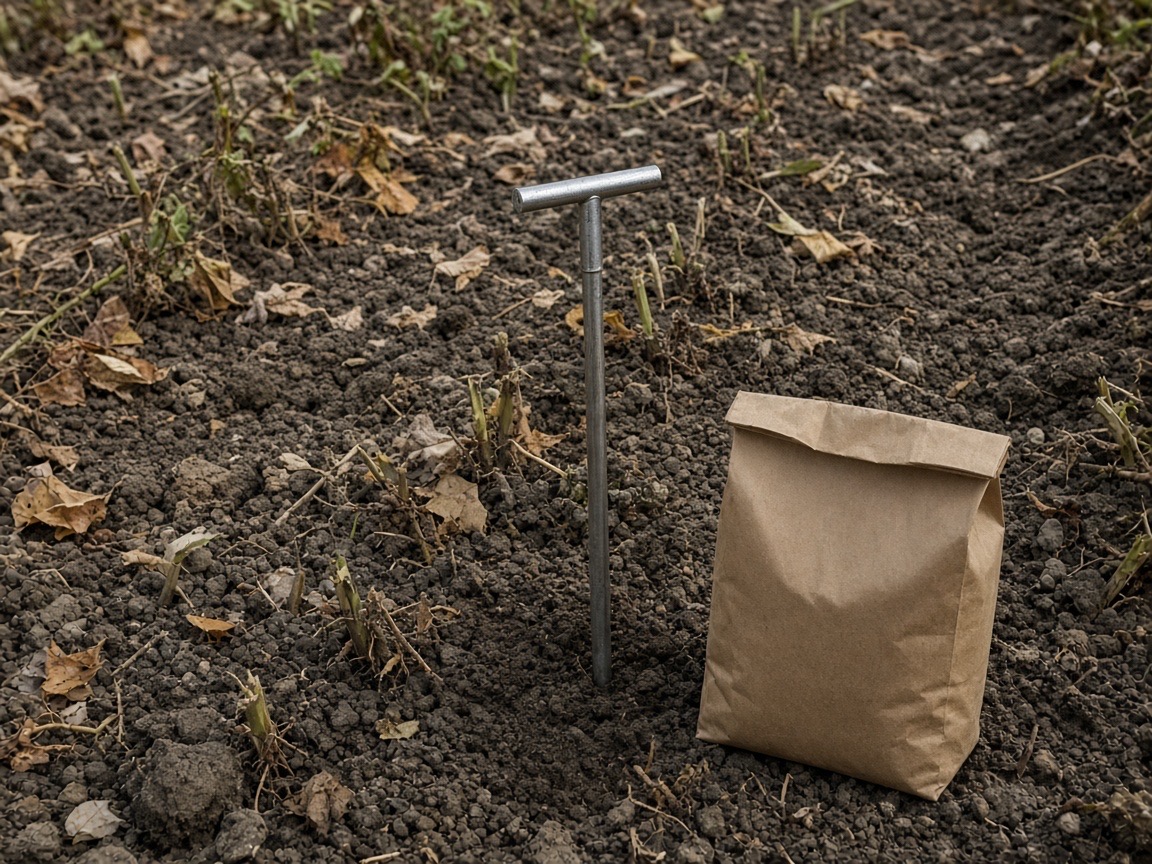
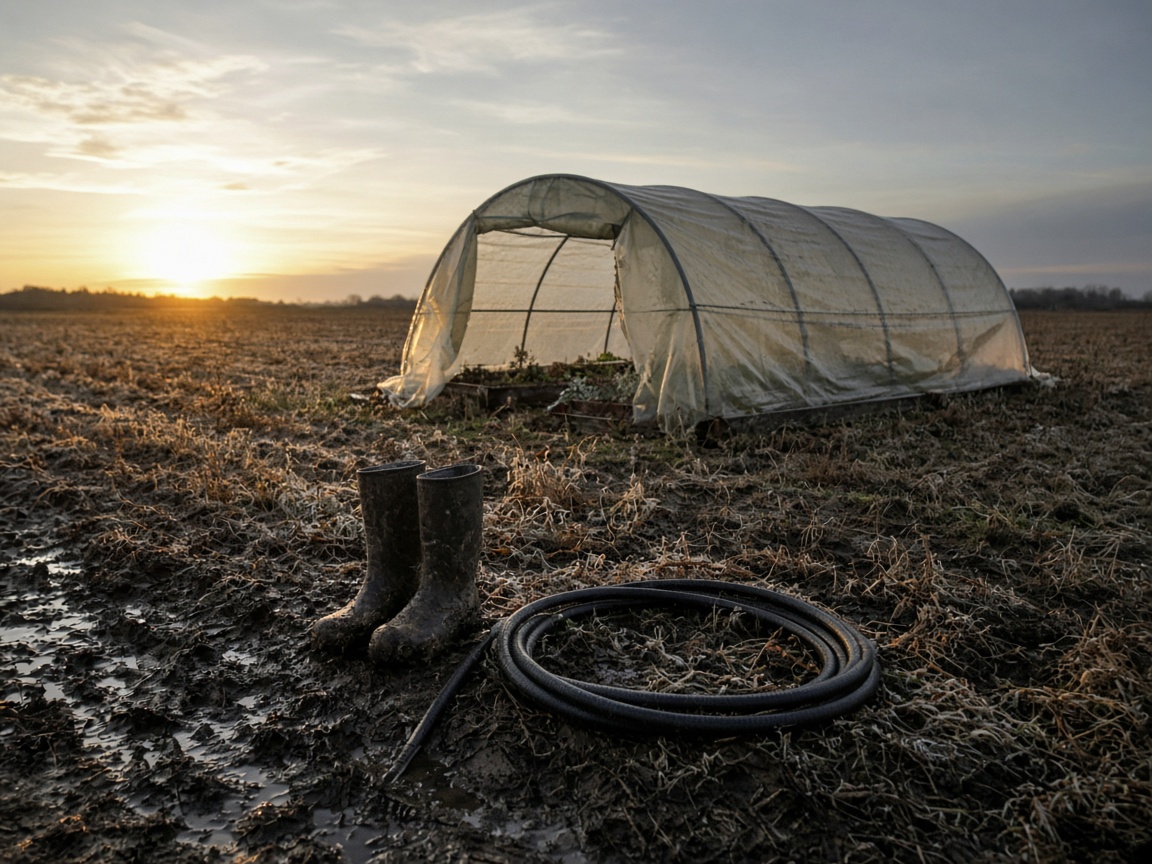
That is the close-down. Cut week took the crop. The hardware is still outside, full of water, or flapping in a Great Lakes wind. At Divine Toke, a Detroit-area sun-grown farm in Michigan, we treat that hardware as its own job. The dirt job lives in fall soil rest after cut week. The season clock lives in farming on Michigan time. The jar on a cold porch lives in the first-frost shopper checklist. This page stays on three things you can touch: water lines, hoop plastic, and steel tools.
MSU Extension frost climatology puts Detroit's median first 32°F night on October 18 (1981–2018). In about 1 year out of 10, that first 32°F has already landed by October 10. A hose left full does not get a vote.
What Does a Michigan Outdoor Grower Shut Down After the Plants Are Cut? #
Shut off the water and get it out of every line, decide whether the hoop skin stays up for snow, and get steel tools clean, dry, and oiled inside. The plants are already down. What is left can crack, tear, or rust while you are in the dry room.
Think of the hoop the way you think of a truck you park for winter. You do not leave the radiator full and the doors flapping because the load is already delivered. The load was the plants. The truck is the house, the tape, and the tools.
Here is the split between tonight and April:
| Job | Do it before the freeze | It can wait |
|---|---|---|
| Water | Shut the supply. Open ends. Drain low spots. Pull hoses off bibs. | New drip tape for next year, once this year's water is out. |
| Plastic | If the hoop is a round house the maker did not rate for snow, get the skin off or rolled up before the first real snow. If it stays on, close the ends. | Putting a stored skin back on after the spring snow risk drops. |
| Steel | Knock the mud off. Dry it. A thin oil film. Hang it inside. | A spring touch-up on an edge you already oiled. |
| Flower | Move the hang into a room you control. A hoop that will hit 28°F is a bad dry room. | The cure clock. That lives with the jars, not the bib. |
| Dirt | Leave the bed plan to the soil piece. Do not till the rows "so they look finished." | Cover-crop timing and spring termination. |
The flower you already cut should not finish drying in a tunnel that is about to ice. Ice, then a thaw, wets the hang again. How a Michigan dry room actually runs is in drying flower from harvest to cure. This page assumes the stalks are already out.
Divine Toke does not publish a street address, a plant count, or a cultivar list. A Detroit-area sun-grown farm is the frame. Your bib, your bows, and your hose are the job.
When Does Detroit's First Freeze Hit, and Why Does the Hose Freeze First? #
Detroit's median first 32°F is October 18, and a hose lying on the bed can freeze while the airport thermometer is still above that. MSU's 1981–2018 table is the number. It is a station record, not a vibe.
The National Weather Service calls a freeze surface air at 32°F or below over a wide area for a real stretch of time. Frost on the grass is not required. A hard freeze is 28°F or lower for an extended period, and it kills most vegetation (NWS hard-freeze glossary). NWS Detroit/Pontiac draws those two lines for southeast Michigan: one map for 32°F, one map for 28°F.
Same MSU table, southeast Michigan only. Median means the 50th percentile. Half the years in that record were earlier. Half were later.
| Station | Median first 32°F | Median first 28°F | What it means for a hose |
|---|---|---|---|
| Flint | October 9 | October 20 | Inland and earlier on both rows. A Flint-area hoop does not get Detroit's extra week. |
| Ann Arbor | October 14 | November 1 | A short drive from Detroit and four days earlier on the 32°F median. |
| Detroit | October 18 | November 3 | The clock for this page. Earliest 32°F in the record: October 2. Latest: November 12. |
| Monroe | October 22 | November 8 | Closer to Lake Erie, later on both rows. The hose still sits on dirt. |
Detroit's 32°F spread in that record is the part people skip:
- Earliest: October 2
- 10th percentile: October 10 (about 1 year in 10, the first 32°F is already done)
- Median: October 18
- 70th percentile: October 25
- 90th percentile: November 6
- Latest: November 12
The 28°F row for Detroit is later. Median November 3. Tenth percentile October 21. Latest in the record November 22. A hard freeze is the night NWS damage notes flag unprotected outdoor plumbing and undrained irrigation. That Hastings page serves Nebraska and Kansas. The temperature class is the national one. The Detroit date is the MSU row above.
Two more facts from the same MSU write-up change how you read the airport app.
- The dates are from about 5 feet up, inside an instrument shelter.
- Air near the ground can run several degrees colder, especially on a clear, calm night.
Your drip line is not at 5 feet. It is on the bed, in a low spot, or against a bib on the north wall of the hoop. The night the forecast says 34°F at Detroit Metro can still be a freeze in that low spot. Drain on the cut-week calendar. Do not wait for the app to say 28.
Cadillac's median first 32°F in that same table is September 21. A Detroit-area hoop is not on a Cadillac clock. It is also not on a California clock. The full season shape is in farming on Michigan time. The only use of the date here is simple. Get the water out while you still have an afternoon above freezing.
Read the percentiles the way MSU wrote them. The date is the day by which that share of years has already seen the first freeze.
- By October 10, about 10 percent of Detroit years in that record have already had a 32°F night.
- By October 18, half of them have.
- By October 25, about 70 percent have. The other 30 percent wait until later in the month or into November.
- By November 6, about 90 percent have. One year in ten is later than that, and the latest in the book is November 12.
This post is dated September 27. On a median Detroit year you still have about three weeks before the first 32°F. On a 10th-percentile year you have about two weeks, and the record includes a first freeze on October 2. The hose does not know which year this is. Empty it while the afternoon is still warm enough for water to run.
A worked week, if cut day was this weekend:
| Day | What the calendar is doing | What you do with hardware |
|---|---|---|
| Late September | Plants are down. Median freeze is still ahead. | Drain on the first dry afternoon. Do not wait for a red warning. |
| October 2–10 | This is the early slice of the Detroit record. | If the hose is still full, you are inside the years that already froze. |
| October 18 | Median first 32°F. | Water should already be out. This is a late day to start. |
| November 3 | Median first 28°F in Detroit. | Hard-freeze class. Undrained fittings are the damage NWS talks about. |
| November 12 | Latest 32°F in the 1981–2018 Detroit row. | "It has not frozen yet" is not a plan. It is the late tail. |
Flint's medians sit earlier (October 9 for 32°F, October 20 for 28°F). Monroe's sit later (October 22 and November 8). A Detroit-area farm can be either side of that drive. Use the station closest to the hoop, then still treat the ground line as colder than the shelter.
How Do You Drain Irrigation So the Lines Don't Split? #
Shut the supply, open every end, and get standing water out of valves, filters, and low spots before the first hard freeze. Utah State University Extension says it in one breath. Valves, pipes, and other parts can break because water left inside expands as it freezes.
USGS measured the physics without a farm in the sentence. Upon freezing, the density of ice drops by about 9 percent. The same water needs more room. In a glass, the ice rises. In a closed fitting, the fitting is the thing that moves. It cracks.
A hoop does not get rain on the beds the way an open field does. You put the water there with tape and a header. When the plants are gone, that hardware is still a closed system if the ends are capped and the bib is open.
Do it on a day the hose can actually drain. Frozen mud and a shut valve is how people "winterize" a line that is still full.
- Close the supply. The valve between the well, the hydrant, or the barn manifold and the field. If a timer is still plugged in, kill the schedule too. A timer that clicks on in January refills the line you just emptied.
- Open the zones. Every valve that was holding pressure. You want the water to have a way out, not a place to sit.
- Pull the end caps. Drip tape and header ends. Water will not leave a line you corked at both ends.
- Open the low spot. If the row dips, that belly holds water after the rest looks empty. Walk it. Lift the sag. Let it run out.
- Empty the filter and the regulator. These are small, rigid, and full of water. They split before the long tube does. Take them off. Dump them. Store them inside if they come apart.
- Blow the trapped pieces if gravity cannot. USU says a real blow-out wants a large compressor, and a lot of people hire that instead of faking it with a pancake compressor. If you cannot blow it, add a drain at the low spot and leave that drain open. Do not invent a pressure number. Stay under whatever the tape and the fittings are rated for, and never blow into a closed end.
- Leave a path open. A cap that you put back on "so bugs stay out" can also trap the last cup of water. A loose screen is fine. A sealed cap on a wet line is how you start over in April with a split coupling.
Poly tube feels softer than a rigid fitting. Soft is not a promise. The barb, the valve, the filter bowl, and any stretch you kinked are still tight spots. USU does not give a full line a free pass. It says leftover water expands and breaks parts. Treat every closed pocket the same way.
What April looks like if you skip it:
- A filter bowl with a hairline crack that only leaks once pressure is on.
- A barb that pushed out of the header and soaked one bay on the first test.
- A bib that weeps inside the housing, where October looked fine.
- Tape you left capped, now split at the sag you meant to "get in the spring."
- A timer that fired on a January thaw because the schedule was never killed, and refilled a line you thought was empty.
None of that shows up the week you cut. It shows up the week you want to plant. Michigan's spring window is already short. Spending it in a parts store is the expensive version of a ten-minute drain.
| Piece | What water does there | What you do |
|---|---|---|
| Header | Sits level and looks empty while a belly stays full | Lift and walk it. Open the flush end. |
| Drip tape | Holds a film in emitters and sags | Open ends. If you will reuse it, roll it only after it is drained. |
| Filter | A cup of water in a plastic or metal bowl | Remove it. Dump it. Store it where it cannot freeze. |
| Hose bib and timer | The faucet side can freeze back into the wall | Shut the indoor valve if you have one. Disconnect the hose. Drain the bib. |
| Fertigation injector | Small, expensive, full of leftover mix | Pull it. Rinse it. Bring it inside. |
If you only do one lap, do the bib and the filter. A split header is a spring invoice. A split bib can be a wall.
What Happens to the Hose Bib, Filters, and Drip Tape? #
Disconnect every hose, dump every filter, and do not leave a nozzle on a line you plan to store. University of New Hampshire Extension is blunt about garden hoses. Drain them all the way. Store them rolled and laid flat. A bad coil can split and crack the hose.
The bib is the piece people walk past because the plants are gone and the hose "looks fine." Fine and full are different. A hose left threaded on the faucet holds water against the valve. That is the crack you find in April, inside the housing, where you cannot see it in October.
Walk this list before you coil anything:
- Shut the outdoor faucet. If there is a shutoff inside the barn or the house, use that one too, then open the outdoor faucet so the short stub drains.
- Unthread the hose. Do not leave it "just for tomorrow" if tomorrow might be 30°F.
- Hold the hose so the water actually runs out. A coil left in a pile hides a loop full of water.
- Pull nozzles, splitters, wands, and quick-connects. Shake them. A brass nozzle is a little closed pipe.
- Coil without a hard kink. UNH says lay the roll flat. A kink is a trap for the last ounce of water, and it is a crack waiting for a freeze.
- Store the hose inside, or at least off the ground and out of the weather. A hose that survived the drain can still crack if you store it wrong.
Drip tape is the same idea in a thinner body. Open the ends. Let it weep out. If this tape was a one-season strip, you can pull it once it is empty so a winter sag does not sit full in the row. If you plan to reuse it, roll it loose after it is dry enough not to mildew, and keep mice and sun off the roll. Do not cap it wet and call it stored.
Filters and regulators come inside. They are the parts with O-rings. An O-ring that freezes once goes stiff. You will chase a leak in May and blame the tape.
Timers and battery controllers come inside too. Cold kills the battery, and a dead timer that still has a valve cracked open is a flood on the first warm day you test the zone.
One Michigan-specific habit. Great Lakes nights in October can swing. You get a mild afternoon and a clear night that drops at the ground. Do the bib on the mild afternoon. Do not save it for the morning you see ice on the wagon.
Does Hoop-House Plastic Stay On Through a Michigan Winter? #
It depends on the roof shape and whether the maker rated that house for snow. A round hoop holds snow. A peaked house sheds it. A multi-bay that was only meant for the growing season comes apart for winter where it snows. Penn State Extension separates those houses on purpose. One rule for every bow is how a Detroit-area skin tears.
Read your house before you read a blog. The label, the maker's snow note, and the way the roof is shaped beat a general tip.
Sixty seconds at the end of the bay, before you touch a clip:
- Look at the ridge. A point or a gothic arch is a shed roof. A smooth half-circle is a Quonset. Penn State uses those names. Your eye can see the difference without a tape.
- Find the paper. If the maker printed a snow load, that number runs the decision. If there is no number, do not invent one from a neighbor's house.
- Check the layer. One sheet is one sheet. A double layer with a blower between the sheets is a northern setup Penn State describes. It is built that way. A box fan in a single skin is not the same thing.
- Check the anchors you can see. Loose stakes, a bowed purlin, a rope that has gone slack. Plastic will not stiffen a tired frame.
- Ask who will be here in a January storm. A rated house still needs snow pulled off. If nobody will be on the farm that week, a skin on a round roof is a bet.
Then decide. Off and stored dry, or on and closed up. "We'll see at Thanksgiving" is how wet snow picks for you.
| House | What Penn State says about snow | Close-down move in a snow state |
|---|---|---|
| Round single bay (hoop or Quonset) | More likely to hold snow. The curve does not shed the way a peak does. | If the maker did not rate it for your snow, take the skin off or roll it up before the first real snow. Store it dry. |
| Gothic or peaked single bay | Built to shed snow and to carry snow load. Can run all four seasons. | Skin can stay if the frame, anchors, and rating are sound. You still knock snow off. You still close the ends. |
| Multi-bay | Not designed for snow load. Used to cover a crop in the normal season. | Where it snows, plastic comes off and gets bundled for winter. |
| North, double layer | Some northern houses run two layers with air blown between them. | Only if that is how the house was built. Do not inflate a single-layer skin and hope. |
Michigan gets snow. A Detroit-area winter is not a deep-north lock every week, and it is not a no-snow winter either. Lake-effect and a wet heavy snow will sit on a round roof. Wet snow is heavier than the dry stuff people picture. The frame cares about weight, not about how pretty the hoop looked in July.
If the skin stays on:
- Tighten what the maker told you to tighten. Ropes, wiggle wire, battens. Loose plastic flaps, and flap becomes a tear.
- Close end walls before a wind night. An open end lets wind in. The skin balloons. Anchors and bows take the hit.
- Plan to clear snow. A rated house is not a house you ignore for a week of storms.
- Patch tears now. A three-inch cut becomes a panel in a January blow.
If the skin comes off:
- Pick a day above freezing, with low wind. Plastic is a sail.
- Get it dry before you fold it. Wet film mildews and sticks to itself.
- Store it out of the sun and off the mice. Sun is what the UV package was spending all summer. A barn loft beats a south fence.
- Label the bundle. Spring-you will not remember which end wall went with which bay.
Do not invent a year count for the film. The warranty on the roll is the clock. Winter abrasion, a flap, and a snow load spend that clock faster than a calm summer. If the skin is already brittle and chalky, coming off for winter is also the moment you decide it does not go back on.
The bows stay. Plastic is a cover. It is not the structure. A weak anchor does not get stronger because you left the skin on for looks.
How Do You Lock Ends, Doors, and Loose Plastic Before Wind? #
Latch the doors, tie the roll-up sides, and pick up every loose tarp before the first windy freeze. Snow load is one failure. Wind in an open end is the other. Penn State's tunnel notes treat ventilation and end walls as part of the house, not as an afterthought you leave rolled up because harvest is over.
A hoop after cut week looks abandoned on purpose. Doors propped with a bucket. Sides rolled to the hip rail. Shade cloth half clipped. That is a summer setup. A winter wind uses it.
Do this while your hands still work without gloves:
- Latch both doors. A door that slams all winter beats the hinges and the plastic around the frame. If the latch is broken, rope it to the frame the way the maker allows. Do not leave it free.
- Tie roll-up sides. Up or down, they need a tie. A side that unrolls at 2 a.m. becomes a flag, then a tear.
- Drop temporary covers. Row-cover hoops, insect net, and shade cloth are crop tools. They are not winter structure unless the product says they can carry snow and sun all winter. Most cannot. Dry them. Fold them loose. Store them inside, out of the sun, and not in a sealed wet bag. Wet cloth in a tote goes musty.
- Pick up loose poly scraps, stakes, and spare hose. They become missiles, or they hold a puddle against a fitting.
- Look at the anchors. A stake that worked in July mud may be loose after a dry September. Plastic cannot substitute for a brace.
- Keep a door you can still open after a snow. Do not pile the pulled skin, the tomato stakes, or the old tape in front of the only exit.
If you are leaving the skin on a peaked house, walk the perimeter once after the first real wind. You are looking for a new flap, a loose rope, and a puddle at a post. Ten minutes. That walk saves a panel.
If you took the skin off a round house, the frame is still a wind catcher, but it is a smaller one. You still latch what is left. You still pick up the scraps. An empty bow with a loose end-wall flopping is how the end wall leaves the farm.
Great Lakes wind does not wait for a snow forecast. October can hand you a warm rain and a west blow on the same day the hose is still on the bib. Do the latch and the hose on the same lap.
How Do You Keep Tools From Rusting in a Damp Shed? #
Clean the mud off, dry the steel, wipe on a thin coat of oil, and hang the tool inside off the floor. Illinois Extension says not to leave tools out where dew and wet grass sit on them. Store them in a shed, barn, or garage, off the ground. UNH Extension adds the oil: a light coat, or a silicone spray, so the metal does not rust. Boiled linseed oil on wood handles so they do not dry and crack.
Michigan sheds are damp. The lake keeps air wet deep into fall. A tool that was "clean enough" on the tailgate will bloom orange by March if you leaned it on a concrete floor. Concrete sweats. The blade drinks it.
The order that matches those extension sheets:
- Knock the soil off. A wire brush or a scraper for hoes, shovels, and forks. Sap on pruners comes off with a rag. If you need a solvent for pitch, follow the can. Do not soak a wood handle.
- Dry it. Oil on a wet blade traps water against the steel. That is rust with a shiny coat.
- Rub off light rust now. Steel wool. If the blade is deeply pitted or the edge is notched through, oil will not resurrect it. Replace that one.
- Sharpen what cuts. Pruners, loppers, hoes, the shovel's bite. UNH says do this before storage, then oil the edge so the fresh steel does not rust. File the bevel you already have. Do not invent a new angle on a tired blade.
- Oil the metal thin. Illinois names a light lubricant such as WD-40. UNH names lightweight oil or silicone spray. You want a film, not a drip that glues dust. Wipe the pivot on pruners and work the handle so the oil gets into the joint.
- Oil the wood if it is dry and cracked-looking. Boiled linseed oil, wiped thin. Let it dry before you hang the tool against other tools.
- Hang it. Long tools on a rack. Cutting edges not on the floor. Illinois is explicit: off the ground, away from moisture.
What rust actually costs you in April is time. A pruner that bites halfway through a stem crushes it. You will feel that on the first day you prune again. Ten minutes in October is the whole trick.
A Detroit-area shed has its own winter. Concrete floors hold a chill and a film of damp. A tool leaned in the corner wicks that damp up the blade. Hanging it on a rack puts air under the steel. A leak in the roof is a second problem. If the drip lands on the rack, move the rack. Oil cannot beat a steady drip.
Wood handles split when they spend winter wet, then dry out over a heater. Boiled linseed oil is the cheap coat. Wipe it. Let it dry. Do not leave a puddle of oil on the handle or it stays tacky and grabs dirt in April.
The snow shovel is the one tool UNH says you may still need. Clean the blade now, while you are already at the rack. A nick you ignore in October is the shovel you swear at in January. Wax on the blade helps wet snow release. That is a winter tool, and it still rusts if you store it wet.
Gloves, harvest snips, and the little trimmers live in the same rule. They are steel. They got wet plant juice on them all month. Wipe them. Oil them. Do not leave them in a bucket of rain on the hoop floor.
Fuel and engines are a longer list than this page. If you have a pump that sat on the irrigation, drain it the way the manual says, and do not store it full of water. The hand tools are the part every outdoor grower actually owns.
What Close-Down Work Can Wait Until Spring? #
Spring can have the new tape, the re-skin, the touch-up sharpening, and the soil test. It cannot have the water you left in a line, a loose skin in a snow country, or a wet tool on the floor. Freeze damage is an overnight bill. The rest is a calendar.
This is the honest wait list:
| Can wait | Why it can wait | Do not "wait" on this |
|---|---|---|
| New drip for next year | You are not irrigating a cut bed in November. | This year's water, still in the old tape. |
| Putting plastic back on | A round house you stripped for snow gets dressed again after the snow risk drops. | A skin that is still up, flapping, on a house that cannot carry snow. |
| Touch-up sharpening | If you already cleaned, oiled, and hung the tool. | A muddy blade you plan to "deal with in April." April finds rust. |
| Washing the whole frame | Cosmetic until there is disease trash you already should have pulled. | A torn panel or a loose anchor. |
| Bed shaping and compost spreading | The dirt plan is a different job, and frozen ground fights you. | Tilling the bed so it looks clean. That fights the winter the soil needs. |
| A soil test | A thawed sample is a better sample. | Using "I'll test in spring" as a reason to skip the hose. |
| Rebuilding trellis | The crop is down. | Leaving wire and loose ends as wind catchers in the skin. |
Cover crops, leaving roots, and not flipping the bed are real fall work. They are written in fall soil rest after cut week. If you have one mild week, do the hose and the plastic on day one and the dirt on day two. If a freeze warning is up tonight, the hose wins the afternoon. A late cover date has a recovery. A split buried fitting often does not.
The shopper side of a cold night is also a different list. Jars, porches, and the drive home are in the first-frost consumer checklist. Draining a farm hose does not tell a customer how to store an eighth.
Spring, when you do come back, is a short Michigan window. Farming on Michigan time is why April and May feel fast. You want to spend those weeks planting, not replacing a header you could have emptied in October.
What Is a One-Afternoon Close-Down Order? #
Flower out, water out, plastic decided, doors tied, tools oiled. One lap around a Detroit-area hoop. No new projects.
Do it in this order so you are not walking back through mud you just made:
- Confirm the hang is out of the hoop. Stalks, wet trim buckets, and fans that belong in the dry room. See harvest to cure if the room is not ready. Do not "finish them in the tunnel for a few more nights" if those nights can hit the ground at 32°F.
- Kill the water. Supply valve. Timer. Then open ends and low spots. Filters and regulators off and emptied.
- Pull hoses off bibs. Drain, coil flat, store. Nozzles off.
- Call the plastic. Round and unrated: off or rolled, on a calm day, stored dry. Peaked and rated: ends closed, ropes tight, snow plan in your head. Multi-bay in snow country: skin bundled, per the way that house was built.
- Latch and tie. Doors, roll-ups, loose tarps, shade cloth, bug net. Inside, dry, labeled.
- Tools. Mud off, dry, thin oil, wood wiped if it needs it, hung up. Snips too.
- One last walk at dusk. Listen for a hiss you missed. Look for a sag in the tape. Look for a flap. That is the whole inspection.
If the light runs out, finish the water before you finish the tool oil. Rust is slow. Ice is not.
Misses that feel small and are not:
| You left this | What the night does | What you find later |
|---|---|---|
| Hose on the bib | Water sits against the valve | A crack in the faucet, or a hose split at the fitting |
| End cap back on wet tape | The sag stays full | A split emitter line in the low spot |
| Round skin, no snow rating, nobody around | Wet snow sits on the curve | A bowed frame or a torn panel |
| Door propped with a bucket | Wind slams it for months | Hinges gone, plastic around the frame shredded |
| Pruners in a muddy bucket | Juice and damp sit on the pivot | Orange jaws that crush stems in spring |
You do not need a perfect farm for this list. You need the water out and the loose stuff tied. The rest of the winter can be quiet.
A second person helps on the plastic. Film is wide, and a gust turns it into a sail. If you are alone, wait for the calm hour. Do the bib anyway.
Write the date on a piece of tape and stick it on the barn door. "Water out. Skin: off / on. Tools hung." Spring-you will trust it more than memory.
FAQ #
Detroit's median first 32°F is October 18, water left in a line can split a fitting, and a round unrated hoop should not carry snow alone. The short answers below use the same MSU dates and extension steps as the sections above.
When is the median first 32°F freeze in Detroit? #
October 18, in the MSU Extension table for 1981–2018. That is the 50th percentile for the Detroit station, not a forecast for one year. The 10th percentile is October 10. The 90th is November 6. The earliest in that record is October 2, and the latest is November 12. Those dates are in the MSU climatology article.
What is a hard freeze, and when is Detroit's median? #
A hard freeze is 28°F or lower for a long enough stretch to kill most plants, and Detroit's median first 28°F in that same MSU record is November 3. The National Weather Service glossary sets 28°F. A regular freeze is 32°F. Your hose can be in trouble on either night if it still holds water. The 28°F night is the one weather offices tie to undrained irrigation damage.
Do I still drain the lines if the plants are already cut? #
Yes. The plants are not what splits. The water in the tape, the filter, and the bib is what splits. Utah State University Extension warns that leftover water expands as it freezes and can break valves and pipes. Cut week removes the crop. It does not empty the line.
How much bigger does water get when it freezes? #
Ice is about 9 percent less dense than liquid water, so the same water needs more room. That figure is from the USGS Water Science School. In an open ditch, you see ice. In a capped fitting, the extra room comes from a crack in the fitting.
Will a soft poly line survive if I leave it full? #
Do not bet the header on that. Soft tube moves more than rigid pipe. The barbs, valves, filters, and any kink are still tight spots, and water left in them expands. USU's winter note does not excuse a full line because the tube is plastic. Open the ends. Drain the low spots. Bring the small parts inside.
Should I take the plastic off a round hoop house? #
If the maker did not rate that round house for snow, yes. Get the skin off or rolled up before the first heavy snow. Penn State Extension says round tunnels are more likely to hold snow, while a peaked or gothic roof sheds it. Michigan gets snow. A round unrated roof is the one that keeps a load.
Can a peaked hoop stay covered all winter? #
A peaked single-bay house that was built for snow can stay covered, and you still have to close the ends and clear snow. Penn State says those houses are designed to handle snow load and can run four seasons. In northern setups, some use two layers with air between them. That is a built system. It is not a box fan and a hope. If your manual says the skin comes off, follow the manual.
What oil goes on pruners and shovels? #
A thin coat of lightweight oil or a silicone spray on dry metal, and boiled linseed oil on dry wood handles. UNH Extension and Illinois Extension both land there. Illinois also names a light spray such as WD-40. Wipe the extra off. Hang the tool. Do not store it on a damp floor.
Can the garden hose stay on the bib? #
No. Drain it, unthread it, and store the coil flat. UNH says a hose that is stored wrong can split and crack. A hose left on the faucet also holds water against the valve. Shut the supply, open the bib so the stub drains, and take nozzles off before you coil.
What can actually wait until spring? #
New tape, putting a stored skin back on, a sharpening touch-up, and a soil test can wait. Standing water, a flapping unrated skin, and a wet tool cannot. Bed cover and no-till rest are their own job in fall soil rest. If a freeze is imminent, empty the line first. Spring in Michigan is short. You will want those weeks for planting, which is the point of farming on Michigan time.
Does the airport temperature match a hose lying on the bed? #
No. MSU's dates are from about 5 feet up in a shelter, and the air at the ground can be several degrees colder. A forecast of 34°F at the Detroit station can still freeze a line in a low spot on a clear, calm night. Drain before you need the forecast to say 28. NWS Detroit/Pontiac is the regional freeze map. Your bed is the local one.
Does any of this change how a shopper handles a jar? #
The jar has its own cold-night rules, and they are not a hose checklist. Bring flower inside, skip an icy porch session if that is your plan, and do not drive high. That list is the first-frost consumer checklist. A farm that drained its lines is a farm habit. It does not change the label on this month's eighth.
If You Want the Flower That Came Off a Season Like This #
A drained line and a decided skin are how a Detroit-area sun-grown farm meets winter without buying the same fittings again in April. Divine Toke grows outdoor flower in living soil around Detroit. We do not print a street address or a bed count. The hardware rules above are the public ones. Your tunnel manual still wins on snow load.
If you want to smoke what that kind of season tastes like, start with the jar. Sun-grown flower, 1 gram pre-rolls, and the kraft 20-pack (20 one-gram joints at $120). Smell it. Read the date. The hoop you do not see is why there is a next October.
The wider farm loop, from soil to jar, sits in how regenerative cannabis actually runs. The dry room between cut week and that jar sits in drying from harvest to cure.
This piece is farm practice, not a build manual for your exact house. Follow the maker on plastic, anchors, and blow-out pressure. When the numbers above are dates and temperatures, they come from MSU, the National Weather Service, and the extension pages linked in the sentence.
Grown in Detroit. Shipped to your door.
Small-batch, sun-grown cannabis cultivated in living soil. Mail-order shipping to all 50 states.