Kief and Dry Sift vs Rosin: What You Are Actually Buying
You tap the grinder and pale dust falls out. That dust is kief. Dry sift was screened. Rosin was pressed. Here is which Michigan buy is worth the money.
Questions this article answers
- What is the difference between kief, dry sift, and rosin?
- Is the dust in my grinder the same as dry sift?
- Is rosin stronger than kief?
- Does kief count as a concentrate in Michigan?
- Which is worth buying, kief or rosin?

Head Cultivator
On this page
You knock the grinder on the kitchen table. Pale dust sits in the catch. A friend holds up a tiny jar of rosin that was priced like an eighth, and the jar is not an eighth.
That dust is kief. The jar was pressed. They are not the same buy.
I'm Jamie. I grow the sun-grown flower Divine Toke sells to adults in Michigan. The counter question is the difference between kief, dry sift, and rosin, and which one is worth buying.
The longer map of hash, rosin, and why the starting plant matters is the concentrate guide. This one stays on the three things people mix up at the register. I will not give you a press temperature, a plate setup, or a screen recipe. That work belongs in a licensed facility, not a Detroit apartment.
What Is the Difference Between Kief, Dry Sift, and Rosin? #
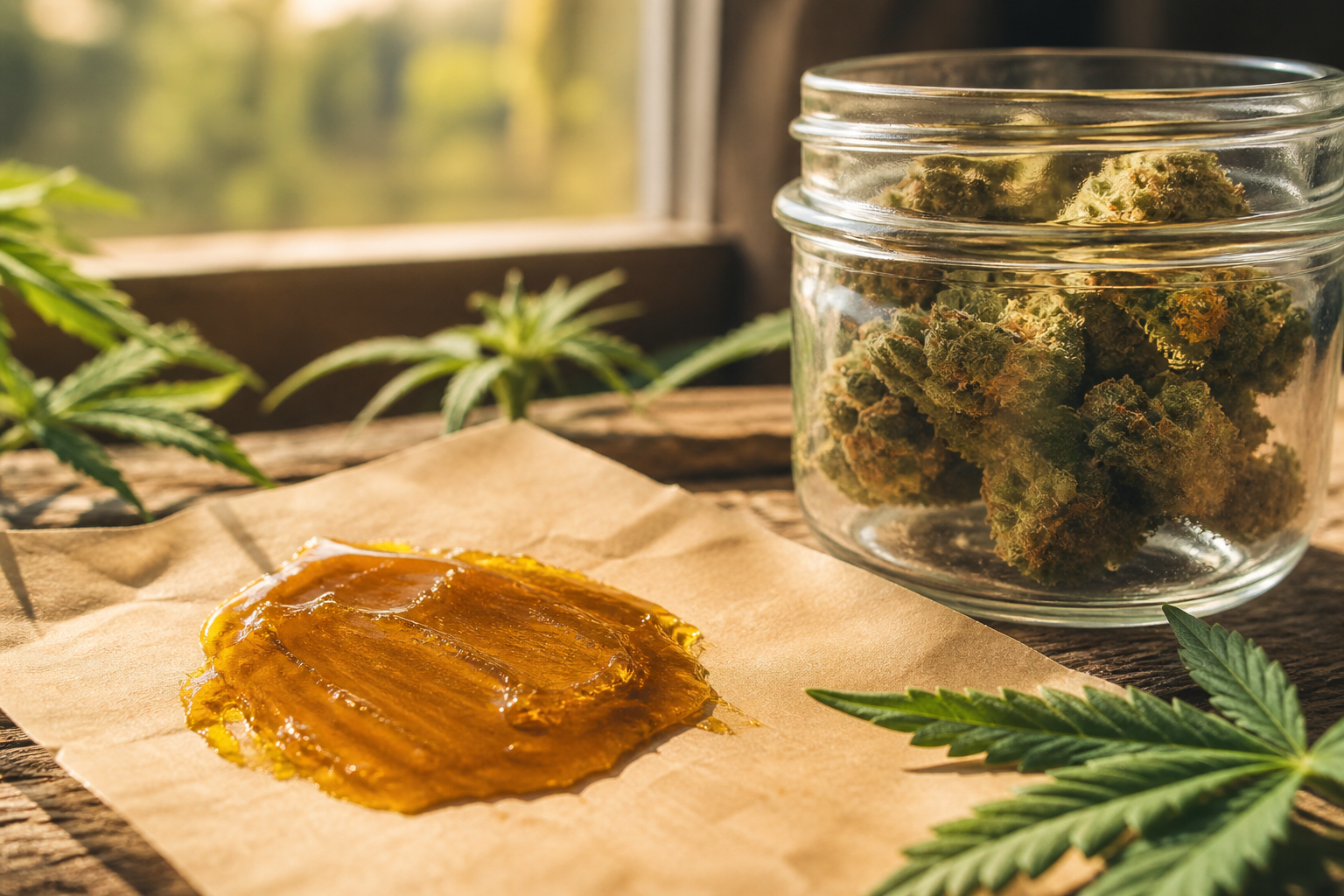
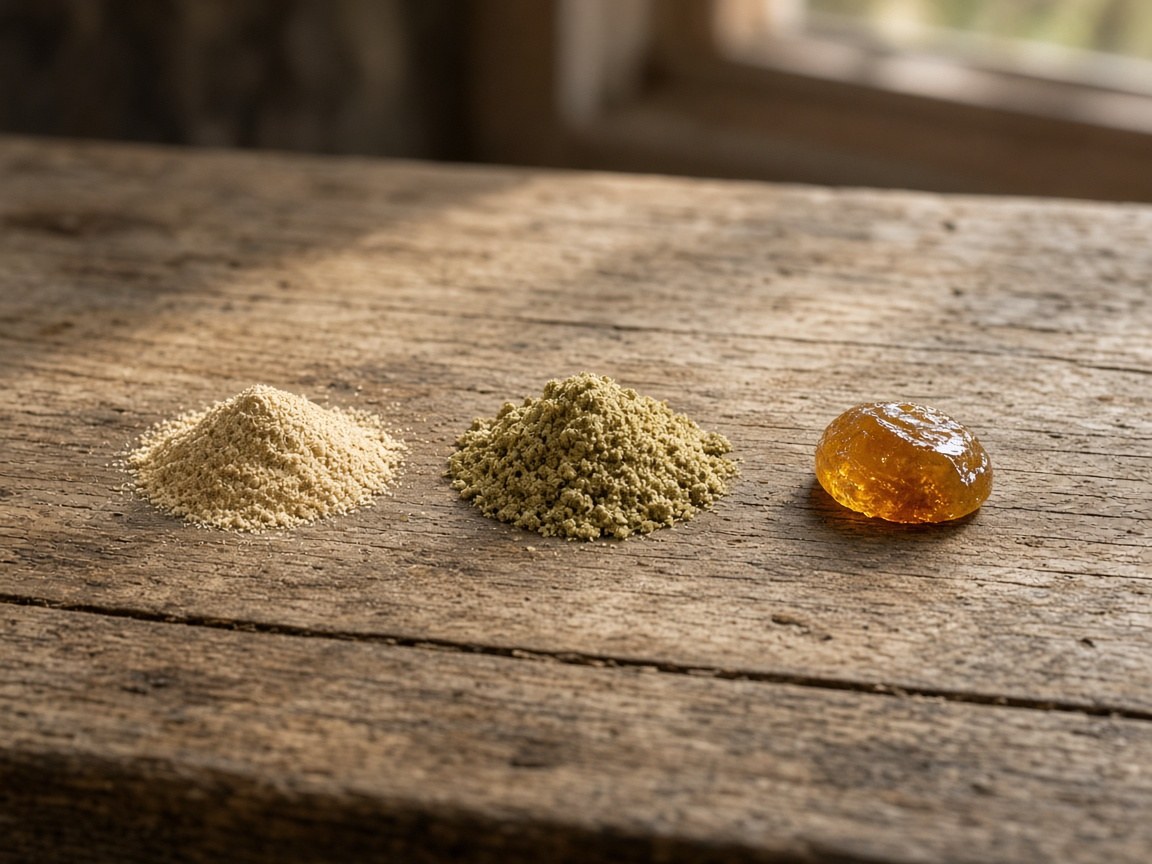
Kief is loose crystal dust. Dry sift is crystal dust that was shaken through a screen on purpose. Rosin is the sticky oil you get when flower or that dust is pressed with heat. You are buying trichomes in three shapes. A trichome is the tiny crystal on a bud that holds THC and the smell oils.
The National Institute on Drug Abuse calls those crystals trichomes and lists the ways people collect them. Dry processing includes kief. Water processing includes bubble hash. Another method combines pressure with heat. That last one is the family rosin sits in. A peer-reviewed processing review (PMC8290527) says rosin extraction uses compression and heat to pull oil. No butane bath. No propane bath.
Here is the buy, in one table:
| What you see | Plain name | How it got that way | What you are paying for |
|---|---|---|---|
| Pale dust in a grinder catch | Kief | Crystals knocked loose while flower was ground | A pinch of resin, plus whatever fine leaf came with it |
| Sandy powder or a soft puck from a screen | Dry sift | Dried flower or trim shaken over a screen so crystals fall through | A cleaner pile of the same crystals, if the screen work was honest |
| Glossy dab in a small jar | Rosin | Flower, sift, or hash pressed with heat so the oil comes out | A small amount of pressed resin, not a pile of dust |
| Wet-process hash, often tan or pale | Bubble hash | Ice water knocks crystals off, then they are collected | A different hash. It is not rosin until someone presses it |
NIDA's June 2020 fact sheet puts numbers on the potency gap, and the date matters. Solvent-based concentrates in that sheet averaged about 54–69% THC, with some reports over 80%. Non-solvent methods averaged about 39–60% THC. Seized marijuana plant material averaged just over 15% THC. Those are class averages from that fact sheet, not the percent on the jar in your hand. Kief is the least cleaned version of dry processing, so it can sit well under the non-solvent band. Do not borrow 39% or 60% for a grinder catch.
A clinical review table (PMC10249738) lists rosin, in general, around 40–75% THC. That is a review table, not a Michigan shelf audit. The only percent that counts for your money is the one on that package's lab sheet.
Three shopping facts fall out of the table:
- Name is not purity. Two jars can both say kief and carry different amounts of green leaf dust.
- Rosin is not a stronger kief. The texture changed. The oil was squeezed out. You use less, and it hits faster.
- Bubble hash is a cousin, not a synonym. NIDA lists it under water processing. If a menu says hash rosin, ask what was pressed.
Divine Toke does not sell kief, dry sift, or rosin. We sell sun-grown flower and 1 gram pre-rolls. If you want the plant before anybody knocks the crystals off, that is the flower. The weeknight gram math is a 1 gram pre-roll versus an eighth.
Is the Dust in Your Grinder the Same as Dry Sift? #
No. Grinder kief is whatever fell off while you ground flower. Dry sift is a screened pile someone meant to collect. They can look alike in a bag. The work behind them is not alike.
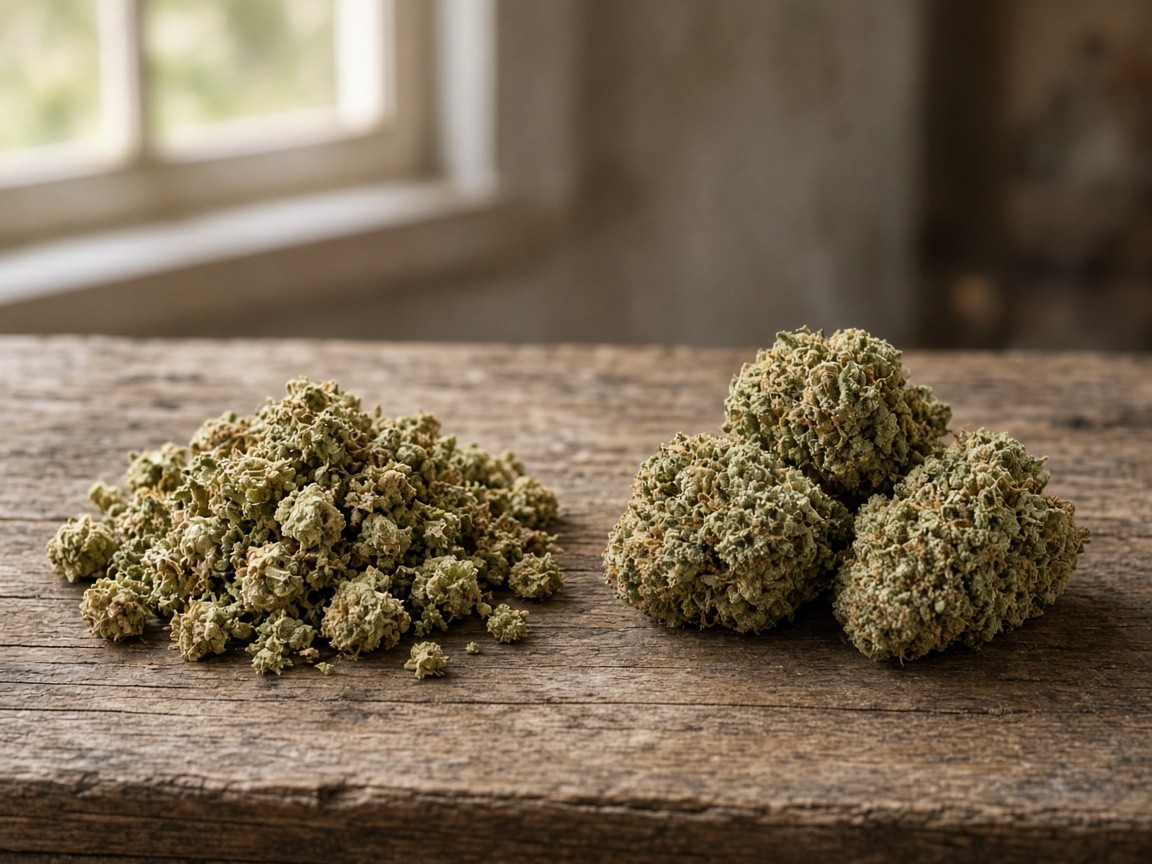
A four-piece grinder has a catch under the screen in the grinder itself. Every time you twist a nug, some crystals drop through. So does fine green plant dust. Pistils. Bits of leaf. That mix is still kief in everyday talk. It is not a graded product. It is leftovers from the flower you already bought.
Dry sift starts with dried cannabis and a screen used for that job. A microscopy study (PMC10071647) measured glandular heads, the round part of the crystal, at about 40 to 110 micrometers across. On two cultivars at six weeks of flower, the average heads were about 75 and 90 micrometers. A micrometer is a millionth of a meter. You cannot see one. You can see a pile of them.
A screen number on a menu, like 90 micron, is the size of the hole. It is not a lab grade. Heads in that study already span 40 to 110 micrometers, so one hole size cannot mean "only perfect crystals" for every plant. Broken heads, stalks, and leaf dust can fall through the same hole. A separation paper (PMC12051344) says traditional dry separation uses size and density, and pushing the yield can cost purity. More powder is not the same as cleaner powder.
What you can check without a microscope:
- Color. Pale gold or sandy tan usually means more crystal and less green leaf. Green usually means more plant dust. Color is a clue, not a pass.
- Feel. Dry sift that was cleaned harder often feels a little sandy and even. Grinder dust feels random because the grinder was not trying to grade it.
- The word on the label. If it only says kief, assume a broad mix until the lab sheet says otherwise.
- A micron number with no lab sheet. The number is a screen. It is not THC, and it is not a mold test.
Finer is not a trophy. A very fine fraction can be broken crystals and plant dust. A slightly coarser fraction can be whole heads if that plant grew bigger glands. The same microscopy study is why. Head size changes with the plant and the week of flower.
If you already own flower, the dust in the catch is a bonus from that jar. It is not a reason to pay sift prices for an unnamed powder. If you are buying sift, you are paying for the screening work and for a batch that was tested on purpose. Ask for the sheet.
What Happens When That Dust Gets Pressed Into Rosin? #
Rosin is the oil that comes out when heat and pressure squeeze resin from flower, sift, or hash. You stop holding a powder. You hold a dab. A dab is a small bit of concentrate you inhale off heat, all at once.
NIDA's fact sheet is blunt about that inhale. People who dab take the whole amount in one breath. Flower is a joint you can put down. A dab is the dose, then it is gone. That is the main reason a new smoker gets wrecked by a jar that "looked small."
The processing review describes solventless methods, including dry-sieving and rosin, as ways to move cannabinoids that are already semi-liquid when heated. Solventless means nobody added butane, propane, or another extraction solvent to dissolve the plant. It does not mean the farm was clean. Pesticides, mold, and metals on the input can still show up in the oil. Concentrating the resin concentrates what was on the plant. That is the whole point of the concentrate guide.
Read the input line. It tells you what went into the press:
| Label words | What went in | What you should not assume |
|---|---|---|
| Flower rosin | Dried flower was pressed | It is not automatically "full plant" in a good way. Leaf and chlorophyll can come along |
| Dry-sift rosin or hash rosin from sift | Screened crystals were pressed | The micron number still is not a safety test |
| Hash rosin | Hash was pressed, often bubble hash | Hash and rosin are two steps. The jar is the second step |
| Live rosin | Shop talk for material frozen fresh, then washed, then pressed | Michigan's rules I am citing do not define the word "live" as its own category |
I am not giving you the press settings. NIDA already documents the other bad idea: people making butane hash oil at home have started fires and suffered serious burns. Rosin skips the flammable solvent. It is still not a kitchen project this blog will coach. Buy it from a licensed Michigan shop, or skip it.
A sticky jar also hides dose. A grain of rosin the size of a rice crumb can carry more THC than a whole bowl of average flower, because the flower average in that NIDA sheet was just over 15% and the non-solvent concentrate average was 39–60%. Your batch can miss both averages. The direction is the lesson. Small does not mean gentle.
How Is Bubble Hash Different From These Three? #
Bubble hash is ice-water hash. It is not kief, it is not dry sift, and it is not rosin until somebody presses it. NIDA splits the methods on purpose. Dry processing is where kief sits. Water-based processing is where bubble hash sits. Pressure plus heat is the rosin step.
People mash the names because all three can look tan and sandy. The water step is the tell, if the maker actually says it. Ice water knocks crystals off the plant. Dry sift never takes that bath. Grinder kief never does either. If a jar says bubble hash, you are holding the water-process hash. If it says hash rosin, someone pressed that hash afterward. Two products. Two prices. Do not let a menu use both words for one puck and shrug.
| Name on the menu | The step that defines it | Still a powder? |
|---|---|---|
| Kief | Crystals knocked loose, often in a grinder | Yes |
| Dry sift | Crystals shaken through a dry screen | Yes, unless they pressed the powder into a puck |
| Bubble hash | Crystals collected with ice water | Often a sandy or pressed hash, still not oil |
| Rosin | Heat and pressure squeezed oil out of flower or hash | No. It is a dab |
A pressed puck of sift can feel like hash and still never have seen a rosin press. Texture is not the method. The label's input line is the method. If the shop cannot say dry, water, or press, you do not have enough to pay a premium.
None of this is a home setup. I am not listing screens, bags, water temperatures, or plates. NIDA's fact sheet already ties amateur solvent extraction to fires and burns. The solventless cousins are still a licensed processor's job. A Detroit kitchen is where you store the jar you bought, not where you build the product.
Does the Heat in Rosin Change the THC? #
Heat can start turning THCA into THC, and it can cook off smell oils, but the jar is not a finished "activated" edible. Most of the turn still happens when you smoke or dab it. Read both rows on the lab sheet.
THCA is the acid form. It is the version the plant mostly stores. THC is the form that makes you high after heat knocks a piece off the molecule. The weights are public. PubChem lists THCA and PubChem lists THC. The acid is heavier. Divide the THC weight by the THCA weight and you get about 0.877. That is why a sheet often prints:
Total THC = THC + (0.877 × THCA)
Use the lab's printed total. Do not redo it in a parking lot off Woodward and then treat your napkin as the high. The same size math shows up on other acids. How a Michigan sheet prints a minor like CBC is CBC on a Michigan COA.
The processing review says high heat is what decarboxylates those acids, and that more heat can also drop terpenes. Terpenes are the smell oils. Mango, pepper, pine, gas. They are not the THC number. A hotter press can look stronger on a THC line and smell flatter. That is a trade, not a free upgrade.
What the sheet is telling you:
- High THCA and low THC means the jar is still mostly the raw acid. Heat at use will do more of the conversion. The total THC line is the lab's estimate of that potential, not a promise of how the dab will feel.
- A huge total THC with almost no terpene lines can mean the smell got cooked off, or the lab did not print the smell test. Ask which one.
- The word solventless tells you the method family. It does not tell you the percent.
Flower you smoke has the same THCA story. The joint is the heat. Rosin just starts that heat earlier, inside the press, for a short time. It does not finish the job for you.
How Does Michigan Treat Kief Versus a Concentrate? #
Rosin counts toward Michigan's 15 gram concentrate cap. Standalone kief is tested with bud and shake in the harvest-batch mold table. Kief rolled onto flower with other oil becomes a concentrate in the state's own bulletin. The receipt category matters as much as the nickname.
Adults 21 and older may possess, purchase, and transport 2.5 ounces or less, and not more than 15 grams of that may be marijuana concentrate. That is MCL 333.27955. The CRA's MRTMA summary points at the same adult-use law. At home you may store up to 10 ounces, and anything over 2.5 ounces has to sit in a locked container or locked area under MCL 333.27954. That lock is the house rule for the extra weight.
A shop has a matching brake. R 420.506 says an adult-use retailer cannot sell a person 21 or older more than 2.5 ounces in one transaction, with the same 15 gram concentrate cap.
Fifteen grams is not a lot once you are buying dabs. Fifteen one-gram jars fill the concentrate cap even if your flower pocket is empty. A sixteenth jar crosses it. A Detroit Friday run that adds "one more jar" can be that jar. Count grams, not bags.
The test bucket for loose kief is different from that cap, and I am not going to mash them together.
The CRA Sampling and Testing Technical Guidance puts bud, shake/trim, and kief from a harvest batch in one microbial table. A harvest batch is one crop lot grown and cut together. For that table, as printed in the guidance:
| Test on bud, shake/trim, and kief | Adult-use limit | Medical limit |
|---|---|---|
| Total yeast and mold | 100,000 CFU/g | 10,000 CFU/g |
| Total coliform | 1,000 CFU/g | 1,000 CFU/g |
| Shiga toxin E. coli | Not detected in 1 gram | Not detected in 1 gram |
| Salmonella | Not detected in 1 gram | Not detected in 1 gram |
| Aspergillus flavus, fumigatus, niger, and terreus | Not detected in 1 gram | Not detected in 1 gram |
CFU/g means colony-forming units per gram. It is a count of living microbes in a lab dish, scaled to one gram. A pass means the sample came in under that ceiling. It does not mean the pouch can sit in a hot car and stay clean.
The same guidance says a marijuana sample passes water activity if it does not go over 0.65 aw. Water activity is how much water is free for mold to use, not how wet the powder feels on your finger. Medical and adult-use shoppers in metro Detroit often share a counter and then go home to different rules. Ask which lane the pouch is in before you treat 100,000 and 10,000 as the same ceiling.
Heavy metals get tighter when the product is an inhaled concentrate. Table 2 in that CRA guidance lists lead at 1.00 ppm for inhaled flower and 0.500 ppm for inhaled concentrates. Arsenic, mercury, cadmium, chromium, and nickel are tighter on the concentrate side too. Ppm is parts per million. The oil is stronger, so the state allows less metal in it. "Solventless" does not skip that table.
There is a third bucket, and it catches a lot of "kief" marketing.
On September 19, 2022, the CRA published Compliant Creation and Testing of Inhalable Compound Concentrate Products and Pre-Rolls. It says an inhalable compound concentrate is any product made by combining one or more marijuana products with marijuana, and it names flower and kief in that sentence. The examples include an infused pre-roll, moon rocks rolled in kief, and a tarantula joint with distillate plus kief or hash. The CRA classifies those finished products as concentrates for transaction limits, transfers, transportation, and labeling.
The same bulletin says each piece needs a passing safety test in Metrc before it is combined, under the idea in R 420.206(14). The finished piece is tested again under R 420.304 and R 420.305. Metrc is the statewide tracking system. A pass on the flower does not cover the oil you rolled onto it.
Two lines in that bulletin matter at a shop, and they are not a home recipe:
- Retailers and provisioning centers are not allowed to add kief to raw pre-rolls.
- Adding kief to a raw pre-roll is only allowed when that kief comes from the same harvest batch as the flower, and retailers still do not get to do it. Producers and microbusinesses, not class A microbusinesses, are the license types the bulletin names for building these products.
If a Detroit menu says "kief coated" or "infused," you are likely in the concentrate transaction bucket, not the flower bucket. How a pre-roll is built in the first place is why our pre-rolls are different. Ours are flower. They are not a kief product, and I am not going to pretend a dusted joint is the same SKU.
What Should You Read on the Label Before You Buy? #
Match the package tag to a lab sheet that says pass, then read total THC, the input, and the contaminant rows. The nickname on the menu is the ad. The sheet is the product.
Michigan's packaging rule, R 420.504, makes the container show net weight, plus the THC and CBD numbers from the lab that passed the lot, and the name of that lab. Grams are allowed. A jar that says "rosin" and never shows grams is not ready for you to compare to a one-gram flower pre-roll. Weight first.
R 420.305 is the testing rule behind those numbers. The CRA sampling guidance says a result over the action limit is a failure. Do not buy a fail. If someone says the batch was fixed later, ask for the new passing sheet on that same package tag. A story is not a retest.
Walk the sheet in this order:
- Package tag and lab name. The tag is the batch. A kief pouch and a rosin jar with two tags are two products, even if the strain name matches.
- Net weight. Rosin is often sold by the gram or the half gram. Kief might be a gram or two. Write the grams down before you talk yourself into "it's a small jar, so it's a small high."
- Total THC and the THCA row. High THCA with a low THC row is normal for a lot of inhaled products. The total line is the one to compare. The feeling still depends on how you inhale it.
- Terpene lines, if they printed them. Terpenes are smell oils. A sheet with only "total terpenes" and no names is a blur. How to read a Michigan terpene panel is the COA shopping guide. What "lab tested" covers, and what it does not, is what lab-tested means in Michigan.
- Microbes. For harvest-batch kief, use the yeast, coliform, E. coli, Salmonella, and Aspergillus rows from the table above. A pass is a snapshot of the sample, not a forever promise after the pouch lives in a humid apartment.
- Metals and chemical residues. Inhaled concentrates have tighter metal ceilings than flower in the CRA table. Look for the word pass. Do not infer a pass from "organic," "indoor," or "solventless."
- Residual solvents, if this is not rosin. Rosin should not need a butane purge, because no butane was the solvent. If the jar says live resin, BHO, wax, or shatter, that is a solvent extract. NIDA warns that leftover solvent is a real concern in that family. A blank solvent row is not a pass. Ask for the row.
| Stop sign | Why you walk |
|---|---|
| Tag on the jar does not match the sheet | You are reading someone else's batch |
| Any safety row says fail | The guidance treats a result over the limit as a failure |
| "Full melt" or "six star" and no sheet | Those are marketing grades, not CRA tests |
| Green kief priced like hash rosin | You may be paying sift money for grinder dust |
| Solventless used as a health claim | Method is not a medical promise |
Mold and kief get confused on purpose by bad bags. Trichomes glitter. Mold powders and smells like a basement. If you are staring at a pouch after a wet Michigan week and you are not sure, do not smoke the question. The nose check, and why you do not "cut around" rot, sits in the flower world. The lab floor under it is the same CRA microbial table.
A minor cannabinoid line, like CBC, can show up on a full sheet and still not tell you whether the dab is the right buy. Read it if you are curious. Do not let it replace the pass rows. The CBC walkthrough is the post linked above.
Which One Is Worth Buying on a Detroit Weeknight? #
Buy flower when you want a session you can put down. Buy kief only as a sprinkle from flower you already trust. Buy dry sift when the sheet shows a real screened batch and the price is not rosin money. Buy rosin when you already know your THC tolerance and you want a small, strong, smelly dab. If you are new, skip the jar.
NIDA's fact sheet says higher THC doses are more likely to bring anxiety, agitation, paranoia, and psychosis, and that the risk of dependence rises as THC exposure rises. That is not a moral lecture. It is why a rice-crumb dab is a bad first night. The CDC's cannabis FAQ lists a fast heart rate among signs you used too much, next to panic, and points people who used too much toward Poison Control. In an emergency, call 911. Poison Control in the U.S. is 1-800-222-1222.
The heart side has its own page, because a racing pulse is common enough to deserve the mechanism. Why cannabis makes your heart race walks through the American Heart Association's 2020 statement: THC can raise heart rate and raise how much oxygen the heart muscle wants. A concentrate does not get a free pass on that. If you already get a pounding chest from a joint, do not "solve" it with a stronger oil.
Here is the weeknight split I actually use when friends ask:
| You want | Buy | Skip |
|---|---|---|
| One joint after a plant shift, then sleep | Flower, or a 1 gram pre-roll | A dab you cannot divide |
| A little extra on a bowl you already like | The kief from that same flower, a pinch | A new pouch with no tag |
| Cleaner crystals than grinder dust, still a powder | Dry sift with a matching COA | A micron number and a shrug |
| Flavor and strength in a tiny amount, and you have done this before | Rosin with a pass sheet and a named input | Your first cannabis, or a night you have to drive |
| The cheapest session you will finish | Flower you will actually smoke | A $ jar you take one dab from and forget |
I am not printing a Divine Toke price for kief or rosin, because we do not sell them. I am not inventing a dispensary menu for Detroit either. Statewide flower averages move every month, and a dab menu on one block is not the next block. Compare grams on the label to grams you will use. A one-gram rosin jar and a 3.5 gram eighth are not the same pile of plant. If you only wanted one gram of flower tonight, the pre-roll math is the other post. Do not let a concentrate nickname talk you out of counting grams.
Who should pass on the strong end:
- New or rare smokers. The dose is too easy to miss. Start with flower you can set down.
- Anyone who has had panic, paranoia, or a bad vomiting night from THC. More THC per breath is the wrong direction.
- People with heart disease, a prior heart attack, a rhythm problem, or chest pain they have not had checked. Talk to a clinician before you add any cannabis, and do not use this page as clearance.
- Anyone under 21. MCL 333.27955 is an adult-use rule. It is not a teen rule.
- Anyone who has to drive, including a night shift commute on I-94 or the Lodge. Do not dab and drive. Do not "wait ten minutes" and drive. Give the night to the couch.
A practical order if you are curious and you are already a flower smoker: one small pinch of your own grinder kief on flower you know, on a night you do not need to be anywhere. Wait. Do not stack a second pinch because the first one felt slow. Inhaled THC can show up in minutes, and NIDA's point about one breath still applies when the dust is on a bowl. If that pinch was plenty, you do not need a rosin jar this month.
If the sift costs about what rosin costs and the sheet is thin, buy the rosin or buy neither. You are paying for cleanliness and a test, not for a prettier word.
What Do 15 Grams Look Like Next to an Eighth? #
Fifteen grams is the whole adult-use concentrate allowance, and one gram of rosin uses one of those grams. An eighth of flower is 3.5 grams of flower. It does not spend the concentrate allowance. The scale treats them as weight. Your head does not.
MCL 333.27955 is the possession rule: 2.5 ounces total, and not more than 15 grams of that in concentrate. 2.5 ounces is 70 grams if you use 28 grams to the ounce. 2.5 × 28 = 70. A retailer mirrors that in one sale under R 420.506.
| What is in the bag | Weight | Concentrate cap (15 g) | 2.5 ounce cap (70 g) |
|---|---|---|---|
| One rosin jar | 1 gram | 14 grams of room left | Barely touches it |
| Fifteen 1 gram rosin jars | 15 grams | You are at the cap | 15 of 70 grams |
| A 16th 1 gram rosin jar | 16 grams | Over the cap | Still under 70, and still illegal on the concentrate line |
| Eighth of flower | 3.5 grams | Not concentrate | Fine |
| Divine Toke 1 gram pre-roll | 1 gram of flower | Not a concentrate | Fine |
| Divine Toke 20-pack | 20 grams of flower | Not a concentrate | Under 70 grams |
The 20-pack is 20 flower joints. It is not 20 grams of rosin. Do not add those columns in your head and call it one pile. If a kief pouch is rung up as concentrate, those grams join the 15. If the label will not say, ask before it goes in the same tote as a dab jar.
Effect is the other column nobody prints. NIDA's fact sheet put seized flower a little over 15% THC and non-solvent concentrates around 39–60%. A 1 gram dab jar can hold more THC than a 3.5 gram eighth of ordinary flower, and you can inhale a dab in one breath. Legal room left is not a dare to finish the jar tonight.
What Do You Ask Before You Hand Over the Card? #
Ask for the grams, the input, the pass, and whether the register counts it as concentrate. Four questions. Then you can decide if the price is for dust, for a screen, or for a press.
Say it like this at a metro Detroit counter:
- "How many grams are in this package?" R 420.504 already requires net weight. You are checking that the jar in your hand matches the sticker. A "gram" that is light is a worse deal before you ever talk potency.
- "What went in?" Flower, dry sift, bubble hash, or loose kief. Bubble hash is the ice-water kind NIDA lists separately from dry kief. If they say rosin, ask which of those was pressed. The word alone is the method, not the ingredient.
- "Does this tag match a sheet that passed?" Microbial, metals, and, if it is a solvent extract, solvents. A fail is a no. The CRA sampling guidance treats a result over the action limit as a failure.
- "Does this count toward the 15 gram concentrate limit?" Rosin should. An infused pre-roll with kief should, under the September 19, 2022 bulletin. Loose kief might be rung up with flower. Get the category off the receipt, not off a nickname.
If the answer to 2 or 3 is a shrug, leave it. You can buy flower instead. Divine Toke's flower and 1 gram pre-rolls are the thing we actually sell. They are not a secret kief line.
A budtender can be unsure about slang. The label still has to show the weight. Write the grams down before you compare a dab jar to an eighth. I am not filling in dollar signs. Menus move, and I will not invent one.
How Should You Store the Pouch So It Does Not Go Flat? #
Keep kief, sift, and rosin cold, dark, and closed, and lock the strong stuff where a kid cannot pinch it. Smell oils leave when the jar sits in heat, light, or open air. A sunny Michigan windowsill is a slow cooker.
The lab's 0.65 aw water-activity line is about free water in a marijuana sample, from the CRA guidance above. Your kitchen is not that lab. A damp fall week off the Great Lakes still matters, because a warm, closed car or a steamy bathroom can put moisture where mold likes it. Powder is easy to ignore. It is still plant resin. If the pouch smells like a basement, stop. Do not sprinkle basement dust on a bowl and call it kief.
What I tell people who already bought a jar:
- Close it. Air is the quiet thief. Every time the lid sits off "for later," the smell gets flatter.
- Get it out of the sun. A dashboard in October can still bake a dab jar while you are in the store.
- Cold helps concentrates. The flower storage piece is how to store your weed. Flower and pressed oil do not want the exact same spot. Do not freeze a damp flower jar because a rosin post said cold. Read that guide for the flower rules.
- Do not leave a open dab tool on the coffee table. Rosin looks like candy-adjacent goo. Kief looks like sugar dust. Neither one belongs next to snacks.
Child-resistant packaging is a shop test. It is not a lock once you have opened it. The home version, before candy season and on ordinary Tuesdays, is lock it before the candy bowl. The statute lock in MCL 333.27954 is aimed at amounts over 2.5 ounces in the residence. A one-gram rosin jar can sit under that ounce line and still be the thing a child should never find. Lock the strong jar anyway.
If you are over 2.5 ounces in the house because flower plus a few concentrate jars added up, the extra has to be in a locked container or locked area. A sock drawer is not a lock. Count the concentrate grams toward the 15 gram cap before you count the flower ounces. They share the 2.5 ounce possession picture, and the concentrate slice has its own ceiling.
Places that cook a jar in a Michigan week, even in October:
| Spot | What happens | Better spot |
|---|---|---|
| Dashboard while you run into a shop | Sun on glass heats the dab | Take the bag inside, or do not leave it |
| Bathroom shelf after a shower | Steam adds free water | A closed tin in a closet |
| Windowsill in a Detroit apartment | Light plus afternoon sun | A drawer, away from the glass |
| Next to the stove | The burner is a second press | Not the kitchen heat |
| Open on the coffee table | Air flattens the smell, and kids can reach it | Closed, then locked |
October nights in Michigan get cold. The car still gets hot in the sun on a clear day. Cold night air does not undo a baked afternoon. If the rosin smells flatter than it did at the counter, the heat already took some of the oils. You cannot press them back in at home. Buy less next time, and do not park the jar in the light.
FAQ #
Is kief the same thing as dry sift? #
No. Kief is the loose crystal dust, and dry sift is that kind of dust after a screen was used on purpose. Grinder kief also picks up fine leaf. A microscopy study (PMC10071647) found glandular heads from about 40 to 110 micrometers, so a screen hole is only a size class. It is not a promise that every grain is a clean resin head.
Is rosin stronger than kief? #
Usually yes, gram for gram, because rosin is pressed resin and kief is still a powder that can include plant dust. NIDA's June 2020 fact sheet put non-solvent concentrates around 39–60% THC on average, against seized plant material at just over 15%. That sheet does not give a kief-only average. Your jar's total THC is the number. A small dab is still easy to overdo, because dabbers inhale the amount in one breath.
Does rosin have solvents in it? #
Rosin is made without an extraction solvent. Butane hash oil is not rosin. A processing review (PMC8290527) describes rosin as compression plus heat. NIDA still warns that solvent extracts can carry leftover solvent, and that pesticides can show up in concentrates too. Solventless does not mean the farm skipped mold or metals. Read the pass rows.
Does kief count as a concentrate in Michigan? #
Loose kief is listed with bud and shake in the CRA harvest-batch microbial table. Rosin is the product that clearly sits in the 15 gram concentrate cap. Kief combined into an inhalable, like a coated pre-roll, is classified as a concentrate. That split is the sampling guidance plus the September 19, 2022 bulletin. If the receipt already says concentrate, count the grams toward 15 under MCL 333.27955.
Can a Detroit shop sprinkle kief on a raw pre-roll for me? #
No. The CRA bulletin says retailers and provisioning centers are not allowed to add kief to raw pre-rolls. Adding kief to a raw pre-roll is only permitted when the kief is from the same harvest batch, and that job is not the retailer's. An infused pre-roll that already has oil plus kief is an inhalable compound concentrate, and it counts as a concentrate for the transaction limit.
What THC percent should I expect? #
Do not expect one percent. NIDA's non-solvent band is 39–60%, and a review table (PMC10249738) lists rosin in general around 40–75%. Neither one is your batch. Kief can land much lower because of plant dust. Read total THC on that package. R 420.504 is why the THC number has to be on the label at all.
Why does rosin cost more than kief? #
You are paying for a press run, a named input, and a small weight of oil, not for a pinch of leftovers. Grinder kief came off flower you already paid for. Screened sift costs more when someone removed more leaf and tested the batch. If sift is priced like rosin and the sheet is missing, you are paying for a word. Compare price per gram only after the label shows the grams.
Is live rosin worth the extra money? #
Only if the package says what was frozen, and the COA still passes. In shop talk, live usually means fresh-frozen material, then hash, then a press. I am not citing a Michigan statute that defines that word. The CRA bulletin defines inhalable compound concentrates and kief. It does not grade "live" as safer or stronger. Pay extra for a real input line and a pass sheet, not for the adjective.
Can kief or rosin make your heart race? #
Yes. THC can raise heart rate, and a concentrate is an easy way to take a bigger THC dose in one breath. The American Heart Association's 2020 statement, covered in why cannabis makes your heart race, links THC with a faster heart and a higher oxygen demand. The CDC FAQ lists a fast heart rate as a sign of too much. Chest pain, fainting, or a heartbeat that will not settle is 911, not a second dab.
How do I store dry sift and rosin? #
Closed, cold, and dark, then locked up. Heat and open air flatten the smell oils. The CRA water-activity pass line for a marijuana sample is 0.65 aw in the sampling guidance, which is a lab number, not a kitchen setting. Flower storage details are in how to store your weed. The kid problem is in the child-resistant storage guide. A sock drawer is not a lock.
Who should skip concentrates? #
New smokers, anyone who panics on THC, anyone with a heart problem that has not been cleared, anyone under 21, and anyone who still has to drive. MCL 333.27955 starts at 21. NIDA ties higher THC doses to more anxiety and paranoia. A Detroit night shift does not change that. Flower you can put down is the saner first buy.
Does Divine Toke sell kief or rosin? #
No. Divine Toke sells sun-grown flower and 1 gram pre-rolls to Michigan adults. We do not have a kief pouch or a rosin SKU, and this post will not invent one. If you want the bud before the crystals get knocked off, start with the flower. The price split between one gram tonight and a 3.5 gram eighth is the pre-roll versus eighth math.
If You Want the Flower Before the Dust #
Kief is the catch. Dry sift is the screen. Rosin is the press. The one that is worth it is the one whose lab sheet matches the package, at a dose you already know you can handle.
If you are still on flower, stay on flower until a pinch of your own grinder dust feels like enough. Most Detroit weeknights never need the jar. A joint you can put out beats a dab you cannot divide.
When you do want the longer version, with hash, solvents, and why a dirty input gets worse as it gets concentrated, read rosin, hash, and clean inputs. When you want the plant we actually grow, it is sun-grown flower from Michigan, not a house concentrate.
| If the package says | You are holding | Worth it when |
|---|---|---|
| Kief | Loose crystal dust, often with some leaf | It fell off flower you already trust, and you use a pinch |
| Dry sift | Screened crystals | The sheet matches the pouch and the price is not rosin money |
| Bubble hash | Ice-water hash | You wanted hash, and nobody called it rosin by accident |
| Rosin | Pressed oil, no extraction solvent | You already handle THC well, and the input is named |
| Infused pre-roll with kief | A concentrate, per the CRA bulletin | You meant to buy a concentrate, and the tag passed |
Divine Toke has no public shop address and no Detroit storefront. The flower ships. The same four checks still apply at whatever licensed counter you use in the city or anywhere else in Michigan.
This article is for education. It is not medical advice, and it is not a license to press oil at home. Talk to your own clinician before you add cannabis, especially if your heart, your meds, or your head have already given you trouble.
Grown in Detroit. Shipped to your door.
Small-batch, sun-grown cannabis cultivated in living soil. Mail-order shipping to all 50 states.