When a Michigan Cannabis Test Says Fail, Put It Back
A Michigan COA that says fail means put the product back. Here are the CRA lines for aspergillus, pesticides, and heavy metals.
Questions this article answers
- Which failed safety numbers on a Michigan cannabis test mean put the product back?
- What does an aspergillus fail mean on a Michigan COA?
- What are Michigan cannabis pesticide action limits?
- What heavy metal limits fail Michigan cannabis flower?
- Can a failed Michigan cannabis batch be retested and sold?

Head Cultivator
On this page
The QR code opened on a cracked phone in a Detroit parking lot. One line said FAIL. The eighth was already in the bag.
Put it back. On a Michigan safety test, fail means that batch went over a number the state published, or the lab found a mold it is not allowed to find. Do not smoke it while you squint at the THC percent.
What Does a Fail on a Michigan Cannabis COA Mean? #
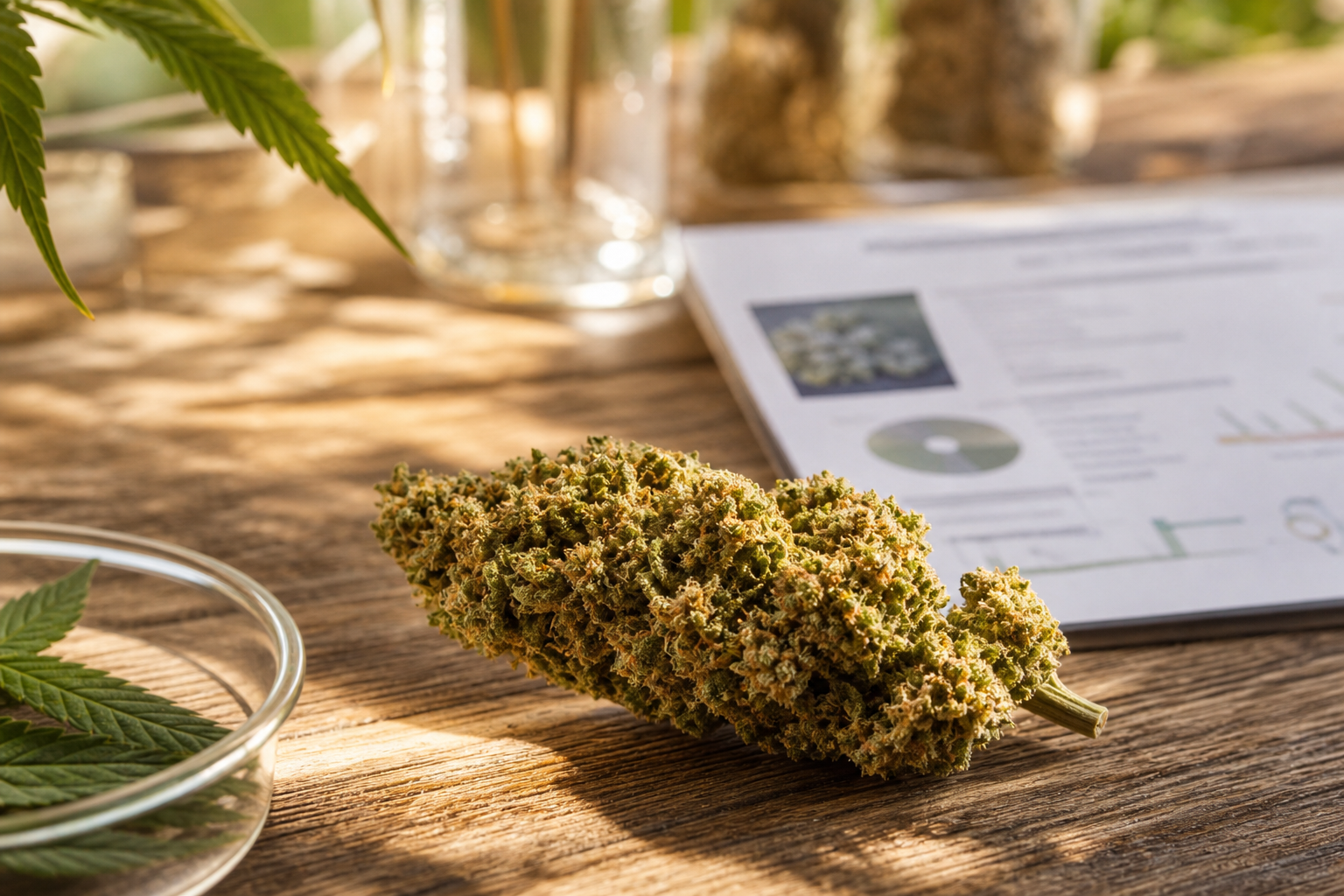
A fail means that batch is not cleared for sale, so the jar in your hand goes back on the counter. A COA is the lab sheet for one batch. The Cannabis Regulatory Agency testing guide (version 5.2, revised September 23, 2024) says the lab marks pass or fail in Metrc and on that sheet. Those two should match, aside from extras the state does not require, like terpenes.
R 420.305(10) is the line that matters. A result over the published action limit is a failed sample. A result at the limit, or under it, is a pass. "Action limit" just means the number the agency published. Over it fails. On it passes. The same sentences sit in the CRA's compiled marihuana rules, with a history line of March 7, 2022 on these sampling rules. Cornell's page is the easy read. The PDF is the state copy.
R 420.304(k) keeps a batch in quarantine while it is being tested. It cannot be packaged, transferred, or sold until a pass is in the statewide monitoring system. Metrc is that system. If the sheet in front of you says FAIL, that product should not be in the bag.
The same limits apply at a licensed counter in Detroit and at a shop on the other side of the state. This is a Michigan rule, not a house rule.
| What you see | What you do |
|---|---|
| FAIL on a safety line | Put the product back |
| A number over the action limit for that product type | Put it back |
| A number at the limit, and the line says pass | The rule calls that a pass |
| Terpene percents only, no safety lines | That is not a full safety sheet |
The longer map of what "lab tested" covers, and where the system has cracked before, is what lab-tested means in Michigan. Smell and terpene percents are a different page: reading a Michigan terpene panel. This one is the fail sheet.
A harvest batch cannot be bigger than 50 pounds under R 420.304(c). The lab samples that batch. Your eighth is a slice of it. A fail is about the batch, not the one nug you sniffed.
Which Failed Numbers Mean Put the Product Back? #
Put it back when aspergillus is detected, when a banned chemical is over its action limit, or when a heavy metal is over the limit for that kind of product. Those three are the ones people miss because they cannot see them, smell them, or taste them. The numbers below are from the September 23, 2024 testing guide, version 5.2. If a newer guide replaces it, the new guide wins. This page does not guess ahead of that PDF.
| Fail line | The published number | Put it back? |
|---|---|---|
| Aspergillus flavus, fumigatus, niger, or terreus on bud, shake, trim, kief, or an infused product | Not detected in 1 gram | Yes. Any detection fails |
| Any chemical in the banned list, over its own action limit | Example: myclobutanil over 0.2 ppm | Yes |
| Lead on inhaled flower | Over 1.00 ppm | Yes |
| Inorganic arsenic on inhaled flower | Over 0.400 ppm | Yes |
| Mercury on inhaled flower | Over 0.200 ppm | Yes |
| Cadmium on inhaled flower | Over 0.400 ppm | Yes |
| Total chromium on inhaled flower | Over 1.200 ppm | Yes |
| Nickel on inhaled flower | Over 1.000 ppm | Yes |
| Lead on an inhaled concentrate | Over 0.500 ppm | Yes |
| The same metal on a gummy or other non-inhaled product | Use the "other products" column, not the flower column | Yes, if that column is exceeded |
ppm means parts per million. It is the unit on the metals table and on the chemical table. A result that lands exactly on the limit passes. A result over it fails. That split is R 420.305(10), and the testing guide repeats it.
Do not borrow the flower lead number and slap it on a cart. Do not borrow the cart number and slap it on flower. The columns are different on purpose. The full metal table is below.
A yeast count can be high and still pass. That is a different row from aspergillus. Do not treat them as the same word.
If the only word you can read on the safety block is FAIL, stop there. You do not need the species name. You do not need to convert ppm in the parking lot. That word means the batch missed a published line. Put the product back. Ask for a different batch if you still want flower that night.
The numbers in the next sections are for the sheet that prints a result and forgets the word, or for the day you want to know what the word was measuring. They are the version 5.2 guide. They are not a Divine Toke lab sheet. We are not going to invent one.
A pass on yesterday's batch does not pass today's bag. Match the tag every time.
What Does an Aspergillus Fail Mean? #
If the sheet says aspergillus was detected in 1 gram, put the product back. The testing guide's Table 3 names four species: Aspergillus flavus, fumigatus, niger, and terreus. The limit is "not detected in 1 gram" for bud, shake, trim, and kief from a harvest batch, and the same words for a marijuana-infused product.
Aspergillus is a mold. You do not need the Latin to shop. You need the line on the sheet. Detected means fail. Not detected means that line passed.
Why the state splits this mold from a yeast count #
A big yeast number can still be a pass. An aspergillus detection cannot. Total yeast and mold is a count of what grew in a lab dish. The unit is CFU/g, colony-forming units per gram. Aspergillus on this panel is a named find, not a count you are allowed to have a little of.
| Test | Bud, shake, trim, kief from a harvest batch | Infused product |
|---|---|---|
| Medical total yeast and mold | 10,000 CFU/g | 10,000 CFU/g |
| Adult-use total yeast and mold | 100,000 CFU/g | 10,000 CFU/g |
| Total coliform | 1,000 CFU/g | 100 CFU/g |
| Shiga toxin-producing E. coli (STEC) | Not detected in 1 gram | Not detected in 1 gram |
| Pathogenic Salmonella | Not detected in 1 gram | Not detected in 1 gram |
| Aspergillus flavus, fumigatus, niger, and terreus | Not detected in 1 gram | Not detected in 1 gram |
Those CFU numbers are ceilings. Over the ceiling fails. At the ceiling passes, because R 420.305(10) says at or below the action limit is a pass. The "not detected" rows do not have a little-bit allowance. A find fails.
Adult-use flower in Michigan can show up to 100,000 CFU/g of total yeast and mold and still pass that row. Medical flower on the same table is 10,000. An infused product is 10,000 in both lanes. If you are buying adult-use flower after a Detroit shift, a yeast count under 100,000 can still be a pass on that row. If aspergillus says detected, put it back.
The guide's Table 3 prints those two columns. It does not print a third yeast number for concentrates. If a cart's sheet says aspergillus fail, or FAIL on that line, put it back. This page will not invent a concentrate yeast ceiling the table does not show.
What mycotoxins have to do with that mold #
Some aspergillus molds can leave a poison behind, and Michigan makes the business check for that poison before an aspergillus fail can be cleaned up and sold. The CRA mycotoxin FAQ (February 2, 2023) says aflatoxins and ochratoxin A are made by certain molds, including some Aspergillus species. The FAQ calls mycotoxins potential carcinogens. That is the agency's word for "cancer risk," not a promise that one puff gives you cancer.
Table 6 of the testing guide lists accepted detection limits:
| Mycotoxin | Listed limit |
|---|---|
| Aflatoxin B1 | <20 ppb |
| Aflatoxin B2 | <20 ppb |
| Aflatoxin G1 | <20 ppb |
| Aflatoxin G2 | <20 ppb |
| Ochratoxin A | <20 ppb |
ppb means parts per billion. Smaller than ppm. R 420.305(20) says a sample over the published acceptable level fails. The table's symbol is "<20," so this page will not pretend the fail starts at some other number.
The same FAQ says the agency anticipated that less than 0.05% of samples would fail for mycotoxins, based on a 2022 look at aspergillus failures in flower. That is their sentence from February 2023. It is not a 2026 audit of every jar in Detroit. A rare fail is still a fail. Put that jar back.
Bud that looks brown and rotten in the jar is a different check. What that looks like before it should ever be bagged is late September bud rot. A pretty green nug can still fail an aspergillus line you cannot see. Use both eyes and the sheet.
Which Pesticide Numbers Fail a Michigan Test? #
If a banned chemical on the sheet is over its action limit, put the product back. The testing guide's Table 4 is titled as a list of banned chemical ingredients. It still prints a number, not a blank. R 420.305(11) says any result over the action limit is a failed sample. At the limit, or under it, R 420.305(10) calls it a pass.
There is one action-limit column for these chemicals, not a flower column and a cart column. The table has 58 lines. You do not need to memorize them. You need the sheet to say pass, or a number that is not over the limit next to that name.
How to read one line without a fake COA #
Myclobutanil fails when the result is over 0.2 ppm. At 0.2 ppm, the rule calls it a pass. That chemical is on Table 4 at 0.2 ppm, and the lab's quantitation floor (LOQ) on that row is 0.1 ppm. LOQ means the smallest amount that method is supposed to measure cleanly. A note that says "<LOQ" means they are under that floor.
This is not a real bag and not a Divine Toke result. It is the rule, with the state's number:
- Printed result 0.2 ppm of myclobutanil: at the limit. Pass, if the sheet says so.
- Printed result over 0.2 ppm: fail. Put it back.
- Printed result under 0.2 ppm, including <LOQ: under the limit. That line can pass.
People know myclobutanil because it has been a problem on cannabis that gets burned. The longer version of that story is why we don't use pesticides. The shopping move on this page is still the number.
The farm label and the jar test are two different desks #
A pesticide label can be legal on a Michigan farm and the finished jar can still fail. MDARD says cannabis is an agricultural commodity in Michigan, and failing to follow the label is a violation of state and federal law. That is the use rule. The CRA table is the jar rule. Do not treat a farm essay as a pass on your eighth.
The 58 action limits #
Every row below fails when the result is over the action limit. Limits are ppm. They come from Table 4 in version 5.2 of the testing guide. Permethrins are measured as the cis and trans isomers added together. Pyrethrins are measured as pyrethrin 1, cinerin 1, and jasmolin 1 added together. The guide says that in the footnotes under the table.
| Chemical | Action limit (ppm) | LOQ (ppm) |
|---|---|---|
| Abamectin | 0.5 | 0.25 |
| Acephate | 0.4 | 0.2 |
| Acequinocyl | 2 | 1 |
| Acetamiprid | 0.2 | 0.1 |
| Aldicarb | 0.4 | 0.2 |
| Azoxystrobin | 0.2 | 0.1 |
| Bifenazate | 0.2 | 0.1 |
| Bifenthrin | 0.2 | 0.1 |
| Boscalid | 0.4 | 0.2 |
| Carbaryl | 0.2 | 0.1 |
| Carbofuran | 0.2 | 0.1 |
| Chlorantraniliprole | 0.2 | 0.1 |
| Chlorfenapyr | 1 | 0.5 |
| Chlorpyrifos | 0.2 | 0.1 |
| Clofentezine | 0.2 | 0.1 |
| Cyfluthrin | 1 | 0.5 |
| Cypermethrin | 1 | 0.5 |
| Daminozide | 1 | 0.5 |
| DDVP (Dichlorvos) | 1 | 0.5 |
| Diazinon | 0.2 | 0.1 |
| Dimethoate | 0.2 | 0.1 |
| Ethoprophos | 0.2 | 0.1 |
| Etofenprox | 0.4 | 0.2 |
| Etoxazole | 0.2 | 0.1 |
| Fenoxycarb | 0.2 | 0.1 |
| Fenpyroximate | 0.4 | 0.2 |
| Fipronil | 0.4 | 0.2 |
| Flonicamid | 1 | 0.5 |
| Fludioxonil | 0.4 | 0.2 |
| Hexythiazox | 1 | 0.5 |
| Imazalil | 0.2 | 0.1 |
| Imidacloprid | 0.4 | 0.2 |
| Kresoxim-methyl | 0.4 | 0.2 |
| Malathion | 0.2 | 0.1 |
| Metalaxyl | 0.2 | 0.1 |
| Methiocarb | 0.2 | 0.1 |
| Methomyl | 0.4 | 0.2 |
| Methyl parathion | 0.2 | 0.1 |
| MGK-264 | 0.2 | 0.1 |
| Myclobutanil | 0.2 | 0.1 |
| Naled | 0.5 | 0.25 |
| Oxamyl | 1 | 0.5 |
| Paclobutrazol | 0.4 | 0.2 |
| Permethrins | 0.2 | 0.1 |
| Prallethrin | 0.2 | 0.1 |
| Phosmet | 0.2 | 0.1 |
| Propiconazole | 0.4 | 0.2 |
| Propoxur | 0.2 | 0.1 |
| Pyridaben | 0.2 | 0.1 |
| Pyrethrins | 1 | 0.5 |
| Spinosad | 0.2 | 0.1 |
| Spiromesifen | 0.2 | 0.1 |
| Spirotetramat | 0.2 | 0.1 |
| Spiroxamine | 0.4 | 0.2 |
| Tebuconazole | 0.4 | 0.2 |
| Thiacloprid | 0.2 | 0.1 |
| Thiamethoxam | 0.2 | 0.1 |
| Trifloxystrobin | 0.2 | 0.1 |
If the name on your sheet is on this list and the number is over the limit, put it back. If the line already says FAIL, you do not need to do the math. Put it back.
Which Heavy Metal Numbers Fail a Michigan Test? #
Put it back when a metal is over the limit for the product in your hand, using that product's column. Plants pick up metal from soil and water. The state did not set these lines at zero. The testing guide says the heavy metal limits are based on a 5 gram per day consumption assumption. The lab has to set its LOQ at half the action limit for these metals.
| Metal | Inhaled flower (ppm) | Inhaled concentrate (ppm) | Other marijuana products (ppm) |
|---|---|---|---|
| Lead | 1.00 | 0.500 | 0.500 |
| Inorganic arsenic | 0.400 | 0.200 | 1.500 |
| Mercury | 0.200 | 0.100 | 3.000 |
| Cadmium | 0.400 | 0.200 | 0.500 |
| Total chromium | 1.200 | 0.600 | 2.000 |
| Nickel | 1.000 | 0.500 | N/A |
| Copper | N/A | 3.000 | N/A |
Over the number in the right column fails. At the number, or under it, passes.
Flower, a cart, and a gummy are not the same column #
Inhaled concentrates are tighter than flower on lead, arsenic, mercury, cadmium, chromium, and nickel. Flower lead fails over 1.00 ppm. Inhaled-concentrate lead fails over 0.500 ppm. Other products, the column for things that are not inhaled flower or inhaled concentrate, fail lead over 0.500 ppm too.
Inorganic arsenic goes the other way on that third column. Flower fails over 0.400 ppm. Other products fail over 1.500 ppm. Mercury on other products fails over 3.000 ppm, while flower fails over 0.200 ppm. If you use the flower mercury line to judge a gummy, you will call a legal number a fail, or you will miss a real one. Read the column that matches the package.
The guide marks nickel and copper with an asterisk. The only footnote it prints is for copper: copper is required for vaping products only. Copper is N/A on flower and N/A on other products, and 3.000 ppm on inhaled concentrates. This page will not invent a nickel footnote the PDF does not print. The nickel numbers that are printed still stand: 1.000 ppm on inhaled flower, 0.500 ppm on inhaled concentrates, and N/A on other products.
Concentrates squeeze whatever was in the plant into a smaller dab. That is why the metal lines get tighter, and why clean starting flower matters more once you extract. The shopping version of that idea is rosin, hash, and clean inputs.
A metal fail is not a terpene story and not a THC story. It will not show up as a smell.
Do Yeast Counts, Mycotoxins, and Water Activity Fail the Same Way? #
They fail when they go over their own lines, and those lines are not the aspergillus line. You already have the yeast, coliform, E. coli, and salmonella ceilings in the table above. Three more shopper lines from the same testing guide sit next to them.
Water activity #
Flower fails water activity when the number goes over 0.65 aw. The guide says a marijuana sample passes if water activity does not exceed 0.65 aw. So 0.65 passes. 0.66 fails. aw is water activity, a dryness score. Wetter flower is a mold risk later, which is why the state measures it.
An edible infused product passes if water activity does not exceed 0.85 aw. Non-edible infused products are not subject to that test. Marijuana beverages are not subject to it when the agency approves that skip. Do not demand a 0.65 score on a drink.
Stuff that does not belong in the jar #
Glass, metal shavings, or synthetic fibers are an automatic fail. The guide calls that inorganic foreign matter. Any of it on the plant, a concentrate, or an infused product fails. The lab is supposed to note what it saw in Metrc.
For crude marijuana, the organic-matter lines are not more than 5.0% stems and not more than 2.0% other foreign matter. Over either number fails. Stems are not aspergillus. They are still a fail if they cross 5%.
Vape oils are a different fail #
If a vape sheet says fail for MCT oil or vitamin E acetate, put the cart back. The testing guide says vape cartridges have to be tested for both, and it dates mandatory MCT testing to October 1, 2024. Table 5 prints a quantitation floor of 100 ppm for those analytes. This page will not relabel that floor as an action limit the table does not name. FAIL on the line is enough. Put it back.
A real Michigan recall already used that lane. On August 27, 2025, the CRA recall bulletin for Exclusive Brands covered 5,765 vape carts after later testing found medium chain triglyceride oil, MCT. The named product was Kushy Punch vapes, Pineapple Jealousy, sold between January 23, 2025 and May 12, 2025. That recall was not an aspergillus fail. The cart still had to come off the shelf. The longer shopping split between clean oil and cut oil is the vape cartridge guide.
What Should a Detroit Shopper Do When the Sheet Says Fail? #
Match the tag, read fail before you read THC, and leave the product if any safety line failed. Do this at the counter before you pay. A parking-lot QR check still counts if the bag is unopened and you can walk back in.
- Match the package to the sheet. The Metrc tag, lot, or batch on the COA has to be the one on the package. A pass for a different batch is a pass for a different jar.
- Read the safety lines before the percent. Pesticides, metals, aspergillus, and the other microbe rows come first. THC is not a safety test.
- If any required safety line says FAIL, put it back. Do not average it out with a pretty nose.
- If there is a number and no pass/fail word, compare it to the column for that product. Over the action limit means fail even if somebody forgot to type the word.
- If you already paid, do not use it. Ask the shop to take it back. If a CRA recall notice lists that Metrc tag, follow the notice. The Exclusive bulletin told people to return the cart to the store or discard it.
- If you feel sick, tell a doctor and tell the CRA. The same bulletin gives the phone 517-284-8599 and points to the adverse reaction form.
A parking-lot check after a shift #
You do not need all 58 chemical names in your head. After a plant shift around Detroit, you are tired and the lot is dark. Do four things before you drive.
- The tag on the bag matches the tag on the sheet.
- The safety lines say pass. Aspergillus says not detected, not a CFU you are allowed to carry.
- If a metal number is printed, the column matches what you bought. Flower is not a cart. A cart is not a gummy.
- If you cannot get the sheet, leave the jar. A budtender who will not pull the batch is not saving you time.
A number under the limit can still be printed. That is not a secret fail. The testing guide tells labs to report results under the LOQ as "<LOQ." Under the action limit, with a pass, you are looking at a cleared line.
What "remediated" means if you see the word later #
Remediated means the batch failed once, then the business got permission to clean it up and it had to pass again. The February 8, 2023 bulletin says remediated product has to be marked that way in Metrc, and it has to pass two consecutive retests under the action limits. A sheet that still says FAIL is not that status. A later sheet that says pass, and is marked remediated, is a batch that took the long road and cleared the retests. You can read that word and decide if you want it. You should not smoke the copy that failed.
A passed sheet is about that batch. It is not a coupon for the next drop. It is also not a soil test, and it is not a promise that the farm is organic. Sun-grown flower in Michigan still has to clear this panel. Living soil does not erase a lead number.
Divine Toke does not have a Detroit storefront. The flower still has to clear the same CRA panel before it can ship. This page will not invent a fail, a recall, or a perfect record for our jars. If you want the system story, read what lab-tested means. If you want the smell story, read the terpene panel guide.
Can a Failed Michigan Batch Be Fixed and Sold Later? #
A shopper should not buy it while that fight happens. The business has a process. You have a bag. Those are different jobs.
R 420.305(6) says that unless R 420.306 provides another path, the business that submitted the sample has to destroy the whole batch and record that in the statewide system within 90 calendar days.
R 420.306(2) is the other path's gate. A failed product has to pass two separate tests, with new samples, consecutively, before it can be sold or transferred. One lucky retest is not enough.
The February 8, 2023 remediation bulletin gives the licensee three options:
| Option | What the business has to do | What you do |
|---|---|---|
| Retest | Two separate passing retests on new samples before the batch can leave quarantine | Do not buy the failed jar while they try |
| Remediate | CRA approval first. Then two consecutive retests under the action limits. Flower also gets a new potency test. An extract also gets a residual-solvent test. The package is marked remediated in Metrc | Still do not buy a sheet that says fail |
| Destroy | Destruction under R 420.211 | You are not the one mixing the waste |
Remediation is not a quiet back-room move. The bulletin says the licensee emails CRA-Info@michigan.gov with the subject "Request for Remediation," then waits for approval. The bulletin says that approval email is supposed to come within 72 business hours, and the licensee is not allowed to remediate without it.
Aspergillus has an extra step. R 420.306(3) says products that failed for aspergillus may be remediated after later mycotoxin testing. The February 2, 2023 FAQ is blunt: a failed aspergillus test must be followed by a passing mycotoxins test. The CRA does not recommend which cleanup method to use. If mycotoxins also fail, the FAQ says a retest is still possible, and a later aspergillus fail still needs another mycotoxin test. None of that is your project at the counter.
If the only sheet you can see says FAIL, the batch is not in a sellable status for you. Put it back. A later pass on a new sample does not bless the bag you almost walked out with today.
FAQ #
A fail still means put the product back, and these are the short versions of the Michigan lines above.
If the bud looks fine, can I ignore a fail? #
No. Put it back. Aspergillus, pesticide residue, and heavy metals are not a color you can see on the nug. R 420.304(k) says the batch cannot be sold until a pass is in the statewide system. A pretty nose does not replace that pass.
Does a number right at the action limit fail? #
No. At the limit is a pass. Over the limit is a fail. R 420.305(10) says a value that exceeds the published action limit fails, and a value at or below it passes. Myclobutanil at 0.2 ppm is at the limit. Myclobutanil over 0.2 ppm fails.
Is any aspergillus finding a fail in Michigan? #
Yes, for the four species the state names, on the products in Table 3. Flavus, fumigatus, niger, and terreus have to be not detected in 1 gram on bud, shake, trim, kief, and on an infused product. The testing guide does not give those species a CFU allowance the way it does for total yeast and mold.
What is the myclobutanil fail line? #
Over 0.2 ppm. Table 4 lists myclobutanil at an action limit of 0.2 ppm and an LOQ of 0.1 ppm. The same table holds 57 other chemicals with their own limits. A FAIL already printed on the line means you can stop doing math.
Are heavy metal limits the same for flower and vapes? #
No. Inhaled flower lead fails over 1.00 ppm. Inhaled concentrate lead fails over 0.500 ppm. Copper is required for vaping products only, at 3.000 ppm on the inhaled-concentrate column, and it is N/A on flower. Use the column that matches the package. The basis printed in the guide is a 5 gram per day assumption.
Does a high yeast count mean the same thing as an aspergillus fail? #
No. Adult-use harvest batches can pass total yeast and mold at or under 100,000 CFU/g. Medical harvest batches and infused products use 10,000 CFU/g. Aspergillus is "not detected in 1 gram." A yeast number under its ceiling can pass on the same day an aspergillus detection fails.
Can a failed Michigan batch be retested and sold later? #
Only after two consecutive passes on new samples. R 420.306(2) is that gate. Remediation needs CRA approval first, under the February 8, 2023 bulletin. Aspergillus remediation also needs a mycotoxin pass. You still should not buy the jar whose sheet says fail today.
What if I already took it home? #
Do not use it. Take it back to the shop if they will take it. If a CRA recall names your Metrc tag, follow that notice. The August 27, 2025 Exclusive Brands bulletin told buyers to return the product or discard it. That one was MCT oil in vapes, 5,765 carts, not a mold line. The move for you was the same. Do not hit it.
Does a passed lab test mean the jar is organic? #
No. A pass means that batch cleared the required safety tests under the action limits. MDARD still treats cannabis as an agricultural commodity with label rules for pesticides. Organic, Sun + Earth, and "lab tested" are not the same stamp. The panel on this page is the safety fail sheet.
Who do I call if the product made me feel sick? #
A doctor first if you are in trouble, and the CRA at 517-284-8599. That number is printed on the August 27, 2025 Exclusive Brands recall bulletin. The form is the adverse consumer reaction form. Bring the package and the Metrc tag if you still have them.
Is bud rot the same as a failed aspergillus test? #
No. Rot you can see in a jar is a look-and-smell problem, covered in late September bud rot. An aspergillus fail is a lab find of named species in 1 gram. Michigan rain can push both risks. They are still different lines on different days. A dry-looking nug can fail the lab. A rotten nug should never get as far as your grinder, pass or fail.
Does Divine Toke skip this panel? #
No. Flower sold in Michigan's licensed market has to clear the CRA safety tests before it can be sold. Our sun-grown jars go through that same panel. We are not going to invent a failed batch, a recall, or a spotless record on a blog post. If the sheet for a batch said fail, that batch would not be the one you should smoke.
If You Want Flower That Already Cleared the Panel #
Buy the batch whose safety lines already say pass, then shop the smell.
A fail is a stop sign. A pass is permission for that batch, not a personality. Read the safety lines, then the nose, then the percent.
If you want the smell panel after the safety lines are actually passes, use reading a Michigan COA. If you want the holes in the testing system, use what lab-tested means. If the product is a cart, use the vape guide and still treat a FAIL as a reason to put it back.
Divine Toke is sun-grown flower for adults in and around Detroit, sold by mail, not from a shop window. Pre-rolls are 1 gram. The safety sheet is still the safety sheet. If you are curious what cleared flower smells like once the fails are off the table, start with the jar, not the biggest THC number on the menu.
This is not legal advice. If you need a lawyer for a license, a recall, or a bad product in your hand, hire one. This article is for educational purposes only and is not medical advice. Always consult your healthcare provider before starting any new wellness routine.
Grown in Detroit. Shipped to your door.
Small-batch, sun-grown cannabis cultivated in living soil. Mail-order shipping to all 50 states.