What a Fall Soil Test Actually Measures After Cut Week
Plants are cut. The dirt bag is still on the truck seat. What a Michigan fall soil test measures, and which numbers matter before the ground locks up.
Questions this article answers
- After cannabis is cut, what does a Michigan soil test actually tell you before winter?
- what does a fall soil test measure
- MSU soil test phosphorus critical level ppm
- soil pH versus lime index
- can a fall soil test predict next year nitrogen

Head Cultivator
On this page
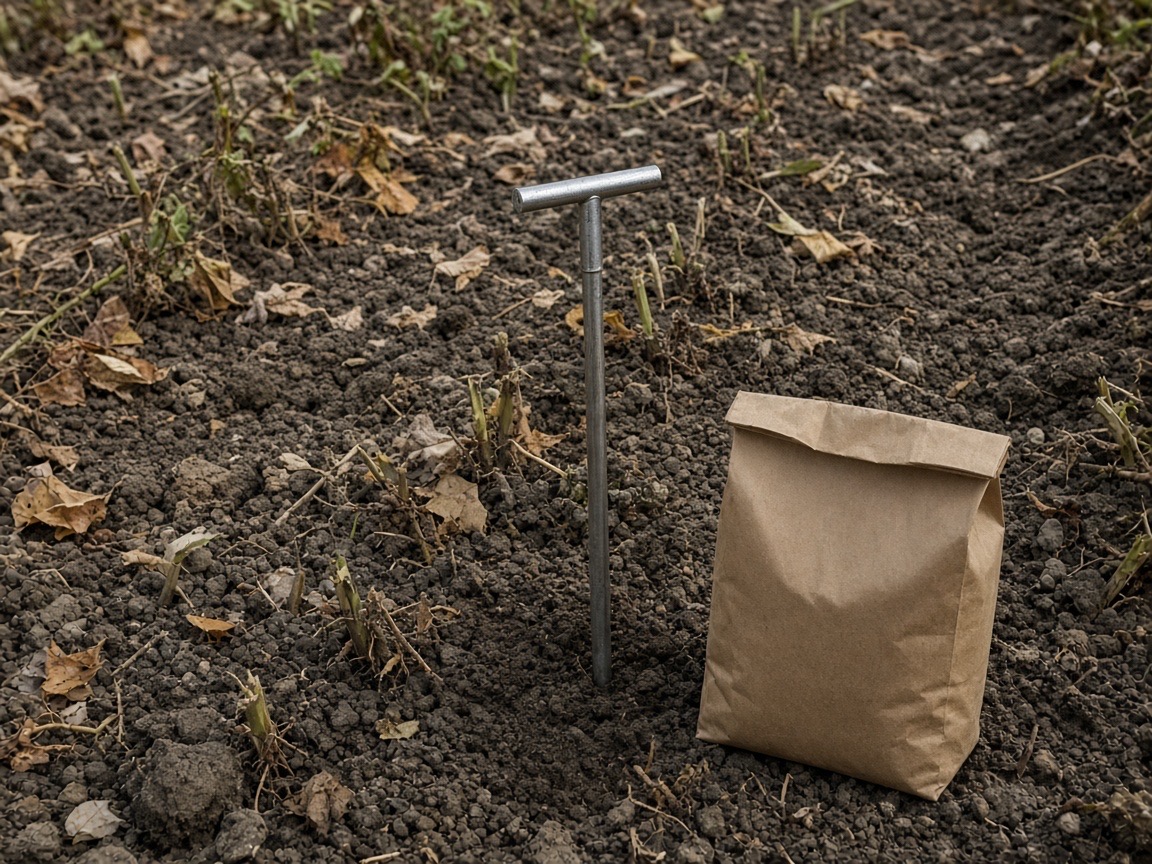
The stalks are on the wagon. The paper bag of dirt is still on the truck seat, and nobody has opened it.
That bag is the fall soil test. Cut week took the plants. The sheet inside is a lab reading of the dirt you sent, not a weather forecast and not a promise about next June. At Divine Toke, a Detroit-area sun-grown farm in Michigan, we do not publish a soil-test number, an acreage, or a street address. Your bag is the one that counts. Before the ground locks, four lines matter: pH, phosphorus, potassium, and organic matter. Cover-crop dates live in fall soil rest after cut week. The map of sand and clay lives in Michigan soil, region by region. This page stays on the lab sheet.
What Does a Fall Soil Test Actually Measure After Cut Week? #
A fall soil test measures the dirt in the bag. It does not measure next June. MSU Extension bulletin E-2904, Nutrient Recommendations for Field Crops in Michigan, says fall and spring are the practical times to sample, because by fall the nutrient status is more stable.
The Michigan State University Soil and Plant Nutrient Lab runs a set recipe on that dirt. You can read the recipe without a chemistry degree. Each line is an extract. The lab shakes the soil with a liquid, then measures what came off the particles.
| Line on a routine sheet | What the lab actually did | Plain read |
|---|---|---|
| Soil pH | Mixed soil with an equal amount of water (a 1:1 slurry) | How acidic the water around the roots is today |
| Lime index | Added an SMP buffer to that same slurry and read the pH again | How hard the soil will fight you if you try to raise pH |
| Phosphorus | Bray-Kurtz P1, a weak-acid extract, reported in ppm | A score for plant-available phosphorus, not a fertilizer bag |
| Potassium, calcium, magnesium | Pulled with 1 N neutral ammonium acetate | Holding-and-release scores for those three nutrients |
| Organic matter | A percent by weight, when the lab prints it | How much decayed plant stuff is in the sample. Not a bug count |
Ppm means parts per million. A result of 15 ppm phosphorus means 15 parts of that extract's phosphorus in a million parts of soil. It is a lab score. It is not 15 drops you can see in the bed.
E-2904 is a field-crop book. Corn, soybeans, wheat, alfalfa, potato, and rye for cover are in it. Cannabis is not. Hemp is not. That absence is the whole point of this page. You can still use the ruler. You cannot pretend the ruler was built for the plant you just cut.
Two extras sit next to the routine lines, and people mix them up:
- Micronutrients (iron, manganese, zinc, copper, boron, sulfur) are separate extracts. They are not the same shake as phosphorus.
- Nitrate, the form of nitrogen roots drink fastest, is a different test with a different calendar. The fall bag is not that test. More on that below.
Some commercial labs use a different shake called Mehlich III, often because the machine can read many elements at once. E-2904 says those labs use Mehlich III for phosphorus, potassium, calcium, and magnesium. A Mehlich number and a Bray number are not automatically the same. If the sheet does not say "Bray-Kurtz P1" or "Bray equivalent," do not lay it on MSU's Bray table.
What do the units on the sheet mean? #
The letters are the whole intimidation. They are smaller than they look.
| Unit | Where you see it | Plain meaning |
|---|---|---|
| pH | First line, no unit besides the number | A score around 7 is neutral. Lower is more acid. |
| Lime index | A number often in the 60s or 70 | Not pH. A 70 means no lime for the 6.0, 6.5, and 6.8 targets in the top 9 inches. |
| ppm | Phosphorus and potassium | Parts per million in the lab extract. A score, not a scoop you can see. |
| CEC, me/100 g | Next to potassium | Holding power. You need it before the potassium ppm means anything. |
| % organic matter | Its own line | Weight. 2 to 4% is an ordinary mineral soil in the MSU horticulture handout. |
| tons/acre | The lime recommendation | The book's acre unit. Scale it to your depth and to the size of the bed. |
If a sheet uses Mehlich III and never says the phosphorus was converted to a Bray equivalent, stop before you compare it to the 15 ppm corn line in E-2904. Different shake, different ruler.
Divine Toke grows sun-grown flower in living soil around Detroit. The lab method above is public extension science. It is not a printout from our beds.
Which Numbers on the Sheet Matter Before a Michigan Winter? #
Before a Michigan winter, act on pH, the lime index, phosphorus, and potassium. Treat the organic-matter percent as the slow background, not as a nitrogen plan. Nitrogen does not get a winter decision from this bag.
E-2904 says available nutrients usually rise before or at planting, then fall through the season as plants take them up. By fall, the status is more stable. That is why the bag you pull after cut week is a fair snapshot. Stable does not mean frozen in place until August.
Here is the winter sort:
| Number | Use it this winter | Leave it |
|---|---|---|
| pH and lime index | Decide whether lime is even on the list, and roughly how much, before you are planting again | Do not invent a cannabis pH. MSU's table has no cannabis row |
| Phosphorus | See if you are under the field-crop critical level or sitting in the "put back what you removed" band | Do not buy a phosphorus product because a menu said "living soil" |
| Potassium | Read it with the CEC (the holding-power score). A single ppm with no CEC is half a sentence | On muck, do not treat a fat fall number as the spring number. Potassium can wash over winter |
| Organic matter % | Know if the mineral bed is thin (around 1%) or in the ordinary 2 to 4% band | Do not convert the percent into "this many pounds of nitrogen next June" |
| Nitrate | Not this bag | Late spring, with a test built for that job |
| Calcium | Glance. Most Michigan mineral soils formed from lime-rich parent material and already carry enough calcium for field crops | The western Upper Peninsula is the exception MSU names. A Detroit-area bed is not that exception, and the sheet still shows the number |
CEC is cation exchange capacity. It is the soil's holding power for nutrients that carry a positive charge. The lab reports it as me/100 g, which is just the unit on the sheet. Clay and organic matter hold more than plain sand. You need that score before the potassium line means anything.
The hose, the hoop skin, and the tools are a different afternoon. That close-down is winterize the hoop house before Detroit's first freeze. The dirt bag can ride along in the truck. It should not be the reason a full hose stays on the bib.
Sampling for most field crops is an every-three-years habit in E-2904. If you haul off the whole top, the way hay or silage corn leaves a field, MSU says test at least every two years, because the levels move faster. Cannabis is not in that sentence. A cut that removes a lot of plant is closer to the two-year habit than to "ignore it for a decade." It is still an analogy, not a cannabis rule.
What Do pH and the Lime Index Tell You That a Thumb Test Cannot? #
pH is the acidity in the water right now. The lime index is how much hidden acidity that water number is hiding. Two beds can share a pH and need very different tons of lime. A thumb in the dirt cannot see either number.
E-2904 measures pH in a 1:1 mix of soil and water. Seven is neutral. Under seven is acid. Over seven is alkaline. The book tells farmers to keep mineral soils between 6.0 and 6.5. Below 5.5, available aluminum climbs, and that aluminum can stunt roots. Organic soils (muck) get a lower target, 5.3 to 5.8, because they do not carry the same aluminum problem.
The crop table is more exact than the 6.0-to-6.5 band. These are mineral-soil targets from Table 1. Cannabis is not a row.
| Crop on the MSU table | Target pH, mineral soil | What to do with it after cut week |
|---|---|---|
| Most field crops, including corn and soybean | 6.5 | A comparison, not a cannabis order |
| Alfalfa | 6.8 | Only if alfalfa is actually in the rotation |
| Potato | 6.0 | Potato's number. Not a flower number |
| Rye for cover | 6.5 | The pH line only. Species and dates are in the fall soil rest piece |
| Cannabis | Not listed | Do not borrow a row and call it yours |
If the mineral subsoil tests under pH 6.0, MSU says raise the target by 0.2. A surface sample does not tell you the subsoil. Say so on the sheet if you never checked deeper.
The lime index comes from the SMP buffer. Think of pH as the sourness of the soup. The lime index is how big the pot is. A sandy bed is a small pot. A clay bed is a big pot. The same spoon of lime moves the small pot more.
E-2904's lime table assumes agricultural lime with a neutralizing value of 90, mixed into the top 9 inches:
| Lime index | Tons per acre to reach pH 6.0 | To reach 6.5 | To reach 6.8 |
|---|---|---|---|
| 70 | 0 | 0 | 0 |
| 67 | 1.9 | 2.5 | 2.9 |
A lime index of 70 means the buffer already says you do not need lime for those three targets. A lower index means more reserve acidity, which means more lime. If your incorporation depth is not 9 inches, scale the rate. The book's own example: 3 tons for 9 inches becomes 1 ton if you are only neutralizing the top 3 inches. A no-till or barely tilled bed should use that shorter depth. MSU also says that when tillage is under 4 inches, or there is no tillage, pull a second sample from the top 0 to 3 inches. Surface pH can be a different world from the 8-inch mix. That second slice matters on a living-soil bed you do not plow. How that bed stays alive is the living soil guide. This page only needs the sample depth.
Sandy soils can fool the buffer. E-2904 says the SMP test may underestimate lime need on weakly buffered sand. If pH is 0.3 to 0.5 below the target and the sheet calls for less than 1 ton per acre, apply 1 ton. If pH is 0.6 or more below the target and the sheet calls for less than 2 tons, apply 2 tons. That patch is for sand that looks "fine" on the index and sour on the pH. It is not a reason to lime a bed that is already at the target.
Finer print on lime products sits in MSU bulletin E-471, which E-2904 points to. The rate still starts with your index, your target, and your depth. Divine Toke does not publish a lime rate for a Detroit bed we have not sampled on this page.
What Do Phosphorus and Potassium Mean When Cannabis Is Not on the Crop List? #
There is no cannabis phosphorus target in MSU's field-crop book. For corn grain, the critical Bray phosphorus level is 15 ppm. Potassium has no single ppm at all. It climbs with the soil's holding power.
E-2904 draws a curve. At the critical level, yield is near 95 to 97 percent of the maximum for that field crop. Below it, adding the nutrient is likely to pay. Above it, you are mostly replacing what the harvest hauled off, or you are drawing down a full bank. That curve was built on corn, beans, wheat, and the other crops in the tables. It was not built on the plant that just left a Michigan bed in September.
Phosphorus #
The extract is Bray-Kurtz P1. In the corn grain section, MSU says crop-removal rates maintain the soil when the test is above the critical value of 15 ppm. That 15 is a corn number.
A second 15 sits nearby, and it is easy to mash them together. The critical level changes by crop (Table 8). The maintenance plateau for most field crops on mineral soil is 15 ppm. In the table, that plateau is a length: how wide the "enough" band is above the critical level. Wheat grain's mineral critical level on that table starts at 25 ppm, then a 15 ppm plateau length. Corn's critical level is 15 ppm. The plateau length for most crops is also 15 ppm. Same digits. Different jobs.
| Phrase on the sheet or in the book | What it is | What it is not |
|---|---|---|
| Bray-Kurtz P1, ppm | Weak-acid phosphorus score | A Mehlich III number, unless the lab says it converted it |
| Corn critical level, 15 ppm | Where MSU stops calling corn short | A cannabis target |
| Maintenance plateau, 15 ppm for most mineral-soil field crops | The width of the "replace what you removed" band | The only number you are allowed to have |
| pH above 7.2 and Bray P1 under 10 ppm | Switch to the Olsen test. Bray goes weak on those chalky soils | A reason to panic at any alkaline bed |
| Buildup math | About 20 pounds of P2O5 to raise the test 1 ppm, figured as 5 pounds per acre per year over four years | A shopping list for a ten-foot bed. The cap in the book is 200 pounds of P2O5 per acre per year |
If your phosphorus is under the critical level for the closest field crop you are willing to use as a ruler, the winter job is "this bed is short." If it is inside the maintenance band, the winter job is "put back roughly what left with the crop," not "pour on more because the number feels low." If it is above that band, the bank is full. E-2904 says you should not expect a yield response up there.
Potassium #
Potassium is stickier. On mineral soils, MSU's critical level is a formula: 75 + (2.5 × CEC). CEC is that holding-power score from the last section. Plug in the CEC on your sheet.
| CEC (me/100 g) | Critical potassium, ppm |
|---|---|
| 4 | 85 |
| 8 | 95 |
| 12 | 105 |
| 16 | 115 |
A sandy bed with a CEC of 4 is "enough" for those field crops at a lower test than a clay bed with a CEC of 16. Someone quoting "you want 100 ppm potassium" without the CEC is skipping the only part that makes the number real.
The maintenance plateau for most field crops is 30 ppm wide on mineral soils and 25 ppm wide on organic soils. Inside that band, the potassium recommendation equals crop removal. It is not a second critical level. A result of 30 ppm on a mineral soil with a CEC of 8 is far under the 95 ppm critical level in the table. Do not read "plateau 30" as "30 is plenty."
On organic soils, a fall potassium number often will not match spring. E-2904 says a lot of potassium can leach from organic soils over winter, especially at the spring thaw, so spring samples usually test lower than fall samples. If your bed is muck, write "fall" on the sheet in ink. Next April's number can drop without anyone hauling potassium away in a wagon.
How would one pretend sheet read against the field-crop ruler? #
This is a teaching sheet, not a Divine Toke pit and not a Detroit address. Call it a mineral bed sampled October 8, twenty cores, eight inches, one uniform area. The numbers are chosen so every comparison below is a figure you can find in E-2904 or in Biernbaum's percent bands.
| Line | Pretend result | Field-crop read | Cannabis read |
|---|---|---|---|
| pH | 6.0 | 0.5 below the 6.5 target used for most mineral-soil field crops | No cannabis target to miss |
| Lime index | 67 | 2.5 tons per acre to reach pH 6.5 in the top 9 inches | Same tons only if you choose that 6.5 comparison on purpose |
| Bray P1 | 12 ppm | 3 ppm under corn's 15 ppm critical level | Not a flower target |
| Potassium | 70 ppm | Under the 95 ppm critical level at CEC 8 | Still not a flower target |
| CEC | 8 | The reason the potassium critical level is 95, not 85 or 115 | Do not drop this line |
| Organic matter | 2.5% | Inside the 2 to 4% average band for mineral soil | A weight, not a microbe count |
Walk the lime line before you buy a pallet. Index 67 on the mineral table is 2.5 tons per acre when the target is 6.5 and the mix is 9 inches deep. A bed you do not plow may only need the top 3 inches neutralized. The book's own scaling is rate times (your depth divided by 9). Here that is 2.5 times 3/9, about 0.83 tons per acre for those 3 inches. Acres are the book's unit. A small bed is a fraction of an acre. Do the fraction. Do not dump a per-acre tonnage on a ten-foot row.
The sandy patch does not fire on this pretend sheet. That patch is for when pH is 0.3 to 0.5 below target and the sheet already says less than 1 ton. This sheet says 2.5 tons for a 9-inch mix. Use the table. The patch is for sand that looks hungrier on pH than on the index.
Phosphorus at 12 ppm is short of corn's 15 ppm critical level. The buildup piece of the mineral-soil equation is (critical level minus your test) times 5, in pounds of P2O5 per acre, plus what the crop removes. Three ppm times 5 is 15 pounds of P2O5 per acre for the buildup slice this year. The "20 pounds to move 1 ppm" line in the same chapter is the four-year total, because 5 pounds a year for four years is 20. Use the yearly slice once. Do not stack 20 and 5 and call it a cannabis rate. The book also caps phosphorus recommendations at 200 pounds of P2O5 per acre per year. A 15-pound buildup slice is nowhere near that cap.
Potassium at 70 ppm with a CEC of 8 is short of 95. The mineral-soil buildup slice is (critical level minus your test) times (1 plus 0.05 times CEC), then plus crop removal. That is (95 minus 70) times (1 plus 0.4), which is 25 times 1.4, or 35 pounds of K2O per acre before crop removal. The annual cap is 300 pounds of K2O per acre. Again, this is field-crop math from the bulletin. It is the ruler. It is not a flower prescription, because cannabis is not in the equation.
Organic matter at 2.5% does not change those pounds. It tells you the mineral bed is in the ordinary band, not the very-low 1% band and not muck. It still does not forecast June nitrate.
If your real sheet is muck, throw this pretend mineral table out and use the organic columns. Critical phosphorus and potassium numbers run higher there, and a fall potassium reading can shrink by spring. If your real extract says Mehlich III and does not say Bray equivalent, do not lay the 12 ppm on the corn 15. Different shake.
Calcium and magnesium come off the same ammonium-acetate shake. Magnesium gets fertilizer math in the book. Calcium, for most of Michigan, does not. The soils formed from calcareous parent material, which is the lime-rich stuff glaciers and old lake beds left behind. MSU says those soils generally already have enough calcium for field crops. The western Upper Peninsula, from more acidic rock, is the exception they name. Southeast Michigan is lake plain, till, and sand. The series names are a different article. The calcium line is still worth a glance so you know the lab ran the shake. It is rarely the winter decision.
What Does the Organic Matter Percent Actually Count? #
The organic matter percent is weight, not a head count of living microbes. On mineral soil, a Michigan State horticulture handout calls 1% very low, 2 to 4% average, and over 5% high. Muck is a different material, often 30 to 40%.
That handout is John Biernbaum's Organic Matters (MSU Horticulture, March 2012). He splits the percent into four piles that share one number on the sheet:
| Pile | What is in it | Can the percent see it alone? |
|---|---|---|
| Living | Roots, bacteria, fungi, and the rest of the soil life | No. It is one slice of the weight |
| Active | The stuff breaking down on a shorter clock | No. Same percent |
| Slow | He calls this the "really dead" fraction, breaking down over years | No |
| Stable | The "really, really dead" fraction, over decades | No |
A lab can print 3% and tell you nothing about whether the fungi are awake. The living web is its own subject in mycorrhizal fungi under sun-grown cannabis. Adding decayed plant material on purpose is composting for cannabis farming. Neither post turns a fall percent into a microbe score, and this one will not either.
Use the categories on the right dirt:
- Sand, loam, or clay (mineral soil). 1% is very low. 2 to 4% is the average band. Over 5% is high. Biernbaum's line is that more is generally better, and then he spends the rest of the handout saying the type of organic matter matters as much as the percent.
- Muck, peat, or organic soil. 30 to 40% is normal for that kind of ground. Do not scold a muck bed for "failing" a mineral-soil chart, and do not cheer a mineral bed that somehow printed 30%. One of those readings is the wrong column.
Organic matter holds water and holds nutrients, and as it breaks down it feeds the living pile. That is the mechanism. It is not a release schedule. The handout's own nitrogen example is a stack of "if" statements (if 1% of the organic matter is nitrogen, if 10% of it breaks down this year). Those ifs are a teaching sketch. They are not a measured June credit for a Detroit bed.
What the percent can change this winter is expectation. A mineral bed at 1% has less cushion than a bed at 3%. It will hold water worse and hold nutrients worse. Cover on that bed still matters, which is the job in fall soil rest, including which plants still fit after a September cut. The percent does not pick the species. The calendar does. The older companion-planting piece is cover crops and companion planting. This sheet does not replace it.
Tillage burns organic matter faster because it wakes microbes and gives them air. Biernbaum says frequent tillage can make them eat the bank you were trying to save. A no-till winter, if that is your bed, is a way to stop spending the percent. It is not a way to make the percent count heads.
What Can a Fall Sample Not Predict for Next Year? #
A fall sample cannot tell you next June's nitrate, next year's rain, or how many microbes will be working in May. It can tell you the pH, the phosphorus score, the potassium score, and the organic-matter weight of the dirt you sent in September or October.
Nitrogen is the miss people feel in July. E-2904 is blunt about the tool that does measure nitrate. The soil nitrate test sees nitrate only. It does not see ammonium, and it does not see nitrogen still tied up in organic matter. The useful timing is late May and early June, after the soil has warmed and before sidedress, not the week the stalks leave the field.
The presidedress nitrate test, the PSNT, is that late-spring tool:
| PSNT rule in E-2904 | Number |
|---|---|
| When | Corn 3 to 12 inches tall, shortly before sidedress. Late May or early June in a normal Michigan corn year |
| How many cores | At least 15 |
| How deep | 1 foot. Not the 8-inch fertility core |
| How much ground | No more than 20 acres in one bag |
| After you pull it | Dry it right away, or keep it cold until the lab has it |
| Cleaner read | More accurate if less than 40 pounds of nitrogen per acre went down at planting |
A cut cannabis bed in metro Detroit in late September is none of those conditions. The plants are gone. The soil is cooling. A nitrate number on that day is a snapshot of leftover nitrate, and leftover nitrate moves. E-2904 says nitrate can leach at any soil temperature. Denitrification, the loss to gas, happens fast when the soil is waterlogged and warmer than 50°F. Sandy ground can be fertilized hard one year and show little carryover the next, because the nitrate washed through. Fine, poorly drained ground loses more to denitrification. Great Lakes fall rain does not ask which one you have.
Fall nitrogen on corn is not recommended in the same bulletin, even with a nitrification inhibitor, because of leaching. That is a corn sentence. The lesson for a flower bed is smaller: do not spend winter believing an October nitrate line. The conversion of organic matter, old roots, and any manure into nitrate happens in spring, when the soil is warm and wet. The PSNT was built to see that conversion. Your fall fertility bag was not.
What else the bag will not do:
- It will not name next year's weather. Rain decides leaching, waterlogging, and how fast microbes work. The sheet has no rain row.
- It will not count microbes. The organic-matter percent is weight, split across living and dead piles. May's biology depends on moisture and warmth you do not have yet.
- It will not guarantee the same potassium in April on muck. Fall tests on organic soils usually read higher. The thaw can carry potassium out.
- It will not print your soil series. Pewamo, Brookston, Selfridge, Kalkaska. Those names live on the NRCS Web Soil Survey. The chemistry sheet does not care what the map calls the pit. Mixing a sand lens and a clay swale in one bag makes an average that fits neither bed. That geography is Michigan soil, region by region.
- It will not pick a cover crop or a rye date. Target pH for "rye for cover" on mineral soil is 6.5 in Table 1. The planting window is not in this bulletin. Use fall soil rest after cut week.
- It will not tell you the season clock. Frost dates, hoop houses, and how short the Michigan outdoor year is sit in farming on Michigan time.
pH can still drift if you lime, if you add sulfur, or if a wet winter rearranges a weakly buffered sand. The fall reading is the baseline you act on. It is not a contract that April will print the same tenth of a unit. Write the date next to the number so future-you does not treat a 2026 fall sheet like a 2027 spring sheet.
How Do You Pull a Clean Sample Before Detroit's Ground Locks? #
Mix about 20 cores from the top 8 inches of one even area, skip a fertilizer band you can still see, and send 1.5 to 2 cups while the probe still goes in. MSU climatology puts Detroit's median first 32°F night on October 18.
Those dates are 1981 through 2018, read at about 5 feet in an instrument shelter. The article says air at the ground can be several degrees colder. A forecast that still says 34°F at the station can be a frozen crust on a low bed. If the probe bounces, the window for that bed is shut. You are guessing with a shovel full of ice.
| Station | About 1 year in 10, first 32°F by | Median first 32°F |
|---|---|---|
| Ann Arbor | October 1 | October 14 |
| Detroit | October 10 | October 18 |
| Monroe | October 9 | October 22 |
A bed west of the city, toward Ann Arbor, often locks before a bed in Detroit. A bed down by Monroe often gets a few more days. Cut week on an outdoor Michigan farm is already behind you by the end of September. The sample week is the gap between the wagon and that freeze, on a day the soil is workable. Do not pull a mud ball after a Great Lakes soaker and call it a core. Wet clay smears, and the mix lies.
E-2904's field steps, in order:
- Split the ground on purpose. Same soil, same history, same bed. A sand rise and a clay swale are two samples. The map that names the series is the Web Soil Survey. The lab will not do that split for you.
- Pull about 20 cores to 8 inches. Mix them until the handful you send looks like one soil, not a stripe of subsoil and a stripe of trash.
- Stay out of the band if you can still see where fertilizer went down. If the band is gone, take extra cores at random so one hot stripe does not own the average.
- Cap the area. One composite for every 15 to 20 acres, and no more than 20 acres in a bag. A home bed or a small field is still one uniform area. Do not stretch one bag across a whole farm because the box had room.
- On a bed you do not plow, or where tillage is shallower than 4 inches, pull a second sample from 0 to 3 inches. That one is for surface acidity. The 8-inch mix can look fine while the top inch is sour.
- Send 1.5 to 2 cups. Label the bed, the depth, and the date. Fall versus spring matters next time you compare, especially for potassium on muck.
- Match the season next time. E-2904 says long-term planning works better when you sample at the same time of year. A fall sheet against a spring sheet is a wobble, not a trend.
Most field-crop fields in the book get this test every three years. Fields that lose the whole top, like hay or silage corn, get it at least every two. Write the year on the bag so the next cut week starts from a date, not a guess.
What mistakes make the lab number a lie? #
The lab can only test the dirt that arrives. A sloppy bag beats a sloppy reading of a clean bag, because the math downstream assumes the sample was fair.
- One bag for two soils. A sand rise and a clay low spot average into a soil you do not farm. Split them. The survey map is the clue. Your eyes are the other clue.
- The compost pile instead of the bed. A scoop from the pile tells you about the pile. E-2904 wants cores from the area you are actually going to plant.
- The fertilizer band. If you can still see it, stay out of it. One hot stripe can make a short bed look rich.
- A mud ball. Wait until the soil crumbles. Smeared clay is not a mix.
- No date, no depth. Fall against spring is a wobble. Eight inches against a top-inch scratch is a different sample. Write both on the bag.
- A frozen crust. If the probe will not enter, stop. Detroit's median first 32°F night is October 18, and the ground can be colder than the shelter reading.
The hardware can freeze on a faster clock than the dirt. Drain lines before you need this soil sample as an excuse to stay outside. That job is the hoop-house close-down. The season those dates sit inside is farming on Michigan time.
Divine Toke does not print which Detroit-area bed we sampled, or a ppm from it. The 20 cores and the October 18 median are the public rules. Your probe and your freeze are the local ones.
How Is a Soil Bag Different From a Michigan Flower COA? #
A soil bag is a fertility test. A Michigan flower COA is a product test. Passing one does not pass the other. The Cannabis Regulatory Agency makes a licensed lab check the jar before a shop can sell it. E-2904 makes an extension lab check the dirt so a grower can plan lime and fertilizer.
Detroit shoppers see the jar. They do not see the paper bag from October. If a menu says "tested soil" and the only paper on the counter is a certificate of analysis, those are different sheets. Ask which one they mean.
| Fall soil bag | Michigan flower COA | |
|---|---|---|
| What goes in the bag | Dirt, about 1.5 to 2 cups, from the bed | Finished flower from the batch |
| Who the rules come from | MSU Extension E-2904 for the field-crop read | CRA sampling and testing guidance |
| What you are hoping to learn | pH, lime need, phosphorus, potassium, organic matter | Whether this batch is legal to sell, and what the label must say |
| Typical lines | Bray phosphorus, ammonium-acetate potassium, lime index | Potency, pesticides, heavy metals, microbes, and the rest of the product panel |
| What it will not say | It will not clear a metal or mold question on the flower | It will not tell you the bed's phosphorus or the lime index |
The CRA guidance groups product testing into nine categories. Potency, pesticides, heavy metals, microbial impurities, mycotoxins, residual solvents, foreign matter, water activity, and homogeneity. Which boxes a batch has to tick depends on the product. Flower is not an edible, and flower is not a soil core. The full consumer read of that panel is what lab-tested means in Michigan.
Heavy metals on a flower fail are a product problem. They are not a line on the routine fertility sheet described in E-2904. If you are worried about metals or pesticide leftovers in the dirt, that is a separate environmental order from a lab that runs those screens. Do not stare at a Bray number and decide the bed is "clean." Do not stare at a passed flower test and decide you know the pH.
A shopper in Detroit can use both ideas without owning a probe:
- The COA is about the eighth in your hand. Read it for the batch.
- "Living soil" on a menu is a practice claim. It is not a lime index.
- A farm that can talk about pH, phosphorus, and organic matter without inventing a cannabis ppm target is describing the sheet this article is about. A farm that quotes a magic soil number with no extractant and no date is describing a vibe.
Sun-grown flower still has to pass the same CRA panel as any other legal Michigan flower. The soil sheet is how the next season gets planned. The COA is how this season's jar gets sold. Divine Toke's jars go through that product panel. We are not going to pretend a fall soil test is the label.
FAQ: Fall Soil Test After Cut Week #
What does a fall soil test measure after the plants are cut? #
It measures the dirt you sent: pH, lime index, phosphorus, potassium, and usually calcium, magnesium, and organic matter. It does not measure next year's rain or next June's nitrate. MSU Extension E-2904 says by fall the nutrient status is more stable, which is why the week after cut is a fair time. Cannabis is not a crop in that bulletin.
When should I pull a Michigan sample, fall or spring? #
Fall or spring. Pick one season and stick to it. E-2904 says those are the practical times, and comparisons work better when the month matches. In the Detroit area the fall window closes as the ground locks. The median first 32°F night at Detroit is October 18, and about 1 year in 10 that first freeze has already hit by October 10 (MSU climatology, 1981–2018).
How deep should the cores go, and how many do I mix? #
About 20 cores, 8 inches deep, mixed into one sample of 1.5 to 2 cups. Keep the bag to one even area, and to no more than 20 acres. If you do not plow, or tillage is shallower than 4 inches, pull a second sample from the top 0 to 3 inches for surface pH. Those depths are the E-2904 field-crop method, not a special cannabis depth.
What is a lime index? #
The lime index is reserve acidity, from an SMP buffer, and it sets the tons of lime. Soil pH is only the acidity in a 1:1 water mix today. A lime index of 70 means 0 tons to reach pH 6.0, 6.5, or 6.8 in the top 9 inches of mineral soil. An index of 67 means 1.9, 2.5, or 2.9 tons for those same three targets. Scale the rate if you are not mixing 9 inches deep.
Is 15 ppm phosphorus the number for cannabis? #
No. Fifteen ppm is a corn critical level on the Bray-Kurtz P1 test, and a plateau length for most field crops. Cannabis is not on the table. E-2904 says corn grain sits above a critical value of 15 ppm when crop-removal rates are enough to maintain the soil. Wheat grain's mineral critical level on Table 8 starts at 25 ppm. Do not paste either number onto a flower bed and call it law.
Why is there no single good potassium number? #
Because the critical level moves with CEC, the soil's holding power. On mineral soils the formula is 75 + (2.5 × CEC). At a CEC of 8, that critical level is 95 ppm. At a CEC of 16, it is 115 ppm. The "30 ppm" line in the book is the width of the maintenance plateau for most field crops, not a target. A fall potassium test on muck usually reads higher than the spring test after thaw leaching.
Does the organic matter percent count living microbes? #
No. It is percent by weight, and the living pile is only one part of that weight. On mineral soils, Biernbaum's MSU handout calls 1% very low, 2 to 4% average, and over 5% high. Muck is often 30 to 40%. A separate biology test would be required to count microbes. This sheet does not do that.
Can this test predict next year's nitrogen? #
It cannot. Nitrate is a different test, and the useful one is in late spring. The presidedress nitrate test uses at least 15 cores, a foot deep, when corn is 3 to 12 inches tall. It sees nitrate only, not the nitrogen still locked in organic matter. E-2904 does not recommend fall nitrogen on corn because of leaching, even with an inhibitor. An October cannabis bed is not a PSNT moment.
Is a soil test the same thing as a Michigan COA? #
No. The soil test reads the bed. The COA reads the jar. The CRA testing guidance covers product categories such as potency, pesticides, metals, and microbes. A Bray phosphorus number is not on that panel. A passed flower test does not tell you the lime index. The longer shopper version is what lab-tested means in Michigan.
Will the lab sheet name my soil series? #
No. Series names come from the soil survey, not from a fertility extract. Pewamo, Brookston, and Selfridge can sit next to each other in southeast Michigan, and they should not share one bag. Look them up on the NRCS Web Soil Survey, then read what that mix does to a plant in Michigan soil, region by region. The lab sheet will still be pH and nutrients.
What on the sheet can wait until spring? #
A repeat of the same test can wait. A full hose cannot. Most field crops in E-2904 are on a three-year sample clock, or two years when the whole top is hauled off. Nitrate waits for late spring on purpose. Lime math and a seriously low phosphorus or potassium reading are the notes worth keeping on the bench all winter. Cover-crop species and dates wait in fall soil rest, not because they are optional, but because they are a different page.
What if the probe will not go into the bed? #
Then you missed the pull for that spot. Do not send a chunk of frozen crust. Detroit's median first 32°F is October 18, Ann Arbor's is October 14, and the air at the ground can be several degrees colder than the 5-foot shelter. Sample the next workable day in spring, and label it spring so you do not compare it blindly to an old fall sheet.
If You Want the Flower From a Season That Starts With a Sheet #
A fall soil test is how a Detroit-area sun-grown farm stops guessing at pH and phosphorus before the ground locks. Divine Toke grows outdoor flower in living soil around Detroit. We do not print a street address, a bed count, or a ppm from our own pits. The numbers above are MSU's, Biernbaum's, and the CRA's. Your sheet still wins on your dirt.
If you want to smoke what that kind of season tastes like, start with the jar. Sun-grown flower, 1 gram pre-rolls, and the kraft 20-pack (20 one-gram joints at $120). Smell it. Read the date. The soil sheet you do not see is why there is a next October.
The wider loop from soil to jar sits in how regenerative cannabis actually runs. The map under the bag sits in Michigan soil by region. The plants you put on a rested bed sit in fall soil rest after cut week.
This piece is a lab-sheet reading, not a fertilizer prescription for your exact field. When a number above is a ppm, a pH, a date, or a ton of lime, it comes from the extension pages linked in the sentence. Cannabis is not a row in E-2904. Do not add one.
Grown in Detroit. Shipped to your door.
Small-batch, sun-grown cannabis cultivated in living soil. Mail-order shipping to all 50 states.