Seed vs Clone for Next Michigan Outdoor Season
You liked the jar. A seed with the same name is not that plant. What a clone copies, what a seed shuffles, and what Detroit's October frost date changes.
Questions this article answers
- Should a Michigan outdoor grower start next season from seed or from a clone?
- what is the difference between a cannabis seed and a clone
- are feminized cannabis seeds genetically identical
- does a Michigan cannabis label say seed or clone
- do autoflower seeds finish before Detroit frost

Head Cultivator
On this page
You liked the jar. You want that plant again next summer.
The seed pack with the same name is not that plant. A clone is a cut from a plant somebody already grew. A seed is a new kid from two parents, or from one plant that made its own pollen. At Divine Toke, a Detroit-area sun-grown farm in Michigan, we do not print our cultivar list, our acreage, or a street address. The choice is still the same one any outdoor grower has to make before the ground thaws. Michigan's first 32°F night does not wait while you sort males and late siblings.
The frost map, the hoop-house weeks, and the daylight slide live in farming on Michigan time. When the flowers are actually ready lives in sun-grown harvest timing. This page stays on the genetics: seed variation, a clone of a known plant, sexing, and what a shopper can ask.
Should a Michigan Outdoor Grower Start Next Season From Seed or a Clone? #
Start from a clone when you already trust the plant and you need the row to finish on one clock. Start from seed when you want new plants and you can pull males, hermaphrodites, and late ones before Detroit's median first freeze.
Utah State University Extension puts the split in farm language. A cutting from a mother plant roots into a genetically identical, all-female plant with traits you can plan around. Feminized seed is cheaper to buy, and those plants are still genetically different from each other. They also carry a greater chance of males and hermaphrodites than clones do.
A short season does not invent a magic winner. It punishes a surprise. Southeast Michigan's growing season ends in October, per NWS Detroit/Pontiac. On the MSU Extension 1981–2018 table, Detroit's median first 32°F freeze is October 18. A plant that is still leafy that week is a problem. A plant you have already watched finish once is a plan.
| What you are holding | What you actually get | What the short season cares about |
|---|---|---|
| Regular seed | A mix of males and females. Kids differ. | Males eat plant slots. Late kids miss the frost. |
| Feminized seed | Mostly female, still a mix of sisters | You still scout. One late sister can miss October. |
| Rooted clone | A copy of one mother | The row flowers on a closer clock, if the mother was a good outdoor plant. |
| Autoflower seed | Flowers by age, not by long nights | The word "auto" is not a Detroit finish date. |
No paper in this stack measured "a clone saves X days before a Michigan frost." Do not buy a number that precise. The honest edge is narrower. A clone skips sprouting. It is already a piece of a mature plant. A seed has to become a plant before it can race the same cold.
Three people, three starts #
Pick the start that matches the plant you already trust, the slots you are allowed, and how many surprises you can pull.
| Who is deciding | Lean this way | The catch |
|---|---|---|
| Home grower, first outdoor year in Michigan | Feminized seed, fewer than 12, so you can cull | You will not know the late sister until fall |
| Home grower who loved one plant last year | Clone that plant, if you kept a mother or a cut | A cut of a plant that hermed will herm again |
| Shopper who wants last October's jar again | Ask "one mother, or seed" before you rebuy the name | The label's strain line will not settle it |
A first-year home grower in the Detroit area should not fill all 12 premises slots with regular seed and hope. MCL 333.27955 counts every live plant on the premises, and PMC7329997 puts a normal cross near half male. Leave empty slots for the culls. Feminized seed, the kind Utah State says can run over 99% female, still needs a scout. It just wastes fewer pots.
Someone who already kept a mother through winter is in a different spot. The cuts are the plant. The risk is the mother's health and her finish time, not a new shuffle. If she ripened before the median freeze once, she is a better bet than a fresh pack with the same name. If she was still leafy on October 18, cloning her copies the late habit. Do not clone your way into the same miss.
A shopper is not running the premises cap. The shopper is trying not to pay twice for a surprise. Sun-grown flower from a Detroit-area farm can be either start. Price does not tell you. A higher THC line does not tell you. The sentence "one mother" or "blended seed" tells you. Ask it. Then read the harvest date and decide if you want that jar this month while next year's tray is still a plan.
What Is the Difference Between a Cannabis Seed and a Clone? #
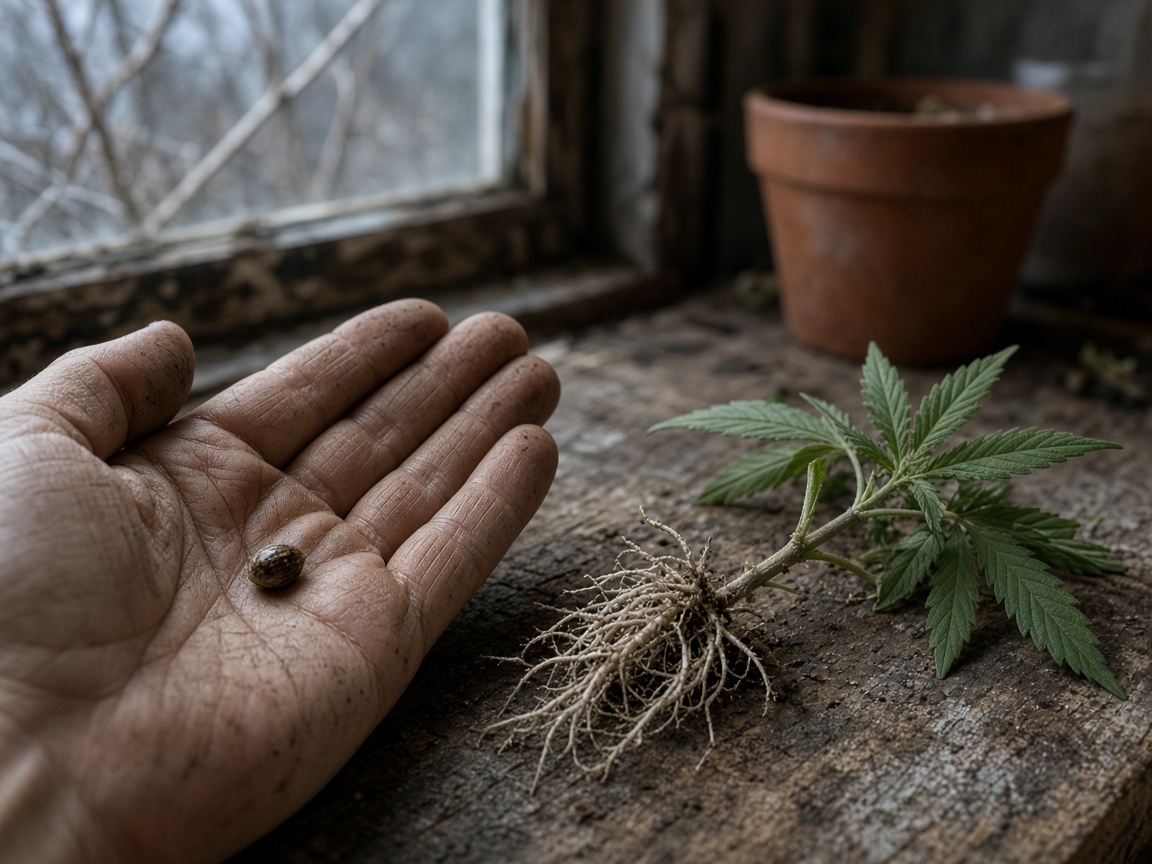
A seed is a new genetic shuffle. A clone is a branch of a plant you already know, stuck in a medium until it grows roots.
Cannabis is usually dioecious. That means male flowers and female flowers grow on different plants. Punja and Holmes (PMC7329997) describe it that way: the plants are obligatory out-crossers. A regular seed is the kid of a pollen parent and a seed parent. The kid gets a mix. Two seeds from one pack can be sisters. They are not copies.
A clone skips that shuffle. You cut a shoot off a chosen female, often called a mother, and you root it. Utah State says that cutting is genetically identical to the mother and female, because you did not add a father. The job of keeping that mother alive, and why people mix her up with the word "indica," is a different article: what a mother plant is.
Roots are the part people romanticize. The same Utah State page notes that seed-grown plants often build a stronger taproot if they are sown in the field, while clones build a more fibrous root system. Utah State says that pattern shows up in many crops. It is not a special trick of feminized cannabis seed. A bad seed lot can erase the taproot benefit before you ever see it.
How fast those roots show up is not one number:
- A PLOS ONE hemp trial scored cuttings 12 days after cloning. Rooting success ran from 13% to 80%, depending on the plug. The medium mattered more than the hormone.
- A Danish medicinal-cannabis trial (PMC10255170) kept cuttings in an aeroponic box and scored them after 25 days. In that setup, rooting success was 100% across the cultivars and treatments they tested, including plain water.
Same plant. Two clocks. "Rooted" means whatever the study decided to count. It does not mean every cutting on a Michigan bench is ready in a week, or that a pretty white root guarantees an October finish.
What the bench looks like before anyone is outside #
A seed still has to sprout. A cutting still has to root. Neither one belongs in a 32°F Detroit night.
Picture the potting bench in late winter, not a tent full of purple lights. A heat mat, a tray, a window that is still gray. That is the honest start for a Michigan outdoor season. MSU Extension has listed Detroit's average last frost around April 30. Until that risk drops, the plants live inside or in a covered hoop you can actually heat or cover. The winter hoop-house page is about closing the house, not about pretending plastic is July.
A workable order, with no fake "week 6" promise:
| Step | Seed | Clone |
|---|---|---|
| First job | Keep the seed warm and moist until it splits | Stick a healthy shoot and wait for roots |
| What "ready" means | A real root and a few true leaves, not a swollen seed | Roots you can see, not a stem that looks green |
| What you do not do | Set the tray in the yard during a freeze warning | Set unrooted sticks outside to "harden" |
| What you write down | Pack name, sow date, which cells came up | Mother, cut date, which plugs rooted |
The PLOS ONE range (13% to 80% at day 12) is why you start more cuts than you mean to keep, then throw the duds away before they count as plants in the ground. The Danish trial hit 100% by day 25 in a mist box. Your kitchen will land somewhere in between. Plan for misses. Do not plan for a brochure.
Water is the other quiet difference. A taproot from a direct-sown seed, the pattern Utah State describes, goes down. A clone's fibrous mat stays shallower. In a hot Detroit July, the shallow mat dries first. That is a watering habit, not a moral win for seed. Mulch and a consistent pot size matter more than the origin story once the plant is in the bed. Soil numbers after harvest, pH and the rest, belong to the fall soil test. They do not tell you which cutting to take.
A clone also copies problems. If the mother was sick, slow, or quick to throw pollen sacs under stress, the cuts can carry that. Utah State tells growers to be picky about what they buy, because there is no U.S. certification program that checks a feminized seed lot the way a corn bag gets checked. The same caution fits a cutting from a stranger. You are trusting a plant you may not have watched.
Why Do Plants From One Seed Pack Look Different? #
Because each seed is its own mix. The name on the pack is a family name, not a fingerprint of one mother.
Growers call the visible result a phenotype. That is the plant you can see: height, branch shape, how fast it flowers, how loud it smells. The genes underneath are the genotype. A clone holds the mother's genotype. A seed pack holds a litter.
Punja and Holmes measured that litter in a way that surprises people who think "feminized" means "copy." Seedlings from hermaphroditic flowers were genetically female. After one generation of that selfing, the amount of genetic variation in those kids was similar to the variation in kids from a normal male-female cross. Female does not mean identical. The sisters still differ.
That is why two jars can share a strain name and smell nothing alike. The Michigan label rule asks for the strain name. It does not ask which sister filled the bag. A shopper staring at two eighths in Detroit is often looking at that gap, not at a printing error.
What usually moves inside one seed lot:
| Trait | Why a seed lot splits | Why a clone row stays closer |
|---|---|---|
| Sex | Regular seed is a boy-girl mix. Feminized seed can still throw a male or a herm. | The cut came off a female. It stays that plant. |
| Finish week | Sisters can start flower on different days. | They share the mother's flowering habit. |
| Height and branches | Some kids stretch. Some stay short. | Structure tracks the mother, then the weather. |
| Smell and resin | Chemotype can segregate. Sisters can lean different. | The genes match. Sun, dry-down, and cure still move the jar. |
Weather still gets a vote. A clone of a plant that smelled like pepper in a dry September can smell flatter after a wet one. Genes are the recipe card. The season is the kitchen. Harvest cues, trichomes and all, stay in the harvest-timing guide. Do not read a clone as a promise that every top will match last year's photo.
A picked phenotype is the middle path. You pop seed, you watch the row, you keep the one plant that finished clean and smelled right, and next year you clone that one. The first year is the audition. The second year is the copy. On a short Michigan clock, the audition year is the risky year, because you learn who is late in the same month the frost shows up.
What the first seed year spends #
Year one buys information. Year two spends it. Michigan rarely gives you a relaxed year one.
Here is the spend, without inventing a farm's yield. You sow a pack. Some cells never come up. Of the ones that do, PMC7329997 says a normal cross is about half male. You kill the males when you can tell. The females left are still not one plant. One finishes while the leaves are still feeding the flowers. One is fox-tailing and pale when the neighbors have already cut. You keep a cut of the early one, if you have a place to hold a mother under long days through winter. That hold is indoor work. Outdoor Detroit in January is not a mother room.
What you should tag, in pencil, on the pot:
- Sow date, so you know who had a real head start and who was just late.
- First day you saw pistils, so finish time is a note and not a vibe.
- Smell on a rubbed stem, in your own words. "Gas" and "candy" are enough. Skip the poem.
- Any pollen sacs. A plant that herms once under a normal fall is a bad mother candidate.
- The night you actually cut her, next to the Detroit forecast, not next to a holiday.
Next spring, the clone of that tagged plant is the row. The leftover seed from the pack is a different row, if you have room. Do not mix them in one bed and then call the jar one thing. A shopper cannot unbake that blend. If you are the shopper, this is the question hiding under a familiar name: did they keep the winner, or did they bag the whole audition?
Punja and Holmes already showed the genetic point that makes the tag worth it. Even the all-female seedlings from hermaphrodite seed were as mixed as kids from a regular cross. Selection is the tool. The pack is the pile you select from. A clone is what you do after the selection, not before.
How Do Feminized Seeds Change the Male and Female Count? #
Regular seed from a male-female cross splits about half and half. Feminized seed is made so the kids are female. It does not make them copies, and it does not make male flowers impossible.
PMC7329997 reported an approximately 1:1 male-to-female sex expression ratio in seedlings from cross-fertilized seed. In the same study, seed that came off hermaphroditic flowers produced seedlings with a female genetic makeup. The pollen in that case came from a genetic female that grew male parts. There was no father plant in the usual sense.
The chemical route has a name. A 2024 review (PMC11557428) says silver thiosulfate, often shortened to STS, is the ethylene inhibitor that most reliably flips a female plant into making pollen. Ethylene is a plant gas that helps a female stay female. Block it, and pollen sacs can show up on a plant that is still genetically female. Dust that pollen on another female, and the seeds are the feminized kind. The same review flags the failures shops and farms actually meet: weak seed, and male flowers showing up again in the kids.
Utah State Extension says feminized seed can be over 99% female, and in the next breath says those plants are genetically different and more likely than clones to produce males and hermaphrodites. Both sentences belong on the bench. "Over 99%" is an extension description, not a certified stamp. Utah State is explicit that the United States has no certification program for feminized seed.
What to look for when you scout, in plain clothes:
- Female: white hairs (pistils) at the nodes. Those become the flowers people smoke.
- Male: small clusters that look like bunches of balls. Those open and shed pollen.
- Hermaphrodite: both. A few pollen sacs on an otherwise female plant can seed the row.
Utah State says that scouting should start at pre-flower, when the first signs show and before pollen dumps. Pull males early if you want seedless flower. A herm you miss can do the same job as a male, with less warning.
Ethephon is the opposite chemical story. It releases ethylene and is used in some hemp work to push male plants toward female flowers. It is not the standard way people make the feminized packs sold for female crops. If a label says "feminized," assume the pollen parent was a reversed female, then still look at the plants. The bag cannot scout for you.
Seeded flower is a quality hit, not a mystery. Punja and Holmes note that commercial marijuana crops keep genetic females and destroy males because seed formation reduces flower quality. A shopper who finds seeds in a jar is often looking at a missed male, a herm, or a neighbor's pollen. The label will not confess which one.
How to scout before pollen flies #
Look at the nodes when the first hairs show. Do it more than once. One walk through the row is how a male gets a weekend head start.
Utah State's pre-flower note is the whole method. You do not need a microscope. You need a habit.
- Start when plants leave the baby stage and the nodes begin to show sex, not on the day you hoped to harvest.
- Check the lower nodes and the inner branches. Males often declare there first.
- Bag and remove a male the day you are sure. Do not "wait until Sunday" if the sacs are swelling. Pollen is dust. It travels.
- Recheck females a week later. A herm can open a few sacs on an otherwise hairy plant after the first pass looked clean.
- If you are at the home cap, remove the male from the premises. A dead plant in the compost is not the issue. A live male still in a pot on the same premises still counts toward the 12 in MCL 333.27955, and a pot you slid into the garage still counts too.
A feminized pack changes the odds. It does not cancel step 4. PMC11557428 treats male flowers in the kids as a production problem, not a rumor. STS can build a feminized lot. Stress and a leaky parent can still put pollen in the room. Outdoor Michigan adds wind. Your neighbor's male, if you have one nearby, does not care what your pack promised.
Clones do not get a free pass on this walk. A cutting of a female should show female flowers. A cutting of a plant that herms under cool nights can herm again when Detroit nights drop. Scout the clone row once at pre-flower anyway. It is a ten-minute walk. It is cheaper than seeded tops.
If you do want seed on purpose, that is a different goal. One chosen male, far from the smoke flower, timed on purpose. Do not learn that lesson in the same bed as the jars you meant to sell or smoke. Pollen does not stay in its lane.
How Does Detroit's Frost Date Change Seed vs Clone? #
The frost date does not pick seed or clone for you. It sets the deadline. A late sister from a seed pack can still be unripe on the week Detroit's median first 32°F arrives. A clone of a plant that already finished outdoors is easier to time.
Detroit's median first 32°F freeze is October 18 on the MSU Extension 1981–2018 climatology. Median means half of those years froze earlier and half froze later. It is not a promise for 2027. NWS Detroit/Pontiac still draws the consumer line in one word: October is when the growing season ends across Southeast Michigan. The city-by-city table, the lake effect that keeps this corner later than inland Michigan, and the hoop-house math all stay in farming on Michigan time. I am not rebuilding that calendar here.
The spring wall is the other half. MSU Extension has listed Detroit's average last frost around April 30. Average is doing a lot of work. A May cold snap still happens. You do not set tender cannabis outside through a 32°F night and call it a head start. A hoop can be a place to harden plants. Closing that house before winter is the winterize the hoop house page, not a genetics page.
Most drug-type cannabis is a short-day plant. It starts flower when nights get long enough, not because a calendar page flipped. A University of Guelph study (PMC10386198) found that all ten drug-type cultivars they tested initiated flower under day lengths up to 14 hours of light. Some even initiated under 15 hours, but those flowers did not keep developing. Indoor rooms often force bloom at 12 hours of light and 12 of dark. Outdoor Michigan does not hand you that switch.
An ASHS HortTechnology paper on hemp planting dates says that after a juvenile phase, many photoperiod-sensitive cultivars may start flowering when day length drops below about 14 to 16 hours. Genetics decide where in that band a plant sits. That is the seed-versus-clone point. Sisters from one pack can sit in different parts of the band. Cuts from one mother sit together.
So the frost changes the choice like this:
- Known finisher. If a plant already ripened in a southeast Michigan fall, cloning it keeps that habit. You still watch the sky. You are not auditioning ten endings.
- Seed audition. You will not know the late kid until the days are already short. By then, October 18 is close. Culling late plants hurts. Keeping them can mean a freeze or October rain on unfinished flowers. Wet flower and rot are the late-September bud rot problem, not this one.
- No universal week saved. Rooting papers time roots. They do not time a Detroit harvest. Anyone selling "clones finish three weeks sooner" as a law is ahead of the data we have.
A juvenile phase is the stretch when a seedling is too young to flower even if nights are long. The Guelph paper does not hand you a day count for that stretch in drug-type plants. Do not invent one. The practical read is enough. A seedling has a baby stage a cutting already left behind, and Michigan does not give you extra Octobers to spend it.
Do Autoflower Seeds Beat a Short Michigan Season? #
An autoflower starts bloom with age, so it does not wait on long August nights. That habit can fit a short season. It is not a finish date you can circle on Detroit's frost table.
Photoperiod plants wait for shorter days. Day-neutral plants, the ones sold as autoflowers, flower even when days stay long. A 2023 flowering-genomics review (PMC10421669) traces that habit to ruderalis-type plants, the northern form people nicknamed autoflowering because age matters more than night length. In the hemp cross mapped by Toth and colleagues, photoperiod insensitivity behaved as a recessive Mendelian trait. They named the spot Autoflower1 and placed it on chromosome 1, roughly 17.74 to 22.94 Mb on the CBDRx v2 map.
Read the next sentence in that same review before you trust a pack. Other cannabis populations did not split like a simple one-gene switch. Ratios came out messy: about half and half, two late to one early, all early, or no clean 3-to-1. One locus explains a studied hemp family. It does not explain every jar that says "auto."
What that means on a Michigan bench:
| Label on the pack | What the plant is waiting for | What October 18 still does |
|---|---|---|
| Photoperiod / "regular photo" | Nights long enough for that cultivar | A late cultivar can still be unripe at the median freeze |
| Autoflower / day-neutral | Age, after a juvenile stretch | Frost can still hit before the plant is ripe |
| "Fast" or "early" photo | A shorter wait inside the short-day habit | Early is not the same word as day-neutral |
No cited trial gives a universal week when Michigan autos come down. Treat harvest as a cultivar-by-yard result. If you need the full outdoor clock, use the frost-date post. If you need to know when flowers are done, use trichomes and the plant, not the word auto, in harvest timing.
What "recessive" means when you are holding a pack #
In the hemp family Toth mapped, a plant flowers on its own only when it inherits the auto trait from both parents. One copy is not enough in that cross.
PMC10421669 describes that result as a recessive Mendelian trait. Mendelian here means the kids split in a countable pattern, the way a coin-flip family tree does in a textbook. Recessive means the day-neutral habit showed up in plants that got the version from both sides. Plants with a single copy flowered in between. Plants with none of it behaved as late, photoperiod types.
That is a breeding fact from one studied hemp cross. It is not a sticker you can trust on every "auto" pack at a shop. The same review says other populations refused the neat split. Some families came out half late and half early. Some came out all early. If your pack does not cite a test, you are looking at a vendor's word.
Practical reads, still without a fake finish week:
- An auto pack can still segregate. Two seeds can flower weeks apart even when both are "day-neutral."
- A photoperiod clone does not become an auto because you planted it late. It still waits on night length, up to the 14-hour initiation window in the Guelph study.
- Crossing your keeper to an auto, at home, is a breeding project. The kids may not all auto. Do that only if you want a hunt, and only inside the 12-plant premises cap if you are not a licensed farm.
- Outdoor Detroit still ends in October. An auto that starts early can still sit in September rain. Rot risk is the bud-rot page, not a reason to skip the frost date.
If you want one known plant and a shared finish, a clone of a photoperiod mother that already made it in southeast Michigan is the cleaner bet. If you want plants that do not wait for August nights, buy auto seed and still scout sex, still cull the late kid, and still watch NWS Detroit in October. The gene does not move October 18.
Autos are sold as seed, not as a clone of one famous mother, in almost every pack a home grower can buy. You still get sibling variation. You still get the sex question if the pack is not feminized. You gain a plant that does not sit in vegetative growth until August. You do not gain a contract with the sky over Detroit.
What Can a Shopper Actually Ask About Seed or Clone? #
You can ask whether the batch was a cutting of one mother, a single picked plant, or a blend of seed kids. The Michigan label and the standard lab sheet do not have to answer that for you.
Mich. Admin. Code R 420.504 tells a licensed seller what goes on adult-use flower at the counter. The list includes the cultivator, the package tag, the harvest date, the strain name, the net weight, lab THC and CBD (with a note that the number can vary by 10%), the lab that passed the tests, and the legal warnings. Seed versus clone is not on that list. A pretty strain name can sit on a clone run and on a seed run. The sticker will look legal either way.
Safety testing is a different sheet. The CRA sampling and testing technical guidance is about potency and contaminants, the pass-fail work that lets a batch move. It does not identify the plant's parents or say "this was a cutting." How to read the chemistry you do get is in reading a Michigan COA and what lab-tested means.
| What you can check | Where it lives | What it cannot prove |
|---|---|---|
| Strain name | Label, R 420.504 | That this jar matches last year's plant |
| Harvest date | Label | That the plant started as seed or clone |
| THC and CBD | Label, within the 10% note | Propagation method |
| Pesticides, metals, microbes | COA, when the shop shows it | Which sister was in the bag |
| Smell in the jar | Your nose | A genetic ID |
Questions that fit in one breath at the counter, or in a note to a farm:
- Ask if this batch was cut from one mother, or grown from seed.
- If it was seed, ask if they kept one plant or blended the pack.
- Ask if males or hermaphrodites were pulled before pollen flew.
- Read the harvest date, and ask if that is the cut day or a later pack day. The gap is its own article: harvest date vs pack date.
- Ask for this batch's COA, not a generic sheet from another lot.
A DNA test could compare flower to a reference sample if someone paid for it and kept the chain of samples. Michigan's routine retail tests are not that test. Two similar THC numbers do not prove a clone. Two different numbers do not prove seed. Sun versus indoor is a different shopping split, covered in sun-grown vs indoor for Detroit shoppers.
Words that get a straight answer #
Short questions get short answers. A speech about terpenes usually gets a strain name back.
Try these, in this order, the next time you are at a Detroit counter with two jars that share a name:
- "One mother, or seed."
- "If seed, one keeper or the whole pack in the bag."
- "Harvest date on this jar."
- "COA for this tag, or a different batch."
You are done. You do not need to explain STS or chromosome 1 to the person on the register. If they know, they will say "clone of our outdoor keeper" or "seed run, mixed." If they do not know, you learned something too. You are buying flower, not a pedigree.
At Divine Toke these flowers are sun-grown in the Detroit area. This page does not add a mother-plant name to make the story tidy. If a farm cannot say one mother or a blended seed lot, buy the jar for the smell and the date you can verify. The missing sentence is the information.
What a good answer sounds like, and what a dodge sounds like:
| You hear | What it means |
|---|---|
| "Cuts off one mother we've run outside" | Genes match a plant they kept. Still ask the harvest date. |
| "From seed, we hunted and kept one pheno" | Year one was the mix. This jar is the keeper, if they really separated it. |
| "From seed, whole pack" | Sisters in one bag. Expect the jar to drift. |
| "It's the strain name, that's the genetics" | They skipped the question. The name is a label field under R 420.504, not a fingerprint. |
| "Lab-tested, so it's the same" | The lab did not test seed versus clone. Open the COA anyway for potency and contaminants. |
What Goes Wrong If the Start Does Not Fit the Season? #
The usual misses are a male in a short legal row, a late seed kid still out at the median freeze, a sick mother copied into every cut, and a shopper who trusted the strain name alone.
Home growers in Michigan hit a hard cap before the frost does. MCL 333.27955 lets a person 21 or older cultivate not more than 12 marihuana plants for personal use, provided that no more than 12 plants are possessed, cultivated, or processed on the premises at once. The premises cap is the line. Two adults in one house do not turn it into 24. A licensed farm is a different license and a different rule. Divine Toke's outdoor work is not a 12-plant home garden, and this page is not legal advice. Read the statute before you pop a tray.
Why the cap changes seed math:
- Pop 12 regular seeds, and Punja and Holmes would lead you to expect about a 1:1 male-female split. You may spend half the legal slots on plants you have to kill.
- You cannot backfill those slots with new plants if you are already at 12 on the premises. The males counted while they were alive.
- Feminized seed, per Utah State, can run over 99% female and can still throw males and herms. Scout anyway. The cap does not care that you were surprised.
- Twelve female clones can all be the plant you meant, if the mother was healthy. They can also all be the problem, if she was not.
Twelve slots, on paper #
Write the trays before you wet the seed. The statute counts plants, not good intentions.
A home premises under MCL 333.27955 gets 12 living plants at once. Here is one way to spend them, and one way to waste them. These are illustrations, not a yield claim and not a Divine Toke plant count.
| Plan | What you start | What you are likely holding in July | What October cares about |
|---|---|---|---|
| Regular seed, full cap | 12 seeds, all kept as they sprout | About half may be male, per the 1:1 finding | You flower the females that are left. Some may be late. |
| Feminized seed, full cap | 12 feminized seeds | Mostly females, plus any herm you missed | Sisters can still finish on different weeks. |
| Clone run | 12 rooted cuts of one female | 12 copies, minus any that died | One flowering habit, if the mother fit this latitude |
| Split on purpose | 6 clones of a known finisher, 6 feminized seeds in a second bed | A sure row and an audition row | You can lose the audition without losing the season |
"About half" is the study's ratio applied to a full tray. Your pack can tilt. The point of the table is the cap, not a promise of six females. If you want extras to cull, start them only after you have pulled plants off the premises, or start fewer than 12 so culls do not put you over. Count pots in the yard, the garage, and the basement. The statute says premises, not "the ones I like."
A licensed outdoor farm does not use this 12-plant picture. The shopper's version is simpler. A farm that ran seed and kept every sister will jar a blend. A farm that cloned one outdoor mother will jar a closer match to last year, still moved by weather. Ask which one you are holding. Then look at the date.
Other misses that show up in October, not in the catalog:
| Miss | What you see | What to do next year |
|---|---|---|
| Late phenotype | Green, airy flowers when nights are already at 32°F | Clone the early sister, or drop that pack |
| Pollen in the row | Seeds in the flower you wanted to smoke | Scout at pre-flower. Do not keep a herm "to see" |
| Dirty cuts | The same bugs or rot on every plant | Do not clone a sick mother |
| Frozen seedlings | Black leaves after a hopeful April set-out | Wait past Detroit's last-frost average, around April 30 |
| Trusting the name | This jar is nothing like last October | Ask seed or clone before you rebuy the name |
A freeze is not the only October failure. Rain on fat flowers is how botrytis, the gray mold people call bud rot, gets a start. If your seed kids are the ones still out after the neighbors have cut, you are borrowing risk from a different page. Cut timing and the jar you should refuse are in bud rot before the jar.
Dirt is a separate decision from genetics. After the plants are down, a soil test tells you pH and nutrients, not which seed pack to buy. That sheet is what a fall soil test measures. Do the dirt. Then pick the start. Mixing those jobs is how people lime a bed and still grow the wrong plant.
Frequently Asked Questions #
The frost median, the 12-plant premises cap, and the label rule are the three facts people smear together. The rest follow from seed versus clone.
Is a clone the same plant as the mother? #
Genetically, yes. A clone is a rooted cutting of that mother, not a child. Utah State University Extension calls the result a genetically identical, all-female plant. The jar can still shift with sun, water, and dry-down. Same genes, different kitchen. The mother-plant job itself is in what a mother plant is.
Will feminized seeds all be female? #
They are bred to be female. They are not guaranteed, and they are not clones. Utah State says feminized seed can be over 99% female, with a greater chance of males and hermaphrodites than clones, and with no U.S. certification program behind the bag. A 2024 review (PMC11557428) says male flowers in the progeny are a known problem even when silver thiosulfate is used to make the pollen.
Are regular seeds half male? #
A normal male-female cross lands near half and half. PMC7329997 reported about a 1:1 male-to-female sex expression ratio in cross-fertilized seedlings. One pack can tilt. The expectation is still a mix, not a room of females. On a Michigan home premises capped at 12 plants, those males are expensive slots.
Does a Michigan COA say seed or clone? #
No. The standard sheet is chemistry and safety, not a family tree. The CRA sampling and testing guidance covers the potency and contaminant work that releases a batch. It does not record propagation. Two matching THC numbers do not prove the plants were cuttings.
Does the jar label have to say how the plant started? #
No. It has to say the strain, the harvest date, and the lab THC and CBD. That list is R 420.504. Seed versus clone is a question you ask. It is not a field the rule forces onto the sticker. Harvest day versus the day someone packed the jar is a separate check: harvest date vs pack date.
Can two adults keep 24 plants in one Michigan house? #
The statute caps the premises at 12 plants at once, not 12 per adult stacked in one home. MCL 333.27955 says not more than 12 plants for personal use, and no more than 12 possessed, cultivated, or processed on the premises at once. Licensed farms follow license rules, not this home cap. This is not a lawyer's opinion. Read the section.
Do autoflowers finish before Detroit's first frost? #
Not by definition. Detroit's median first 32°F is October 18 in the MSU 1981–2018 table. Autoflower means day-neutral flowering, mapped in part to Autoflower1 in PMC10421669. It does not mean "ripe before October 18." Watch the plant. Use the harvest-timing guide for ripe, not the pack slogan.
Does a clone finish faster than a seed? #
It skips sprouting and the baby stage. Nobody has a clean Michigan trial that turns that into a fixed number of days. Cuttings in the PLOS ONE trial were scored at 12 days, with rooting success from 13% to 80% by medium. A Danish trial scored at 25 days and saw 100% rooting in that aeroponic setup. Roots are not a harvest date. A late mother's clone is still late.
Can two seeds from one pack smell different? #
Yes. They are sisters, not copies. Punja and Holmes found that even seed from hermaphroditic flowers, which grew into genetic females, carried about as much genetic variation as seed from a normal cross. Smell is the part you notice. Finish week is the part that hits a Detroit frost.
Do clones have weaker roots than seeds? #
They often grow a fibrous root system, while a direct-sown seed can build a taproot. Utah State says that, and says the pattern is common in many crops, not a cannabis-only rule. A fibrous root is not a failed plant. A weak, unrooted cutting is. Do not set sticks outside before they are actually rooted and before the last frost risk has passed.
What should I ask before I buy sun-grown flower? #
Ask if the batch was one mother, one picked plant, or a blended seed lot. Then read the harvest date. The strain name is required. The starting method is not. If you are choosing between outdoor and indoor flower for a Detroit menu, that is sun-grown vs indoor. If you are choosing next year's start, the name on last year's jar is only a clue.
Can I tell seed-grown flower by looking at the bud? #
Not reliably. Seeds inside the flower mean pollen got there. They do not prove the crop started from seed. A uniform row can still be a seed lot that was heavily selected. A clone row can still throw airy bottoms and dense tops in the same bag. Bag weight and grade are the smalls vs tops conversation. Looks are not a paternity test.
If You Want That Plant Again #
Buy the flower in front of you for this month. Plan next year from a plant you have watched, or from seed you are willing to cull.
You liked the jar. The matching pack is a maybe. A cut of the plant that filled a jar you trusted is the closer ask, and only if the farm actually kept that mother. A Detroit-area sun-grown farm, including ours at Divine Toke, still answers to the same October. NWS Detroit puts the end of the Southeast Michigan season in that month. MSU puts Detroit's median first 32°F on October 18. Genetics decide whether your row meets that date together or one plant at a time.
If you are curious to smoke sun-grown flower while you plan, start with what you can verify this week: the nose, the harvest date, and a real answer on seed or clone. The frost calendar, the hoop, and the soil test are the other three tools. They do not pick the plant. You do.
This article is for education. It is not legal advice and not a grow guarantee. Home plant counts are in the statute. Frost dates are medians, not a forecast for next October.
Grown in Detroit. Shipped to your door.
Small-batch, sun-grown cannabis cultivated in living soil. Mail-order shipping to all 50 states.
You Might Also Enjoy
Winterize the Hoop House: Plastic, Irrigation, and Tools Before Detroit's First Freeze
September 27, 2026 · 34 min read
What a Fall Soil Test Actually Measures After Cut Week
September 30, 2026 · 37 min read

Farming on Michigan Time: Frost Dates, Hoop Houses, and the Short Season
August 20, 2026 · 30 min read